


When a potential diner in your neighborhood pulls out their phone, hungry, what do they see? That's the million-dollar question, and local SEO is the definitive answer. For restaurants, local SEO is the operational framework for ensuring your establishment appears first when people search for food nearby. It’s the critical link that converts a craving into a customer walking through your door.
Why Local SEO Is Your Restaurant's Core Growth Driver
Across decades of driving growth in SaaS, marketplaces, and hospitality, one constant holds true: you must be present where your customers are. For any restaurant, that primary touchpoint is now online. The modern diner's journey almost invariably begins with a Google search. Long before they experience the aroma of your food or the ambiance of your decor, they've already formed an opinion based on your digital footprint.
Frankly, the competition for that first click is a zero-sum game. A robust local SEO strategy isn’t some ancillary marketing add-on; it is a fundamental component of your customer acquisition model. It represents the most direct, high-intent path from someone typing "best tacos near me" into Google to them occupying a seat at one of your tables.

From Clicks to Covers: The Data-Driven Reality
The data is unequivocal. By 2025, a staggering 90% of diners will research restaurants online before making a decision. This means your digital presence has become arguably more critical than your physical one.
Consider the metrics: 64% of consumers click on one of the top three local search results. Securing a position in that top bracket is paramount. For restaurants that land in Google's coveted "local pack"—that map with three listings at the top—the results are even more impactful. A decisive 73% of diners choose a restaurant from those top listings.
I have personally architected strategies for restaurant groups that established an unassailable hold on their local market purely by mastering local SEO. This isn't magic. It's a scalable system that reliably drives new customer acquisition without a massive ad spend, creating a predictable and defensible revenue stream.
It's More Than Just Marketing; It's a Business Function
Viewing local SEO as a siloed marketing task is a critical strategic error. It is a core business function that intersects with every part of your operation. It touches operations (are your hours and menu accurate online?), customer service (who is responding to reviews?), and finance (what is the ROI on this acquisition channel?).
When your entire organization—from the front-of-house staff to the executive team—is aligned on this, you create a powerful, cross-functional system that drives real, measurable growth.
Ultimately, mastering your local search presence gives you control. It ensures that when someone nearby is hungry and ready to spend, your restaurant is the most visible, credible, and compelling choice. If you're seeking more strategies to fill your dining room, our guide on how to get more customers in my restaurant offers tactics that integrate seamlessly with a dominant SEO framework.
Master Your Google Business Profile to Win the Map Pack
I’ve seen too many restaurant operators treat their Google Business Profile (GBP) like a legacy asset from a bygone era. They set it and forget it, perhaps glancing at it annually, then wonder why their competitors are capturing market share while their own growth stagnates.
Let's be clear: your GBP is not a static directory listing. It is your digital front door, your most powerful tool for customer acquisition, and the single most significant variable in securing a feature in the high-value Google Map Pack.
Ignoring it is a massive strategic blunder. To dominate local search, you must transform your profile from a passive placeholder into an active, dynamic marketing engine. This isn't about filling out a few fields; it's about managing your GBP with the same daily operational rigor as your kitchen's line check.
Beyond The Basics: Complete Data Fields to Capture Niche Intent
The absolute baseline is ensuring your core information is correct. Your Name, Address, and Phone number (NAP) must be perfectly accurate and consistent across all digital platforms. But that’s merely table stakes. Real growth is unlocked when you meticulously populate every single available field with rich, relevant, and persuasive data.
This requires drilling down into the specific attributes that high-intent diners are actively searching for. Don't just categorize yourself as an "Italian restaurant."
- Do you have a patio for outdoor seating? Add the attribute.
- Is your entrance wheelchair accessible? Mark it.
- Do you offer free Wi-Fi or have a kid-friendly menu? These are all selectable data points.
Each attribute you add is another powerful signal sent to Google, clarifying your unique value proposition. It dramatically increases your probability of appearing for specific, high-conversion searches like "family restaurant with a patio near me."
Visualize The Experience with Geotagged Photos
Text can only convey so much. The decision to try a new restaurant is fundamentally emotional and sensory. Nothing sparks that connection more effectively than high-quality photography. Diners demand a preview of your food, your ambiance, and your team before they commit to a reservation.
But here’s a tactical advantage most operators miss: geotagging your photos. Before uploading any images to your GBP, embed the latitude and longitude coordinates of your restaurant directly into the image's metadata. This sends a powerful, hyper-local signal to Google, reinforcing your physical location and strengthening your local authority.
The data is conclusive. Google’s own metrics show that businesses with complete and active profiles receive 7 times more clicks than incomplete ones. Furthermore, adding compelling photos of your dishes can boost clicks on your menu by a staggering 32%. In a market where 62% of diners use Google to find restaurants and almost none navigate to the second page, this level of optimization isn't just a good idea—it's essential for survival and growth.
This image breaks down the keyword brainstorming process, a critical first step before optimizing your profile.
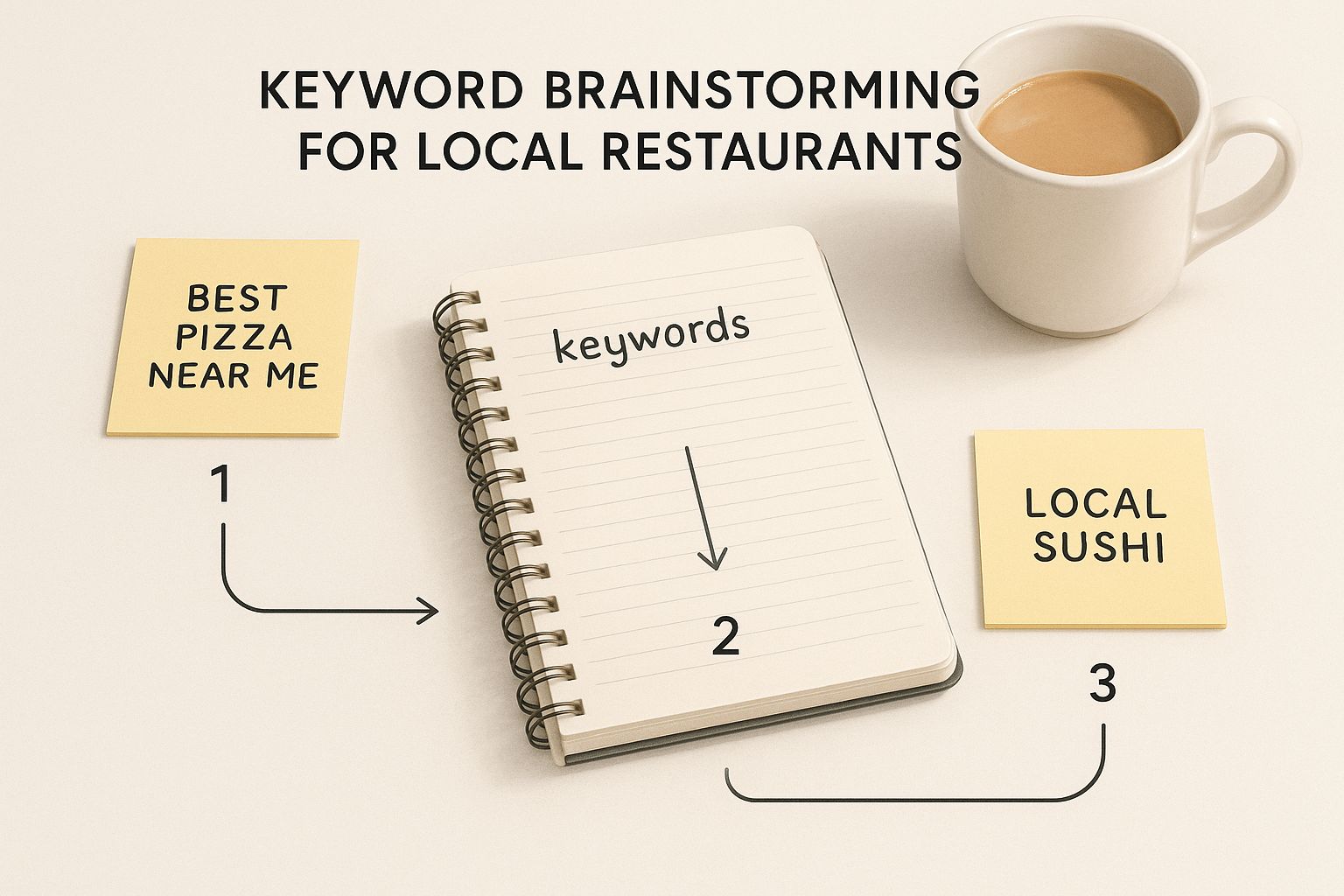
As you can see, search intent varies from broad queries about cuisine to specific searches for a particular dish. This is precisely why a comprehensive, data-driven optimization strategy is non-negotiable.
To help you stay on track, I've developed a checklist of the most critical GBP features and their impact. Think of this as your operational guide to converting a basic profile into a customer-generating powerhouse.
Google Business Profile Optimization Checklist
| GBP Feature | Optimization Tactic | Impact on Growth |
|---|---|---|
| Business Name & Categories | Use your exact legal business name. Select all relevant primary and secondary categories (e.g., "Italian Restaurant," "Pizza Restaurant," "Catering"). | Improves relevance for a wider range of local searches and helps Google understand your core offerings. |
| Address, Phone, Website (NAP) | Ensure 100% accuracy and consistency with your website and other online listings. Use a local phone number. | The foundation of local SEO. Inconsistencies erode your local ranking credibility. |
| Hours of Operation | Keep hours updated meticulously, especially for holidays or special events. Use the "special hours" feature. | Builds trust with customers and prevents negative experiences (and reviews) from showing up to a closed restaurant. |
| Photos & Videos | Upload high-quality, geotagged photos of your food, interior, exterior, and staff regularly. Add short videos if possible. | Drastically increases user engagement, clicks, and emotional connection. Geotagging strengthens local signals. |
| Attributes & Services | Select all applicable attributes (e.g., "Outdoor seating," "Serves cocktails," "Free Wi-Fi"). Detail your specific services or menu items. | Helps you appear in filtered and specific searches, capturing high-intent customers looking for exactly what you offer. |
| Products & Menu | Upload your full menu directly or link to it. Use the "Products" feature to highlight signature dishes with photos and prices. | Makes it easy for customers to make a decision, leading to more calls, clicks for directions, and reservations. |
| Google Posts | Regularly publish posts about daily specials, events, new menu items, or promotions. Use a compelling image and a clear call-to-action. | Signals to Google that your business is active and engaged. Puts timely offers directly in front of searchers. |
| Q&A Section | Proactively ask and answer your own FAQs (parking, reservations, dietary options). Monitor and answer new questions promptly. | Controls the narrative, removes friction for potential customers, and provides another opportunity to include relevant keywords. |
| Reviews | Actively encourage happy customers to leave reviews. Respond to all reviews (positive and negative) professionally and promptly. | Builds social proof and trust. Review volume, velocity, and your responses are major local ranking factors. |
Treating this checklist not as a one-time project but as an ongoing operational process is what separates the restaurants that thrive in local search from those that get left behind.
Keep Your Profile Dynamic with Posts and Q&A
A static profile is a dead profile in Google's algorithm. The system rewards businesses that actively engage with the platform. Two of the most underutilized features are Google Posts and the Q&A section.
Google Posts are effectively mini-billboards that appear directly on your search listing. You should be using them relentlessly to promote:
- Daily specials or a new seasonal menu.
- Upcoming events like live music or a wine tasting.
- Limited-time offers or holiday promotions.
Every post is a fresh signal of activity to Google and a direct communication channel to potential customers at the precise moment they are making a decision.
The Q&A section is your opportunity to preemptively address customer questions and control the narrative. Don't wait for inquiries. Proactively populate this section by asking and answering the most common questions you receive.
- "Do you take reservations for large parties?"
- "Is there dedicated parking nearby?"
- "Do you offer vegetarian or gluten-free options?"
By answering these upfront, you remove friction for a potential customer and showcase excellent service before they even enter your establishment. It also provides a prime location to naturally integrate important keywords related to your offerings.
If managing these operational components feels overwhelming, partnering with a specialized restaurant marketing agency can provide the strategic oversight and execution required. Winning the Map Pack is never an accident; it is the direct result of a deliberate, data-driven, and continuous process of optimization.
Using On-Page SEO to Dominate Local Search
Think of your Google Business Profile as your digital outpost—it’s absolutely critical for discovery. But your website? That's your fortress. It’s the one digital asset you truly own, where you control the narrative, the customer journey, and the conversion funnel without direct competitors present.
I’ve seen too many restaurant groups invest heavily in a pristine GBP listing, only to link it to a website that is slow, confusing, or architecturally outdated. This is a classic operational failure that breaks the customer acquisition chain. On-page SEO is the discipline of structuring your website not just for search engine algorithms, but to convert a curious searcher into a confirmed diner.
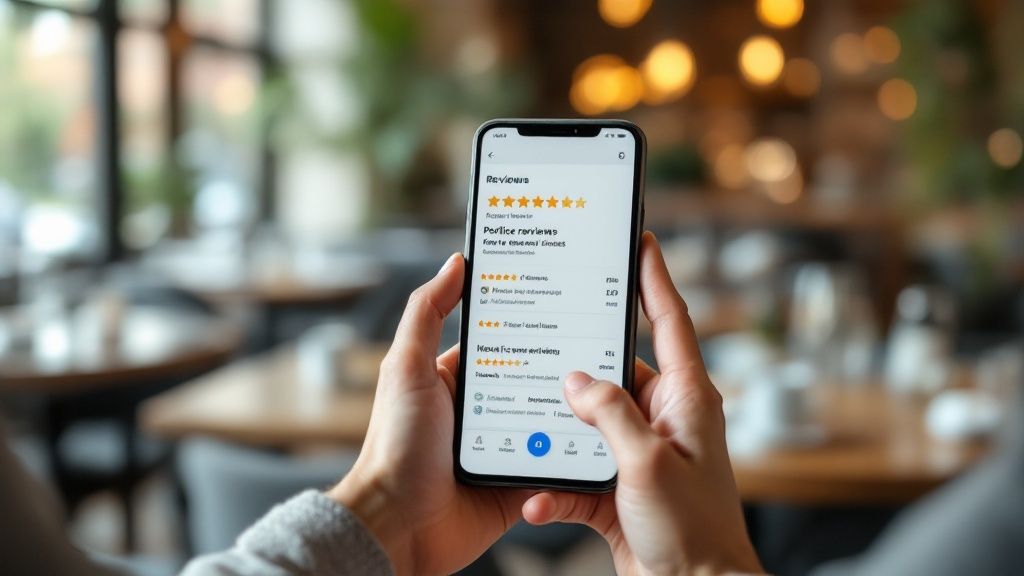
This is about sending unambiguous signals to Google about who you are, where you are, and what you serve. When your website and your GBP operate in concert, you create a powerful feedback loop that solidifies your authority within your local market.
Align Your Website with Diner Intent
First, you must adopt a customer-centric mindset. When a user lands on your site, what information do they require? Almost universally, it's your location, hours, menu, and a frictionless way to book a table or order online. Obscuring this information is a cardinal sin in restaurant marketing.
Your core business details—Name, Address, and Phone Number (NAP)—must be prominently and consistently displayed. I always mandate placing them in the footer of every single page. This serves user convenience and acts as a constant, site-wide signal to Google, reinforcing your location and building algorithmic trust.
Beyond the fundamentals, you must get specific. User search behavior for food has evolved dramatically. They are no longer just typing "restaurants."
Recent data is staggering: hyper-local searches using modifiers like "near me" have surged by 900% in just the last two years. Concurrently, highly specific searches for dishes, such as "hot honey pizza," have jumped 232% year-over-year. This data indicates that diners demand both convenience and unique culinary experiences.
This market shift means your on-page strategy must be equally specific. Generic content no longer delivers results.
Build Hyper-Local Landing Pages for Each Location
If you operate a multi-unit restaurant group, this is the single most potent on-page tactic at your disposal. Many brands make the strategic error of creating a generic website with a simple "locations" page. This is a massive missed opportunity. Market leaders build dedicated, unique landing pages for each and every restaurant location.
Consider each location page as a self-contained hub of local information. It must include:
- Unique Local Content: Do not simply copy and paste. Discuss the neighborhood, introduce the local management team, and articulate what makes that specific location unique.
- Location-Specific Title Tags and Headers: The page title for your Miami location shouldn't be "Our Miami Restaurant." It must be optimized, such as "Authentic Italian Food in Brickell, Miami | [Your Restaurant Name]."
- Embedded Google Map: This provides users with a helpful visual cue and serves as another powerful local signal for search engines.
- Local Testimonials: Feature positive reviews from customers who specifically mention that location to build immediate social proof.
This strategy enables you to rank for neighborhood-specific searches and dominate multiple local markets simultaneously. You are effectively transforming your website from a single entity into a network of locally-focused digital assets.
Use Schema Markup to Speak Google's Language
Schema markup, or structured data, is one of the most effective yet widely underutilized tools in a restaurant's SEO arsenal. It is essentially a specialized vocabulary added to your website's code to explicitly tell search engines what your content is about. You leave nothing to algorithmic chance.
Instead of hoping Google correctly interprets your business hours, cuisine type, and price range, you can use Restaurant schema to spell it out for them.
Here’s why this is a game-changer for growth:
- It Powers Rich Snippets: Schema is what generates those eye-catching search results with star ratings, review counts, and price ranges displayed directly on the search page. This significantly enhances the appeal of your listing and can dramatically boost your click-through rate.
- It Improves Relevancy: By clearly defining your offerings, you help Google match your restaurant to much more specific, high-intent searches.
- It Prepares You for Voice Search: When a user asks a smart device, "Find a moderately priced Thai restaurant near me that's open now," it is schema that feeds the direct, structured answer.
Implementing schema is not as complex as it sounds, and the competitive advantage it provides is immense. This is a perfect example of how technical marketing execution directly supports strategic business goals. A well-executed on-page strategy is a core pillar of any successful https://mgxgrowth.com/blog/digital-marketing-for-restaurants framework, converting your website into a reliable engine for growth.
Building Authority with Local Citations and Backlinks
In local search, Google's algorithm seeks verification. It’s one thing for you to claim you’re the best Italian restaurant in Tampa, but it’s another entirely for Google to see other reputable online entities corroborating that fact. This is where your off-page SEO strategy—citations and backlinks—becomes your most powerful tool for building digital trust and authority.
Think of it this way: citations are your restaurant's digital passport, consistently verifying your name and address across the web. Backlinks, on the other hand, are letters of recommendation from other respected players in your community. A successful growth strategy requires both to build a defensible digital footprint.
Master Your Citations for Foundational Trust
A citation is any online mention of your restaurant's Name, Address, and Phone number (NAP). They appear on business directories, social media profiles, and industry-specific websites. The absolute golden rule here is 100% consistency.
I cannot overstate how many times I've seen a restaurant's local rankings suppressed by a simple data inconsistency, such as one listing using "St." while their Google Business Profile uses "Street." These discrepancies, while seemingly minor, create algorithmic confusion and erode the trust you are trying to build.
Your first operational task is to conduct a citation audit. Google your restaurant’s name and analyze the results. Your objective is to ensure your NAP is identical everywhere.
- Tier 1 Platforms: Ensure you are correctly listed on the major platforms: Yelp, TripAdvisor, Apple Maps, and Bing Places. These are non-negotiable.
- Industry-Specific Hubs: Next, secure listings on platforms actual diners use, like OpenTable, Zomato, or influential local dining guides.
- Data Aggregators: These services syndicate your business information to hundreds of smaller directories. Listing with them ensures wide-reaching consistency.
Remediating inconsistent citations is tedious but essential work. It is analogous to repairing a building's foundation before remodeling the interior. This meticulous attention to detail is what gives top-ranking restaurants their competitive edge.
Acquire High-Value Backlinks That Move the Needle
If citations form the foundation, high-quality backlinks are the steel beams that provide your website with real authority. A backlink is simply a link from another website to yours. Google interprets these as votes of confidence, but not all votes are weighted equally. A single link from a well-regarded local food blogger is exponentially more valuable than a hundred links from generic, low-quality directories.
This is a game of quality and local relevance, not quantity. Forget outdated, spammy link-building tactics. The objective is to earn links by becoming an integral part of your local community.
From my experience, the backlinks that actually drive meaningful results stem from real-world relationships, not transactions. It's about integrating your online and offline activities. Sponsoring a local charity event is not just good corporate citizenship—it's a perfect opportunity to earn a powerful, relevant backlink from the event's website.
Here are a few strategies that I’ve seen deliver exceptional ROI for restaurants:
- Engage Local Food Bloggers: Identify influential food writers in your city. Don't just send a cold email asking for a review. Invite them for a complimentary dining experience to initiate a genuine relationship. If they value your product, a feature on their blog—with a link back to your site—becomes a natural outcome.
- Sponsor Community Events: Integrate your brand into the local fabric. Local festivals, school fundraisers, and neighborhood sports teams constantly seek sponsors. This often includes a placement on their website's sponsor page, complete with a valuable local backlink.
- Host Your Own Events: A wine-tasting night, a guest chef collaboration, or a cooking class can generate significant local buzz. Promote it effectively, and you will naturally attract links from local event calendars and news outlets.
- Join Local Business Associations: Membership in your local Chamber of Commerce or a downtown business alliance typically includes a listing in their online directory, which almost always provides a link to your website.
Building this network of citations and backlinks is a long-term strategic investment in your restaurant's digital authority. It pays dividends for years and creates a sustainable competitive advantage that cannot be easily replicated.
How to Turn Online Reviews Into Your Best Marketing Tool
Reviews are not a passive byproduct of running a restaurant; they are one of your most potent growth engines. I’ve seen countless operators obsess over menu engineering but treat customer feedback as a reactive, administrative chore. This is a fundamental strategic error. Your reviews are one of the most powerful signals you can send to both Google and your next potential customer.
This extends far beyond simple reputation management. A steady stream of authentic reviews signals to Google that your restaurant is active, relevant, and a trusted part of the local community. It is powerful social proof and a significant factor in climbing local search rankings.
Build a System for Generating Authentic Reviews
Hoping for reviews to appear is not a strategy. The most effective operators I know implement a simple system to actively encourage feedback. The key is to do so without ever crossing the line into incentivizing reviews, which violates platform policies and erodes consumer trust.
The objective is to make it frictionless for happy customers to share their positive experience at the peak of their satisfaction.
How do you execute this? You integrate the "ask" seamlessly into your service flow.
- Timing is Everything: Train your front-of-house staff to identify satisfied guests. When a customer is praising a dish, that is the opportune moment. A simple, "I'm so glad you enjoyed it! It would mean the world to our kitchen team if you shared that on Google" feels authentic and is incredibly effective.
- Remove Friction: Place a QR code on your receipts or table tents that links directly to your Google review page. This is critical. No one wants to go home, remember to search for your business, find the correct page, and then write a review. A QR code enables them to do it in 30 seconds while still at the table.
- The Gentle Follow-Up: If you use a reservation or online ordering system like Toast or OpenTable, configure a simple, automated email. A message sent the following day, thanking them for their visit and including a review link, can be highly effective.
This is not about being aggressive. It’s about recognizing that most satisfied customers are willing to leave a review; they simply require a convenient, low-friction prompt.
Turn Negative Feedback into a Positive Asset
Every operator experiences the sting of a one-star review. However, I have learned to view them as a strategic opportunity. A negative review provides a public forum to demonstrate your commitment to exceptional service. Handled correctly, one resolved complaint can build more trust than a dozen glowing five-star ratings.
Ignoring negative feedback is the worst possible action. Becoming defensive is a close second. What you need is a calm, professional, and repeatable process. The mission is to acknowledge their sentiment, demonstrate empathy, and immediately offer to move the conversation offline to resolve the issue.
My rule is simple: Always respond, always be professional, and always show you care. Remember, data shows that 68% of diners have tried a new restaurant based on positive online reviews. Your public responses to negative reviews are a huge part of that equation, showing potential customers how you operate when things aren't perfect.
Here is the exact framework I've implemented to turn negative feedback into public relations wins.
A structured approach to review responses is a game-changer. It prevents emotional, in-the-moment replies and ensures your brand always appears professional and in control.
Review Response Strategy Matrix
| Review Type | Key Objective | Core Response Elements | Example Snippet |
|---|---|---|---|
| Glowing Positive (5-Star) | Amplify and appreciate | Thank them by name, mention a specific detail from their review, and invite them back. | "Thanks so much, Sarah! We're thrilled you loved the short rib risotto. The team works hard on that dish, and we can't wait to see you again soon!" |
| Vague Positive (4-Star) | Encourage specifics | Thank them for the feedback, express happiness they had a good experience, and gently probe for more details. | "Thank you for the four-star review! We're glad you had a great time with us. We'd love to know what we could do to make it a five-star experience next time." |
| Constructive Negative | Show you're listening | Acknowledge their specific issue, apologize sincerely, and offer to make it right offline. | "We're so sorry to hear the service was slower than usual. That's not our standard, and we'd appreciate the chance to learn more. Please email our manager at…" |
| Angry or Unfair Negative | De-escalate and control | Stay professional, acknowledge their frustration without accepting blame if it's unfair, and move the conversation offline immediately. | "We're very sorry to read about your frustrating experience. We take feedback like this seriously. Please contact us directly so we can address your concerns properly." |
By operationalizing this matrix, you transform every piece of feedback—good, bad, or neutral—into a marketing opportunity that demonstrates an unwavering commitment to your customers.
Your Top Restaurant SEO Questions, Answered
I’ve spent countless hours in boardrooms and on-site with restaurant owners, from passionate single-location entrepreneurs to marketing executives managing large franchise portfolios. The operational intensity of running a restaurant is immense, and when we shift the conversation to local SEO, the same strategic questions consistently arise.
Let's dispense with the jargon and focus on the practical, data-driven answers I've distilled from decades in the trenches. This is the essential information you need to drive more customers through your door.
How Long Until I See Real Results?
This is always the first question, driven by the need for ROI. While you can achieve some quick wins—a well-optimized Google Business Profile can increase calls and direction requests within weeks—real, sustainable growth requires patience.
From my experience, you should forecast a 4-6 month timeline to see a significant, measurable impact on traffic and bookings. Think of it less as flipping a switch and more like building a valuable asset. You are systematically earning trust with Google through consistent business listings, a steady velocity of new reviews, and high-quality local links. It takes time, but the result is a defensible competitive advantage that cannot be replicated overnight.
Which Is More Important: My Website or My Google Business Profile?
This is a frequent question, but it presents a false dichotomy. Asking whether your website or your Google Business Profile (GBP) is more important is like asking if a car's engine is more important than its wheels. You need both, operating in perfect synergy.
- Your GBP is your handshake. It is the primary discovery tool for new, local customers, particularly when they encounter you in the Google Map Pack.
- Your website is your conversation. This is your owned platform to tell your brand story, showcase your full menu, convey your restaurant's ambiance, and secure the conversion by facilitating a reservation.
Neglecting one breaks the entire system. A fantastic GBP that links to a slow, confusing website will lose the customer. Similarly, a beautiful website that is undiscoverable due to a weak GBP is a wasted investment. They must be strategically aligned.
How Do I Know if This Is Actually Working?
Gut feelings don't drive EBITDA growth—data does. To measure the efficacy of your SEO initiatives, you must connect marketing metrics to real-world business outcomes. We don't chase vanity metrics like "impressions." We focus on KPIs that directly impact revenue.
The KPIs that matter are non-negotiable. We must see a clear month-over-month increase in direct and discovery searches in your GBP Insights, a steady climb in organic traffic to your website, and a measurable increase in phone calls originating directly from your Google listing.
Ultimately, the goal is a quantifiable lift in online reservations and foot traffic that can be directly attributed to your SEO investment. You must be able to draw a straight line from ranking higher for "best tacos in [your neighborhood]" to the number of covers you seat on a Tuesday night. That is the only valid proof of performance.
My Budget Is Tight. Where Do I Start?
For any operator managing tight margins, this is the critical question. If you have limited resources, allocate every available ounce of effort to your Google Business Profile. It delivers the highest ROI, bar none.
A meticulously completed and actively managed GBP is the absolute bedrock of local search. Populate every single section. Upload high-quality, geotagged photos weekly. Use Google Posts to announce specials and updates. Then, operationalize a simple process for your team to encourage and respond to customer reviews. These actions require time, not capital, and they directly influence whether a hungry customer discovers you at the exact moment of purchase intent. Master this first, then scale your efforts.
At MGXGrowth, our sole focus is transforming complex growth challenges into straightforward, actionable plans that deliver measurable results. If you’re ready to build a true growth engine for your restaurant, let’s connect. You can find us at https://www.mgxgrowth.com.
