


In my decades driving growth across SaaS, hospitality, and real estate, I’ve learned to distinguish between fleeting trends and fundamental market shifts. We are in the midst of the latter. The luxury market is undergoing a seismic pivot from one-size-fits-all service to predictive, hyper-individualized engagement.
At the epicenter of this transformation are hyper-personalized travel concierge systems. These aren't just tools for reacting to client requests; they are sophisticated engines of growth, leveraging data and AI to anticipate needs before they are even articulated.
The New Baseline for Luxury Travel
For years, the pinnacle of luxury travel was defined by high-touch, reactive service. A client would make a request, and a skilled agent would execute. This model, while effective in its time, is no longer sufficient to secure enduring loyalty from today's high-net-worth individuals. The strategic imperative has shifted from fulfilling requests to predicting desires.
This is precisely the operational gap that hyper-personalized travel concierge systems are designed to fill. I don't view them as mere software; I see them as a strategic asset for market capture. They are complex ecosystems architected to develop an almost precognitive understanding of your clientele.
At its core, this technology breaks down the silos between a client's historical behavior and their future intent. It’s about connecting disparate data points to engineer a travel experience so seamless and intuitive it feels like a strategic advantage—because it is.
From Reactive Service to Predictive Growth
The transition from a traditional reactive model to a hyper-personalized, predictive one unlocks substantial enterprise value. The focus shifts from optimizing single transactions to cultivating high-margin, long-term relationships. The key lies in leveraging data to inform every interaction, ensuring each touchpoint is not just personalized, but strategically relevant. This mindset is foundational for any executive serious about elevating the luxury resort guest experience with automation and driving repeat business.
This shift is validated by market data. The demand for these advanced services is accelerating. The global luxury travel concierge market, valued at USD 759.15 million in 2024, is projected to reach USD 1,207.43 million by 2032. This isn't just a function of novel technology; it's a direct response to a client base that now demands—and is willing to pay a premium for—true personalization. For those who, like me, are data-driven, the full market analysis from 360iResearch is worth a deep dive.
Deconstructing the Hyper-Personalization Engine
To truly grasp the strategic power of hyper-personalized travel concierge systems, one must look under the hood. In my experience, the most effective growth strategies are never about a single piece of software; they are about architecting an integrated ecosystem. This principle holds true here.
The correct analogy isn't buying a suit off the rack; it's commissioning a bespoke garment from a master tailor. Every component is engineered to work in concert, creating a perfectly fitted experience for each traveler.
This entire ecosystem is built on four distinct yet deeply interconnected pillars. Each pillar executes a critical function, converting raw data into the kind of predictive service that builds loyalty and drives revenue. A weakness in one pillar compromises the integrity of the entire structure.
The Four Pillars of Anticipatory Service
Let's dissect how this engine is architected, piece by piece.
H3: The Data Foundation
Everything begins with a robust Data Foundation. This is far more than a simple CRM; it’s a dynamic, 360-degree view of your client. We're talking about the systematic capture of every touchpoint: travel history, stated preferences, in-trip purchases, dining choices, and post-trip feedback.
Disciplined data aggregation is the first step in moving beyond superficial segmentation. For organizations whose current approach feels shallow, a deep dive into advanced customer segmentation strategies can be transformative.
H3: The AI Core
Next is the AI Core—the central nervous system of the operation. This is where machine learning algorithms process the aggregated data to identify patterns and, crucially, predict a traveler's future desires. It is engineered to answer questions like, "Based on her last three trips to Italy and recent dining habits, what specific private cooking class is she likely to value for her upcoming anniversary trip… before she even thinks to request it?"
This is the component that transforms a repository of historical data into a potent, forward-looking strategic asset.
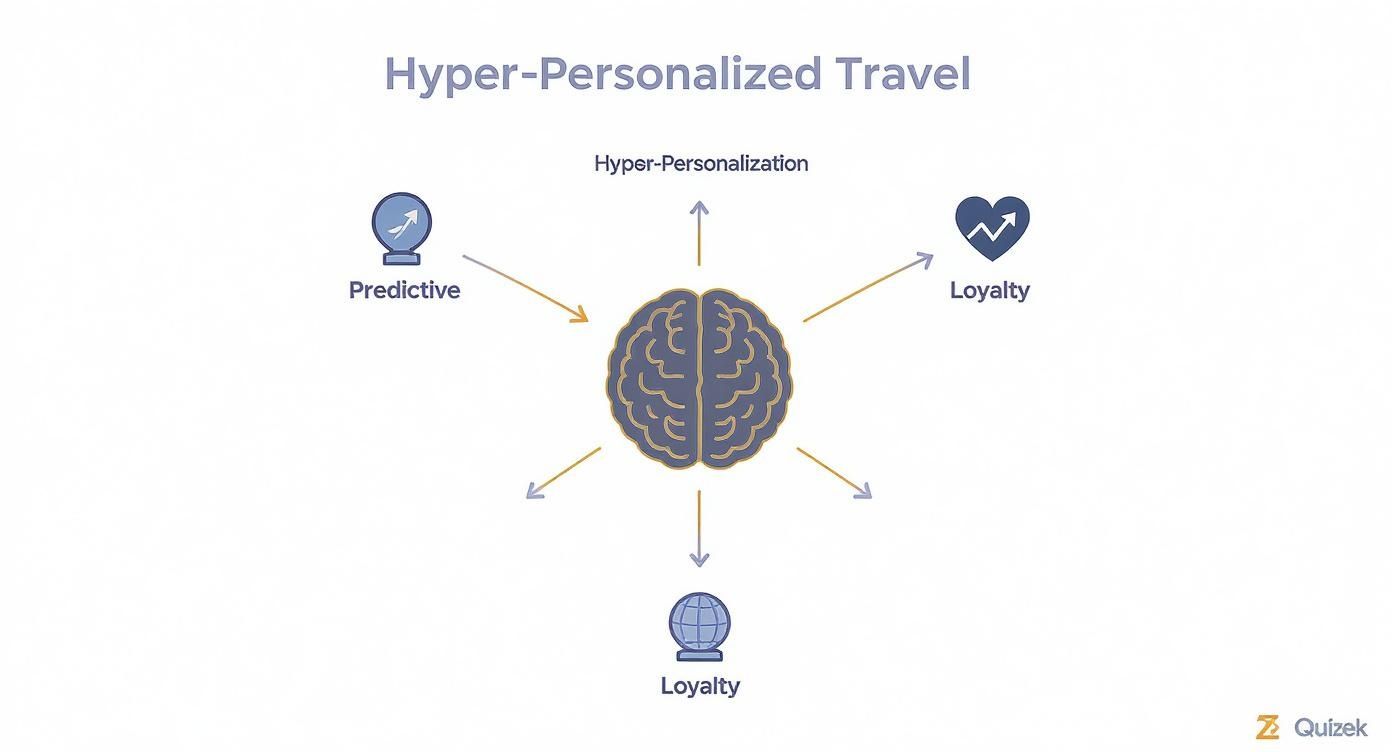
As this model illustrates, the ability to anticipate traveler needs directly feeds a virtuous cycle of customer loyalty and business growth, creating a powerful, self-sustaining loop.
Translating Insights Into Action
Once the AI Core generates its predictive insights, the system must translate them into tangible actions.
H3: The Dynamic Itinerary Builder
This is where the Dynamic Itinerary Builder comes into play. This component leverages the AI's predictions to construct bespoke travel plans in real-time. It moves beyond booking flights and hotels to orchestrating exclusive activities and experiences that align perfectly with the client’s unique profile.
Consider the commercial impact. It’s the difference between presenting a client with an overwhelming list of 100 hotel options versus a curated selection of the three properties you know will resonate most deeply.
H3: The Omni-Channel Interface
Finally, the Omni-Channel Interface ensures the entire experience is frictionless for the traveler. Whether the client interacts via a mobile app, a web portal, or a human concierge, the context and continuity of the conversation are perfectly maintained.
The system guarantees that every channel operates with the same deep, nuanced understanding of the client. This eliminates the operational friction of forcing clients to repeat their preferences across different touchpoints.
Here is a summary of how these components integrate.
Core Components of a Hyper-Personalized System
A breakdown of the essential technological pillars and their strategic functions in creating tailored travel experiences.
| Component | Function | Business Impact |
|---|---|---|
| Data Foundation | Aggregates all client data (behavioral, transactional, preferential) into a single, unified profile. | Provides the raw material for accurate personalization, moving beyond generic segmentation. |
| AI Core | Uses machine learning to analyze data, identify patterns, and predict future client needs and desires. | Transforms historical data into predictive insights, enabling proactive, high-margin service. |
| Dynamic Itinerary Builder | Constructs real-time, personalized travel plans and recommendations based on AI-driven insights. | Increases conversion rates by presenting highly relevant, curated options instead of generic lists. |
| Omni-Channel Interface | Delivers a consistent, personalized experience across all touchpoints (app, web, human agent). | Boosts customer satisfaction and loyalty by eliminating friction and demonstrating institutional knowledge. |
When all four pillars operate in harmony, they create a formidable engine that not only delights customers but drives sustainable, profitable growth for the business.
The Business Case for Anticipatory Service
In my experience, any strategy worth executing must deliver a clear, measurable impact on the bottom line. Talk is cheap; EBITDA and market share are the metrics that matter. Hyper-personalized concierge systems are a prime example of a strategy that delivers real, quantifiable outcomes far beyond "customer delight."
This is about building a more profitable, more defensible business. When you transition from reacting to customer requests to anticipating them, you fundamentally alter your unit economics. It’s a direct lever for increasing revenue, improving margins, and capturing market share from competitors still operating under the old paradigm.
Driving Tangible Financial Outcomes
The link between predictive service and financial performance is not theoretical. I have seen it drive results firsthand. Let's be specific and break down the four key areas where these systems generate significant enterprise value.
- Dramatically Increase Customer Lifetime Value (CLV): True loyalty is not secured through points programs. It is earned through the consistent delivery of superior experiences. When you anticipate a client's needs, your service becomes so intuitive that switching to a competitor feels like a significant downgrade in value. This is the mechanism for driving retention and converting transactional relationships into reliable, recurring revenue streams.
- Boost Average Spend Per Trip: Intelligent upselling is not about pushing generic add-ons. It's about presenting the right high-margin offer at the optimal moment. A personalized system understands that a generic spa package is irrelevant to a known oenophile, but a private, curated vineyard tour is a high-conversion opportunity. This level of relevance leads to higher-margin sales and can increase in-stay spend by 20% or more.
This isn't an operational tweak. It’s about building a powerful brand moat that competitors cannot easily cross. True personalization, delivered at scale, becomes your most potent competitive weapon.
Building an Unbeatable Market Position
Beyond immediate financial returns, the long-term strategic impact is where the real value lies. These systems create operational efficiencies and a brand identity that are exceptionally difficult for competitors to replicate.
First, you unlock significant operational efficiencies. By automating the complex, time-consuming aspects of planning and pre-empting requests, you empower your human experts to focus on what they do best: relationship management and handling unique, high-value tasks. This directly improves your margins and enables you to scale revenue without a linear increase in headcount.
Second, and most importantly, you create a powerful barrier to entry. While competitors are busy reacting to market trends, you are building deep, data-driven relationships that are incredibly sticky. This model of anticipatory service becomes ingrained in your brand's DNA—a promise of effortless, intuitive luxury that solidifies your position as a market leader. This is how you win not just for the next quarter, but for the next decade.
How AI and Mobile Platforms Forge Market Leaders
In every industry I’ve operated in—from SaaS to high-end hospitality—I've observed a consistent pattern: market leadership is not just about a superior product. It's about possessing the technological infrastructure to deliver that product at scale. For hyper-personalized travel concierge systems, the two pillars supporting the entire edifice are AI-powered intelligence and mobile-first platforms. These are not features; they are the engine room of the entire operation.

Too many executives still view AI as a sophisticated chatbot. This is a critical strategic blind spot. In this context, AI is a digital strategist, perpetually analyzing vast datasets to enable proactive, anticipatory service. It's about correlating a client's past travel behavior with real-time signals—such as a social media mention or a calendar event—to surface suggestions they will value before they've even formulated the need.
This is the difference between asking, "Where would you like to have dinner?" and stating, "I've secured a table for you at that new restaurant that just received a stellar review for its farm-to-table concept—I know it aligns perfectly with your culinary preferences." The former is reactive service. The latter is the application of intelligence that defines a market leader.
The Non-Negotiable Mobile Experience
The other critical component is the mobile platform. Your most valuable clients operate on their mobile devices. A clunky or disjointed digital experience is not merely an inconvenience; it's a brand signal that you are out of touch with their reality. A seamless, intuitive mobile application is no longer a "nice-to-have"; it is table stakes.
A well-architected mobile platform does more than present information. It becomes the primary conduit for the entire hyper-personalized experience, delivering:
- Real-time updates on itinerary adjustments or emergent opportunities.
- Direct, frictionless communication with human or AI-powered concierges.
- Proactive alerts and suggestions triggered by geolocation and known preferences.
The most successful growth strategies I've implemented have always centered on removing friction. In the high-end travel sector, the mobile device is the ultimate friction-remover, placing a world of curated, personalized service directly into the client’s hand.
Integrating Tech to Dominate the Market
It is the synthesis of AI and mobile that creates an unassailable market position. This powerful combination has fundamentally reshaped the luxury concierge market, making highly tailored travel both more accessible for clients and more efficient for providers to deliver.
The data confirms this trend. By 2025, the global luxury concierge service market is projected to reach US$ 681.6 million. The online segment of this market is forecasted to capture nearly 80% of the share. This seismic shift underscores the demand for digital platforms that offer instantaneous, seamless interaction. You can explore the data on the future of the luxury concierge market to understand the full scope.
Ultimately, any company serious about leading this space must master this integration. The strategy is not about choosing AI or mobile; it is about architecting a unified system where intelligent, data-driven insights are delivered through a flawless, on-the-go digital experience. That is the formula for building a durable competitive advantage.
A Practical Roadmap for Implementation
A strategy is merely a hypothesis until it's executed. Over my career, I've seen countless brilliant plans fail, not due to flawed logic, but due to chaotic implementation. The rollout of a hyper-personalized travel concierge system is no different—it requires a methodical, phased approach that is fundamentally a business transformation initiative, not just a technology project.
Too many leaders are seduced by the technology and neglect the organizational change management required. The most common point of failure I've witnessed is a lack of alignment across functional silos. Marketing owns its data, operations has its own, and the two systems rarely communicate effectively. The work must begin there.
Phase 1: Build Your Data Foundation
Before you can even contemplate AI, you must get your data infrastructure in order. This initial phase is the most critical and is entirely focused on creating a single, unified view of the customer. It requires breaking down the technological and cultural walls between your systems.
The objective is to architect a foundation where every piece of client information—from booking history and in-stay preferences to every marketing interaction—flows into one central, accessible repository. Without this single source of truth, your AI will operate on incomplete data, and its predictive capabilities will be severely compromised.
Phase 2: Select Your AI Engine
With a solid data infrastructure in place, you can then evaluate the AI engine itself. This presents the classic "build versus buy" decision, and there is no universal right answer. The optimal path depends on your organization's scale and technical maturity.
- For most businesses, partnering with a specialized AI provider is the more strategic choice. It accelerates time-to-market, is more cost-effective, and provides access to proven models without the need to build an expensive in-house data science team.
- For larger enterprises with significant resources, developing a proprietary in-house solution may offer a long-term competitive advantage, but it requires a substantial commitment to R&D and talent acquisition.
The key is to select the path that enables rapid execution while aligning with your long-term growth ambitions.
Phase 3: Integrate People and Technology
This final phase is where many initiatives falter. You cannot simply deploy new software and expect transformational results. This step is about thoughtfully integrating the technology with your human service teams, positioning it as a tool that enhances their expertise, not one that threatens to replace them.
The objective is a seamless partnership. The technology handles the predictive analysis and automation, freeing your human concierges to focus on relationship-building and managing the nuanced, high-touch moments that a machine cannot replicate.
This requires rigorous training, clear communication, and a commitment to redesigning legacy workflows. Your team must view the system as an indispensable ally that empowers them to deliver unparalleled service. When you achieve this fusion of human insight and machine intelligence, you create an unbeatable customer experience and unlock the promised growth.
Real-World Examples of Market Dominance
Theory is useful, but as a growth strategist, I focus on results. The ultimate validation of any strategy is its performance in the market, delivering outcomes that leave competitors struggling to adapt. In the realm of hyper-personalized travel concierge systems, the brands that are winning are not just adding new technology. They are fundamentally re-architecting the client relationship around a data-centric core.
Let's dissect what this looks like in practice. This is not about abstract case studies; it's about understanding the mechanics of their market dominance.
Aman Resorts: The Art of the In-Stay Experience
Aman Resorts has mastered the art of discreet, anticipatory service. Technology, though often invisible to the guest, is a critical enabler of this experience. They utilize smart devices and AI-driven systems not as overt features, but as silent enablers that gather preference data throughout a guest's stay.
This allows for the seamless personalization of everything from room ambiance to dinner wine suggestions, all delivered without intrusion.

The result is an experience so intuitive it feels as if the resort inherently understands the guest. This creates a powerful competitive moat. Once a guest experiences this level of personal recognition, a standard luxury hotel feels impersonal and commoditized by comparison.
The strategic goal is not just to meet expectations, but to create a new standard of personal recognition that becomes synonymous with the brand itself. This is how you build unshakeable loyalty and justify premium pricing.
Exclusive Access Fueled by Data
Beyond the property, top-tier concierge services are leveraging data analytics to secure the inaccessible. By analyzing a client's travel history, stated interests, and even their social graph, these systems can predict which exclusive event—a sold-out concert, a private gallery viewing—will have the greatest impact.
This proactive approach transforms the value proposition. The concierge evolves from a reactive order-taker into a trusted curator of unique life experiences.
This is a high-growth, high-margin market segment. The global VIP travel management market is projected to reach USD 96,038.8 million by 2032, driven largely by demand from high-net-worth individuals. You can analyze more data on the VIP travel solutions market to appreciate the scale of this opportunity.
The same principles are being applied across the luxury sector, including private aviation. For a deeper analysis of that vertical, see our guide on implementing an AI concierge for jet charter clients.
Ultimately, these examples all reinforce the same strategic truth: durable market dominance is achieved by using data to deliver something competitors cannot easily replicate—the profound feeling of being completely understood.
Common Questions on Hyper-Personalization Strategy
As a growth strategist, I have participated in countless executive sessions. When the discussion turns to hyper-personalized travel concierge systems, the same set of insightful, pragmatic questions inevitably arise. Here is how I address them, based on years of implementing these systems in the real world.
What Is the Single Biggest Obstacle to Implementation?
It is almost never the technology. The primary challenge is organizational. The most significant roadblock I consistently encounter is the difficulty of breaking down the data silos that exist between functional departments.
To achieve a true 360-degree view of a traveler, you require seamless data flow between marketing, sales, and operations. If marketing has data indicating a client's preference for boutique hotels, but that data is not accessible to the sales or service teams, the system fails to deliver on its promise.
This is where decisive leadership is non-negotiable. An executive champion must drive a customer-centric culture and secure the investment needed for an integrated data architecture. Without this, you are merely layering expensive software on top of a dysfunctional foundation.
How Do We Measure the ROI of This Initiative?
You must look beyond initial booking revenue. The true value is deeper and accrues over time. The key performance indicators I always track are:
- Customer Lifetime Value (CLV): Are your high-value clients increasing their spend and engagement over the entire duration of their relationship with your brand? This metric must be trending upward.
- Average Revenue Per User (ARPU): The system should be surfacing relevant, high-margin upsell opportunities that increase the value of each client engagement.
- Net Promoter Score (NPS): This is a direct measure of customer satisfaction and your ability to create brand advocates.
- Customer Retention Rate: This is the ultimate litmus test. Are your best customers returning? High retention is proof of a sticky, high-value service.
Do not neglect to measure operational efficiency gains as well. Track the reduction in time your human concierge team spends on manual, repetitive planning tasks.
Can smaller luxury travel agencies genuinely compete with larger players in this domain? Absolutely. Large corporations have scale and budget, but smaller firms possess a critical asset: agility and an inherent capacity for high-touch service.
The strategy is not about outspending the competition; it's about being more intelligent. Focus on a specific luxury niche that you can dominate. Instead of building a massive, proprietary tech stack, leverage powerful third-party AI platforms. A boutique agency can fuse its intimate client knowledge with this technology to deliver a level of personalization that larger, more bureaucratic competitors cannot easily replicate at scale.
At MGXGrowth, this is precisely our focus—we architect AI-powered growth strategies that deliver measurable results. We help businesses break down internal silos, align technology with strategic objectives, and drive quantifiable gains in revenue and market share. If you are ready to build a durable competitive advantage, you can learn more about our approach.
