


When you search for "restaurant marketing services near me," you're not just looking for a social media manager. You're looking for a growth partner who can engineer a reliable system for driving foot traffic and online orders. My entire career has been built on one principle: transforming marketing from a cost center into a direct investment in your bottom line.
Why Smart Marketing Is Your Restaurant's Decisive Edge
Across every industry I've operated in—from SaaS to hospitality—one truth is constant: a superior product does not sell itself. Your phenomenal food and exceptional service are merely the price of entry in today's hyper-competitive market; they are not your strategic differentiators.
Sustainable growth is never an accident. It is the direct result of a deliberate, data-driven system engineered to acquire new customers and increase the lifetime value of your existing ones. This is the operational difference between restaurants that are perpetually booked and those grappling with empty tables on a Tuesday.
The New Battlefield for Diners
Analyze the modern diner's decision-making process. It begins, almost invariably, on a mobile device. They search, they vet reviews, they scrutinize your social media, and they assess the friction in your booking or ordering process. Digital invisibility is the modern equivalent of operating a premier restaurant with no sign and a locked door.
Effective marketing integrates these touchpoints into a cohesive system that drives tangible business outcomes. For a restaurateur, this means focusing on a core set of objectives:
- Increased Seating Utilization: Driving foot traffic, particularly during off-peak hours.
- Optimized Online Revenue Streams: Transforming your website and delivery apps into high-margin channels.
- Enhanced Customer Loyalty: Forging a connection that increases visit frequency and average spend.
Navigating a Booming but Brutal Market
The market opportunity is substantial. The global foodservice sector reached $3.09 trillion in 2024 and is projected to exceed $4.1 trillion by 2033. However, this growth masks a harsh reality. For the average restaurant, net profit margins are razor-thin, often hovering between 3% and 5%.
This leaves zero tolerance for inefficient marketing spend. A deeper dive into these restaurant industry statistics highlights the intensity of the competitive landscape.
As a growth strategist, I don't view marketing as a creative function. I view it as a revenue-generation engine. Every dollar deployed must be directly attributable to a measurable outcome—a new reservation, a delivery order, a repeat visit.
This guide will bypass the standard marketing platitudes and provide a clear framework for selecting services that directly contribute to revenue growth. We will deconstruct the essential strategies required to build a system that doesn't just generate fleeting buzz, but methodically builds your brand equity and your EBITDA.
Understanding Your Modern Marketing Toolkit
The modern customer journey to your restaurant is a non-linear, multi-touchpoint process. It initiates with a mobile search, meanders through social feeds and review platforms, and—if your system is optimized correctly—culminates in a reservation or an online order.
Winning in this environment requires an integrated marketing system, not a series of disconnected tactical executions.
Consider the analogy of a professional kitchen. You wouldn't hire a chef skilled only at the grill station. You require a leader who understands how every component—from sauté to pastry—contributes to the final product. The same principle applies to your marketing. You need a full suite of tools, each deployed with a specific, revenue-focused objective.
This visual breaks down the tangible business benefits of a well-executed, localized marketing strategy.
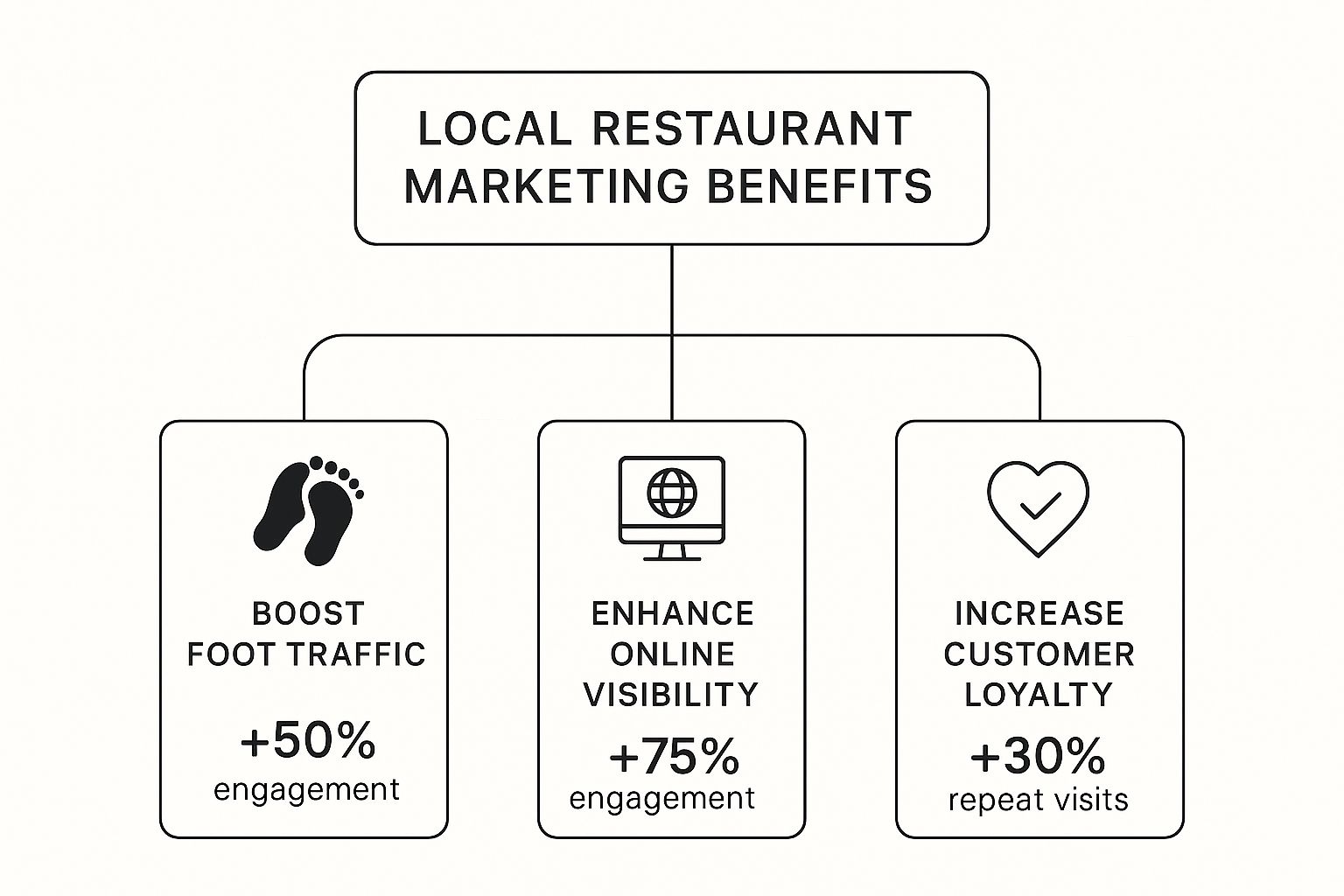
As illustrated, these are not abstract metrics. They translate directly into increased foot traffic, superior online engagement, and—the ultimate objective—a higher rate of repeat business.
The Core Parts of Your Restaurant's Growth Engine
What are these essential services? Let's move beyond jargon and focus on the specific business problem each component solves. When evaluating restaurant marketing services near you, these are the outcomes you should be demanding.
-
Local Search Engine Optimization (SEO): This is the foundation. When a potential customer searches "best tacos near me," Local SEO is the mechanism that ensures your restaurant appears in the top search results. It solves the critical problem of invisibility to high-intent customers in your immediate vicinity.
-
Paid Digital Advertising (PPC & Social Ads): This is your precision targeting tool. It allows you to intercept specific audience segments, such as individuals within a 3-mile radius actively searching for "brunch spots this weekend." You are purchasing attention at the precise moment of purchase intent.
-
Social Media Management: This is where your brand's narrative is built and validated. It is your community hub, solving the problem of establishing trust and "social proof" long before a diner considers making a reservation. Customers use Instagram not just to view food, but to validate their dining decision.
-
Website & Online Ordering System: This is your digital storefront and point-of-sale system, integrated into one. A high-friction website or a clunky ordering process directly causes revenue leakage. An optimized system solves for lost sales by making it frictionless for customers to transact with you.
From my experience, the most significant error restaurant owners make is viewing these services in silos. A brilliant social media campaign driving traffic to a non-functional website is a catastrophic waste of capital. A top search ranking is worthless if it leads to poor photography and outdated reviews. Growth is ignited by the synergistic integration of these components.
Connecting Services to Your Bottom Line
To be more precise, let's map these marketing activities directly to the financial metrics that matter. This is how you bridge the gap between marketing execution and P&L impact.
The following table illustrates how specific marketing services solve distinct problems and drive tangible, revenue-focused outcomes.
Key Restaurant Marketing Services and Their Business Impact
| Marketing Service | What It Solves | Key Performance Indicator (KPI) | Direct Business Impact |
|---|---|---|---|
| Local SEO | Invisibility to high-intent local customers | Google Maps Ranking, "Near Me" Searches | Increased Walk-Ins & Reservation Calls |
| Social Media | Lack of brand trust & community engagement | Engagement Rate, User-Generated Content | Higher Reservation Volume & Brand Recall |
| Paid Ads | Inconsistent customer traffic patterns | Return on Ad Spend (ROAS) | Predictable Revenue & Off-Peak Traffic |
| Website/Ordering | High friction in the conversion funnel | Conversion Rate, Cart Abandonment | Increased Online Order Profitability |
Mastering this framework is non-negotiable. It enables a strategic shift from merely "buying marketing services" to investing in a growth system engineered for your restaurant. Every component must operate in concert to guide a potential diner seamlessly from initial discovery to final purchase.
For a more granular analysis, our guide on digital marketing for restaurants provides a comprehensive blueprint for architecting this type of integrated strategy. Consider it your first step toward transforming your marketing into a predictable revenue driver.
Mastering Your Digital Reputation and Social Proof

After years of scaling businesses, I've learned a critical truth: your most powerful marketing assets are often the ones you don't directly control. For your restaurant, nothing is more influential than your digital reputation—the synthesis of online reviews and your social media presence. This is your modern-day storefront, and your reviews are your most persuasive, unpaid sales force.
It's a common mistake to believe that posting aesthetically pleasing food photos is sufficient. It is not. True success requires a systematic approach to building trust and what we call social proof—the psychological principle that people conform to the actions of others. A restaurant with high engagement and a flood of positive reviews signals to potential customers that it is a safe, validated, and rewarding choice.
This is no longer a peripheral activity. The data is unequivocal: 72% of people leverage social media when researching restaurants, and a staggering 74% of diners finalize their decision based on what they find there. Furthermore, 88% of diners trust online reviews as much as a personal recommendation. To grasp the full impact of social media on dining choices, review the latest statistics on CropInk.com.
Turning Social Media into a Customer Magnet
Platforms like Instagram and TikTok have transcended their origins as simple photo repositories. They are now essential discovery and validation engines. Before a customer contemplates a reservation, they are using these platforms to answer critical questions: What is the ambiance? Is this appropriate for a casual dinner or a major celebration? Crucially, what is the public sentiment?
Your social media must function as a living, dynamic extension of your restaurant. This is achieved by focusing on three key areas:
- Go Beyond the Plate: Cease the endless procession of static food photography. Showcase the energy of your kitchen, introduce your high-performing team, and narrate the story of your ingredient sourcing. Short-form video is the dominant medium here—it is the most effective tool for capturing and conveying your restaurant's true atmosphere.
- Leverage Your Customers as Advocates: Your most satisfied guests are your most effective marketers. Actively incentivize them to tag your restaurant and systematize the process of resharing their content. This user-generated content (UGC) is the most authentic and potent form of social proof available.
- Build a Tangible Community: Social media is a conversational channel, not a broadcast medium. Responding to comments and messages demonstrates attentiveness and care. This fosters a loyal community that feels a genuine connection to your brand, moving beyond a simple follower count.
I’ve observed countless teams become fixated on vanity metrics like follower counts. The metrics that actually impact revenue are engagement, shares, and mentions. These are leading indicators that you're cultivating a genuine community built on trust—and that trust converts directly into reservations and foot traffic.
A Proactive System for Managing Reviews
Your online reviews on Google, Yelp, and TripAdvisor constitute a permanent public record of your customer service. Many operators view negative reviews with dread; I see them as a strategic opportunity. A negative review handled with professionalism and grace can be more powerful than a dozen positive ones because it demonstrates transparency and a commitment to operational excellence.
Your approach to reputation management must be proactive, not reactive. Here is a framework for a robust system:
- Implement Continuous Monitoring: Utilize a monitoring tool for instant alerts on new reviews across all platforms. Response velocity is critical.
- Develop a Response Protocol: Create standardized, yet customizable, response templates for both positive and negative feedback. Every negative review must be publicly addressed within 24 hours. Acknowledge the issue and provide a direct, offline channel for resolution.
- Systematize Feedback Solicitation: Do not passively await reviews. Make it frictionless for satisfied customers to leave feedback, whether via a QR code on the receipt or a simple automated follow-up email.
This disciplined process transforms occasional service failures into public demonstrations of your commitment to excellence. When a potential customer observes you handling criticism with professionalism, it builds immense trust.
For a deeper dive into constructing this type of engagement engine, consult our complete guide on restaurant social media marketing. Ultimately, reputation management is not about damage control; it's about systematically building trust through every single customer interaction.
Winning the Local Search Battle: Your Neighborhood, Your Customers
For any brick-and-mortar business, especially a restaurant, success is won at the hyper-local level. Your entire operation hinges on being the definitive answer when a high-intent customer searches for food "near me." Local Search Engine Optimization (SEO) is not a marketing buzzword; it is the single most powerful lever for generating a consistent flow of local customers. It is the mechanism by which you convert your physical address into an unmissable digital beacon.
Think of Local SEO as your prime digital real estate. Just as a corner location on a high-traffic street is invaluable, so is securing a position in Google's "Local Pack"—the map-based trio of top listings. Achieving this is not a matter of chance; it is the outcome of a methodical and consistent strategy. When you search for restaurant marketing services near me, you need a partner with deep expertise in this specific domain.
This is a game of fundamentals, and it begins with your digital front door: your Google Business Profile (GBP).
Your Google Business Profile: More Than Just a Listing
Your GBP is not a static directory listing. It is a dynamic, interactive hub that forms the first impression for the majority of your potential customers. A neglected profile is the digital equivalent of a restaurant with dirty windows and a flickering sign—it signals operational sloppiness. To dominate, every component of your profile must be meticulously optimized.
A winning GBP includes:
- A Strategic Photo Strategy: Your imagery must narrate a story. This extends beyond food photography to capturing the experience. High-quality photos of your dining space, your team in action, and satisfied customers create an emotional connection that a simple product shot cannot replicate.
- A System for Review Management: As previously discussed, reviews are your digital word-of-mouth. A system for consistently generating new, positive reviews is non-negotiable. This can be operationalized by training staff to solicit feedback or by using QR codes on receipts that link directly to your review platforms. Reduce friction for the customer.
- An Optimized Q&A Section: The Questions & Answers feature is an underutilized asset. Proactively populate this section with answers to common inquiries regarding parking, reservations, dietary accommodations, and specials. This demonstrates attentiveness and reduces the operational burden on your staff.
The most successful businesses across all sectors dominate the channels where customers make decisions. For restaurants, that channel is the local search results page. A perfectly optimized Google Business Profile is the highest-leverage investment you can make for driving measurable foot traffic.
Adding Rocket Fuel with Geo-Targeted Ads
Once your organic foundation is solid, it's time to inject an accelerant with paid advertising. If Local SEO is your wide-net defensive strategy, then geo-targeted digital ads are your offensive precision strikes. They allow you to target specific demographics within a defined geographic radius, precisely when their purchase intent is highest.
This is about surgical execution, not broad-based advertising. Imagine targeting individuals within a five-mile radius who have recently searched for "anniversary dinner spots" or "best brunch with a patio." Platforms like Google Ads and social networks enable targeting by age, interests, and online behavior, ensuring your ad spend is maximally efficient.
The true strategic advantage lies in the synergy between these two tactics. Your strong SEO builds long-term authority and trust, while your paid ads capture immediate demand and drive traffic for specific promotions or high-margin offerings. This integrated approach transforms your local digital presence from a passive signpost into an active, customer-acquisition machine.
Turning Delivery Platforms into Profit Centers

I've observed a recurring pattern in my work scaling businesses: leaders often misclassify operational channels as marketing funnels. For restaurants, there is no greater example of this than online ordering. Most operators view it as a low-margin, necessary evil. I see it as one of the most undermanaged—and potentially valuable—marketing assets you possess.
The challenge is well-documented. The global online food delivery market is projected to reach $430 billion, with a compound annual growth rate of 7%. However, over-reliance on third-party aggregators, which can charge commissions up to 30%, can eviscerate your profit margins. While many restaurants are adopting first-party systems to mitigate costs, the strategic imperative extends far beyond margin preservation. You can review the data on this trend at GloriaFood-POS.com.
The fundamental trade-off is not about commission fees; it's about control over your most valuable asset: your customer data.
The Third-Party App Dilemma
Let's be clear: platforms like DoorDash and Uber Eats are powerful customer acquisition engines. They invest billions in marketing to attract users and place your menu in front of new audiences. Consider them a billboard on a high-traffic digital highway—they provide visibility you might not otherwise afford.
But this visibility comes at a steep strategic cost. When an order is placed through a third-party app, that individual is not your customer. They are DoorDash's customer. The platform owns the relationship, the data, and all communication channels. You are relegated to being a fulfillment kitchen.
From a growth strategist's perspective, outsourcing your customer relationships is a fatal long-term error. You're effectively paying a premium to rent customers instead of building an asset of loyal, direct patrons.
This is a critical silo that must be broken. Your front-of-house, kitchen, and marketing functions must align on a single objective: converting every third-party user into a direct, high-margin customer.
A Two-Step Strategy for Owning Your Growth
The optimal strategy is not to abandon these platforms, but to leverage them tactically. The goal is to systematically migrate their users to your proprietary, more profitable direct-ordering system. This is how you convert a margin-eroding channel into a sustainable growth engine.
Here is a simple, actionable framework to execute this strategy:
-
Use Third-Party Apps for Discovery: Continue to leverage platforms like Uber Eats for their immense marketing reach. Frame the commission fee as your customer acquisition cost (CAC). Your sole objective on these platforms is to get a new customer to experience your product.
-
Convert Them to Your Direct Channel: This is where strategic marketing comes into play. Every single delivery order fulfilled through a third-party app must include a "bounce-back" offer designed to drive the next order to your website. This is not a mere flyer; it is a strategic conversion tool.
The bounce-back offer must be compelling. For instance, include a small card in every bag stating: "Enjoy 15% off your next order when you order directly from our website." A QR code should link them directly to your ordering page, minimizing friction. This creates a powerful and immediate incentive to switch channels.
Once a customer orders directly, you capture their contact information. You now own the relationship. You can integrate them into your CRM, deploy targeted email and SMS campaigns, and build a direct line of communication for fostering long-term loyalty.
This simple two-step process transforms a high-cost transaction into a high-value customer relationship. It is the mechanism by which you stop renting customers and start building a loyal, profitable community that will fuel your growth for years to come.
How to Select a True Restaurant Growth Partner
Hiring a marketing agency is not a procurement decision—it's a strategic investment in your restaurant's future. I've witnessed too many business owners make the costly error of treating this as a simple vendor selection process. The reality is stark: the difference between a genuine growth partner and a mere service provider is the difference between stagnant sales and predictable, scalable revenue growth.
When you begin searching for "restaurant marketing services near me," you will be inundated with proposals. Your primary objective is to filter through the noise and identify a firm that functions as a true extension of your leadership team. A genuine partner doesn't lead with discussions about creative campaigns; they focus on your business objectives and architect a plan to directly impact your P&L.
Moving Beyond Vague Promises to Concrete KPIs
The first major red flag is a focus on "vanity metrics." Any agency can promise to enhance "brand awareness" or increase "social media engagement." These are outputs, not business outcomes. A true growth partner commits to key performance indicators (KPIs) that are directly tied to revenue.
Do not accept ambiguous goals. Demand specific, measurable results.
-
Don't accept: "We'll grow your Instagram following."
-
Instead, demand: "We will execute a strategy to increase online reservations originating from social media by 20% within six months."
-
Don't accept: "We'll improve your brand visibility."
-
Instead, demand: "Our local SEO initiative will secure a top-three position in the Google Local Pack for five target keywords, driving a measurable increase in inbound phone orders."
Framing the conversation this way establishes immediate accountability and ensures their success is inextricably linked to yours.
The Litmus Test Questions to Ask Any Potential Partner
To properly vet potential partners, you must probe their process and strategic mindset. These are the questions I consistently use to distinguish true strategists from articulate salespeople. Their responses will reveal their entire approach to growth and partnership.
- "Walk me through your client onboarding process in detail." A structured, step-by-step process indicates a commitment to strategic alignment from day one. A vague answer suggests they will activate billing without a clear, data-driven plan.
- "What business metrics do you report on, and what is your reporting cadence?" If their reports are a highlight reel of social media likes, disengage. You require dashboards that connect marketing spend to hard metrics like Customer Acquisition Cost (CAC), Lifetime Value (LTV), and Return on Ad Spend (ROAS).
- "Provide a case study of a restaurant client who faced a similar business challenge to ours." Look for quantifiable results and a clear narrative linking their specific actions to tangible business outcomes.
- "How do you diagnose and course-correct a campaign that is underperforming against its targets?" You are not looking for a promise of perfection; you are assessing their process. The correct answer involves data analysis, rapid iteration, and transparent communication—not excuses or deflection.
Choosing a marketing partner is one of the most critical leadership decisions you will make. An exceptional one operates as a fractional Chief Growth Officer, constantly analyzing data to find new levers for revenue generation. A poor one is a capital drain that delivers reports devoid of business substance.
Ultimately, you are hiring a team that speaks the language of business, not just marketing. For a more exhaustive checklist, our guide on selecting a restaurant marketing agency provides a deeper framework. Use these tools to ensure the firm you choose is as obsessed with one thing as you are: sustainable, profitable growth.
Your Top Restaurant Marketing Questions, Answered
Let's cut directly to the core issues. When it comes to restaurant marketing, ambiguity is the enemy of progress. Having spent years advising restaurant leadership teams, I've identified the most pressing and frequently asked questions. Here are the direct, actionable answers you need to make informed decisions.
What's the Single Most Important Marketing Channel for My Restaurant?
Unequivocally, it is Local SEO. All other efforts are secondary. The highest-intent customer you can reach is the one actively searching on their phone for "pizza near me" or "best tacos in [your city]." This is the point of decision.
Social media builds brand affinity and paid ads can provide a tactical lift, but Local SEO is the foundational engine that captures customers who are prepared to transact at that exact moment. For generating consistent, high-ROI foot traffic, no other channel compares in efficiency.
How Much Should We Actually Budget for Marketing?
There is no universal percentage, but a sound operational baseline is 3% to 6% of your total revenue.
However, the key is to shift your mindset. Do not focus on the budget percentage; obsess over your Return on Ad Spend (ROAS). I advise clients to begin with a modest, targeted budget allocated to specific, measurable objectives—for example, a 20% increase in online reservations or 100 new loyalty program sign-ups. Once a channel demonstrates positive ROI, you can confidently increase investment.
The most critical mental shift is to stop viewing marketing as a cost. It is not an expense line item; it is an investment in a predictable revenue-generation system. Every dollar deployed must be attributable to a result. If it is not, you are engaged in speculative spending, not strategic investment.
Should I Hire a Local Marketing Agency or a Big National Firm?
For nearly every independent restaurant or small-to-medium-sized chain, a specialized local agency with deep domain expertise in hospitality is the superior choice.
A large national firm will lack the nuanced understanding of your local market dynamics—the new community event, the competitor who just opened two blocks away, the unique character of your neighborhood. A local team possesses this ground-level intelligence. They provide hands-on support and develop campaigns that resonate authentically with your community. When your strategic goal is to become the dominant player in your specific geography, that local expertise is an insurmountable advantage.
Ready to transition from guesswork to a data-driven growth strategy? MGXGrowth partners with ambitious restaurant brands to engineer marketing systems that deliver measurable business outcomes. Let's architect your growth plan together. Schedule your strategic consultation with us today.
