


Digital marketing is no longer a line item on a restaurant's P&L; it's the central nervous system for scalable growth. We're talking about an integrated, data-driven engine that leverages every digital touchpoint—from local search to SMS—to drive customer acquisition, increase lifetime value, and ultimately, grow revenue. This is a fundamental operational shift, moving beyond vanity metrics like pretty food photos to a system that converts online activity into measurable cash flow.
The New Blueprint for Restaurant Growth

Forget the outdated playbooks for filling tables. They’re obsolete. The battle for customer loyalty isn't won with street-side signage; it's won on the digital platforms where your customers live. Having driven growth across multiple industries for decades, I've seen the hospitality sector undergo a seismic shift. The operators who win are the ones who embrace this reality.
Your digital presence is not a marketing silo; it is the core of your commercial operation. The walls between marketing, operations, and finance must be demolished. Every team needs to be aligned around a single set of growth metrics.
The industry data validates this imperative. When 550 restaurant operators were recently asked about their tech spending, 46% identified digital marketing as their top priority. That's a greater focus than core operational systems like POS (40%) or digital ordering platforms (38%).
The mindset shift is critical. Digital marketing is not an expense. It is your most powerful, measurable, and scalable investment in revenue generation. Every dollar deployed must be tracked from click to check, with a clear line of sight to its impact on the bottom line.
Building a Cohesive Digital Engine
A winning strategy is not a checklist of disparate tactics. It's an integrated system where each component amplifies the others, creating a growth flywheel, not a to-do list.
Here’s a strategic overview of the core channels and how they function within an integrated system.
| Core Digital Marketing Channels for Restaurants |
| — | — | — |
| Channel | Primary Function | Core KPI |
| Local SEO & Google Business Profile | Dominate search intent for "near me" queries, driving high-quality inbound traffic. | Local search rankings; conversion rate on calls/direction requests. |
| Social Media (Instagram, Facebook, TikTok) | Build community, articulate the brand narrative, and drive direct commercial action. | Engagement rate; conversion rate from social to ordering/booking. |
| Email & SMS Marketing | Nurture high-value customer segments and drive repeat business with personalized communication. | Open/click rates; offer redemption rate; customer lifetime value (LTV). |
| Online Ordering & Delivery Platforms | Provide a frictionless path to purchase, optimizing for conversion and order size. | Conversion rate; average order value (AOV). |
| Paid Ads (Google, Social Media) | Acquire new customers with precision targeting and scale what works. | Return on Ad Spend (ROAS); Customer Acquisition Cost (CAC). |
Each channel executes a specific function, but their true power is unlocked only when they operate in concert.
The objective is to build an automated system that consistently drives new and repeat revenue.
- Discoverability: It starts with owning local search. When a high-intent user searches for "best pasta near me," your restaurant must be the definitive answer.
- Engagement: Social media is not for collecting likes. It is a channel for building a loyal audience and converting them into reservations and online orders.
- Retention: Your email and SMS lists are your most valuable owned assets. They provide a direct, high-ROI channel to your most profitable customers, enabling personalized offers that drive repeat business.
This is the framework for building a digital presence that doesn't just generate awareness, but drives predictable foot traffic, online orders, and revenue. Our work in restaurant growth consulting has proven time and again that an integrated, data-driven system crushes siloed, tactical efforts every time. We are moving away from guesswork and building a predictable revenue machine.
Dominate Local Search and Own Your Digital Storefront
Before allocating a single dollar to paid media, you must first build and control your foundational digital assets. I’ve seen this mistake countless times: companies incinerate capital on advertising, driving hard-won traffic to a weak or nonexistent online footprint. For a restaurant, that foundation is local search.
The customer journey is clear. A potential diner pulls out their phone and searches "best tacos near me" or "Italian restaurant with a patio." The battle for their business is won or lost in that moment. Your restaurant must surface as the immediate, authoritative answer. This isn't about chasing algorithms; it's about systematically ensuring you are the most discoverable option at the point of highest purchase intent.
Your Google Business Profile (GBP) is no longer a simple listing; it's your digital front door. It is the first interaction a potential customer has with your brand, providing the critical data needed for a decision: hours, menu, location, photos, and—most importantly—social proof via reviews. To neglect it is the digital equivalent of boarding up your physical restaurant's windows.
Your Google Business Profile Is Non-Negotiable
Treating your GBP as a "set it and forget it" task is a critical error. It is a dynamic asset that requires active management. Consistent activity signals relevance, operational status, and trustworthiness to Google. An optimized profile directly correlates with your probability of appearing in the high-value "local pack"—the map and top three listings that capture the vast majority of clicks.
This is your command center for managing that crucial digital asset.
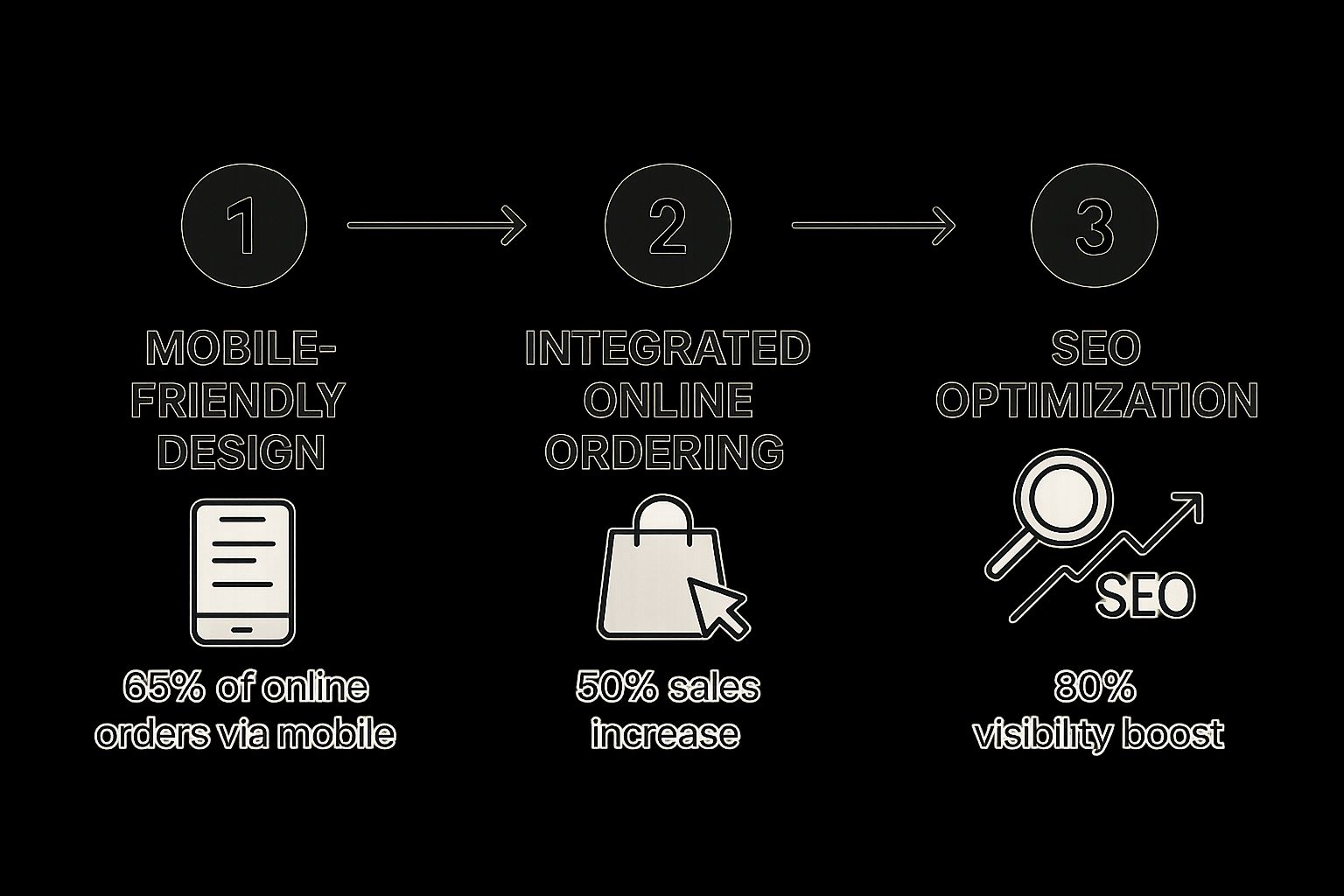
From this dashboard, you control the entire narrative, ensuring every piece of information a customer needs is accurate, current, and compelling.
To dominate this channel, you must be obsessive about two fundamentals: completeness and consistency.
- NAP Consistency: Your Name, Address, and Phone number must be identical across all online directories—your website, GBP, Yelp, etc. A minor variation like "St." vs. "Street" can create data conflicts that erode search engine trust and negatively impact your ranking.
- Data Completeness: Do not skip a single field. Populate every available section. This includes standard hours, special holiday hours, attributes like "outdoor seating" or "women-led," and a detailed business description strategically populated with keywords that describe your cuisine and dining experience.
- Visual Asset Deployment: Utilize professional, high-resolution photography of your food, interior, and exterior. Crucially, supplement this with user-generated content (UGC). Encourage customers to add their photos, as UGC provides a layer of authenticity and social proof that professionally staged shots cannot replicate.
Fueling the Engine with Reviews
In the hospitality sector, reviews are the currency of trust. A consistent flow of positive, recent reviews is a powerful signal to both prospective customers and Google’s algorithm that you deliver a high-quality experience. This does not happen organically.
I’ve watched teams obsess over acquiring one new customer while ignoring the goldmine of feedback from the hundred they just served. Responding to every review—positive and negative—is not a customer service task; it's a high-impact marketing activity that demonstrates engagement and a commitment to quality.
You must implement a system to actively solicit reviews. This can be as straightforward as a QR code on receipts linking to your GBP page or an automated follow-up email after an online order. The objective is to remove all friction for satisfied customers to share their experience.
And when a negative review appears? Respond with speed and professionalism. Offer to resolve the issue offline. This demonstrates to future customers that you are accountable and committed to rectifying service failures.
Optimizing Your Website: Your Digital Home Base
If GBP is your storefront, your website is your headquarters. It is the one digital asset you completely own and control. Its primary function is to convert a visitor into a reservation or an online order. It must be engineered for that purpose.
Flawless on-page SEO is a prerequisite. Your menu, location details, and brand story must be structured for easy machine readability. Integrate your location into page titles and headers. Develop content that naturally incorporates high-intent keywords like "family-friendly dining in [Your City]" or "best happy hour specials."
Executing this foundational layer correctly builds a sustainable, long-term customer acquisition pipeline. It creates an asset that generates revenue organically, reducing your dependency on paid media and establishing a powerful, defensible competitive advantage.
Your Social Media Is a Sales Engine—If You Treat It Like One
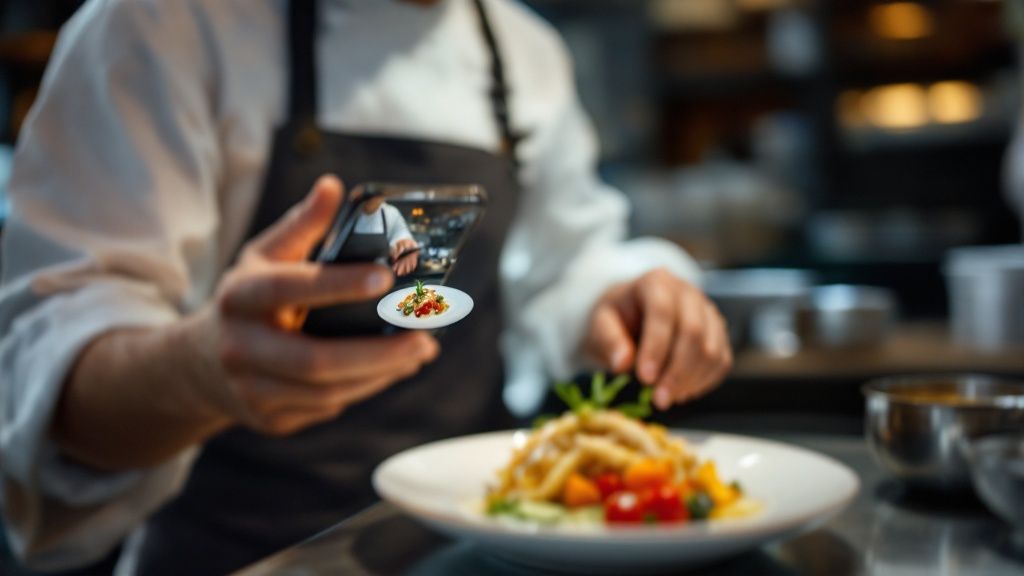
The number of restaurant operators I've encountered who view social media as a creative sideline is staggering. They post aesthetically pleasing food photos and hope for engagement. This is a massive, revenue-killing strategic error. Your social media presence is not a digital art gallery; it is a direct channel to your community and a potent sales engine when operated with discipline.
The data is unequivocal. By 2025, 74% of diners will use social media to decide where to eat. These platforms are the new word-of-mouth at scale. Beyond discovery, 22% of customers report returning to a restaurant specifically due to its active social presence, and 57% book reservations directly through these channels. You can analyze more of this data in this great analysis of restaurant social media data.
The strategic shift is from guesswork to integration. Every post, story, and ad must have a clear business objective. Are you driving online orders, increasing table turns on a Tuesday night, or generating demand for a new menu item?
Master the Right Platform for the Right Job
A one-size-fits-all approach to social media is a surefire way to waste capital and effort. Each platform has a distinct user context and audience demographic. Your strategy must be tailored to the native behavior of each channel.
- Instagram: The Visual Appetizer. This is where you generate desire. Deploy high-quality photos and Reels to showcase your culinary offerings. But go deeper. Use Instagram Stories to provide authentic, behind-the-scenes content: your chef plating a special, your bartender executing a complex cocktail, your team prepping for service. This raw, operational content builds an emotional connection that polished, professional assets cannot.
- Facebook: The Community Hub. While no longer the newest platform, Facebook remains a powerful tool for building local community. It is the ideal channel for promoting weekly specials, announcing events, or running targeted promotions. I strongly advise creating a private Facebook Group for your most loyal patrons. Grant them exclusive access to reservations and special offers to foster a sense of insider status.
- TikTok: The Discovery Engine. Writing off TikTok as a platform for a younger demographic is a strategic blind spot. It is a formidable engine for discovery. A short, visually satisfying video—a cheese pull, a perfectly seared steak—can achieve viral reach overnight, introducing your restaurant to thousands of potential local customers.
The content you deploy is the vehicle for your brand narrative. To go deeper on this, we've developed a guide on how branding and content marketing work together to construct a compelling story.
Stop obsessing over vanity metrics like follower counts. I’ve seen restaurants with enormous followings struggle with profitability. I would rather have an engaged community of 5,000 local patrons who book and order than 100,000 passive followers who will never convert into revenue.
Turn "Likes" Into Actual Sales
The sole purpose of this activity is to convert followers into paying customers. You must engineer a frictionless path from content consumption to commercial transaction. Engagement is merely the first step in the funnel.
This means every single post must contain a clear call to action (CTA). Do not just display a photo of your steak; instruct users to "Book your table now" with a direct link in your bio. Don't just post a video of your brunch menu; command them to "Order for pickup this weekend" and link directly to your online ordering portal. Make it effortless for them to transact.
Run Ads That Actually Work
Organic content is for nurturing your existing audience; paid advertising is for acquiring new customers. Social media ad platforms provide unparalleled targeting capabilities, which is a strategic game-changer for restaurants.
Here are tactics that have consistently delivered superior ROI:
- Hyper-Local Geofencing: Deploy ads targeting users exclusively within a 1- to 3-mile radius of your location. Use time-sensitive offers like a "lunch special for locals" or "happy hour starts now" to drive immediate foot traffic.
- Clone Your Best Customers: Upload your customer email list to the ad platform to create a "lookalike audience." The platform's algorithm will identify and target new users with demographic and behavioral profiles similar to your most valuable customers. This is an incredibly efficient method for acquiring high-LTV patrons.
- Retarget High-Intent Prospects: A user visited your website and viewed the menu but did not convert. Re-engage them with a retargeting ad featuring the specific dish they viewed. A simple message like, "Still thinking about our famous burger? Order now for 10% off," can effectively close the conversion loop.
When you integrate your social media directly with your sales and reservation systems, it ceases to be a creative expense and becomes a measurable, high-performance growth engine for your restaurant.
Drive Predictable Revenue with Email and SMS
Let's be direct. Customer acquisition is expensive. Sustainable profitability is driven by retention. Yet, this is precisely where most restaurant operators fail. They invest heavily in acquiring a customer for a single visit, then do nothing to systematically drive their return.
Your email and SMS list is, unequivocally, your most valuable marketing asset. It is not your Instagram following or Facebook fanbase. Why? Because you own it. It represents a direct, high-engagement communication channel to your most loyal customers, one that is not subject to the whims of an algorithm.
Beyond the Monthly Newsletter
We must move beyond the generic, low-impact monthly newsletter that most recipients ignore. The real value is unlocked through automated, data-driven campaigns triggered by specific customer behaviors. This is where your marketing stack and your POS data must be deeply integrated.
Consider the possibilities when these systems are connected:
- The Birthday Offer: An automated email is deployed one week prior to a customer’s birthday, presenting a high-value offer like a complimentary dessert or appetizer. This is consistently one of the highest-performing automated campaigns.
- The "We Miss You" Campaign: If a high-value customer has not transacted in 60 days, an automated SMS message provides a gentle nudge: "It's been a while! Your favorite Pad Thai is waiting. Here's 15% off your next order."
- The Favorite Dish Reminder: Your data identifies a customer who orders your signature burger on a regular cadence. When they deviate from this pattern, a simple, personalized email serves as a timely reminder to drive a repeat purchase.
These are not one-off campaigns. They are intelligent, automated sequences operating 24/7 to drive predictable revenue from your existing customer base. For operators ready to build this type of system, our guide on marketing automation implementation provides a detailed roadmap for integrating the necessary components.
How to Build Your Most Valuable Asset
A high-quality list is not built by chance. It requires a systematic process for capturing contact information at every customer touchpoint, both digital and physical. The key is to provide a clear, immediate value exchange.
Never request contact information without offering tangible value in return. A customer's email or phone number is a form of currency; you must compensate them for it with a compelling incentive.
Here are proven methods for list acquisition:
- Online Ordering Opt-In: Integrate this seamlessly into your checkout process. A simple checkbox stating, "Join our VIP list for exclusive offers" is highly effective.
- In-Store Sign-ups: Utilize QR codes on menus, table tents, or receipts that link to a simple sign-up form. The offer should be immediate and valuable: "Scan to get 10% off your next visit" or "Join our text club for a free appetizer today."
- Wi-Fi Gateway: If you offer complimentary Wi-Fi, require an email address or phone number for access. This is a low-friction, highly effective method for capturing contact information from nearly every dine-in customer.
The objective is to transform every transaction—digital or in-person—into an opportunity to build a direct, long-term customer relationship. This isn't just marketing; it's about converting one-time visitors into a loyal community that fuels your long-term growth.
Use Your Data to Personalize and Tell Your Brand Story
In a saturated market, your menu is only one component of your value proposition. Consumers today don't just purchase a meal; they invest in an experience and a story that resonates with them. This is where I see a massive missed opportunity: restaurants operate with siloed technology. Your POS, reservation software, and online ordering platform are not just operational tools; they are repositories of invaluable customer data.
When these data sources are not integrated, you are operating blind. You lack a clear understanding of your customer segments, their preferences, and their visit frequency. Merging this data is the foundational step in breaking down the wall between operations and marketing. It's how you transform raw data points into a unified, actionable view of your customer.
This isn't about invasive tracking; it's about delivering relevance at scale. Personalization is no longer a novelty—it is a baseline expectation. A loyal customer who has ordered your vegan burger five times should never receive a generic email promoting a steak special. It's lazy marketing that communicates, "We don't know who you are, and we don't care to."
Weaving Data into a Cohesive Story
With a unified customer view, you can finally transcend one-off promotions and begin telling a consistent brand story. The data reveals what your customers truly value, and your marketing must reflect that back to them.
This is where brand storytelling evolves into a data-informed strategy. It is the narrative that imbues your menu, your service, and your community presence with meaning. It's the "why" that underpins your operation.
For example, your data might reveal that a significant customer segment consistently orders your farm-to-table specials. You also observe their highest engagement on social media is with posts featuring your local suppliers. This isn't just a menu preference; it's a powerful signal that they value sustainability and local sourcing. You have just identified a potent narrative to anchor your brand.
Your brand story is not a clever tagline conceived in a marketing meeting. It is the authentic truth of your restaurant, amplified and guided by what customer data proves they value most.
This approach transforms your marketing from a series of disconnected campaigns into a continuous dialogue. Every email, social post, and piece of in-store collateral reinforces the same core narrative. You stop merely building a customer base and begin cultivating a tribe of advocates who are invested in your mission.
Marketing What Matters Beyond the Plate
Let's continue with the sustainability narrative. It is a powerful story that resonates with a growing consumer segment. We are seeing eco-conscious marketing emerge as a major strategic advantage for restaurants that execute it authentically. This requires more than a footnote on the menu; it demands a commitment to environmental responsibility and the skill to communicate that story effectively. You can see more on how these restaurant marketing trends are shaping the industry.
Here’s how to translate green operational practices into marketing ROI:
- Show, Don't Just Tell: Leverage your social channels to feature the local farmers you partner with. Post short video clips of fresh produce arriving from a nearby farm. This transforms an abstract concept like "local sourcing" into a tangible, authentic story.
- Market Your Waste Reduction: If you've implemented a composting program or transitioned to eco-friendly packaging, quantify and communicate it. A simple, data-driven post can have a significant impact: "This month, we diverted 500 pounds of food waste from landfills thanks to our new composting initiative."
- Build Campaigns Around Your Values: Instead of another discount-based promotion, create a campaign tied to your narrative. For instance, launch a special menu where a percentage of sales is donated to a local environmental organization.
This is how you convert intelligent operational decisions into a compelling brand narrative. You are no longer just selling food; you are selling a set of values. When you use data to understand your audience's motivations and weave that into an authentic brand story, you build a deep, loyal connection that price-driven competitors simply cannot replicate.
Answering the Tough Questions
Over my career, I've worked directly with countless restaurant operators and their executive teams. We've strategized through the real-world challenges that arise when you shift from a gut-feel operation to a data-driven growth model.
Here are the questions I'm asked most frequently, along with the direct answers forged in the trenches.
How Much Should We Actually Budget for Digital Marketing?
There is no universal magic number, but a strategic starting point is to allocate 5-10% of total revenue to marketing.
For new launches or aggressive growth phases, you should be operating closer to the 10-12% range to capture market share. For established brands with strong repeat business, you can often achieve significant results in the 5-7% range.
The critical mindset shift is to view this budget as a growth investment, not a cost center. You must know your unit economics. Once you rigorously track your Customer Acquisition Cost (CAC) and Lifetime Value (LTV), the budget allocation becomes a data-driven decision. If a channel is delivering profitable customers, you should increase investment until the marginal return diminishes.
What's More Important: Page Views or Engagement Rate?
Engagement. Every single time. It is not a comparable metric.
Page views and impressions are vanity metrics. They may look impressive on a report, but they provide zero signal as to whether your message is resonating. It's the equivalent of a packed room where no one is listening.
Engagement—likes, comments, shares, and especially saves—is quantitative proof of connection. It is a direct signal that your content is valuable to your target audience. I would take a community of 1,000 highly engaged fans who convert into weekly orders over 100,000 passive scrollers every time. Your strategy must be built around content that drives interaction and strengthens brand affinity.
Should I Do This In-House or Hire an Agency?
This decision hinges on three variables: internal capability, bandwidth, and budget. If you have a dedicated team member with proven digital marketing expertise and the capacity to execute, an in-house model can be effective.
However, the digital landscape evolves rapidly. A specialized agency is immersed in emerging trends, has access to enterprise-level tools, and brings cross-client experience that an in-house team cannot replicate.
The optimal structure I've seen is often a hybrid model.
- Outsource the highly technical, specialized functions like SEO and paid media management to an agency.
- Retain the day-to-day brand voice and community management in-house. This requires an intimate understanding of your restaurant's culture and customer base.
The most critical factor is not who executes the work. It is whether your marketing and operations teams are fully integrated and aligned on the same KPIs. A siloed agency and in-house manager are a recipe for failure.
How Do I Actually Measure the ROI of My Marketing?
You must establish a clear, unbroken line of sight between marketing activities and sales data. This is not about estimation; it's about direct attribution.
First, you need robust tracking for all digital transactions. This involves using unique tracking links (UTM parameters) for every campaign and specific promo codes for each offer.
To track in-store traffic, leverage your POS system. Coupon redemptions can be tied directly to a specific digital source. Do not underestimate the value of low-tech methods: train your front-of-house staff to ask, "How did you hear about us today?" and implement a system for logging these responses. This qualitative data is incredibly valuable.
When you can attribute a sale directly back to the acquisition channel, you can finally calculate your true return on investment. This is how you transition from hoping your marketing is effective to knowing precisely which levers to pull to drive profitable growth.
At MGXGrowth, our entire focus is on connecting these dots. We build predictable growth systems for ambitious brands that are tired of guesswork. If you're ready to measure the true P&L impact of your marketing, let's connect.
