


In my career driving growth across hospitality, SaaS, and real estate, I've learned that a restaurant marketing agency is not a vendor; they are a dedicated growth partner. This is an external team that lives and breathes restaurant promotion, handling everything from your digital footprint to your local community buzz. Unlike a generalist agency that might apply the same playbook to a software company or a local dentist, these specialists understand the unique pressures, P&L statements, and rhythms of the hospitality world.
Why Generic Marketing Fails Restaurants
I’ve spent decades scaling businesses, breaking down silos between marketing, sales, and operations to drive revenue and EBITDA growth. One truth has become abundantly clear: the restaurant industry operates under a unique set of economic and customer-centric rules. Marketing strategies that drive incredible results for a SaaS platform or a real estate marketplace fall flat when applied to a restaurant because the entire business model—and the definition of success—is fundamentally different.
A generalist agency might excel at building broad brand awareness, but a restaurant's success is measured in covers, table turns, and delivery orders—tonight, not in six months. They often miss the operational nuances that are actually the core of the business: the urgency of moving a daily special with a high-margin, the power of a hyper-local community event, or how to navigate the complex, margin-eroding world of third-party delivery aggregators. That operational disconnect leads to wasted marketing spend and missed opportunities to fill your dining room.
The Profitability Puzzle
It all comes down to margins and velocity. While the U.S. restaurant industry is projected to hit an astounding $1.5 trillion in sales in 2025, the on-the-ground reality is a battle for profitability. The average profit margin for a full-service restaurant hovers at a razor-thin 9.8%.
With Cost of Goods Sold (COGS) consuming 28-35% of every dollar and menu prices rising, every marketing dollar must be ruthlessly efficient. It’s not just about creative campaigns; it’s about engineering quantifiable, value-driven marketing systems. For a restaurant, this is a core operational competency.
A specialized restaurant marketing agency understands this financial reality. They aren't just building campaigns; they are architecting growth systems designed specifically for the unique unit economics of hospitality.
This visual quantifies the performance leap restaurants typically see when they transition from a DIY or generalist approach to a specialized partner.
The data tells the story. Partnering with a specialist doesn't just liberate an immense amount of executive time; it can more than double your return on investment because they deploy capital on the channels proven to drive covers and orders for restaurants.
In my experience leading growth teams, the most successful operators are those who stop viewing marketing as an expense. They see it as a critical investment in their most valuable asset: the customer relationship and its resulting lifetime value. A generalist sees clicks; a specialist sees covers and calculates the LTV.
To drive home the difference in strategic thinking, let’s analyze how these two agency types would approach common restaurant challenges.
Generalist vs Specialist Agency Approach
| Marketing Challenge | Generalist Agency Approach | Restaurant Marketing Agency Approach |
|---|---|---|
| Filling Tables on a Slow Tuesday | Runs a broad brand awareness ad campaign across a wide demographic. | Launches a geo-fenced "Taco Tuesday" social media ad, targeting users within a 3-mile radius with a demonstrated interest in Mexican food. Tracks redemptions via a unique offer code to calculate ROAS. |
| Launching a New Seasonal Menu | Sends a single email blast to the entire customer database. | Executes a multi-channel campaign: "sneak peek" Instagram Reels, a blog post on the chef's sourcing story, an exclusive tasting event for high-LTV customers, and targeted ads for the new hero dishes. |
| Getting More Online Orders | Focuses on increasing overall website traffic. | Optimizes the Google Business Profile for "near me" searches, runs Google Ads for high-intent keywords like "pizza delivery," and analyzes the UX to ensure the ordering process is frictionless. |
| Managing a Negative Online Review | Recommends a standard, corporate-sounding apology template. | Crafts a personalized, empathetic response that addresses the specific complaint, offers to make it right offline, and uses the feedback as a data point to identify potential operational issues. |
The contrast is stark. The specialist's approach is tactical, immediate, and directly tied to revenue-generating KPIs.
Ultimately, restaurants don't just need "marketing." They need a strategic partner who understands their operational reality. This understanding is the foundation for building a sustainable growth model and is a key lever in how to reduce customer acquisition cost over the long term. In today's hyper-competitive local market, a specialized agency isn't a luxury—it's a core component of your growth stack.
What a Restaurant Marketing Agency Actually Does
Let's move from strategy to execution. I've seen firsthand that a brilliant growth hypothesis is useless without rigorous, data-driven execution. The real differentiator is the set of tangible actions that produce measurable results. A top-tier restaurant marketing agency cuts through the noise and focuses on a core set of services designed for one purpose: to increase covers and order volume.
This isn't about chasing vanity metrics. It's about a relentless focus on outcomes that are visible on your profit and loss statement. Unlike generalist firms, these specialists concentrate on the levers that actually move the needle for a restaurant, like driving foot traffic and converting first-time diners into high-LTV regulars. Their day-to-day work involves activities like obsessively optimizing your Google Business Profile, managing online reviews as a customer feedback loop, and creating loyalty campaigns to solve for the Tuesday slump. Success is measured in reservations booked, orders placed, and repeat visit frequency—not social media followers. You can see more on how these agencies tailor their services for direct impact in this breakdown from MarketerHire.
This practical approach is built on several key pillars that function as an integrated growth engine.
Dominating Local Search
For any restaurant, the highest-intent customer is the person a few blocks away searching "best pasta near me" on their phone. A specialized agency's first priority is to ensure you win that search result. This goes far beyond basic SEO.
It begins with a meticulous optimization of your Google Business Profile (GBP). The objective is to transform that listing from a digital business card into your primary customer acquisition channel. This means:
- Strategic Keyword Integration: Weaving terms like "outdoor patio," "family-friendly," or "brunch spot" into your profile description and posts to capture qualified, high-intent searches.
- Consistent Media Uploads: Maintaining a fresh and engaging profile by showcasing new menu items, the dining atmosphere, and special events to increase conversion.
- Active Q&A Management: Proactively answering common questions to reduce friction and make the decision to choose you as simple as possible for a potential diner.
The objective is clear: when someone nearby is hungry and searching, your restaurant must be the most visible, compelling, and frictionless choice.
Managing Your Digital Reputation
In the restaurant business, perception is reality. A few negative reviews on Yelp, TripAdvisor, or Google can negate a month of marketing investment. A crucial service is proactive online reputation management, and it's not just damage control—it’s a rich source of customer data.
A strong agency doesn't just reply to reviews. They analyze them for operational patterns. Is that "slow service" comment an outlier, or is it the third one this month pointing to a Saturday night staffing issue? This is how marketing data can directly inform and improve operations, breaking down the silo between the front-of-house and the growth team.
This service involves systematically encouraging satisfied customers to leave positive reviews and professionally addressing negative feedback to demonstrate a commitment to service excellence. It's a non-negotiable component of any effective digital marketing strategy framework.
Finally, they create and manage targeted digital ad campaigns on platforms like Meta and Google to achieve specific business goals. This could be a tightly geo-fenced ad campaign to fill tables on a slow Tuesday night or a campaign promoting a new high-margin seasonal cocktail. Every ad dollar is tracked and tied directly to a business outcome, ensuring you have a clear understanding of your return on ad spend (ROAS).
Mastering Your Digital Storefront
In every industry I’ve operated in—from SaaS to real estate—the concept of a "storefront" has been redefined. For a modern restaurant, your physical address is only half the equation. Your website and social media profiles are your new front doors, and a high-friction digital experience is as detrimental as a dirty dining room or a rude host. This is where the customer journey begins.
A data-driven restaurant marketing agency understands this. They know your digital presence isn't a static brochure; it’s a revenue-generating asset waiting to be optimized. Their function is to convert casual online browsers into paying customers, whether they book a table, place an online order, or walk through your physical door. It's a blend of art and science—compelling creative guided by a rigorous, data-informed strategy.
The Power of Visual Storytelling
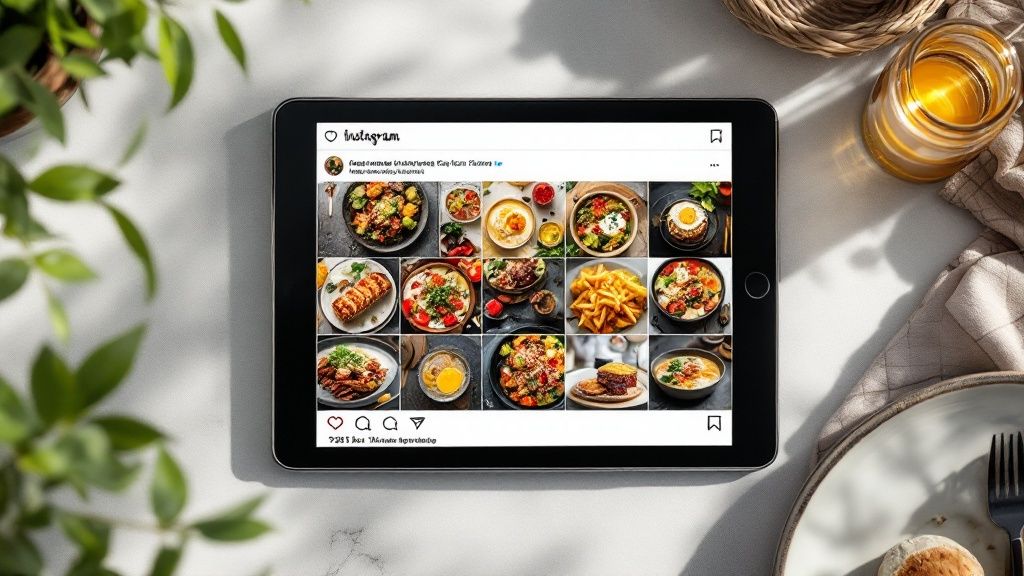
Let's be direct: high-quality food photography and video are no longer optional. They are table stakes. Grainy, poorly lit photos of your signature dish will actively decrease conversion rates. We eat with our eyes first, and platforms like Instagram and TikTok have become primary discovery channels for dining.
This visual-first strategy isn't based on intuition; the data confirms it. Social media is a significant driver of dining decisions. A staggering 74% of diners choose a restaurant based on its social media presence, and 40% will physically visit after seeing enticing food photos online. With digital ad spend projected to hit $276.7 billion, it’s clear where customer attention is focused.
The objective isn’t just posting aesthetically pleasing pictures. It's about creating content that interrupts a user's scroll and triggers an immediate action: "I need to eat that tonight." That is the conversion point where an online impression translates into revenue.
From Content to Commerce
A beautiful Instagram feed is a strong top-of-funnel asset, but it's only one part of the system. A great agency connects that visual storytelling directly to a business objective. They bridge the gap between content and commerce, engineering a seamless path from discovery to transaction.
This strategic integration is critical. It involves building a content calendar that supports business goals—promoting high-margin dishes, driving traffic on slow weekdays, or boosting a local event. Even more crucial is integrating a frictionless online ordering system directly into your website. This single move transforms your site from a passive menu into an active, 24/7 sales channel, capturing revenue that might otherwise be lost to third-party delivery apps with their high commission fees. To learn more about this, our guide on branding and content marketing details how to build a narrative that drives measurable results.
Building a Loyal Customer Base
It doesn't matter if you're selling software subscriptions or soufflés—the business mathematics are universal. Acquiring a new customer is a tactical win, but converting them into a high-LTV repeat customer is how you build a sustainable, profitable business. The most successful restaurants I’ve analyzed aren’t just chasing a constant stream of new diners; they are obsessed with cultivating loyalty.
A sharp restaurant marketing agency understands this. Their work doesn’t stop at the first visit; it's about architecting the systems for the second, fifth, and tenth. They build the infrastructure that turns a one-time diner into a brand advocate. The strategy is to create a direct, high-value communication channel with the people who have already demonstrated affinity for your product.
Beyond the Generic Newsletter
Email marketing is a powerful tool in this equation, but I'm not referring to generic, batch-and-blast newsletters that are promptly ignored. A strong agency will build intelligent, segmented campaigns that leverage customer data to deliver personalized value.
This is where data becomes your most strategic asset. These campaigns are personal and triggered by behavior. Consider the possibilities:
- Celebrating Milestones: An automated email with a special offer for a customer's birthday or anniversary.
- Rewarding Frequency: A thank you perk sent to a regular who has a predictable Friday night visit pattern.
- Re-engaging Lapsed Diners: A "we miss you" incentive sent to a customer who hasn't visited in 90 days.
Your marketing transitions from feeling like a promotion to feeling like a personalized invitation. That’s how you remain top-of-mind during the decision-making process.
Designing Loyalty Programs That Work
The other half of this equation is a loyalty program with low friction and high perceived value. A modern restaurant agency will replace antiquated paper punch cards with a seamless digital rewards system that effectively motivates repeat business.
A loyalty program is not just a mechanism for giving away free food. It is a data collection engine. It provides invaluable insights into visit frequency, average spend, and menu preferences, allowing you to make smarter operational and marketing decisions.
The goal is to create a program that is both valuable and incredibly simple to use, whether through a dedicated app or integrated directly into your POS system. By building this virtuous cycle of repeat visits and direct communication, an agency helps you create your most powerful asset: a loyal customer base that significantly reduces your dependency on high-commission, third-party acquisition channels.
Measuring What Actually Moves the Needle
Ultimately, every business conversation I have comes down to one question: what are the results? I have no interest in vanity metrics like social media impressions or follower counts. In the margin-sensitive world of restaurants, those numbers do not pay rent or make payroll.
We must track the metrics that directly impact your bottom line.
A competent restaurant marketing agency understands this. They won't present reports filled with feel-good "engagement" stats. They will bring hard data that draws a direct, quantifiable line from their marketing activities to your revenue. If an agency cannot have this conversation, you are working with the wrong partner. It's that simple.
The entire purpose is to connect marketing spend to real-world business outcomes, ensuring every dollar invested is an efficient driver of growth, not an expense. To achieve this, we must obsess over a specific set of Key Performance Indicators (KPIs) that tell the true story of your restaurant's financial health.
From Vanity Metrics to Valuable KPIs
Let's get specific. These are the metrics your agency should live and breathe, and they should be reported to you consistently. This is the dashboard that tells you if your marketing is working.
-
Customer Acquisition Cost (CAC): This is your total marketing spend divided by the number of new customers acquired. A great agency is relentlessly focused on driving this number down over time.
-
Customer Lifetime Value (LTV): This metric projects the total revenue a single customer will generate over their entire relationship with your restaurant. The goal is a high LTV to CAC ratio, which indicates that your loyal customers are far more valuable than the cost to acquire them.
-
Reservation & Order Source Attribution: You must know precisely where your customers are coming from. Was it a Google search? A paid Instagram ad? An email campaign? Understanding your most profitable channels is critical for intelligent budget allocation.
-
Table Turnover Rate (During Promotions): When you run a campaign to drive traffic on a slow Tuesday night, does it result in more seated tables? This metric directly connects a marketing initiative to operational efficiency and revenue.
In my experience, the moment a restaurant owner starts demanding these specific KPIs, the entire marketing strategy becomes more focused and accountable. It forces a shift from activity-based reporting to impact-based reporting.
A true partner agency won't just track this data; they will use it to facilitate strategic conversations with you. They should be able to demonstrate exactly how a campaign drove an increase in online orders or how a specific ad led to a 20% lift in reservations from a key demographic. That is the data-driven partnership that fuels real, sustainable growth.
Tracking the right KPIs is non-negotiable for understanding the true ROI of your marketing. It's about moving beyond surface-level numbers to analyze the data that directly correlates with your restaurant's financial performance.
Key Restaurant Marketing KPIs and What They Mean
| KPI (Key Performance Indicator) | How to Measure It | Why It Matters for Your Restaurant |
|---|---|---|
| Customer Acquisition Cost (CAC) | Total Marketing & Sales Spend ÷ Number of New Customers Acquired | Tells you exactly how much it costs to get a new customer in the door. The lower, the better. |
| Customer Lifetime Value (LTV) | (Average Spend per Visit) x (Number of Visits per Year) x (Average Customer Lifespan in Years) | Shows the total value of a customer over time. A high LTV means your marketing is attracting loyal, repeat guests. |
| Conversion Rate | (Number of Conversions / Total Visitors) x 100 | Measures how many website visitors take a desired action, like making a reservation or placing an online order. |
| Return on Ad Spend (ROAS) | (Revenue Generated from Ads ÷ Cost of Ads) x 100 | This is the most direct measure of your advertising profitability. For every dollar you spend, how many are you getting back? |
| Cost Per Lead (CPL) | Total Ad Spend ÷ Number of Leads Generated | Crucial for catering or private events. It shows how efficiently your marketing is generating new business inquiries. |
| Table Turnover Rate | Number of Parties Seated ÷ Number of Tables | When tied to a promotion, it shows if marketing efforts are successfully filling seats during targeted periods. |
Ultimately, these metrics empower you to make smarter, data-backed decisions. They transform marketing from a "cost center" into a predictable engine for growth, ensuring that every campaign is designed not just for clicks, but for customers.
How to Choose the Right Agency Partner
Throughout my career, I've vetted hundreds of potential partners. I can state with certainty that selecting an agency is one of the most critical decisions a restaurant owner or executive will make. The right partner acts as a force multiplier, accelerating growth. The wrong one becomes a significant drain on capital, time, and team morale.
Identifying the best restaurant marketing agency for your brand is not about being impressed by a slick sales presentation. It requires a structured, analytical approach to find a genuine partner who delivers results that are visible on your P&L statement.
Scrutinize Their Track Record
Begin by analyzing their case studies with a critical eye. Vague claims like "boosted engagement" are immediate red flags. You need to see cold, hard, quantifiable results. Look for evidence that they have driven growth for restaurants similar to yours in concept, price point, or geography.
Do not hesitate to demand the specific data behind their success stories:
- What was the client's Customer Acquisition Cost (CAC) before your engagement, and what was it after?
- By what percentage did you increase the Customer Lifetime Value (LTV)?
- Can you demonstrate a direct attribution line between your campaigns and an increase in online orders or reservations?
An agency that is confident in its ability to perform will have this data readily available. If they become defensive, equivocate, or attempt to distract you with vanity metrics, it's a clear signal to end the conversation.
Ask the Right Questions
Once you've verified their performance claims, it's time to test their strategic thinking. The initial conversations should feel less like a sales pitch and more like a collaborative strategy session. A generic, one-size-fits-all plan is another warning sign. Their proposed strategy should be custom-tailored to your specific challenges and business objectives.
The most revealing question you can ask is, "How will you measure the success of our partnership in the first 90 days?" Their answer is diagnostic. A strong partner will discuss revenue, reservations, and return on ad spend (ROAS). A weak one will talk about tasks and deliverables.
Your objective here is simple: find a partner who thinks like a business owner, not just a marketer. They should be as obsessed as you are with a fuller dining room, increased order volume, and a healthier bottom line. This mindset is what separates a true growth partner from just another vendor.
Frequently Asked Questions
After vetting countless strategic partners over the years, I've heard every question in the book from restaurant owners. Let's address the ones that matter most, cutting through the jargon to focus on what drives business value.
How Much Does a Restaurant Marketing Agency Cost?
This is invariably the first question, and the direct answer is: it varies. The investment can range from a few thousand dollars a month for a focused local search campaign to tens of thousands for a multi-location, integrated strategy.
However, this is the wrong question. It should not be "what does it cost?" but "what is the expected return on this investment?" Any agency worth considering should be able to forecast a return based on clear, mutually agreed-upon goals. Look for a partner who frames the conversation around performance and can model how their work will generate a positive impact on your net income, not just accumulate billable hours.
How Soon Can I Expect to See Results?
Marketing is not magic, but you should see measurable traction quickly. High-intent tactics like targeted social media ads or optimizing your Google Business Profile can begin driving customer traffic and online orders within the first 30-60 days. These are the quick wins that provide an immediate impact on cash flow.
More foundational, long-term strategies like organic search (SEO) and building true brand equity yield significant returns over a longer horizon, typically showing major impact within 6-9 months. A sophisticated agency will architect a plan that delivers short-term wins while simultaneously building the foundation for sustainable, long-term growth.
The ultimate objective is to build a growth flywheel, not just execute a series of one-off campaigns. Early results should generate momentum and data, making each subsequent marketing dollar more efficient and continuously lowering your blended customer acquisition cost.
What If I Already Have an In-House Team?
This is an asset, not an obstacle. A specialized restaurant marketing agency is not a replacement for your internal team; they are a strategic amplifier. Your team possesses invaluable institutional knowledge and lives your brand daily. They understand your operations at a granular level.
The agency brings a different, specialized skill set to the table: deep expertise in areas like performance marketing, complex data analysis, or technical SEO that may not be core competencies of your team. Think of them as a strategic force multiplier. They execute the highly technical aspects of growth marketing, which frees up your team to focus on what they do best—running an excellent restaurant and engaging with your guests.
Finding the right agency partner can seem daunting, but the process becomes clear when you focus on the right questions—questions centered on data, accountability, and measurable growth.
At MGXGrowth, we architect marketing systems that draw a straight line from investment to bottom-line impact. If you're ready to build the next stage of your restaurant's growth, see how we can help at https://www.mgxgrowth.com.
