


For decades, I’ve driven growth by re-engineering business models across multiple industries, from SaaS to hospitality. The common thread has always been the same: disruptors who master technology and customer data win. Today, luxury travel is at that inflection point. The legacy playbook—five-star service and a thick rolodex—is obsolete. Today's high-net-worth clients demand more: journeys that are not just luxurious, but predictive, seamless, and deeply personal. This is the strategic imperative that AI-enabled luxury travel ecosystems are built to address.
The New Blueprint for Bespoke Travel
The definition of luxury has fundamentally shifted from assets to intelligence. It's no longer about exclusive inventory; it's about anticipating client needs before they are articulated. For the C-suite and leadership teams I work with, this isn't a subtle change—it's a seismic event that has completely moved the goalposts for market leadership.
Stop thinking about booking engines, concierges, and tour operators as discrete business units. The winning model is a single, intelligent network that integrates every touchpoint of a traveler's journey, from initial consideration to post-trip engagement. This is the essence of an AI-powered ecosystem. It functions as a central nervous system, where AI orchestrates every component—aviation, accommodations, experiences—in perfect harmony with the traveler's unique profile.
From Siloed Services to a Unified Journey
Historically, luxury travel planning was a fragmented, high-friction process. A client booked a flight, reserved a villa, and arranged a local concierge through separate, disconnected channels. Each transaction created an isolated data silo, making it impossible to construct a holistic, 360-degree view of the customer.
The ecosystem model demolishes those silos.
The objective is to create one continuous, intelligent feedback loop with the traveler. What the system learns from their flight preferences directly informs their dinner reservations. This integrated data flow enables a level of proactive personalization that was previously impossible to deliver at scale. The market is unequivocally rewarding this new architecture.
The integration of artificial intelligence into luxury travel ecosystems has dramatically reshaped how high-net-worth individuals plan and experience their journeys. This shift is not just a trend; it's a core driver of market expansion.
The numbers validate this thesis. Our analysis shows the global luxury travel market is on track to grow by a staggering USD 578.72 billion between 2024 and 2028. This growth, humming along at a compound annual rate of 7.31%, is largely driven by AI-powered personalization meeting the demands of rising disposable incomes. You can dig into the full market growth report and its drivers for a deeper look.
This playbook is an executive's guide to this new model, providing a clear, actionable framework for leaders who want to build or tap into these powerful systems. Understanding this isn't a competitive advantage anymore—it's a requirement for survival in the new era of luxury travel.
Breaking Down the AI-Powered Travel Ecosystem
To build a durable competitive advantage, you must first master the architectural blueprint. An AI-enabled luxury travel ecosystem is not a client-facing app; it is the central nervous system of your entire operation, a multi-layered system engineered to deliver predictive, seamless service and drive profitable growth.
The strategic goal is to shift from a reactive model—waiting for a client request—to an anticipatory one. The system must know what your client wants, often before they do. We're not talking about automating marketing emails; we're talking about orchestrating complex, multi-stop itineraries with an intelligence that feels both deeply personal and operationally flawless.
To achieve this, you must understand the four distinct, yet deeply interconnected, layers that make the system function. This diagram illustrates how a central AI brain can integrate the disparate verticals of a luxury trip—aviation, accommodations, experiences—into a single, cohesive journey.
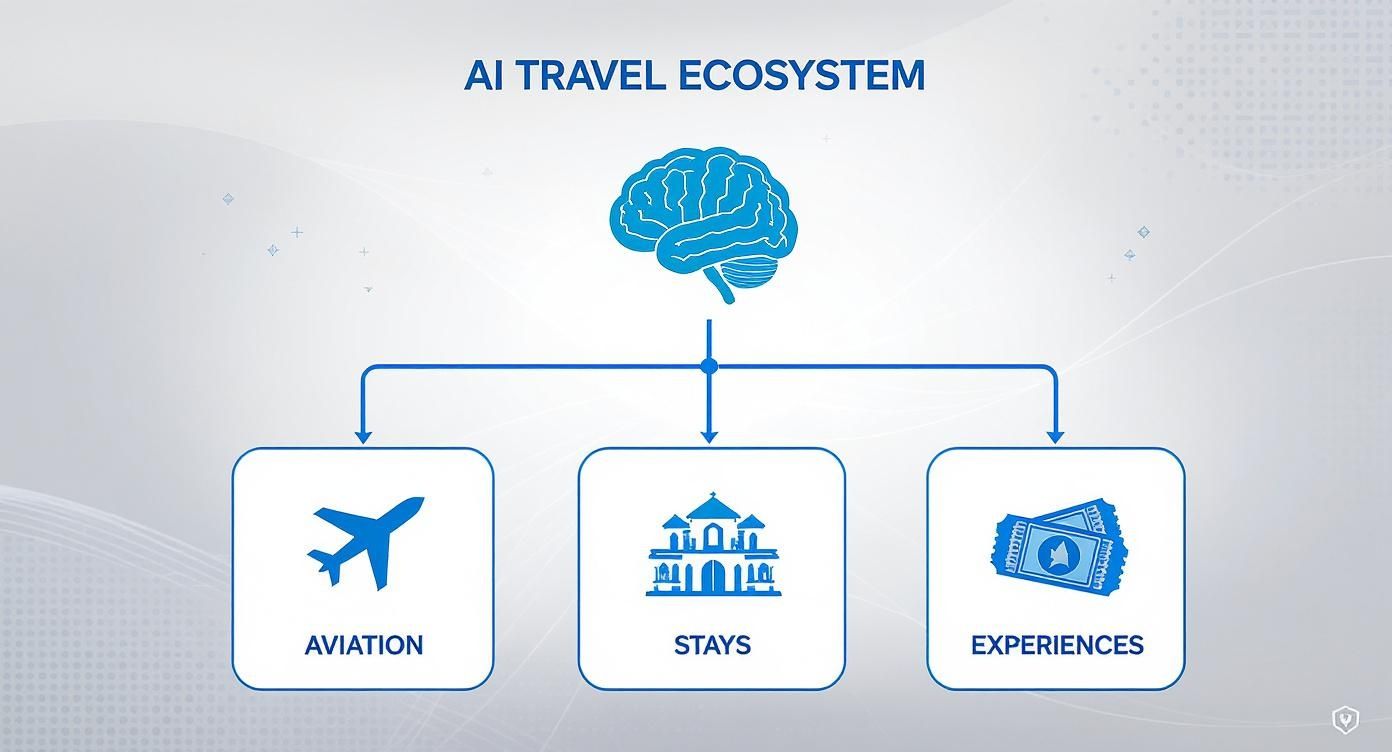
This visual underscores a fundamental business truth: siloed operations are a liability. True value is created at the intersection of these verticals, connected by a shared intelligence layer.
The Unified Traveler Profile
The foundation of the entire structure is the Unified Traveler Profile. This is the dynamic, 360-degree view of your client—not a static CRM record, but a living dossier that becomes richer and more valuable with every interaction, both digital and human.
This profile aggregates data from disparate sources to build a deep, contextual understanding of each individual:
- Transactional Data: Where have they gone? What did they book (a sprawling villa or a penthouse suite)? What is their travel frequency and average spend?
- Stated Preferences: All explicit requests—dietary needs, a preference for a specific aircraft, a room on a high floor away from the elevator.
- Behavioral Data: Website click-paths, email engagement, and the nuances of conversations with your advisors.
- Third-Party Signals: Public social media activity might reveal a new passion for modern art, fine dining, or adventure sports.
By centralizing this information, you eliminate the fragmented knowledge that cripples legacy operators. You establish a single source of truth that informs every strategic and tactical decision.
The AI Personalization Engine
The Unified Traveler Profile is the fuel for the second layer: the AI Personalization Engine. This is the predictive brain of the operation. It leverages machine learning to analyze the rich profile data, identifying patterns to anticipate needs and surface bespoke recommendations that are both highly relevant and perfectly timed.
For instance, the engine might identify a client who frequently visits wine regions. It can then automatically suggest a reservation at a new Michelin-starred restaurant in Napa just as they begin planning their next trip. For an art collector, it could proactively secure a private viewing at a gallery showing their favorite artist. This is how you convert raw data into high-value, relationship-defining moments that drive loyalty and repeat business.
The Service Orchestration Platform
Intelligence is worthless without execution. The third layer, the Service Orchestration Platform, provides the operational muscle. This platform connects your entire network of elite partners—from private jet charters and exclusive villa owners to your top local guides—into a single, cohesive delivery system.
Think of it as an API-driven switchboard. It connects inventory, availability, and booking systems in real-time, allowing you to instantly piece together complex itineraries that would normally take days of phone calls and emails to coordinate.
The Proactive Service Layer
Finally, the Proactive Service Layer acts as the guardian of the client experience. This AI-powered component continuously monitors for potential disruptions. It's scanning for flight delays, adverse weather events, or even severe traffic congestion.
When it identifies a potential issue, it automatically triggers a contingency plan. It might reroute a client’s car service to avoid a sudden highway closure, ensuring they still arrive at the airport with ample time. This shifts your service delivery from reactive problem-solving to proactive problem-prevention, cementing your status as an indispensable travel partner. Mastering these four components is how you build an unassailable market position.
Four Pillars of Growth Through AI Integration
In every boardroom, I see executives miscategorizing this technology as an operational expense. This is a fundamental strategic error. Building an AI-enabled luxury travel ecosystem is a direct investment in scalable growth with a clear, measurable ROI. This isn't about cost-cutting; it's about engineering a superior, data-driven business model designed for market leadership.
This model is built on four distinct, revenue-driving pillars. Each pillar transforms a critical business function from a cost center into a growth engine. The true strategic advantage emerges when you break down the silos between marketing, operations, and sales, creating a compounding effect across all four areas.
Hyper-Personalization at Scale
The first pillar is Hyper-Personalization at Scale. For decades, "personalization" in luxury travel meant a dedicated advisor remembering a client's favorite champagne. While a nice touch, this model is fundamentally unscalable. AI enables the delivery of that same intimate, one-to-one service to every client, every time, by algorithmically interpreting their entire interaction history.
This level of intelligence builds deep, defensible loyalty. When a client feels truly understood—when their needs are anticipated, not just met—they cease to view you as a vendor and begin to see you as an essential partner. This is how you maximize customer lifetime value (CLV) and eliminate churn. Brands that master this data-driven intimacy consistently see a 20% increase in repeat bookings.
Operational Supremacy
The second pillar is Operational Supremacy. The logistics behind a flawless luxury journey are a complex web of dependencies, juggling dozens of partners and countless variables. A single point of failure—a missed transfer, a double-booked suite—can destroy the entire experience and inflict lasting damage on your brand's reputation.
AI-powered automation de-risks these complex logistics. It can predict potential disruptions before they occur and streamline communication across your entire partner network. This does more than minimize service failures; it slashes operational overhead and directly improves margins. You are engineering a system where excellence becomes the operational baseline. Our guide on automating the luxury resort guest experience provides a deeper tactical analysis of this principle.
Investing in an AI ecosystem is not just about enhancing the front-end experience. It's about engineering a more profitable, resilient, and efficient back-end operation that can support growth without collapsing under its own weight.
Predictive Revenue Streams
The third pillar is about shifting from a reactive to a predictive business model. You can create Predictive Revenue Streams by using machine learning models to forecast demand with remarkable accuracy. These models excel at identifying high-intent upsell and cross-sell opportunities that even your most seasoned sales team would miss.
This allows you to deploy dynamic packages and offers timed for maximum conversion. Imagine the system identifying a client as a prime candidate for a private aviation upgrade based on their travel patterns, then presenting that offer at the exact moment of highest purchase intent. This data-first approach consistently lifts average order value (AOV) and unlocks entirely new revenue channels.
Unbreakable Client Relationships
Finally, these pillars converge to forge Unbreakable Client Relationships—your ultimate competitive moat. When your service is consistently proactive and anticipatory, you graduate from being a transactional service provider to an essential advisor. Clients begin to depend on your ecosystem's intelligence to simplify their lives and enhance their travel experiences.
The entire market is already migrating in this direction. We're seeing a massive surge in AI-powered booking platforms, with online channels on the verge of complete dominance. By 2025, online channels are projected to account for 71.13% of all luxury travel revenue—a figure expected to climb to 75.22% by 2029, according to data from Grand View Research's U.S. luxury travel market report. The data sends a clear mandate to executives: invest in an intelligent, integrated digital ecosystem now, or be prepared for market share erosion.
To make these concepts more concrete, let's look at the specific metrics you can expect to move by focusing on each pillar.
Key Growth Metrics by AI Implementation Pillar
| Growth Pillar | Core AI Function | Primary Business Benefit | Key Performance Indicator (KPI) |
|---|---|---|---|
| Hyper-Personalization | Predictive Analytics & Personalization Engines | Increased Customer Loyalty & Lifetime Value | – Repeat Booking Rate – Customer Lifetime Value (CLV) – Net Promoter Score (NPS) |
| Operational Supremacy | Process Automation & Logistics Optimization | Reduced Operational Costs & Improved Margins | – Cost Per Acquisition (CPA) – Service Failure Rate – Employee Productivity |
| Predictive Revenue | Machine Learning-Based Forecasting | Higher Average Order Value & New Revenue | – Average Order Value (AOV) – Upsell/Cross-sell Conversion Rate – Revenue Per User |
| Client Relationships | Proactive Service & Automated Communication | Enhanced Client Retention & Market Share | – Customer Churn Rate – Share of Wallet – Client Engagement Score |
As the table demonstrates, each pillar is directly tied to tangible, bottom-line results. This isn't a theoretical exercise; it's a practical roadmap for building a more profitable and resilient luxury travel business.
Real-World Examples: Seeing AI Ecosystems in Action
Strategy without execution is hallucination. After decades spent driving growth, I know that a brilliant strategy deck is worthless until it's proven in the market, solving real-world problems and generating tangible revenue. Let's move beyond the theoretical framework of an AI-enabled luxury travel ecosystem and examine how leading companies are executing this playbook.
I've observed three dominant models emerge, each representing a masterclass in leveraging AI to solve a fundamental challenge in the luxury sector. These are not mere technology projects; they represent a complete re-architecture of how these businesses operate and compete.
The Integrated Hospitality Conglomerate
First is the Integrated Hospitality Conglomerate. Imagine a global hotel group that has strategically decided it is no longer in the business of selling rooms. Its new mission is to own the end-to-end customer journey, from initial inspiration to long after the guest returns home. They execute this with a central AI brain.
This model is a masterclass in breaking down the data silos that plague large enterprises. The AI platform becomes the single source of truth, connecting data points from every interaction:
- Pre-Stay: The AI analyzes historical booking data and even website browsing behavior to determine a guest's affinities. This intelligence fuels hyper-personalized offers for spa packages or specific dinner reservations before they even check-in.
- During Stay: On-property, the system acts as a master orchestrator. It uses guest location data and real-time requests to suggest relevant afternoon activities or automatically adjust room lighting and temperature to learned preferences.
- Post-Stay: Instead of generic marketing emails, the AI deploys highly relevant, personalized follow-up offers, effectively converting a single successful stay into a predictable pipeline of future bookings.
By achieving a unified, 360-degree view of their guests, these conglomerates are solving the chronic problem of fragmented customer data. The business outcome is a significant increase in customer lifetime value and a marked reduction in churn.
The Next-Gen Digital Concierge
Second is the Next-Gen Digital Concierge. These are tech-native companies. They don't own the physical assets—the hotels or jets. Instead, they operate as an intelligent hub, connecting a curated network of global suppliers. Their platform is engineered to be a force multiplier for elite human travel advisors.
The core problem these platforms solve is the extreme, time-consuming complexity of crafting a truly bespoke itinerary from the ground up. For instance, a platform like The Luxurist uses sophisticated AI to grant top travel advisors access to over 3,300 elite properties worldwide. It provides instant booking, AI-powered itinerary construction, and 24/7 support, compressing what was once days of manual work into minutes. You can learn more about how AI is reshaping the luxury travel market.
The brilliance of this model is that the technology augments human expertise; it doesn't attempt to replace it. The AI handles the heavy lifting—logistics, data analysis, option generation—freeing the advisor to focus on high-value activities: building client relationships and understanding their deepest motivations.
The Niche Experience Curator
Finally, we have the Niche Experience Curator. This model is deployed by highly specialized operators managing high-stakes journeys—think private expeditions to Antarctica or complex, multi-country African safaris. For these businesses, a logistical failure isn't just a bad review; it's a potential safety crisis.
The AI ecosystem here serves a dual mandate: flawless operational execution and predictive risk management. It continuously analyzes weather data, supply chain updates, and even sensor data from the vessel itself to identify and mitigate potential problems before the client is even aware of them.
Simultaneously, the same AI is hyper-personalizing the guest experience. It can curate a dinner menu based on individual dietary profiles or suggest a change in the day's itinerary because it knows a rare pod of whales has been spotted nearby.
This dual focus on operational resilience and extreme personalization creates an immense competitive advantage. It's particularly potent in sectors like private aviation, where an AI concierge for jet charter clients can be the difference between a seamless journey and a logistical catastrophe. The ROI is absolute client trust, which translates directly into premium pricing power.
Navigating Key Implementation Challenges
Let me be direct: implementing a high-performance AI-enabled luxury travel ecosystem is a strategic business transformation, not an IT project. I’ve seen countless brilliant strategies fail, and the cause is rarely the technology. The most formidable roadblocks are organizational and cultural.
The single greatest barrier is internal fragmentation. Success is contingent upon your ability to demolish the functional silos between marketing, operations, sales, and IT. You must forge a single, unified view of the customer. This requires more than just data sharing; it demands a cultural shift where every team is measured against the success of the client's end-to-end journey, not just their departmental KPIs.
This transformation is difficult, but it is non-negotiable. Without it, your ecosystem will never be more than an expensive, disconnected software tool.
Mastering Data Governance and Privacy
The second critical challenge is data governance. In the luxury sector, you are the custodian of highly sensitive information about high-net-worth individuals. Your commitment to privacy and security must far exceed baseline compliance. A data breach is not a technical failure; it is a profound violation of trust that can cause irreparable damage to your brand.
Robust governance requires crystal-clear policies for:
- Data Collection: What data is essential to the client experience, and how is it gathered ethically and transparently?
- Data Access: Who has permission to view and utilize client data, and under what specific circumstances?
- Data Security: How are you actively protecting this invaluable asset from both external and internal threats?
Handling the personal data of elite travelers is a foundational responsibility. An institutional commitment to exceeding privacy standards is not an operational burden—it is a core pillar of your brand's value proposition.
When executed correctly, this commitment builds the trust necessary for clients to share the very data that fuels hyper-personalization, creating a virtuous cycle of superior service and deeper loyalty.
Balancing Automation with the Human Touch
Finally, you must strike the delicate balance between AI-driven automation and the irreplaceable value of a seasoned human advisor. The goal is never to replace your experts, but to supercharge them. Let AI manage the operational complexity—the logistics, the data analysis—so your team can focus on what they do best: building high-value, strategic relationships.
Think of it this way: AI can optimize a flight path with computational efficiency that no human can match, but it cannot deliver the empathy of an advisor reassuring a client during a disruption. This synergy is particularly crucial in complex logistics, where mastering AI for flight operations and dispatch can create a massive competitive advantage. The technology manages the operational load, freeing human experts to deliver the exceptional, high-touch service that commands a premium.
Successful implementation requires a pragmatic roadmap. Begin with a phased approach to secure early wins. Align cross-functional teams around shared customer outcomes, and relentlessly drive a data-first culture. The objective is not to deploy technology; it's to solve customer problems in ways that were previously impossible.
The Future of Hyper-Personalized Travel
Where are these AI-enabled luxury travel ecosystems evolving? The trajectory is not merely incremental improvement. We are on the verge of a paradigm shift from automation to hyper-automation—a future where the system functions less like a tool and more like an intuitive, predictive travel companion.
The next frontier is not about answering client requests more efficiently; it's about anticipating needs they have not yet articulated.
This is the dawn of 'ambient intelligence' in travel. Imagine an ecosystem so deeply integrated into a traveler's life that it operates with near-silent prescience. A guest enters their suite, and their preferred single-malt Scotch is already on the bar—not because they requested it, but because the system knows. A dinner reservation materializes for a new restaurant that aligns perfectly with their past culinary preferences and recent online activity. This isn't just superior service; it's practically clairvoyant.

From Planning Tool to Continuous Companion
The fundamental role of the ecosystem is transforming. It is evolving beyond a platform for planning and booking into a continuous, real-time companion that travels with the client, providing context-aware, intelligent support at every stage of the journey. This intelligent layer will autonomously manage complex logistics and preference matching, freeing up your human capital to focus exclusively on relationship management and solving unique, high-value challenges.
This evolution is occurring in lockstep with explosive market growth. The global luxury travel market is on a trajectory to hit USD 1.5 trillion in 2025 and is projected to grow at a CAGR of 8.1%, reaching an incredible USD 3.1 trillion by 2034. This expansion is fueled by the very trends we're discussing: a growing demand for unique experiences enabled by deeply integrated AI. You can review the underlying data and see the drivers of the luxury travel market for yourself.
The Rise of Restorative Journeys
The next generation of these ecosystems will also integrate a deeper layer of personal data, specifically from health and wellness inputs. By syncing with wearables and health applications, the system can design journeys that are not merely indulgent, but genuinely restorative.
Consider the applications:
- Jet Lag Mitigation: An ecosystem that dynamically adjusts in-flight lighting, meal timing, and cabin temperature based on a traveler's real-time biometric sleep data, ensuring they arrive refreshed and optimized for performance.
- Nutritional Alignment: Dining recommendations will transcend taste, tailoring suggestions to a client's specific health goals or dietary requirements pulled directly from their wellness profile.
- Activity Pacing: The system could detect biometric signs of fatigue or stress and proactively suggest a more relaxed itinerary, ensuring the trip delivers true rejuvenation.
For executives, the strategic imperative is clear. Future competitive advantage will not be derived from exclusive access to properties. It will be commanded by those who possess the most intelligent, responsive, and deeply integrated travel ecosystem.
This shift toward hyper-automation and ambient intelligence represents the final dissolution of legacy operational silos. It creates a single, perpetually learning intelligence that oversees the entire client lifecycle. The brands that master this will not just lead the industry—they will redefine the very meaning of luxury travel for the next generation.
A Few Common Questions
As a leader, your focus is on the bottom line. It's not enough to discuss creating superior experiences; any major strategic initiative must have a clear path to profitability and market share growth. Let's address the most critical questions I hear from leadership teams evaluating a shift toward an AI-enabled luxury travel ecosystem.
These questions move past the "what" and drill down into the "how" and "why"—the domain where real strategic execution occurs.
How Do We Measure ROI Beyond the Initial Tech Spend?
This is always the first, and most critical, question. The initial capital expenditure for technology is a known quantity, but the true return on investment manifests in a specific set of growth metrics that the ecosystem is engineered to impact. Your executive dashboard must track far more than just booking volume.
I advise clients to focus on three core areas:
- Customer Lifetime Value (CLV): Are your highest-value clients booking more frequently? Is their average spend per trip increasing? This is the ultimate metric of loyalty and satisfaction.
- Share of Wallet: For your top clients, what percentage of their total annual travel spend are you capturing? AI-driven personalization is the single most effective lever for increasing this share.
- Operational Margin: Track the reduction in costs associated with service failures, the man-hours saved on manual coordination, and the decrease in customer acquisition cost (CAC). These efficiencies flow directly to the bottom line.
What’s the First Step for a Smaller Operator?
You don't need a nine-figure budget to begin. For smaller, more agile operators, the optimal first step is to achieve mastery of the Unified Traveler Profile. Defer the complex AI models and concentrate all initial efforts on breaking down your internal data silos.
Your most valuable asset isn't your network of partners; it's the data you already possess on your clients. The goal is to aggregate every piece of information—booking history, stated preferences, even unstructured notes from calls—into a single, accessible source of truth.
Once you have this clean, unified dataset, you can begin leveraging off-the-shelf AI tools for basic personalization and segmentation. This allows you to prove the concept, demonstrate early ROI, and build a solid business case for further investment.
Can We Maintain Our Brand’s Exclusivity with This Technology?
This is a valid concern. The answer is yes, but it requires a disciplined strategy. The technology must never dilute your brand's human element; it must amplify it. The entire strategic purpose is to use AI to automate the complex, non-client-facing logistics, thereby liberating your expert advisors to focus on what they do best: building high-value, personal relationships.
The market data overwhelmingly supports this approach. The U.S. luxury travel market was valued at USD 397.91 billion in 2024 and is on a steep growth trajectory. OTA bookings, which are entirely technology-driven, are projected to grow at a CAGR of 9.4% through 2030—outpacing the market as a whole. You can dive deeper into the trends shaping the U.S. luxury travel market to see the data for yourself.
In today's market, exclusivity is not defined by the avoidance of technology. It is defined by the quality of the intelligence and service that technology enables.
Ready to architect the next stage of your growth? MGXGrowth partners with ambitious brands to build sustainable, AI-powered revenue engines. We deliver real business results, not just theoretical concepts. Schedule a strategic consultation with our team to start building your competitive advantage today.
