


In my decades of steering growth for hospitality leaders, I've learned a critical truth: not all promotions are created equal. The difference between a fleeting sales spike and sustained, profitable growth lies in strategy, not just discounts. Too many restaurateurs throw tactics at the wall, hoping something sticks, only to erode margins and attract fickle customers. This reactive approach creates operational chaos and obscures the path to real market leadership.
We're not here to talk about generic '2-for-1' deals. This is a senior executive's guide to the data-driven, customer-centric restaurant promotions that work; the ones that build brand equity, increase customer lifetime value, and forge a moat around your business. Forget surface-level advice. We will dissect eight powerful promotional frameworks, moving beyond the 'what' to the 'why' and the 'how'.
This guide is about transforming your marketing from a cost center into a predictable revenue engine. It's designed to help you break down the silos between marketing, finance, and operations. By executing these strategies flawlessly, you can drive measurable EBITDA growth and secure your restaurant's long-term success. Let's move beyond discounts and build a strategic blueprint for sustainable growth.
1. Happy Hour Promotions
The happy hour is a classic for a reason: it's one of the most effective restaurant promotions that work to solve a perennial challenge: the dreaded afternoon slump. By offering time-sensitive discounts on high-margin items like beverages and appetizers, you create a powerful incentive for customers to visit during typically slow periods, such as the gap between lunch and dinner. This strategy not only fills empty seats but also introduces new patrons to your menu and atmosphere at a lower price point, effectively turning a slow period into a profitable customer acquisition channel.
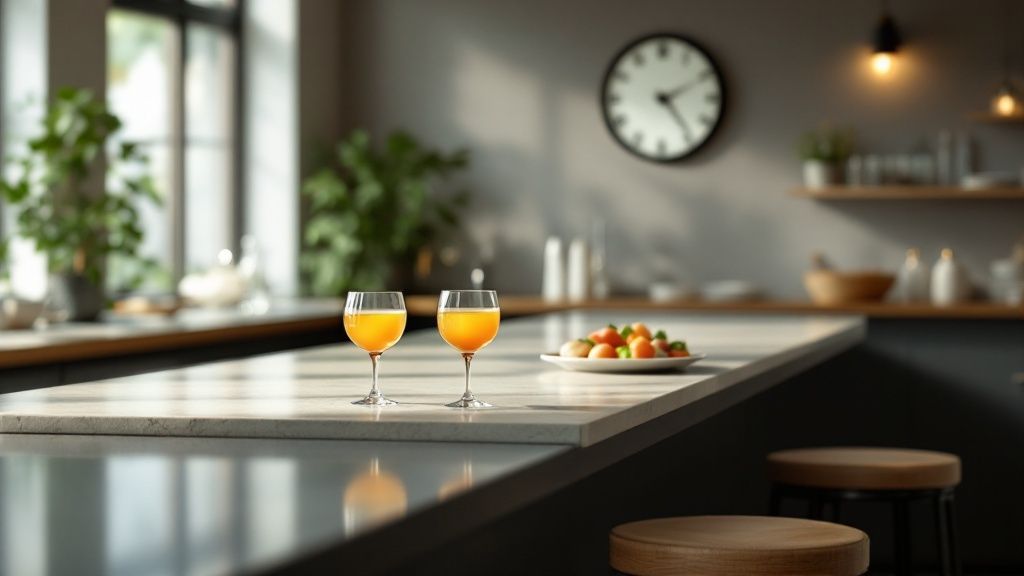
From my experience driving growth, the key is to view happy hour not just as a discount, but as a strategic tool to alter customer behavior. Chains like Applebee's, with its half-price appetizers after 9 PM, successfully captured a late-night crowd that might otherwise go elsewhere. The goal is to create a compelling, urgent offer that builds a habit.
How to Implement a High-Impact Happy Hour
To maximize your return on investment, a data-driven approach is essential. Don't just copy a competitor; engineer your happy hour for profitability.
- Strategic Scheduling: Analyze your point-of-sale (POS) data to identify your slowest hours with pinpoint accuracy. This is typically between 3 PM and 6 PM on weekdays. Scheduling your promotion during these specific times directly addresses your revenue gaps.
- Menu Engineering: Focus your discounts on high-margin, low-labor items. Think craft cocktails, house wines, and shareable appetizers that require minimal prep. This protects your overall profit margins while still offering an attractive deal to customers.
- Upselling and Cross-Selling: Your staff is your most valuable asset here. Train them to see happy hour as the start of the conversation, not the end. A simple prompt like, “Would you like to pair your discounted craft beer with our signature sliders?” can easily transition a happy hour guest into a full-paying dinner customer.
- Digital Promotion: Create a sense of daily excitement. Use your social media channels and email lists to announce daily or weekly happy hour specials. This not only reminds your followers of the offer but also creates a "fear of missing out" (FOMO) that drives immediate traffic.
2. Loyalty Programs and Rewards
Acquiring a new customer can cost five times more than retaining an existing one. Loyalty programs are among the most powerful restaurant promotions that work because they directly address this reality. They formalize the customer relationship by rewarding repeat business with tangible benefits like points, discounts, and exclusive items. This not only encourages retention but transforms your customer base into a predictable revenue stream and a rich source of behavioral data for targeted marketing.
From my experience, the true value of a loyalty program isn't just the repeat visits; it's the data. Brands like Starbucks and Panera have built empires by understanding customer preferences through their rewards programs, allowing them to personalize offers at scale. The goal is to create a value exchange where customers feel recognized and rewarded, making it a frictionless choice to return.
How to Implement a High-Impact Loyalty Program
A successful loyalty program should feel less like a transaction and more like a relationship. It's about making your best customers feel valued and giving them a reason to choose you over a competitor every single time.
- Effortless Enrollment: Make signing up simple and immediately rewarding. Offer a compelling incentive for joining, such as a free appetizer or drink on their next visit. The lower the barrier to entry, the higher your adoption rate will be.
- Data-Driven Personalization: Use the purchasing data collected through your program to send personalized offers. If a customer frequently orders a specific dish, send them a "buy one, get one" offer for that item. This shows you're paying attention and makes the rewards more meaningful.
- Mobile Integration: A modern loyalty program must be mobile-first. Integrate it with a mobile app for easy point tracking, ordering, and redemption. This convenience is no longer a luxury; it’s an expectation for today's consumers.
- Delight with Surprises: Beyond a predictable point system, incorporate surprise-and-delight rewards. A random free dessert or an unexpected discount can create a memorable experience that fosters genuine brand affinity and drives long-term success. These strategies are crucial for improving your customer lifetime value; explore more on how to increase customer lifetime value on mgxgrowth.com.
3. Social Media Contests and User-Generated Content
Social media contests are a powerful way to transform your customers into an active, volunteer marketing force. This strategy incentivizes patrons to create and share content featuring your restaurant in exchange for a prize, turning their personal social feeds into valuable advertising space. It’s one of the most effective restaurant promotions that work because it generates authentic social proof and builds a community around your brand, driving organic reach far beyond what paid ads can achieve alone.
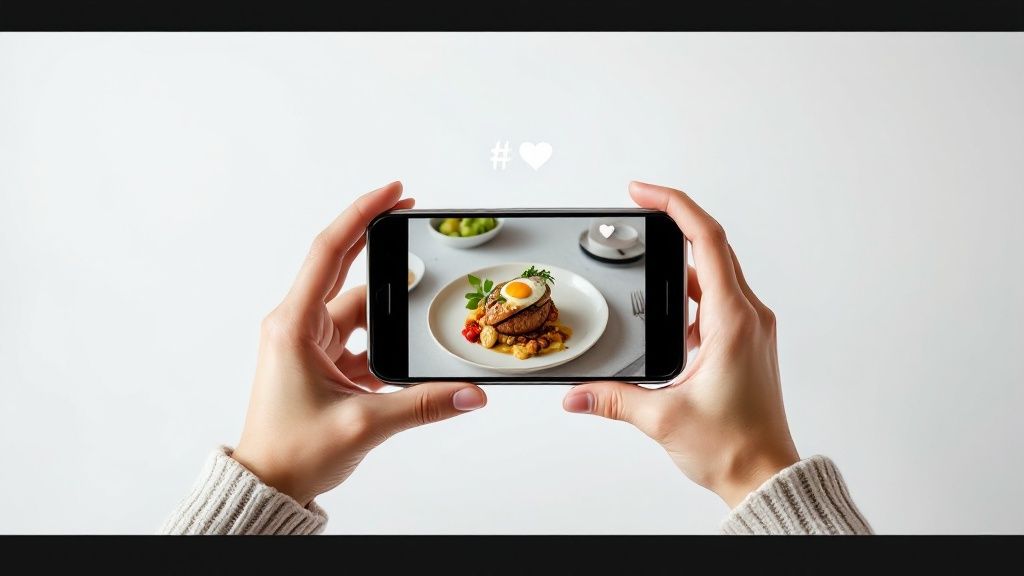
From my growth marketing experience, the real value here isn't just the contest; it's the treasure trove of user-generated content (UGC) you acquire. Brands like Taco Bell and Wendy's have mastered this by building campaigns that feel less like corporate advertising and more like a fun, interactive conversation with their audience. The goal is to make participation irresistible and sharing your brand a badge of honor for your customers.
How to Launch a Winning Social Media Contest
A successful UGC campaign is built on simplicity and clear value exchange. Don't just ask for content; create an experience your customers are excited to be a part of.
- Create Simple, Compelling Rules: The barrier to entry must be low. A "tag a friend and follow us to win a $50 gift card" or "share a photo of your meal with #YourBrandHere" contest is easy to understand and execute. Complex rules will kill participation before it starts.
- Use a Branded Hashtag: A unique, memorable hashtag is non-negotiable. It allows you to track all entries, creates a searchable gallery of UGC, and reinforces your brand identity with every post.
- Offer an Attractive Prize: The prize must be valuable enough to motivate action. This doesn't have to be expensive; free dinners for a month, exclusive merchandise, or a private tasting event can generate more excitement than a simple cash prize.
- Engage and Amplify: Your role is to be an active participant. Like, comment on, and share entries throughout the contest. When it's over, celebrate the winner publicly and repurpose the best UGC across your website, emails, and in-store displays to maximize its value.
4. Limited-Time Offers (LTOs)
Limited-Time Offers (LTOs) are one of the most powerful restaurant promotions that work because they leverage a core psychological driver: scarcity. By introducing special menu items or deals available for a finite period, you create a compelling sense of urgency that disrupts routine customer behavior and drives immediate visits. This strategy is perfect for generating buzz, testing new menu concepts without long-term commitment, and keeping your brand fresh and exciting.
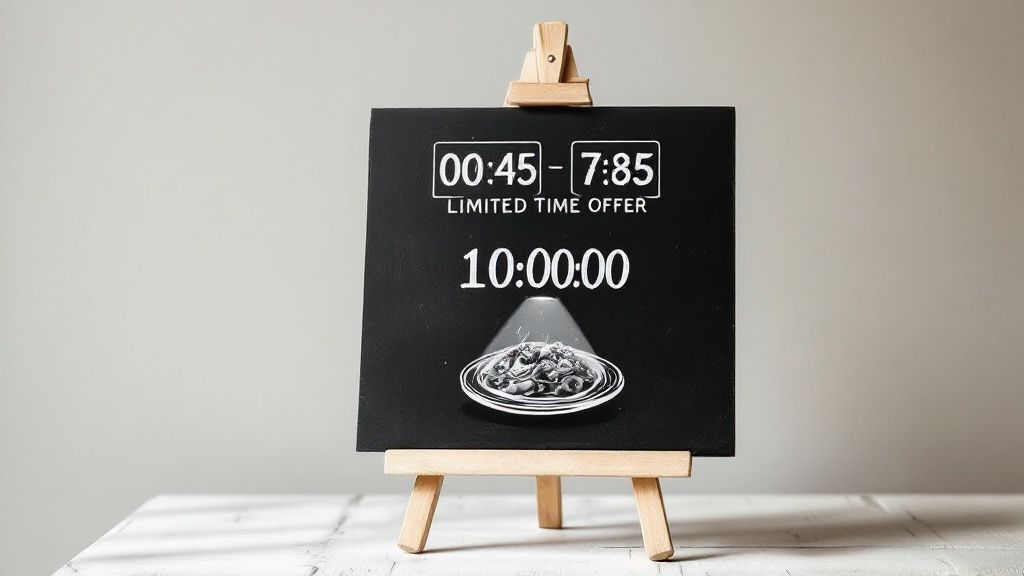
In my experience scaling brands, LTOs are a growth engine disguised as a promotion. The periodic return of McDonald's McRib or the seasonal frenzy for Starbucks' Pumpkin Spice Latte are masterclasses in manufactured demand. These aren't just menu items; they are cultural events that drive immense traffic and free press, transforming a simple offer into a highly anticipated, revenue-generating tradition.
How to Implement a Profitable LTO Strategy
A successful LTO is a carefully orchestrated campaign, not just a new item on the menu. The goal is to maximize impact while controlling operational complexity and cost.
- Create genuine urgency: Clearly define and communicate the offer's end date. Use countdown timers in your emails, on your website, and in social media posts. Language like "Available until Sunday!" or "Only 100 available" creates the fear of missing out (FOMO) that compels action.
- Leverage social media: LTOs are made for visual platforms like Instagram. Invest in high-quality photos and videos of your limited-time item. Encourage user-generated content by creating a unique hashtag and running a contest for the best photo, turning your customers into brand ambassadors.
- Strategic inventory management: Before launch, carefully forecast demand based on past data and market trends to plan your inventory. It's a delicate balance; stocking out too early creates disappointment, but overstocking leads to waste and erodes profitability.
- Empower your team: Your staff must be your LTO champions. Equip them with talking points, train them on the unique selling propositions of the item, and incentivize them to upsell it. A simple prompt like, “Have you tried our new seasonal truffle burger? It’s only here for two more weeks,” can significantly boost take rates.
5. Influencer and Local Partnership Marketing
Modern marketing thrives on trust, and third-party endorsements are one of the most powerful ways to build it. Partnering with local food influencers, bloggers, and non-competing businesses is a highly effective restaurant promotion that works by leveraging established credibility. This strategy taps into existing, engaged audiences, allowing you to bypass the noise of traditional advertising and receive an authentic recommendation from a trusted source. It’s about borrowing authority to build your own.
From my experience scaling brands, the most successful partnerships feel like genuine collaborations, not transactional ads. When a local food blogger with a loyal following raves about your new seasonal dish, their audience sees it as a recommendation from a friend. Similarly, a partnership with a nearby gym offering a post-workout discount builds a direct pipeline of health-conscious customers. This approach transforms marketing into community-building, creating authentic connections that drive both foot traffic and brand loyalty.
How to Implement a High-Impact Partnership Strategy
To ensure your collaborations deliver a strong ROI, you must be strategic in your selection and execution. It’s about finding the right fit and creating mutual value.
- Identify Synergistic Partners: Look beyond just follower counts. Use demographic data to find influencers whose audience mirrors your ideal customer profile. For local businesses, consider partnerships with hotels, theaters, or corporate offices that can drive consistent traffic. A micro-influencer with 5,000 highly engaged local followers is often more valuable than a macro-influencer with 100,000 disinterested ones.
- Define Clear, Mutual Wins: Approach partnerships with a clear proposal of what’s in it for them. For influencers, this could be a hosted meal and creative freedom. For a local business, it might be a reciprocal promotion to your email list. The goal is a long-term, mutually beneficial relationship, not a one-off post.
- Empower Creative Freedom: Provide your partners with key talking points and brand guidelines, but avoid overly restrictive scripts. The value of an influencer is their unique voice and authentic connection with their audience. Allow them the creative freedom to present your restaurant in a way that feels natural to their followers.
- Track and Measure Performance: Use unique discount codes, custom landing pages, or ask customers how they heard about you to measure the direct impact of each partnership. This data is crucial for identifying which collaborations are driving real business and helps refine your strategy for future campaigns. To get the most out of your campaigns, you might want to consider working with a restaurant marketing agency to optimize your efforts.
6. Email Marketing Campaigns
In an era of fleeting social media trends, email marketing remains one of the most powerful and direct restaurant promotions that work. It's your privately owned communication channel, allowing you to bypass algorithms and speak directly to your most loyal customers. By delivering personalized offers, event news, and menu updates straight to their inboxes, you build a durable relationship that drives repeat business and fosters genuine brand loyalty. This strategy isn't about spamming; it's about providing consistent value that keeps your restaurant top-of-mind.
From my experience scaling customer retention programs, I've seen that the highest ROI comes from owned audiences. While social media is for discovery, email is for nurturing. A well-segmented email list is a direct revenue driver. For example, Olive Garden's famous birthday offers are a masterclass in personalized, trigger-based marketing that creates an immediate and compelling reason to visit.
How to Implement a High-Impact Email Campaign
To turn your email list into a consistent revenue stream, you need a disciplined, data-informed strategy. Avoid generic blasts and focus on delivering the right message to the right person at the right time.
- Segment Your Audience: Don't treat every subscriber the same. Use your POS and reservation data to create segments based on visit frequency, average spend, or menu preferences (e.g., "wine lovers," "brunch regulars"). This allows you to send hyper-relevant offers that are far more likely to convert.
- Craft Compelling Subject Lines: Your subject line is the gatekeeper to your message. Use action-oriented, intriguing, and personalized language to boost open rates. A subject like "Your Table is Waiting, [Name]" or "A Special Treat for Your Birthday" is far more effective than "Our Weekly Newsletter."
- Embed Clear Calls-to-Action (CTAs): Every email should have a clear purpose. Whether it's "Book a Table," "View Our New Menu," or "Claim Your 20% Off," your CTA should be prominent and direct, guiding the customer effortlessly toward the desired action.
- Automate and Personalize: Set up automated campaigns for birthdays, anniversaries, or a "we miss you" message for lapsed customers. This creates a personalized touch at scale and ensures you never miss an opportunity to re-engage a valuable patron. Learn more about how this integrates into a broader strategy from this guide on restaurant digital advertising.
7. Group Dining and Event Packages
Group dining and event packages are one of the most powerful restaurant promotions that work for maximizing revenue per square foot. This strategy bundles food, beverages, and services into tiered offerings for large parties, transforming your dining room into a predictable, high-margin event space. By creating structured packages, you streamline the sales process, guarantee revenue in advance, and lock in significant sales from a single booking, which is far more efficient than serving individual tables.
From my experience in hospitality growth, I've seen that the most successful restaurants treat events not as a side business, but as a core revenue stream. They move beyond just taking reservations to proactively selling experiences. For instance, a steakhouse offering a "Corporate Power Lunch" package with a prix-fixe menu, private room, and A/V equipment can dominate the local business lunch market. It's about solving a customer's problem-in this case, event planning-before they even have to ask.
How to Implement Profitable Event Packages
To truly capitalize on group dining, you must shift from a reactive to a proactive sales mindset. Build systems that make booking easy for the customer and profitable for you.
- Create Tiered, All-Inclusive Packages: Design clear, easy-to-understand packages for different needs and budgets (e.g., Bronze, Silver, Gold). Include per-person pricing that covers the menu, beverages, service fees, and gratuity. This simplifies the decision-making process for planners and protects your margins.
- Designate an Event Coordinator: Assign a single point of contact for all event inquiries. This person is your internal sales engine, responsible for responding to leads, customizing packages, coordinating with the kitchen, and ensuring a flawless event. This professionalizes the service and builds trust.
- Leverage Off-Peak Times: Market your private dining spaces and event packages for weekday afternoons, Sunday evenings, or other historically slow periods. Offering a slight discount for booking during these times can turn zero-revenue hours into some of your most profitable.
- Build a Follow-Up System: The booking doesn't end when the party leaves. Implement a system to follow up with event organizers for feedback. A simple "thank you" email with a small incentive for their next booking can turn a one-time event into a long-term corporate account or a source of recurring family celebrations.
8. Community Event Participation and Local Sponsorships
Beyond the four walls of your establishment, one of the most powerful restaurant promotions that work involves embedding your brand directly into the fabric of your local community. Participating in events and sponsoring local teams or causes is a grassroots marketing strategy that builds goodwill, brand loyalty, and direct customer relationships. This approach shifts the focus from transactional discounts to creating an emotional connection, turning your restaurant into a recognized and respected neighborhood institution.
From my experience, I've seen that modern consumers, especially younger demographics, actively choose to support businesses that align with their values and invest in their local area. When a family-owned pizzeria sponsors the local little league, they aren't just getting their logo on a jersey; they are becoming part of cherished community memories. This long-term brand building generates a level of loyalty that a simple 10% off coupon can never achieve.
How to Implement High-Impact Community Engagement
To ensure your community efforts translate into tangible business growth, your approach must be strategic, authentic, and well-executed. This isn't just about writing a check; it's about active, visible participation.
- Align with Your Audience: Choose events and sponsorships that resonate with your target customer demographic. If you're a family-friendly diner, sponsoring school events or youth sports is a natural fit. A trendy, upscale bistro might find more value in sponsoring a local art festival or a charity gala.
- Create an On-Site Presence: Don't just sponsor; participate. Set up a branded booth at a county fair or farmer's market. Prepare attractive, easy-to-eat samples of your signature dishes. The goal is face-to-face interaction that allows potential customers to experience your food and hospitality firsthand.
- Train Brand Ambassadors: Your staff working at these events are the face of your brand. Train them to be more than just servers; they should be engaging storytellers who can speak passionately about your restaurant's mission, menu, and community commitment.
- Capture Leads for Future Marketing: Use your presence as an opportunity to build your marketing list. Offer a small incentive, like a free appetizer voucher, in exchange for customers signing up for your email or text message list. This turns a one-time interaction into a long-term marketing channel.
Effective Promotion Strategies Comparison of 8 Key Restaurant Tactics
| Strategy | Implementation Complexity 🔄 | Resource Requirements ⚡ | Expected Outcomes 📊 | Ideal Use Cases 💡 | Key Advantages ⭐ |
|---|---|---|---|---|---|
| Happy Hour Promotions | Medium – scheduling and pricing management required | Moderate – staff training and marketing | Increased off-peak traffic and repeat visits | Slow business hours, beverage-focused menus | Drives revenue during slow periods, builds loyalty |
| Loyalty Programs and Rewards | High – technology setup and management needed | High – app development, data analytics | Enhanced customer retention and data collection | Businesses seeking long-term customer value | Increases lifetime value, personalized marketing |
| Social Media Contests and UGC | Medium – active social media management | Low to Moderate – digital content and prize costs | Increased engagement and organic brand awareness | Brands focusing on social presence and engagement | Cost-effective, builds community and authentic content |
| Limited-Time Offers (LTOs) | Medium – planning and marketing coordination | Moderate – marketing and inventory control | Immediate sales boost and menu experimentation | Seasonal menus or product launches | Creates urgency, generates buzz and repeat visits |
| Influencer & Local Partnership | Medium to High – partner vetting and collaboration | Moderate to High – influencer fees and coordination | Expanded audience reach and brand credibility | Targeted marketing and community connection | Builds trust, cost-effective vs traditional ads |
| Email Marketing Campaigns | Medium – content creation and list management | Low to Moderate – email platform and content | Direct customer communication and increased repeat business | Businesses with established customer lists | High ROI, trackable metrics, personalized offers |
| Group Dining and Event Packages | High – logistics, staffing, and space coordination | High – dedicated staff and setup | Higher transaction value, steady revenue from events | Large groups, events, corporate gatherings | Increases average check, builds relationships |
| Community Event Participation & Sponsorships | Medium – staff time and event coordination | Moderate – event fees and samples | Strong community loyalty and positive brand image | Local engagement and grassroots marketing | Builds goodwill, direct customer interaction |
From Strategy to Execution: Architecting Your Growth Engine
We have navigated through a tactical playbook of eight powerful promotional frameworks, from the consistent draw of Happy Hours to the community-building power of local sponsorships. Each of these represents a proven lever for driving foot traffic, increasing check sizes, and building brand loyalty. But true, sustainable growth is never about pulling one lever in isolation.
The most critical takeaway is that isolated tactics produce isolated results. The real competitive advantage is architected when these strategies are woven into an integrated, data-driven system. Think of it as a closed-loop ecosystem: your Loyalty Program generates the first-party data that fuels hyper-personalized Email Marketing campaigns. Your Social Media Contests and partnerships generate the user-generated content that provides social proof, driving the success of your next Limited-Time Offer. This is how you build a flywheel, not just a series of one-off campaigns.
The Shift from Tactics to a Growth System
In my experience advising companies from SaaS to hospitality, the most common mistake is viewing promotions as a short-term patch for slow periods. This is a reactive, low-leverage mindset. The leaders who win market share reframe this entirely. They see restaurant promotions that work not as a fix, but as a strategic tool for customer lifecycle management and data acquisition.
Key Insight: A promotion's success isn't just measured in the revenue it generates today, but in the customer data and loyalty it builds for tomorrow.
To make this transition, you must break down the silos between marketing, operations, and finance. Your front-of-house team needs to understand the "why" behind a new LTO to execute it flawlessly. Your finance team needs to see the data connecting a loyalty program investment to increased customer lifetime value. This alignment is where the magic happens; it turns your restaurant into a well-oiled growth machine where every component works in concert.
Actionable Next Steps: Building Your Engine
Your path forward is about disciplined execution and relentless optimization.
- Audit and Select: Don't try to implement all eight strategies at once. Analyze your current business challenges and customer data. Are you struggling with new customer acquisition? Prioritize Influencer Partnerships and Community Events. Is repeat business the issue? Double down on a tech-enabled Loyalty Program.
- Define and Measure: For every promotion you launch, define your key performance indicators (KPIs) upfront. Go beyond top-line revenue. Track customer acquisition cost (CAC), visit frequency, and customer lifetime value (CLV).
- Iterate with Data: Use the data from every campaign to learn and refine. Was the offer compelling? Was the redemption process seamless? Leverage analytics to move from guessing what your customers want to knowing what drives their behavior.
Ultimately, the strategies detailed in this article are the building blocks. Your real, defensible moat is the operational excellence and data-obsessed culture you build around them. The era of "spray and pray" marketing is definitively over. The future belongs to the operators who can execute an integrated, customer-centric, and data-informed growth strategy at scale.
Ready to move from tactical promotions to architecting a predictable growth engine? At MGXGrowth, we partner with leadership teams to implement these data-driven systems, break down internal silos, and turn strategic concepts into measurable, bottom-line results. Visit MGXGrowth to see how we can help you build your competitive advantage.
