


Great food is table stakes. To build a restaurant that doesn't just survive but systematically dominates its market, you need a disciplined, data-driven approach to branding and marketing. It’s about engineering a memorable identity and executing proven growth strategies to drive foot traffic, foster loyalty, and ultimately, protect your P&L.
This is the operational system that separates scalable brands from businesses that are merely selling food.
Building Your Foundation in a Crowded Market

I'm Mikhail Gaushkin. For decades, I’ve been in the trenches driving revenue and market share growth across hyper-competitive sectors like hospitality, SaaS, and real estate. The common thread is always the same: sustainable success is never accidental. It's engineered.
The restaurant industry is notoriously unforgiving. Margins are razor-thin, and the operational pressures are immense. I see it constantly—talented operators pour their capital and energy into perfecting the menu, operating under the assumption that a superior product is all it takes to guarantee nightly demand.
My P&L experience tells a different story. The brands that achieve breakout velocity are those that integrate a quality product with an unforgettable identity and a data-driven marketing engine. They aren't just selling food; they are delivering a consistent, repeatable experience that connects with a specific customer segment on an economic and emotional level.
Moving Beyond Generic Advice
This guide is not a list of generic tips. It’s the integrated growth playbook I’ve deployed to break down silos and unlock measurable growth. My objective is to provide a blueprint for building a resilient, profitable restaurant that doesn't just attract customers, but converts them into high-value, long-term assets.
We will focus on the pillars that support a high-growth restaurant:
- Defining your core brand story to build a defensible moat against competitors.
- Pinpointing your ideal customer with precision, using quantitative and qualitative data.
- Selecting marketing channels that deliver the highest, most measurable return on ad spend (ROAS).
Let's be pragmatic. The market is saturated. While U.S. restaurant and foodservice sales were projected to reach $1.5 trillion in 2023, the average net profit margin remains dangerously low, hovering between 3% and 5%. The top decile performers might touch 10%. The data is clear: an exceptional culinary product must be amplified by strategic branding and marketing to achieve meaningful profitability. You can analyze these restaurant industry statistics to quantify the competitive landscape.
In my experience, the greatest barrier to growth isn't competition—it's obscurity. A strong brand is your weapon against being forgotten. It's the cohesive story that aligns your team, attracts your target audience, and ultimately, protects your bottom line.
This is about building a scalable asset, not just a lifestyle business. It's about engineering a brand so compelling it becomes a destination.
Let’s get to work.
Defining Your Core Brand Identity Beyond the Menu
What is the first association a customer makes with your restaurant? If it's merely a logo or a single dish, you have a critical vulnerability. Your brand is the net sentiment a customer holds about your business—it’s the promise you make the moment they encounter you, and the operational discipline you exhibit in keeping it, every single day.
Too many restaurateurs execute this backward. They jump straight to tactical outputs—logos, color palettes, decor—before completing the essential strategic work. A strong identity is not a creative exercise; it is the foundational logic upon which all marketing and operational decisions must be built. Without it, you are relegated to competing on price and location alone.
Pinpoint Your "Why"
Before a single dollar is spent on design, you must codify your "why." This is your mission. It is the core reason for your existence beyond generating profit, and it must inform everything from menu architecture to staff training protocols.
Assemble your leadership team and address these questions with intellectual honesty:
- What specific problem are we solving for a specific customer segment? (e.g., a high-quality, expedient lunch for time-poor professionals?)
- What unique experience can we deliver that is difficult for competitors to replicate? (e.g., an immersive escape to coastal Italy.)
- If we ceased to exist tomorrow, what tangible value would the market lose?
The answers form the bedrock of your brand promise. It's not just about what you do; it's about the value you create.
The brands I've seen weather market downturns and competitive threats are those anchored by a clear mission. When your team internalizes the "why," they shift from executing tasks to delivering on a promise. Customers feel that operational alignment instantly.
To operationalize this, you need a process to translate abstract ideas into tangible assets. This workflow illustrates the path from market research to a functional brand guide.
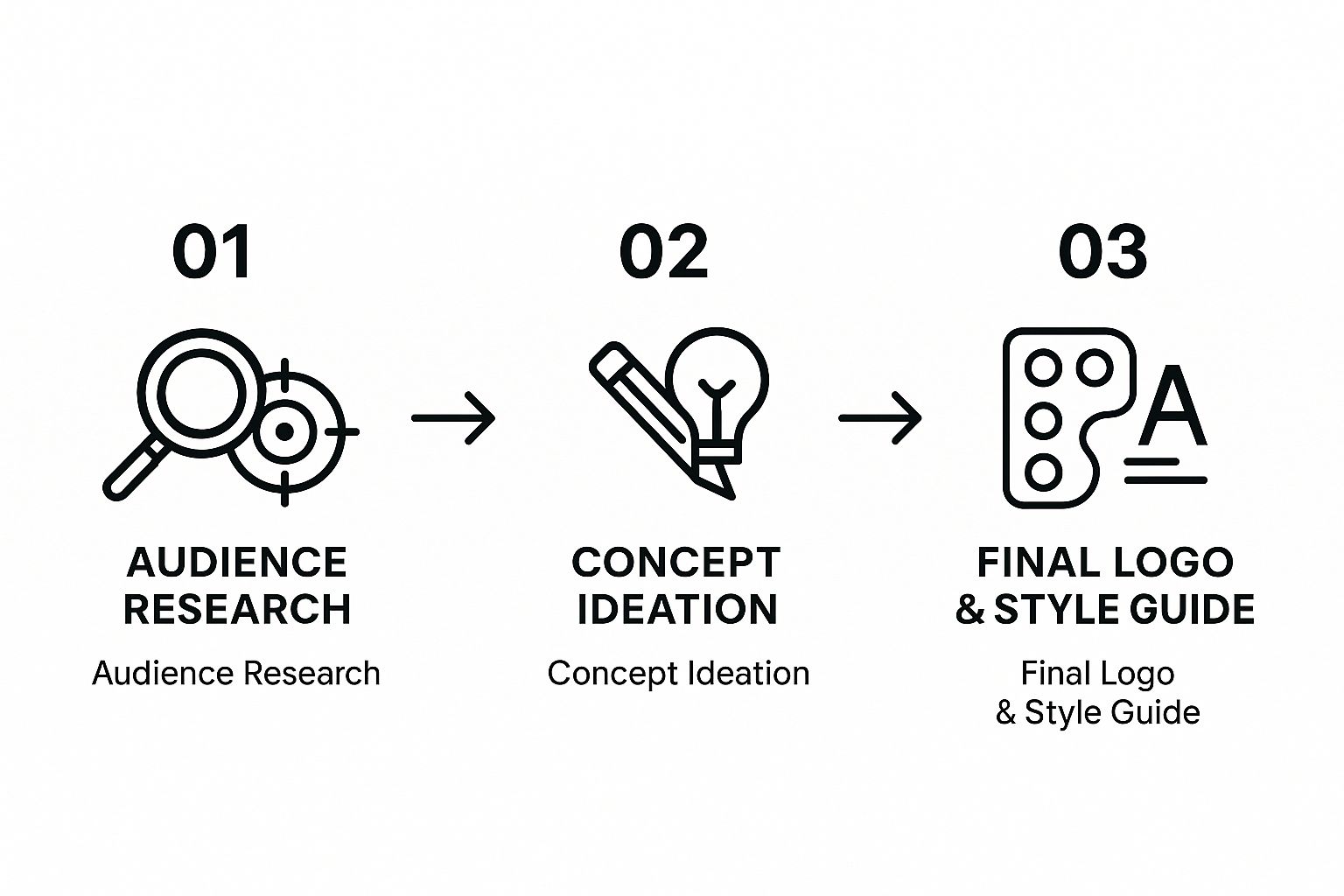
Adhering to a structured flow—from customer intelligence to a finalized style guide—ensures your brand is built on sound strategy, not subjective preference.
To translate your core principles into a tangible identity, here’s a framework that deconstructs the process.
Brand Identity Framework From Mission to Message
This step-by-step framework translates your restaurant's core principles into a tangible brand identity that governs all marketing execution.
| Framework Component | Key Question to Answer | Practical Example (Farm-to-Table Bistro) |
|---|---|---|
| Mission (Your "Why") | Why do we exist beyond making money? | "To reconnect our community with the source of their food and celebrate local farmers." |
| Vision | What future are we working to create? | "To be the neighborhood's most trusted destination for fresh, seasonal, and sustainable dining." |
| Values | What principles guide our actions and decisions? | "Community, Transparency, Sustainability, Craftsmanship." |
| Audience Persona | Who is our specific target customer? | "The 'Conscious Foodie,' Sarah (35), who values quality ingredients and an authentic story." |
| Brand Voice | What is our communication style? | "Warm, educational, and passionate. Like a trusted farmer at the market." |
| Value Proposition | Why should they choose us over all alternatives? | "We offer a true farm-to-table experience where every dish tells the story of its local origin." |
| Key Message | What is the single most important idea we want them to remember? | "Taste the difference that local makes." |
Employing a structured approach like this ensures that every brand touchpoint, from your mission statement to a social media caption, is consistent and authentic.
Build Your Ideal Customer Persona
This is a frequent point of failure. Restaurants attempt to appeal to everyone. Consequently, they resonate with no one. You must achieve laser-focus on your ideal customer—and this requires moving far beyond basic demographics.
You must dissect their psychographics:
- Values: Do they prioritize sustainability, convenience, or pure indulgence?
- Motivations: What job-to-be-done are they hiring your restaurant for? A celebration, a quiet workspace, a frictionless family meal?
- Aspirations: What is their desired self-image? How does dining with you affirm that identity?
Consider a fast-casual vegan concept. Their target is not merely "vegans." Their ideal customer profile might be the "Health-Conscious Professional"—a 30-year-old who is time-poor but unwilling to compromise on ingredient quality or ethical sourcing. Every decision, from minimalist decor to a frictionless mobile ordering app, must be engineered for this specific persona. Mastering this is a cornerstone of effective restaurant branding and marketing.
Forge Your Unique Value Proposition
You have codified your "why" and defined your target customer. Now, you must articulate your unique value proposition (UVP). This is a clear, concise statement answering one critical question: "Why should our target customer choose us over any competitor?"
This is not a marketing tagline. It is an internal strategic directive. An effective UVP fuses your core competency with your target customer's primary need. To understand how this central idea fuels your entire marketing apparatus, I’ve detailed the link between branding and content marketing.
For a family-owned pizzeria, a powerful UVP might be: "We provide busy families a welcoming space to connect over authentic, handcrafted pizza without financial stress." This single sentence defines the audience (families), the experience (welcoming), the product (handcrafted pizza), and the benefit (connection and value). This level of strategic clarity is your most potent competitive weapon.
Building a High-ROI Marketing Mix
Once your brand identity is locked, it's time to amplify it. This is where most operators err. They adopt a "spray and pray" methodology, allocating budget across numerous channels hoping for a positive outcome. That is not a strategy; it is a costly gamble.
Sustainable growth is a function of precision, not volume. Constructing a marketing mix that generates a high return on investment (ROI) is not about doing more, but about executing the right initiatives, for the right audience, on the right platforms. It requires a deliberate, analytical approach to channel selection.
Align Tactics With Your Restaurant Model
Your marketing playbook must be custom-engineered for your specific business model. The tactics that generate significant returns for a high-volume quick-service restaurant (QSR) will unequivocally fail for an intimate fine-dining establishment. Their core business objectives are fundamentally different.
A QSR's success hinges on speed, convenience, and value. Its marketing must be direct and transactional.
- Local SEO: Dominating "pizza near me" search queries is paramount. A fully optimized Google Business Profile is your most valuable digital asset.
- Mobile App Promotions: A robust loyalty program with app-exclusive offers is the mechanism for driving repeat purchases and increasing order frequency.
- Geofenced Ads: Targeting mobile devices within a specific radius of your location is a proven method for triggering impulse purchases.
A full-service restaurant, conversely, sells a holistic experience. The marketing must reflect this, focusing on building desire through ambiance and narrative. The customer's decision journey is longer and more emotionally driven. You must nurture this process with high-fidelity, immersive content on platforms like Instagram and Pinterest, which are optimized for visual storytelling. You are not just marketing food; you are marketing an atmosphere.
I’ve always operated under the principle that a marketing budget is an investment portfolio. You wouldn't put all your money into one stock, nor would you spread it randomly across hundreds. You allocate capital to assets with the highest potential return based on your specific goals. Marketing is no different.
Understanding these distinctions is critical for efficient capital allocation. Consider the market data: the full-service restaurant segment is projected to grow to $1.97 trillion by 2032, driven by consumer demand for unique dining experiences. The QSR segment is forecast to reach $381.79 billion by 2033, with a higher growth rate fueled by technology and convenience. These are disparate market dynamics requiring distinct strategic plans. Analyzing these global restaurant industry trends and statistics is essential for sharpening your strategy.
Create an Integrated System
Optimal marketing is not a collection of siloed activities. It is an interconnected system where each channel amplifies the others. Silos are the enemy of growth. Your digital advertising should drive traffic to a website optimized for lead capture. Your email marketing should promote an in-person event. That event should generate user-generated content for your social media. This creates a self-reinforcing growth flywheel.
An integrated system in practice:
- Awareness (Top of Funnel): Leverage platforms like Instagram or TikTok. Use high-quality video to articulate your brand story and showcase the atmosphere. Execute targeted ad campaigns to reach your ideal customer profile during their discovery phase.
- Consideration (Middle of Funnel): Direct traffic to your website or Google Business Profile. Here, potential customers conduct their due diligence—reviewing your menu, reading social proof (reviews), and assessing the experience you offer. This is the trust-building phase.
- Conversion (Bottom of Funnel): Engineer a frictionless path to booking a table or placing an order directly from your site. Deploy retargeting ads to re-engage users who visited your site but did not convert.
- Loyalty (Post-Conversion): Capture customer data (email or phone number) at the point of transaction. Nurture this relationship with exclusive offers and content that reinforces their status as an insider.
This systematic approach ensures you are not just capturing attention; you are guiding prospects down a defined conversion path that culminates in a reservation and, critically, repeat business. For more tactical ideas, consult our guide on the best marketing ideas for restaurants.
Ultimately, your marketing mix must be dynamic. It requires continuous testing, measurement, and reallocation of budget based on performance data. This is how you transition from spending on marketing to strategically investing in your restaurant’s growth engine.
Mastering the Digital Customer Journey
Across every industry I've operated in, one axiom holds true: you must meet your customers where they are. For restaurants today, that initial meeting point is not the host stand. It is on their mobile device, typically during a moment of high purchase intent. The customer journey from stranger to loyal advocate begins long before they see your physical location—it starts with a search, a tap, or a scroll.
Your digital presence is not an adjunct to your physical space; it is your new front door. A poorly managed online profile is the digital equivalent of a dirty, unwelcoming storefront. It signals operational sloppiness and will cost you revenue before you ever have a chance to compete.
Optimizing Your Digital Storefront
The initial battle is won or lost in local search. When a user queries "best tacos near me," the restaurants that command the top search positions gain a decisive competitive advantage. Winning this moment is a critical component of modern restaurant branding and marketing.
Your website and your Google Business Profile (GBP) are the two pillars of this digital storefront. Your website must be mobile-first, load instantly, and be optimized for conversion—meaning the menu and reservation/ordering functions are frictionless. However, for initial discovery, your GBP is arguably more critical. It must be flawless.
This requires:
- Complete and Accurate Information: Hours, address, and phone number must be 100% accurate. Inaccuracies create friction and destroy trust.
- High-Quality Photography: Showcase your product, ambiance, and atmosphere. Online, visual data is the primary driver of consideration.
- Active Review Management: Respond to every review—positive and negative. This demonstrates that you are actively listening to customer feedback and are committed to operational excellence.
A meticulously maintained GBP is not merely a directory listing; it's a powerful signal to both customers and search algorithms that you are a relevant, active, and trustworthy local business. It is a non-negotiable component of any effective digital marketing strategy framework.
Reimagining Social Media as a Community Hub
Too many operators view social media as a one-way broadcast channel for food photography. This is a significant strategic error. Your social channels should not be a monologue; they must facilitate a dialogue. The primary objective is not to accumulate followers, but to cultivate a genuine community around your brand.
A billboard interrupts; a community invites. This mental model shift should transform your content strategy. Instead of simply broadcasting promotional messages, you begin to tell stories. Showcase the controlled chaos of the kitchen, introduce the team members behind the experience, and share the provenance of your ingredients.
I’ve seen countless brands unlock explosive growth by reframing their social media from a sales channel to a community platform. When you give people a reason to care about your story, they stop being customers and start being advocates. That's a force multiplier no ad budget can buy.
The data corroborates this imperative. 72% of consumers use social media to research restaurants, and 68% consult a restaurant’s social media before making a dining decision. When combined with the fact that 88% of patrons trust online reviews as much as personal recommendations, it becomes clear that your social presence is a mission-critical asset.
Leveraging Social Proof and User-Generated Content
Your most potent marketing assets are not on your payroll; they are the customers who become advocates for your brand. Actively encouraging and amplifying user-generated content (UGC) is one of the highest-ROI strategies available. When a customer posts a positive photo and tags your restaurant, it serves as an authentic, third-party endorsement to their entire network.
You can systematically encourage this behavior:
- Create "Instagrammable" Moments: Engineer elements into your experience—a uniquely plated dish, a signature piece of decor, visually striking cocktails—that are inherently shareable.
- Feature Customer Photos: Systematically repost the best UGC on your own channels (with attribution). This rewards your most vocal fans and signals that you value their contribution.
- Run Contests or Giveaways: A simple campaign prompting users to share their favorite memory at your restaurant can generate a significant volume of positive content and engagement.
By transforming your restaurant into a stage for your customers' narratives, you create a powerful flywheel of social proof. This authentic content builds trust far more effectively than any corporate advertisement. It is the mechanism by which you convert online discovery into offline revenue and, ultimately, into durable customer loyalty.
4. Measuring What Matters to Prove Your ROI
I have seen it countless times: a restaurant's marketing budget is the first line item to be cut during a downturn. This happens for one reason: marketing is perceived as an expense, not a revenue-generating investment. That perception only exists when marketing fails to demonstrate its value in the only language that matters to the C-suite: financial return.
A core principle I operate by is: if you can't measure it, you can't manage it. Allocating capital to marketing without rigorous tracking is just expensive guesswork. This is where we connect brand-building activities directly to financial outcomes. We will move past vanity metrics like 'likes' and 'followers' and focus exclusively on the numbers that impact the P&L.
Defining Your Key Performance Indicators
First, you must define what you will measure. These are your Key Performance Indicators (KPIs). Think of them as the vital signs of your restaurant's commercial health. Avoid the trap of tracking everything; the objective is to isolate the few critical metrics that directly link marketing activities to business results.
A well-defined set of KPIs acts as a business dashboard, providing an at-a-glance view of what is working and what is not.
- Average Check Size: The average revenue generated per customer transaction. A successful campaign promoting premium menu items should directly increase this metric.
- Table Turnover Rate: The efficiency with which you can seat, serve, and reset a table. While primarily an operational metric, a well-timed "happy hour" promotion can significantly improve this during off-peak hours.
- Reservation vs. Walk-in Rates: Are visits planned or spontaneous? Tracking this ratio helps you understand demand patterns and measure the direct impact of a reservation-driving campaign on platforms like OpenTable.
When you analyze these operational numbers through a marketing lens, you begin to see a clear narrative about which campaigns are driving the most profitable customer behaviors.
Calculating CAC and CLV: The Two Most Important Metrics
Now, let's get to the core financial model. To truly understand the ROI of your marketing, you must master two metrics: Customer Acquisition Cost (CAC) and Customer Lifetime Value (CLV). These are not just for tech companies; they are fundamental to any business reliant on repeat customers.
Customer Acquisition Cost (CAC) is the total average cost to acquire one new paying customer. The calculation is straightforward: divide your total marketing spend over a given period by the number of new customers acquired in that same period.
Customer Lifetime Value (CLV) is the total projected net profit a single customer will generate over the entire duration of their relationship with your restaurant. It's calculated by multiplying their average check size by their purchase frequency and the average customer lifespan.
The golden rule I've always followed is that your CLV must be significantly higher than your CAC. A healthy target is a CLV:CAC ratio of at least 3:1. If you're spending $50 to bring in a new guest who only ever spends $40, you have a serious problem.
Understanding this ratio transforms marketing from an expense into a predictable growth investment. It tells you precisely how much you can afford to pay for a new customer while maintaining profitability.
Essential Restaurant Marketing KPIs
Tracking the correct metrics is the only way to determine if your marketing is a strategic investment or a sunk cost. Here is a breakdown of the KPIs that should be on every restaurant operator's dashboard. These metrics move beyond superficial data to provide a true assessment of marketing's impact on business health and profitability.
| KPI | What It Measures | How to Calculate It | Why It Matters |
|---|---|---|---|
| Customer Acquisition Cost (CAC) | The average cost to acquire one new customer. | (Total Marketing & Sales Spend) / (Number of New Customers Acquired) | Ensures marketing spend is efficient. A high CAC erodes profitability. |
| Customer Lifetime Value (CLV) | The total projected revenue from a single customer over time. | (Avg. Check Size) x (Purchase Frequency) x (Avg. Customer Lifespan) | Defines the long-term value of your customers, justifying initial acquisition costs. |
| CLV:CAC Ratio | The relationship between a customer's value and the cost to acquire them. | CLV / CAC | The ultimate measure of marketing ROI. A ratio of 3:1 or higher indicates a sustainable growth model. |
| Reservation Source | Where your online bookings originate. | Tracked via booking platforms like OpenTable or Resy. | Identifies the most effective channels (e.g., Google, Instagram, website) for driving high-intent visits. |
| Promo Code Redemption Rate | The percentage of offer codes used from a specific campaign. | (Number of Codes Redeemed) / (Number of Codes Distributed) | Provides direct attribution of sales to specific marketing initiatives, like an email campaign or social ad. |
| Average Check Size | The average amount a customer spends in one transaction. | (Total Revenue) / (Number of Transactions) | Measures the effectiveness of upselling, promotions, and menu engineering on customer spend. |
| Table Turnover Rate | How many parties are seated at a table during a specific time period. | (Number of Parties Seated) / (Number of Tables) | Helps quantify the impact of campaigns designed to increase traffic during non-peak hours. |
By focusing on these specific metrics, you can make data-driven decisions. You will know exactly which levers to pull to increase revenue, improve profitability, and build a marketing engine that delivers a clear, undeniable return on investment.
Attributing Revenue to Specific Channels
The final component is attribution. It is insufficient to know that your marketing is working; you must know which elements of your marketing are driving results. This requires connecting marketing channel data with your sales data.
Your systems must be integrated. By connecting data from your Point of Sale (POS) system (like Toast or Square), your reservation platform, and your website analytics, you can directly trace revenue back to its source.
- Unique Promo Codes: This is the simplest method. Assign distinct discount codes to your email newsletter, a Facebook ad, and a direct mail piece. Redemption data provides clear attribution.
- Reservation Source Tracking: Modern booking systems excel at this. They can automatically tag a reservation based on its origin—be it your Google Business Profile, a link in your Instagram bio, or a paid search ad.
- First-Party Data Collection: It may seem rudimentary, but it is effective. A simple "How did you hear about us?" from your host or a field in your online ordering form can capture valuable data that digital tracking may miss.
By diligently tracking these inputs, you move from assumption to knowledge. You can confidently double down on channels delivering high-value customers and eliminate those that are underperforming. This is the definition of a data-driven restaurant operation.
Weaving Your Brand Into the Fabric of Your Restaurant
We have covered the strategic imperatives: defining your brand identity, engineering a high-ROI marketing mix, and establishing a rigorous measurement framework. Now, we address the most critical phase: execution and integration. This is where you fuse strategy with day-to-day operations.
In my experience, the restaurants that achieve market leadership do not just have a brand; they are the brand. Every decision, from macro-level strategy to micro-level execution, becomes a reflection of the core brand promise.
This deep integration is the key to creating a sustainable competitive advantage. Your restaurant branding and marketing cannot exist as a siloed function. It must be woven into the operational DNA of the business, influencing everything from hiring criteria to supply chain management.
Your marketing creates an expectation. Your daily operations determine whether you meet or fail that expectation. A disconnect between the two creates brand dissonance, which irrevocably erodes trust and customer loyalty.
Tearing Down the Walls Between Teams
The most significant barrier to brand consistency is the classic silo problem. Marketing promises a unique, locally-sourced experience, while the culinary and front-of-house teams are not aligned with or trained on that narrative. To resolve this, you must operationalize your brand.
- Hiring & Training: Hire for brand alignment, not just technical skill. During onboarding, train every employee not just on the 'what' and 'how' of their role, but on the 'why'—how their specific function contributes to the overarching brand mission.
- Performance & Culture: Integrate brand values into your performance management system. Recognize and reward team members who exemplify the brand promise in their customer interactions.
- The Menu as a Storyteller: Your menu is a primary marketing asset. Each dish, ingredient, and description should serve as a chapter in your brand narrative—whether that story is about culinary innovation, community heritage, or sustainable sourcing.
Your brand promise isn't just a tagline; it's a commitment that has to be delivered by every single person on your team, every single day. There are no exceptions. When all the pieces of your business are singing the same tune, you create a powerful, authentic experience that doesn't just attract customers—it turns them into passionate fans. That is what drives unstoppable growth.
Frequently Asked Questions
After decades of advising restaurant leadership, I’ve identified recurring patterns in the questions I receive. While each restaurant's context is unique, the fundamental challenges are remarkably consistent. Here are direct answers to the most common inquiries regarding branding and marketing.
How Much Should a New Restaurant Budget for Marketing?
There is no universal percentage, but my standard benchmark is this: a new restaurant should allocate 10-15% of projected gross revenue to marketing during its first operational year.
This figure is substantially higher than the 3-6% I would recommend for an established brand with existing market awareness. As a new entity, you are starting from zero. You must invest aggressively to build initial awareness and drive trial.
Frame it not as an expense, but as an investment in acquiring market momentum. This initial budget must be focused on high-impact activities that generate immediate foot traffic while building long-term brand equity. This includes professional food photography, a high-performance website with integrated online ordering, and a hyper-targeted local digital ad campaign.
What’s the Single Biggest Branding Mistake You See?
Inconsistency. It is the most prevalent and corrosive error I observe.
Consider this common scenario: a restaurant's branding and logo suggest a rustic, farm-to-table ethos, but the interior decor is cold and minimalist. Or its social media voice is casual and irreverent, yet the in-person service is formal and stiff. This creates a cognitive dissonance for the customer. It signals a lack of strategic clarity and undermines brand authenticity.
Your brand is the sum of every interaction a customer has with your business. When these touchpoints are not aligned, your brand becomes forgettable. A cohesive brand builds trust and fosters the kind of loyalty required to navigate market volatility.
Should I Do My Own Marketing or Hire Someone?
This is a classic time versus capital trade-off. In the early stages, it is feasible for an owner-operator to manage day-to-day marketing tasks like social media posting. Many do so effectively.
However, as the business scales, your time becomes the most valuable and constrained resource. Your role must evolve from tactical execution to strategic leadership.
My recommendation: begin by outsourcing the marketing functions that require deep technical expertise and have a steep learning curve. Local SEO, paid media management (PPC), and public relations are prime candidates for outsourcing to a specialized freelancer or agency. This allows you to delegate complex technical work to experts, freeing you to focus on high-level brand strategy and the core guest experience.
At MGXGrowth, we build the strategies and marketing systems that help ambitious restaurants grow. If you're ready to stop guessing and start building a plan for real, sustainable success, let's talk. You can find us at https://www.mgxgrowth.com.
