


Running Google Ads for restaurants can be a game-changer for driving reservations and online orders. But let's be clear: it only works when you stop thinking about "brand awareness" and start obsessing over profit. In my experience across multiple industries, success isn't about getting clicks; it's about tracking real-world results that impact your P&L, like your cost-per-reservation.
Why Your Restaurant Ads Are Failing
I’ve looked under the hood of countless ad accounts, from cozy local cafes to sprawling multi-location chains, and I see the same costly pattern again and again. Most restaurant owners treat Google Ads like a digital flyer. They throw money at it, hoping to get their name out there, and are left with disappointing, untraceable results. The platform isn't the problem—the strategy is.
Your ads are probably failing because they have no direct line to your profits. Clicks and impressions are just vanity metrics. They might look good on a report, but they don't pay your staff or your suppliers. The only numbers that truly matter are the ones that hit your bottom line: cost-per-reservation and cost-per-order.
Moving Beyond Brand Awareness
Far too many campaigns get this wrong by chasing broad, generic keywords that attract people who are just browsing. Think about the difference between someone searching "how to make pasta" versus someone searching "best Italian restaurant near me open now." The first person is doing research; the second is a hungry customer ready to pull out their wallet. Your ad budget needs to be laser-focused on capturing that second person.
The core philosophy is simple: every dollar you spend must be an investment in a measurable outcome. We aren't buying clicks; we are buying customers. This mental shift from expense to investment is the first and most critical step toward building a profitable ad engine.
In my experience, real growth happens when you tear down the wall between your marketing spend and your daily operations. Your ad manager shouldn't just be talking about click-through rates; they need to understand your average table value and profit margins.
The Most Common Pitfalls I See Daily
To stop the budget bleed, you have to get honest about the mistakes that are holding you back. These are the strategic blunders I find myself correcting most often with hospitality clients:
- Ignoring Hyper-Local Intent: So many restaurants target an entire city when their actual customer base lives or works within a three-to-five-mile radius. This just burns cash on clicks from people who are never going to walk through your door.
- Failing to Track Conversions: Without proper conversion tracking, you're flying blind. You have no clue which keywords, ads, or campaigns are actually making the phone ring, booking tables, or bringing in online orders.
- Creating a Fractured Customer Journey: A brilliant ad that leads to a slow, confusing, or clunky website is a complete waste. The path from that first click to a booked reservation has to be seamless, especially on a phone.
- Misaligned Ad Copy and Offers: Your ad might promise a fantastic "lunch special," but when someone clicks, the landing page only shows the full dinner menu. That disconnect is jarring, and it makes potential customers bounce instantly.
In this guide, we’re going to cut through all that noise. Consider this your playbook for transforming Google Ads from a money pit into a predictable, scalable growth engine for your restaurant. We'll skip the fluffy theory and get straight to actionable strategies that turn every click into an opportunity for profit.
Building Your Profitable Campaign Foundation
Before you spend a single dollar on a click, the most successful campaigns have already won. Why? Because their foundational strategy is solid. I've seen it time and time again—true growth isn't about outspending your competition; it's about outthinking them from the very start. This is where we build that strategic advantage.
The first question I always ask a restaurant owner is simple but crucial: What are you really trying to achieve? "Get more customers" isn't a strategy; it's a wish. We need to get specific.
Are you trying to drive high-margin dinner reservations for Friday nights? Are you pushing a new lunch special to the local business crowd? Or is the goal to boost online delivery orders during the week?
Each of these goals demands a completely different game plan. You wouldn't use the same message to sell a luxury steak dinner that you would to promote a quick cup of coffee. Likewise, a campaign to fill your tables on a Saturday night is fundamentally different from one built to increase weekday takeout orders.
Defining Your Customer Through Search Intent
Once the objective is clear, we can figure out who we're talking to. For a moment, let's forget traditional demographic personas—age, income, location. While that stuff is useful for targeting later, it doesn’t tell us intent. In the world of search ads, the most valuable piece of information is understanding what your customer is actively looking for right now.
I prefer to build personas based on search behavior. Let’s think about two potential customers:
- The "Weekend Family Dinner" Persona: This person is searching for things like "family friendly restaurants near me," "kid's menu restaurants," or "best Italian place for a large group." Their intent is social, planned, and they're probably keeping an eye on value.
- The "Quick Business Lunch" Persona: This individual is typing in "quick lunch spot downtown," "salads near me," or "fast casual restaurant for meeting." Their intent is transactional, immediate, and all about efficiency.
Seeing this distinction is everything. It dictates the keywords you bid on, the ad copy you write, and the landing page experience you create. You'd show the "Weekend Family Dinner" searcher images of a lively dining room and a link to your full menu. For the "Quick Business Lunch" searcher, you’d highlight your speed of service and send them straight to an online ordering page for pickup.
Aligning Campaign Goals with Keyword Strategy
Connecting your business goals directly to your keyword strategy is where the magic happens. A well-structured campaign ensures you're not just getting clicks, but getting the right clicks that lead to your desired outcome. This table breaks down how different goals translate into practical keyword choices and campaign setups.
| Business Goal | Primary Keyword Type | Example Keywords | Recommended Campaign Type |
|---|---|---|---|
| Increase Dinner Reservations | High-Intent, Location-Based | "italian restaurant near me," "best steakhouse downtown," "reservations for two tonight" | Search Campaign with Call & Location Extensions |
| Promote a New Lunch Special | Time-Sensitive, Local | "lunch specials near me," "quick lunch financial district," "healthy lunch options" | Search & Performance Max with Dayparting |
| Boost Online Delivery Orders | Transactional, Cuisine-Specific | "pizza delivery," "order chinese food online," "sushi takeout near me" | Search Campaign with Sitelinks to Ordering Page |
| Build Brand Awareness Locally | Broad, Informational | "new restaurants in [City]," "best brunch spots," "[Cuisine] food" | Display & Video Campaigns targeting local interests |
This alignment ensures every dollar you spend is strategically aimed at a specific, measurable result. By matching your campaign type and keywords to what you want to achieve, you create a far more efficient and effective advertising machine.
Setting a Data-Driven Budget
With a clear goal and a defined customer, we can finally talk about budget. Too many restaurant owners either pick a random number that "feels" safe or they avoid paid ads altogether out of fear. A data-driven mindset changes all that. Your budget shouldn't be based on feelings; it should be a calculated investment based on what's happening in your local market.
This chart gives a bird's-eye view of how costs and budget allocation can play out in a typical restaurant campaign.
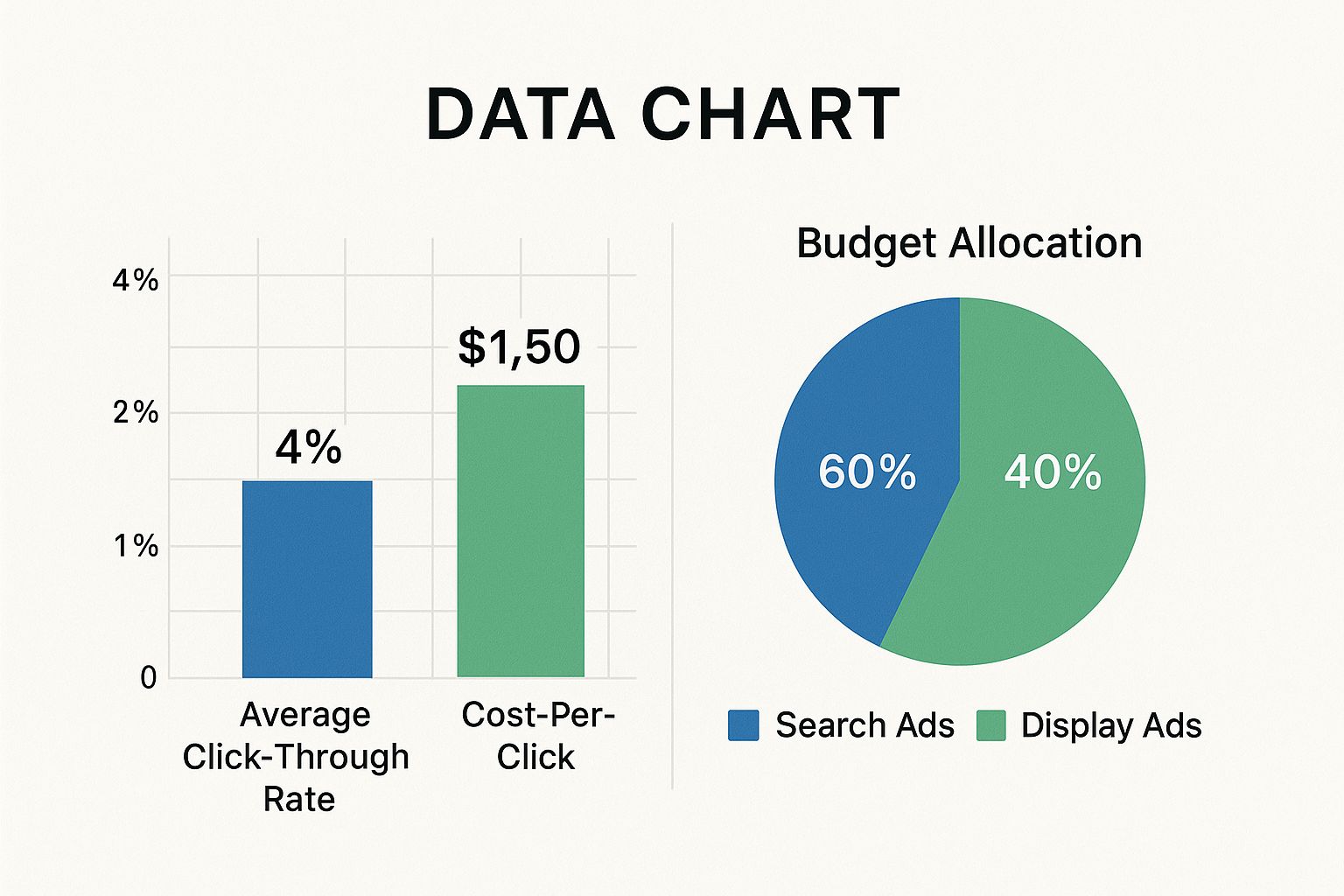
What you're seeing is a fundamental trade-off: ads with a lower click-through rate often come with a higher cost per click. This highlights the need for a balanced budget that uses high-intent Search Ads for immediate action and broader-reach Display Ads for awareness.
Knowing your market's cost is the final piece of this foundation. The cost per click (CPC) for Google Ads in the restaurant world varies wildly. Industry benchmarks in 2025 put the average CPC for restaurants at $2.69, but I've seen savvy agencies get that down to $0.23 with smart strategies. In hyper-competitive markets, CPCs can easily top $3. For context, the average CPC across all industries is about $0.73, or $1.31 if you exclude low-cost outliers. You can find more detail on these restaurant advertising benchmarks from Astralcom.
Think of your initial budget as a data acquisition tool. You aren't aiming for massive profits in week one. You are investing a calculated amount to buy data on which keywords convert, which ads resonate, and what your true cost-per-acquisition really is.
Once you know that it costs you, say, $15 in ad spend to secure a dinner reservation with an average table value of $100, budgeting is no longer a guessing game. It becomes a predictable lever for growth. You can confidently decide how many new reservations you want each month and fund the ad spend knowing your return is there. This is how you build a profitable campaign from the ground up.
Crafting Ads That Drive Reservations and Orders
Your Google Ad is your digital handshake. It’s the very first impression a potential diner has of your restaurant, and frankly, I see too many businesses fumble this crucial moment. They fall back on generic, meaningless copy like "Best Tacos in the City." This isn't a selling point; it’s just noise that gets lost in a sea of identical claims.
Truly profitable ads don't just state what you are; they solve an immediate problem for the person searching. You have to get inside their head. Someone typing "late-night tacos delivered" isn’t looking for the "best" tacos—they're hungry right now and need something convenient. Your ad has to answer that specific need directly and immediately.
The ads that really work feel like a direct conversation. They acknowledge the searcher's situation and present your restaurant as the perfect, obvious solution.
Writing Ad Copy That Solves a Problem
To cut through the clutter, your headlines and descriptions need to be all about solving a customer's problem, not just broadcasting your existence. This means shifting from feature-based language ("We have a patio") to benefit-driven language ("Book Your Sun-Soaked Patio Table Now").
Let's walk through a real-world scenario. A parent is searching for "family restaurant for birthday."
- The Generic Ad: "Mario's Italian Kitchen – Best Pasta in Town – Visit Us Today"
- The Problem-Solving Ad: "Host Your Birthday at Mario's – Private Rooms & Kids Menu – Book Your Celebration"
The second ad is going to win every single time. It instantly confirms you can handle their request, highlights features that matter to them, and gives them a clear, actionable next step.
Your ad copy's number one job is to mirror the searcher's intent back to them. When a potential customer feels understood, clicking your ad becomes an impulse, not a choice.
This simple shift turns your ad from a billboard into a helpful answer. You’re not just another listing; you're exactly what they were looking for.
Supercharging Your Ads with Extensions
Once you’ve nailed your core message, it's time to add the secret sauce: ad extensions. Honestly, I consider these non-negotiable for any restaurant. They are completely free to use, they make your ad physically larger on the search results page (pushing competitors down), and they pack in crucial info that drives higher click-through rates (CTR).
For a restaurant, these are the absolute must-haves:
- Location Extensions: This is your direct link to Google Maps. It shows your address and gives mobile users one-tap directions, which is gold for capturing those "near me" searches.
- Call Extensions: Put your phone number right in the ad. This is a game-changer for driving reservations by removing the friction of someone having to click to your site and hunt for the number.
- Sitelink Extensions: These are direct links to your most important pages. Think "View Our Menu," "Order Online," "Book a Table," or "Catering Services." This lets you guide different types of customers to the right place instantly.
- Image Extensions: Nothing sells food like a great photo. Showcase your most drool-worthy dishes, your beautiful dining room, or your vibrant patio. Visuals make your ad pop and speak directly to a diner's appetite.
Using extensions is like upgrading from a tiny classified ad to a full-page feature. They give customers more reasons to choose you, right then and there.
The Art of the Call-to-Action and Continuous Testing
Okay, your ad copy and extensions have grabbed their attention. The final piece is the call-to-action (CTA)—the clear instruction telling them exactly what to do next. Weak, vague CTAs like "Learn More" just don't cut it. You have to be direct and specific.
- "Reserve Your Table Now"
- "Order for Delivery"
- "Get Directions"
- "Call to Book"
These create urgency and leave no room for confusion. But here’s the thing: no ad is perfect on the first try. This is where testing becomes your best friend. You should always be running at least two ad variations for each ad group (an A/B test). Tweak just one thing at a time—a headline, the description, or the CTA.
Let it run for a week or two, then dive into the data. Which ad got a better CTR? Which one led to more calls, bookings, or online orders? You pause the loser, double down on the winner, and create a new variation to test against it.
This constant cycle of testing and optimizing is what separates the pros from the amateurs. It’s how you turn a good campaign into a genuine revenue-generating machine. And the potential is huge. Recent data from April 2025 shows the median CTR for food and beverage search campaigns was a very strong 14.79%, with top performers hitting an incredible 24.5%. While the broader industry average is lower, it proves that well-crafted ads that truly connect with searchers can deliver amazing results. You can find more detail on these CTR benchmarks for the food industry on Varos.com.
Mastering Hyperlocal Targeting and Bidding
For most restaurants, your entire world of potential customers might be living or working within a five-mile radius of your front door. This is exactly where I see the most ad budgets get torched—targeting an entire city when only a sliver of that population can realistically walk in for dinner tonight. It’s time to stop casting a wide net and start using a spear.
The whole point is to focus every single dollar on reaching someone who isn't just hungry, but is actually close enough to become a customer. This means we have to get much smarter than basic city-level targeting to capture that immediate, local intent. Think of it less like putting up a billboard and more like handing a menu to someone walking down your street.
This level of precision is non-negotiable. We're not just running google ads for restaurants; we're building a system to completely dominate your specific service area.
Advanced Geo-Targeting Strategies
To truly own your local market, you have to treat geography as more than just a background setting. It’s an active tool for slicing up your audience and putting your money where it matters most. Basic radius targeting is a start, but we can do so much better.
Here are a few tactics I always deploy to squeeze every drop of value from a client's budget:
-
Geo-fence Your "Hot Zone": Draw a tight, one-to-two-mile circle around your restaurant. For anyone searching on a phone inside this zone, we get aggressive with our bids—cranking them up by 50% or more. These are your absolute highest-value prospects.
-
Target by Affluence: If you run a fine-dining spot, it makes no sense to advertise to everyone equally. Identify the top three to five most affluent zip codes in your area and create campaigns that only target them. This ensures your ad spend is laser-focused on households with the disposable income to become regulars.
-
Use Exclusion Zones: Just as important as who you target is who you don’t. I always make a point to actively exclude areas that are a pain to get to. Is there a major highway, a river, or a notoriously gridlocked part of town in the way? Exclude it. Even if it's geographically close, those clicks are likely wasted if the journey is a hassle.
This isn't just about cutting wasted spend. It's about taking that saved money and reallocating it to bid more aggressively where it actually counts. I’d much rather pay a premium to be the #1 result for someone standing a block away than get a hundred cheap clicks from the other side of town.
This granular approach allows us to draw a straight line from ad dollars to actual foot traffic. You can get deeper on identifying these valuable customer pockets by reading our guide on powerful customer segmentation strategies.
Demystifying Bidding and Ad Scheduling
Once your targeting is dialed in, the next piece of the puzzle is controlling when you show up and how much you're willing to pay. Google’s automated bidding is powerful, but blindly trusting it is a rookie mistake I see all the time. The right strategy really depends on how mature your campaign is and what you're trying to achieve.
Here’s my simple framework for picking the right bidding strategy:
| Bidding Strategy | Best Use Case | My Take |
|---|---|---|
| Manual CPC | A brand-new campaign launch, a limited-time offer, or anytime you need absolute control. | I always start new campaigns here for the first couple of weeks. It lets us gather clean conversion data without Google's algorithm making any premature assumptions. |
| Maximize Conversions | Established campaigns that are getting at least 15-20 conversions per month. | Once you have solid conversion history, this is your workhorse. It lets Google’s machine learning do the heavy lifting to find you more customers for your budget. |
| Target CPA | Mature, predictable campaigns where you know your exact cost-per-acquisition for profitability. | This is for when you've scaled up and know your numbers cold. You tell Google what you're willing to pay for a customer, and it goes out and gets them at that cost. |
Finally, let's talk about timing. Your restaurant isn't open 24/7, so why should your ads run around the clock? Ad scheduling is a simple but incredibly effective way to focus your budget where it counts. Stop burning money at 2 AM.
Instead, set your campaigns to run—and even bid higher—during the hours leading into the lunch and dinner rush. I typically find the sweet spots are from 11 AM to 1 PM and again from 4 PM to 8 PM.
By layering precise geo-targeting with smart bidding and scheduling, you make sure your ads are shown to the right people, in the right place, at the exact moment they’re deciding where to eat. This is how you turn a monthly ad budget into a predictable stream of nightly revenue.
Turning Clicks Into Profitable Customers
Here's a hard truth I’ve learned over the years: a click without a conversion is just a sunk cost. In this business, we don't get paid for traffic; we get paid for transactions. This is the final, most critical link in the chain where your ad spend either turns into real profit or just vanishes.
I’ve seen far too many restaurant campaigns with amazing click-through rates ultimately fail. Why? They drop the ball the second a potential customer hits their website. The entire journey—from the ad to the confirmation page—has to be an obsession. It needs to be frictionless, persuasive, and, most importantly, measurable.
Designing Your Conversion-Focused Landing Page
When someone clicks your ad, they have a very specific goal in mind. Your landing page has one job: fulfill that goal as quickly and easily as possible.
Sending traffic from an ad for "dinner reservations" to your generic homepage is a classic, costly mistake. It forces the user to hunt around for the booking tool, and every extra click is another chance for them to give up and leave.
Instead, you need dedicated landing pages built for your specific campaign goals. An ad promoting online orders should go straight to your ordering platform. An ad for booking a private event needs a page with a simple inquiry form. This alignment isn't just a good idea; it's non-negotiable.
Your landing page must be built with a few core elements:
- A Crystal-Clear Value Proposition: The headline should instantly tell the user they're in the right place. If your ad said "Book Your Patio Table," the page headline better say something like "Reserve Your Table on Our Sun-Soaked Patio."
- Mouth-Watering Visuals: Use high-quality, professional photos of your food and dining space. People eat with their eyes first, and this is your best shot at making an immediate emotional connection.
- Frictionless Forms: Keep your reservation or order forms dead simple. Ask only for what you absolutely need. For every extra field you add, you can expect your conversion rate to drop.
The single biggest point of failure I see, time and time again, is a poor mobile experience. Well over half of all restaurant-related searches happen on a smartphone. If your landing page isn't designed for a thumb—with large buttons and easy-to-read text—you are actively turning away paying customers.
The Absolute Necessity of Conversion Tracking
Now for the part that separates the pros from the amateurs: conversion tracking. Without it, you're just guessing. You have no real idea which keywords, ads, or campaigns are actually making you money. This isn’t a nice-to-have feature; it's the central nervous system of a profitable Google Ads for restaurants strategy.
You have to track every single action that has value for your business. This is how you connect your ad spend directly to revenue and start making data-driven decisions instead of emotional ones.
At a minimum, we must set up tracking for these key actions:
- Online Reservations: Track every single time a user successfully completes the booking form on your site. This is your primary goal for any dine-in campaign.
- Phone Calls from Ads: Use Google’s call extensions and call reporting. This lets you see exactly which campaigns and keywords are making the phone ring with new customers.
- Online Order Completions: Place a tracking pixel on the "Thank You" or confirmation page of your online ordering system. It's the only way to measure the true ROI of your delivery and takeout ads.
This kind of detailed measurement is the bedrock of any successful https://mgxgrowth.com/blog/data-driven-marketing-strategy. Without this data, you can't calculate your cost-per-acquisition, you can't properly optimize your bidding, and you can't scale what works.
The industry benchmarks for conversion rates (CVR) show just how vital this is. Back in April 2025, the median CVR for food and beverage search campaigns was a solid 5.68%, performing much better than other campaign types. However, the overall industry median dipped to 3.93%, which tells us that competition is fierce and unoptimized campaigns will get left behind. This data, and other insights on Google Ads CVR for the food industry, proves you have to track and optimize relentlessly to stay ahead.
By meticulously engineering the post-click journey and tracking every valuable outcome, you transform your ad account from a black box of expenses into a predictable, scalable engine for growth. This is where you finally stop buying clicks and start buying profitable customers.
Answering Your Top Restaurant Ad Questions
Over the years, I've had the same core conversations with hundreds of restaurant owners. The technology changes, but the fundamental business questions? They pretty much stay the same. Here are my straight-up, no-fluff answers to the questions I get asked most about running Google Ads.
How Much Should a Restaurant Spend on Google Ads?
Honestly, there's no magic number. If someone throws a figure at you without digging into your specific business, they're just guessing. I always tell my clients to flip the question: instead of asking "What should I spend?" ask "What can I afford to pay for a new customer?"
Start with a test budget you won't lose sleep over. For most restaurants, this is somewhere in the $500 to $1,500 per month range.
Think of this initial spend not as a quest for immediate profit, but as an investment in data. Your only job in the first 30-60 days is to figure out your profitable cost-per-acquisition (CPA).
Once you know that putting $1 into ads reliably brings in $5 worth of orders, your perspective shifts. The budget is no longer a "cost" but an "investment." It's a growth lever you can pull anytime you want to bring in more customers, not just a fixed line item on your P&L.
Should I Bid on Competitor Restaurant Names?
This is a tricky one. It’s an advanced move that I only suggest after you've squeezed every last drop of value from your own branded searches and high-intent local keywords. It's tempting to try and poach customers, but it's often a costly distraction that can escalate into a pricey bidding war.
Master the fundamentals first. Get your core campaigns dialed in—the ones targeting searches like "[your cuisine] near me" or "best happy hour downtown." Once those are humming along profitably, then you can think about this. If you do, carve out a small, separate test budget for competitor keywords and watch the CPA like a hawk. For most restaurants I've worked with, the return just isn't worth it compared to owning your main local search terms.
Send Ad Traffic to My Website or Google Business Profile?
The right answer here completely depends on your goal. It's not about which one is "better" in general, but which one is better for the specific action you want a customer to take.
Here’s the simple framework I use:
- For Online Orders: If you're pushing for online orders through your own system, send that traffic to a specific landing page on your website. This gives you total control over the experience and lets you track conversions with pinpoint accuracy.
- For Reservations & Foot Traffic: If you just want the phone to ring for reservations or need people to get directions and walk in, sending them straight to your Google Business Profile (GBP) is usually the path of least resistance. It keeps them in the Google environment they already know, making it a simple one-tap process to call or get directions.
My advice? Don't guess—test. Run a simple A/B test with two identical ads. Send one to a website landing page and the other to your GBP. The data will quickly tell you which destination delivers a better cost-per-acquisition for that specific goal. The numbers don't lie.
Ready to stop guessing and start growing? At MGXGrowth, we partner with ambitious restaurants to build profitable, data-driven marketing engines that deliver measurable results. Let's architect your growth roadmap together. Learn more at mgxgrowth.com.
