


A poorly architected loyalty program is not merely a missed opportunity—it's an active drain on your EBITDA. It costs you far more than the margin on a discounted meal. It erodes customer trust, creates operational friction, and leaves a staggering amount of incremental revenue on the table.
The Real Cost of a Flawed Loyalty Program
I've seen this scenario play out more times than I care to admit across my career. A promising restaurant group, energized by the prospect of a new initiative, launches a loyalty program. It then either fizzles out from customer indifference or, far worse, morphs into a financial black hole. Treating loyalty as a simple marketing add-on is one of the most expensive, yet common, mistakes a leadership team can make.
The failure point almost always originates from a fundamental misunderstanding of the program's function. A loyalty program is not about giving away free food. It must be engineered as a data-driven engine for growth. Its primary mandate is to modify customer behavior in a measurable way—increasing visit frequency, driving a higher average check, and providing a direct, owned channel to your most valuable customer segments.
I once consulted for a multi-location QSR chain whose "loyalty strategy" was a "buy ten, get one free" paper punch card. On the surface, they believed it was a success. But when my team integrated their POS data with a proper analytics framework, the reality was alarming.
They had zero visibility into their high-value customer cohorts. They couldn't track spend velocity or personalize a single offer. By failing to segment and engage their customers, they were leaving millions in potential revenue on the table annually.
That punch card wasn't building loyalty; it was subsidizing existing behavior. It was a cost center disguised as a marketing tool.
This is a classic executive blind spot. We know from extensive data that acquiring a new customer costs five times more than retaining an existing one. When you factor in that 75% of consumers state they are more likely to remain loyal to a brand that offers rewards, the strategic disconnect becomes glaringly obvious. Yet, so many restaurant operators are still flying blind. For a closer look at the data, review these insights on restaurant loyalty programs from iOrders.ca.

This graphic quantifies the disconnect perfectly. A significant gap exists between customer expectations and what most restaurants deliver. This isn't a problem; it's a multi-million dollar opportunity for any operator willing to execute with precision.
My intent is not to instill fear, but to drive a clear-eyed assessment of risk versus reward. In today's hyper-competitive market, engaging a restaurant loyalty program consultant is not a luxury. It's a strategic imperative for breaking through growth plateaus and building a resilient, profitable enterprise.
Conducting Your Internal Loyalty Audit
Before you engage any consultant, the most critical work must happen internally. You cannot outsource the foundational understanding of your own business. Approaching a consultation without a clear, data-backed picture of your operation is analogous to asking an architect to design a building without knowing if you need a skyscraper or a storage shed. It’s a surefire way to misallocate significant time and capital.
The first move is a brutally honest, data-driven internal review. We must move past anecdotal evidence and anchor every assumption in quantifiable facts. Is the primary objective to increase the visit frequency of your existing regulars, or is it to convert first-time visitors into repeat customers? These are two disparate goals requiring fundamentally different strategies and financial models.
Digging into Your Data
Your Point of Sale (POS) system is a data goldmine, yet most operators only scratch the surface of its capabilities. We must change that. Begin by extracting reports that define your customer cohorts.
- Your Champions: The top 10-20% of guests who likely drive a disproportionate share of your revenue. What is their order composition? What is their visit cadence?
- The Occasionals: Customers who visit a few times a year. Can we identify the triggers for their visits? Are they event-driven or menu-specific?
- The One-and-Dones: The cohort that visited once and churned. We must diagnose the friction points that led to their attrition.
Calculating your Customer Lifetime Value (CLV) is non-negotiable. This metric quantifies the net profit attributed to the entire future relationship with a customer. It is the core benchmark against which the success of any new loyalty initiative will be measured.
A loyalty program isn't a marketing gimmick; it's a financial instrument designed to increase the aggregate value of your customer base. If you don’t have a baseline valuation, you're not strategizing; you're guessing.
Mapping the Guest Experience
Next, you must meticulously map the customer journey from their perspective. Document every touchpoint, from initial awareness of your restaurant to the final payment transaction. Where are the points of friction? Where does the process feel clunky or inefficient?
Leveraging dedicated customer journey mapping software can provide invaluable clarity here, helping you visualize the entire process and identify weak points. This map becomes a critical artifact for any consultant you engage.
Finally, break down the silos. Convene your key leaders—your Head of Operations, your Marketing Director, your Executive Chef. Ask the difficult questions. This is not about what you want a loyalty program to do; it is about defining what your business needs it to do to drive a material impact on the P&L.
How to Vet Your Loyalty Program Consultant
Selecting the right external partner to architect your loyalty strategy is a decision with significant financial implications. A top-tier consultant is a force multiplier, capable of unlocking revenue streams and margin improvements you didn't know were possible. The wrong one is a costly distraction who will sell you a generic software package before disappearing.
This is where you must learn to distinguish true growth strategists from software resellers.
Your vetting process must probe far beyond surface-level inquiries. Do not ask, "Have you worked with restaurants before?" That is a low-value question.
Instead, frame the challenge strategically: "Walk me through the material differences in how you would architect a loyalty strategy for a high-volume QSR versus a full-service fine dining concept." The response will reveal everything. A true strategist will immediately discuss customer psychology, visit frequency drivers, and margin protection. A reseller will pivot back to their app's features.
Spotting A True Strategic Partner
I've seen it repeatedly: a leadership team mistakes a slick software demonstration for a comprehensive growth strategy. Let's be unequivocally clear—the technology is merely the tool, not the solution. Your objective is to find a partner who understands how to leverage that tool to unify your marketing, operations, and finance functions into a cohesive growth engine.
It's a subtle but profound distinction. I've developed a simple matrix to illustrate precisely what I look for when evaluating a potential partner.
Strategic Consultant vs. Software Reseller
This breakdown highlights the fundamental differences between a partner invested in your financial outcomes and a vendor focused on their own product adoption.
| Attribute | Strategic Consultant (Growth Partner) | Software Reseller (Vendor) |
|---|---|---|
| Primary Focus | Your business outcomes (CLV, visit frequency, profit margin). | Their software features and user adoption. |
| Discovery Process | Deep dive into your POS data, P&L, and operational workflows. | Asks about your technical requirements and budget. |
| Core Deliverable | A custom financial model and growth strategy. | A software implementation plan. |
| Success Metric | Measurable lift in incremental revenue and customer retention. | Number of app downloads and active users. |
Note the difference? A true consultant is focused on your EBITDA, not their user acquisition metrics. To understand this partnership model in greater detail, you can explore our approach to restaurant growth consulting.
Analyzing Case Studies and Capabilities
When a consultant presents case studies, you must look past the vanity metrics. "We signed up 10,000 members" is a meaningless statistic in isolation. I demand to see the numbers that impact the P&L.
Push for the hard data. Specifically, request:
- The lift in average spend for members versus a control group of non-members.
- The documented increase in visit frequency post-enrollment.
- The reduction in customer churn measured over a 6-month period.
This is the kind of empirical evidence that validates a strategy's effectiveness.
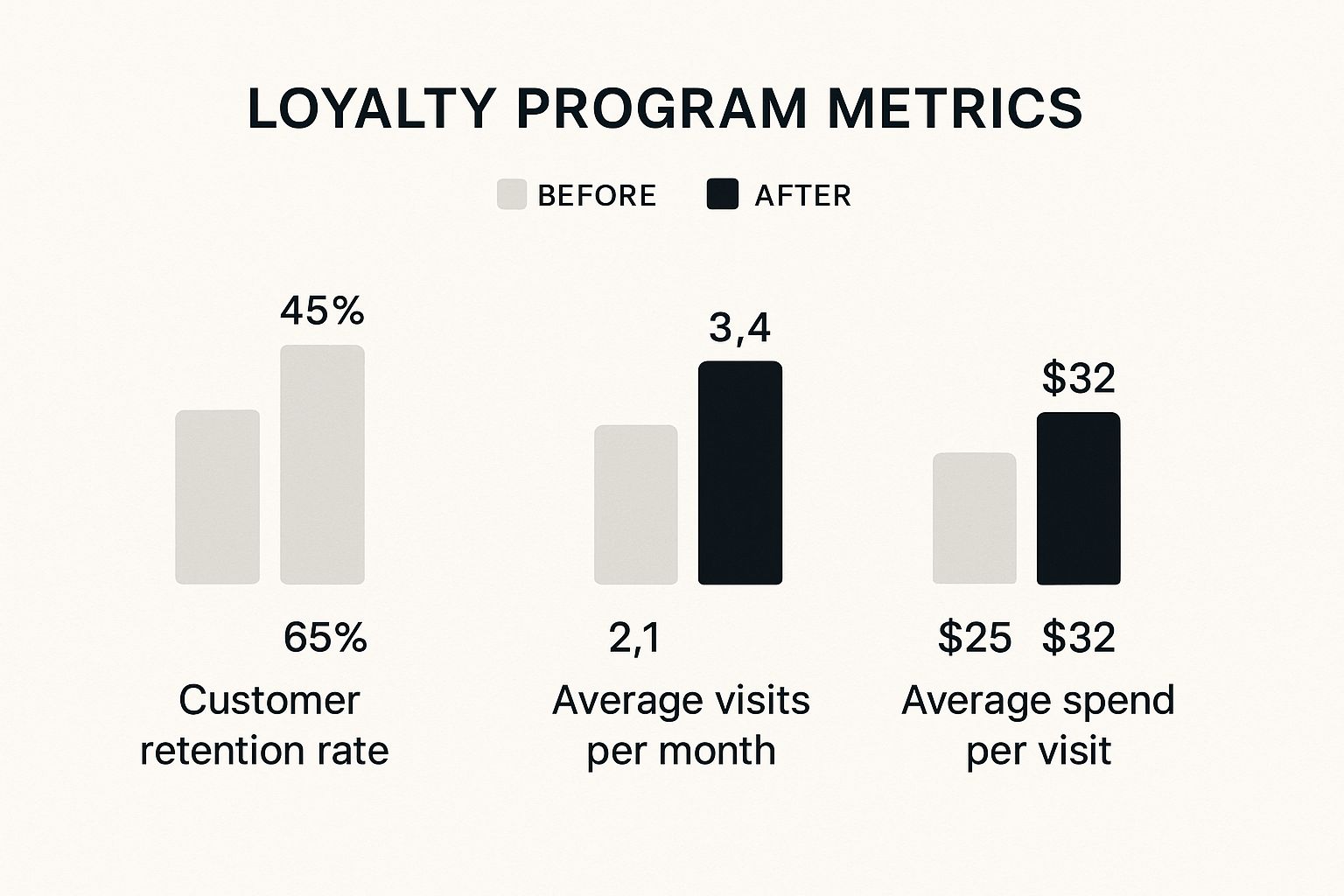
The chart above exemplifies what you should demand—concrete results demonstrating a shift from a baseline to significant growth. It illustrates a clear, quantifiable uplift across retention, visit frequency, and average spend, which are the foundational pillars of a profitable loyalty program.
Finally, scrutinize their technical acumen. Can they integrate seamlessly with your existing POS and marketing technology stack? A consultant who cannot speak fluently about data integration and API architecture is a major red flag. They must be capable of liberating the data currently siloed within your systems to build a program that truly understands and rewards your most profitable customers.
Co-Creating Your Loyalty Program Blueprint
You've selected the right consultant. Excellent. This is not a hand-off; it is the beginning of an intense, collaborative engagement. A top-tier consultant does not arrive with a pre-packaged, one-size-fits-all solution. They arrive with a battle-tested framework, prepared to build a custom blueprint with your team, for your unique business context.
The foundation of this blueprint is a rigorous definition of success. For example, within the quick-service restaurant (QSR) sector, an overwhelming 82% of brands have a loyalty program. But their strategic intent varies significantly. Approximately 60% are designed simply to encourage repeat visits, while 28% are laser-focused on increasing Customer Lifetime Value (CLV) through more sophisticated, targeted rewards. You can analyze more of these QSR loyalty trends in this detailed report.
Designing the Reward Structure
The most prevalent mistake I observe is defaulting to simple, margin-eroding discounts. A "10% off" offer does not build loyalty; it trains customers to wait for a promotion. True loyalty is an emotional bond, not a transactional calculation.
A skilled consultant will facilitate a workshop to engineer rewards that feel exclusive and align with your brand ethos. The objective is to move beyond discounts to create genuine, memorable value.
- Experiential Rewards: Consider a complimentary dessert-making class with your pastry chef or an exclusive invitation to a new menu tasting event.
- Access & Status: This could manifest as priority booking, a dedicated reservation line for members, or "first-to-know" access to seasonal specials.
- Personalization: Imagine a system that automatically triggers a complimentary serving of a regular's favorite appetizer upon their arrival. That is what creates brand advocacy.
A superior loyalty program makes your best customers feel recognized and valued, not merely bribed. It is about status, not just rewards. This is how you convert repeat business into a powerful marketing channel.
Integrating the Technology Stack
Your loyalty program cannot operate in a silo. If it introduces friction for your staff or your customers, it is dead on arrival. Your consultant's role is to ensure the technology is functionally invisible, creating a seamless experience across all touchpoints.
This demands deep, robust integrations with your core operational systems. There are no exceptions.
- Point of Sale (POS): The program must function flawlessly at the point of transaction. Staff must be able to identify members and apply rewards instantly without disrupting service flow.
- Customer Relationship Management (CRM): All loyalty data—visit history, order preferences, reward redemptions—must flow back into your CRM in real-time. This creates a single, unified view of each guest.
- Online Ordering & Delivery: The loyalty experience must be consistent, whether a customer is dining in, ordering takeout via your website, or using a third-party delivery aggregator. Brand consistency is paramount.
A Real-World Blueprint Scenario
I previously advised a bistro client whose primary objective was to increase the profitability of their regulars, not just their visit frequency. We architected a tiered loyalty system directly linked to their highest-margin menu items.
Instead of a generic points-per-dollar model, customers earned accelerated points for ordering specific high-margin entrees or wine pairings. This strategic shift subtly guided purchasing behavior toward more profitable choices. It was a win-win: customers felt they were unlocking greater value and exclusive perks, while the restaurant was actively increasing its gross margin on every loyalty transaction.
This level of strategic precision is only possible with a deep understanding of your customer base, which is why effective https://mgxgrowth.com/blog/customer-segmentation-strategies are absolutely critical to success.
Measuring Your Loyalty Program ROI

If you cannot measure it, you cannot manage it. A loyalty program is a significant capital investment, and you must be ruthless in tracking its return. Disregard vanity metrics like total member sign-ups; that number does not contribute to your P&L. We must focus exclusively on metrics that directly impact bottom-line performance.
This requires shifting the conversation from "engagement" to profitability. Despite industry growth, restaurant margins remain notoriously thin. While top-quartile operators might achieve a 10% net profit, the median hovers between 3-5%. A well-architected loyalty program is one of the most potent levers for protecting and expanding that margin by incentivizing profitable behaviors. You can find more data on how loyalty programs impact restaurant margins over on Deliverect.com.
Key Performance Indicators That Actually Matter
To get a true picture of performance, a competent restaurant loyalty program consultant will help you construct a dashboard centered on the metrics that drive financial growth. These are the KPIs that connect customer actions to financial outcomes, finally breaking down the wall between marketing expenditure and operational revenue.
Your entire focus must be on tracking the incremental lift generated by the program against a control group.
- Increase in Visit Frequency: How many more visits per month are loyalty members making compared to non-members? This is the primary engine of loyalty ROI.
- Uplift in Average Check Size: Are members spending more per visit? An effective program encourages trial of higher-margin items, not just redemption of discounts.
- Customer Lifetime Value (CLV) Growth: Is the total projected net profit from a member demonstrably higher than that of a non-member over 6, 12, and 18-month horizons?
- Churn Rate Reduction: Are you retaining loyalty members at a higher rate than the average customer? This quantifies the program's "stickiness."
Any consultant who cannot help you measure these specific KPIs is not a strategist; they are a software vendor. The entire purpose of this initiative is to transform your loyalty program into a predictable, measurable, and profitable growth channel.
Calculating Your True ROI
Once this data is flowing, calculating the true return on investment becomes a straightforward financial exercise. It is a powerful formula that any member of your executive team or board can immediately understand. This is not ambiguous marketing math; it is rigorous business accounting that justifies the program's budget and validates its existence.
The ROI Formula:
(Incremental Revenue from Members – Total Program Costs) / Total Program Costs = ROI
"Total Program Costs" must be all-inclusive: software licensing fees, marketing spend to promote the program, the cost of goods sold for redeemed rewards, and any consultant fees. This clear-eyed calculation ensures you understand the program's real contribution to profitability. It is what enables continuous optimization through A/B testing and proves, definitively, its value to all stakeholders.
Common Questions About Hiring a Loyalty Consultant
Engaging an external expert invariably raises questions and a healthy degree of skepticism. I understand this completely. Over my decades in this field, I've heard every conceivable concern. My objective here is to provide direct, unvarnished answers grounded in the operational and financial realities of driving growth in the restaurant industry.
Let's cut through the noise and address the most frequent concerns I hear from operators considering a restaurant loyalty program consultant. This is not about abstract theory; it's about practical application and tangible results.
How Much Should a Consultant Cost?
This is almost always the first question asked, but it is the wrong question to lead with. The correct question is not about cost, but about return on investment. Consulting fees vary widely, predicated on project scope and the consultant's demonstrated track record of generating financial returns.
For a comprehensive engagement—from initial strategy and financial modeling through to a detailed implementation blueprint—proposals can range from $5,000 to over $25,000. For ongoing management and optimization, monthly retainers typically fall between $2,000 and $10,000. The critical variable is whether they are a pure strategist or a hands-on partner managing technology integration and campaign execution.
The fee is irrelevant if the business case is sound. A competent consultant must be able to construct a clear financial model demonstrating how their fees will be recouped—and exceeded—by incremental revenue within a specific, measurable timeframe. If they cannot produce this analysis, terminate the conversation.
Can't I Just Use the Loyalty Module in My POS?
While the native loyalty features within many POS systems are convenient, they are rarely the optimal tool for an ambitious, growth-oriented brand. Consider them a starter kit, not a comprehensive strategic solution. They frequently lack the sophisticated segmentation, personalization, and analytical capabilities required to drive significant, measurable financial lift.
A consultant's true value is not in selecting software. Their function is to architect the strategy—the customer psychology, the financial model, and the margin-accretive reward structure. They will help you determine if your POS module is sufficient for an initial pilot or if a dedicated, best-in-class loyalty platform is required to achieve your revenue targets.
What's the Biggest Mistake Restaurants Make?
The single greatest strategic error, without question, is launching a generic, one-size-fits-all program built on a foundation of discounts. This is a race to the bottom. It devalues your brand and attracts the wrong customer cohort: the transient deal-seeker, not the truly loyal guest who drives long-term profitability.
True loyalty is built on an emotional connection, not a transactional one. A superior program leverages data to make customers feel recognized and valued. It offers relevant, personalized rewards—such as their favorite appetizer on the house or early access to a new menu—instead of another bland 10% off coupon. A consultant's core mandate is to pivot your team's mindset from margin-eroding discounting to genuine value creation.
How Long Until I See Real Results?
It is critical to differentiate between leading indicators and lagging financial results. You will see leading indicators—enrollment velocity and initial engagement rates—very quickly, typically within the first 30 to 60 days. These early metrics validate the program's appeal and usability.
However, the P&L-level metrics take longer to mature. A statistically significant increase in visit frequency, a measurable lift in average check size, and a reduction in customer churn—these results typically require 3 to 6 months to become clear and defensible in the data. A seasoned consultant will set these realistic expectations from the outset and build a dashboard to track both short-term adoption and long-term ROI, providing full visibility throughout the engagement.
At MGXGrowth, my team and I specialize in transforming loyalty programs from cost centers into powerful, predictable revenue engines. If you are ready to move beyond generic tactics and build a data-driven strategy that delivers measurable financial results, let's connect. Learn more about our approach to loyalty consulting.
