


Before we discuss a single food photo, we need to address your Instagram profile. It functions as your restaurant's digital front door. It is often the first touchpoint for a potential diner, and if it isn't optimized for conversion, you are leaving revenue on the table. This is where we must convert casual browsers into paying customers.
Your Instagram Profile Is Your Digital Front Door
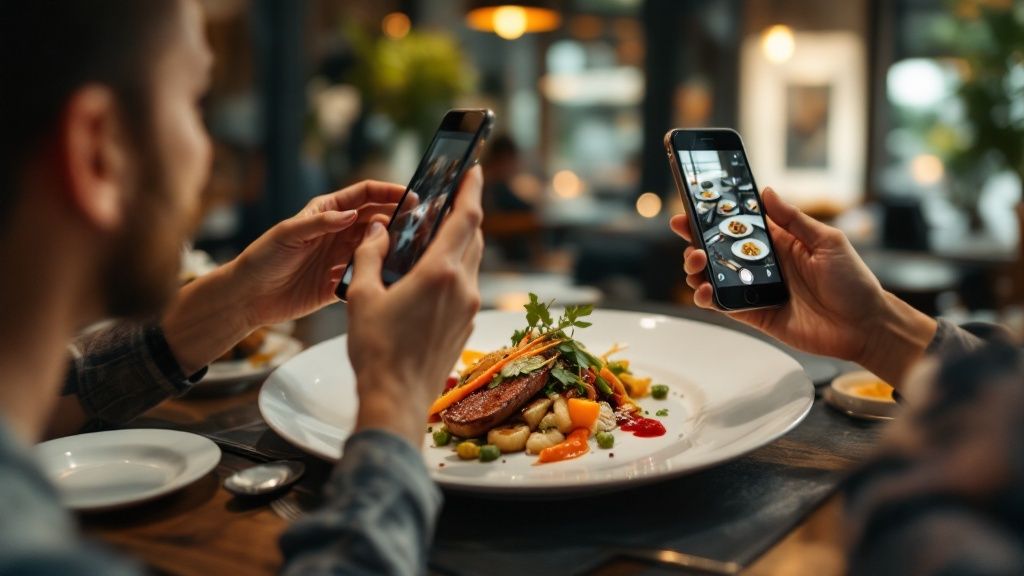
I've seen it across countless portfolios: restaurants with exceptional culinary execution but a neglected, confusing Instagram profile. This is a significant missed opportunity. Your profile isn't merely a gallery; it's an active sales funnel. Every element, from your bio to your profile picture, has a function—to guide a prospect from "that looks appealing" to "I'm making a reservation."
The data substantiates this. We know 46% of millennials evaluate a restaurant's social media presence before making a dining decision. Further, 72% of customers discover new local establishments through visual platforms like Instagram. A passive presence is insufficient; you must be compelling.
Nail Your Bio
You have 150 characters to articulate your value proposition. This is your elevator pitch; it must be strategic. Too often, I see bios that are a meaningless string of emojis or a vague tagline. We must be more disciplined.
Here is a simple, effective framework I implement:
- Line 1: Who You Are. Be direct and descriptive. Are you a "Modern Italian Trattoria," a "Farm-to-Table Bistro," or an "Authentic Neapolitan Pizzeria"?
- Line 2: What Makes You Special. This is your unique selling proposition (USP). It could be an "Award-Winning Wine List," a "Dog-Friendly Rooftop Patio," or "Daily Fresh Pasta."
- Line 3: The Call to Action. This is non-negotiable. Instruct users on the desired next step and eliminate friction. "👇 Book Your Table Below 👇" or "Order Online for Pickup," paired with a trackable link, is the optimal execution.
This structure is a foundational component of any effective restaurant branding and marketing strategy because it converts. It moves a visitor from discovery to action in seconds.
Make Your Profile Picture a Brand Beacon
Your profile picture is a ubiquitous brand asset—it appears in the feed, Stories, and comments. It must be instantly recognizable at a small scale. A complex photograph of a dish becomes an unidentifiable visual.
The optimal choice, in nearly all cases, is a simplified, high-contrast version of your logo. It reinforces brand recognition and conveys professionalism. If your logo is weak, a clean illustration of your signature dish or building exterior can serve as a substitute. The key principle is simplicity.
Remove All Friction with Action Buttons
This is where marketing activity translates directly into revenue. Instagram’s native action buttons—'Reserve,' 'Order food,' 'Call,' 'Email'—are high-value assets. They must be configured.
By integrating directly with reservation or delivery platforms, you reduce the number of steps in the customer journey. Every click saved dramatically increases the conversion rate. If a user must exit the app, open a browser, and search for your booking page, you have introduced multiple points of failure. Action buttons transform a moment of inspiration into an immediate commercial transaction.
Finally, your grid must tell a cohesive brand story. It must feel like an extension of your physical space. If your brand positioning is rustic and cozy, your visuals require warm lighting and rich textures. If you are modern and sleek, prioritize clean lines and bright, airy shots. This visual consistency builds an emotional connection and sets accurate expectations, ensuring a seamless transition from the digital experience to the in-person one.
A Content Strategy That Actually Fills Seats
Once your Instagram profile is optimized, it's time to construct a content plan that does more than generate aesthetic appeal—it must drive revenue. From my experience, the single greatest point of failure in restaurant marketing is the silo between marketing, the kitchen, and front-of-house operations.
A stunning photograph of your signature dish is a liability if you are running low on a key ingredient. It doesn't drive sales; it creates customer friction. Your Instagram strategy cannot be an afterthought. It must be integrated with real-time restaurant operations, whether that means promoting a high-margin special on a low-traffic Tuesday or launching a new seasonal menu.
To execute this, you must break down the wall between your marketing lead and your executive chef. They must operate from a single, unified playbook.
Beyond Just Food Photos: Your Content Pillars
The key to a compelling Instagram feed is strategic variety. An endless stream of repetitive food shots eventually becomes noise. You must tell a broader brand narrative. I have consistently found that structuring content around three core pillars is the most effective methodology for building a brand, not just a photo album.
- The Culinary Showcase: This is your hero content. We are talking about high-quality, visually arresting photos and Reels of your dishes, cocktails, and specials. The objective is singular: to create desire.
- Behind the Scenes: This is where you build trust and humanize the brand. Document a chef's visit to the local farmer's market, show the team prepping for service, or capture a bartender developing a new cocktail. This content reveals the passion behind the final product.
- The Human Element: This is what transforms followers into a community. Feature a "Team Member of the Month," share a positive customer review (with permission), or repost user-generated content from satisfied diners. This transforms your restaurant from a place of commerce into a brand with a soul.
Rotating through these pillars maintains audience interest and provides multiple vectors for engagement. The data is unequivocal—Instagram is a primary acquisition channel for restaurants.
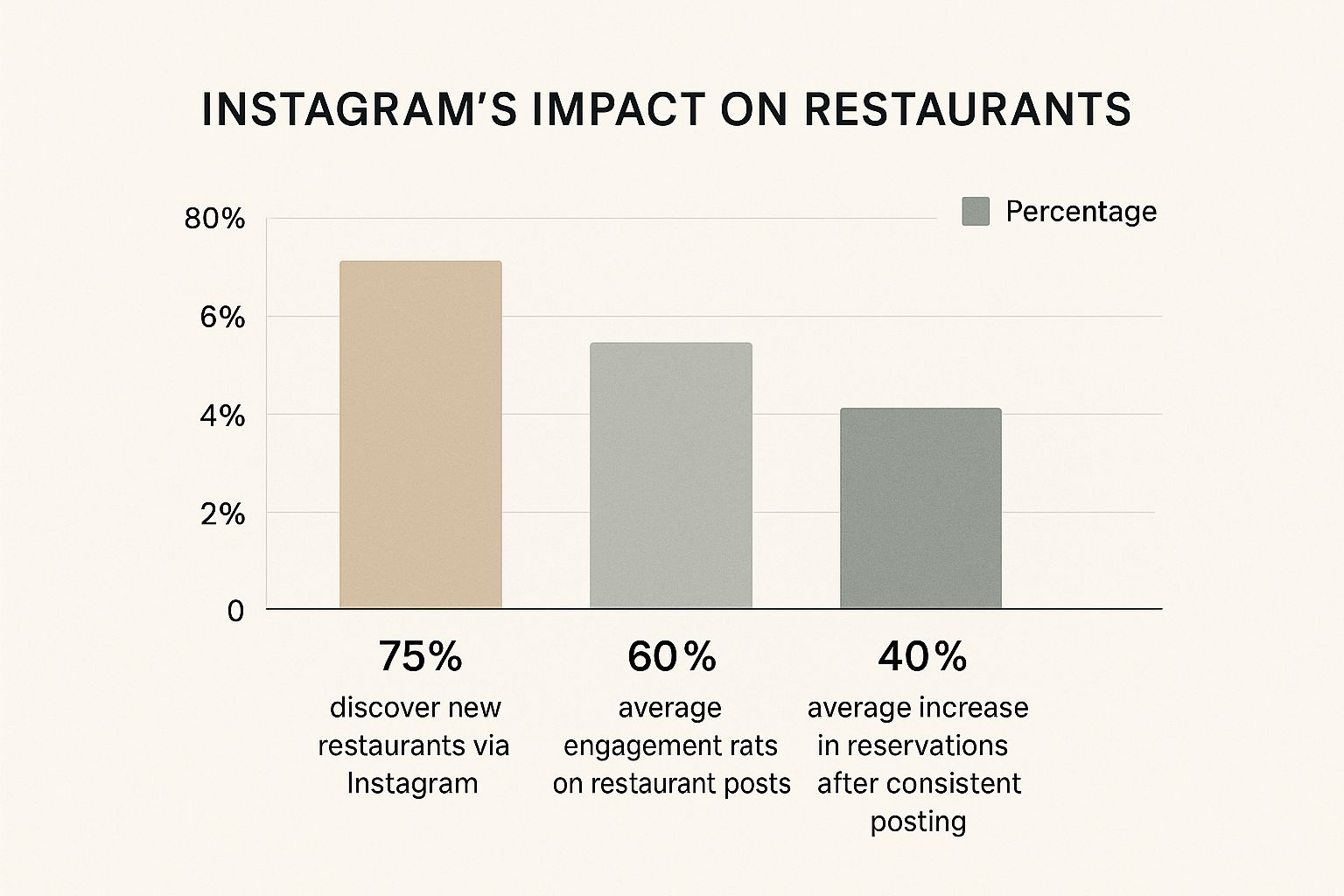
As the data indicates, 75% of diners are discovering new restaurants on the platform. A consistent, strategic presence is no longer optional; it is a direct line to new customers and increased bookings.
Matching Your Content to the Right Instagram Format
You have defined your content pillars. The next operational step is to map them to the correct Instagram format. Each format—Feed, Reels, Stories—serves a distinct strategic purpose.
I've observed countless restaurants making the critical error of cross-posting identical content. A polished, magazine-quality photograph that performs well on the Feed feels incongruous in the raw, immediate context of Stories. You must tailor the asset to the format.
To maximize ROI on content production, you need a smart content mix that leverages the strengths of each format.
Strategic Instagram Content Mix for Restaurants
Here is a simple framework for allocating content, defining objectives, and tracking performance.
| Content Type | Primary Objective | Key Metrics | Posting Frequency |
|---|---|---|---|
| Feed Posts | Build Brand & Desire | Likes, Comments, Saves, Shares | 3-5 times per week |
| Reels | Reach & Discovery | Views, Reach, Shares | 2-4 times per week |
| Stories | Drive Urgency & Engagement | Poll/Sticker Taps, Link Clicks, DMs | 4-7 days per week (multiple frames) |
This multi-format approach ensures you are meeting your audience where they are, in the way they prefer to consume content. For more strategic frameworks, these best marketing ideas for restaurants build upon these same core principles.
Finally, integrate this into a content calendar. This is not just a schedule. It is the operational bridge between marketing and the rest of the business. Plan content around actual business drivers: seasonal menu updates, holiday promotions, local events, and even inventory management.
When your content plan is synchronized with business operations, your Instagram marketing ceases to be a "nice-to-have" and becomes a powerful engine for growth.
Building an Engaged Community of Loyal Patrons
Across every industry I've operated in, from SaaS to hospitality, the data tells an identical story: customer retention is significantly more profitable than customer acquisition. On Instagram, this principle is paramount. Likes and follows are vanity metrics; they do not impact EBITDA. The real asset is a community of loyal patrons who drive repeat business and, more importantly, generate word-of-mouth referrals.
This requires a strategic shift from broadcasting content to building relationships. An engaged follower feels acknowledged and invested in your brand's journey. These are the individuals who will become brand advocates, driving the kind of organic buzz that paid media cannot replicate. This is not a "soft" marketing activity—it is a core component of your growth model.
Crafting Captions That Spark Conversation
Your photo captions must do more than simply describe the image. A caption stating, "Our signature carbonara," is a wasted opportunity.
Now, contrast that with: "Chef Marco learned this carbonara recipe from his nonna in Rome, using guanciale rendered to precise specifications. What’s a dish that reminds you of family?" Observe the difference.
The second example initiates a conversation. It leverages storytelling, creates an emotional connection, and concludes with a question that invites engagement. That simple modification is how you convert passive scrollers into active community members.
Here are several tactics to drive conversation:
- Tell a story: What is the origin of the recipe? Who on your team developed it? What was the inspiration?
- Ask good questions: Maintain simplicity. "Red wine or white with this dish?" or "Tag someone who needs this in their life."
- Give them something to do: Always guide the user to the next action. "DM for reservations," or "Tap the link in our bio for the full weekend menu."
This is not just for appearances. When users spend time commenting on your post, Instagram's algorithm interprets it as a signal of high-quality content and increases its organic distribution.
Turning Customers into Brand Ambassadors
Let's be clear: the most potent marketing does not originate from your brand—it comes from your satisfied customers. User-generated content (UGC) is the digital equivalent of a trusted referral. Your function is to facilitate and incentivize this behavior.
I have seen restaurants fundamentally alter their growth trajectory by implementing a systematic approach to UGC. You cannot passively hope for it. You must build a machine that encourages it.
Contests and giveaways are effective levers. However, instead of a generic "like and follow to win" mechanic, design a contest that generates valuable assets. For example, run a giveaway for a $100 gift card where the entry requirement is to post a photo of their favorite meal at your restaurant and tag your account.
Analyze the outputs of this single tactic:
- You acquire a pipeline of authentic content from real customers.
- Your brand gains exposure to the social graphs of every single participant.
- You accumulate powerful social proof that can be repurposed for weeks.
Putting Community Management into Practice
Community building requires consistent operational effort. This is a common failure point for many restaurants. A comment or a DM is a customer interaction, equivalent in importance to a guest seated at a table. It must be managed with the same level of care.
Rapid response time is critical. A simple "Thank you!" or a thoughtful answer to an inquiry demonstrates that you are actively listening. It is also about celebrating your customers. When a user tags you in a high-quality photo, feature it in your Stories.
When you spotlight a customer's content, you validate their contribution and signal to your entire audience that you are a brand that values its community. This feedback loop is what builds genuine loyalty and transforms your Instagram profile from a static menu into a dynamic, interactive space.
Using Instagram Ads to Drive Predictable Growth
Organic reach is essential for community building, but if you need to increase table turns on a slow Tuesday night, you require a more direct, controllable lever. This is the role of paid advertising. I have spent my career helping businesses turn marketing into a predictable revenue stream, and Instagram Ads are one of the most powerful tools in that arsenal.
This is not about arbitrarily "boosting" posts. We are talking about a disciplined investment—a system where every dollar of ad spend is engineered to drive foot traffic. Executed correctly, paid ads become a reliable growth engine.
First, Align Your Ad Campaigns With Your Business Goals
Before you open Ads Manager, you must answer one question: "What business problem am I solving?" The answer dictates every subsequent decision, from audience targeting to creative execution. We must move beyond vanity metrics and focus on measurable business outcomes.
Think in terms of specific, quantifiable objectives. I have seen restaurants achieve tremendous success by adopting this level of granularity:
- Goal: Drive reservations for our historically slow Wednesday evenings.
- Goal: Promote our new high-margin spring cocktail menu to increase average check value.
- Goal: Sell out our Mother's Day brunch offering through online pre-orders.
- Goal: Generate buzz and build a pre-launch email list for a new location opening.
Each of these objectives requires a unique strategy. A campaign to fill mid-week seats will be fundamentally different from one promoting holiday catering. This strategic clarity is the first step toward turning ad spend into a profitable investment.
Go Way Beyond Basic Targeting
The primary value of the Meta Ads platform lies in its targeting capabilities. If you are only targeting by age and location, you are misallocating capital. We must be surgical, placing our ads in front of high-intent individuals. This is how you achieve efficiency and improve return on ad spend (ROAS).
The most profitable campaigns I have ever managed were built on custom and lookalike audiences. You possess a valuable asset in your customer data—it is time to leverage it.
Begin by building these high-value audiences immediately:
- Custom Audience from Your Email List: This is the lowest-hanging fruit. Upload your customer email list from your CRM or reservation system. This allows you to run targeted campaigns promoting new menu items or loyalty offers to a pre-qualified audience.
- Lookalike Audience from Your Best Customers: This is the key to scalable new customer acquisition. Instruct Instagram to identify users who share characteristics with your most valuable patrons. Base this on your email list or high-engagement users. It is the single most powerful tool for finding your next best customer.
These audience strategies are fundamental to effective advertising on Meta's platforms. For a more detailed operational guide, our framework on Facebook ads for restaurants provides a structure that is directly applicable here.
Design Ads That Actually Stop the Scroll
Your ad has less than two seconds to capture attention in a saturated feed. Its sole function is to interrupt the user's scroll and command their focus.
Here is what consistently performs:
- Video is Your Best Friend: Short, dynamic video is unparalleled. A chef plating a dish, steam rising from ramen, a bartender pouring a cocktail—these visual assets convey the energy of your restaurant more effectively than any static image.
- Have a Crystal Clear Call-to-Action (CTA): Be direct. Instruct the user on the desired action. "Book Now," "Order Online," and "View Menu" are your primary CTAs. Ensure they are prominent.
- Make the Offer the Hero: If you are running a promotion, it must be the headline. "50% Off Bottles of Wine on Wednesdays" should be the first thing a user sees, not a poetic line buried in the caption.
Finally, manage your budget intelligently. Start with a small test budget. A/B test different ad creatives, headlines, and audiences. Once you identify a winning combination that delivers a positive ROAS, you can scale the budget with confidence. This data-driven methodology removes guesswork and transforms your Instagram marketing into a true growth driver.
Measuring Performance to Optimize Your Strategy
I have observed a universal truth across all industries: what gets measured gets managed. Your restaurant's Instagram is no exception. We have established the foundation, developed a content strategy, and allocated a paid media budget. Now, we must translate raw data into actionable business intelligence.
This stage is critical. We are not chasing vanity metrics like likes or follower counts. Those metrics can be misleading and do not necessarily correlate with increased revenue. We must focus on the data points that signal customer intent and directly impact the bottom line.
Focus on Metrics That Matter
To eliminate noise, I advise my clients to create a simple dashboard that tracks a few key performance indicators (KPIs). These are the numbers that provide an accurate signal of your strategy's effectiveness.
Here is what you must monitor closely:
- Reach: The number of unique accounts that viewed your content. This measures the breadth of your brand's distribution.
- Engagement Rate: The percentage of viewers who interacted with your post (liked, commented, saved, or shared). This is a primary indicator of content quality and resonance.
- Profile Visits: The number of users who clicked from a post or Story to your main profile. This signals a higher level of interest and consideration.
- Action Button Clicks: The number of taps on your 'Reserve,' 'Order food,' or 'Get directions' buttons. This is a direct measure of conversion intent.
The objective is to create a direct feedback loop. You publish a Reel of a new pasta special, and you can track whether it led to a measurable increase in profile visits and, critically, 'Reserve' button clicks that day. That is data that directly informs business decisions.
Do not underestimate the significance of this. Globally, 74% of diners use social media to make dining decisions. Furthermore, 22% will revisit a restaurant based on its online engagement. Your activity is a direct driver of both new customer acquisition and customer retention. You can review more insights on how social media influences diner behavior to understand the depth of this connection.
To operationalize this data, it's useful to map metrics to business questions.
Key Instagram Metrics and Their Business Impact
| Metric | What It Measures | Business Impact Question |
|---|---|---|
| Reach | The number of unique accounts that saw your content. | "Is our brand getting in front of new potential customers?" |
| Engagement Rate | The percentage of your audience that interacted with a post. | "Is our content interesting enough to make people stop scrolling?" |
| Profile Visits | The number of times your profile page was viewed. | "Are our posts compelling people to learn more about us?" |
| Action Button Clicks | Taps on your 'Reserve', 'Order', 'Directions', or 'Call' buttons. | "Is our Instagram presence directly driving reservations and orders?" |
| Saves | The number of times users saved your post to a collection. | "Are we creating content that people find valuable enough to revisit?" |
| Story Taps Back/Forward | How users navigate through your Stories. | "Are our Stories holding people's attention, or are they skipping through?" |
Consistent tracking of these metrics provides a clear, objective assessment of what is working and what is not.
The Weekly Performance Review
Data is useless without analysis and action. I mandate a simple, 30-minute performance review each week. Using your native Instagram Insights, ask three direct questions about the previous seven days.
- What Worked? Identify your top-performing post based on engagement and profile visits. Was it the behind-the-scenes video? A macro shot of a dessert?
- What Didn't? Identify your lowest-performing post. Why did it fail to resonate? Was the image quality poor? Was the caption uninspired? Conduct an honest post-mortem.
- What Will We Do Next? Based on this analysis, commit to one specific change for the upcoming week. This could be as simple as, "We will produce more Reels that follow the format of our top performer," or "We will cease posting static photos of the empty dining room."
This simple, repeatable process ensures your strategy is in a constant state of optimization based on audience feedback. It is the difference between guessing what content to create and knowing what drives revenue. This is the final, critical step in transforming Instagram from a social media channel into a reliable growth engine for your restaurant.
Common Questions About Restaurant Instagram Marketing
After advising countless restaurants on their growth strategies, I've observed that the same operational questions consistently arise. The hospitality sector has unique challenges, but the fundamentals of data-driven marketing are universal. Let's address the most common practical questions.
These are not theoretical exercises. They are the real-world friction points that determine the success or failure of your Instagram strategy. Executing these correctly is key to generating a tangible return on your investment of time and capital.
How Much Should I Really Budget for Instagram Ads?
There is no universal magic number. Anyone who provides one is not operating from a data-driven framework. Your budget must be a function of your business goals and your Customer Lifetime Value (LTV). Instead of selecting an arbitrary figure, I advise clients to work backward from their target Cost Per Acquisition (CPA).
Begin with a small test budget—perhaps $10 to $20 per day. The initial objective is not to generate immediate volume; it is to acquire data. Run small, targeted campaigns to different audiences with varied offers. Your sole mission is to determine your cost to acquire a confirmed reservation or a delivery order.
Once you have established a viable CPA, you can scale your budget with confidence. For instance, if you determine that every $15 of ad spend generates a two-person reservation with an average check of $100, you have just built a predictable revenue model.
How Often Should My Restaurant Post on Instagram?
Consistency is more important than frequency. I have witnessed numerous restaurants suffer from burnout by attempting to post multiple times per day. Content quality inevitably declines, followed swiftly by engagement. A high-volume, chaotic approach is less effective than a steady, disciplined one.
Focus on a sustainable cadence that you can maintain without compromising quality. For most restaurants, the optimal rhythm is 3-5 high-quality feed posts per week, supplemented with more ephemeral, timely content on Stories daily.
Consider this: one well-produced Reel of your chef plating a weekend special, published on a Thursday afternoon, provides more value than ten low-quality photos posted throughout the week. Every post is a representation of your brand. Do not dilute its impact.
How Do I Handle Negative Comments and Reviews?
You address them directly—publicly, professionally, and promptly. Attempting to delete or hide negative feedback is the fastest way to erode brand trust. In my experience, a well-handled complaint can build more credibility than a dozen positive reviews. It demonstrates that you are listening and committed to quality.
Here is a simple, effective response protocol:
- Acknowledge and Apologize: Begin by thanking them for the feedback and offer a sincere apology. For example, "We're very sorry to hear we missed the mark during your visit."
- Take it Offline: The public comments section is not the appropriate venue for a protracted dispute. Provide a direct channel for resolution. "Could you please send us a DM with your contact information? Our manager would like to connect with you personally."
- Learn from It: Treat this feedback as valuable operational data. Was service slow? Was a dish inconsistent? Relay this information to your team to address the root cause.
This approach transforms a potential liability into a public demonstration of excellent customer service. It shows all other observers that even when a mistake occurs, you are committed to making it right. That is how you build a resilient brand and a loyal following.
Ready to transform your restaurant’s marketing from an expense into a predictable source of revenue? At MGXGrowth, we implement the data-driven systems discussed here to drive measurable business results. We help ambitious brands build scalable growth engines. Let's build yours together.
