


Let's be blunt: if email marketing isn't a core pillar of your growth strategy, you're leaving significant EBITDA on the table. It's the single most powerful asset a restaurant possesses for driving repeat business and forging defensible guest loyalty. This isn't just about marketing; it's about owning a direct, high-margin channel to your customer base—a channel that allows you to deploy promotions, intelligence-gathering campaigns, and personalized offers directly to the people who already value your product, converting first-time diners into high-LTV regulars.
Why Email Is Your Restaurant's Unbeatable Growth Engine
In my decades of driving growth across multiple industries, I've seen countless marketing channels rise and fall. Social media is a necessary tool for brand awareness, but you’re always operating at the mercy of a third-party algorithm. You don't own the relationship; you're essentially building your brand on rented land.
Email is different. It’s a proprietary asset you own and control, period.
This channel is your direct, unfiltered connection to guests who have already given you their vote of confidence by dining with you. I view it as the central nervous system for your entire marketing ecosystem, integrating your loyalty program, online ordering system, and in-person experience into one cohesive, revenue-generating machine. When you architect a real strategy behind it, email ceases to be a marketing tactic and becomes the engine for predictable, scalable growth.
The Undeniable Data Behind Email ROI
The numbers are unequivocal. Data consistently proves that email marketing delivers a return on investment that other channels simply cannot match. Recent analyses show an average ROI of a staggering $42 for every $1 spent.
For the hospitality sector, the metrics are even more compelling. We see open rates soar as high as 43%. And that critical first welcome email? It can achieve an almost unbelievable 91.43% open rate. Your customers want to hear from you.
This is about far more than coupon distribution. It’s about building a robust, direct-to-consumer relationship that yields compounding returns.
I've seen it time and again: the restaurant groups that achieve breakout success are those that treat their email list like a strategic asset, not a bullhorn. Every message is an opportunity to reinforce your brand narrative, articulate your value proposition, and give your guests a quantifiable reason to choose you over a competitor.
Email Marketing vs Other Channels: A Restaurant's ROI Snapshot
To put this in perspective, let's analyze how email stacks up against other channels in your marketing mix.
| Marketing Channel | Average ROI (per $1 spent) | Average Engagement/Open Rate | Key Advantage |
|---|---|---|---|
| Email Marketing | ~$42 | ~20-43% | Direct ownership, high personalization |
| Social Media Ads | ~$5-10 | ~1-3% | Broad reach and brand awareness |
| Paid Search (PPC) | ~$2-3 | ~2-5% (CTR) | High-intent customer targeting |
| Direct Mail | ~$7-12 | ~2-4% | Tangible, good for local targeting |
While a multi-channel approach is sound, the data clearly indicates that for pure return on investment and direct engagement, no channel comes close to a well-architected email program.
A Strategic Growth Lever, Not Just a Marketing Tactic
Viewing email as merely a promotional tool is a fundamental strategic error. It's an engine for business intelligence. Every campaign you deploy is a goldmine of first-party data, revealing customer preferences, dining cadences, and offer elasticity. This feedback loop is invaluable for optimizing your menu, improving service protocols, and making more intelligent capital allocation decisions across the enterprise.
When executed correctly, your email strategy becomes one of the most effective restaurant revenue growth strategies you can deploy. It empowers you to:
- Drive Off-Peak Traffic: A targeted, time-sensitive offer sent to a high-value segment can transform a slow Tuesday night into a profitable service.
- Increase Average Check Size: Announce a new high-margin tasting menu or wine pairing exclusively to your "foodie" segment and measure the direct impact on check value.
- Recover Lapsed Customers: Implement an automated "We Miss You" campaign for any guest who hasn't visited in 90 days. A small, data-triggered nudge can reactivate dormant revenue streams.
- Build a Defensible Brand Moat: Share behind-the-scenes narratives from the kitchen, introduce your team, and make your subscribers feel like true insiders, building loyalty that transcends price.
Building Your Foundation to Capture Guest Emails
Let's be clear: your email list is the single most valuable marketing asset you can build. Its power, however, is not a function of size but of quality. Across every industry I've operated in, the most common point of failure is a passive approach to list acquisition. A simple "sign up for our newsletter" field on your website is insufficient. It signals a one-way communication channel with no tangible benefit to the customer.
Real growth is unlocked when you engineer a clear and compelling value exchange at every customer touchpoint. You must provide a quantifiable reason for a guest to grant you access to their inbox. This requires building a system—a framework integrated into your daily operations—that consistently captures emails from guests who have a high propensity for future engagement.
Integrating Email Capture into Daily Operations
The key is to integrate the email capture process seamlessly into the guest experience, removing friction and operational drag. This requires breaking down silos between your marketing function and your front-of-house operations. Your technology stack and your team must be perfectly aligned.
Here are the tactics I've deployed that generate high-quality sign-ups with proven efficacy:
- Guest Wi-Fi Login: This is a classic for a reason. Requiring an email address for Wi-Fi access is a low-friction value exchange.
- QR Code Menus: Don't just display the menu. Integrate a well-designed call-to-action that offers immediate value, such as "Receive a complimentary dessert on your next visit," in exchange for an email.
- Reservation & Online Ordering Systems: This is the lowest-hanging fruit. Your booking and ordering platforms are already capturing guest data. Ensure you have clear consent language to automatically port these highly engaged customers into your CRM.
- Point-of-Sale (POS) Prompts: This requires operational finesse but is extremely powerful. Train your staff with a simple script and a compelling offer to present at checkout.
The objective here is to transform transactional moments into relational opportunities. A guest paying a bill is completing a transaction. A guest who provides their email is initiating a long-term, high-LTV relationship.
The Psychology of a Compelling Offer
Vague promises are ineffective. "Join our newsletter for updates" has a conversion rate that rounds to zero. Your offer must be specific, immediately understandable, and tangibly valuable. I’ve found that offers providing immediate or near-future gratification are what truly move the needle.
Consider the difference in performance:
| Vague Offer (Low Conversion) | Specific Offer (High Conversion) |
|---|---|
| Sign up for discounts | Get a free appetizer on your next visit |
| Join our VIP club | Unlock our secret off-menu cocktail list |
| Get our weekly updates | Receive a complimentary coffee with your next brunch |
The specific offers convert because they create a clear mental model of value. A free appetizer is a tangible asset your guest can visualize, making the email exchange feel more than equitable. This simple principle is a cornerstone of effective email marketing for restaurants.
This screenshot from a Klaviyo report crystallizes the point, showing how loyalty programs—promoted via email—directly influence subsequent diner behavior.
The key takeaway is that loyalty members—your most engaged email subscribers—are 38% more likely to increase their spending over the next few months. Acquiring that email address is the gateway to unlocking this significant revenue potential.
Empowering Your Front-of-House Team
Your servers are the frontline of your brand. They don't need to be salespeople, but they must be trained as effective advocates for your digital programs. The key is operationalizing the process.
Equip them with a simple, non-intrusive script. For example, when dropping the check: "If you'd like to receive a complimentary dessert on your next visit, just pop your email in here. We only send our best offers to this list."
This simple adjustment reframes the ask from a data extraction to a tangible guest benefit. When you systematize these small tactics into your daily operations, you create a reliable engine that grows your most important asset, day in and day out.
Using Intelligent Segmentation to Drive Revenue
If you're deploying the same generic email to your entire database, you are materially damaging your bottom line. It's one of the fastest ways to erode engagement and train your audience to ignore you. In my experience, the largest revenue lifts don't come from casting a wider net; they come from precision-targeting different customer cohorts based on their actual behavior.
This is the core of effective email marketing for restaurants. It's the intersection of data science and hospitality. The goal is to move beyond simplistic demographics and build dynamic segments based on transactional data, transforming your email platform into a personalized engine that drives occupancy.
Moving Beyond the Batch and Blast Mentality
The archaic "batch and blast" methodology is obsolete. It completely ignores the rich narrative your customer data provides. A guest who visits every Friday for happy hour is driven by entirely different motivations than a guest who came once for an anniversary dinner six months ago. Sending both a generic "20% Off Lunch" email is simply value-destructive noise.
The data is incontrovertible: personalized emails generate six times higher transaction rates. Yet, a surprising number of restaurant operators fail to execute this crucial step. The solution is to integrate data from your Point-of-Sale (POS) and reservation systems directly with your email marketing platform. This is the critical linkage that unlocks the ability to build segments that reflect actual guest behavior.
My philosophy has always been to break down the silos between technology and operations. When your POS system communicates with your email software, you stop making assumptions about customer intent and start responding directly to their revealed preferences.
Actionable Segments That Drive Real Results
Where should you begin? Let's focus on the most impactful segments you can operationalize immediately. These are not theoretical concepts; they are practical cohorts you can build today to generate immediate ROI. For a deeper dive into the underlying principles, our guide on customer segmentation strategies provides a more detailed framework.
Here are four essential segments every restaurant must have:
- The High-Value Regulars: Your top 5-10% of customers based on visit frequency and total spend. These are your brand evangelists and the bedrock of your revenue.
- The First-Time Visitors: Anyone who has dined with you only once within a defined recent period (e.g., the last 30-60 days). The sole mission here is to secure the crucial second visit.
- The Lapsed Diners: Guests who have not transacted in a specific timeframe, typically 90+ days. They demonstrated affinity once; they require a compelling incentive to reactivate.
- The Specific-Interest Crowd: This cohort is defined by purchase behavior. Examples include the "Lunch-Only Crew," "Weekend Brunch Fans," or "Craft Cocktail Enthusiasts."
Crafting Targeted Campaigns for Each Segment
With clearly defined segments, you can now architect campaigns that resonate with the specific motivations of each group. This is where strategy translates into revenue.
For Your High-Value Regulars
These guests do not require discounts; they demand recognition and exclusivity. Your campaigns must reinforce their VIP status.
- Campaign Idea: An exclusive invitation to a "Chef's Table" event or a pre-release tasting of a new seasonal menu.
- The Message: "As one of our most valued guests, we are extending a private invitation for you to be the first to experience…"
- The Goal: Fortify loyalty and transform them into vocal brand advocates.
For Your First-Time Visitors
The post-visit window is critical. Your communication must be prompt and welcoming to catalyze momentum for visit number two.
- Campaign Idea: An automated "Thank You" email deployed 24 hours post-visit. Include a modest, time-sensitive offer like a complimentary dessert for their next meal.
- The Message: "We enjoyed hosting you. Please return within the next two weeks to enjoy a dessert on us."
- The Goal: Convert a one-time diner into a repeat customer before brand recall fades.
For Your Lapsed Diners
Customer reactivation is almost always more cost-effective than new customer acquisition. A well-timed, data-driven win-back campaign is a high-ROI tactic.
- Campaign Idea: An email with a direct subject line like "We Miss You!" that includes an aggressive, margin-aware offer, such as 30% off their next meal.
- The Message: "It's been a while. Here is a compelling reason to return and see what's new."
- The Goal: Re-engage dormant customers and remind them of your core value proposition.
By adopting this segmented, data-informed approach, you transform your email marketing from a generic broadcast into a series of personalized, value-added conversations. It’s a more intelligent strategy that respects guest attention and contributes directly to your bottom line.
Crafting Campaigns That Actually Fill Seats
Executing sophisticated audience segmentation is a critical victory, but it's only half the equation. If the email that lands in your guest's inbox is uninspired, poorly designed, or strategically unsound, all prior work is nullified. In a saturated digital environment, your campaigns must earn the right to be opened and, more critically, acted upon.
Across every industry I’ve operated in, a core principle remains constant: communication must provide clear, immediate value. For a restaurant, this translates to every email feeling like a genuine invitation, not marketing spam. You are tasked with translating the tangible atmosphere and quality of your dining room into a digital asset that compels a specific action: making a reservation.
The Anatomy of an Irresistible Restaurant Email
Through years of A/B testing and performance analysis, I've developed a strategic checklist for what separates a high-performing email from one that is instantly deleted. It’s a framework that merges creative execution with data science, ensuring every component is optimized to drive a single, desired action—typically booking a table or placing an order.
Here is my breakdown of the mission-critical elements:
-
An Unforgettable Subject Line: This is your primary, and often only, opportunity to make an impression. It must be intriguing, concise, and optimized for mobile viewing. "Weekly Newsletter" is a death sentence. Instead, deploy subject lines that create curiosity or urgency, such as "Your Table for This Weekend's Chef Special Is Waiting" or "A Taste of Summer We Saved Just for You."
-
Mouth-Watering Visuals: Humans eat with their eyes first. This is a cliché rooted in neuropsychology. Your emails must feature high-quality, professional photography of your product and ambiance. A low-resolution, poorly lit photo of your signature dish is more damaging than no photo at all. Invest in visual assets that trigger a visceral, appetitive response.
-
A Singular, Clear Call-to-Action (CTA): What is the single action you want the reader to take? Do not create decision paralysis with a buffet of options. If the goal is reservations, your primary button must be "Book Your Table." If you're promoting a delivery special, it must be "Order Now." The CTA must be prominent, unambiguous, and frictionless.
In my experience, the most common strategic error is creating an email that attempts to achieve multiple objectives simultaneously. It announces a new menu, promotes a happy hour, and solicits a review. This approach paralyzes the reader. Focus each campaign on a single, compelling objective.
Designing for the Mobile-First Diner
The data is unequivocal: the vast majority of your guests will open your email on a smartphone, likely while in transit or multitasking. This reality must dictate your entire design architecture.
Complex, multi-column layouts that render well on desktop are a usability disaster on mobile. Your templates must be single-column, with large, legible fonts and ample white space. Buttons must be sized for easy tapping with a thumb. Every element must be optimized for fast load times and guide the reader effortlessly toward the call-to-action.
Storytelling That Connects and Converts
Beyond the mechanics of design lies the soul of your campaign: the narrative. This is your opportunity to reinforce your brand positioning and build a genuine connection with your audience.
- Introduce the People: Share a brief profile of your head chef or master sommelier. People connect with people; humanizing your brand creates a more personal and defensible experience.
- Explain the "Why": Why was a new dish added to the menu? Is there a narrative behind the local purveyor you sourced ingredients from? These stories provide context and elevate the perceived value of your product.
- Create a Sense of Place: Use evocative language to convey the atmosphere of your restaurant. Are you a cozy, romantic destination or a high-energy, social hub? Your email's tone must be congruent with your brand identity.
I once advised a modern Italian concept whose campaign didn't just announce a new pasta dish. The email told the story of the chef's sourcing trip to Tuscany, complete with a stunning photo of him in a sun-drenched Italian market. The CTA, "Taste the Story," was not a sales pitch; it was an invitation to an experience.
Unsurprisingly, reservations for that week increased by 35%. That is the power of combining superior visuals, a compelling narrative, and a clear conversion path.
Let Automation Work While You Sleep
In every business I’ve scaled, the inflection point for growth occurs when you build systems that generate revenue automatically. In the restaurant industry, that system is email automation. It’s how you transition from manually chasing customers to building consistent, reliable relationships that drive predictable revenue, 24/7.
This isn't merely about efficiency gains. It’s about deploying an intelligent, personalized communication strategy that is perpetually active. Think of it as a dedicated digital hospitality manager for every single person on your email list, programmed to deliver the right message at the right moment.
Setting Up Your Must-Have Automated Workflows
You do not need a dozen complex automated sequences. Significant growth comes from mastering a few core automations that address the most critical junctures in the guest lifecycle. These are the non-negotiable workflows I implement first for any restaurant serious about impacting its bottom line.
- The Welcome Series: This is your digital first impression. The moment a guest provides their email, you have a golden opportunity to welcome them, set expectations, and begin building a long-term relationship.
- The Birthday & Anniversary Campaign: Acknowledging personal milestones demonstrates that you view guests as individuals, not transactions. It is one of the highest ROI campaigns for generating goodwill and an immediate booking.
- Post-Dining Feedback & Review Request: This workflow transforms a single meal into a source of operational intelligence and powerful social proof. It signals that you value their opinion and are committed to continuous improvement.
- The Win-Back Campaign: Your POS data identifies churn risk. This workflow automatically flags guests who haven't visited within a set timeframe (e.g., 90 days) and deploys a targeted offer to reactivate them.
Once your systems are integrated, launching these campaigns is remarkably straightforward. This flow chart illustrates how a single customer action can trigger a sophisticated, automated marketing sequence without any manual intervention.
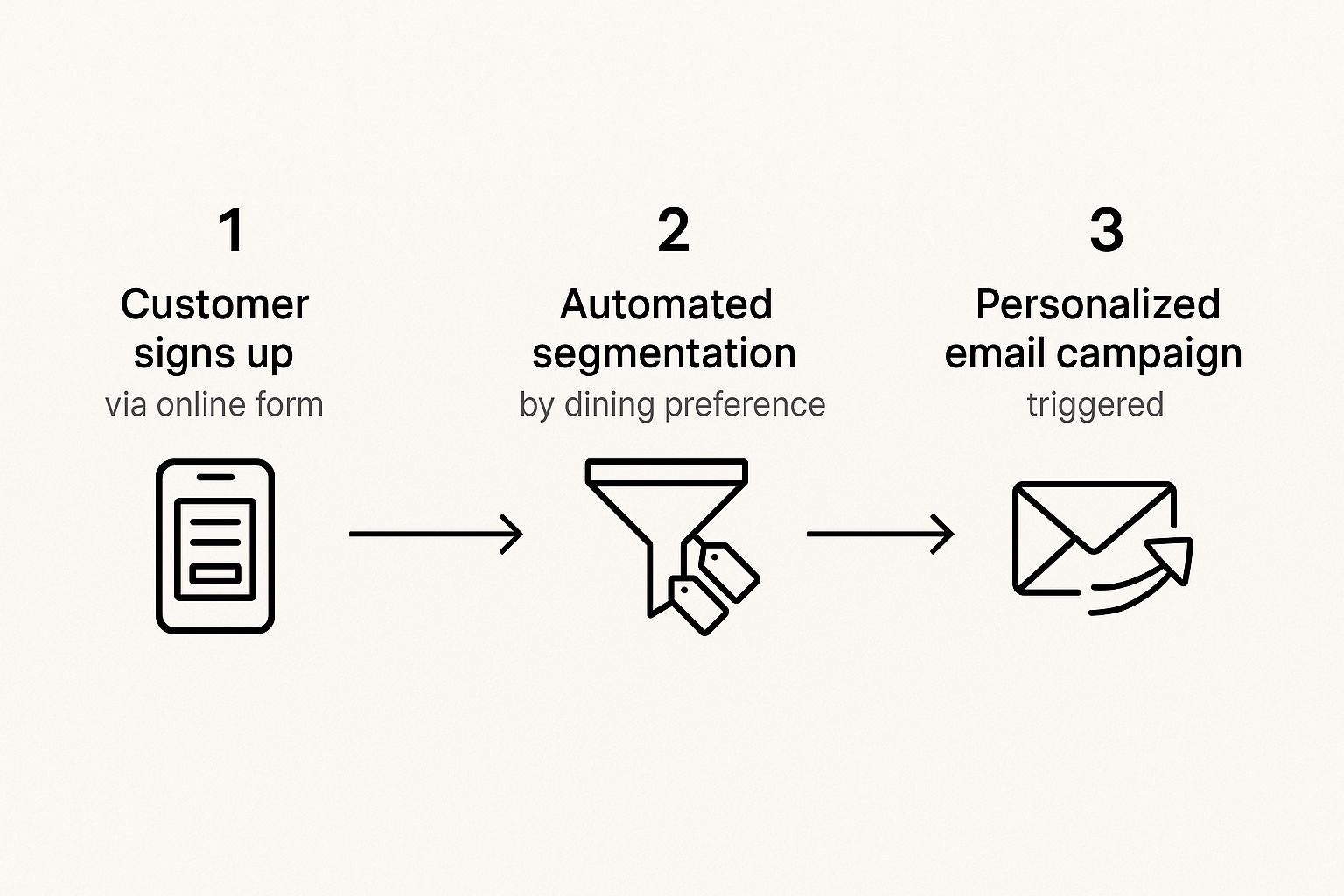
This demonstrates how a small customer action can initiate a multi-step, personalized journey that operates autonomously to drive value.
The Data Doesn't Lie
The impact of these automated, trigger-based emails is not theoretical; the performance data is conclusive. More than 53% of restaurants are already leveraging automation because the results are impossible to ignore.
These triggered emails achieve open rates 70.5% higher and click-through rates an incredible 152% higher than standard broadcast campaigns. One bistro I tracked saw a 50% increase in engagement just three months after implementing a focused automation strategy. You can dig deeper into these metrics and see for yourself the compelling case for restaurant email marketing.
The purpose of automation is not to be less human—it is to scale the human touch. By automating the predictable, repeatable tasks, you liberate your team to focus on delivering the exceptional in-person experiences that build lasting brand equity.
A Closer Look at the Welcome Series
If you only build one automation, it must be your welcome series. It is your single greatest opportunity to forge a connection while your brand is top-of-mind for a new subscriber.
A simple yet highly effective 3-part welcome series can be structured as follows:
- Email 1 (Sent Immediately): Fulfill the promise. If you offered a free appetizer for signing up, deliver the redemption code instantly. This builds immediate trust.
- Email 2 (Sent 2 Days Later): Tell your story. Introduce your chef, articulate your philosophy on sourcing, or share what makes your brand unique. This builds a connection beyond the initial transaction.
- Email 3 (Sent 5 Days Later): Provide social proof. Share glowing customer testimonials or link to a recent positive press mention. This builds confidence and provides a final impetus to use the introductory offer.
This single workflow can convert a casually interested subscriber into an engaged brand advocate who is actively seeking to make a reservation.
Weaving Email and Loyalty Together to Boost Lifetime Value
From my perspective, transformative growth occurs when marketing systems cease to operate in silos. Too many restaurants maintain a separate email list and a disconnected loyalty program. This fragmented approach actively hinders growth. The most sophisticated brands I've advised treat them as two integrated halves of the same customer relationship engine.
When you fuse your email and loyalty programs, you create a powerful flywheel for growth. Email becomes the primary communication channel for your loyalty program, and the loyalty program provides the rich, first-party behavioral data needed to hyper-personalize your email campaigns. It’s a virtuous cycle where each component enhances the other, leading to a measurable increase in customer lifetime value (CLV).
Moving Beyond Just Transactions
Your email strategy should function as the fuel for your loyalty program. Instead of deploying generic "20% off" blasts, your messages evolve into personalized status updates that reinforce the value of their membership.
This requires setting up automated triggers, such as:
- Sending a "New Points Balance" email immediately after a transaction.
- Notifying members when they are within striking distance of their next reward tier.
- Granting them exclusive early access to new menu items or event ticket sales.
These are not just emails; they are strategic touchpoints designed to build engagement. They make your members feel recognized and rewarded, which directly correlates to increased visit frequency and higher average spend. For a deeper analysis of this integrated approach, see how a restaurant loyalty program consultant would architect such a system.
The Real-World Financial Impact
The data is clear. A loyalty program actively promoted via email is a direct driver of revenue. Diners who join a loyalty program are 38% more likely to increase their spending at that restaurant over the next six months.
This isn't about marginal gains. We are talking about a significant behavioral shift. Loyalty members visit more frequently—averaging once a week—and demonstrate higher spend per visit. The data shows they are twice as likely as non-members to increase their spending, a metric that should command the attention of any operator.
This undeniable correlation between loyalty and revenue is precisely why your email strategy is so critical. You can find more supporting data on how loyalty members drive restaurant revenue on Klaviyo.com.
By leveraging email to constantly communicate the value of your program—their points, their rewards, their exclusive access—you are doing more than marketing. You are cultivating a loyal community that has a vested interest in your brand's success. This is the mechanism by which you convert a first-time guest into a high-value, long-term asset.
Common Questions About Restaurant Email Marketing
As a growth strategist operating in the restaurant space, I encounter the same set of questions repeatedly regarding email marketing. Let's address the most critical ones directly, moving beyond generic advice to what actually drives revenue. These are the operational hurdles that most frequently impede success.
How Often Should My Restaurant Send Emails?
This is the classic frequency question, and there is no single magic number. However, one principle is certain: deploying a low-value, generic email daily is the fastest path to audience fatigue and list churn. Conversely, prolonged silence leads to brand irrelevance.
For most restaurant concepts I advise, a solid baseline is one high-value promotional email per week. This cadence maintains top-of-mind awareness without becoming intrusive.
This should then be augmented with personalized, automated campaigns triggered by behavior, such as birthday offers or post-visit feedback requests. Ultimately, the optimal frequency is revealed in your data. If you observe a decline in engagement metrics, you are likely exceeding the optimal cadence for that segment.
What's the Best Day and Time to Send?
You've likely heard generalized advice about Tuesday mornings being the "golden hour" for email deployment. This is a flawed, one-size-fits-all heuristic that does not apply to the restaurant industry. The optimal deployment time is a function of your specific customer base and their dining consideration patterns.
Consider the context:
- A breakfast cafe? Test deployments early in the morning, when customers are planning their coffee run.
- A fine-dining establishment known for weekend reservations? A Thursday afternoon deployment, when weekend planning is top-of-mind, is a logical hypothesis to test.
My counsel here is consistent: begin with an educated hypothesis based on your peak business hours. But then, you must test, measure, and iterate. A/B test your deployment times, analyze the data, and allow your audience's behavior to dictate your strategy.
Can I Just Buy an Email List to Get Started?
Let me be unequivocal: absolutely not. From a strategic and ethical standpoint, this is one of the most value-destructive actions you can take.
A purchased list is, by definition, worthless. It is a collection of cold contacts who have no prior relationship with or affinity for your brand. The outcome is predictable: abysmal open rates, high spam complaints, and significant damage to your sender reputation, which can impair your ability to reach the inbox of even your legitimate subscribers.
Building your list organically—through guest Wi-Fi, online ordering, and in-venue sign-ups—is the only viable path. It ensures you are communicating with an audience that has explicitly opted-in. That is the foundation of a high-ROI email program.
Ready to stop guessing and start growing? At MGXGrowth, we architect data-driven marketing systems that transform your restaurant's potential into predictable revenue. Let's architect your growth together.
