


In my decades driving growth across hospitality, SaaS, and real estate, I've seen countless marketing channels promise the world. Facebook advertising, however, is different. It's not a digital billboard; it's a direct, data-driven system for filling your tables and boosting online orders. Executed with precision, it transforms ad spend from an expense into a predictable revenue engine. This is how we move from hoping for customers to systematically acquiring them.
Why Facebook Ads Are a Must-Have for Growth
The modern diner's journey begins on social media. This isn't a trend; it's a fundamental behavioral shift. The data is unequivocal: 74% of diners leverage social platforms to make dining decisions. Ignoring this channel is akin to locking your front door during peak hours. Your next customer is scrolling through their feed right now, and if your competitor reaches them first, you've lost.
A robust Facebook ad strategy is non-negotiable for any restaurant serious about scalable growth. It's about engineering predictable outcomes, not just hoping for foot traffic.
Get Past the "Likes" and Focus on What Matters
I've seen too many marketing teams get distracted by vanity metrics—likes, shares, comments. These metrics don't contribute to EBITDA. A growth-oriented strategy ties every dollar of ad spend to a quantifiable business objective.
- Drive Off-Peak Traffic: Target users within a 3-mile radius with a compelling "2-for-1 Tuesday" offer to increase utilization during historically slow periods.
- Boost High-Margin Items: Deploy a Carousel ad showcasing your new seasonal cocktail menu to an audience that has previously demonstrated an interest in craft beverages.
- Increase Online Orders: Implement a retargeting campaign offering complimentary delivery to users who visited your menu page but abandoned their cart.
As a growth strategist, I focus on building repeatable systems. Facebook Ads provide the data and targeting infrastructure to construct a customer acquisition machine that operates autonomously, driving traffic even as you manage the complexities of the kitchen and front-of-house.
The platform's core value lies in its granular targeting capabilities. Imagine deploying a birthday dinner special exclusively to individuals within your delivery zone whose birthday falls in the next seven days. This level of precision, once the domain of enterprise-level operations, is now accessible to every local business.
For a broader view of integrating this into your overall plan, refer to our complete guide on restaurant digital advertising. The objective is to convert passive scrolling into profitable action.
Building Your Restaurant's Ad Foundation for Profitability
In my experience breaking down silos between marketing and finance, one truth holds: campaigns fail more from a weak strategic foundation than from flawed creative. Before a single ad is conceived, the essential architecture must be in place. This is the critical differentiator between profitable campaigns and cash-burning exercises.
The most common error I observe is a rush to execution—boosting posts without proper tracking or a centralized management tool. This is analogous to constructing a building without blueprints; it’s structurally unsound and destined for failure.
Your operational command center for all advertising activity is the Meta Business Suite. Consider it the professional-grade control panel for your ad accounts, pages, and, most critically, your data assets.
Setting Up Your Command Center
Configuring your Business Manager is the first step toward executing scalable, professional-grade Facebook ads for restaurants. It institutionalizes your operations by separating personal profiles from business assets and enabling granular control over team permissions.
Upon logging in, you are presented with the central dashboard for asset management.
This hub is where you will connect your Facebook page, establish your ad account, and integrate data sources like the Meta Pixel.
Immediate action items include:
- Create or Add Your Ad Account: This is the financial entity through which all campaigns are funded and executed.
- Connect Your Facebook Page: Link your restaurant's official page to serve as the identity for your advertising.
- Assign Roles and Permissions: Grant access to internal team members or external agencies without compromising personal account security.
This simple setup elevates your marketing function from an amateur endeavor to a professionally managed operation, providing the framework for secure and effective budget management.
The Meta Pixel: The Key to Measuring Real ROI
A core principle I've applied across every industry I've worked in is this: if you cannot measure it, you cannot optimize it. The Meta Pixel, a snippet of code installed on your website, is the single most critical tool for quantifying the business impact of your advertising.
It tracks post-click user behavior on your site. Without it, you are limited to surface-level vanity metrics. With it, you unlock the ability to measure what truly impacts the bottom line.
The Meta Pixel is the mechanism that transforms ad spend from an operational expense into a measurable investment. It enables direct attribution of a reservation or an online order back to a specific ad, thereby proving return on investment.
Think of the Pixel as your digital intelligence unit. It monitors on-site user actions—who viewed the menu, who initiated a reservation, who completed a booking—and feeds that data back to the platform. This data is the lifeblood of any optimized campaign.
Defining Your Most Valuable Conversions
With the Pixel installed, you must define the conversion events that align with your business objectives. For a restaurant, we must move beyond generic metrics and track actions that directly correlate with revenue.
The critical conversion events for any restaurant are:
- View Content: Tracks views of high-intent pages like your menu or daily specials, signaling initial interest.
- Initiate Checkout: For online ordering, this event fires when a user adds an item to their cart, indicating strong purchase intent.
- Purchase: The terminal goal for e-commerce, tracking a completed transaction.
- Lead/Submit Application: The ideal event for tracking online reservation form submissions—a direct proxy for filling tables.
By tracking these specific actions, you provide Facebook's algorithm with the necessary data to identify more users likely to perform the same high-value actions. You cease optimizing for clicks and begin optimizing for customers—the only metric that drives sustainable growth.
Crafting Ad Creative That Stops the Scroll
You have less than two seconds to arrest a user's attention in a crowded feed. Having managed countless high-performance campaigns, I can state unequivocally that success hinges on connection, not perfection. We are not merely selling a dish; we are selling an experience, a craving, a compelling reason for a user to transition from passive scrolling to active dining.
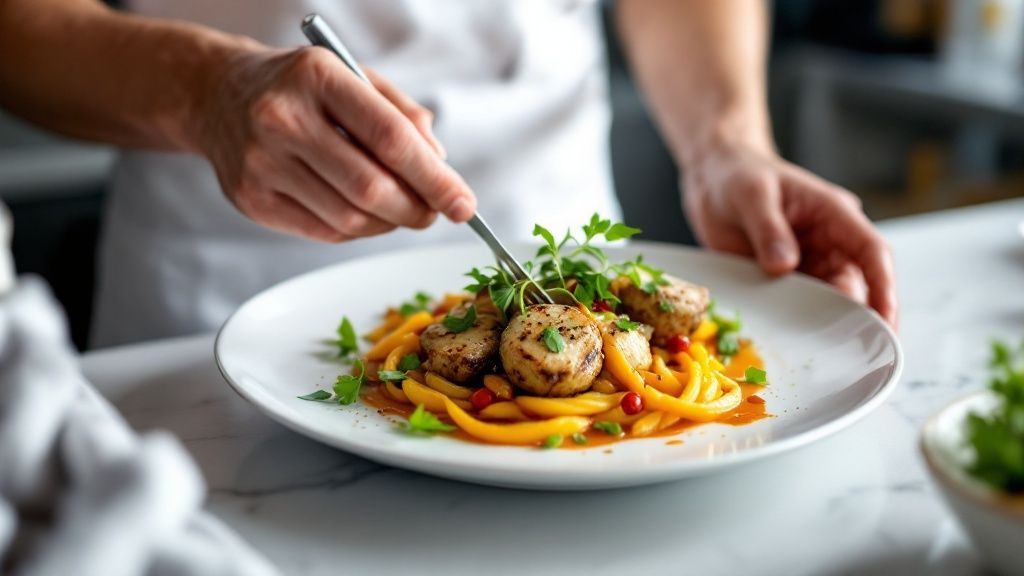
Many restaurants fail at this juncture. They invest in sterile, studio-quality photography that looks corporate and fails to resonate. The data consistently demonstrates that authenticity outperforms polish. A short, well-lit smartphone video of your chef plating a signature dish will almost invariably outperform a static, perfectly produced image.
It feels genuine. It cuts through the noise of overproduced advertising and offers an authentic glimpse into your restaurant's identity.
The Power of Authentic Visuals
The objective is to create content that feels native to a user's feed, not like an intrusive advertisement. The content people engage with is typically raw, personal, and narrative-driven. This is the standard your creative must meet.
Focus your visual strategy on these high-impact areas:
- Behind-the-Scenes Video: Capture the sensory details—the sizzle of a steak, the focused technique of a mixologist, the camaraderie of your team before service. These elements forge a human connection that a static food photo cannot replicate.
- User-Generated Content (UGC): Solicit and reshare customer photos and stories with permission. This serves as powerful social proof, acting as a digital word-of-mouth recommendation.
- Before-and-After Shots: This tactic is surprisingly effective. Showcasing the transformation from raw, high-quality ingredients to a beautifully plated dish tells a compelling visual story that is universally understood.
The trust engendered by social proof is significant. Data shows that 88% of patrons trust online reviews as much as personal recommendations. Featuring UGC directly activates this powerful psychological trigger. You can review more data on how social proof drives dining decisions on menutiger.com.
Writing Copy That Sells an Experience
Your visual has secured the initial stop. Now, your copy must convert that attention into intent. Generic phrases like "Come visit us!" are an inefficient use of ad budget. Your copy must address a specific diner motivation and overcome potential friction.
A simple yet highly effective framework I deploy is Hook, Story, Offer.
- The Hook: Open with a question or a bold statement targeting a desire or pain point. "Tired of the same boring weeknight dinner?" or "The weekend brunch you've been dreaming of is finally here."
- The Story: Do not simply list ingredients; articulate the experience. Describe the flavor profiles, the ambiance, the emotional payoff. "Imagine perfectly crispy fries dipped in our house-made truffle aioli, paired with an ice-cold local craft beer."
- The Offer: Conclude with a clear, low-friction call-to-action (CTA). Avoid vague directives. Be specific: "Book Your Table for Friday Night" or "Order Now for Free Delivery."
Your ad creative is the first touchpoint in the customer experience. Every component, from the visual asset to the headline, must cohesively answer one critical question for the user: "Why should I choose you tonight?"
Leveraging Specific Ad Formats
Facebook's suite of ad formats provides a toolkit for enhancing your message. To create truly effective Facebook ads for restaurants, you must think beyond the single image post.
Two formats I find particularly effective for this sector are:
- Carousel Ads: Ideal for narrative storytelling or showcasing variety. A carousel can guide a user through a multi-course tasting menu, with each card highlighting a specific dish. Alternatively, it can feature your happy hour, with separate cards for cocktails, appetizers, and the overall atmosphere.
- Instant Experiences (formerly Canvas Ads): This format functions as an in-app microsite, loading instantly within the Facebook environment. It enables an immersive, full-screen experience combining video, images, carousels, and text to showcase your brand story, menu, and ambiance without requiring the user to leave the platform.
By integrating authentic visuals, persuasive copy, and the appropriate ad format, you move beyond simple promotion. You craft a compelling invitation, transforming your ad from an interruption into a destination.
Mastering Hyper-Local Targeting to Find Diners Nearby
Across every growth strategy I've implemented, one constant holds true: precision is paramount. The strategic advantage of Facebook is not its scale, but its surgical ability to isolate your precise target customer. For a restaurant, this capability is a force multiplier.
It allows you to cease broad, inefficient communication and engage in direct, personalized dialogue with potential diners located just blocks away.
Forget archaic city-wide targeting—it's a recipe for budget incineration. Our approach is to construct high-intent local audiences by layering data, ensuring every ad dollar is deployed against individuals who are not only proximate but also predisposed to becoming high-value customers.
Start with Precise Geo-Targeting
The foundation of any effective local campaign is geo-targeting. This is your primary filter. Avoid targeting entire cities or broad postal codes. For nearly every restaurant, the most profitable customers reside or work within a tight radius of the establishment.
I initiate campaigns by setting a 1- to 5-mile radius around the physical address. This immediately concentrates spend on the most probable patrons. For added precision, use the "drop pin" feature to target specific high-density office complexes during lunch hours or residential enclaves in the evening.
This focused spend increases ad frequency among high-potential customers, building brand recall and consideration without wasting impressions on those too distant to convert.
Layer on Behavioral and Interest Targeting
With your geographic perimeter established, the next step is to refine your audience. Layering behavioral and interest data transforms your targeting from "people nearby" to "the right people nearby." Facebook's data allows you to identify users based on their demonstrated interests and online behaviors.
Consider the strategic power of these targeting layers:
- Life Events: Target users with an "upcoming birthday" or an "anniversary within 30 days." These are individuals actively seeking celebration venues.
- Interests: Move beyond broad categories. Target interests in your specific cuisine ("Italian cuisine," "sushi," "craft beer") or, more strategically, users who follow your direct competitors.
- Behaviors: Isolate users identified by Facebook's algorithm as "frequent diners" or those who have recently engaged with content from other restaurant pages.
This multi-layered methodology ensures your ad for a romantic anniversary special is served to couples in the planning phase, not to college students seeking value-priced pizza. This level of granularity is what distinguishes underperforming Facebook ads for restaurants from campaigns that drive tangible results.
Unlock the Power of Your Own Data
This is where explosive growth is often unlocked. Your most valuable audiences are composed of individuals with whom you already have a relationship. By creating Custom Audiences, you can leverage your first-party data to re-engage past customers across Facebook's ecosystem.
You can upload customer lists from:
- Your email marketing platform
- Your online reservation system (e.g., OpenTable, Resy)
- Your online ordering platform's customer database
Once audiences are created, you must select an appropriate bidding strategy. This infographic provides a high-level comparison of common models and their typical performance characteristics.
As illustrated, while a Cost Per Action (CPA) bid may appear more expensive on a per-unit basis, its superior conversion rate often renders it the most efficient model for driving bottom-of-funnel actions like reservations or orders.
Targeting these warm audiences with bespoke offers is one of the highest-ROI marketing activities available. They have an existing affinity for your brand; a simple, timely prompt is often all that is required to drive a repeat visit. To explore this further, consider implementing advanced customer segmentation strategies.
Your first-party data is a strategic asset. A Custom Audience of past diners can be marketed to with unparalleled efficiency. Cease paying to re-acquire the same customer.
Next, we leverage Lookalike Audiences. Here, Facebook's algorithm analyzes your source Custom Audience and identifies new users who share similar characteristics and behaviors.
A 1% Lookalike Audience built from a seed list of your top-spending patrons is one of the most powerful tools for acquiring new, high-value customers with a high propensity to convert.
This systematic process shifts your targeting from assumption to data-driven precision. You reallocate capital from low-probability targets to those primed to make a reservation.
To clarify these options, here is a matrix outlining the primary audience types.
Restaurant Audience Targeting Matrix
| Audience Type | Data Source | Best Use Case for Restaurants |
|---|---|---|
| Saved Audience | Interests, Behaviors, Demographics, Location | Acquiring new local customers for top-of-funnel brand awareness and consideration. |
| Custom Audience | Your own data (email list, reservation data) | Re-engaging past customers to drive loyalty, repeat business, and higher LTV. |
| Lookalike Audience | Facebook's analysis of your Custom Audience | Finding new, high-potential customers who mirror the profile of your best existing patrons. |
The optimal audience selection is dictated by the specific objective of the campaign, whether it's net-new customer acquisition or increasing visit frequency from your existing base.
Optimizing Your Ad Spend for Maximum Restaurant ROI
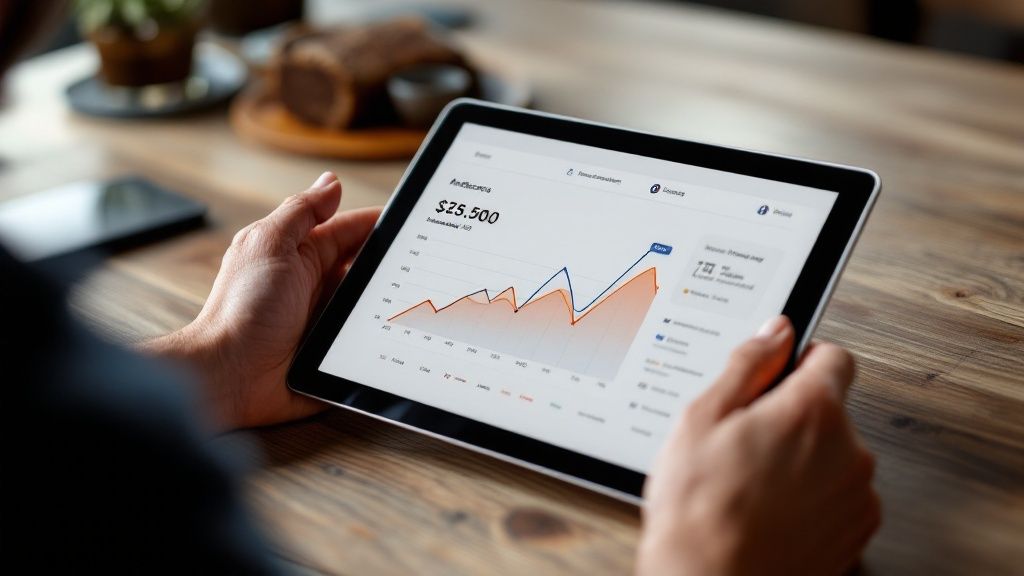
Deploying capital into Facebook ads is simple. The strategic imperative—what separates high-growth restaurants from the rest—is generating a consistently positive and scalable return on that capital. This requires a shift in mindset: from restaurateur to data-driven performance marketer.
Having managed multi-million dollar ad budgets, the principles remain constant. You must have an intimate understanding of your key metrics, trust empirical data over intuition, and be ruthless in your optimization decisions. This means knowing precisely where to allocate budget, when to scale a winning asset, and when to divest from an underperforming one.
Demystifying Bidding and Budget Allocation
One of the most powerful tools in the modern advertiser's arsenal is Campaign Budget Optimization (CBO). Rather than manually assigning budgets to individual ad sets, you establish a single, unified budget at the campaign level.
Facebook’s algorithm then dynamically allocates that budget to the highest-performing ad sets in real time. It functions as an automated portfolio manager, shifting capital to the assets generating the best returns—be it reservations or online orders. I recommend CBO for nearly all restaurant campaigns as it streamlines management and leverages machine learning for superior efficiency.
CBO is the first step toward managing ad spend like a strategic investment portfolio. You are not simply purchasing media; you are empowering a sophisticated algorithm to allocate capital to maximize total return.
This approach, however, is only effective if you have clearly defined performance benchmarks. The restaurant sector benefits from favorable platform dynamics. The average click-through rate (CTR) for food and dining ads exceeds 2%, outperforming the platform average. The average cost per click (CPC) is approximately $0.74, significantly lower than in more competitive verticals. You can explore these Facebook ad benchmarks on Theedigital.com for more context.
This data indicates a user base that is highly receptive to restaurant advertising—a built-in strategic advantage.
Key Metrics That Actually Matter
Disregard vanity metrics. They provide psychological comfort but do not impact financial statements. When managing Facebook ads for restaurants, my focus is exclusively on metrics that correlate directly with revenue.
Obsess over these three key performance indicators:
- Cost Per Acquisition (CPA): Your north star metric. What is the fully loaded cost to generate one confirmed reservation or one completed delivery order? If your average check is $50 and your CPA is $5, you have a profitable and scalable model.
- Return on Ad Spend (ROAS): The ultimate measure of profitability. For every dollar invested in advertising, how many dollars in revenue are generated? A 5x ROAS signifies that $1 of ad spend yields $5 in revenue.
- Customer Lifetime Value (CLV) to CPA Ratio: The long-term strategic metric. If your CPA is $10, but your analysis shows that a new customer generates $500 in revenue over the subsequent 12 months, that $10 acquisition cost is a highly profitable investment. Understanding how to reduce customer acquisition cost is fundamentally about optimizing this ratio.
Scaling Winners and Killing Losers
With these key metrics as your guide, budget management becomes a data-driven, unemotional process. The rules of engagement are clear.
When to Scale a Campaign:
A campaign is a "winner" if it consistently meets your target CPA and ROAS over a 3-5 day period. To scale without disrupting the algorithm, increase the budget by no more than 20% every 48 hours. This methodical approach maintains performance stability and avoids re-entering the volatile "learning phase."
When to Kill a Campaign:
Be decisive. If an ad set has expended twice your target CPA without a single conversion, it must be deactivated. Do not fall prey to the "sunk cost fallacy." The data is providing a clear signal. Cut the underperforming asset, reallocate the capital to a proven winner, and move forward.
This disciplined methodology ensures every dollar of your marketing budget is deployed for maximum impact on your restaurant's growth.
Your Top Facebook Ad Questions, Answered
Having advised numerous restaurant leadership teams and managed significant ad spend in this vertical, I've identified several recurring strategic questions. These inquiries go beyond tactical execution and address the core challenge: transforming ad spend into a reliable growth engine.
Here are my direct, data-informed answers, designed to help you execute Facebook ads for restaurants with analytical rigor, replacing guesswork with a system that drives measurable results.
How Much Should a Restaurant Spend on Facebook Ads?
There is no universal figure, but there is a strategic starting point. I advise clients to initiate with a "data acquisition budget" of $20 to $30 per day. This is not an attempt to drive immediate, massive returns; it is a calculated investment in market intelligence. You are gathering data on audience and creative resonance without significant capital risk.
The objective of this initial phase is to identify a profitable formula—a state where your Cost Per Acquisition (CPA) is substantially lower than the lifetime value of the customer acquired.
Once a profitable ad is identified, the impulse is to scale aggressively. Resist it. The optimal scaling methodology is incremental. I adhere to a rule of never increasing an ad set budget by more than 20% every 48-72 hours. This maintains algorithmic stability and prevents a regression into the inefficient "learning phase." The primary focus must always be on maintaining your target Return on Ad Spend (ROAS), not on the raw spend figure.
What's the Biggest Mistake Restaurants Make?
The single most costly mistake is utilizing the "Boost Post" function without a clearly defined, trackable business objective. This action generates high-cost vanity metrics (likes, comments) that do not correlate with revenue and is the fastest way to incinerate a marketing budget with zero attributable ROI.
Every dollar of spend must be assigned a specific job: drive reservations, generate catering leads, or increase online orders. If an activity's outcome cannot be measured against a business goal, it should not be funded.
The second most common error is excessively broad targeting. An ad broadcast to an entire metropolitan area is financially inefficient. Effective campaigns are hyper-local, typically targeting a 3-5 mile radius. This geographic focus is then refined with interest and behavioral layers to achieve precision. This is a game of surgical strikes, not carpet bombing.
Should I Run Ads for Delivery or Dine-In?
You must do both, but they must be executed as distinct campaigns. You are addressing two different customer segments with disparate motivations. A single, generic message will resonate with neither.
This is my standard operational breakdown:
-
Dine-In Ads: The objective is to sell the experience. Utilize video assets that convey your restaurant's ambiance and atmosphere. The copy should evoke the feeling of being there. The call-to-action must be a direct "Book Now," linking to your reservation platform.
-
Delivery & Takeout Ads: The focus here is on convenience and product. This requires high-quality, compelling food photography. The messaging must emphasize the ease of access to your product from home. Calls-to-action should be "Order Now," with offers potentially tailored to the delivery channel.
A highly effective tactic is to create a Custom Audience from your existing delivery customer database. Targeting this segment with specific retention-focused ads is an incredibly efficient method for converting a transactional customer into a loyal, high-frequency user. Each channel demands its own strategic playbook.
At MGXGrowth, we architect and implement data-driven advertising systems for ambitious restaurants. We bypass theory and focus exclusively on building growth engines that convert ad spend into predictable revenue and measurable EBITDA contribution.
