


Growing your restaurant's sales isn't just about tweaking the menu anymore. It demands a disciplined, almost scientific approach that brings together data, technology, and a deep understanding of customer psychology. This is about engineering predictable growth and, just as importantly, protecting your hard-earned margins.
Why Restaurant Growth Has Changed Forever
After spending decades driving growth in some of the most competitive industries out there, I can tell you the restaurant business has fundamentally changed. Having a killer menu and a great location used to be the ticket. Not anymore. To build a truly profitable restaurant today, you have to master the new forces shaping the market.
The numbers paint a clear picture of both immense opportunity and serious challenges. The U.S. restaurant industry is on track to hit an incredible $1.5 trillion in sales in 2025, which is an 82% jump from the lows we saw in 2020. That's a huge comeback and shows people are eager to dine out. But it also means the fight for every single customer dollar is more intense than ever. You can dig into the industry's projected growth and what it means for operators to see the full scope.
The Modern Diner's Mindset
Today's customers are savvy. They’re looking for value, but it's not just about the lowest price. While nearly 81% of Americans say they'd eat out more if they had the cash, their decisions are far more complex. They're chasing experiences, demanding convenience, and expecting a personal touch.
This is the new reality for restaurant owners. Success isn't an accident; it's designed. It means you have to tear down the walls between your kitchen, your front-of-house, and your marketing to build one seamless growth machine.
Think about this: the most profitable restaurants, the ones hitting net margins closer to 10% instead of the typical 3–5%, aren't just getting lucky. They are disciplined operators. They use data to make smarter decisions every single day on everything from menu pricing to how they spend their marketing budget.
Moving Beyond Generic Advice
This guide isn't about rehashing the same old tips. We're reframing sales growth as a core strategy built on two pillars: differentiation and operational excellence. You’re going to learn the sophisticated tactics that the top performers use to pull away from the pack.
We'll get into the nitty-gritty of how to:
- Conquer your digital and off-premises channels to bring in new money.
- Engineer true profitability by tightening up operations and keeping a close eye on costs.
- Turn amazing customer experiences into a reliable, recurring source of income.
- Find and develop new revenue streams that go beyond your dining room.
Adopting this mindset means you start seeing your entire operation as one interconnected system. Every single choice—whether it’s adding a new dish or launching a social media campaign—has to be made with one goal in mind: driving top-line revenue while protecting your bottom line.
In all my years helping scale global marketplaces, one truth always came out on top: a business’s four walls no longer define its revenue potential. This couldn't be more accurate for restaurants. If you're looking for the single biggest lever you can pull to increase sales right now, it's mastering your digital and off-premises channels.
Your off-premises business—that’s delivery, takeout, and catering—isn't just some add-on anymore. For a lot of places, it’s the main engine driving revenue. The goal isn't just to "be online." It's to engineer a seamless digital experience that extends your unique hospitality far beyond the dining room table.
This visual really drives the point home. It shows just how much off-premises channels are growing, with online orders making up a huge chunk of total sales, massive year-over-year growth in delivery, and a higher average check for digital customers.
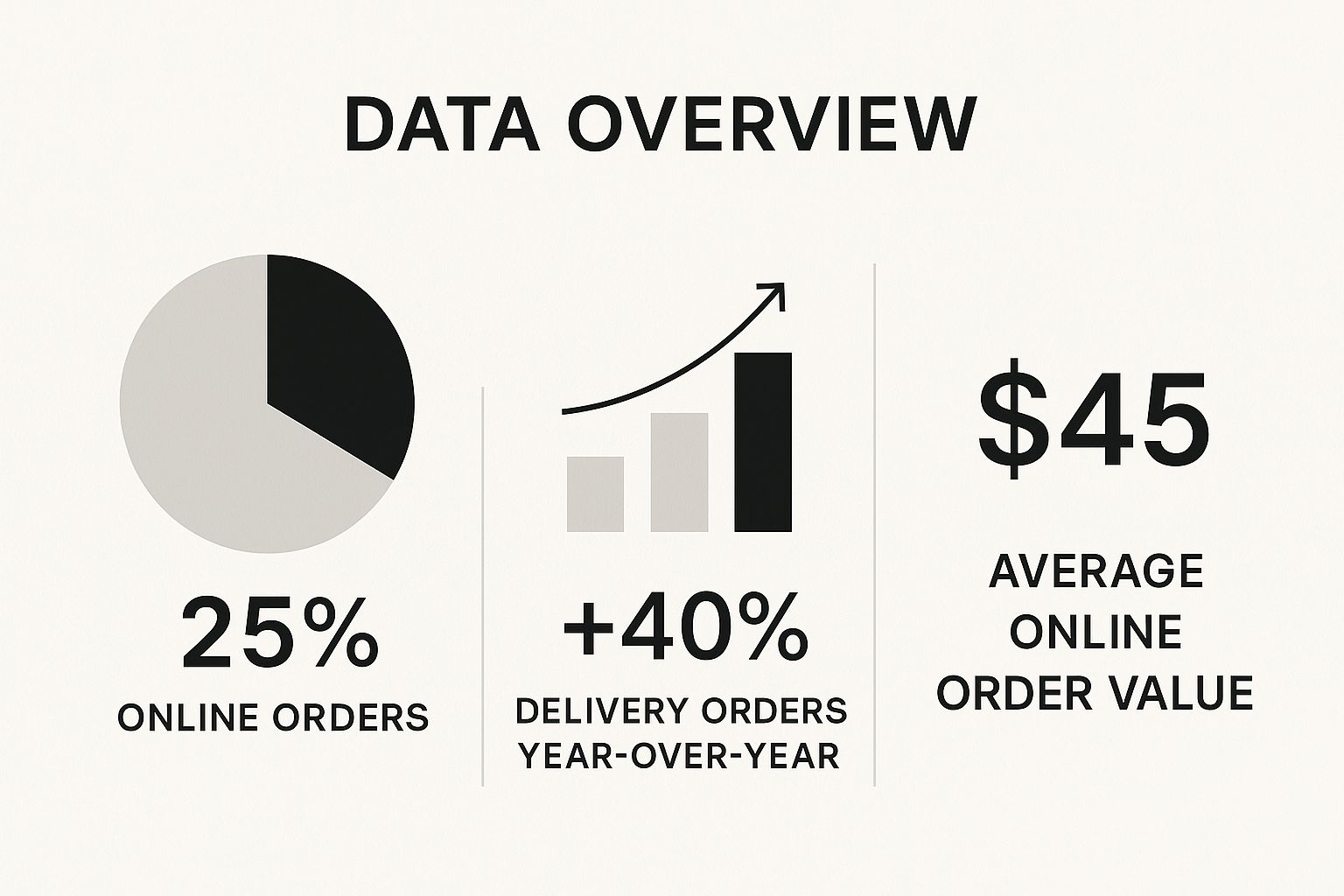
The numbers don't lie. Customers who connect with you online tend to spend more and are increasingly choosing delivery. That makes this channel absolutely essential for growing your top line.
Build a Frictionless Digital Front Door
Think of your website and mobile app as your new front door. If a customer has to click more than three times to place an order, you're losing money. The whole process has to be intuitive, fast, and look good—it should be a direct reflection of your brand's quality.
Here’s a way to frame it: every bit of friction—a slow-loading menu, a confusing checkout process, a broken link—is the digital version of a dirty table or a rude host. It kills trust and sends hungry customers straight to your competition.
The core principle is simple: make it easier for customers to give you their money. This means investing in a high-quality online ordering system, whether it’s a native platform you control or a carefully managed third-party integration.
Of course, your digital presence has to be discoverable. That’s where your Google Business Profile comes in, and optimizing it is non-negotiable. It’s free real estate on the world’s biggest search engine. Make sure it’s loaded with:
- Direct Ordering Links: Funnel customers straight to your most profitable channel.
- High-Quality Photos: Show off your food, your space, and your team.
- Accurate Menus: Nothing frustrates a potential customer more than an old menu.
- Customer Reviews: Actively manage and respond to feedback. It's how you build social proof.
The Third-Party Delivery Dilemma
Let's talk about platforms like DoorDash and Uber Eats. They are incredibly powerful for getting new customers in the door—they give you access to a huge audience you could never reach on your own. But those commission fees, often hitting 15-30%, can absolutely crush your margins if you're not strategic.
So, don't just see them as a necessary evil. Treat them as a marketing expense. Your goal is to use their massive reach to attract a customer for the first time, and then do everything you can to convert them into a direct, more profitable customer for every order after that.
A simple but effective tactic? Stick a small marketing insert in every single third-party delivery bag. Offer a small discount or a free item on their next order, but only if they place it directly through your website. This is a proven way to start migrating customers from those high-commission marketplaces into your own ecosystem, where you own the relationship and the data.
Turn Data Into Dollars with Smart Promotions
Your customer data is pure gold. A good loyalty program isn't about giving away free food; it’s a machine for collecting data and influencing guest behavior. Dive into your Point of Sale (POS) and online ordering data to create targeted promotions that actually drive sales.
For example, pull a list of customers who haven't ordered in 60 days and send them a personalized "We Miss You" offer. Or, create a new lunch bundle and send the promo exclusively to guests who typically only order dinner. This shifts you away from generic, margin-killing discounts and toward precise, data-driven incentives. This is a key area where a dedicated restaurant marketing agency can bring the expertise to build and run these campaigns effectively.
To help you decide where to focus your efforts, here's a quick breakdown of common digital initiatives, balancing their potential impact against the effort required to get them right.
Digital Growth Levers: Impact vs. Effort
| Digital Initiative | Potential Sales Impact | Implementation Effort | Key Action for Owners |
|---|---|---|---|
| Google Business Profile Optimization | High | Low | Fill out every section, add weekly posts and high-quality photos. |
| Direct Online Ordering System | High | Medium | Invest in a user-friendly system; promote it over third-party apps. |
| Email & SMS Marketing | Medium-High | Medium | Set up automated campaigns for new, loyal, and lapsed customers. |
| Third-Party Marketplace Strategy | High | Low-Medium | Use it for acquisition, then convert users to direct channels via inserts. |
| Social Media Engagement | Medium | High | Focus on one or two platforms, post user-generated content, run targeted ads. |
| Paid Search Ads (Google/Bing) | High | Medium-High | Target keywords like "tacos near me" to capture high-intent customers. |
Choosing the right levers depends on your current resources, but this table gives you a solid starting point for prioritizing what will move the needle the most.
Digital convenience is no longer a "nice to have"—it's a cornerstone for growth. According to the National Restaurant Association, restaurants that nail the combination of frictionless digital access, genuine hospitality, and personalized rewards are the ones best positioned to capture a larger market share. This is happening globally, as operators who invest in solid online delivery systems often see a 20–30% revenue jump from these channels in the first year alone. You can read more about these evolving consumer expectations on Restroworks.com.
Build Your Profits from the Inside Out Through Operational Excellence

Let's be blunt. Sales growth is just a vanity metric if it doesn't actually hit your bottom line. I’ve spent my entire career in the trenches, bridging the gaps between finance, marketing, and the day-to-day chaos of operations. I've seen far too many popular, packed-out restaurants go under simply because their margins were paper-thin.
Real, sustainable growth isn't just about packing the house. It's about building a resilient business that can handle the punches, whether it's soaring food costs or another key employee turning in their notice. It’s time to get serious about the operational levers that protect and expand your profitability.
The Profitability Puzzle: Rising Costs and Shifting Habits
The current climate is tough, no doubt about it. We're all feeling the squeeze from labor costs and operational pressures that eat into profits, even when sales are up. While the average U.S. restaurant profit margin is stuck between 3% and 5%, the top operators are consistently hitting closer to 10%. The secret? It's all about operational discipline.
These challenges are compounded by high staff turnover and a worrying trend of declining tips, which slipped from 15.17% to 14.99% in early 2025. That might not sound like much, but it directly hits your team's morale and their wallets. It all points to a critical truth: lasting success is less about chasing new customers and more about mastering what happens within your four walls. You can get a closer look at these industry-shaping trends in this 2025 restaurant industry review on blackboxintelligence.com.
Master Your Menu Engineering
Your menu is the single most powerful tool you have for driving profit. It's not just a list of dishes; it's a strategic sales document. Menu engineering is how you use data to stop guessing and start making smart decisions about what you sell.
I always tell my clients to think of their menu in four simple categories:
- Stars: These are your slam dunks—high popularity and high profit. You feature them, you talk about them, and you never, ever get rid of them. They are your cash cows.
- Plow Horses: Everyone loves them, but they don't make you much money. You can't just ditch them, so you have to get creative. Can you bump the price by a dollar? Tweak the portion size slightly? Find a less expensive garnish without sacrificing the quality?
- Puzzles: High profit, but nobody's ordering them. Your job is to figure out why. Run it as a special, train your staff to recommend it, or give it a better spot on the menu.
- Dogs: Low profit and low popularity. These items are dead weight. Unless there's a compelling reason to keep one, it's time to let it go.
This isn't about gut feelings. It's about pulling the data from your POS and making calculated decisions. I've seen this process alone add several points to a restaurant's bottom line without selling a single extra plate.
Use Technology to Tighten Up Labor and Slash Waste
After your food costs, labor is almost certainly your biggest line item. Smart scheduling isn't just about filling slots; it’s about matching your staffing levels to your sales flow with surgical precision. Modern scheduling software can look at your historical sales data and predict busy and slow periods, so you're not burning cash on an overstaffed floor or getting crushed during an unexpected rush.
The same logic applies to inventory. From what I’ve seen, the average restaurant loses between 2-5% of its revenue to completely avoidable waste, spoilage, or theft. An inventory management system gives you a real-time look at your stock, flags potential waste before it gets out of hand, and can even automate reordering.
The goal is to create a feedback loop where sales data informs scheduling, scheduling informs inventory, and inventory data helps you refine your menu. This is how you break down those internal silos and build a truly efficient operation.
Invest in Training That Actually Drives Revenue
Finally, stop thinking of your staff as a cost center. They are your front-line revenue generators. Targeted, strategic training is one of the best investments you can possibly make, and it goes way beyond just memorizing the menu.
Your team needs to be trained on specific upselling and cross-selling techniques that feel natural and helpful, not like a cheap sales pitch. For example, instead of a server asking, "Can I get you anything else?" they could say, "If you're a fan of the short rib, our new barrel-aged old fashioned is the perfect pairing for it."
This simple shift doesn't just bump up the average check size; it genuinely improves the guest experience, which is what builds loyalty and gets people coming back. For a deeper dive, our guide on how to improve operational efficiency lays out a more detailed framework. When you focus on these core operational pillars—menu, labor, inventory, and training—you're not just running a restaurant; you're building a profit engine.
Turn Customer Experience Into Predictable Revenue
I've worked in a lot of different industries, from tech startups to high-end hospitality, and one thing is always true: the product is only half the story. In the restaurant world, the experience you create is your most powerful weapon. It's what drives the kind of word-of-mouth advertising you simply can't buy, turning a first-time visitor into a lifelong fan who brings their friends.
A lot of operators get stuck on the idea of "good service." But good service just means you met the basic expectations. A truly great experience—the kind that builds predictable, recurring revenue—has to be designed from the ground up. It’s a deliberate strategy that covers every single interaction, from the moment a guest finds you on Instagram to the final "goodnight" at the door.
From Feedback to Financials
The first step in building a better experience is seeing it through your guests' eyes. This means you have to stop passively waiting for reviews to pop up online and start actively listening. You need to build a system for gathering feedback.
A simple text or email survey sent out after a meal can work wonders. The key is to ask smart, specific questions that give you real, actionable information:
- "What was the single most memorable part of your visit with us tonight?"
- "Was there anything at all we could have done to make your experience even better?"
- "On a scale of 1-10, how likely are you to recommend us to a friend?"
The answers you get back are pure gold. This data will shine a light on the little friction points your team might be completely blind to, and it will also show you the "wow" moments that are already working. Your job is to systematically get rid of the problems and figure out how to recreate the magic, every single time.
I’ve always said that a customer complaint is a gift. It's a free consultation from someone who actually cares enough to point out where you’re missing the mark. When you handle a complaint well, you can turn an unhappy guest into your most vocal supporter. Give your managers a budget and the freedom to fix problems on the spot—a free dessert, a discount on their next visit—without having to run it up the chain.
Mapping the Guest Journey
To really understand where you can improve, you need to map out the entire guest journey. This is a simple but powerful exercise where you visualize every single touchpoint a customer has with your restaurant. This goes way beyond what happens inside your four walls.
Think about the whole process in stages:
- Discovery: How do people even find you? A Google search for "best Italian near me"? A friend's recommendation? An influencer's post?
- Booking: How easy is it to get a table? Is your online reservation system a breeze to use on a smartphone?
- Arrival: What’s that first impression like? A genuine welcome from the host? The vibe and energy of the room?
- Dining: This is the main event—the service from the waitstaff, the quality of the food, the timing and pace of the meal.
- Departure: How does it all end? Is paying the bill quick and painless? Is the farewell as warm as the welcome?
- Post-Visit: What happens after they leave? Do you send a follow-up email? Ask for a review? Invite them to a special event?
When you break the experience down like this, you start to see all the small places where you can make a huge impact. For a really detailed look at this, you can find guides on how to use customer journey mapping software that provide a data-driven picture of every step. This method forces everyone—from marketing to the kitchen—to see the business through the customer's eyes.
The Power of Personalization
In a market this crowded, personalization is what makes you stand out. It’s how you build a real emotional connection that a faceless delivery app can never compete with. A solid CRM or guest management system is your best friend here, letting you track preferences and make people feel special.
Think about it: a regular guest who always orders the same Cabernet Sauvignon comes in. Your host sees a note in the system and asks, "Shall we get a glass of your favorite Cabernet started for you at the table?" That tiny gesture changes everything. It's no longer just a transaction; it's a relationship. It tells the customer you see them and you value them.
This is what builds true loyalty. Research has shown that 59% of guests will gladly pay more for a customized tasting menu, and 53% will spend more on personalized drink pairings. This isn't an expense; it's an investment in getting customers to come back more often and spend more over their lifetime, creating a much stronger, more profitable business.
Unlock New Revenue Streams Beyond The Core Menu

I've seen it time and again, whether in tech or hospitality: the businesses that truly last are never one-trick ponies. If your entire operation hinges on dine-in and takeout sales, you're leaving yourself dangerously exposed. The operators who are crushing it are the ones constantly looking for new ways to diversify, to squeeze more value out of every single asset they have.
Growth isn't just about packing the dining room. It's about building a brand that works for you around the clock, generating income from multiple sources. This creates a financial buffer that lets you breathe easy when foot traffic lulls or the market gets shaky.
Monetize Your Brand Beyond the Plate
Your brand is so much more than the food you serve. Your loyal customers already love your quality and know your story. So why not give them a way to take a piece of that experience home? That’s where retail products come in.
I’ve watched this strategy transform businesses of all sizes, and it doesn't have to be complicated. Just start with your hero items—the things people can't stop talking about.
- Signature Sauces & Spice Rubs: That famous BBQ sauce everyone asks about? Bottle it. Your unique steak seasoning? Package it up. This is usually the simplest and most effective way to dip your toe into retail.
- Meal Kits: Put together all the key ingredients for one of your most popular dishes. You’re tapping right into the at-home cooking trend and giving customers a totally new way to connect with your menu.
- Branded Merchandise: Go beyond a simple t-shirt. Think about high-quality aprons, custom glassware, or even a cookbook featuring your best recipes. In fact, research shows a staggering 87% of consumers would gladly buy these kinds of items from their favorite restaurants.
The brilliant part is that this isn't just a new, high-margin revenue stream. It's also fantastic marketing. Every bottle of your sauce on a grocery shelf or in a customer's fridge is a constant advertisement for your restaurant.
Start small to test the waters. Pick one or two products, sell them directly in your restaurant, and listen carefully to what your customers say. This is a low-risk way to prove the concept before you even think about scaling up.
Turn Your Space Into a Multi-Use Asset
Your physical restaurant space is one of your biggest monthly bills. Every hour it sits empty, it’s costing you money. The most successful operators I know have learned to make every square foot earn its keep, especially during those quiet, off-peak hours.
Stop thinking of your downtime as a loss. Those slow weekday mornings or mid-afternoons are actually a huge opportunity. Your space can be transformed to serve completely different needs.
- Host Corporate Meetings: Local companies are always hunting for interesting places for off-site meetings. Put together a simple package with coffee, Wi-Fi, and a catered lunch.
- Offer Cooking or Mixology Classes: You're paying for the expertise of your chefs and bartenders anyway—why not monetize it? Host ticketed classes teaching guests how to craft your signature cocktails or perfect a pasta dish.
- Rent for Private Events: Make your restaurant the default choice for birthday parties, rehearsal dinners, and holiday gatherings. Create a few tiered event packages to make the booking process dead simple for potential clients.
When you do this, your rent shifts from being a major liability to a dynamic, revenue-generating asset. You're no longer just selling food; you're selling an experience, access to your unique space, and the talent of your team. This shift in mindset is what separates the restaurants that just get by from the ones that truly grow.
Restaurant Sales FAQs: Your Top Questions Answered
After decades of working in the trenches with businesses in hospitality, tech, and everything in between, I’ve heard it all. While every restaurant has its unique challenges, the core mission is always the same: drive sustainable, profitable growth. I get asked a lot of questions, so I wanted to tackle some of the most common ones I hear from operators looking to boost their sales.
What Is the Quickest Way to Increase My Sales Right Now?
The fastest lever you can pull is almost always your digital front door. I'm talking about optimizing your online presence for direct orders. This doesn't mean you need a massive, expensive overhaul.
Start with your Google Business Profile. It’s your most valuable piece of free real estate. Research shows that 1 in 3 people find and book restaurants through Google, so you can't afford to neglect it.
Make sure it has:
- High-quality, mouth-watering photos of your signature dishes and the dining room's ambiance.
- Your most current menu and absolutely accurate hours.
- A direct link to your own online ordering system, not just a third-party app.
At the same time, slip a simple marketing insert into every single third-party delivery bag. Offer a small discount on their next meal if they order directly from your website. You're using the marketing muscle of the big apps to find the customer, then immediately working to convert them to your own, more profitable channel. It’s a low-cost, high-impact tactic that starts paying off from day one.
How Much Should I Spend on Marketing?
There's no single magic number, but a healthy benchmark for most established restaurants is 3-6% of your total revenue. If you're new or in a serious growth phase, you'll likely need to push that closer to 6-10% to build momentum and grab market share.
But honestly, the more important question is how you're spending that money, not just how much. I’ve seen restaurants with massive budgets get zero results and others on a shoestring budget absolutely crush it.
The key is to stop thinking of marketing as an expense and start treating it as an investment with a measurable return. Every dollar you put out there should be tracked. If you're running a Facebook ad campaign, you need to know precisely how many online orders it drove. Data-driven decisions will always beat gut feelings.
Is It Better to Focus on New Customers or Existing Ones?
You need both, but the data is crystal clear on this one: retaining an existing customer is five to twenty-five times cheaper than acquiring a new one. Your most reliable path to growing sales is getting your regulars to visit more often and spend a little more each time they do.
This is where knowing your customers becomes a superpower. A simple, effective loyalty program that integrates with your POS system can give you the data you need to send targeted, relevant offers. For example, you can easily identify guests who haven't stopped by in 90 days and send them a personalized "We Miss You" text with a compelling reason to come back. This kind of thoughtful outreach is far more powerful than a generic, mass-market discount blast.
How Can I Increase Average Check Size Without Raising Prices?
This is all about smart, strategic upselling and cross-selling. The best way to nail this is by empowering your staff with knowledge and giving them incentives to perform. You need to train them to be trusted guides, not just order-takers.
For instance, instead of the dead-end, "Anything else?" question, they should be making specific suggestions that genuinely enhance the meal.
- "The Malbec you chose is a perfect match for our braised short rib; it really brings out the richness."
- "Since you enjoyed the spicy shrimp appetizer, our new jalapeño margarita has that same kick you might like."
This approach feels helpful and expert, not pushy. You can also get creative with online reservation upgrades—let guests pre-order a celebratory bottle of champagne or a birthday dessert. These small, incremental wins really add up across hundreds of tables a week, boosting your top line without the sticker shock of a price hike.
At MGXGrowth, we specialize in architecting these kinds of data-driven growth strategies. We partner with ambitious brands to uncover untapped revenue levers and build the systems necessary for sustainable success. If you're ready to move beyond theoretical concepts and achieve measurable results, let's connect. Learn more about our approach at https://www.mgxgrowth.com.
