


My name is Mikhail Gaushkin. Across decades of driving revenue growth in sectors from SaaS to hospitality, I’ve learned one immutable truth: potential without a rigorous, data-driven growth strategy is simply a missed opportunity.
A restaurant business consultant is the external expert who architects that strategic framework for you. Think of us as an operational co-pilot, brought in to fine-tune every component of your business—from menu engineering and supply chain logistics to marketing execution and team efficiency—all geared toward a single, unified goal: maximizing EBITDA and market share.
Is Your Restaurant Reaching Its Full Potential?
You have the passion, the concept, and the drive. But in the hyper-competitive hospitality arena, passion alone doesn't fortify your P&L statement.
Escalating food costs, intense local competition, and volatile consumer trends can cripple even the most promising concepts. So many owners I collaborate with are trapped in a reactive cycle of firefighting. They're solving today's immediate problems, never architecting for tomorrow's growth. This is precisely where an objective, external perspective becomes a game-changing asset.

A restaurant business consultant is engaged to break that cycle. Don't view this role as a temporary patch, but as a strategic architect for your entire business ecosystem. Our function is to step back and provide an objective, data-backed analysis of what’s truly happening under the hood.
From Daily Grind to Strategic Growth
Transitioning from a reactive mode to a proactive growth engine requires a fundamental paradigm shift. It's about engineering systems that create stability, predictability, and scalability. A consultant facilitates this critical leap by focusing on several core tenets:
- Objective Analysis: We diagnose the root cause of issues like declining foot traffic or compressing margins, looking past superficial symptoms to identify the core operational or strategic flaw.
- Data-Driven Decisions: We help you eliminate guesswork. You will leverage real data and analytics to engineer your menu for profitability, set dynamic pricing, and execute intelligent operational enhancements.
- Breaking Silos: A seasoned consultant connects the dots between your culinary team, your front-of-house operations, and your back-office functions. We ensure every component of the business is aligned and pulling in the same direction toward your financial targets.
My approach has always been to treat a business like a high-performance engine. Every component must be perfectly calibrated and synchronized. A consultant's job is to identify and eliminate the friction and misalignments that are draining your power, speed, and efficiency.
This guide isn't a collection of generic advice. It’s a clear framework for understanding what this strategic partnership truly entails. We will dissect how you can shift from merely running your restaurant to strategically building a resilient, profitable brand poised for scalable growth.
Consider this your first step toward transforming that passion project into a bona fide market leader.
What a Restaurant Business Consultant Actually Does
When I engage with restaurateurs, many initially perceive a consultant as an emergency service—the person you call when revenue is plummeting or a full-blown crisis is imminent. But let's reframe that. A great restaurant business consultant isn't a firefighter. We are strategic architects, brought in to redesign your business so it’s fire-resistant by design.
Think of us as a business physician. You might call us for a specific symptom, like dwindling foot traffic, but our real value lies in conducting a full diagnostic. We analyze everything from your supply chain efficiency and menu profitability to your team’s workflow and digital footprint to uncover the root cause of the issue.

One of our primary functions is to break down the invisible silos that inevitably form within any organization. From my cross-industry experience, those divisions between the kitchen (product), the front-of-house (sales/service), and the back office (finance) are where profitability erodes. A consultant’s job is to bridge those gaps, creating a unified system where every decision is financially sound and supports your overarching growth objectives.
The Analyst and The Strategist
A consultant embodies two critical roles: the analyst and the strategist. First, we must be the analyst, diving deep into your data to get a cold, hard, unbiased view of performance. This isn't about intuition; it's about quantitative reality.
- Financial Health: We dissect your P&L statements, cost of goods sold (COGS), and labor costs to pinpoint precisely where capital is leaking.
- Operational Workflow: We observe your kitchen and service operations to identify the bottlenecks that destroy efficiency, inflate ticket times, and degrade the customer experience.
- Market Position: We assess your brand, your competitive landscape, and your customer data to determine if your market positioning is optimized.
Once that analysis is complete, we transition into the strategist. This is where we architect a bespoke roadmap for growth. It is never a one-size-fits-all template but a concrete, actionable plan built for your restaurant’s unique challenges and opportunities.
An effective consultant doesn’t just deliver a report and exit. We provide a clear, step-by-step implementation plan and often remain engaged to help execute it, ensuring the new strategies translate into measurable results. It’s about building sustainable systems, not applying temporary fixes.
Navigating a Tough Market
This level of strategic guidance is more critical now than ever. The industry is under immense pressure from rising costs and shifting consumer behavior. In fact, forecasts for 2025 predict that same-store traffic will likely decline between 2.4% and 3.4%, even as menu prices continue to climb.
To remain profitable in this environment, restaurant owners must double down on operational efficiency, intelligent technology adoption, and a superior customer experience—all areas where a consultant provides significant leverage. You can discover more insights on the 2025 restaurant industry forecast to get the full picture.
Ultimately, a restaurant business consultant's role is to bring clarity. We cut through the daily operational chaos to provide an objective, data-backed perspective that’s nearly impossible to achieve from within. We provide the diagnosis, prescribe the solution, and guide you through the implementation to establish a foundation for long-term business health.
What a Restaurant Consultant Actually Does to Grow Your Business
After decades architecting growth strategies across multiple industries, I can state with certainty: real progress never comes from a generic playbook. A top-tier restaurant consultant doesn't arrive with a binder of templated "solutions." We bring a specialized toolkit of services designed to address your restaurant's specific performance gaps and deliver a measurable return on investment.
Our job is to pull the right, data-driven levers that generate real forward momentum. Think of us less as general contractors and more as master craftsmen with precise instruments for financial analysis, operational optimization, and brand strategy. Let's break down the core services that actually move the needle.
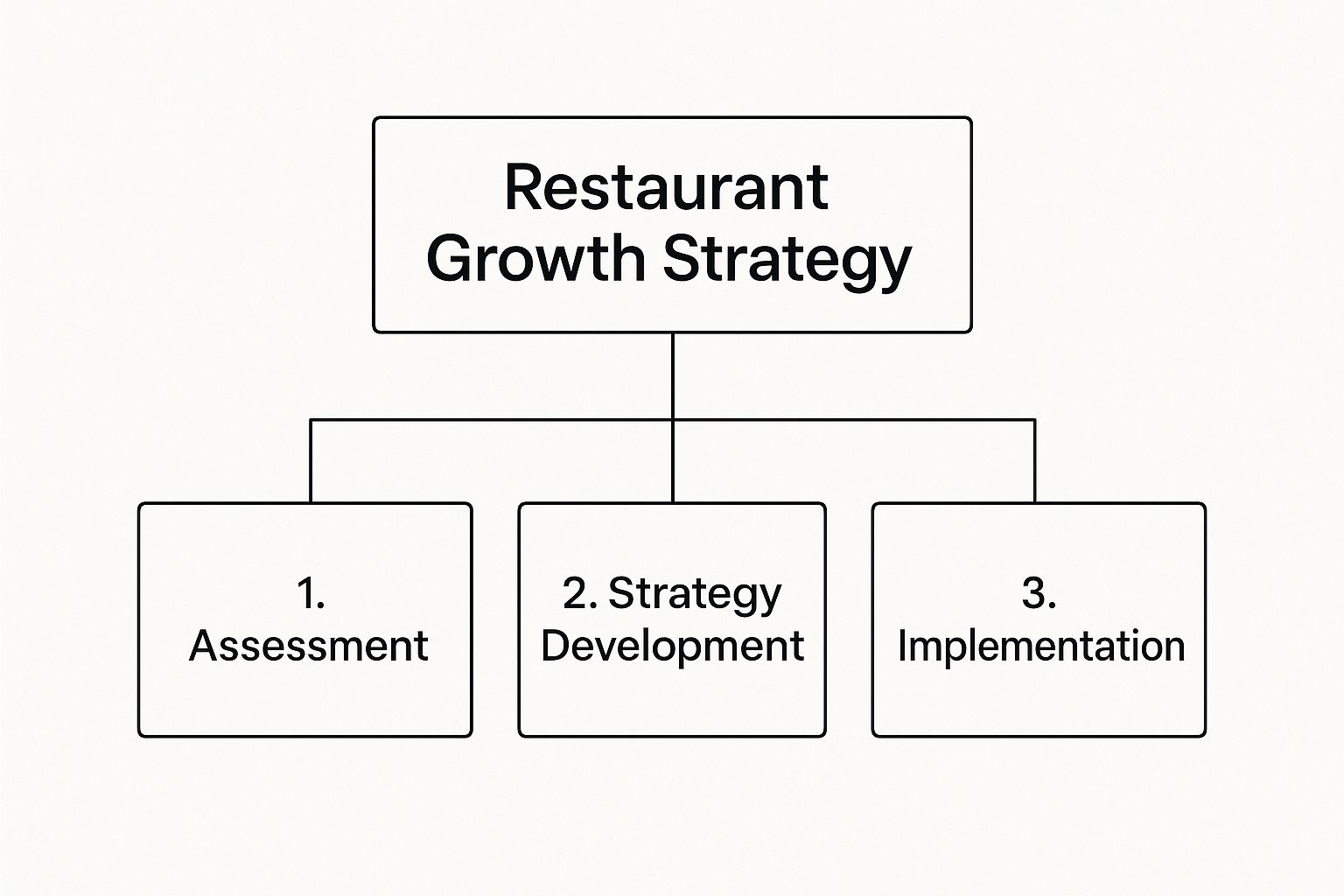
The image above illustrates the fundamental three-phase approach a great consultant deploys. It’s a logical sequence: begin with deep analysis, construct a smart strategy from the resulting data, and then transition to hands-on execution. This process ensures every decision is built on a rock-solid foundation of facts, not assumptions.
Deep-Dive Financial Analysis
Before you can chart a course forward, you must have a precise understanding of your current position. A consultant begins by acting as a financial detective. We conduct a deep dive into your Profit & Loss (P&L) statements, place your Cost of Goods Sold (COGS) under a microscope, and analyze labor costs with forensic detail. The entire objective is to identify where capital is leaking and spot opportunities for optimization that are invisible when you're running the floor.
This isn't just about cost-cutting. It's about intelligent resource allocation. For example, by cross-referencing sales data with inventory reports, a consultant might discover you're consistently over-ordering low-margin produce that results in waste. By reallocating that capital into high-demand, high-margin ingredients, you directly increase your bottom-line profitability without sacrificing quality.
Operational Audits and Workflow Optimization
Profitability isn't just about what you sell; it's about how efficiently you operate. An operational audit is a top-to-bottom review of your restaurant's daily mechanics. A consultant will map your kitchen workflow, time your front-of-house service steps, and evaluate your inventory systems to find and eliminate hidden bottlenecks and inefficiencies.
The result? A smoother, faster, and less wasteful operation. By streamlining the expediting process alone, you can shave critical minutes off ticket times. This leads to faster table turnover and an enhanced guest experience—both of which directly drive revenue. It’s about making small, calculated optimizations that create a powerful compounding effect.
Strategic Marketing and Brand Positioning
In today’s saturated market, excellent food is merely table stakes. You need a compelling brand that resonates deeply with your ideal customer profile. A restaurant consultant helps you define—or redefine—that brand identity and build a marketing strategy that generates tangible results. This goes far beyond simply running social media ads.
A powerful brand strategy ensures every single customer touchpoint tells the same compelling story—from your menu’s typography and your staff’s service protocol to your digital presence. That is how you convert first-time visitors into loyal brand advocates who drive word-of-mouth growth.
This process involves analyzing your target demographic, assessing the competitive landscape, and crafting campaigns that drive both awareness and, more importantly, foot traffic. The end goal is to build a brand that commands loyalty, which is the key to sustainable, long-term success. If you wish to explore this further, our guide on how to increase restaurant sales offers proven strategies.
To provide a clearer picture of how these services translate into real-world results, here is a breakdown of what a consultant does and the specific business metrics they are tasked to improve.
Restaurant Consultant Services and Their Business Impact
| Service Area | Consultant Action | Key Performance Indicator (KPI) Impacted |
|---|---|---|
| Financial Analysis | Identifies capital leakage by analyzing P&L, COGS, and labor data. | Prime Cost, Net Profit Margin, EBITDA |
| Operational Audit | Maps and streamlines kitchen-to-table workflows to eliminate bottlenecks. | Table Turnover Rate, Ticket Times, Food Waste % |
| Brand Positioning | Defines target audience and crafts a unique value proposition and market identity. | Customer Acquisition Cost (CAC), Brand Recognition |
| Marketing Strategy | Creates and executes targeted campaigns across relevant acquisition channels. | Foot Traffic, Online Reservations, Customer Lifetime Value (CLV) |
| Menu Engineering | Analyzes item popularity and profitability to optimize menu design and pricing. | Gross Profit Margin, Average Check Size |
| Concept Development | Conducts market research and financial modeling for new ventures or expansions. | Return on Investment (ROI), Time to Profitability |
As you can see, each action is directly tied to a tangible, measurable outcome. A consultant's value is not in abstract advice; it's in delivering quantifiable improvements to the metrics that determine your business's health and valuation.
Menu Engineering and Concept Development
Your menu is your single most important sales tool. Period. Menu engineering is the science of analyzing the profitability and popularity of every single dish to design a menu that maximizes profit per guest. A consultant helps you identify your "stars" (high profit, high popularity) and redesign the menu layout to guide the customer's eye directly to them.
For those looking to launch a new restaurant, a consultant's guidance during concept development is mission-critical. We provide the market research, financial modeling, and operational planning required to ensure your vision is not just creative but commercially viable from day one. This strategic foresight is crucial, especially as the industry is projected to hit $1.1 trillion in sales in 2024. Getting the model right from the start can be the difference between a successful launch and a quiet closure.
How to Find the Right Consulting Partner
Selecting a restaurant business consultant is one of the most critical decisions you will make for your company. The right partner becomes a strategic weapon, an extension of your leadership team who understands your vision and accelerates your progress. The wrong one is a costly detour that can create more problems than it solves.
I have seen this scenario play out time and again. The vetting process must go beyond a résumé scan or a slick presentation. You are not just hiring a contractor; you are entrusting someone with the financial health of your business. This demands a sharp, pragmatic approach to identifying a true strategic partner.

Look for a Proven Track Record of Real Results
The first filter is empirical proof. It's that simple. Do not get swayed by vague promises of "improvement" or "streamlining." Demand to see the cold, hard data. A top-tier consultant will be eager to share case studies that detail the exact, measurable results they have delivered for businesses similar to yours.
Be direct and quantitative with your questions:
- “Walk me through a project where you increased a client’s net profit. By what percentage, and over what time frame?”
- “Show me an example of how you reduced prime costs for a restaurant in my category.”
- “What specific KPIs did you impact, and what was the client’s ROI on your engagement fees?”
If they cannot answer with data, they are not the right fit. A consultant who is not fluent in the language of EBITDA, COGS reduction, and table turnover is not the data-driven partner you need to win in today's market.
Specialization and Cultural Fit Are Deal-Breakers
The restaurant industry is not monolithic. The operational realities of a fine-dining establishment are worlds apart from the challenges of a multi-unit quick-service franchise. Your consultant must possess deep, hands-on experience in your specific niche. They need to intuitively grasp the flow of your service model, your customer's expectations, and the competitive pressures of your market.
Equally critical is the cultural fit. This individual will be embedded with your team, challenging established processes and asking difficult questions. They must be an exceptional communicator who can build trust and align your team toward a common goal, not put them on the defensive. A consultant who cannot connect with both your executive chef and your front-of-house manager will ultimately fail, no matter how brilliant their strategy is on paper.
A consultant’s real impact comes from breaking down the silos between your teams. If their personality creates friction, they will only reinforce those barriers.
Key Questions to Ask Every Potential Consultant
Once you have a shortlist, the interview is where you dissect their process and mindset. Here are the non-negotiable questions I always recommend:
- What is your diagnostic process? How will you get under the hood to analyze our current state before recommending any changes?
- How will we measure success? What specific metrics will we be tracking, and what is the target?
- What is your communication protocol? How frequently will we connect, and what will your progress reports look like?
- How do you manage resistance to change? What is your process when my team or I push back on a recommendation?
- What do you require from me and my team to ensure this engagement is a success?
Their answers will reveal everything about their professionalism, their reliance on data, and their ability to integrate into your operation. Remember, their expertise is an investment. The median salary for a restaurant consultant in the U.S. is $81,376, with top performers commanding significantly more. You are deploying serious capital, so be meticulous. For a fuller picture, you can explore detailed restaurant consultant demographics and salary data.
Ultimately, finding the right restaurant business consultant means finding a partner who is as obsessed with your numbers and your success as you are. For a closer look at a specific growth area, review our guide on selecting the right restaurant marketing agency, which can be a powerful complement to a consultant's operational focus.
Maximizing Your ROI From a Consultant Partnership
Hiring a sharp restaurant business consultant is an excellent strategic move. But let's be clear—the real work begins after the contract is signed. The kind of growth that materially impacts your P&L statement is not passive; it is earned through a structured, transparent, and intensely collaborative partnership.
You cannot simply delegate and disengage. In my experience, the greatest returns are always generated when the owner and their leadership team are fully vested in the process. It's about fusing the consultant's objective, external perspective with your invaluable institutional knowledge. That is how a consulting fee transforms from an expense into a high-yield investment.
Setting the Stage for Success
The foundation for a successful engagement is laid before any operational analysis begins. It starts with establishing absolute clarity on the desired outcomes. You and your consultant must be perfectly aligned on what success looks like, defined by specific, quantifiable business metrics.
This means setting crystal-clear goals and Key Performance Indicators (KPIs) from day one. A vague goal like "increase sales" is insufficient. You need specific, measurable targets that leave no room for ambiguity:
- Increase net profit margin by 5% within six months.
- Reduce prime costs from 65% to 60% by the end of Q3.
- Improve table turnover rates by 15% during peak dinner service.
These concrete numbers become the North Star for the entire engagement. Every recommendation and action will be calibrated to achieve these tangible outcomes.
The Pillars of an Effective Partnership
Once the goals are set, execution begins. Maximizing your ROI boils down to three core principles: total transparency, a culture of openness to change, and relentless progress tracking. If any of these pillars are weak, even the most brilliant strategy is likely to fail.
A consultant provides the roadmap, but you and your team are driving the vehicle. If you obscure the dashboard data or ignore a recommended turn, you will never reach your destination.
A true partnership requires granting your consultant full access to the data—all of it. This means financials, sales reports, inventory logs, and staffing schedules. Obscuring information or downplaying problems only handcuffs the very expert you hired to solve them.
Equally important is securing buy-in from your team. Change is difficult. Your staff must understand the why behind the consultant's presence and feel that they are part of the solution, not the problem. Their engagement is absolutely critical for the successful implementation of new systems or workflows. For more on this, our guide on how to improve operational efficiency delves into the human element of making strategic changes stick.
Finally, you must track progress obsessively. This means establishing a regular cadence for check-ins—weekly or bi-weekly—to review performance against the established goals. These meetings are where you identify what's working, what's not, and how to pivot the strategy in real-time. This constant feedback loop keeps the engagement on track and delivers the kind of sustainable improvements that will generate returns long after the consultant's work is complete.
Real-World Restaurant Success Stories
In business, theory is inexpensive. Strategy sessions are valuable, but what truly matters is the result that appears on the P&L statement. Let's move beyond frameworks and examine what happens when a restaurant partners with the right consultant to execute a data-driven turnaround.
These are not just anecdotes. They are tangible, boots-on-the-ground examples of how a precise diagnosis and disciplined execution create a material, bottom-line impact.
Case Study 1: The Casual Diner on the Brink
I once engaged with a classic neighborhood diner. The owner possessed immense passion and a loyal customer base, but he was working 80-hour weeks and hovering near break-even. He was a dedicated operator, but he was on a clear path to burnout.
The problem was not a lack of revenue—the diner was consistently busy. The issue was a series of small, cascading financial leaks that were bleeding the business dry. After a deep dive into his financials and operational workflows, two primary culprits emerged: a poorly engineered menu and excessive food waste.
The data was revealing. We discovered that several of his most popular dishes were actually loss leaders, with food costs exceeding 70%. Furthermore, his procurement process was based entirely on intuition. Lacking any inventory management system, he was discarding a significant amount of perishable goods each week.
We implemented a two-pronged strategy:
- Menu Engineering: We deconstructed and rebuilt the menu. Pricing was realigned based on actual plate costs, not historical precedent. We also strategically redesigned the menu layout to emphasize the high-profit "star" items, guiding customer choice toward more profitable options.
- Supply Chain Optimization: We implemented a simple inventory management system and established pars based on historical sales data. The "order-by-feel" approach was eliminated.
The results were dramatic. Within six months, the restaurant’s overall profit margin increased by 15%. The owner was able to draw a proper salary for the first time and had capital to reinvest in the dining room—all without alienating his core clientele.
Case Study 2: The Flawless Fine-Dining Launch
The second case involves a new fine-dining concept. The founders were talented chefs with a clear culinary vision, but they were astute enough to recognize that great food does not guarantee a successful business. They engaged a consultant at the outset to architect the business for profitability from day one.
The consultant's mandate was to engineer every aspect of the operation for success before the doors opened. This was not about guesswork; it was about leveraging data and best practices to build a robust operational and financial model.
The focus areas were:
- Kitchen Workflow Optimization: The kitchen layout was meticulously designed for maximum efficiency. Every station was mapped to reduce unnecessary movement and prevent bottlenecks during peak service, ensuring faster ticket times and lower labor costs from the start.
- Targeted Pre-Launch Marketing: Instead of a broad, expensive advertising push, the consultant executed a hyper-focused digital campaign. They targeted local food influencers and diners within specific affluent zip codes who matched the ideal customer profile.
The return on this upfront strategic planning was immense. The restaurant was fully booked for its entire opening month, generating immediate, strong cash flow and significant market buzz. That early momentum provided the stability to navigate the notoriously difficult first year, setting the stage for long-term, profitable growth.
These examples underscore a critical point: an effective restaurant consultant does not just provide advice. We deliver a measurable, data-backed return on investment that can rescue a struggling business or launch a new one into a market-leading position.
Your Questions About Restaurant Consulting Answered
When I meet with restaurant owners, a consistent set of questions always emerges. They are practical, bottom-line-oriented inquiries. Engaging a restaurant business consultant is a significant decision, so it's natural to have questions about the process, the cost, and the expected ROI. Let’s address the most common ones directly.
How Much Do Restaurant Consultants Charge?
There is no standard rate card. The cost is contingent on the scope of the engagement, its duration, and the consultant's experience and track record. Typically, you will encounter one of three pricing models:
- Project-Based Fees: This is the most common model. You pay a flat fee for a defined outcome, such as a complete menu re-engineering or a new marketing strategy implementation. A targeted, smaller project might be in the low thousands, while a comprehensive operational turnaround could be $25,000 or more.
- Hourly Rates: Some consultants bill by the hour, with rates ranging from $150 to over $500. This model is effective for smaller tasks, troubleshooting a specific issue, or when you need an expert on call for advisory support.
- Monthly Retainers: For a long-term strategic partnership, a monthly retainer provides ongoing access to a consultant for strategic planning, performance monitoring, and continuous improvement initiatives.
It is more accurate to view this as an investment, not an expense. A competent consultant should deliver a return that far exceeds their fee, often by uncovering savings or unlocking new revenue streams that pay for the engagement many times over.
How Long Does a Typical Engagement Last?
The timeline is dictated entirely by your objectives. If the goal is to optimize your supply chain or provide front-of-house service training, the engagement might last a few weeks. However, for a more substantial undertaking, such as reviving a struggling brand or launching a new concept, a three to six-month partnership is more realistic.
The best consultants will define clear milestones and deliverables from the outset. This ensures the project remains on schedule and that you are seeing tangible progress throughout the engagement, rather than waiting for a final report.
What If I Disagree with a Consultant’s Advice?
This is an excellent question because it cuts to the core of a successful partnership. A top-tier consultant is not there to issue directives; they are there to collaborate. Disagreement is not only normal but can be highly productive—provided it is grounded in data, not just anecdotal evidence or resistance to change.
If a recommendation doesn't sit right with you, challenge it. Ask to see the supporting data and the rationale behind the strategy. A true professional will welcome this scrutiny and be able to defend their position with facts. Ultimately, as the owner, the final decision is yours. The consultant's role is to provide the objective, data-backed perspective you need to make the most informed decision possible for your business.
Ready to transition from daily firefighting to strategic, sustainable growth? At MGXGrowth, we don't just offer advice; we architect data-driven systems that deliver measurable results for your restaurant. Let's architect your path to greater profitability.
