


Over my career, I've driven growth in sectors from SaaS and marketplaces to real estate and hospitality. The core principles are surprisingly consistent: sustainable growth isn't about a single silver bullet; it's about building an interconnected system where strategy, operations, finance, and customer experience are perfectly aligned. Restaurant growth consulting is precisely that—a strategic partnership where we dissect your business, eliminate the friction between departments, and engineer a scalable model for long-term profitability and market share capture. It’s about moving beyond the daily operational grind to architect the core systems that drive EBITDA and enterprise value.
Why Your Restaurant Growth Has Stalled

I've advised dozens of founders across multiple industries, and the pattern is always the same: a passionate leader hits an invisible ceiling. For restaurant owners, this plateau isn't a failure of passion or product. It's a symptom of the immense operational and market complexity you face daily.
You're a CEO, COO, and CMO rolled into one, managing supply chains, P&Ls, human resources, and marketing campaigns simultaneously. When you're that deep in the tactical execution, strategic oversight becomes nearly impossible. The very grit and hustle that launched your business can become the primary obstacle to scaling it. You're trapped in the business, not working on it.
The Forces Holding You Back
The challenges you're facing are not unique; they are systemic pressures impacting the entire industry. Identifying them with analytical precision is the first step toward building a resilient, anti-fragile enterprise.
Here's a breakdown of the likely culprits:
- Margin Compression: Escalating food costs, rising labor expenses, and volatile supply chains are systematically eroding your profitability. Every dollar of revenue is harder to convert into net profit.
- Evolving Customer Expectations: The modern diner demands a seamless, multi-channel experience. They expect frictionless digital ordering, delivery integration, and a value proposition that extends far beyond the plate.
- Operational Bottlenecks: Inefficient kitchen workflows, poor inventory management, and inconsistent service aren't minor issues. They are systemic flaws that directly impact unit economics, customer lifetime value, and brand reputation.
These challenges trap you in a reactive loop, forcing you to firefight symptoms instead of engineering solutions to root causes. This is where an objective, data-driven perspective becomes invaluable. A restaurant growth consulting engagement isn't about generic advice; it's about a surgical diagnosis of these core constraints.
From Revenue to Real Profitability
On the surface, the market looks strong. The industry has seen significant top-line revenue growth post-2020. However, revenue is a vanity metric; profit is sanity. While elite operators can achieve net profit margins nearing 10%, the industry average hovers at a precarious 3% to 5%.
That delta between the average and the best-in-class is where strategic advantage is built. It's a clear indicator that operational excellence is the true driver of financial success. You can explore these restaurant industry statistics to benchmark your own performance.
For many founders, the business runs them. True growth is achieved when the founder stops being the Chief Operator and becomes the Chief Architect of a scalable, data-driven system.
This strategic shift is the fundamental goal of a consulting engagement. It's about designing a business that thrives because of its systems, not in spite of heroic individual effort. That is how you break the growth ceiling.
What Is Restaurant Growth Consulting, Really?

Let's be direct. Restaurant growth consulting isn't about delivering a static playbook. In my experience across fast-moving sectors, off-the-shelf solutions fail because they ignore the unique operational DNA of a business. Real, defensible growth comes from architecting a dynamic, interconnected system tailored to your specific market, model, and goals.
I view your restaurant as a high-performance system. You are the expert on the ground. A growth consultant is your systems architect, the strategist who analyzes the data from every component—finance, operations, marketing—to optimize the entire machine for peak output. My role is to elevate you from daily tactical execution to a position of strategic oversight. It’s about building an enterprise engineered for scale.
More Than Just a Quick Fix
Many operators engage consultants to solve a single, acute problem—a sudden drop in revenue or spiraling food costs. We certainly address those symptoms, but my core function is to diagnose and resolve the underlying systemic disease.
It's the difference between patching a leaky pipe and re-engineering the entire plumbing system for optimal flow and zero leakage.
We achieve this by focusing on three integrated pillars:
- Operational Systems Design: We map your entire value chain, from procurement to the final customer touchpoint. The objective is to identify and eliminate every point of friction and inefficiency that bleeds cash and compromises the guest experience.
- Financial Engineering: This goes beyond standard accounting. We build predictive financial models for revenue forecasting, optimize cash flow cycles, and implement dynamic pricing strategies to maximize contribution margin.
- Technology Stack Optimization: This is not about adding more software. It's about integrating the right tools—POS, inventory, CRM—into a cohesive stack that automates low-value tasks and provides the critical data needed for high-quality, high-velocity decision-making.
When we break down the silos between the back-of-house, front-of-house, and your financial data, the system begins to work. This unified strategy aligns every team member and function toward a single goal: profitable growth.
A Partnership Guided by Data
In every C-level role I've held, one principle has been paramount: gut instinct is for hypothesis generation; data is for validation and decision-making. A true growth consultant does not operate on assumptions. We immerse ourselves in your POS data, inventory reports, labor analytics, and customer feedback to uncover the objective truth your numbers are telling.
A consultant’s value isn't in having answers. It's in knowing which questions to ask and how to leverage data to extract answers from within your own operation.
For instance, data might reveal that a menu item with a low food cost is underperforming due to poor menu placement—a classic menu engineering problem. Or, we might correlate a 15% drop in table turnover rates to a specific shift, tracing it back to an inefficient payment processing workflow. These are the granular, data-backed insights that unlock significant performance gains.
The global restaurant industry is forecasted to reach a market size of $4.03 trillion by 2025 and is projected to grow at a 7.8% CAGR through 2032. The opportunity for market capture is immense for data-driven operators. You can review the specifics of these global restaurant industry trends on restroworks.com. A data-first partnership is what positions you to claim your share of that growth.
Ultimately, restaurant growth consulting is a strategic partnership designed to install a new operating system for your business—one founded on data, obsessed with efficiency, and architected for profitable, long-term expansion.
The Four Pillars of Restaurant Growth
Across every industry I've operated in, from SaaS to hospitality, sustainable growth is never the result of a single "hack." It's the output of a well-architected system built on a solid foundation. For restaurants, that foundation rests on four interconnected pillars. When managed in silos, they create friction and inefficiency. When integrated into a unified strategy, they become a powerful, self-reinforcing growth engine.
A common strategic error is over-investing in one pillar—typically marketing—at the expense of the others. You can run the most brilliant marketing campaign in the world, but if your kitchen operations are inefficient or your menu isn't profitable, you're merely accelerating your burn rate. True restaurant growth consulting is about reinforcing all four pillars in unison.
This holistic approach transforms disparate functions into a cohesive machine for driving revenue, profitability, and enterprise value. Let's dissect how we align these pillars to build a business that dominates its market.
Pillar 1: Financial Engineering
The first pillar is not just accounting; it's Financial Engineering. This is the discipline of moving from passively tracking money to actively optimizing the flow of every dollar. We must deconstruct the financial DNA of your restaurant to enable high-quality strategic decisions that directly increase profitability.
Our process begins with a granular decomposition of your Profit and Loss (P&L) statement. This is a forensic audit of your food costs, labor deployment, and overhead to identify every opportunity for margin enhancement that doesn't compromise quality. For example, a prime cost (COGS + Labor) exceeding 60% of revenue is a critical vulnerability that requires immediate intervention.
Key activities here include:
- Strategic Pricing & Menu Engineering: We analyze every menu item based on its profitability and popularity (contribution margin vs. sales velocity). The goal is to engineer a menu that is a strategic asset for maximizing gross profit.
- Cash Flow Optimization: We build robust cash flow forecasting models. This provides the visibility needed to manage liquidity, plan for capital expenditures, and mitigate financial risk.
- Supply Chain & Vendor Management: We implement strategies for negotiating favorable terms and pricing with suppliers. A marginal decrease in your cost of goods sold (COGS) can have a disproportionately positive impact on your bottom line.
By treating your finances as a strategic lever, we ensure that top-line growth translates directly into improved EBITDA and a healthier balance sheet.
Pillar 2: Operational Excellence
With a robust financial architecture in place, the second pillar is Operational Excellence. This is where strategy meets execution. Inefficient operations are a silent killer of profit, creating waste, inconsistent service, and employee burnout.
The objective is simple: design and implement frictionless workflows for both your customers and your team. We conduct comprehensive operational audits, mapping every process from procurement to payment. We hunt for bottlenecks, redundancies, and any activity that does not add value. It is a complete systems analysis of your restaurant's core operational engine.
For example, a poorly designed kitchen layout could be adding minutes to ticket times, while a clunky POS system could be creating friction during peak hours. Resolving these seemingly minor operational drags can unlock significant gains in throughput and customer satisfaction.
True operational excellence is when your restaurant runs so smoothly that the execution appears effortless to the guest. This consistency is the foundation of trust and customer loyalty.
The following table illustrates how these integrated pillars form the core of a comprehensive consulting partnership.
Core Pillars of Restaurant Growth Consulting
| Pillar | Strategic Focus | Key Activities | Expected Outcome |
|---|---|---|---|
| Financial Engineering | Maximize profitability and financial health. | P&L deconstruction, menu engineering, cost control systems, cash flow forecasting. | Increased EBITDA, improved margins, and sustainable financial stability. |
| Operational Excellence | Design efficient, scalable, and consistent systems. | Process mapping, workflow optimization, staff training protocols, quality control. | Reduced waste, increased throughput, higher customer satisfaction, and improved team productivity. |
| Brand Resonance | Build a powerful brand and a loyal customer base. | Market positioning, data-driven digital marketing, CRM & loyalty systems, reputation management. | Increased market share, higher customer lifetime value (CLV), and predictable revenue growth. |
| Technology Integration | Implement a tech stack that drives data-driven insights and automation. | POS system optimization, inventory management automation, CRM integration, analytics dashboards. | Enhanced decision velocity, improved efficiency, and a 360-degree view of the business. |
Mastering these four domains is the difference between surviving and building a scalable, high-value enterprise.
Pillar 3: Brand Resonance and Marketing
With your financial and operational engines firing on all cylinders, it's time to amplify your message. The third pillar is Brand Resonance. This extends far beyond aesthetics; it's about forging a deep, defensible connection with your target market. It is the sum of every touchpoint and experience you deliver.
This is where we explicitly break down the silos between marketing, operations, and finance. Your brand promise must be delivered consistently, from the quality of your ingredients to the efficiency of your service. We focus on data-driven marketing systems that generate measurable ROI, not just vanity metrics. This visual demonstrates how a central strategy integrates all marketing activities.
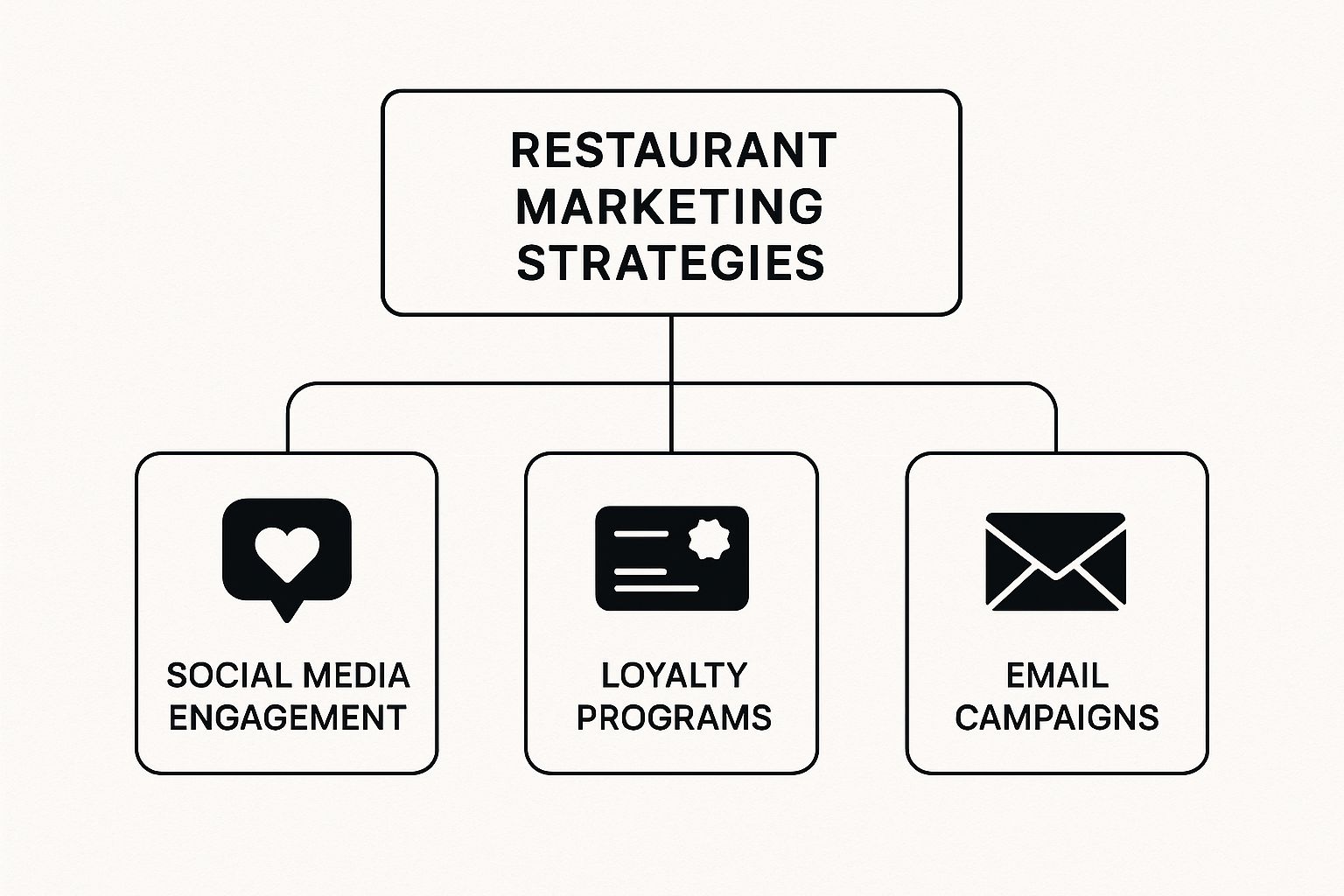
As the diagram shows, a coherent marketing strategy serves as the central hub, powering customer-facing channels like social media, loyalty programs, and email automation. This integrated system ensures every customer interaction reinforces your brand and drives repeat business. To understand the mechanics of building such a system, you can explore our detailed guide to crafting a digital marketing strategy framework.
Pillar 4: Technology Integration
The final pillar that unifies the entire system is Technology Integration. In my experience, the right technology stack is the ultimate force multiplier. The goal is not to adopt technology for its own sake, but to strategically deploy tools that provide actionable data and automate low-value manual processes. This liberates your team to focus on high-value activities, namely delivering an exceptional guest experience.
For any restaurant operator serious about scale, a modern, integrated tech stack is not a luxury; it is a prerequisite. The core components typically include:
- A Point-of-Sale (POS) system that functions as a data analytics hub, not just a payment processor.
- An inventory management platform that automates procurement and minimizes waste.
- A Customer Relationship Management (CRM) tool for building loyalty and executing personalized marketing.
When these systems are integrated, you unlock a 360-degree, real-time view of your business. You can instantly identify your most profitable menu items, correlate marketing campaigns to sales data, and analyze staff performance. This data-driven visibility is the bedrock of strategic decision-making, completing the growth flywheel.
Choosing the Right Growth Partner
Selecting a partner for restaurant growth consulting is a high-stakes leadership decision. The right partner acts as a catalyst, unlocking latent potential and accelerating your growth trajectory. The wrong one becomes a costly distraction, consuming capital and time with little to no ROI. I have witnessed both outcomes firsthand.
The objective is to identify a true strategic partner, not a mere vendor who delivers a report and disappears. A genuine partner integrates with your team, engages in the operational details, and becomes personally invested in your success. They will challenge your core assumptions with objective data and, crucially, work to build the internal capabilities required to sustain growth long after the engagement concludes.
Look Past the Presentation
A polished slide deck is table stakes. To identify a firm capable of delivering tangible results, you must look deeper. Approach the vetting process not as a sales meeting, but as a rigorous interview for a key executive. Demand proof of process, not just promises of outcomes.
Insist they detail their methodology. A top-tier consultant will articulate a clear, repeatable, data-driven process. Ask for specifics on how they diagnose operational bottlenecks or their approach to financial modeling. An inability to clearly explain their system is a significant red flag.
Ask the Tough Questions
The right questions cut through rhetoric and reveal true capability. I advise structuring your diligence around these critical areas:
- Track Record with Similar Challenges: Move beyond generic case studies. Ask, "Detail an engagement with a restaurant facing a prime cost crisis similar to ours. What specific interventions did you implement, and what was the quantifiable impact on their EBITDA?"
- Methodology and Measurement: Be direct. "How do you define and measure success?" A robust answer must transcend top-line revenue and include key metrics like profit margin, customer lifetime value (CLV), and employee retention.
- Cultural and Team Fit: A consultant is an agent of change, which can create organizational friction. Ask, "What is your change management methodology? How do you secure buy-in from front-line staff to senior leadership?"
A consultant who only speaks to the owner is a theorist. A consultant who engages the dishwasher, the line cook, and the server is a partner. They understand that sustainable growth is driven by the entire organization, not just executive mandate.
Demand Specialized Expertise
The restaurant industry is not monolithic. Performance varies significantly by geography and segment, making specialized expertise essential. For example, recent data shows strong sales growth in markets like Dallas and Houston while others contracted. Simultaneously, the Fast Casual segment expanded while Fine Dining traffic declined.
A generic playbook is useless in such a nuanced market. Your partner must possess a deep understanding of these micro-trends to develop a strategy that aligns with your specific context. This level of insight is often the differentiator, much like selecting the right https://mgxgrowth.com/blog/restaurant-marketing-agency requires a firm that has mastered your local customer acquisition channels.
Your Roadmap to Making Growth Happen
As a growth executive, I've learned that a brilliant strategy is worthless without rigorous execution. Strategy is easy; implementation is hard. The real work begins when a plan must be translated from a whiteboard into measurable results on a P&L statement. This is why a structured implementation roadmap is non-negotiable for any serious restaurant growth consulting engagement.
The goal is not simply to deliver a plan. It is to embed a system for execution into the cultural fabric of your restaurant. This requires precision, transparent communication, and a relentless focus on breaking down the cross-functional silos that kill momentum. A successful rollout is a coordinated effort, phased to align every part of your operation toward a common set of objectives.
Phase 1: The Deep-Dive Discovery
Before we can define the destination, we must establish a precise starting point. This initial phase is an intensive, data-driven audit. We immerse ourselves in your operations, not as outside observers, but as partners seeking to understand the business from the inside out. We establish the quantitative and qualitative baseline against which all future progress will be measured.
This is a forensic analysis, not a superficial review. We are hunting for points of friction and untapped opportunities by examining:
- Operational Workflows: We map every core process, from procurement to guest payment, identifying bottlenecks that destroy efficiency and degrade the customer experience.
- Financial Health: We conduct a deep financial analysis, deconstructing prime costs, assessing menu item profitability, and modeling cash flow to pinpoint areas of financial leakage.
- Team Dynamics & Capabilities: We engage with key personnel at all levels—from GMs to line cooks. Designing effective solutions requires a ground-truth understanding of the daily challenges your team faces.
This phase is about replacing assumptions with empirical data. It is the solid foundation upon which the entire growth strategy is built.
Phase 2: Building the Strategy, Together
With a clear, data-backed understanding of your current state, we proceed to strategy development. This is a collaborative workshop, not a one-way presentation. My core belief is that people support what they help create. True organizational buy-in is not achieved through top-down directives; it is forged through shared ownership of the plan.
We work alongside your leadership team to translate the insights from our discovery into a concrete, actionable strategy with clearly defined objectives. We specify, in quantitative terms, what success looks like.
A growth plan isn't a document; it's a shared commitment. When your front-of-house manager and head chef are co-architects of the goals, they become champions for the change, not obstacles to it.
This collaborative process ensures the final strategy is not only ambitious but also practical and grounded in your operational reality. We align every department around a single set of Key Performance Indicators (KPIs), ensuring the entire organization is pulling in the same direction.
Phase 3: Rolling It Out and Watching the Numbers
Execution is a process of disciplined, iterative implementation. We deploy changes in logical, manageable phases to avoid overwhelming your team or disrupting service. This phased approach allows us to test, learn, and adapt, using real-time data to inform subsequent actions. Each phase builds upon the success of the last, creating sustained, positive momentum.
Concurrently, we implement a rigorous performance tracking system. We build concise dashboards that provide a real-time, transparent view of progress against the KPIs established in phase two. This data-driven feedback loop is paramount. It allows us to double down on what's working and rapidly pivot away from what isn't.
This cycle of continuous measurement is our accountability mechanism. It's how we ensure the strategic plan is delivering a measurable, compelling return on your investment.
Measuring Your Return on Consulting
As an executive, I operate under a simple principle: what gets measured gets managed. An investment in restaurant growth consulting is not an act of faith; it is a strategic capital allocation that must deliver a clear, quantifiable return. We are not here to chase vanity metrics. We are here to drive meaningful improvement in the key performance indicators (KPIs) that determine the financial health and enterprise value of your business.
A consulting engagement is successful only if it generates a direct, positive, and measurable impact on your bottom line. The entire process is about converting strategic insights into tangible financial and operational outcomes. This requires a disciplined framework for tracking progress against the specific goals we establish at the outset.
The KPIs That Actually Matter
To capture the complete picture of ROI, we must break down data silos and measure performance across three critical domains: financial, operational, and customer. Each data point contributes to a holistic view of the engagement's impact.
A well-designed performance dashboard provides unambiguous visibility into these core metrics.
Key Financial Metrics:
- EBITDA Growth: This is the ultimate measure of profitability and the primary indicator of increased enterprise value.
- Profit Margin Improvement: We obsessively track gross and net margin expansion to ensure revenue growth translates into actual profit.
- Prime Cost Reduction: As a direct reflection of operational efficiency, driving prime costs (food + labor) below the 60% threshold is a critical objective and a massive financial win.
Key Operational Metrics:
- Table Turnover Rate: A direct measure of asset utilization and revenue generation capacity during peak periods.
- Cost of Goods Sold (COGS): We relentlessly track COGS to validate the effectiveness of menu engineering and supply chain optimizations.
- Employee Churn: Reduced turnover significantly lowers recruitment and training costs, improves service consistency, and is a key indicator of a healthy culture.
Success isn't a feeling; it's a number on a dashboard. A clear ROI framework ensures that every decision is held accountable to a measurable outcome, proving the value of our partnership.
Connecting the Dots to Customer Success
Finally, all financial and operational improvements must ultimately translate into enhanced value for your most critical asset: your customers. Sustainable growth is impossible without building a loyal customer base.
Here, we analyze customer-centric data. We focus on metrics like Customer Lifetime Value (CLV), which quantifies the long-term worth of a loyal guest. An increasing CLV is a direct indicator of improved service and a stronger brand connection. We also monitor review scores and repeat visit rates to maintain a real-time pulse on guest satisfaction.
For a more detailed look, our guide provides frameworks for effective client satisfaction measurement.
By building a custom dashboard that integrates these data points, you gain complete visibility into the business impact of the consulting partnership. This is not just about our accountability; it's about embedding a data-driven culture that will continue to drive performance long after our engagement concludes.
Answering Your Top Questions About Growth Consulting
Over the years, I've had hundreds of conversations with restaurant founders. They are sharp, driven, and deeply knowledgeable about their craft. But they often harbor valid skepticism about bringing in outside expertise. The questions are consistent: What is the process? What is the true ROI? And critically, will my team embrace the change?
Let's address these head-on.
When Is the Right Time to Hire a Consultant?
The most common mistake is waiting for a crisis. While a skilled consultant can certainly execute a turnaround, the optimal time to engage a restaurant growth consulting expert is at a point of inflection—when you've hit a growth plateau, or more strategically, when you are preparing for significant expansion.
Consider it analogous to a professional athlete engaging a coach during the off-season. The goal isn't to recover from an injury; it's to proactively build the strength and systems required to win the next championship. Early engagement allows you to scale intelligently, bypassing the costly errors that frequently undermine rapid growth. It's about architecting your future, not just repairing your past.
What Does This Kind of Consulting Cost?
There is no standard price. The investment is contingent on the scope of the engagement and the scale of your operation. Models can include project-based fees, monthly retainers, or performance-based structures where fees are tied directly to achieving specific financial outcomes.
However, I urge every leader to reframe the question. Do not focus on the cost; focus on the Return on Investment (ROI).
An effective consultant is never a cost center. They are a profit center. Their fee should be a fraction of the new EBITDA and enterprise value they help create.
Any credible consultant will present a clear business case from the outset, quantifying the expected financial return and the timeframe in which it will be delivered.
How Do I Get My Team to Buy Into the Changes?
This is the most critical question. A brilliant strategy without team buy-in is a guaranteed failure. The key is to position the consultant as a partner and an ally—not an auditor sent to find fault. From my experience leading teams, the only transformations that succeed are built on a foundation of collaboration and trust.
A skilled consultant is an expert in change management. They must:
- Engage at all levels: They need to be in the kitchen during a dinner rush and on the floor with servers to gain true operational empathy.
- Co-create the solution: When your team participates in designing the new processes, they take ownership. They become advocates, not adversaries.
- Demonstrate clear benefits: We must articulate how new systems and processes will make their jobs more effective and rewarding, not just add to their workload.
When your team views the consultant as a resource dedicated to helping them succeed, you create unified organizational momentum. That is the engine of real, sustainable change.
Ready to stop reacting and start building the future of your restaurant? The team at MGXGrowth specializes in creating data-driven, sustainable growth systems for ambitious hospitality brands. Let’s talk about what’s possible. Learn more at https://www.mgxgrowth.com.
