


As a growth strategist who has spent decades connecting marketing spend to real business outcomes like EBITDA and market share, I've seen countless "game-changing" tools come and go. Marketing Mix Modeling (MMM) isn't one of them.
So, what is marketing mix modeling? Put simply, it’s a powerful statistical analysis that shows you exactly how much each marketing input—from your Super Bowl ad to your latest TikTok campaign—actually contributes to sales. It gives you a clear ROI for every dollar you spend.
Your Executive Compass For Growth

In every boardroom I've sat in, the same fundamental question always comes up: "How do we know our marketing is actually working?" Too often, marketing budgets are just another line item, a cost center measured by fuzzy metrics that don’t tie back to the bottom line. This is where MMM steps in to separate wishful thinking from predictable, sustainable growth.
Think of it like a thorough financial audit for your entire marketing operation. It doesn't just count clicks or impressions. Instead, it isolates the true sales impact of each channel while factoring in all the external noise—things like seasonal trends, what your competitors are doing, and even broad economic shifts.
This complete, 360-degree view is what finally turns marketing from an art into a science.
More Than Just Another Analytics Tool
Many executives make the mistake of seeing MMM as just another complex tool for the data science team. That’s a huge miscalculation. I see it as a compass for the C-suite, providing the clarity needed to make confident, high-stakes investment decisions.
It's built to answer the foundational business questions that actually drive value, like:
- Which marketing channels have we saturated and are now hitting the point of diminishing returns?
- How would a 15% budget shift from paid social to connected TV actually impact our quarterly revenue?
- What is the long-term sales lift from our brand-building efforts versus our short-term, direct-response campaigns?
By putting a number on the contribution of every single marketing lever, MMM gets the entire executive team—from the CMO to the CFO—on the same page, working from a single source of truth. It demolishes the silos that kill growth and creates a shared understanding of how marketing directly fuels business performance.
To help visualize these moving parts, here’s a quick breakdown of the core dimensions MMM addresses and why they matter to leadership.
Key Dimensions of Marketing Mix Modeling
| Dimension | Description | Strategic Value for Leadership |
|---|---|---|
| Channel Contribution | Quantifies the specific sales volume or revenue driven by each individual marketing channel (e.g., TV, search, social). | Enables budget allocation based on proven ROI, not just historical spend or gut feeling. |
| ROI & Efficiency | Calculates the return on investment (M-ROI) for each dollar spent, identifying the most and least efficient channels. | Provides a clear financial metric for comparing channel performance and justifying marketing investments to the board. |
| Diminishing Returns | Models the "saturation point" where additional spend in a channel stops generating proportional returns. | Prevents wasted ad spend and helps reallocate funds from oversaturated channels to those with more growth potential. |
| External Factors | Isolates the impact of non-marketing variables like seasonality, economic conditions, and competitor activity. | Gives a true picture of marketing effectiveness by separating it from external market forces you can't control. |
This table shows that MMM isn't about creating complicated charts for the sake of data. It's about architecting a powerful and predictable growth engine.
It’s about being able to confidently answer the "what if" questions that will define your company's future. Ultimately, it’s how you turn your marketing budget into your most reliable driver of market share and profitability.
From Executive Intuition to Data-Driven Strategy
To really get what modern marketing mix modeling can do, it helps to know where it came from. When I was starting out, the boardroom was a different world. We made huge marketing decisions based on decades of collective experience and a whole lot of gut feeling—we had to, because clean, detailed data was a luxury, not a given.
We trusted our instincts, argued our points, and placed big bets on what we believed would move the needle. While that kind of experience is priceless, it also leaves way too much to chance. That gap, the one between spending money and knowing what it actually accomplished, is exactly why the first generation of MMM was born.
The Dawn of Marketing Measurement
The core idea of marketing mix modeling goes all the way back to the 1950s and 60s. This was the era when big consumer brands started pouring massive amounts of money into TV ads and desperately needed a way to prove to their boards that it was worth it. By the 1970s, statisticians had developed the first real models, but they were nothing like the nimble tools we have today.
These early models were slow, incredibly expensive, and it could take a team of experts months of hard work just to build one. As a result, by the 1980s, industry estimates suggest that only about 5–10% of companies worldwide could actually afford to use MMM. You can get a great sense of its academic roots and early days from this in-depth guide on MMM.
This exclusivity meant MMM was a tool for the Fortune 500 elite. A single model was a massive project, usually done just once or twice a year. It could tell you what worked last year, but it couldn't give you the real-time feedback needed to adjust a campaign that was already running.
This historical context is critical. Understanding MMM’s origins as a slow, expensive, and exclusive tool highlights just how significant the current shift is. We've moved from a world of rearview mirror analysis to one of forward-looking, predictive strategy.
The Shift From Annual Reports to Agile Insights
The journey from those old, clunky models to today's dynamic platforms marks a massive leap in what's strategically possible. Technology has completely opened up access to the kind of insights that were once locked away in the ivory towers of corporate giants.
What used to take a team of PhDs six months to build can now be updated much more frequently, giving marketing leaders the ability to move with real agility. This evolution is the cornerstone of building a truly modern, responsive marketing team. It's the key to shifting from static annual plans to a fluid and adaptable data-driven marketing strategy.
This isn't just a history lesson. Seeing this path—from gut-feel decisions to data-powered strategy—is essential for any leader who wants to build a growth engine that's not just powerful, but also predictable and sustainable in today's messy market.
Deconstructing Your Growth Engine
At its heart, marketing mix modeling is about reverse-engineering your company's success to figure out what's really making a difference. Too many leaders think MMM is just a way to measure marketing channels. It's so much more than that. A properly built model acts as a full-business diagnostic, cutting through the noise to isolate the impact of dozens of factors, both inside and outside your company walls.
Imagine your total sales are like a final, complex dish. The flavor comes from a specific recipe, and every single ingredient plays a part. A solid MMM analysis mathematically breaks down how much each of those "ingredients" contributed to the final result, giving you a crystal-clear, quantitative picture of what’s working and why.
This kind of clarity is the first step toward breaking down the walls between marketing, finance, and sales. When every team can see the precise contribution of their efforts, conversations shift from defending budgets to collaborating on real growth.
The Three Core Drivers of Sales
To get a practical feel for what marketing mix modeling is, we need to look at its key components. Every model I’ve ever built or commissioned organizes performance drivers into three distinct buckets. Each one tells a different part of your growth story.
- Base Drivers: This is the bedrock of your business. These are the sales you'd still get even if you shut off all your marketing tomorrow. Think of it as the baseline demand for your product.
- Incremental Drivers: This bucket holds all your active marketing and promotional efforts. These are the levers you're actively pulling to generate sales on top of that baseline.
- External Factors: These are the forces you can't control but that absolutely influence your performance—things like market trends, what your competitors are doing, or even the weather.
A well-executed model doesn't just list these things out; it quantifies the exact sales volume each one is responsible for. This is how you can confidently say that your brand equity drove $10 million in sales last quarter, while your paid search campaigns added another $4 million on top of that.
A Closer Look at the Ingredients
Let's break down what actually goes into each of these buckets. Getting this structure right is the key to building a sophisticated digital marketing strategy framework that you can measure and fine-tune over time.
Base Drivers (The Foundation)
These are the elements that create a stable floor under your revenue.
- Brand Equity: This is all about the power of your brand. Years of consistent messaging and good experiences build an inherent demand that fuels sales without any direct ad spend.
- Pricing Strategy: A massive driver. Your price point directly impacts sales volume, and MMM is brilliant at quantifying how sensitive your customers are to price changes.
- Distribution & Accessibility: How easy is it for people to buy from you? This covers everything from your retail footprint and website user experience to your sales team's reach.
Incremental Drivers (The Accelerators)
These are the tactical investments you make to juice short-term and long-term growth.
- Media Advertising: This includes all your paid channels—TV, radio, search, social media, CTV, print, you name it. The model measures the direct sales lift from every single one.
- Promotions & Discounts: Think flash sales, coupons, and special offers. MMM isolates the true incremental revenue from these tactics, separating it from sales that would have happened anyway.
- Sales Team Activities: For B2B companies, this is huge. The model can link specific activities, like the number of demos completed, directly to closed deals.
The real magic here is getting a precise Marketing Return on Investment (M-ROI) for every single incremental driver. The model should tell you, without a shadow of a doubt, that every dollar spent on YouTube ads generated $4.50 in revenue, while a dollar on print ads only brought back $0.80.
External Factors (The Environment)
Finally, a smart model has to account for the world you're operating in.
- Seasonality: Those predictable peaks and valleys in demand, like holiday rushes or summer slowdowns.
- Competitor Actions: A major competitor launching a new product or a massive ad campaign will absolutely impact your numbers. The model accounts for that.
- Economic Conditions: Broader trends like inflation, unemployment, or shaky consumer confidence can put a damper on sales or, sometimes, even give them a boost.
By mathematically separating these three types of drivers, marketing mix modeling gets you out of the guessing game of correlation and into the confident world of causation. It hands you the blueprint to your own growth engine, showing you exactly which levers to pull to get predictable and profitable results.
Understanding How Marketing Mix Modeling Actually Works
So, let's get past the "what" and dig into the "how." A lot of executives I've talked to see marketing mix modeling as this mysterious black box. You feed data in one side, and somehow, perfect answers pop out the other. That’s not just wrong; it’s a dangerous way to think about it.
A solid MMM program isn't magic. It's a logical, transparent process. As a leader, you need to understand this process to actually trust the results and bet millions of dollars on them. I’ve run this playbook countless times, and I always break it down into three core phases. This isn't just for the data scientists on your team; it's a framework for business leaders to make sure the whole thing is built right.
This visual gives you a great sense of how a model breaks down your company's growth into its core drivers—from your baseline business all the way to the impact of your marketing and external factors.
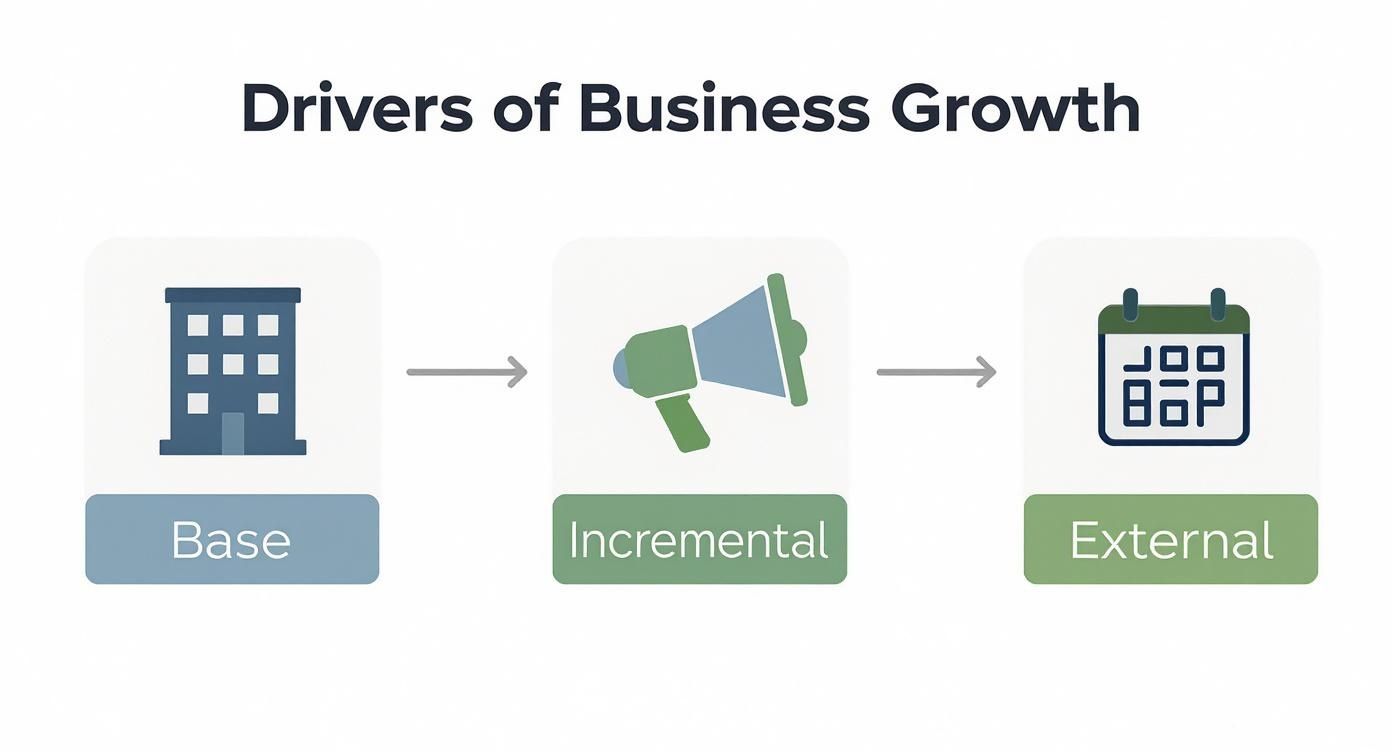
The big takeaway here is that your marketing never happens in a vacuum. It builds on your existing brand strength and gets pushed around by market forces you can’t control. A good model accounts for all of it.
Phase 1: Data Aggregation and Cleaning
The first phase is the most important and, honestly, the most tedious. It's all about the data. You’ve heard the old saying, "garbage in, garbage out," and in modeling, it's the absolute gospel. If your data is a mess—incomplete, inconsistent, or just plain wrong—the model’s insights will be worthless.
This stage means rolling up your sleeves and gathering at least two to three years of historical data from every corner of the business. We're talking about:
- Sales Data: Revenue, units sold, and conversions, ideally broken down by week or even by day.
- Marketing Spend & Activity: Detailed records of every dollar spent and every impression earned across all your channels, from TV and radio to Google Ads and in-store displays.
- External Factors: Data on what your competitors are spending, broader economic trends, and even things like seasonal buying patterns or major holidays.
The whole point is to create one master dataset where every single input lines up perfectly on the same timeline. This is where teamwork is make-or-break. Finance, sales, and marketing have to be in sync to ensure the data is clean and reliable.
Phase 2: Model Building and Refinement
Once you've got a clean, unified dataset, the real modeling work can begin. This is where the data scientists do their thing with complex statistics, but the core ideas are surprisingly simple from a business standpoint. The model basically uses regression analysis to figure out the mathematical relationship between all your inputs (marketing, pricing, etc.) and your main goal, which is usually sales or revenue.
But a basic regression isn't enough. We have to teach the model how marketing actually works in the real world. This is done by incorporating two critical concepts.
Adstock (The Halo Effect): A great ad doesn't just work the second you see it. That clever TV spot you saw last week might be the reason you grab a product off the shelf today. Adstock is the mathematical way of modeling this lingering impact, making sure your brand-building efforts get the long-term credit they deserve.
Saturation (Diminishing Returns): Think about it. Your first $10,000 spent on a new channel might deliver incredible results. The next $100,000 will probably deliver less bang for your buck, and the $1,000,000 after that might be a complete waste. The model calculates this point of diminishing returns for every channel, showing you exactly where pouring in more money stops making sense.
If you're a leader, you absolutely have to grasp these two concepts. They're what elevate the model from a simple historical report card into a powerful strategic tool for planning future investments.
Phase 3: Validation and Calibration
Finally, a model is just a fancy spreadsheet until you can prove it’s accurate. This final phase is all about stress-testing the model's predictive power. The team will typically hold back a chunk of historical data—a "holdout" set the model has never seen—and then challenge the model to predict what actually happened during that period.
We’re looking for a few key signals of a healthy model:
- Predictive Accuracy: How closely do the model’s predictions for a past quarter match the actual sales numbers?
- Logical Outputs: Do the results pass the common-sense test? If the model claims that print ads are your number-one driver, but you know for a fact your customers live online, something’s fishy and needs to be investigated.
- Calibration with Experiments: The best models are anchored in reality. If you ran a real-world test, like a regional ad campaign that you know caused a 10% sales lift, you can use that result to fine-tune the model. This grounds the statistical findings in proven, causal evidence.
Only after a model passes these rigorous checks is it ready for the big leagues. This three-phase approach takes the mystery out of MMM, turning that "black box" into a transparent, trustworthy compass to guide your entire growth strategy.
Unlocking Growth Beyond the Marketing Department

The biggest mistake I see leaders make is pigeonholing Marketing Mix Modeling as a tool just for the CMO. When you do that, you're leaving a good 80% of its value on the table. The real power of MMM is unlocked when its insights break out of the marketing department and start informing decisions across the entire business.
This isn't just about tweaking your ad spend. It's about getting a data-backed, holistic view of what actually drives your business forward. I've seen firsthand how this shift transforms companies from siloed and reactive to aligned and proactive.
From Budget Defense to Precise Optimization
For years, the marketing budget discussion has been a battlefield. Marketing asks for more, finance pushes back, and the whole dance is based on last year’s numbers and a bit of gut feel. MMM changes the game entirely, turning that old argument into a collaborative, data-driven exercise in precision.
Instead of just defending a budget, you can confidently show why you need to reallocate it for maximum impact. The model provides a clear roadmap. It might reveal that shifting $500,000 from an oversaturated social media channel to CTV could generate an incremental $2 million in revenue.
This is where the walls between marketing and finance start to crumble. When the CFO sees a clear M-ROI forecast for every dollar, the budget stops being a cost center. It becomes a portfolio of investments managed for optimal returns.
Suddenly, everyone is speaking the same language. This data-driven approach fosters mutual respect and aligns both teams toward the one goal that matters: driving profitable growth.
Informing Broader Strategic Planning
The insights from a solid MMM program go way beyond campaign tactics. They become crucial inputs for your highest-level strategic planning, influencing decisions in operations, product, and sales.
- Pricing Strategy: MMM actually quantifies your price elasticity. It might show that a 5% price increase would barely dent demand, which goes straight to your bottom line.
- Promotional Effectiveness: Are your holiday discounts actually bringing in new sales, or just pulling future purchases forward? The model gives you the real answer, helping you design promotions that are genuinely profitable.
- Geographic Expansion: By analyzing regional performance, MMM can spotlight untapped markets where your marketing dollars will have an outsized impact, giving you a clear direction for expansion.
In my experience, this is how you connect the dots between day-to-day marketing and long-term business value. It provides a strategic framework for growth that everyone can get behind. And when you have these big-picture insights, a smart marketing automation implementation is what ensures those strategic decisions are executed flawlessly on the ground.
MMM vs Other Attribution Models A Strategic Comparison
To really appreciate the top-down value MMM brings to the executive table, it helps to see it next to other common measurement methods, like Multi-Touch Attribution (MTA). Think of MTA as a bottom-up tool; it’s fantastic for tactical, in-the-weeds optimization because it tracks individual user journeys.
MMM, on the other hand, operates at a much higher altitude. It’s designed to answer the big-picture questions that steer the entire company.
| Attribute | Marketing Mix Modeling (MMM) | Multi-Touch Attribution (MTA) |
|---|---|---|
| Primary Goal | Strategic budget allocation and long-term planning. | Tactical, in-flight campaign optimization. |
| Scope | Holistic; includes online, offline, and non-media factors (e.g., pricing, economy). | Narrow; focused exclusively on digital touchpoints in the user journey. |
| Data Source | Aggregated, time-series data (e.g., weekly spend and sales). | User-level, granular data (e.g., clicks, impressions per user). |
| Strength | Measuring the impact of upper-funnel and offline channels like TV and brand campaigns. | Optimizing digital performance channels and understanding conversion paths. |
One isn't inherently "better"—they simply answer different questions for different people. But for a leadership team trying to break down silos and drive overall business growth, MMM provides the comprehensive, C-suite-level view needed to get everyone pulling in the same direction.
Avoiding Common Pitfalls on Your MMM Journey
Kicking off a Marketing Mix Modeling initiative is a serious undertaking. It costs time, money, and a good deal of political capital. And like any powerful strategic tool, there are plenty of traps that can completely sink its effectiveness. Over my career, I've seen organizations stumble, and the mistakes are almost always the same. Steering clear of them from the start is the secret to building a program that actually delivers.
The most common and deadly mistake? The classic 'Garbage In, Garbage Out' problem. A model is only as good as the data you feed it. If your historical data on media spend, promotions, or sales is patchy, inconsistent, or just plain wrong, your model’s outputs won't just be a little off—they’ll be dangerously misleading.
This isn’t just a technical headache for the data team; it's a leadership challenge. It means breaking down the walls between finance, sales, and marketing to create a single source of truth before a single line of code is ever written.
Mistaking a Project for a Program
Another huge pitfall is treating MMM as a one-and-done project. I see it all the time: executives commission a model, get a deck with some recommendations, and check the box. This completely misses the point of what marketing mix modeling is supposed to be. It’s not a static report; it’s a living, breathing strategic capability.
Markets don’t stand still. Consumer behavior changes, new competitors pop up, and the economy shifts. A model built on last year’s data will quickly become a relic.
To be effective, your MMM program must be an ongoing process. The model needs to be refreshed with new data, recalibrated, and revalidated regularly—at least quarterly, if not more often. This transforms it from a rearview mirror into a forward-looking guidance system.
Ignoring the Human Element
Finally, you can have the most sophisticated model on the planet, but it’s worthless if no one is prepared to act on what it says. This is where culture becomes critical. I’ve seen brilliant, counter-intuitive insights get buried because they challenged a senior leader's long-held belief about their favorite channel.
This is the danger of confirmation bias. Leaders have to build a culture of intellectual honesty, one where data has permission to challenge sacred cows. You have to prepare your teams for some potentially uncomfortable truths.
Here’s a practical checklist to keep your initiative on the rails:
- Data Integrity First: Get an executive sponsor to enforce data quality across all departments before you start.
- Establish a Rhythm: Set a clear schedule for model updates and insight reviews from day one. It should be a recurring part of your strategic planning.
- Challenge Everything: Create a space where model outputs can be debated openly. Encourage healthy skepticism to really kick the tires on the findings.
- Translate for Action: Make sure the data science team’s findings are translated into plain English and clear, actionable next steps for channel owners.
Building a successful MMM program is as much about people and process as it is about stats. By getting ahead of these common stumbles, you can ensure your investment pays off with real, predictable growth.
Your Top MMM Questions, Answered
Over the years, working with everyone from SaaS startups to massive gaming companies, I've noticed the same questions pop up whenever leadership starts digging into Marketing Mix Modeling. Let's cut through the noise and tackle these head-on. My goal here is to give you the straight answers you need to make smart, strategic moves.
How Long Does It Take to Build a Reliable Marketing Mix Model?
This is always the first question, and the honest answer is: it really depends on how clean and complex your data is. Generally, you can get a solid, foundational model up and running in about 3-4 months. That timeline covers the essentials—digging up the data, cleaning it, building the actual model, and then kicking the tires to make sure it's accurate.
Now, if your company has a ton of different marketing channels or your data is scattered all over the place, you might be looking at a 6-month project. But the most important thing is to see this as a journey, not a destination. Your first model will deliver value right away, and it only gets more powerful as you keep feeding and refining it.
Don’t get stuck chasing a "perfect" model right out of the gate. A good model that you can use today is infinitely more valuable than a flawless one you get a year from now. Those initial insights build the momentum you need to prove the whole program is worth it.
Is MMM Only for Companies with Huge Marketing Budgets?
Not anymore. It's true that MMM used to be the exclusive playground of giant corporations with massive TV ad spends, but things have changed dramatically. With open-source tools like Google’s Meridian and other accessible analytics platforms, MMM is now a realistic option for almost any business.
The fundamental goal—measuring your return on investment—is the same for everyone. A smaller business might have fewer channels to model, but understanding how to squeeze the most out of every single dollar is just as crucial, if not more so. The real barrier to entry isn't the size of your budget; it's having at least two years of consistent historical data so the model has enough information to spot reliable patterns.
How Does MMM Handle Brand Building Versus Direct Response?
This is where MMM truly flexes its muscles and leaves other attribution methods in the dust. It’s uniquely built to measure the impact of both those big, top-of-funnel brand campaigns and the nitty-gritty, bottom-of-funnel performance ads.
Here’s how it works: The model splits your sales into two buckets. There's your 'base' sales—the revenue you’d get anyway thanks to your brand reputation, market position, and so on. Then there are the 'incremental' sales—the lift directly caused by specific marketing activities.
By using techniques like adstock, the model can measure the long-term, fading effect of brand advertising over time. This allows it to tell the difference between the steady lift you get from a great brand campaign and the quick, sharp spike from a direct-response ad. You finally get a complete, holistic picture of how your entire marketing portfolio works together.
At MGXGrowth, we're all about helping companies move from theory to action. If you’re ready to stop treating marketing as a cost center and start running it like a predictable growth engine, let's talk. You can see how we work at MGXGrowth.com.
