


For decades, I've sat in boardrooms and watched companies roll out loyalty programs based on the same tired, antiquated playbook. You know the one: gold, silver, and bronze tiers that feel more like a sorting mechanism than a genuine reward. Let's be blunt: that model is broken. In today's market, true loyalty—the kind that impacts EBITDA—is built on a deeply personal connection. That's where AI comes in, transforming a basic points system into a predictable growth engine.
Moving Beyond One-Size-Fits-All Rewards
Regardless of the industry—from SaaS to hospitality—I’ve seen the same fundamental mistake hamstring growth: lumping valuable customers into broad, faceless segments. The old approach was like shouting a message into a crowd and hoping the right person was listening. That doesn't drive revenue anymore. Your customers, whether they're enterprises or individuals, expect a one-on-one conversation.
This is precisely why traditional loyalty frameworks are failing. They’re rigid, impersonal, and incapable of creating the emotional bond that actually drives retention and increases lifetime value. They were designed to reward transactions, not build profitable, long-term relationships.
From Static Tiers to Dynamic Personalization
The real shift isn't just about plugging in new technology; it's a fundamental change in business philosophy. It’s about moving away from mass-market assumptions and building a culture that values and acts on individual customer data. This is how loyalty stops being a marketing expense and becomes a core driver of revenue and market share.
The data confirms this pivot. We're seeing a massive shift, with over 58% of businesses now investing in AI to create more relevant, revenue-generating customer experiences. You can find more data on how AI is rewiring loyalty programs across every vertical.
The ultimate objective is to stop treating loyalty as a transaction. It's about forging a partnership. When your program truly understands a customer—their habits, their preferences, their next likely move—it stops being a cost center and starts generating predictable revenue.
This AI-driven approach fundamentally rewires the customer relationship. It enables you to move past generic buckets and deliver offers, content, and experiences that feel architected for one person. It's not just better marketing; it's a smarter, more profitable way of doing business. It's how you build a brand that people don't just buy from, but one they feel strategically aligned with.
Before we dive deeper, it's critical for leadership to grasp the strategic gap between the old and new paradigms. The difference isn't just tactical; it's transformational.
Traditional vs AI-Driven Loyalty Programs: A C-Suite View
| Key Area | Traditional Loyalty Programs (The Old Way) | AI-Driven Loyalty Programs (The Growth Engine) |
|---|---|---|
| Customer Insight | Relies on broad segments and past purchase history. | Uses predictive analytics to understand individual intent and future needs. |
| Personalization | Generic, tiered rewards (e.g., "Silver members get 10% off"). | Hyper-personalized offers based on real-time behavior and predictive signals. |
| Business Impact | Viewed as a marketing cost center; difficult to measure direct ROI. | Directly tied to revenue, CLV, and retention; a predictable growth driver. |
| Engagement | Passive and reactive. Customers earn points transactionally. | Proactive and dynamic. Engages customers with relevant, timely interactions to drive specific outcomes. |
| Operational Model | Static and rule-based. Difficult and slow to change. | Agile and adaptive. Continuously learns and optimizes in real-time to maximize financial impact. |
This table makes it clear: clinging to the old model means actively leaving money on the table. The AI-driven approach isn't just an upgrade—it's a competitive necessity for any business serious about long-term, profitable growth.
Building Your AI-Powered Loyalty Framework
Jumping into AI without a solid operational plan is a recipe for burning capital. I've seen it happen time and again—a company gets excited about the tech, invests heavily, but without a cohesive framework, the project fails to deliver ROI. The problem is rarely the AI itself; it's the lack of a clear structure connecting your data, tools, and teams to a specific business outcome.
Success begins by tearing down the data silos that plague most organizations. You cannot have a truly AI-driven loyalty program when your customer data is scattered across a dozen disconnected systems. The first critical step is architecting a unified, 360-degree view of your customer.
This means integrating every piece of the puzzle from every touchpoint:
- Transactional Data: Sales history from your CRM, ERP, and point-of-sale systems.
- Behavioral Data: Website clicks, app usage, product engagement, and content interactions.
- Support Interactions: Valuable insights hidden in call logs, helpdesk tickets, and live chat transcripts.
- Social & Third-Party Data: Context on public sentiment and your customers' broader interests.
Once these streams feed a single, reliable source, your AI models finally have the high-quality fuel required to produce commercially valuable insights.
Assembling the Right Technology and Teams
With your data foundation in place, it's time to build your tech stack. It’s easy to get distracted by the latest shiny tool, but discipline is key. Focus on what's mission-critical versus what's just "nice to have." Your core stack must handle data ingestion, predictive modeling, and the automated execution of personalized campaigns. For a closer look at what you might need, our guide on foundational AI tools for business is a pragmatic starting point.
But let me be clear: the best technology in the world is useless without the right cross-functional team behind it. A classic leadership mistake is hiring a couple of data scientists and expecting magic to happen in a vacuum. The real unlock is forcing deep, daily collaboration between your marketing, product, IT, and operations teams.
I’ve always said that growth happens at the seams of an organization. Your AI loyalty program will only succeed if the marketing team defining the strategy, the IT team managing the data, and the operations team executing the campaigns are working as one integrated unit, all accountable to the same KPIs.
This integrated approach ensures the insights your AI generates are more than just interesting data points. They become actionable strategies directly tied to core business goals, like boosting EBITDA or capturing market share.
Many legacy loyalty programs remain stuck in an outdated, linear process like the one shown below.
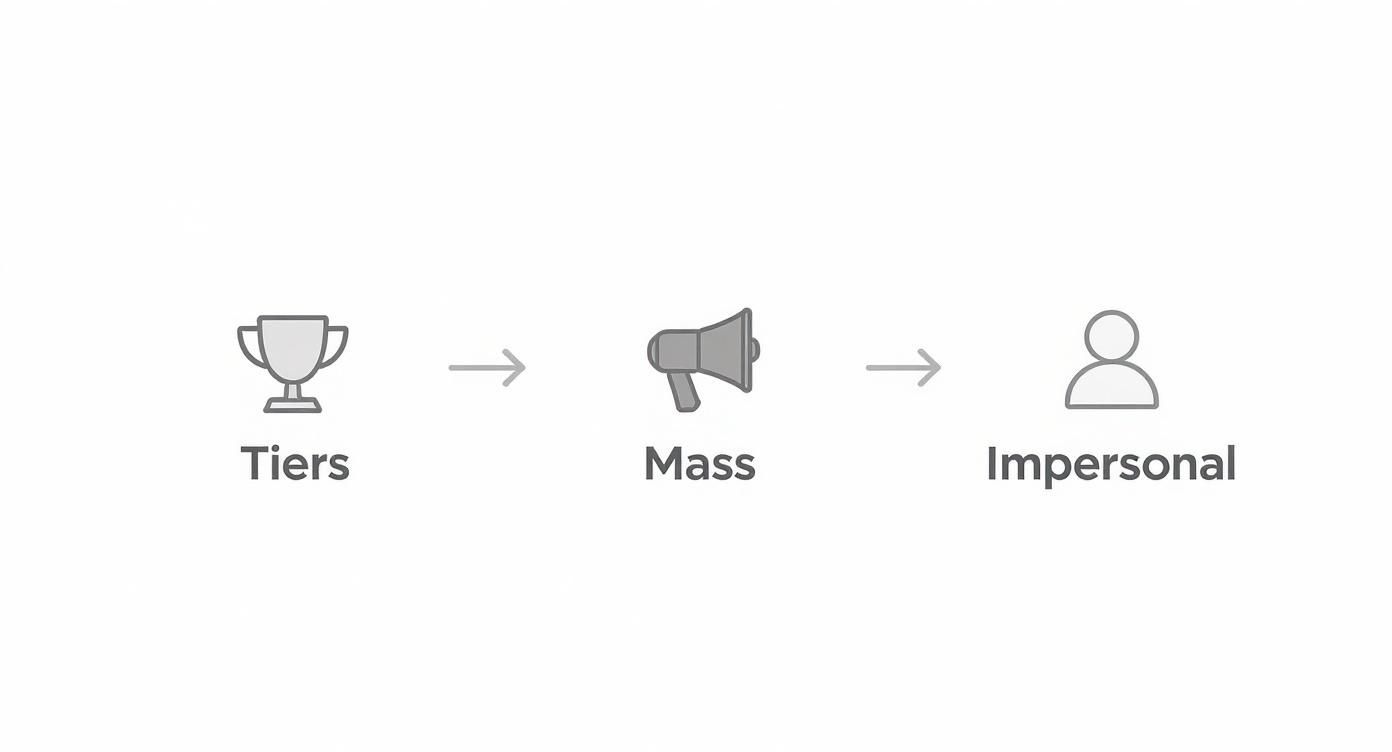
This graphic perfectly illustrates the one-way street of generic engagement. It's precisely the model a modern, integrated framework is designed to obsolete. Instead of this static, predictable flow, an AI-powered system creates a dynamic, continuous loop of learning, action, and optimization.
Deploying Predictive Personalization to Drive Revenue

This is where strategy translates directly to the P&L. All the data integration and platform work we've discussed starts to directly impact your bottom line. Forget simply slotting a customer's first name into an email template—true predictive personalization is about anticipating your customer's next move and meeting them there before a competitor does.
From my experience scaling both SaaS companies and large marketplaces, the most significant revenue gains always came when we used AI models to forecast future behavior. This is the critical shift from being reactive to proactive, which turns a loyalty program from a cost center into a powerful revenue engine.
Anticipating Customer Needs and Preventing Churn
The most immediate and profitable application is churn prediction. When you feed a well-trained AI model with unified customer data, it can detect subtle behavioral shifts that signal a customer is at risk. This isn't a hunch; it's data science identifying patterns that even your most seasoned account manager might miss.
Consider this: a system flags a high-value SaaS user whose product engagement has dipped by 15% over the last two weeks. Instead of discovering they've canceled a month later, your program can automatically trigger a personalized retention offer—perhaps a one-on-one session with a product expert or a temporary discount. That is AI-driven loyalty program optimization delivering real-time financial impact.
Identifying and Activating High-Potential Segments
Predictive models are also exceptional at spotting untapped revenue opportunities. By continuously analyzing purchasing habits, browsing history, and engagement metrics, AI can identify customer segments with the highest propensity to upgrade or make a repeat purchase. This is worlds away from basic demographic bucketing. Our guide on modern customer segmentation strategies goes deeper into building these valuable micro-segments.
The real power isn't just knowing who is likely to buy more. It's understanding why and when. An AI model might determine that customers who use Feature A and have visited the pricing page twice are 80% more likely to upgrade in the next 30 days. Now that's an actionable, high-probability insight you can build an entire revenue campaign around.
This is what fundamentally changes your program's economics. The ROI becomes quantifiable, not theoretical. We're seeing organizations that embrace AI in their loyalty programs achieve a remarkable 5.2 times return on investment, driven by precisely this kind of hyper-targeted action.
Whether it's AI-powered product recommendations that feel genuinely insightful or gamified challenges that encourage deeper product adoption, these tactics create a powerful, self-improving loop. Better personalization drives higher engagement, which feeds the AI more data, making the next prediction even more accurate. This continuous cycle is how you unlock sustained, predictable revenue growth.
Using AI to Streamline Operations and Boost Efficiency
Growth isn't just about driving the top line; it's built on a foundation of operational excellence. While AI-powered loyalty programs are phenomenal for creating a superior customer experience, their biggest—and often most overlooked—benefit is the operational leverage they create. This efficiency is what fuels sustainable, profitable growth.
I’ve led teams across multiple industries, and one constant is that marketing departments get buried in manual, repetitive work. They spend their days wrestling with spreadsheets, tweaking campaigns, and putting out fires instead of focusing on strategy. AI-driven loyalty program optimization flips that script by automating the tactical grunt work of program management.
This goes far beyond scheduling emails. We're talking about complex, continuous processes humming along in the background, freeing up your A-players to do what they do best: innovate and drive strategy.
Automating Program Health and Security
One of the most powerful applications of AI here is in real-time program monitoring and fraud detection. Legacy loyalty systems rely on manual, periodic checks. That means you often don't identify a problem—like a system bottleneck or a spike in fraudulent point redemptions—until it has already damaged your customer experience and your P&L.
AI changes the game entirely. It constantly monitors your data, ready to:
- Spot Anomalies Instantly: AI algorithms are trained to recognize anomalous patterns in point accrual or redemption. If it detects behavior indicative of fraud, it flags it for review before significant damage occurs.
- Predict System Strain: By monitoring metrics like API response times and transaction volume, AI can forecast potential system overloads and alert your technical team to prevent a crash during a high-traffic event.
- Optimize Your Incentive Spend: Instead of issuing the same bonus points to everyone, AI can dynamically adjust incentives based on inventory levels, customer behavior, and profit margins to ensure you're not needlessly giving away value.
This proactive stance makes a significant operational difference. A recent study found that integrating AI into core loyalty operations can yield cost reductions between 26% and 31%, primarily from reducing manual management and operational overhead. You can dig deeper into how AI makes loyalty programs more efficient and secure.
The real strategic win here is freeing up your best people. When you automate the tedious but critical tasks of monitoring and fraud prevention, your best marketers can stop playing defense. They can finally focus on architecting the next phase of your growth strategy, which is where their true value lies.
Ultimately, this obsession with efficiency is what maximizes the ROI of your loyalty investment. A program that runs like a well-oiled machine provides a seamless customer experience and allows your team to focus on work that actually moves the needle on revenue and growth.
Measuring Success and Optimizing for Growth
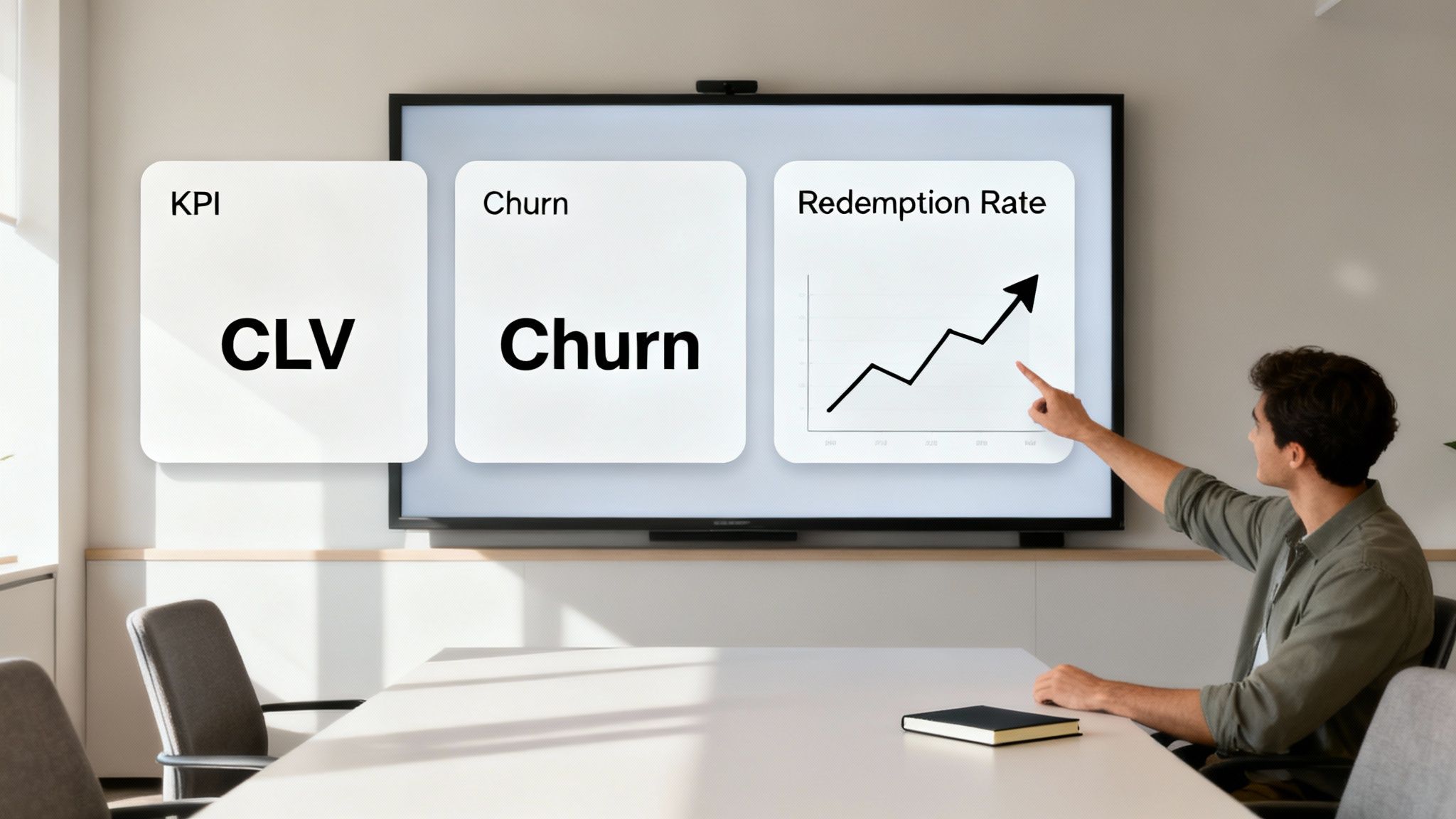
In every boardroom I've sat in, the conversation ultimately comes down to one thing: results. If you can't tie an initiative back to the P&L, it might as well not exist. This is especially true for a significant investment like an AI-driven loyalty program.
We must move past vanity metrics. Enrollment numbers look good on a slide, but they don’t impact shareholder value. The true test is found in the KPIs that demonstrate how the program is influencing customer behavior and, consequently, the bottom line. These are the only numbers that matter.
Focusing on C-Suite Metrics
When I present to leadership, I don’t start with engagement rates. I lead with the numbers that speak their language—revenue and EBITDA growth. Your entire measurement framework must be built around these core financial indicators:
- Customer Lifetime Value (CLV) Uplift: This is the ultimate metric. Can you prove that a program member is demonstrably more valuable over their lifetime than a non-member in a control group? A well-built AI model tracks this cohort comparison continuously.
- Churn Reduction Rate: How effective is your program at retaining high-value customers? Even a 5% reduction in churn can boost profitability by 25% to 95%. That is a statistic that commands immediate executive attention.
- Incremental Revenue Per Member: This is about precision. It isolates the revenue generated specifically by loyalty activities—like a customer redeeming a personalized offer—from their organic spending habits.
- Personalized Offer Redemption Rate: This KPI is a direct proxy for how well your AI understands your customers. High redemption rates mean your predictions are accurate and the offers are commercially compelling.
The entire point of leveraging AI is to draw a straight, measurable line from a personalized action to a profitable outcome. When you can walk into a meeting and state, "Our churn prediction model saved us $500k in Q3 by retaining these specific high-value customers," you have won.
This level of granular, outcome-based tracking is what separates a world-class loyalty program from a simple points card. For anyone looking to build this kind of reporting muscle, mastering the fundamentals of a successful business intelligence implementation is the first, non-negotiable step.
Creating a Continuous Optimization Loop
The true power of an AI-powered system is its ability to learn and adapt in real time. The data flowing from your core KPIs shouldn't just populate a dashboard; it must feed directly back into the system to create a powerful feedback loop that drives relentless improvement.
This is about putting your data in the driver's seat.
AI allows you to run A/B/n tests at a scale that was impossible just a few years ago. You can test thousands of variations of offers, rewards, and messaging across countless micro-segments simultaneously.
For instance, you might test two different approaches for the same at-risk customer group:
- Offer A: A straightforward 15% discount on their next purchase.
- Offer B: Double loyalty points on their next purchase.
The AI will rapidly determine which offer generates a higher CLV uplift and automatically favor the winning strategy. This removes guesswork and opinion from the equation, replacing them with data-driven decisions that compound in value, ensuring your program is always evolving to maximize its financial return.
Your AI Loyalty Questions, Answered
As a leader, you need direct answers, not buzzwords. I've spent years helping executives deploy AI loyalty programs, and the same critical questions always surface. Let's tackle them head-on so you can move forward with clarity and confidence.
What’s the Real First Step to Implementing an AI Loyalty Program?
Before you even discuss algorithms or predictive models, you must unify your data. I cannot overstate the importance of this foundational step. Your AI is only as intelligent as the data it learns from, so you need a single source of truth for each customer.
This means integrating everything:
- CRM data
- Point-of-sale transactions
- E-commerce browsing and purchase history
- Customer service logs and interactions
If you don't break down these internal data silos first, you are building on a foundation of sand. Your personalization will be ineffective, and your predictions will be unreliable. It is the unglamorous, heavy lifting, but it is absolutely non-negotiable.
I’ve seen it time and again: projects that rush past the data unification step are the ones that inevitably fail. The successful ones treat it as the most critical milestone on their entire AI roadmap.
Getting this right from day one ensures that every subsequent phase of your AI-driven loyalty program optimization is powered by clean, complete, and actionable information.
How Do We Actually Measure the ROI on This?
Forget soft metrics like email open rates. To secure C-suite buy-in and continued investment, you must connect your AI loyalty initiatives directly to the P&L. It's all about tracking KPIs that reflect tangible financial impact.
Your ROI dashboard should be laser-focused on metrics like these:
- Higher Customer Lifetime Value (CLV): How much more are program members worth over time compared to a control group of non-members?
- Lower Customer Churn: Are you successfully reducing attrition, especially among your most profitable customer segments?
- Incremental Revenue: Can you directly attribute new sales to specific AI-powered offers and personalized campaigns, proving causality?
When you frame the results in these terms, you elevate the conversation from a marketing cost to a strategic growth investment. That is how you prove the program's value and justify the budget for future expansion.
Can We Do This Without a Massive Budget?
Yes, absolutely. You do not need a multi-million dollar, custom-built system from day one. The key is to start small, prove value, and scale.
Many modern CRM and marketing automation platforms now have embedded AI features, like predictive analytics or personalization engines. Start there. Identify one specific, high-value problem to solve—perhaps it’s identifying customers with a high propensity to churn or predicting the next best offer for your top 10% of clients.
Run a tightly scoped pilot program on that single use case. Once you have clear, positive results and a quantifiable ROI, you can use that data to build a compelling business case for a wider rollout and a larger budget. This approach minimizes risk while building crucial internal momentum.
At MGXGrowth, we specialize in architecting these precise, data-driven strategies that deliver measurable results. If you're ready to transform your loyalty program into a powerful growth engine, let's connect. Learn more at mgxgrowth.com.
