


Across my career driving growth in SaaS, marketplaces, gaming, and real estate, I've seen one truth hold firm: most companies are drowning in data but starving for insight. They fixate on vanity metrics—big, flashy numbers that look great in a board deck but say nothing about the underlying health of the business.
Sustainable growth, the kind that drives real enterprise value, isn't found in a simple month-over-month revenue chart. It’s unlocked by understanding the behavior of your customers over time. The most powerful way to do this is with cohort analysis. The concept is brilliantly simple: group users by a shared characteristic—most often when they joined—and track their behavior as a unit. This method turns abstract data into a clear narrative about your business.
Your Secret Weapon for Sustainable Growth

Stop thinking of your customer base as a single, monolithic entity. Instead, view it as a series of distinct "graduating classes." The class that signed up in January 2023 will behave differently from the class of June 2023. By studying each class—each cohort—separately, you cut through the misleading averages that mask critical threats and opportunities.
A rising total user count, for instance, can look fantastic. But what if you're losing valuable long-term customers just as fast as you're acquiring low-value new ones? This is the classic "leaky bucket" syndrome, and aggregate metrics will never reveal it. Cohort analysis shines a spotlight on these dynamics, giving you an unvarnished look at customer retention and product stickiness.
It tells you precisely when and why certain groups of users thrive while others churn. This transforms your data from a rearview mirror into a predictive roadmap for growing revenue, expanding market share, and maximizing customer lifetime value. It’s the difference between reacting to symptoms and architecting a fundamentally healthier, more profitable business.
A business that doesn't understand its cohorts is like a ship's captain navigating without a compass. You see the waves, but you have no idea which currents are actually moving you forward or pulling you off course.
This is a fundamental mindset shift. Once you start thinking in cohorts, you can measure the direct impact of your strategic decisions. Did that Q2 marketing campaign attract higher-value customers? Did the new onboarding flow we launched in May actually improve long-term engagement? Cohort analysis delivers the answers, enabling sharp, data-driven leadership.
For any executive, mastering these fundamentals is non-negotiable for strategic planning. This table breaks down the core concepts.
Cohort Analysis Core Concepts at a Glance
| Concept | Strategic Importance |
|---|---|
| Cohort | A group of users who share a common characteristic, most often their start date (e.g., "January 2024 Sign-ups"). This allows for apples-to-apples comparisons. |
| Time Series | The timeline over which you track a cohort's behavior (e.g., Week 1, Week 2, Month 1, Month 2). It reveals how engagement and value change over time. |
| Metric | The specific action or value you're measuring, such as retention rate, average revenue per user (ARPU), or purchase frequency. This defines what "success" looks like. |
| Cell | The intersection of a specific cohort and a specific time period, showing the metric's value at that point (e.g., the retention of the "January" cohort in Month 3). |
With these concepts in mind, the strategic advantages of cohort analysis become undeniable. It's not a reporting tool; it’s a diagnostic one.
The immediate benefits are powerful and practical:
- Identify Your Best Customers: Pinpoint which acquisition channels or sign-up periods deliver the most loyal and profitable users.
- Improve Retention: Isolate the exact moments in the customer lifecycle where engagement falters, so you can intervene proactively.
- Calculate True ROI: Move beyond simple acquisition costs to understand the real lifetime value delivered by different customer segments.
This is how you break down the silos between marketing, product, and finance. It aligns everyone on a single, unifying goal: creating durable, long-term customer value.
Breaking Down Cohort Analysis for Leaders
Let’s be direct. Throughout my career, I’ve seen far too many leadership teams misled by high-level metrics. A chart showing "monthly active users" climbing steadily looks great in a board meeting, but it often conceals a dangerous reality. It can easily mask a "leaky bucket"—new users pouring in the top while the customers you fought hard to win are quietly churning out the bottom.
This is precisely why we must move beyond simple data snapshots. Think of it this way: analyzing your entire user base at once is like looking at a single photograph of a forest. It shows you what’s there right now, but it tells you nothing about its health, growth, or future trajectory.
Cohort analysis, on the other hand, is like watching a time-lapse video of that same forest, tracking specific groves of trees over multiple seasons. Only the time-lapse reveals genuine growth, which areas are thriving, and which are beginning to decay. It shows you the true, dynamic health of the ecosystem.
Acquisition vs. Behavioral Cohorts
To get this unvarnished view of your business, we primarily use two types of cohorts. Each answers a different—but equally critical—business question.
-
Acquisition Cohorts: This is the most common type. It groups users based on when they started—by the day, week, or month they signed up. This is essential for measuring the long-term impact of marketing campaigns or product launches. For example, you can ask, "Did the users we acquired from our Q2 campaign retain better than those from Q1?" This is your go-to for tracking product stickiness and the effectiveness of your onboarding over time.
-
Behavioral Cohorts: This approach groups users by what they did (or didn't do) within a specific timeframe. For instance, you could create a cohort of all users who utilized a key feature in their first week and compare their retention against those who didn't. This is incredibly powerful for identifying the specific actions that correlate with long-term value and loyalty.
The real power of cohort analysis isn’t just tracking retention; it's about connecting specific actions to long-term outcomes. It empowers you to state with confidence, "Customers who do X are 70% more likely to remain active after one year."
Understanding this distinction is the first step toward building a more intelligent growth engine. Acquisition cohorts tell you when performance is changing; behavioral cohorts help you diagnose why.
This marks a fundamental shift from basic reporting to deep, diagnostic analysis. It's also a crucial component of a successful, data-driven customer segmentation strategy that aligns your marketing, product, and sales teams. When everyone operates from the same unfiltered truth, you can move past misleading averages and uncover the insights that truly drive sustainable growth.
Using Retention Cohorts to Uncover Business Truths
I’ve driven growth across SaaS, marketplaces, and gaming, and one principle is universal: customer acquisition fills the funnel, but customer retention builds the enterprise. Acquiring a new user is a cost center; retaining them is where you generate profit and long-term value. This is precisely where cohort analysis delivers its most significant and immediate return.
Retention cohorts are the simplest, most powerful diagnostic tool for determining if your product is delivering on its promise over time. It answers the fundamental business question: "Are people sticking around?"
Let me share a real-world example. I was advising a SaaS company where top-line user growth looked strong. On the surface, the business was healthy. But when we dug into the retention cohort chart, we discovered a serious problem hiding in plain sight. By comparing monthly acquisition cohorts, we found a shocking 20% drop in 90-day retention for users who signed up in February compared to those from January.
This is the classic case of aggregate data obscuring the truth.
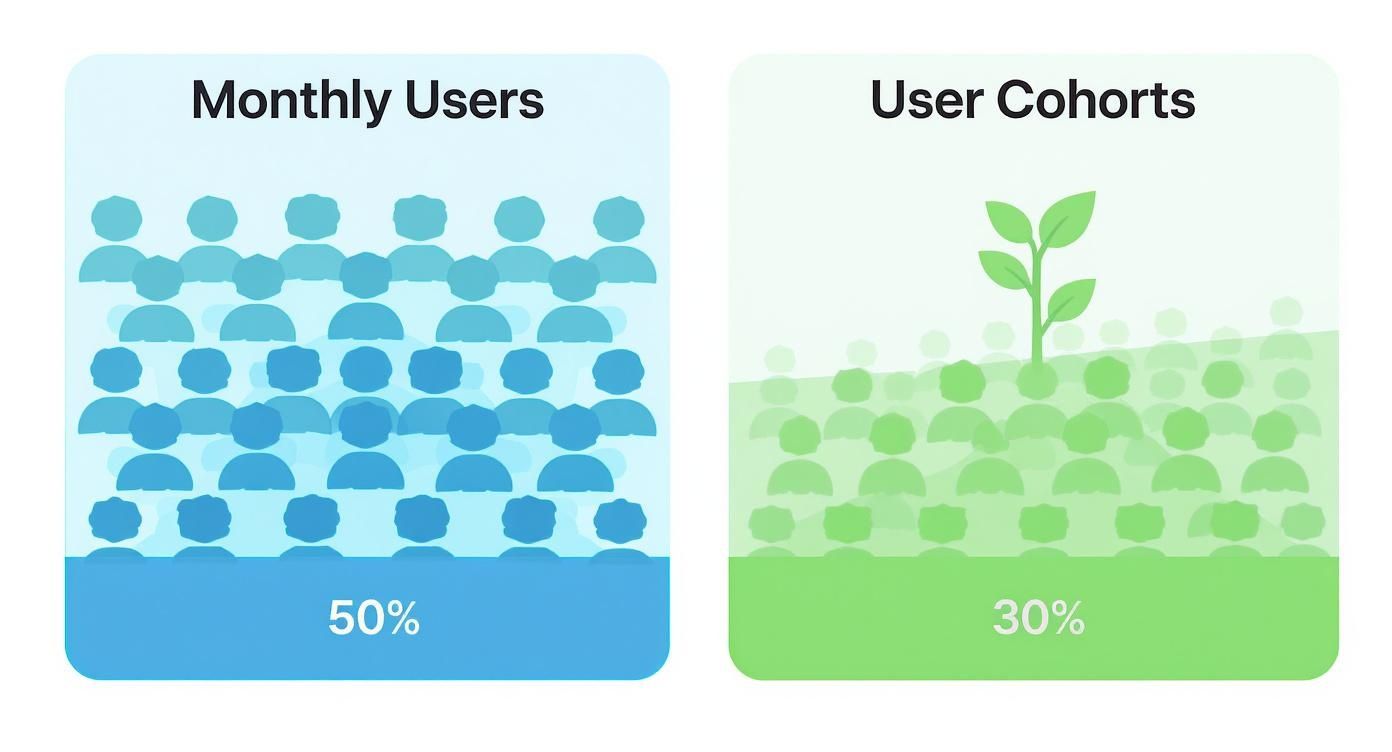
The chart on the left showing total users might paint a rosy picture, but the cohort view on the right tells the real story—it reveals the actual health and trajectory of each group of users as they move through their lifecycle.
Pinpointing the 'Why' Behind the Drop
That 20% drop was a massive red flag that our high-level metrics would have never caught. It triggered an immediate, cross-functional investigation. We brought marketing, product, and engineering into a war room to determine what had changed between January and February.
It didn't take long to isolate the cause: a recent update to the onboarding flow rolled out at the beginning of February. It was intended to be "simpler," but we had inadvertently removed a critical step that helped new users reach their "aha moment" within the first week.
This is the power of a retention chart. It doesn't just show you what happened; it gives your teams a precise starting point—the 'when' and the 'who'—to investigate why it happened.
This single insight enabled us to move with speed and precision. The same principle holds in any industry. In hospitality, a minor change to a booking process can devastate repeat visits, a trend easily missed without cohort analysis. This is a common challenge for restaurants, which is why a targeted communication strategy is so critical. You can learn more by reviewing our guide on email marketing for restaurants.
By correcting the flawed onboarding flow, we didn't just stop the bleeding; we improved retention beyond previous levels. This is how you transform a passive data report into a strategic tool for real, sustainable growth. It breaks down departmental silos and focuses everyone on the only metric that truly matters: long-term customer value.
Optimizing Marketing Spend with Acquisition Cohorts
In every executive role I've held, I've managed marketing budgets as an investment portfolio, not an expense line. Every dollar must be accountable for delivering a return. And the single most powerful tool I've found for auditing that portfolio is cohort analysis. It moves beyond the simplistic question of "What's our Cost Per Acquisition (CPA)?" to the strategic imperative: "Which channels are bringing us the most valuable customers for the long term?"
Too many marketing teams celebrate a low CPA from a particular channel, popping the champagne without ever verifying if those cheaply acquired customers actually stick around. This is a classic, costly error. The marketing team hits its CPA target, but the business is burdened with a flood of low-value users who churn almost immediately, eroding profitability.
Acquisition cohorts smash through that silo, directly linking marketing spend to long-term customer value.
From Cost Per Acquisition to Lifetime Value
Consider a simple example. An e-commerce company runs campaigns on two primary channels: paid social media and organic search.
- Paid Social: The ads are performing, delivering a low CPA of $15.
- Organic Search: This channel is more expensive, with an effective CPA of $35.
At first glance, paid social is the clear winner. The pressure would be to double down on that channel. But once we build acquisition cohorts for each channel and track their spending behavior over the next six months, a completely different narrative emerges.
The most expensive customer you'll ever acquire is the one who leaves and never comes back. Real ROI isn't about the first transaction; it's measured across the entire relationship.
By tracking repeat purchases, you begin to see the true return on investment. The key is to look beyond the initial spend and understand the complete cost of customer acquisition calculation, then weigh that against the value a customer generates over their lifetime.
Revealing the True Winners
For an e-commerce business, this kind of insight is game-changing. An online store might discover that customers acquired through a social media campaign have a 30-day repeat purchase rate of 18%. That seems acceptable until they see their email campaign cohort boasts a repeat purchase rate of 25%. That data point alone signals that email-acquired customers are stickier.
Digging deeper might reveal that customers who spend over $100 on their first order are 65% more likely to make another purchase within six months. As explained in this Saras Analytics cohort analysis guide, these are the patterns that build durable, profitable businesses.
Suddenly, the strategic picture flips. The organic search cohort, despite its higher upfront cost, might generate a Lifetime Value (LTV) that is 3x higher than the paid social cohort. These are the loyal, high-value customers who become brand advocates.
With this data, the strategic move is clear: reallocate a portion of the paid social budget to SEO and content marketing. You’re no longer just asking, "How much did we spend?" Instead, you're focused on the right question: "What is our real, long-term return on this investment?"
Applying Longitudinal Analysis to Business Strategy
The power of what we now call cohort analysis extends far beyond quarterly business reports. Its foundational principles were forged in long-term medical and scientific research—studies that tracked human behavior over decades, not days. To truly appreciate its strategic value, it’s instructive to look at one of the most important longitudinal studies ever conducted: the landmark Framingham Heart Study.
Launched in 1948, this massive, multi-generational study began following a cohort of 5,209 people in Framingham, Massachusetts. By tracking this group—and later, their children and grandchildren—over their entire lifetimes, researchers were able to connect lifestyle, genetics, and heart disease. They identified major risk factors like high blood pressure and cholesterol, concepts now considered common knowledge. This was only possible because they studied a defined group over an extended period—the very essence of cohort analysis. You can learn more about its research applications in this deep dive on cohort analysis.
The Lesson for Business Leaders
The strategic takeaway for any executive is profound: the most powerful insights come from long-term observation, not isolated snapshots. A single financial report is a snapshot. Your aggregate user data for last month is another snapshot. They tell you what’s happening now, but they cannot reveal the deeper currents shaping your company's future.
Just as the Framingham study revealed that small, consistent habits led to major health outcomes decades later, cohort analysis shows how early customer behaviors are predictive of long-term loyalty and lifetime value.
This screenshot from the study's historical overview gives you a sense of its multi-generational structure, following the original participants, their kids, and even a third generation.

The brilliance of this approach was the commitment to tracking specific, related groups over decades. It allowed researchers to disentangle generational trends from individual behaviors—a challenge businesses constantly face.
Connecting Medical Research to Modern Strategy
This is the exact same longitudinal thinking that allows us to uncover fundamental truths about our own business. When we analyze cohorts, we can finally see how a product enhancement in Q1 truly impacts customer retention a year later. We can see how a specific marketing campaign attracted users who remain valuable for years, not just weeks. Your standard short-term analytics will miss these causal links every time.
This is also how you begin to break down stubborn internal silos. When your product, marketing, and finance teams all start looking at the long-term health of your customer cohorts, the entire conversation shifts. You move away from chasing short-term tactical wins and start focusing on sustainable, strategic growth. You stop asking, "What happened last month?" and start asking the much more valuable question: "What are the foundational drivers of our long-term customer value?"
A Strategic Framework for Implementation
Understanding cohort analysis and actually acting on the insights are two different disciplines. I've seen countless teams produce elegant charts that go nowhere because there's no operational link between the data and the decision-makers. The objective isn't to generate reports; it's to embed this methodology into your company's operating rhythm—to build a culture of relentless, data-informed curiosity.
It's about shifting from one-off analysis to a repeatable, strategic cadence. In my experience, a simple three-step framework is all it takes to bridge that gap and start turning insights into measurable improvements in revenue and EBITDA.
1. Define Your Key Business Questions
Before opening a single spreadsheet, start with the questions that matter most to the business. This is the most common point of failure. Don't start with the data; start with strategic imperatives.
- For Product: Which user actions in the first seven days are the strongest predictors of 90-day retention?
- For Marketing: What is the LTV to CAC ratio for customers acquired via our Q2 LinkedIn campaign versus organic search?
- For Finance: How did our new pricing model impact average revenue per user (ARPU) for cohorts acquired after the change?
Framing questions this way provides clear purpose and ensures the insights you uncover are immediately relevant to the leadership team.
The quality of your cohort analysis is directly proportional to the quality of the questions you ask upfront. Vague questions lead to vague, unactionable answers. Sharp, specific questions lead to decisive action.
2. Identify the Right Cohorts to Analyze
With a well-defined business question, selecting the right cohorts becomes straightforward. The question itself dictates the cohort. If you’re measuring the impact of a marketing campaign, your cohorts should be segmented by acquisition channel and sign-up date.
If you're testing a new onboarding flow, you need a behavioral cohort, grouping users by whether they experienced the new flow versus the old one. Resist the temptation to analyze every cohort imaginable. Focus only on the groups that will deliver a clean, unambiguous answer to your primary business question. This focus is what prevents "analysis paralysis" and maintains momentum.
3. Establish a Cadence for Review and Action
Analysis without a formal follow-up is an academic exercise. It is critical to establish a recurring process for reviewing findings and assigning clear action items. This simple step drives accountability and begins to dismantle departmental silos.
This could be a bi-weekly meeting where product, marketing, and data leaders review the latest cohort performance. The goal of that meeting isn't to produce another report; it's to leave with a concrete list of experiments to run, optimizations to make, and new hypotheses to investigate. This is how you close the loop, transforming cohort analysis from a one-off project into a continuous engine for growth.
Common Questions About Cohort Analysis
As a growth strategist, I field questions about cohort analysis constantly. Leaders are always curious, but they tend to circle back to the same high-level queries, whether they operate in SaaS, e-commerce, or another high-growth sector.
Here are the direct, actionable answers I provide.
How Often Should We Run This Analysis?
The answer depends entirely on the velocity of your business.
For a high-transaction SaaS company or a mobile app with daily sign-ups, you should be reviewing key cohorts on a weekly or bi-weekly basis. However, if you're in a business with a longer sales cycle—like enterprise B2B or real estate—a monthly or quarterly review is more appropriate.
The goal isn't just to generate reports. It's to establish a consistent rhythm of analysis, action, and measurement.
What's the Single Biggest Mistake People Make?
Without a doubt, it's analysis paralysis. This is a massive trap. I've seen countless teams get so lost in the data that they spend weeks building dashboards without ever answering a single, meaningful business question.
My advice is to always begin with a specific, high-stakes question. For instance: "Why are our Q2 sign-ups churning faster than our Q1 sign-ups?" That question alone focuses the entire investigation. Never analyze for the sake of analysis.
Cohort analysis should be a tool for making decisions, not just a pretty report. If an insight doesn't point to a clear action or a testable hypothesis, it's just noise.
Is This Really for Small Businesses Too?
Absolutely. In fact, I would argue it's even more critical for a small business. When you only have your first few hundred customers, understanding their behavior is essential for validating product-market fit.
You don’t need expensive, complex software to begin. A simple spreadsheet can reveal powerful truths about which user groups are staying and finding value. For an early-stage company, that clarity is invaluable for guiding your growth strategy with precision.
At MGXGrowth, we go beyond theory. We embed data-driven frameworks into businesses to deliver measurable EBITDA and revenue growth. Discover how we can architect your company's next growth stage by visiting https://www.mgxgrowth.com.
