


Let's cut through the noise. The term "growth hacking" is often misunderstood, seen as a collection of clever tricks or a silver bullet for overnight success. In my decades of driving revenue and market share growth across industries—from SaaS and gaming to real estate and hospitality—I've learned that sustainable growth is never about magic. It's about a fundamental shift in company culture and operating rhythm.
Growth hacking isn't a marketing tactic; it's a C-suite imperative. It's a disciplined, data-driven, and customer-centric methodology for building a scalable business. It's about breaking down the silos that kill momentum and aligning every department—product, engineering, marketing, sales—around a single, measurable objective: growth.
What Is Growth Hacking, Really?

At its core, growth hacking is the application of the scientific method to business expansion. It’s a mindset built on rapid, data-driven experimentation across the entire customer lifecycle. We stop making bets based on seniority or gut feelings and start building a machine that continuously uncovers what truly moves the needle for our customers and our bottom line.
It’s a system designed to find scalable, repeatable, and profitable ways to grow a business by blending different disciplines together.
The Three Pillars of Growth
In my experience, true growth engines are built by fusing three functions that traditional corporate structures keep dangerously separate:
- Creative Marketing: This is the art of understanding customer psychology. It's about crafting compelling narratives and value propositions that resonate deeply and drive initial interest.
- Product & Engineering: This is where growth becomes embedded in the user experience. We're talking about features like frictionless onboarding, built-in referral mechanics, and product loops that create inherent stickiness and advocacy.
- Data Analysis: This is the bedrock of the entire system. Every strategic initiative is treated as a testable hypothesis. Data—not opinion—determines resource allocation and strategy.
This fusion is the competitive advantage. In a legacy organization, marketing brings leads to the door and hands them off. A growth-oriented organization understands that the customer journey is one continuous experience. It assembles a cross-functional team singularly focused on a North Star Metric that reflects the delivery of customer value.
"True growth hacking is applying the scientific method to business expansion. You formulate a hypothesis—'If we simplify our signup form, we will increase user activation by 15%'—then you test it, measure the result, and iterate. It replaces 'we think' with 'we know'."
It's All About the Full Funnel
Herein lies the most critical departure from legacy marketing: scope. Traditional marketing is obsessed with the top of the funnel—awareness and acquisition. While vital, this is a dangerously incomplete picture of business health.
Growth hacking demands a holistic view of the entire customer journey. It’s not enough to acquire a customer; we must ensure they experience the product's core value (activation), form a lasting habit (retention), and become brand advocates (referral), all while driving profitability (revenue).
Imagine your team spends millions on a brilliant acquisition campaign, but 90% of new users churn within a week due to a confusing onboarding experience. A traditional marketing leader might ask for more budget. A growth leader immediately deploys resources to diagnose and fix the activation leak, because that's where the greatest ROI lies. This is the essence of the methodology: find the biggest constraints to growth and systematically eliminate them through experimentation.
Growth Hacking vs Traditional Marketing A Mindset Shift
To institutionalize this approach, leaders must understand the fundamental differences in philosophy. It’s not about "good" versus "bad"; it's about adopting an operating model built for the speed and measurability of the modern economy.
| Aspect | Traditional Marketing | Growth Hacking |
|---|---|---|
| Primary Goal | Brand awareness & lead generation | Scalable, sustainable, and profitable growth |
| Focus Area | Top of the funnel (Awareness, Acquisition) | Entire customer funnel (AARRR) |
| Process | Campaign-driven, often planned quarterly/annually | High-tempo, iterative experimentation cycles |
| Team Structure | Siloed departments (Marketing, Sales, Product) | Cross-functional, integrated teams |
| Decision Making | Based on experience, intuition, and market research | Heavily data-driven; validated learning |
| Key Metrics | Impressions, clicks, leads, cost per lead | North Star Metric, activation rate, retention, LTV/CAC ratio |
Ultimately, while traditional marketing builds a brand's presence, growth hacking builds the operational engine that drives its expansion, profitability, and market share. It is a continuous loop of hypothesizing, testing, and learning that transforms a business into a self-reinforcing growth machine.
The Origins of the Growth Mindset

To truly grasp this methodology, it's crucial to understand its origins. This wasn't a theory conceived in an academic ivory tower or a well-funded corporate lab. It was forged in the high-stakes environment of Silicon Valley startups, where the only options were exponential growth or extinction.
This intense pressure created a new breed of operator. Without the luxury of nine-figure marketing budgets for brand campaigns, founders had to engineer growth directly into their product and user experience. Growth couldn't be an afterthought; it had to be the core function of the business.
The term itself was coined in 2010 by Sean Ellis, who was instrumental in scaling iconic companies like Dropbox and Eventbrite. When hiring his replacement, he realized a traditional VP of Marketing wasn't the right fit. He needed someone whose "true north" was singular and unwavering: growth.
The Seminal Case Study: PayPal
Even before the term existed, its principles were driving extraordinary outcomes. The textbook example is PayPal's early referral program. It was a bold, capital-intensive strategy that perfectly illustrates the growth mindset. Instead of buying ads, they effectively paid their users to build the network for them.
The mechanic was simple: PayPal offered new users $20 for signing up and another $20 for each referred friend who did the same. This ignited a viral loop that fueled a staggering 7-10% daily increase in their user base.
The program cost approximately $60 million—a figure that would terrify most CFOs. But the return on that investment was legendary. It established the critical mass needed to dominate the online payment ecosystem. This wasn't a marketing campaign; it was a product-led growth strategy that demonstrated the power of incentivizing user behavior. For more stats like this, check out the insights on mycodelesswebsite.com.
From Scrappy Tactic to Mainstream Discipline
What started as a set of clever tactics employed by capital-constrained startups has matured into a core business discipline. Early examples, like Airbnb integrating with Craigslist to tap into a massive, existing user base, were seen as ingenious hacks.
This history is vital because it reveals the DNA of growth hacking. It’s not about a single "hack." It’s about a commitment to a process: rapid experimentation, a focus on the entire customer journey, and a relentless pursuit of scalable growth channels.
Over time, established enterprises took notice. They watched as nimble startups achieved immense scale with a fraction of their budgets and realized the power of this agile, data-first approach. Today, the principles born from startup survival are being implemented by global corporations to break down internal silos and build more responsive, customer-centric growth engines. The tools have become more sophisticated, but the core mindset remains unchanged.
Adopting a Mindset of Data Over Opinion

Throughout my career, I've seen one obstacle stall growth more than any other: a culture driven by opinion. In many organizations, decisions are still made by the “HiPPO”—the Highest Paid Person’s Opinion. In today's market, relying on gut feelings is a profound liability. Data is the only currency of truth.
Legacy marketing often involves large, infrequent bets on major campaigns based on historical precedent and what senior leaders believe will work. Growth hacking inverts this model. It fosters a culture of intellectual honesty, obsessed with evidence and ruthless prioritization. You stop debating what customers want and instead build a system to find out definitively.
The transformation begins when leadership empowers teams to think like scientists, prizing validated learning above being right.
The Three Pillars of the Growth Mindset
To embed this data-first approach into your organization's DNA, you must build your culture around three operational pillars. These aren't abstract ideals; they are principles that turn siloed departments into a cohesive, high-performance growth engine.
-
Speed Over Perfection: The primary objective is to maximize the rate of learning. This requires prioritizing rapid, small-scale tests over large, monolithic projects. An imperfect experiment that yields actionable data this week is infinitely more valuable than a perfect plan that launches next quarter.
-
Experimentation Over Assumption: Every strategic idea, no matter how compelling it sounds in a presentation, is treated as an unproven hypothesis. Nothing is accepted as truth until validated by real user behavior. This principle systematically removes ego and politics from the decision-making process.
-
Customer-Centricity Over Product-Centricity: A growth mindset doesn't ask, "How can we sell more of this?" It asks, "What is our customer's core problem, and what is the fastest experiment we can run to test a better solution?" The customer's behavior becomes the ultimate arbiter of success.
When these pillars are established, the concept of failure is redefined. A failed experiment is no longer a setback; it is a valuable data point that illuminates what not to do, efficiently guiding you toward what works.
Breaking Down Silos with Growth Teams
In my experience, the most effective way to operationalize this mindset is by creating dedicated, cross-functional growth teams. These are not rebranded marketing departments; they are small, autonomous pods engineered to bypass the organizational friction that stifles innovation.
A typical growth team integrates key expertise:
- A marketer
- An engineer or developer
- A product manager
- A data analyst
This composition is the strategic advantage. By co-locating these skills and focusing them on a single metric, you eliminate the handoffs, conflicting priorities, and delays that plague traditional structures. A marketer has an idea, the analyst validates the opportunity with data, the engineer builds the test, and the product manager ensures user experience integrity—all within a rapid cycle measured in days, not months.
It's about empowering these teams to ask "what if?" and giving them the autonomy and tools to find the answer through rapid testing. You're not just running experiments; you're building a scalable machine for validated learning.
This approach fundamentally reshapes corporate culture from within. You transition from a top-down model of execution to an environment where empowered teams are constantly identifying opportunities, testing hypotheses, and delivering quantifiable business impact. This is the operational core of what growth hacking truly is—a relentless, data-driven pursuit of scalable expansion.
Applying Proven Frameworks to Drive Growth
A growth mindset is the foundation, but without a structured system, it's merely a philosophy. To deliver tangible results—revenue, EBITDA, market share—you must implement a framework that translates that philosophy into action. Across every industry I've worked in, the winning teams are those who operate within a structured, repeatable process.
This isn't about creating bureaucracy. It's about establishing a shared playbook that governs how your team identifies opportunities, prioritizes experiments, and measures success. Without a framework, you're just guessing. You're throwing resources at disparate tactics, hoping something works. That is a recipe for wasted capital and frustrated talent.
One of the most effective and widely adopted frameworks is the AARRR funnel, also known as "Pirate Metrics." It provides a simple yet powerful lens through which to analyze your entire business from the customer's perspective.
Deconstructing the AARRR Funnel
The AARRR framework dissects the customer journey into five distinct, measurable stages. By analyzing each stage, you can pinpoint the exact points of friction in your growth model and focus your resources for maximum impact.
- Acquisition: How do prospective customers find you? This includes all channels, from SEO and paid media to public relations and strategic partnerships.
- Activation: Does a new user experience the core value of your product? This is the "aha!" moment where they understand how your solution solves their problem. It's a critical milestone, not just a signup.
- Retention: Do users come back? High retention is the hallmark of a healthy business model and a prerequisite for sustainable growth. It proves you've built something of lasting value.
- Referral: Are your satisfied customers becoming brand advocates? This is where growth becomes truly scalable, as your user base becomes your most efficient and credible acquisition channel.
- Revenue: How do you monetize user activity? This stage connects growth initiatives directly to financial outcomes, tracking conversions to paid plans, lifetime value (LTV), and other key financial metrics.
By mapping your key performance indicators to each stage, you create a diagnostic tool for your entire business. It immediately reveals where you're losing customers—the leaks in your funnel.
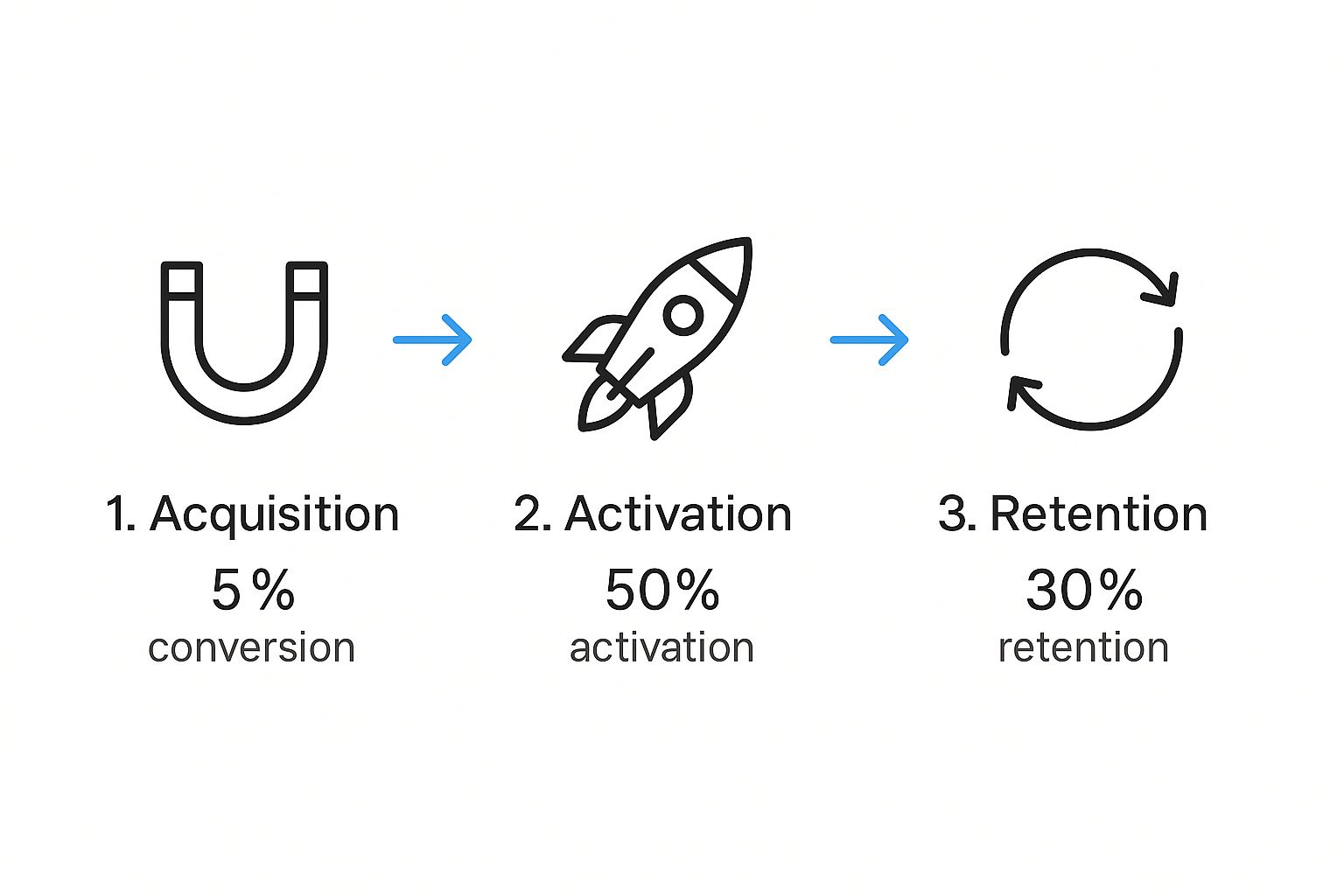
This diagram illustrates a common scenario: even with strong activation, a significant drop-off early in the funnel results in a tiny fraction of the initial audience ever generating revenue. The AARRR model provides a systematic approach to identifying and plugging these leaks.
Implementing a High-Tempo Testing Process
Once the AARRR framework identifies a problem area—a "leaky" stage—you deploy experiments to fix it. This is where the concept of high-tempo testing becomes critical. The objective is to build a repeatable process for brainstorming, prioritizing, and executing experiments at a rapid cadence.
The goal is not to be busy, but to maximize the rate of validated learning. Your team's time is your most valuable asset; this process ensures it is always directed at the highest-potential opportunities.
A well-defined framework like AARRR combined with a high-tempo testing cycle is what separates companies that talk about growth from those that achieve it. It transforms what is growth hacking from an abstract concept into a daily operational reality.
With a backlog full of ideas, you need a disciplined way to prioritize. A simple yet powerful scoring system I recommend is ICE. It forces an objective evaluation of each potential experiment.
- Impact: If this hypothesis is correct, what is the potential impact on our North Star Metric? (Score 1-10)
- Confidence: Based on available data and past experience, how confident are we that this will work? (Score 1-10)
- Ease: How many resources (time, engineering, budget) are required to launch this test? (Score 1-10)
Multiply the scores (I x C x E) to get a final priority score. Ideas with the highest ICE scores are tackled first. This isn't just theory—it's a practical, repeatable system for building a growth engine that delivers predictable, measurable results.
Putting Growth Hacking into Action
Theory and frameworks are necessary, but their value is only realized through application. The most profound lessons come not from textbooks, but from analyzing real-world experiments—understanding the business problem, the underlying hypothesis, the execution, and the measurable outcome.
The classic case studies of Dropbox and Airbnb are foundational, but the landscape has evolved. Today's most effective growth strategies are often highly targeted, addressing specific friction points within the customer journey with surgical precision.
Let's examine two modern scenarios to illustrate how this process works in practice.
The SaaS Activation Breakthrough
Consider a B2B SaaS company in the project management space. Their acquisition engine was performing well, generating thousands of new sign-ups. However, their activation rate—defined as a user creating their first project and inviting a team member—was a dismal 25%. They were effectively pouring capital into a leaky bucket.
-
The Problem: The majority of new users were churning before experiencing the product's collaborative value. The generic, one-size-fits-all onboarding flow failed to resonate with diverse user personas.
-
The Hypothesis: "We believe that by personalizing the onboarding experience based on a user's stated role (e.g., 'marketing manager' vs. 'software developer'), we can increase activation by presenting more relevant initial tasks and templates."
-
The Experiment: The growth team implemented a simple, one-question survey during sign-up: "What is your role?" Based on the answer, users were funneled into one of three tailored onboarding checklists. They ran a controlled A/B/C test against the existing generic flow.
-
The Result: The personalized onboarding delivered a significant uplift. The cohorts receiving tailored experiences achieved an average activation rate of 35%, a 40% increase over the control group. This single, low-effort experiment dramatically improved downstream retention and customer lifetime value.
This is a prime example of finding a high-leverage point in the funnel and applying a data-driven solution.
The E-Commerce Referral Revolution
Now, consider a direct-to-consumer (DTC) brand selling premium coffee. Rising customer acquisition costs (CAC) from paid social channels were eroding their profit margins. They needed a more capital-efficient acquisition channel to scale profitably.
Every business has its own unique growth levers. The job of a growth team isn't to copy tactics but to build a systematic process for discovering and pulling those levers, one experiment at a time.
Their existing referral program was an afterthought—a generic 10% discount that was rarely used and buried in the user account settings.
-
The Problem: The referral incentive was uninspired and lacked visibility. It provided insufficient motivation for customers to actively advocate for the brand.
-
The Hypothesis: "We believe a double-sided, product-centric reward—'Give a free bag, Get a free bag'—will be perceived as higher value than a discount, creating a stronger incentive to share and thereby lowering our blended CAC."
-
The Experiment: The team overhauled the referral program, surfacing the new offer prominently on the post-purchase confirmation page. The messaging was clear and compelling. When a referred friend made their first purchase, they received a free bag of coffee, and the advocate received a credit for a free bag on their next order.
-
The Result: The program's performance skyrocketed. Within three months, referrals accounted for 20% of all new customer acquisitions, effectively cutting their blended CAC in half. The "free bag" had a much higher perceived value than a small discount, successfully converting satisfied customers into an effective, low-cost sales force.
These examples demonstrate the core loop of applied growth hacking: diagnose a business problem with data, formulate a testable hypothesis, execute a measurable experiment, and scale the winning strategy to build a more efficient and profitable growth engine.
Building a Growth Culture in Your Company
Let me be direct. You cannot hire a "growth hacker," assign them a desk, and expect transformative results. That is a fundamental misunderstanding of the discipline. My most significant successes have come from rewiring an organization's core operating system, not from executing isolated tactics. True, sustainable growth requires a cultural shift where everyone in the organization is aligned and accountable for growth.
The most common mistake is to confine "growth" to the marketing department. This guarantees failure. Exponential growth occurs when product, engineering, sales, marketing, and even finance are all focused on the same North Star Metric. Without this alignment, you have talented teams optimizing for conflicting KPIs, ultimately cancelling each other out.
Forging Cross-Functional Alignment
The work begins with the executive team. Leadership must champion a new definition of growth—one that is a company-wide mission, not a departmental goal. This requires moving away from vanity metrics and uniting the organization around customer-centric outcomes, such as improving user activation, increasing retention rates, or expanding customer lifetime value.
Consider this: an engineering team's success should not be measured by lines of code or features shipped. It should be measured by the impact of that work on key business metrics. When an engineer understands how their code directly influences user retention, their entire perspective on prioritization and quality changes.
A true growth culture is born when every single employee, from the newest developer to the CFO, can connect their daily tasks to the company's core growth metrics. The question shifts from, "What did I do today?" to "What impact did we have?"
Structuring Your Growth Engine
With executive alignment secured, you must build the operational engine. This takes the form of a dedicated, cross-functional growth team. This is not a rebranded marketing team. It must be a potent blend of marketing, product, engineering, and data analytics talent operating as a single, autonomous unit. Their sole mandate: run experiments to move the North Star Metric.
To ensure consistent output, you need a predictable operating rhythm. This isn't about bureaucracy; it's about creating a repeatable process for learning and iteration.
- Weekly Growth Meetings: This is the heartbeat of the growth process. It is a high-tempo, data-driven meeting to review the results of completed experiments, analyze learnings (both successes and failures), and select the next batch of tests from the prioritized backlog.
- Defined Roles: Clarity is critical. A Growth Lead or Product Manager typically orchestrates the process, but every team member has clear accountability for ideation, execution, and analysis.
- Shared Knowledge Base: Every experiment—every hypothesis, result, and learning—must be meticulously documented in a central, accessible repository. This institutionalizes knowledge, prevents re-running failed tests, and democratizes learnings across the entire company.
This is the blueprint for transforming a rigid, top-down organization into an agile, data-driven growth machine. It is not an easy or quick transition. It is a fundamental evolution of how your company operates, competes, and wins.
Common Growth Hacking Questions
Over my career, I've discussed this methodology with countless executives, from founders of nascent startups to leaders at Fortune 500 corporations. The curiosity is immense, but so is the confusion. The same key questions consistently arise. Let's address them directly.
Isn't Growth Hacking Just a Startup Thing?
No. This is the most prevalent misconception. While the methodology was born in the capital-constrained, high-velocity environment of startups, its principles are arguably even more powerful within an established enterprise.
Large companies possess assets that startups can only dream of: vast customer data, established brand equity, and significant financial resources. The primary challenge is not a lack of opportunity but organizational inertia. The solution is to create small, empowered, cross-functional "growth pods" and grant them the autonomy to execute rapid experiments without being stifled by corporate bureaucracy.
What's the Real Difference Between a Growth Hacker and a Digital Marketer?
This question cuts to the core of the strategic difference. A traditional digital marketer's focus is typically confined to the top of the funnel. Their domain includes SEO, paid acquisition, and content marketing—all designed to generate awareness and acquire leads. Their primary responsibility is Acquisition.
A growth leader, by contrast, is accountable for the entire customer lifecycle, as defined by the AARRR funnel. Their work truly begins after a user signs up.
- They obsess over Activation, ensuring a user experiences the product's core value immediately.
- They collaborate with product and engineering to improve Retention and reduce churn.
- They build viral loops and incentive structures to drive Referrals.
- They experiment with pricing, packaging, and monetization models to optimize Revenue.
A growth professional is a hybrid of marketer, data scientist, and product manager, singularly focused on finding scalable levers for business growth.
How Can You Even Measure the ROI of This Stuff?
Unlike large-scale brand campaigns where ROI can be ambiguous, growth hacking is obsessively measurable. Every initiative is structured as a controlled experiment with a clear hypothesis and a specific, quantifiable success metric.
We don't guess at the ROI; we prove it. We measure the direct impact of an experiment by comparing its performance to a control group. The goal is always specific, like "Increase new user activation by 15%" or "Cut shopping cart abandonment by 10%." The total ROI is the sum of all these small, proven wins and how they move the needle on major business metrics like Customer Lifetime Value (CLV) and Customer Acquisition Cost (CAC).
In essence, you are systematically replacing high-risk, speculative marketing spend with a portfolio of smaller, data-validated investments in growth.
At MGXGrowth, we help companies build this kind of data-driven, experimental culture from the ground up, creating a growth engine that lasts. You can see exactly how we do it by learning more about our approach.
