


In my decades of driving growth across SaaS, real estate, and hospitality, I've seen leaders chase risky new ventures when the biggest prize—the most predictable EBITDA growth—was right under their nose. A market penetration strategy isn't about moonshots; it's the disciplined, data-driven art of capturing a larger share of your existing market with your existing products. It's about dominating your home turf first, breaking down internal silos to execute flawlessly, and building a defensible moat of market share.
What Is a Market Penetration Strategy?

Think of your market as a pie. Instead of baking a whole new, untested pie (product development) or finding a new group of people to serve it to (market development), market penetration is about claiming a bigger slice of the pie you're already serving. From a capital allocation standpoint, it's often the most efficient and lowest-risk path to sustainable revenue growth.
This approach is all about execution—outmaneuvering competitors right where they live. It’s a game of inches that adds up to miles, built on a deep, almost obsessive, customer-centric understanding of your current market and the competitive landscape. At its core, the objective is to crank up sales volume and build a defensible moat around your business.
How It Works in Practice
Market penetration is a low-risk growth play that centers on one thing: boosting your company's market share within an existing market using your current products. It’s one of the four key quadrants in the Ansoff Matrix, and it relies on proven, measurable tactics like competitive pricing and smarter promotions, not expensive, high-risk product launches.
This is why many SaaS startups, for example, lean heavily on this method. It requires less upfront capital than diversification, giving them a much more predictable runway to scale. For a deeper dive, check out Lighter Capital's analysis of SaaS growth tactics.
The goal isn't just to sell more; it's to become the undeniable choice for your target customer. This strategy forces your entire organization—from sales and marketing to product and support—to align around a single, powerful objective: winning your current market.
When that kind of alignment happens, it breaks down the internal silos that kill growth and fosters a focused, data-driven culture. Success here means you're not just growing; you're building a resilient foundation that makes any future expansion, whether into new products or markets, far more likely to succeed. It's about earning the right to grow through operational excellence.
When you're trying to figure out how to grow a business, you need a good map. For me, that map has always been the Ansoff Matrix. It's a classic strategic planning tool that brilliantly lays out the four fundamental ways a company can expand, forcing you to think critically about the two variables that matter most: your products and your markets.
I've used it for years, whether I was in a boardroom hashing out a SaaS growth plan or mapping out a real estate venture. It helps you weigh the risks and rewards of any potential move.
The matrix breaks growth down into four clear paths, each with its own level of risk. The image below shows some of the key metrics you'd be tracking for the very first quadrant of this matrix—market penetration. Things like market share, customer acquisition cost, and sales growth are the vital signs of a healthy penetration strategy.
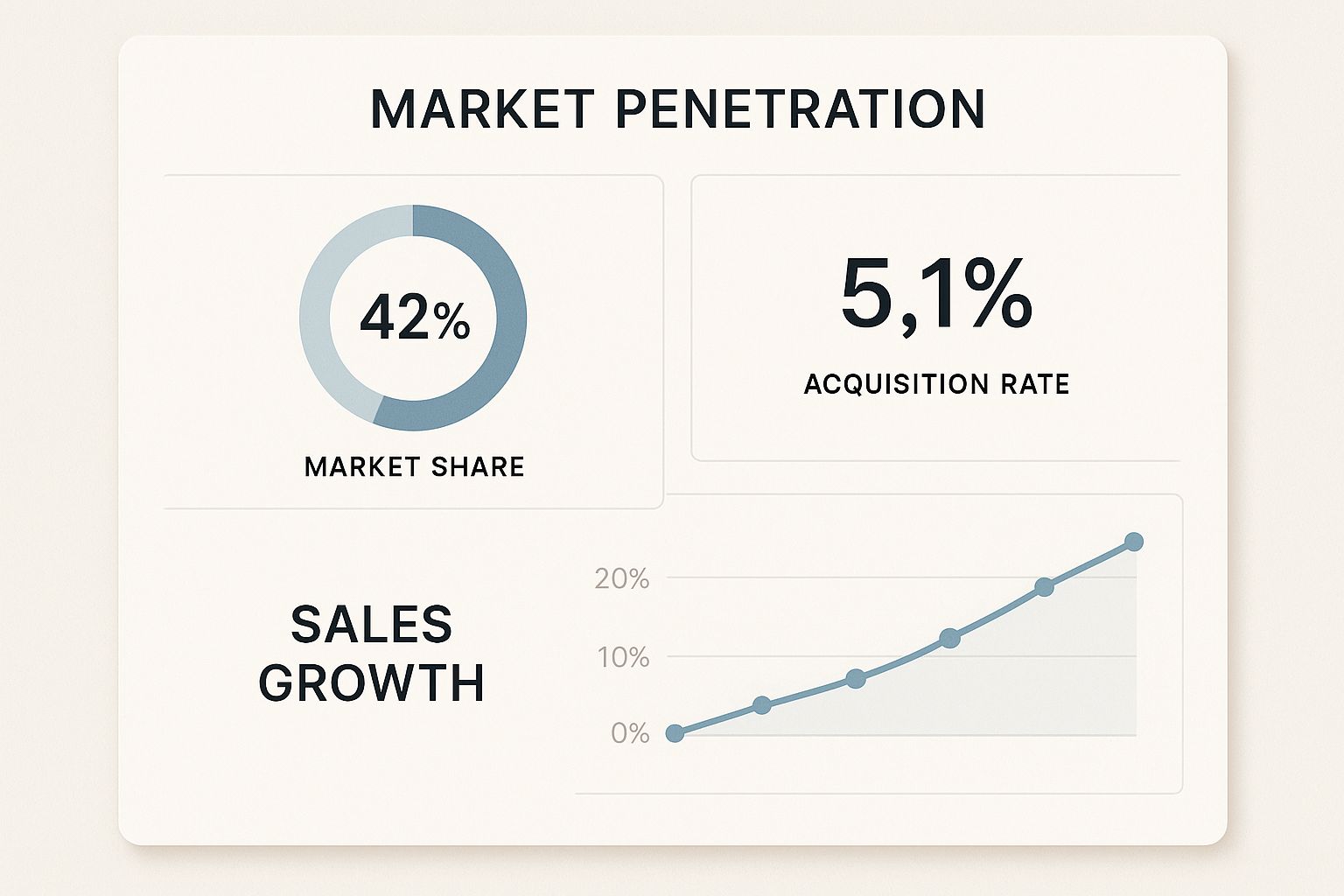
As you can see, getting a handle on your existing market gives you a solid, measurable foundation. It's the bedrock you build everything else on.
The Four Quadrants of Growth
To truly grasp why market penetration is so pivotal, you have to see how it fits into the broader strategic picture. It’s the least risky move you can make because you're playing on your home turf—with products you know inside and out, and customers you already understand. The other three strategies start introducing new variables, which naturally cranks up the risk and the capital required.
Here's how they all fit together:
-
Market Penetration (Existing Product, Existing Market): This is your ground game. The objective is simple: sell more of your current offerings to your current market. You do this by out-competing rivals, finding data-driven ways to get existing customers to buy more, and capturing a larger portion of your target audience. It's all about deepening your footprint.
-
Market Development (Existing Product, New Market): This is when you take a proven asset and introduce it to a new audience. Think of a successful SaaS platform for the US market deciding to launch in the UK. The product is a proven hit, but the new geography brings a new set of customers, competitors, and compliance hurdles.
-
Product Development (New Product, Existing Market): Here, you're creating something new to sell to the people who already trust you. Apple is the master of this. They had a massive, loyal base of iPhone users, so they created AirPods and the Apple Watch to sell directly to them. They knew their customers; the risk was in whether the new products would achieve product-market fit.
-
Diversification (New Product, New Market): This is the high-stakes, high-risk quadrant. You're launching a completely new product into a market where you have no presence. It’s the most difficult and capital-intensive path, with the highest chance of failure. But if you succeed, you can open up an entirely new dimension for your business.
To make this even clearer, let's compare these four strategies side-by-side.
The Ansoff Matrix Growth Strategy Comparison
This table gives you a quick snapshot of how the four strategies stack up against each other in terms of focus, risk, and what you're ultimately trying to achieve.
| Strategy | Focus (Products & Markets) | Risk Level | Primary Objective |
|---|---|---|---|
| Market Penetration | Existing Products, Existing Markets | Low | Increase market share and dominate the current space. |
| Market Development | Existing Products, New Markets | Medium | Find new audiences or regions for proven products. |
| Product Development | New Products, Existing Markets | Medium | Innovate and upsell to a loyal customer base. |
| Diversification | New Products, New Markets | High | Enter entirely new business areas to create new revenue streams. |
As you can see, each quadrant represents a distinct strategic choice.
By laying it all out like this, the Ansoff Matrix makes one thing incredibly obvious: market penetration isn't just one of four equal options. It's the starting block. When you master this first quadrant, you build the brand loyalty, operational muscle, and—most importantly—the cash flow you need to fund riskier moves into the other three.
4 Proven Tactics for Dominating Your Market

A great strategy is just a nice idea until you execute. From my experience in sectors as different as SaaS and real estate, the one thing that separates market leaders from the pack is how relentlessly and intelligently they execute.
A market penetration strategy isn't one single move; it’s a playbook of coordinated tactics designed to systematically capture more territory. Think of it less as a single battle and more as a full-scale campaign, driven by data and a customer-centric mindset.
Here, we'll break down the four primary levers I’ve seen work time and again to drive real, measurable growth in market share. These aren't just theories—they are battle-tested actions.
1. Strategic Price Adjustments
Pricing is the fastest lever you can pull to change customer behavior, but it’s also the riskiest if you get it wrong. The goal is to peel off new, price-sensitive customers from your competitors without starting a race to the bottom that tanks everyone's EBITDA. This is about being smart, not just cheap.
A better approach is to introduce a new, lower-priced version of your product with slightly fewer features, or to bundle services together to increase the perceived value. When supported by a solid product, a smart price drop below a key competitor can boost a brand's market share by double-digit percentages in a single year. You can find more insights on strategic pricing at Indeed.com.
2. Aggressive Promotional Campaigns
Think of promotions as your offense. They’re designed to create a wave of interest and a sense of urgency that pulls customers away from your rivals. We're talking about more than just a simple 10% off coupon here.
Some of the most effective campaigns I've been a part of included:
- Time-Sensitive Offers: "Switch to us this month and get your first three months 50% off." This puts immediate pressure on your competitor's user base to make a decision.
- Loyalty Programs: Rewarding customers for sticking around increases their LTV and makes them harder and more expensive for competitors to steal.
- Referral Incentives: Turning your happy customers into a sales force is one of the most powerful and cost-effective ways to acquire new business.
3. Expanded Distribution Channels
Your product can’t sell if customers can't find it. A huge piece of any penetration strategy is analyzing where and how you sell. Are you only selling directly from your website when a partnership with a major online marketplace could put you in front of millions of new buyers?
In the SaaS world, this might mean getting your app listed on the Salesforce AppExchange or the Shopify App Store. For a physical product, it could mean finally getting shelf space in a national retail chain. Every new channel is another frontline where you can win over customers who never knew you existed.
The core idea is simple: be where your customers are, especially if your competitors aren't there yet. Untapped distribution is often the lowest-hanging fruit for rapid growth.
4. Minor Product Enhancements
Finally, remember that you’re working with a product that people already use. You don't need to rebuild it from the ground up. Sometimes, the biggest wins come from small, customer-focused tweaks that solve a nagging problem better than anyone else.
Talk to your sales and support teams. They hear all day long what frustrates people about the competition. If you can quickly ship a small fix or a highly requested feature, you give those customers a compelling, logical reason to switch. It sends a powerful message to the market: you listen better and move faster. That’s a competitive advantage that has nothing to do with price.
Real-World Examples of Market Penetration
The best way to truly grasp a strategy is to see it in action. Theory is great, but analyzing how the biggest names in the business pull it off provides a real-world blueprint you can actually use.
Let's break down a couple of flawless executions. These aren't just success stories; they're masterclasses in smart, focused growth within an existing market.
Coca-Cola Capturing a New Demographic
Coca-Cola is a classic for a reason. Back in the early 1980s, they were selling an experience, not just a soft drink. But their data showed a blind spot: a growing group of health-conscious consumers who were cutting back on sugar.
Instead of chasing a brand-new beverage category or expanding into an unknown country, Coca-Cola made a brilliant penetration move. They launched Diet Coke. This wasn't just another flavor—it was a strategic product line extension aimed squarely at a specific segment within their existing market.
With Diet Coke, they gave diet-conscious drinkers a reason to stay with the brand, and it paid off massively. The results were staggering. By 1985, just four years after launch, Diet Coke had seized roughly 10% of the entire US soft drink market. It’s a perfect historical example of how a targeted, data-driven tweak can help you dominate a space you already own. You can find more breakdowns of these kinds of market growth strategies on GapScout.com.
Netflix Solidifying Streaming Dominance
Fast-forward to the digital era, and Netflix offers a masterclass in using competitive pricing and product improvements to lock down a market. As they pivoted from DVDs to streaming, they knew they were walking into a battlefield that would soon include giants like HBO, Disney, and Amazon.
Their goal wasn't just to get there first; it was to become so essential that customers couldn't imagine leaving. They pulled this off by making two critical penetration moves at the same time.
First, they priced their subscription so aggressively low that it became an easy "yes" for households looking to cut the cable cord. Second, they poured the revenue from that growing subscriber base back into creating a massive library of exclusive content.
These two moves created a powerful flywheel:
- Competitive Pricing: This was the hook. It attracted a huge user base right out of the gate, building a defensive moat around their business and lowering their CAC at scale.
- Content Library Expansion: This was the glue. It acted as a powerful product enhancement that increased user LTV and gave them a compelling reason to stay, even when competitors showed up with similar price tags.
This two-pronged attack is what market penetration looks like today. Netflix didn't need a new audience; they just gave their existing one an overwhelmingly better value, making their position in the streaming world almost unshakeable.
How to Measure Your Market Penetration Success
I live by a simple rule: if you can't measure it, you can't manage it. A market penetration strategy is only as good as the results it delivers, and far too many teams get bogged down tracking vanity metrics that look impressive but don't actually impact the bottom line.
Success isn't about being busy; it's about delivering measurable impact on revenue and EBITDA. To get a real, honest picture of how your strategy is performing, you have to focus on a handful of key performance indicators (KPIs) that directly tie back to your business's health and growth.
The Core KPIs for Market Penetration
To see if your efforts are truly paying off, you need a dashboard that tells a clear, straightforward story. These aren't just numbers to report—they are the vital signs of your growth engine.
Here are the metrics I insist my teams track relentlessly. They give you a complete view, from how efficiently you're acquiring customers to how valuable they are in the long run.
-
Market Share Growth: This is the ultimate scoreboard. It answers the most important question: are you actually taking territory from the competition? You calculate it by dividing your total sales by the total market's sales. In a large market, even a 1-2% increase can mean millions in new revenue.
-
Customer Acquisition Cost (CAC): This metric cuts right to the chase—how much are you spending to win a new customer? To find it, just divide your total sales and marketing spend over a set period by the number of new customers you brought in during that time. The goal is to drive this number down or at least keep it stable as you grow.
-
Customer Lifetime Value (LTV): LTV tells you what a customer is actually worth to your business over their entire relationship with you. A rising LTV is a fantastic sign that you're not just grabbing new customers, but you're also keeping them happy and growing their value. A healthy business model needs an LTV that's significantly higher than your CAC, ideally by a ratio of 3:1 or more.
To give you a clearer picture, I've put together a table that breaks down the most important metrics, how to calculate them, and why they're so critical.
Key Metrics for Market Penetration Success
| Metric (KPI) | How to Calculate | Why It Matters |
|---|---|---|
| Market Share | (Your Total Sales ÷ Total Market Sales) x 100 | The ultimate indicator of your competitive position. A rising market share proves your strategy is gaining ground. |
| Market Penetration Rate | (Number of Your Customers ÷ Total Potential Customers in the Market) x 100 | Shows how much of the addressable market you've captured. It helps identify how much room for growth is left. |
| Customer Acquisition Cost (CAC) | Total Sales & Marketing Costs ÷ Number of New Customers Acquired | Measures the cost-effectiveness of your growth engine. A lower CAC means you're acquiring customers more efficiently. |
| Customer Lifetime Value (LTV) | (Average Purchase Value x Average Purchase Frequency) x Average Customer Lifespan | Reveals the total revenue a single customer generates. A high LTV indicates strong customer loyalty and retention. |
| LTV to CAC Ratio | LTV ÷ CAC | This is the ROI of your customer acquisition efforts. A healthy ratio (e.g., 3:1) confirms your growth is profitable and sustainable. |
| Brand Awareness | Measured through surveys, direct traffic, and social media mentions. | Tracks how recognizable your brand is within the target market. Increased awareness is often a leading indicator of future sales growth. |
Tracking these numbers gives you a powerful feedback loop. You can see what’s working, what isn’t, and where you need to adjust your strategy.
Measuring these KPIs isn't a one-and-done task. It's about building a culture of accountability where data—not just gut feelings—drives your decisions.
When your marketing, sales, and product teams are all looking at the same core numbers, you start breaking down silos and get everyone pulling in the same direction. Ultimately, these metrics tell you whether your market penetration strategy is a profitable, long-term investment or just a flash in the pan.
Frequently Asked Questions About Market Penetration
When I'm sitting down with leadership teams to talk strategy, a few key questions about market penetration always surface. It's a fantastic way to grow, but it's definitely not a one-size-fits-all solution. Let's tackle the most common ones I hear.
When Is a Market Penetration Strategy Not The Right Choice?
A market penetration strategy is a terrible idea in a market that's already saturated or, even worse, shrinking. If there's simply no more room to grow or the entire customer base is declining, you're just fighting over a smaller and smaller piece of the pie.
It's also the wrong play if your product just isn't up to snuff compared to the competition. In that case, your time and capital are much better spent back in product development. Finally, if you don't have the cash reserves to fund a sustained marketing blitz or weather potential price cuts, you could run out of steam before you see any real gains.
What Is The Biggest Risk Of A Market Penetration Strategy?
The single greatest danger is accidentally starting a price war you can't win. It’s tempting to slash prices to grab market share, but your competitors will almost certainly match you, if not go lower.
This creates a race to the bottom that destroys profit margins for everyone involved. Worse, it can permanently devalue your product category in the eyes of consumers, making it incredibly difficult to ever raise prices again.
A smart penetration strategy is more like a scalpel than a sledgehammer. It’s about finding the right balance of competitive pricing, a strong brand, and a great customer experience—the things that truly convince people to switch and stay with you.
How Long Does It Take To See Results From Market Penetration?
This really depends on your tactics and how your market operates. A splashy, aggressive promotional campaign might give you a nice sales bump in a single quarter. But that’s a short-term win.
Building real, lasting market share is a marathon, not a sprint. You should be prepared for 12 to 24 months of focused, consistent effort to see a meaningful and sustainable shift in your market position. This is all about playing the long game.
Ready to put this all into action? At MGXGrowth, we work with ambitious companies to build growth strategies that actually move the needle. Find out how we can help you capture more of your market at https://www.mgxgrowth.com.
