


A winning SaaS marketing strategy isn't a laundry list of tactics. It is a fully integrated system designed to tie every dollar spent back to a measurable business outcome—revenue, EBITDA, and market share. From my decades of experience scaling companies across multiple sectors, I’ve learned that sustainable growth is unlocked by breaking down the silos between marketing, sales, and product and unifying them around a single, obsessive focus: the customer. This is the only way to move beyond vanity metrics and build a truly profitable enterprise.
Laying the Foundation for Sustainable SaaS Growth
Time and again, I’ve seen companies falter not from a lack of effort, but from a fundamental lack of alignment. Marketing chases MQLs, Sales is handcuffed to quotas, and Product builds features in a vacuum. The result is always the same: a fragmented customer experience and immense capital inefficiency. A modern SaaS marketing strategy must begin by eradicating this dysfunction.
The global SaaS market is projected to hit $300 billion by 2025, with an annual growth rate exceeding 20%. Yet, median churn still hovers between 5% and 7% annually—often much higher for earlier-stage companies. Consider the leverage here: even a marginal improvement in customer retention can amplify profits by up to 95%. The opportunity is staggering, but as these SaaS trends on Zylo.com show, the cost of a misaligned strategy has never been greater.
The Three Pillars of a Winning Strategy
To construct a marketing engine that drives predictable revenue, you must first erect its foundational pillars. These are not merely marketing functions; they are business-wide operating principles that force alignment and accountability. I have deployed this framework to capture market share in SaaS, marketplaces, and beyond because it enforces a level of clarity that is non-negotiable for growth.
Let's examine how these pillars interlock.
SaaS Marketing Pillars at a Glance
| Pillar | Core Focus | Primary Goal |
|---|---|---|
| Deep Customer Understanding | Developing a data-rich Ideal Customer Profile (ICP) based on quantitative user behavior and qualitative feedback. | To inform every decision—from product roadmap to ad copy—with a precise understanding of your most profitable customer cohort. |
| Mastery of Unit Economics | Obsessively tracking and optimizing Customer Lifetime Value (LTV) and Customer Acquisition Cost (CAC). | To ensure every marketing dollar is invested profitably and to construct a predictable, scalable growth model. |
| Cross-Functional Alignment | Establishing shared, revenue-centric goals and a single source of truth for Marketing, Sales, and Product. | To eliminate internal friction and engineer a seamless, unified customer journey from first touch to renewal and expansion. |
By building your strategy on this foundation, you ensure every function of the business is cohesively working to attract, convert, and retain the right customers—profitably.
I’ve seen it happen again and again: the moment these three teams start operating from the same data and working toward the same revenue goals, growth feels almost inevitable. Silos are where profits go to die.
From Theory to Action
A strategy confined to a slide deck is worthless. The objective is to create a living framework that dictates daily operational decisions.
For example, once your Ideal Customer Profile is clearly defined and disseminated, the marketing team ceases production of generic content. Instead, they produce assets that directly address the quantified pain points of your most profitable customers. The sales team then leverages this highly relevant content to increase conversion velocity. It is a simple, closed-loop system.
Simultaneously, when every employee understands the critical interplay between LTV and CAC, decision-making becomes radically sharper. You will know precisely what you can afford to spend to acquire a customer and what an acceptable payback period is for your business model. This isn't academic theory—it is the practical blueprint for transforming marketing from a cost center into a predictable revenue engine.
Building Your Acquisition Engine Beyond Paid Ads
I’ve seen it time and time again: SaaS companies become addicted to paid advertising. It’s understandable; the results are immediate and easily measured. But it’s a precarious position. Sole reliance on paid channels leaves you vulnerable to escalating ad costs and diminishing returns. The moment you cease spending, the lead flow stops.
A truly resilient software as a service marketing strategy is built on owning an asset that appreciates in value over time. That asset is your content engine. It is your proprietary channel that attracts high-intent prospects and cements your authority in the market. It is the critical distinction between renting an audience and owning one.

This is not a matter of opinion; it is a matter of data. High-quality, strategically executed blog content drives approximately 53% of all traffic to SaaS websites, making it one of the most efficient channels for attracting qualified leads. For context, dedicated landing pages typically only account for about 12% of traffic and convert at a significantly lower rate. You can analyze more SaaS industry benchmarks from Digital Silk to see the full picture.
Shifting from Content Creation to Problem Solving
The most common failure I observe in marketing organizations is creating content for the sake of activity. They produce generic articles to meet a publishing quota, but these assets solve no specific, urgent problem for their Ideal Customer Profile (ICP). This approach may generate traffic, but it is low-quality traffic that fails to convert because it lacks a connection to a tangible business pain.
To build a high-performance acquisition engine, you must reframe your entire mindset. Stop thinking about "content creation" and start thinking about "problem-solving at scale." Every asset you publish must be a direct, valuable answer to a question your ICP is struggling with. It should deliver so much utility that they begin to view your company as an indispensable strategic partner.
Your content shouldn't just attract visitors; it should arm your sales team. A great case study or a data-driven report is often the most powerful tool a sales rep has to close a deal.
This is precisely why demolishing the silos between marketing and sales is non-negotiable. Your sales team is on the front lines, absorbing the raw, unfiltered language of your prospects' challenges. Marketing must systematically mine this intelligence to fuel its content strategy.
My Playbook for High-Value Content Assets
A robust content strategy is not just a blog. It is a diversified portfolio of high-value assets engineered to serve different functions throughout the customer journey. Here are several formats I have personally used to drive significant pipeline growth.
- Proprietary Data Reports: Cease regurgitating third-party statistics. Conduct your own primary research. Survey your customers or analyze anonymized user data to uncover novel industry trends. Publishing a report with original findings instantly positions you as a definitive authority and generates high-value backlinks.
- Actionable Webinars: No executive has time for a thinly veiled product demo. Instead, host educational sessions that teach your audience how to solve a specific, measurable problem. Feature guest experts from complementary, non-competitive companies. A focus on delivering tangible value will attract highly qualified leads actively seeking solutions.
- Targeted Case Studies: An effective case study is not about your product's features—it is about your customer's business outcome. Frame it around the problem they faced, the solution you provided, and the quantifiable results they achieved. This is the social proof that senior decision-makers require to de-risk a purchasing decision.
Connecting Content to Commercial Outcomes
Every piece of content must have a job. Is its purpose to generate top-of-funnel awareness? Capture a lead? Enable sales to overcome an objection? When you map each asset to a specific stage in the buyer's journey, you create a direct, measurable line between content investment and revenue generation.
For instance, a blog post about "improving team productivity" attracts a broad audience. Within that post, an offer for a downloadable "Productivity Checklist" captures an email. That new lead is then entered into a nurture sequence that delivers a targeted case study showing how a similar company doubled its output using your software.
Each step is deliberate, guiding the prospect toward a sales conversation. This is how you transform a blog from a publication into a predictable, scalable acquisition machine.
Implementing Product-Led Growth That Actually Works
In my work with SaaS companies, "Product-Led Growth" (PLG) has become one of the most prevalent—and misunderstood—buzzwords. Many founders mistakenly believe that adding a free trial to their website constitutes a PLG strategy. This is a fundamental error.
True PLG is a comprehensive, company-wide operating model. It is when the product itself becomes the primary engine for user acquisition, activation, and expansion.
Your product becomes your most effective salesperson. Instead of relying on demos to tell prospects about your value proposition, you let the product show them. This shift necessitates a completely different, deeply integrated operational model for marketing, product, and sales. It is a vital component of a modern software as a service marketing strategy, leveraging free trials or freemium models to demonstrate value firsthand, a trend you can explore in these top SaaS marketing trends from BigDropInc.com.

Engineering the 'Aha!' Moment
The success of any PLG model hinges on a single, critical event: the "aha!" moment. This is the instant a new user internalizes how your product solves their specific problem and will improve their workflow.
Your entire organization's job is to engineer this moment and reduce time-to-value to the absolute minimum.
I’ve led teams where we obsessed over this, mapping every click a new user made in their first session. We meticulously tracked drop-off points and A/B tested every onboarding element—tooltips, in-app messages, empty states—to eliminate friction on the path to that first moment of value realization.
- Ditch the Unnecessary Steps: Does your sign-up form demand a company name, size, and phone number? Eliminate it. Every field is friction. Get users into the product; you can progressively profile them later.
- Guide Them with In-App Cues: Never abandon a new user in a blank dashboard. Use interactive walkthroughs and contextual tooltips to direct them toward the one or two actions that deliver that initial payoff.
- Celebrate the Small Wins: When a user completes a key action, such as creating their first report, celebrate it. A simple confirmation modal or animation reinforces positive behavior and builds momentum.
Your onboarding flow isn't a museum tour of every feature. It's a guided mission to help the user achieve their first meaningful outcome. In those first few moments, nothing else matters.
Creating Natural Upgrade Paths
Once users experience their "aha!" moment and are actively engaged, the next challenge is converting them to paying customers. This is where many PLG strategies fail. They erect aggressive paywalls that feel punitive.
An effective strategy makes upgrading feel like the natural, logical next step in the user’s journey.
The key is to align your pricing tiers with tangible value, not arbitrary limits. Instead of gating core features, structure your monetization around usage levels or advanced, team-oriented functionality.
For instance, a project management tool might offer a free plan with unlimited projects for an individual user. The upgrade trigger is not a time limit; it's the moment that user needs to collaborate with a teammate. At that point, paying for a team plan is not a penalty—it is an investment in greater capability.
This is where marketing’s role fundamentally evolves. They are no longer just responsible for top-of-funnel lead generation. In a PLG model, marketing owns the mandate to drive deeper product adoption. They use targeted in-app messages, lifecycle email campaigns, and educational content to demonstrate the value unlocked by upgrading. It becomes a full-funnel responsibility that demands absolute alignment with the product team.
Scaling Customer Retention and Expansion Revenue
Too many SaaS leaders view customer acquisition as the finish line. In my experience, it is merely the starting line. The highest-growth companies I have advised are not just focused on acquiring new customers; they are fanatical about retaining and expanding their existing ones. The most sustainable and profitable growth in SaaS is found here—in retention and expansion revenue.
A high churn rate is a terminal diagnosis for a subscription business. It doesn't matter how efficiently you acquire new customers if your existing base is constantly eroding. A marketing-driven retention program is not a "nice to have"; it is a core pillar of a profitable software as a service marketing strategy.

Uncovering Expansion Revenue in Your Data
Your existing customer base is a goldmine of growth opportunities, but you require a precise map to exploit it. That map is your customer data. It is no longer sufficient to track aggregate churn; you must analyze user behavior to understand why customers stay, why they leave, and where the latent potential for expansion exists.
This requires the complete dissolution of walls between marketing, sales, and customer success. These teams must operate from a unified view of the customer, tracking key behavioral signals that predict both risk and opportunity.
- Product Usage Patterns: Which features define your power users? Which are being ignored? A sudden decline in the usage of a critical feature is a leading indicator of churn risk.
- Support Ticket Trends: Are specific customer segments repeatedly encountering the same issues? This may signal a need for improved onboarding or targeted educational content.
- Team Growth Indicators: Has a customer account recently added multiple new users? This is a strong signal that their needs are growing and they may be prime for an upsell.
By analyzing this data, marketing can shift from a reactive to a proactive posture. Instead of waiting for a customer to express dissatisfaction, you can identify at-risk accounts and intervene with targeted, value-added engagement.
Driving Adoption with Educational Content
One of the most potent retention tools is content—but not the type used for acquisition. Retention content is focused on helping existing customers extract more value from the product they already own. The more value they realize, the stickier your product becomes.
This means your content calendar must be bifurcated. One stream must focus on attracting new prospects, but a significant, dedicated stream must focus on deepening the engagement of your current user base.
Too many marketers stop communicating with customers the moment they sign up. This is a massive mistake. The post-sale journey is where loyalty is built and where your best customers become your most powerful advocates.
Here are several tactics I have seen deliver exceptional results:
- Customer-Only Webinars: Host deep-dive sessions that showcase advanced features or sophisticated workflows. This not only educates users but also fosters a sense of an exclusive community.
- In-App Feature Announcements: Do not rely solely on email. When launching a new feature, use targeted in-app messages to announce it to the specific user segments who will derive the most immediate benefit.
- Personalized Lifecycle Emails: Implement automated email campaigns triggered by user behavior. For example, if a user has not adopted a high-value feature within 30 days, send them a concise email with a short video tutorial demonstrating its use case.
Fostering Community and Advocacy
Ultimately, the most powerful form of retention is to transform customers into a community of advocates. When your users feel a connection to your brand and to one another, your product evolves from a mere tool into an integral part of their professional identity.
Building a community does not require a massive investment. It can begin with a private Slack channel or a dedicated forum where users can share best practices and solve problems collaboratively.
The objective is to create a space where your most engaged users can connect, learn, and feel a sense of ownership. When you achieve this, you create a powerful growth flywheel. Satisfied customers have a higher LTV, and they become your most credible and cost-effective marketing channel. This is how you move from fighting churn to building a self-sustaining growth engine.
Measuring What Matters for Sustainable Growth
In every boardroom I've occupied, the conversation invariably centers on results. Yet, I consistently see marketing teams reporting on metrics that generate activity but fail to impact revenue. Website traffic, social media followers, brand mentions—these are vanity metrics. They may appear impressive on a slide, but they do not contribute to enterprise value.
A mature SaaS marketing strategy is measured by its direct impact on the bottom line. As a leader, you must be relentless in focusing your team on the KPIs that reflect the true health and profitability of the business. The goal is to build a dashboard that tells the unvarnished story of your growth, from the first dollar of ad spend to the lifetime value of a customer.
Shifting Focus From Volume to Value
The most critical strategic shift is from measuring volume to measuring value. Who cares if you generated 10,000 leads if their conversion rate is zero or they churn within two months? I would rather have 100 high-quality leads that fit our Ideal Customer Profile and exhibit a high propensity for long-term retention.
This requires a fundamental change in how marketing teams are incentivized. Their primary objective cannot be "more leads." It must be "more qualified pipeline" or "a lower Customer Acquisition Cost." This simple re-alignment connects their daily activities directly to the financial objectives of the business.
The Metrics I Actually Use to Drive Growth
Over the years, I have refined my SaaS dashboard to a core set of metrics that provide an unfiltered view of business performance. These are the indicators that matter.
- Customer Acquisition Cost (CAC) Payback Period: This is one of the most vital health metrics for any subscription business. It measures precisely how many months of revenue are required to recoup the cost of acquiring a new customer. A shorter payback period enables faster capital reinvestment and more aggressive, sustainable scaling.
- Net Revenue Retention (NRR): If you track only one retention metric, make it this one. NRR measures the change in recurring revenue from your existing customer base, factoring in both expansion revenue (upsells) and revenue churn (downgrades/cancellations). An NRR over 100% signifies that your business is growing even without acquiring new customers. This is the hallmark of a powerful, scalable model.
- Customer Lifetime Value (LTV) to CAC Ratio: This classic ratio quantifies the total value of a customer relative to the cost of acquiring them. A healthy LTV to CAC ratio, typically 3:1 or higher, is a strong signal of a sustainable and profitable business model.
This image provides a simplified visualization of how these core unit economics interrelate.
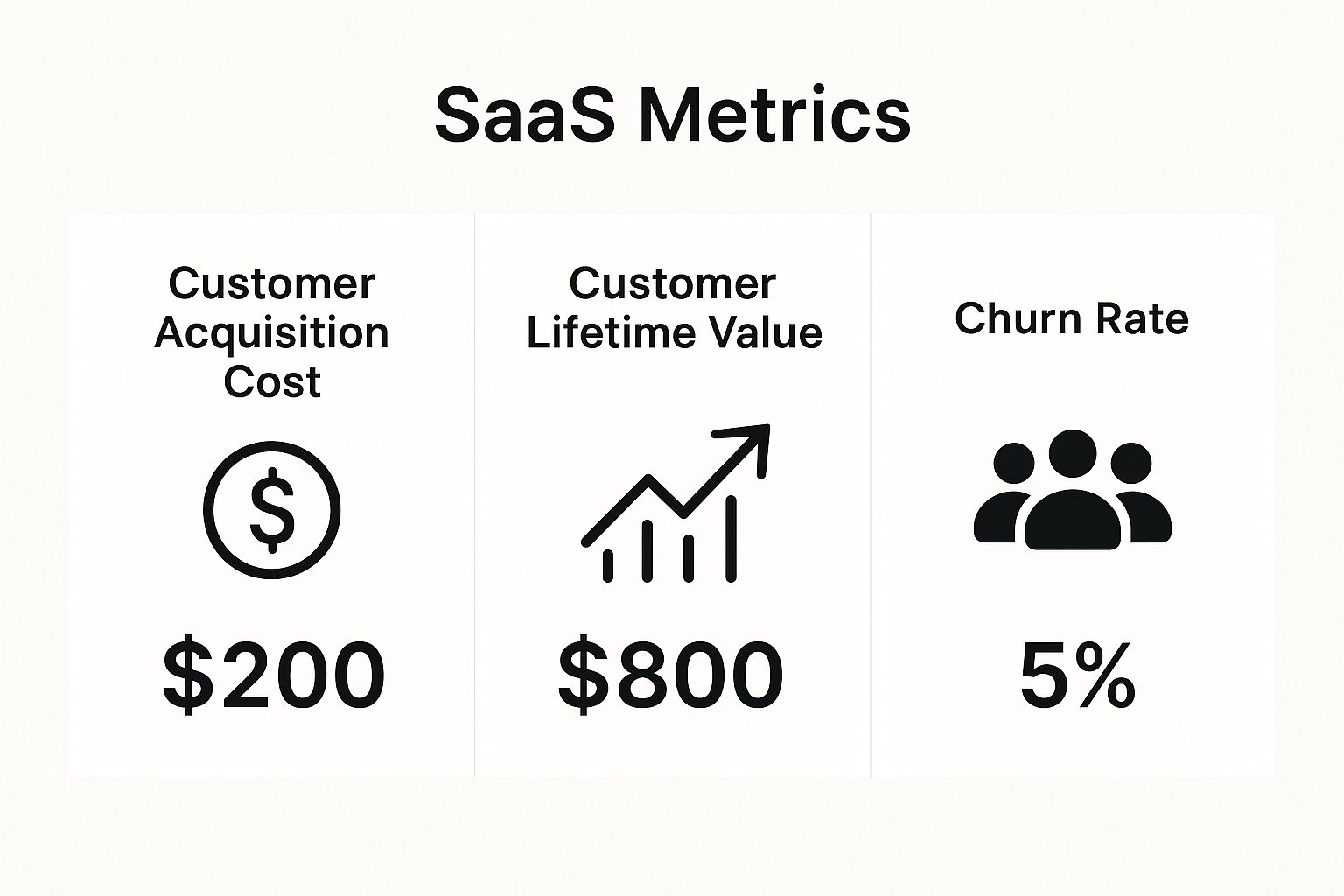
This example illustrates a healthy business where the LTV is four times the CAC, providing a strong foundation for profitable growth.
To maintain focus, it is crucial to distinguish between metrics that drive growth and those that merely inflate egos. Here is a clear comparison.
Key SaaS Growth Metrics vs. Vanity Metrics
| Growth Metric (Track This) | Vanity Metric (Avoid This) | Why It Matters |
|---|---|---|
| Customer Lifetime Value (LTV) | Total Signups | LTV focuses on long-term profitability and customer loyalty, while signups alone don't guarantee revenue. |
| Customer Acquisition Cost (CAC) | Website Traffic | CAC measures the cost-effectiveness of your marketing, whereas traffic can be high without leading to conversions. |
| Net Revenue Retention (NRR) | Social Media Followers | NRR shows if you're growing revenue from your existing customer base, a key sign of a healthy business. Followers rarely correlate to revenue. |
| CAC Payback Period | Content Downloads | This metric tells you how quickly you become profitable on a new customer. Downloads don't have a direct monetary value. |
| LTV:CAC Ratio | Brand Mentions | The ratio confirms your business model is sustainable. Mentions are nice for brand awareness but don't ensure profitability. |
Focusing on the metrics in the first column will give you a true picture of your company's financial health and growth potential.
The Power of Cohort Analysis
Analyzing metrics like churn in aggregate can be dangerously misleading. A 5% monthly churn rate might appear acceptable, but a cohort analysis often reveals a more nuanced—and actionable—story. This involves grouping customers by their sign-up month and tracking their behavior over time.
Cohort analysis is like an MRI for your business. It lets you see precisely which acquisition channels bring in your best customers, which product updates improve retention, and where your customer journey is breaking down.
For example, a cohort analysis might reveal that customers acquired via content marketing in January have a 30% higher LTV than those acquired from a paid ad campaign in the same month. This type of insight is invaluable. It provides the data required to confidently reallocate budget toward channels that deliver real, long-term enterprise value. This is how you transition from guesswork to building a predictable, data-driven growth engine.
Frequently Asked Questions About SaaS Marketing
After years in the trenches with SaaS companies, I’ve noticed the same questions pop up in nearly every strategy session. These aren't just hypotheticals; they're the real, practical hurdles that stand between a startup and scalable growth. Let's get straight to the answers I give leaders when we're mapping out their software as a service marketing strategy.
What Is the Single Most Important Metric to Track?
Everyone wants the one KPI that matters most. While the answer can shift depending on your company's stage of maturity, I almost always anchor the discussion on Net Revenue Retention (NRR).
Why NRR? Because it is the ultimate diagnostic for your product and customer base. It tells you, in unambiguous terms, if your business is growing or shrinking with the customers you already have—before you spend a single dollar on new acquisition.
If your NRR is over 100%, you have achieved a critical milestone. It means the revenue from upsells and cross-sells is outstripping revenue lost to churn. This is the foundation of a sustainable business, proving product-market fit and a clear path to profitability.
How Long Until Content Marketing Shows a Real ROI?
This is a critical area where executive expectations must be managed from day one. In content marketing, patience is a strategic imperative. Too many leaders become anxious when the lead-generation faucet isn't flowing after only a few months.
Realistically, you can expect to see early indicators like organic traffic growth and improved keyword rankings within three to six months. However, to transform that traffic into a predictable pipeline of qualified leads, you must commit to a 9 to 12-month runway.
Think of your content engine not as a campaign with an end date, but as a long-term company asset. You are building a moat around your business that gets wider and deeper over time, making it incredibly difficult for competitors to catch up.
The ramp-up period is slow, but the compounding returns are immense. Once operational, this asset becomes a far more cost-effective and defensible lead source than paid advertising.
Should Early-Stage Startups Focus on Inbound or Outbound?
The "inbound vs. outbound" debate often paralyzes early-stage startups with limited capital. My advice is to reject this false dichotomy. A pragmatic, dual-pronged approach is optimal in the beginning.
You must run both in parallel.
- Go outbound for immediate market feedback. This does not mean spamming a purchased list. It means using hyper-personalized outreach to connect with your first 10-20 ideal customers. The primary goal is not just revenue; it is to validate your messaging and capture the precise language they use to describe their pain points.
- Start your inbound engine from day one. Simultaneously, you must lay the foundation for long-term, scalable growth. Begin creating foundational, problem-solving content and ensure your technical SEO is sound. This is the machine that will feed your business for years to come.
Outbound will almost certainly secure your first deals and provide invaluable market intelligence. Over time, as your inbound engine matures, it will become the dominant and more efficient source of growth. By executing both, you secure the short-term wins required for survival without sacrificing the long-term engine required for scale.
At MGXGrowth, we don't just talk theory. We partner with executive teams to implement these data-driven strategies and build predictable revenue engines. If you're ready to align your teams and architect your next stage of growth, explore our approach to sustainable, AI-powered scaling.
