


In my decades driving growth across SaaS, real estate, and hospitality, I’ve seen countless buzzwords come and go. So, what is demand generation marketing, and why should it command your attention? It’s not just another trendy term; it's a comprehensive, data-driven methodology for creating awareness and desire for your solution, long before a prospect even considers a purchase.
It's about engineering a market, not just capturing existing leads.
Rethinking Marketing as a Revenue Engine, Not a Cost Center

In every growth team I’ve led, the most common—and costly—mistake I've seen is treating marketing as a cost center. The outdated view is that its sole function is to capture interest that already exists. True demand generation flips that entire paradigm on its head. It transforms marketing into a predictable, scalable revenue driver.
The objective is to build a deep reservoir of potential customers who already recognize you as the definitive authority in your space. Think of it this way: you’re not just drilling for a few individual leads; you're cultivating the entire ecosystem.
This approach is centered on educating your audience, maintaining engagement, and systematically earning their trust. When a genuine business need arises, your brand isn’t merely one of the options they find on Google—it's the only one they seriously consider. This strategic patience is what separates market leaders from companies trapped in a cycle of expensive, short-term campaigns.
Connecting Strategy to Growth
At its core, demand generation ties every marketing dollar directly to revenue. It’s a systematic framework for building a pipeline filled with educated, high-intent prospects who are primed for a sales conversation. But for it to work, you must break down the legacy silos between sales and marketing and forge a single, unified revenue team.
A robust program integrates several key activities:
- Valuable Content Creation: This means producing genuinely insightful blog posts, webinars, and research that solve your audience's problems, free of any overt sales pitch.
- Brand Building Initiatives: This is about cementing your company’s reputation as a thought leader and an indispensable resource within your industry.
- Strategic Nurturing: You must maintain a relevant conversation with potential buyers at every stage of their journey, not just when they're ready to procure a solution.
The ultimate goal is to make your brand synonymous with the solution to a specific business problem. When your target customer thinks of their most pressing challenge, your name should be the first that comes to mind. That is the essence of effective demand generation.
The rise of digital has amplified the scale of this practice exponentially. The global digital marketing industry is projected to reach $667 billion by 2025. Yet, despite that staggering figure, a shocking 47% of businesses still operate without a formalized digital strategy.
That is a colossal growth opportunity being left on the table. You can find more illuminating data in this comprehensive statistical report. This gap underscores the critical importance of a clear, well-defined plan for creating and capturing interest in your market.
Understanding the Pillars of Demand Generation

A world-class demand generation program isn't built on a single tactic. It’s a sophisticated engine, and all its components must operate in perfect harmony. From my experience scaling companies, the most common failure point I observe is a team becoming hyper-focused on one area while neglecting the others. True, sustainable growth is achieved only when these core pillars are fully integrated.
Think of it like building a high-performance race car. You could have the most powerful engine on the planet, but it's worthless without a resilient chassis, responsive steering, and tires that grip the track. You'll just spin your wheels. Every component is mission-critical, and they must work in concert to win the race. The same logic applies here.
Let's break down the components every growth-focused organization must master.
Content Marketing: The Fuel for Engagement
Content is the high-octane fuel that powers your entire demand engine. This isn't about churning out blog posts to meet a quota. We're talking about creating genuinely valuable assets that solve real-world problems for your ideal customers. This is how you build authority and earn trust long before a sales conversation is even on the horizon.
Excellent content is the bedrock of every other activity. A single insightful whitepaper can be atomized into a dozen blog posts, a month of social media updates, a webinar topic, and a multi-touch email sequence. As you build out your content library, I recommend you dive deeper into the strategic connection between branding and content marketing to sharpen your approach.
SEO and Paid Media: The Distribution Channels
Once you have the fuel, you need a distribution network to deliver it to those who need it. Search Engine Optimization (SEO) and paid media are two sides of the same coin—they are responsible for placing your valuable content in front of the right audience.
- SEO (Search Engine Optimization): Consider this your long-term organic growth strategy. By creating content that directly answers the questions your audience is typing into search engines, you attract a consistent stream of high-intent traffic to your digital properties.
- Paid Media (PPC & Social Ads): This is your accelerator. Paid channels provide the capability to target specific firmographics and professional profiles, test messaging in real-time, and drive immediate traffic to key assets or landing pages.
The most sophisticated strategies don't treat these as an either/or choice; they integrate them. Use paid ads to validate which topics gain the most traction, then double down by creating comprehensive, SEO-driven pillar pages for the definitive winners.
The most effective strategies use paid media to amplify their best organic content, creating a feedback loop where each channel makes the other stronger. You’re not just buying clicks; you’re investing in audience insights.
ABM and Nurturing: The Precision Instruments
While content, SEO, and paid ads help you cast a wide net, Account-Based Marketing (ABM) and intelligent nurturing provide the focus required to convert that interest into revenue.
Account-Based Marketing (ABM) is about concentrating your efforts on your highest-value target accounts. Instead of broadcasting to a broad audience, ABM aligns sales and marketing to craft hyper-personalized experiences for a curated list of companies.
Finally, strategic nurturing keeps the conversation alive. Whether through automated email sequences, sophisticated retargeting ads, or a timely call from a sales executive, nurturing ensures you remain top-of-mind and guide prospects along their journey until they are genuinely ready for a business discussion.
One of the most common points of confusion I see—and one that causes significant friction between marketing and sales—is the mix-up between demand generation and lead generation. Misunderstanding this distinction leads to misaligned goals, wasted budget, and endless debates over lead quality. Let's clarify this permanently.
Think of it this way: demand generation is like hosting a premier industry conference. The goal isn't to collect every attendee's business card but to create an invaluable experience. You want people talking about it for months, establishing your brand as the host of the most insightful events in the sector. You're building prestige, creating a reputation, and making people want to be in your orbit.
Lead generation, on the other hand, is the registration form for an exclusive, closed-door workshop after the main event. It's for the individuals who were so impressed they want to take the next step. You're capturing the contact information of those who are actively raising their hands and signaling clear intent.
The Core Difference: Creating vs. Capturing
Demand generation is the strategic, long-game effort focused on creating a market for your product. It’s about educating your audience and building trust, often before they even realize they have a problem you can solve. This includes insightful blog posts, in-depth podcasts, compelling social media content, and expert-led webinars. The primary objective here is to build awareness and authority.
Lead generation is a specific, tactical action within that larger strategy. It’s the moment you request information in exchange for a high-value asset. Think of a form to download an ebook, register for a private workshop, or request a demo. The focus shifts entirely to capturing a lead's details.
You simply cannot have effective lead generation without robust demand generation first. Attempting to capture leads from an audience that doesn’t know you or trust your expertise is like trying to drill for oil in a desert.
Demand Generation vs Lead Generation A Strategic Comparison
To make this even clearer, let's break down the key differences side-by-side. While they are symbiotic, their objectives and methods are fundamentally distinct.
| Aspect | Demand Generation | Lead Generation |
|---|---|---|
| Primary Goal | Create awareness and interest in your solution and market category. Educate and build trust. | Capture contact information from interested prospects who are ready to engage. |
| Audience | Broad, often targeting an entire industry or segment. Many may not be in-market yet. | Narrow, targeting individuals who have shown specific interest and intent. |
| Core Tactics | SEO-driven blog posts, social media, podcasts, ungated content, community building, PR. | Gated content (ebooks, whitepapers), webinar sign-ups, free trial forms, demo requests. |
| Key Metrics | Website traffic, social engagement, brand mentions, content downloads, share of voice. | Cost Per Lead (CPL), conversion rate, Marketing Qualified Leads (MQLs), form submissions. |
| Timeframe | Long-term strategy focused on building a sustainable pipeline over time. | Short-term to mid-term actions focused on immediate lead volume and sales pipeline. |
| Relationship | Focuses on building a relationship with the market before the sale. | Focuses on converting an interested individual into a sales prospect. |
As you can see, one sets the stage, and the other converts the audience. They are two different functions requiring two different toolkits.
How They Create a Powerful Growth Engine Together
These two functions are not competitors for budget; they are partners in a powerful growth engine. When your demand generation is strong, your lead generation becomes exponentially more effective. The leads you capture are higher quality because they are already familiar with your brand, understand the problem you solve, and trust your expertise.
This synergy makes the sales team's job infinitely easier. They are not initiating cold conversations. Instead, they are connecting with prospects who are already educated and genuinely interested in a solution. Getting these two functions to work in harmony isn't just a good idea—it's essential for building a predictable and scalable revenue machine.
Measuring the Right Demand Generation Metrics
I've learned one non-negotiable principle in every business I've scaled: what gets measured gets managed. Yet, I see far too many marketing teams drowning in vanity metrics. Clicks, impressions, even total lead volume—they might look good on a dashboard, but they tell you absolutely nothing about the health of the business.
This is where the rubber meets the road. To prove the real-world impact of demand generation, you must connect your efforts directly to bottom-line results. This isn't just about pulling reports. It’s about leveraging data to make smarter investment decisions, justify budget, and finally tear down the silos between marketing and sales.
This diagram illustrates how demand generation functions as the overarching strategy, encompassing everything from broad brand awareness to specific lead capture tactics.
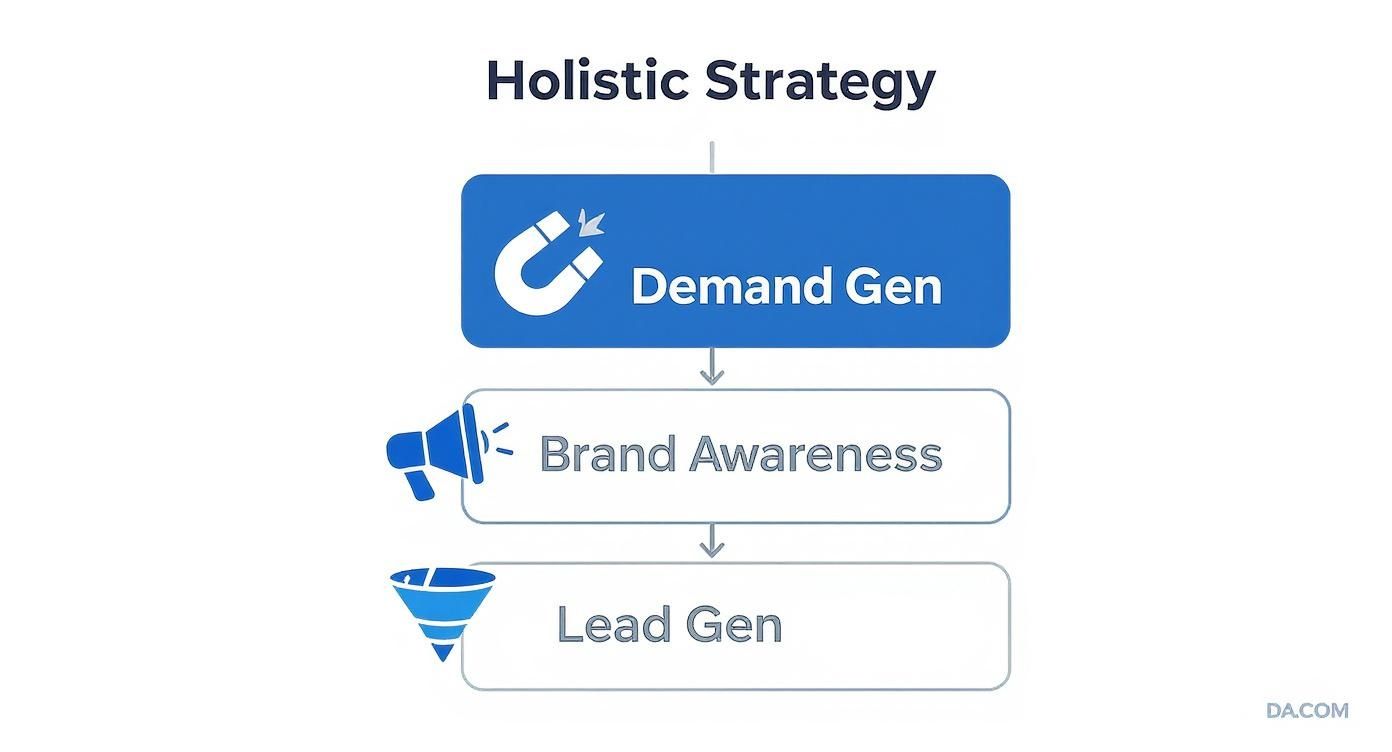
It’s an excellent visual for understanding how demand gen acts as the engine that both creates a market and captures qualified buyers from it.
Shifting Focus to Revenue-Centric KPIs
To gain a true measure of performance, we must look beyond the top of the funnel and measure the entire customer lifecycle. Your mandate is to draw a straight, undeniable line from your marketing initiatives to the numbers your CEO and CFO care about.
Here are the essential KPIs that belong on every demand generation dashboard:
- Customer Acquisition Cost (CAC): Your total sales and marketing expenditure divided by the number of new customers acquired. A decreasing CAC is a clear indicator that your demand engine is gaining efficiency.
- Lifetime Value (LTV): This metric projects the total revenue a single customer will generate over their entire relationship with your company. The magic happens when your LTV far exceeds your CAC—a healthy ratio is often 3:1 or better.
- Marketing-Sourced Pipeline: This is the total dollar value of sales opportunities that originated from a marketing touchpoint. It is a powerful way to demonstrate your team’s direct contribution to future revenue.
- Sales Cycle Velocity: How quickly are leads converting into closed-won deals? A shorter sales cycle improves cash flow and typically indicates that your demand generation efforts are attracting better-educated, high-intent buyers.
In my experience, the moment a marketing team starts reporting on pipeline and sales velocity instead of just MQLs is the moment they earn a permanent seat at the revenue table. It changes the entire conversation from "How many leads did we get?" to "How much revenue did we create?"
Tracking these outcomes is rapidly becoming the standard. A 2025 industry survey found that just under 50% of marketers now actively measure campaign attribution and performance. That’s a significant step in the right direction, but there is still work to be done. You can review the full survey findings on demand generation benchmarks here.
Focusing on these metrics fosters a data-driven culture that aligns the entire organization toward a single goal: sustainable growth. For a deeper analysis of this, you may find our article on how to measure marketing ROI particularly useful. This alignment is what separates the good from the great when it comes to proving marketing's true enterprise value.
How AI and Data Are Shaping Modern Demand Generation

The future of demand generation is no longer a distant concept. It's happening now, built on a foundation of artificial intelligence and proprietary first-party data. In my experience, the companies that create significant market separation are those that embrace these technological shifts early. This isn't about chasing trends; it's about deploying practical tools that deliver real, measurable business outcomes.
We have moved far beyond simple automation. Today's demand generation leverages AI to orchestrate hyper-personalized experiences at a scale previously unimaginable. Imagine having a thousand marketing strategists working 24/7, each one fine-tuning your content and outreach for an individual's specific needs and digital behavior. That is the new competitive advantage.
Unlocking Predictive Insights and Efficiency
The true power of AI in demand generation lies in its predictive capabilities. Instead of reacting when a prospect fills out a form, predictive models analyze thousands of data points—from website engagement to firmographic data—to identify your ideal customers before they even know they are in-market.
This gives your revenue teams a decisive advantage. They can focus time and budget with surgical precision. Why expend resources on a broad, net-casting campaign when data can pinpoint which accounts are exhibiting buying signals today? This is how marketing transitions from a cost center to a predictable revenue engine.
The impact is already clear. By 2026, it is projected that over 50% of top-performing B2B organizations will have AI-powered analytics embedded directly into their demand generation workflows. That’s not merely a statistic; it’s a clear directional signal for the entire industry. You can explore more 2025 demand generation trends to understand just how rapidly the landscape is evolving.
From Data Points to Customer Experiences
Ultimately, AI and data are simply tools. Their true purpose is to enable more relevant, valuable, and human-centric experiences for our customers. When executed correctly, an AI-driven strategy does not feel cold or robotic. It feels uniquely personal.
The smartest growth teams I've worked with don't use data just to be more efficient. They use it to understand the customer’s world so deeply that every interaction feels like a natural conversation, not a sales pitch. That’s the real advantage.
When you deploy these technologies effectively, you finally begin to dissolve the walls between marketing, sales, and product. Everyone gains a clearer, unified view of the customer, which leads to smarter decisions across the entire organization. Of course, this starts with a solid foundation, which is why building a cohesive data-driven marketing strategy is the non-negotiable first step.
Building Your Demand Generation Roadmap
A brilliant strategy is nothing more than a document without a concrete plan for execution. I’ve learned from years of scaling companies that the best demand generation programs aren't built on theoretical frameworks. They're built on a simple, actionable roadmap. This is your guide to translating theory into tangible business results, starting today.
The entire process begins with one non-negotiable step: deeply defining your Ideal Customer Profile (ICP). This is not a perfunctory marketing exercise. It requires getting your sales, product, and customer success leaders in a room and not leaving until you have a crystal-clear, data-backed consensus on who your absolute best customers are. It is equally important to define who they are not.
Laying the Foundation for Growth
With a validated ICP in hand, it's time to meticulously map out the entire buyer journey. You must get inside their world and understand every touchpoint, from the initial awareness of a problem to the moment of purchase. What questions are they grappling with at each stage? What type of information are they seeking?
Once you have that map, you can conduct a crucial content audit. Take a comprehensive inventory of your existing assets—blog posts, webinars, case studies—and identify the gaps. Where are you failing to answer a key question for your ICP at a critical juncture in their journey? That gap analysis becomes your new content plan.
In every company I've led, the single biggest accelerator for growth has been achieving radical alignment between marketing and sales. Without it, even the most brilliant demand strategy will fail.
This brings us to the final foundational element: the Service-Level Agreement (SLA). Think of this as a formal contract that specifies the measurable commitments each team makes to the other. Marketing might commit to delivering a certain number of qualified leads from the ICP, while sales commits to a specific follow-up protocol and timeframe.
This isn't about creating an opportunity to assign blame; it's about establishing shared accountability. An SLA transforms the vague notion of "alignment" into a concrete, data-driven partnership laser-focused on one thing: driving revenue.
Frequently Asked Questions
Over the years, I've noticed the same questions arise in boardrooms and strategy sessions. Let's address the most common queries about demand generation directly.
What Is the First Step in Demand Generation?
Before you create a single piece of content or spend a dollar on advertising, you must establish an unshakeable, data-validated understanding of your Ideal Customer Profile (ICP).
This is not just a marketing exercise. It is a cross-functional imperative that requires input from sales, product, and executive leadership. Without a razor-sharp definition of who you are selling to, every subsequent marketing activity is merely a shot in the dark.
How Long Does It Take to See Results?
Think of demand generation as planting an orchard, not harvesting fruit that is already ripe. It is a long-term strategy focused on building brand equity and market authority.
You may see early indicators—such as increased website traffic or higher social engagement—within 3 to 6 months. However, for a tangible, measurable impact on your sales pipeline and revenue, you should plan for a timeline of 9 to 12 months, or potentially longer. Consistency is the critical variable.
Can Small Businesses Do Demand Generation?
Yes, and they absolutely must. For small businesses, demand generation is not just a strategic option; it's a competitive necessity.
You cannot outspend the market leaders, so you must outthink them. A smaller company can build a powerful competitive moat by focusing on a specific niche audience and becoming their definitive source for valuable, problem-solving content. This is how you attract the high-quality leads that your larger, more generalized competitors will invariably overlook.
At MGXGrowth, we architect the data-driven demand engines that create predictable, scalable growth. If you're ready to build a sustainable marketing strategy that delivers real business impact, let's connect. You can find us at https://www.mgxgrowth.com.
