


In my decades of driving growth across SaaS, gaming, and hospitality, I’ve learned one undeniable truth: if you can't measure it, you can't manage it. Measuring marketing ROI isn't an academic exercise; it's the core discipline that separates businesses that scale profitably from those that burn cash chasing vanity metrics. It’s about forging a direct, unassailable link between every marketing dollar spent and the net profit it generates. This isn't just about reporting; it's about making strategic, data-driven decisions that fuel real growth in revenue and EBITDA.
Moving Beyond Vanity Metrics to True ROI

As a growth strategist, I’ve walked into countless boardrooms where teams are celebrating metrics that look impressive on a dashboard but do absolutely nothing for the bottom line. Clicks, impressions, and 'engagement' can feel productive, but they often mask a fatal flaw: a complete disconnect between marketing activity and actual business outcomes like revenue, profit, and market share. Measuring marketing ROI is not just a calculation; it's a cultural shift that forces alignment across your entire organization.
The Danger of Surface-Level Wins
I once advised a promising SaaS company that was burning through venture capital while boasting about its massive social media engagement. The marketing team was hitting all its KPIs for likes and shares, yet customer acquisition costs were spiraling out of control and churn was dangerously high. They were optimizing for applause, not profit.
The root cause was a classic silo problem. Marketing celebrated vanity metrics, sales chased any lead regardless of quality, and finance was left wondering why revenue growth wasn't tracking with the aggressive spend. It's a textbook path to failure.
I had to completely reframe their perspective. We stopped asking, "How many people saw our ad?" and started asking, "How much EBITDA did this campaign generate?" That single, crucial shift forced marketing, sales, and finance to sit in the same room and engineer a unified growth engine.
Adopting a strict ROI framework didn't just stabilize the company; it ignited its growth. By measuring the true financial return of every campaign, they could finally distinguish between channels that delivered profitable, high-LTV customers and those that were just expensive noise. The path to efficient capital allocation became crystal clear. This is the transformative power of knowing how to measure marketing ROI correctly.
Distinguishing What Works from What Doesn't
To begin, you must ruthlessly separate the metrics that feel good from the metrics that actually drive business value. Here’s how I frame this for my teams to ensure they're focused on what truly matters.
| Vanity Metrics vs. Growth Metrics |
| :— | :— | :— |
| Metric Category | Metrics That Matter | Business Impact |
| Traffic & Reach | Customer Acquisition Cost (CAC), Marketing-Sourced Revenue, Conversion Rate by Channel | Directly ties marketing spend to new customer revenue and profitability. |
| Social Engagement| Lead-to-Customer Rate, Social Media Conversion Rate, Referral Traffic from Social | Measures how effectively social activity turns followers into paying customers. |
| Email Performance| Revenue Per Email Sent, Click-to-Conversion Rate, Customer Lifetime Value (CLV) | Focuses on the direct financial return and long-term value generated from email campaigns. |
| Content Metrics | Content-Attributed Leads/Sales, Lead Quality Score, Pipeline Velocity | Connects content consumption to qualified leads and faster sales cycles. |
Concentrating on the "Metrics That Matter" column ensures your team is perpetually aligned with core financial objectives, not just fleeting digital trends.
The Evolution of ROI Measurement
This discipline is non-negotiable in today's market. Measuring marketing ROI has evolved dramatically, with sophisticated analytics and AI-powered attribution models becoming standard. The median profit ROI for top-tier advertisers has climbed from 1.9:1 to 2.5:1 recently, an improvement driven entirely by superior measurement tools. These advanced strategies provide a far more accurate view of the real impact of advertising investments.
Of course, a rigorous focus on ROI also requires understanding the nuances between short-term wins and long-term value creation. For example, high-impact branding and content marketing efforts may not show a direct, last-click return, but they are fundamental to building the brand equity and customer loyalty that generate profitable growth for years to come.
Building Your Foundation for Accurate Measurement
Before you even touch an ROI formula, you must get your data infrastructure in order. Attempting to calculate meaningful ROI with messy, inconsistent data is like building a skyscraper on a swamp—it will inevitably collapse. The real work begins with establishing a bulletproof system for tracking and agreeing on universal definitions of success.
I’ve seen it play out dozens of times: marketing and sales operate in parallel universes. Marketing hits its MQL targets and declares victory, while sales is drowning in low-quality leads. This classic misalignment almost always stems from a single failure: a lack of agreed-upon fundamentals.
Defining Your Terms of Engagement
Your first move is to get every stakeholder—marketing, sales, finance, operations—in one room to hammer out a universal glossary. This isn't about semantics; it's about architecting an accountable growth engine where everyone from the C-suite to the front lines speaks the same language.
You must achieve absolute clarity on these core concepts:
- What is a "Lead"? Is it a newsletter subscriber? A demo request? Define it with precision.
- What is a "Marketing Qualified Lead" (MQL)? Specify the exact firmographic and behavioral criteria that signal marketing should hand a lead to sales.
- What is a "Sales Qualified Lead" (SQL)? What actions must sales take to validate that an MQL has genuine purchasing intent and budget?
- What is a "Conversion"? This is the finish line. A closed-won deal, a new enterprise subscription, a significant purchase. It must be directly tied to revenue.
Establishing this alignment preemptively eliminates countless reporting headaches and territorial disputes. It ensures that when marketing reports a win, finance and sales understand its precise impact on the P&L. A shared vocabulary is the non-negotiable first step in building a true data-driven marketing strategy.
Calculating Customer Lifetime Value the Right Way
With definitions locked in, the next pillar of your foundation is understanding a customer’s true worth over their entire relationship with your business. Customer Lifetime Value (CLV) is arguably the most critical metric for accurately measuring marketing ROI, especially for businesses with recurring revenue or repeat purchase models.
Evaluating ROI based on a single transaction is dangerously myopic. A marketing channel might appear unprofitable if you only consider the initial purchase. But what if that same channel acquires fiercely loyal customers who remain for years? Its true value is immense.
I once worked with a marketplace ready to slash its SEO budget. The logic? The average first purchase from organic search was lower than from their paid ads. But their CLV calculation was completely broken—it ignored repeat purchases and the higher retention of their organic audience.
We rebuilt their CLV model from the ground up. We analyzed customer cohorts, tracked repeat purchase velocity, and modeled referral value. The new data painted a radically different picture.
- Paid Search Customers: They spent more on their first purchase, but their repeat purchase rate was 35% lower, and they churned much faster.
- Organic Search Customers: While the initial sale was smaller, their CLV over a two-year period was 50% higher because they were incredibly loyal and kept coming back.
Correcting their CLV calculation did more than save their SEO program; it fundamentally altered their growth strategy. They reallocated significant capital into long-term content and organic acquisition, which dramatically improved overall profitability. That's the power of a solid foundation—it transforms what looks like an expense into a predictable, high-return investment. Without it, you’re flying blind.
Choosing the Right Attribution Model
Attribution is where even the most sophisticated marketing ROI strategies can fail. Crediting only the last click for a sale is like giving a striker sole credit for a goal while ignoring the midfielder who made the brilliant pass and the defenders who prevented a counter-attack. It’s a dangerously simplistic view that leads to flawed budget allocation.
The customer journey is not linear. It’s a complex series of interactions across multiple channels, often spanning weeks or months. To truly understand marketing ROI, you must select an attribution model that reflects this reality and assigns credit intelligently.
This decision tree outlines the logical flow for building your ROI foundation. It reinforces the critical point that data integrity must precede any discussion of attribution.
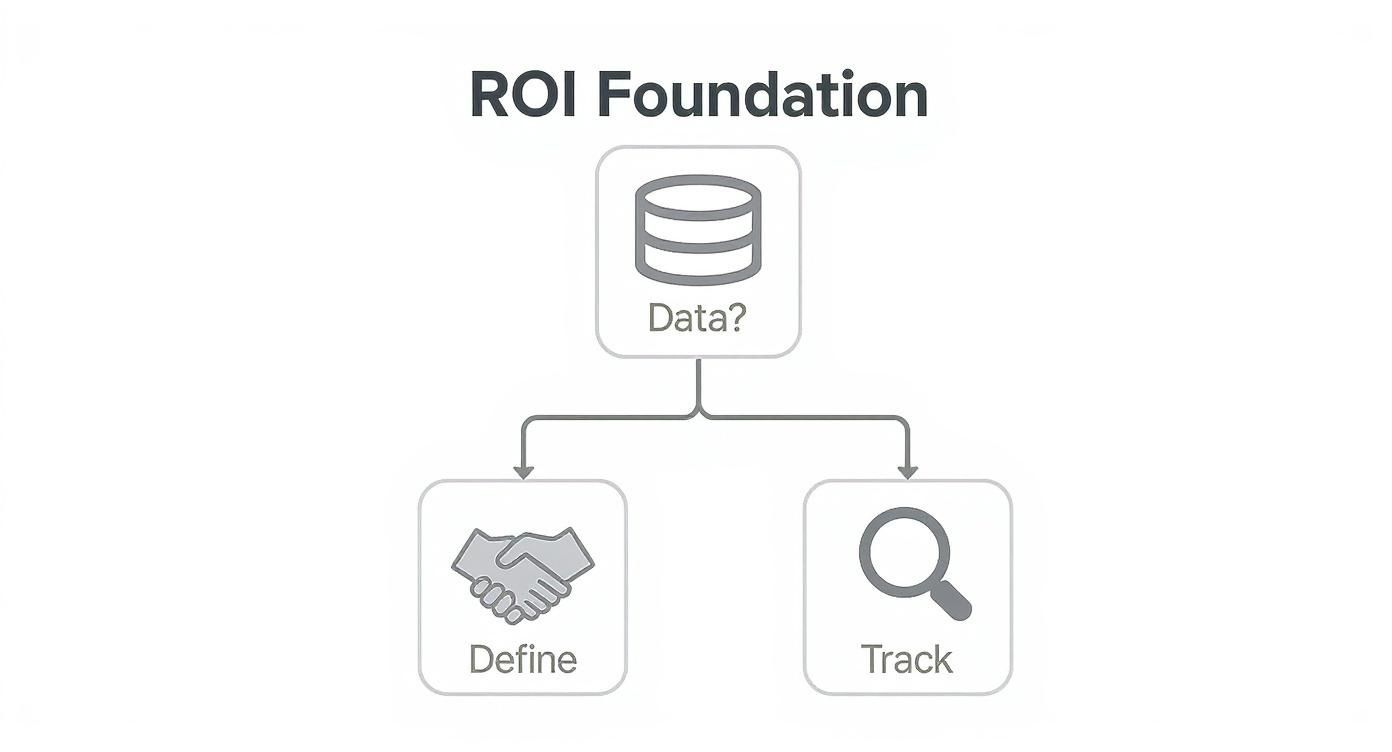
The visual makes it starkly clear: if your data tracking is flawed, your only priority is to fix it. Do not pass go, do not choose a model, do not define success. Fix the tracking first.
Starting with the Classics
The classic, rules-based attribution models are a reasonable starting point. They are simple to implement and understand, and while inherently flawed, they force you to begin thinking about the entire customer journey.
Let's examine them with practical examples:
- First-Touch Attribution: This model assigns 100% of the credit to the initial touchpoint. For a B2B SaaS company, if a lead first discovers you through a blog post found on Google, that blog post gets all the credit. It’s useful for identifying your most effective awareness-driving channels.
- Last-Touch Attribution: This is the most common—and most misleading—model. It gives 100% of the credit to the final interaction before conversion. For an e-commerce brand, this is often the retargeting ad a customer clicked just before purchase. It reveals what closes deals but completely ignores the initial demand creation.
- Linear Attribution: This model distributes credit equally across all touchpoints. If a customer saw a social ad, clicked an email, then performed a branded search, each touchpoint gets 33% of the credit. It’s an improvement because it at least acknowledges the full path.
- Time-Decay Attribution: A slightly more sophisticated model, this gives more credit to touchpoints that occurred closer to the conversion. The last click gets the largest share, the email from last week gets less, and the blog post from a month ago gets even less. This is valuable for businesses with shorter sales cycles where recent interactions carry more weight.
These simpler models can be "good enough" for businesses that are just starting out or have very short, transactional sales cycles. But if you operate in a market with a long, considered purchase journey, relying on them means you are guaranteed to be misallocating capital.
The Leap to Data-Driven Attribution
The true breakthrough in measuring marketing ROI comes from moving beyond these rigid, arbitrary systems. Data-driven attribution leverages machine learning to analyze thousands of customer journeys—both converting and non-converting—to determine the actual incremental impact of each touchpoint.
Instead of making assumptions, the algorithm learns what truly drives conversions. It identifies hidden patterns and assigns credit based on the statistical probability that a specific interaction increased the likelihood of a sale.
The rise of AI in attribution has been a game-changer. Predictive models now achieve 67% greater accuracy in forecasting campaign results compared to old-school rules-based systems. These tools can analyze countless customer paths to find the hidden influencers, automatically weighting each touchpoint by its true impact. For example, a beverage company using machine learning attribution discovered their podcast ads drove 22% more conversions than their last-click model ever gave them credit for. You can dig into more data on modern marketing ROI measurement to see the full picture.
This is not a theoretical advantage; it has profound, real-world consequences. A data-driven model might reveal that your top-of-funnel content—which gets zero credit in a last-touch model—is actually the most critical factor in generating high-value customers. Or it could prove that a specific webinar series dramatically shortens your sales cycle. These are the insights that unlock exponential growth, showing you precisely where to invest your next dollar for maximum return. Upgrading your attribution model is like upgrading from a horse-drawn carriage to a Formula 1 car.
Putting The Numbers to Work: Formulas and Advanced Tactics
With clean data and a sound attribution model in place, it's time to quantify performance. This is where you connect marketing investment directly to profit, building an undeniable business case for marketing as a primary driver of enterprise value.
The classic ROI formula is an excellent starting point, but it's just that—a start. True strategic insight comes from layering in more sophisticated variables that reflect the unique economics of your business.
The Foundational ROI Calculation
The simplest and most direct method to measure marketing ROI is the standard formula:
ROI = (Net Profit – Marketing Cost) / Marketing Cost x 100
Let's apply this to a straightforward example. A SaaS company runs a Google Ads campaign for a new feature.
- Marketing Cost: They invest $20,000 in ad spend.
- Revenue Generated: The campaign produces $80,000 in new annual recurring revenue (ARR).
- Net Profit: Assuming a healthy 75% gross margin, the net profit is $60,000 ($80,000 x 0.75).
Plugging these into the formula, we get: ($60,000 – $20,000) / $20,000 x 100 = 200%.
That’s a 200% ROI. For every dollar invested, the campaign returned two dollars in net profit. This is a clean, defensible number you can confidently present to the CFO and the board.
Beyond The First Sale: Factoring in Customer Lifetime Value
Relying solely on the initial transaction is dangerously shortsighted, particularly in businesses built on long-term relationships. This is where Customer Lifetime Value (CLV) becomes one of your most powerful strategic tools. It reframes your ROI calculation from a short-term snapshot to a long-term value forecast.
Let's re-evaluate a different initiative—a long-term content marketing strategy.
- Marketing Cost: You invest $50,000 over six months developing high-value blog posts and a comprehensive industry guide.
- Revenue Generated (Year 1): The content directly acquires customers generating $40,000 in first-year revenue.
- Simple ROI: On paper, this appears to be a -$10,000 loss. An apparent failure.
But this is where CLV completely rewrites the story. Your cohort analysis shows that customers acquired via content marketing are more loyal. Their average CLV is $3,000 over three years, compared to just $1,200 for customers from paid ads. The content attracted 40 new customers, so their total lifetime value is $120,000 (40 customers x $3,000 CLV).
Now, the ROI calculation reveals a profoundly different reality. You invested $50,000 to generate a massive future profit stream. This long-term perspective is absolutely essential for justifying strategic investments in branding, SEO, and content—the channels that build sustainable, defensible growth, not just fleeting wins.
Unlocking the Bigger Picture with Advanced Techniques
While channel-level ROI is fundamental, the most sophisticated growth teams go deeper to understand the holistic impact of their entire marketing ecosystem. This requires advanced statistical methods that provide a macro view that attribution models alone can miss.
Two of the most powerful techniques I’ve implemented to deliver transformative results are:
- Marketing Mix Modeling (MMM): This is a top-down statistical analysis that measures how different marketing channels contribute to sales. Critically, it also accounts for external factors like seasonality, economic conditions, and competitor activity. It's a game-changer for quantifying the ROI of offline or hard-to-track channels like TV, radio, and PR.
- Incrementality Testing: This involves running controlled experiments (like A/B or holdout tests) to determine if a marketing touchpoint is actually causing incremental sales, or if those customers would have converted anyway. It isolates the true lift generated by a specific ad or campaign.
These methods are rapidly becoming mission-critical. A recent marketing data report found that 49% of marketers now use MMM, with 47% planning to increase investment next year. However, a telling 41% still admit they cannot effectively measure cross-channel ROI, highlighting a major capability gap in the industry.
I once worked with a major hospitality chain under board pressure to justify its massive TV ad budget. Their web analytics showed almost no direct correlation to online bookings. By building a Marketing Mix Model, we proved that the TV campaigns were driving a significant uplift in branded search queries and direct website traffic, contributing to a 30% increase in direct bookings that their standard attribution completely missed.
That insight not only saved a multi-million dollar campaign but shifted their entire measurement philosophy. These advanced methods, often combined with tools like predictive analytics for sales forecasting, are what separate good marketers from elite growth leaders.
Turning ROI Insights into Profitable Decisions

Data sitting unused in a dashboard is just expensive wallpaper. The entire purpose of measuring marketing ROI is to arm yourself with the insights needed to make faster, more profitable decisions. This is the pivot from analysis to action. It’s how you systematically transform marketing from a perceived cost center into a documented, data-driven revenue engine.
I’ve seen too many teams perform rigorous calculations, present their findings, and then fail to act. The real work begins after the report is finished. It’s about instilling a culture of disciplined execution, where every insight triggers a tangible change in strategy and capital allocation.
From Raw Data to a Clear Action Plan
When you analyze your ROI reports, a clear performance spectrum will emerge. Some channels will be champions, delivering exceptional returns. Others will be clear underperformers, burning cash with little to show for it. But the most interesting are often in the middle—channels with potential that require optimization.
Your first step is to categorize all marketing activities into three simple buckets:
- Scale: These are your proven high-performers. The campaigns and channels in this group have a strong, positive ROI and, critically, the capacity to absorb more investment without diminishing returns.
- Optimize: These are the activities hovering near your target ROI but not quite clearing the bar. They show promise but require strategic adjustments—in creative, targeting, or bidding—to become scalable winners.
- Cut: These are the consistent laggards. They are draining capital that could be redeployed to your "Scale" initiatives for a much higher return. Be ruthless here.
This framework forces a shift from passive observation to active portfolio management. It’s a disciplined, albeit sometimes tough, method for prioritizing resources.
The objective isn't merely to identify winners and losers. It's to build a systematic process for reallocating capital from low-return activities to high-return opportunities with speed and confidence. This is how you compound growth.
A Real-World Example in Strategic Reallocation
I once worked with a mobile gaming company pouring millions into a massive, well-known ad network. The user acquisition volume was phenomenal—thousands of new installs daily. Superficially, it looked like a runaway success. But once we dissected the channel-specific ROI, a completely different narrative emerged.
While the cost per install was low, the lifetime value of these users was abysmal. They were low-intent players who churned almost immediately. The channel's ROI was barely positive, yet it was consuming a huge portion of the budget for negligible profit contribution.
Simultaneously, we analyzed a small, experimental spend on a niche community platform for dedicated gamers. The acquisition volume was a tiny fraction of the big ad network's, and the Cost Per Acquisition (CPA) was a staggering 3x higher. Conventional wisdom would demand killing this channel instantly.
But the ROI data told the true story.
| Channel Comparison | High-Volume Ad Network | Niche Community Platform |
|---|---|---|
| Acquisition | Low CPA, high volume | High CPA, low volume |
| User Quality | Low engagement & LTV | High engagement & LTV |
| Final ROI | 1.2:1 | 6:1 |
The users from the community platform were true enthusiasts. They were highly engaged, made significantly more in-app purchases, and had a CLV that was 500% higher than the users from the mainstream network. The ROI was extraordinary.
The decision became clear, even if it felt counterintuitive. We slashed the budget for the high-volume network by 70% and reallocated that capital directly into the niche community. The result? Our overall user acquisition volume dipped slightly in the short term, but our profitability skyrocketed. That single, data-driven move boosted the company’s total marketing ROI by 40% in one quarter.
Creating a Culture of Continuous Improvement
This process of review and reallocation cannot be an annual exercise. To truly master marketing ROI, you must embed this discipline into the operational rhythm of your team.
Here's how to make it part of your company's DNA:
- Set a Reporting Cadence: Your review cycle must align with your business velocity. For a fast-moving e-commerce company, a weekly or bi-weekly ROI review is appropriate. For a B2B SaaS business with a six-month sales cycle, a monthly or quarterly review provides a more strategic lens.
- Democratize the Data: Don't lock ROI reports away. Build accessible dashboards for the entire marketing team. Every channel owner must see exactly how their efforts contribute to the bottom line.
- Tie Incentives to ROI: Evolve your team's performance goals away from vanity metrics like lead volume. Instead, focus on ROI-centric KPIs. When your team is compensated based on profitable growth, their strategic thinking fundamentally changes.
By consistently acting on your ROI insights, you create a powerful flywheel. Each adjustment generates new data, which informs the next round of decisions. This is how you eliminate guesswork and build a predictable, scalable growth machine that drives real enterprise value.
Common Questions About Marketing ROI
Over my career, I've sat in countless boardrooms and strategy sessions where the same difficult questions about marketing ROI arise. These are the classic challenges where theory meets the messy reality of business operations. Let's tackle them head-on with the pragmatic answers I've learned from being in the trenches.
How Often Should I Measure Marketing ROI?
There is no universal answer—your measurement cadence must mirror the rhythm of your business, specifically your sales cycle. Applying a one-size-fits-all reporting schedule is a recipe for flawed decision-making. You need a cadence that enables decisive action without overreacting to short-term data fluctuations.
If you're an e-commerce retailer where a customer sees an ad and buys within the hour, a weekly channel ROI review is essential. But if you’re a B2B enterprise software company with a six-month sales cycle, a weekly report is statistical noise. For that business, a monthly or even quarterly review will provide a far more stable and strategically valuable picture.
The objective is to establish a consistent rhythm. You are looking for meaningful trends that signal when and where to shift capital, not reacting to daily spikes and dips.
What Is a Good Marketing ROI?
This is the quintessential question, and the answer is always, "it depends." You'll hear consultants throw around a 5:1 ratio ($5 in revenue for every $1 spent) as a general benchmark, but blindly chasing an arbitrary number is a strategic error. A "good" ROI is entirely relative to your industry, profit margins, and current stage of growth.
Consider this: a venture-backed startup in a land-grab phase might be thrilled with a 2:1 ROI if it means they are capturing market share faster than any competitor. Conversely, a mature, profitable company with high gross margins should be targeting a 10:1 return or higher.
Your most important benchmark is not a generic industry figure. It's your own historical performance. The primary goal is to achieve steady, quarter-over-quarter improvement in your marketing efficiency. Focus on consistently beating your own record.
How Do I Measure ROI for Branding or Content?
You cannot track a brand awareness campaign or a thought-leadership blog post with the same last-click attribution you'd use for a "buy now" ad, but that absolutely does not mean their impact is immeasurable. It simply requires shifting your focus from direct sales to measuring influence and tracking the correct leading indicators.
For large-scale, top-of-funnel brand initiatives, I focus on metrics that demonstrate our market position is strengthening:
- Branded Search Volume: Are more people typing our company name directly into Google? This is a powerful signal of rising brand salience.
- Direct Traffic: An increase in users navigating directly to our website indicates our brand is becoming a known destination.
- Share of Voice: How frequently are we mentioned in key industry conversations relative to our competitors?
For content marketing, the objective is to connect the consumption of content to eventual revenue. This is where multi-touch attribution models are critical. How many of your eventual customers first engaged with a blog post? Did that new whitepaper generate a surge in qualified leads that entered the pipeline? You are proving that top-of-funnel activity creates a larger, more valuable sales pipeline down the line.
At MGXGrowth, we specialize in cutting through complexity to build data-first growth strategies that deliver tangible, measurable results. If you're ready to move beyond vanity metrics and connect every marketing dollar to bottom-line growth, see how we can help you build your next growth engine at https://www.mgxgrowth.com.
