


In my decades of driving growth across SaaS, gaming, and real estate, I've learned that you can't manage what you don't measure. Multi-channel attribution models are the frameworks that finally let you see the entire customer journey, not just the finish line. Instead of giving all the credit to the last click before a purchase, these models assign value to every critical marketing touchpoint that guided a customer to your door. It’s about getting a complete, accurate picture of what’s really moving the needle on revenue.
Why Your Marketing ROI Is a Black Box

I’ve seen the same expensive mistake play out in every industry I’ve touched. Companies sink millions into their marketing budgets, but when I ask the C-suite a straightforward question—"Which of your channels are actually driving profitable growth?"—I’m usually met with dead silence.
What happens next is predictable. The marketing team points to a buzzy social media campaign. The sales team swears by their outbound calls. And the finance department is left trying to connect the dots between spend and actual EBITDA contribution.
Your return on investment turns into a black box, stuffed with guesswork and departmental politics instead of cold, hard data. This isn't just a waste of money; it's a massive strategic blind spot that cripples growth.
The Last-Click Fallacy
So, where does this confusion come from? More often than not, the culprit is an outdated and dangerously simplistic way of measuring success: last-click attribution. This model gives 100% of the credit for a conversion to the final touchpoint a customer interacts with before buying.
Think about a championship-winning team. Last-click attribution is like handing the trophy to the player who scored the final goal and ignoring everyone else. What about the midfielder who delivered the perfect assist? Or the defenders who shut down every attack? It’s a ridiculous way to view the game because it completely misses the teamwork that led to the win.
This flawed logic leads to terrible budget decisions. You end up over-investing in bottom-of-the-funnel channels (like branded search ads) while starving the very activities that introduced customers to your brand in the first place.
This is exactly why so many growth plans flatline. Your teams are stuck in silos, fighting for credit based on a distorted view of reality. This infighting isn't just about budget allocation; it's a symptom of a broken system. You can dig deeper into fixing this by rethinking your organizational structure for the marketing department.
Moving from Confusion to Clarity
When you operate on last-click data, you're making strategic decisions with one eye shut. You can't see the assists, the early blog post a customer read, or the social media ad that first sparked their interest. It's impossible to scale a business predictably when you can't see the whole playing field.
This is where multi-channel attribution models change the game. They aren't just a fancy analytics tool; they're a core component of your business intelligence engine. By shining a light on the entire customer journey, you can finally stop guessing, start knowing, and turn that black box of ROI into a clear roadmap for growth.
The Evolution of Marketing Measurement
To truly grasp why modern multi-channel attribution models are a strategic imperative, you have to understand where we came from. When I started my career, measurement was a blunt instrument. We ran on basic metrics like impressions and clicks that had a shaky connection, at best, to actual revenue. We were flying blind, but it was the best we could do.
Then the digital boom of the mid-2000s turned that simple world upside down. The customer journey was no longer a straight line; it became a tangled web of interactions across search, social, email, and display ads. The old single-touch models, like last-click, became functionally obsolete overnight. They were giving us a dangerously incomplete picture of how our customers were finding us and, more importantly, what was convincing them to buy.
The Rise of Multi-Touch Thinking
The big players with massive ad budgets, like Amazon and eBay, were the first to see the writing on the wall. They couldn't justify multi-million dollar decisions based on data they knew was flawed. They had to understand the entire sequence of touchpoints that led to a sale, not just the last one. This urgent business need is what drove the first serious multi-touch attribution (MTA) strategies.
This wasn't an academic exercise; it was a direct response to a massive business problem. As digital channels proliferated, MTA models started to catch on. By 2013, companies that adopted these smarter methods were already reporting a 15-20% boost in marketing ROI over those still clinging to the past. The market for attribution tools exploded, growing from a $100 million niche in 2010 to a $1 billion industry by 2018. If you're interested in the history, you can find more on the growth of marketing attribution here.
This history reveals a simple business truth: better data always creates a competitive advantage.
Clinging to outdated measurement is like navigating a modern city with a map from the 1950s. You might eventually find your way, but you'll miss all the efficient new highways and end up wasting a tremendous amount of time and capital.
A Strategic Imperative
Looking at the shift from single-click to multi-touch isn't just a history lesson—it's a lesson in strategy. It shows that the winners are always the ones who adapt their measurement to the reality of their market. Every step forward was about getting a clearer, more accurate view of customer behavior to make smarter, faster decisions.
Understanding this journey puts the risk of inaction into sharp focus. The tools we have today were born out of necessity as the digital world got more complex. They exist because the old methods couldn't provide the clarity needed to drive predictable growth. Investing in a full-funnel attribution strategy isn't about chasing a trend; it's about adopting a proven framework for driving revenue in a complex world.
Getting to Know the Six Core Attribution Models
Choosing the right multi-channel attribution model is like selecting the right lens for a camera. Each one brings a different part of the customer journey into focus, telling a slightly different story about what’s driving results. Get this choice wrong, and you're flying blind, making decisions based on a distorted picture. Get it right, and you unlock a clear, strategic path to growth.
Let's walk through the six main models, from the most basic to the most sophisticated. To make this tangible, imagine a common journey for a B2B software company:
- A prospect first discovers the brand through a blog post found via a Paid Social ad.
- Weeks later, they find and sign up for a webinar through Organic Search.
- They receive a follow-up nurture sequence via Email.
- Finally, they convert after a sales call, booked through a Direct visit to the website.
We'll use this four-step journey to see how each model assigns credit for the final sale.
This infographic shows how marketing measurement has evolved. We've moved from basic tools to the interconnected view that modern multi-channel attribution offers.
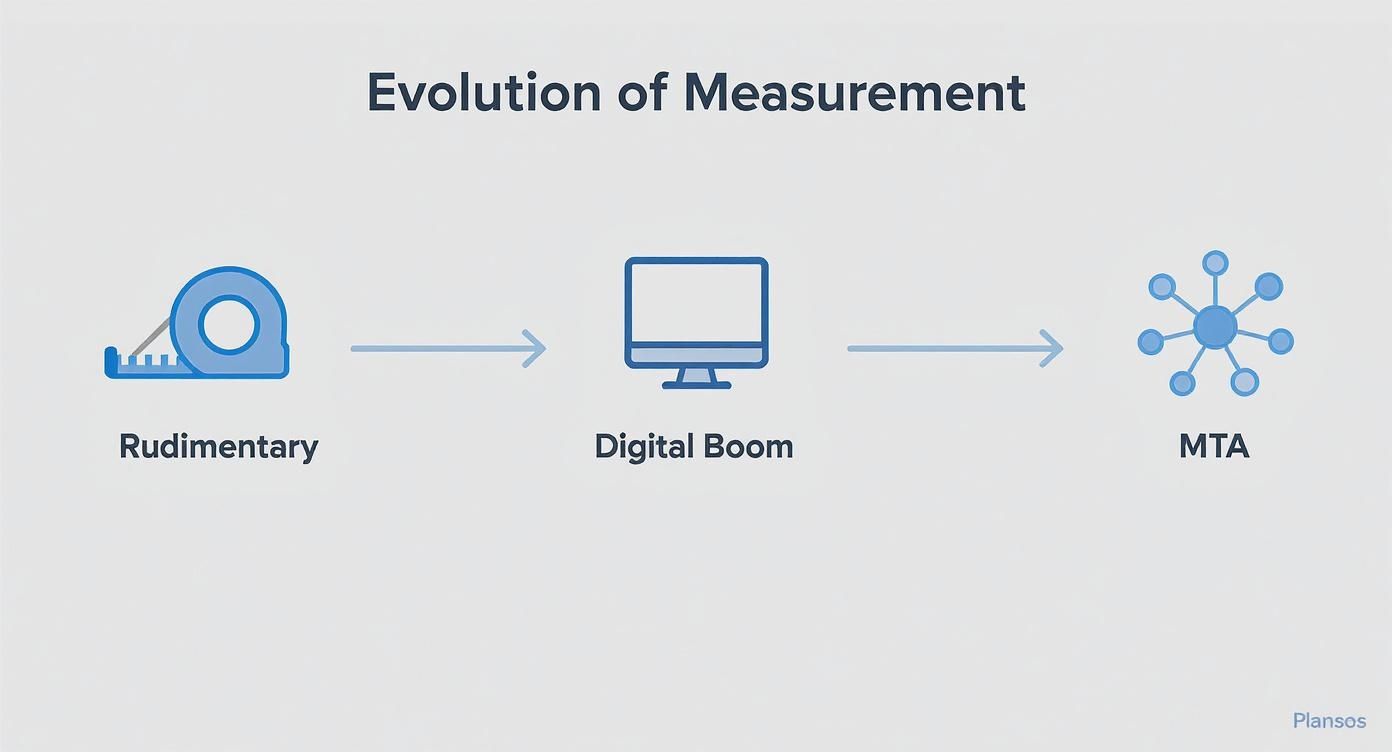
As you can see, our tools had to get smarter as business got more complex. This evolution was necessary to give leaders the clarity needed to make sharp, strategic decisions.
The Single-Touch Models: A Blunt Instrument
First up are the most basic models: Last-Touch and First-Touch. Think of these as blunt instruments. They give 100% of the credit to a single interaction, completely ignoring everything else that happened along the way.
-
Last-Touch Attribution: This model gives all the glory to the final touchpoint before conversion. In our example, the Direct visit for the sales call gets all the credit. It’s simple, but dangerously shortsighted. It completely ignores the top-of-funnel work that brought the lead in the door.
-
First-Touch Attribution: The mirror opposite. It gives all credit to the very first touchpoint—the Paid Social ad. It’s useful for understanding initial demand generation but assigns zero value to the crucial nurturing steps that actually closed the deal.
While easy to implement, single-touch models are fundamentally flawed. They tell an incomplete story, leading to poor budget decisions and missed growth opportunities.
The Multi-Touch Models: Seeing the Bigger Picture
This is where attribution starts to become a powerful strategic tool. Multi-touch models acknowledge that multiple interactions contribute to a sale and spread the credit more fairly.
Comparison of Core Multi-Channel Attribution Models
To get a clear, at-a-glance view of how these models stack up, it helps to compare them side-by-side. Each one tells a different story about your customer's journey, highlighting different moments of influence.
| Attribution Model | How Credit Is Assigned | Best For | Primary Advantage | Primary Disadvantage |
|---|---|---|---|---|
| First-Touch | 100% credit to the very first interaction. | Top-of-funnel and brand awareness campaigns. | Simple to implement; highlights channels that generate initial demand. | Ignores the entire nurturing and closing process. |
| Last-Touch | 100% credit to the final interaction before conversion. | Short sales cycles and bottom-of-funnel campaigns. | Easy to track; shows what closes deals. | Overvalues closing channels and ignores what brings leads in. |
| Linear | Credit is split equally among all touchpoints. | Gaining a holistic, baseline view of the entire customer journey. | Acknowledges every touchpoint; good first step into multi-touch. | Treats all interactions as equally important, which they rarely are. |
| Time-Decay | Credit increases for touchpoints closer to the conversion. | Longer sales cycles where recent interactions are more influential. | Emphasizes the crucial final steps that lead to a sale. | Can undervalue important early-stage, awareness-building efforts. |
| Position-Based (U-Shaped) | 40% to first touch, 40% to last touch, 20% split among the middle. | Valuing both brand discovery and conversion drivers. | Balanced view that highlights both the "opener" and the "closer." | The middle touches, which are crucial for nurturing, get very little credit. |
| W-Shaped | 30% to first touch, 30% to lead creation, 30% to last touch, 10% to others. | Businesses with a distinct lead generation milestone in the funnel. | Provides a nuanced view by highlighting three key journey stages. | More complex to implement and requires clear lead creation tracking. |
This table lays out the fundamental trade-offs you're making with each choice. There is no single "best" model—only the best model for your specific business goals and customer journey.
Linear Attribution
The Linear model is the most straightforward of the multi-touch family. It splits credit equally across every touchpoint. In our journey, Paid Social, Organic Search, Email, and Direct would each get 25% of the credit.
This is an excellent starting point for any team moving beyond single-touch attribution because it finally acknowledges the entire journey.
Time-Decay Attribution
The Time-Decay model operates on the premise that touchpoints closer to the sale are more influential. The interaction on the day of conversion gets the most credit, while an interaction from two weeks prior gets significantly less. In our scenario, the Direct visit would get the largest share, followed by Email, then Organic Search, with Paid Social receiving the least.
This model is valuable for companies with long sales cycles, as it correctly emphasizes the final pushes that get a deal across the finish line.
These models aren't just academic theories; they are practical tools that dictate where millions of marketing dollars are invested. The model you choose is a direct reflection of what your organization values in the customer journey.
Position-Based (U-Shaped) Attribution
Often called the U-Shaped model, this approach gives 40% of the credit to the first touchpoint (the "opener") and 40% to the last (the "closer"). The remaining 20% is split among all interactions in the middle. For our journey, Paid Social and Direct would each get 40%, while Organic Search and Email would share the last 20%.
It’s a popular, balanced approach that values both generating awareness and closing the deal. In fact, about 50% of digital marketing agencies use this model. Meanwhile, the Time-Decay model is preferred by 45% of marketers for conversion-heavy campaigns, and the simpler Linear model is chosen by roughly 35% of businesses. You can dive deeper into the data on how different attribution models are used in the industry.
W-Shaped Attribution
The W-Shaped model adds another layer of sophistication by introducing a third major milestone: lead creation. It assigns 30% of the credit to the first touch, 30% to the touchpoint that created the lead (in our case, the webinar sign-up from Organic Search), and 30% to the final touch. The last 10% is divided among the other interactions.
This model offers an even more complete picture, making it an excellent choice for businesses where generating a qualified lead is a critical, distinct step in the sales funnel.
Choosing the Right Model for Your Business
I've sat in countless boardrooms where the debate over attribution models gets needlessly complicated. The truth is, there is no single “best” model—only the one that best fits your business reality. Selecting the right one isn't an academic exercise; it's a strategic decision that must align with your go-to-market motion, sales cycle, and core business objectives.
A one-size-fits-all approach is a recipe for bad data. Your attribution model is the lens through which you view your marketing performance, and the wrong one will give you a completely distorted picture. This is where theory must meet the real world.
Ultimately, the model you choose is a direct reflection of your strategy. It signals what parts of the customer journey your company values most, which in turn dictates where you invest your capital and your team's energy.
Aligning Models with Business Scenarios
The ideal attribution model for a high-volume ecommerce store is worlds apart from what a B2B SaaS company needs. Their customer journeys, sales cycles, and conversion definitions are fundamentally different.
Let's look at a couple of distinct scenarios:
-
For High-Volume Ecommerce: Imagine a direct-to-consumer brand where the purchase decision happens in days or weeks. Here, you need to know what pushed them over the finish line. A Time-Decay model often works brilliantly. It gives more weight to the touchpoints closest to the sale—like that final retargeting ad or promotional email—which mirrors the speed of the buying decision.
-
For B2B SaaS with Long Sales Cycles: Now, picture a SaaS company with a nine-month sales process involving a committee of decision-makers. The first blog post that piqued their interest is just as important as the demo that sealed the deal. A Linear or U-Shaped model provides a much more balanced view, ensuring those top-of-funnel efforts get the credit they deserve for initiating the conversation.
Choosing a model isn't just a marketing task; it's a leadership decision. The question isn't "Which model is the most popular?" It's "Which model gives us the clearest insight to hit our revenue goals?"
This alignment is everything. Using a last-click model for a long B2B sales cycle will dangerously undervalue the content and brand-building that nurtured that lead for months. Conversely, using a first-touch model for a quick ecommerce purchase ignores the tactics that actually drove the conversion.
Key Strategic Questions to Ask
Before committing to a model, your leadership team must answer a few fundamental questions. These questions cut through the technical jargon and connect measurement to business goals. Getting this right is a cornerstone of any successful digital marketing strategy framework.
Ensure alignment across your teams on these points:
-
What is Our Primary Growth Objective? Are you focused on generating a flood of new leads? A First-Touch or U-Shaped model is well-suited for that. Or is your main goal to accelerate deal closure? Then a Time-Decay or Last-Touch model might be more useful.
-
How Long and Complex is Our Typical Sales Cycle? For simple sales cycles under 30 days, models that emphasize final interactions often make the most sense. For complex, multi-month journeys, you need a model like Linear or W-Shaped that appreciates the entire process.
-
What Are the Critical Milestones in Our Customer Journey? Do you have a key handoff point, like when a lead becomes a "Marketing Qualified Lead" (MQL) or a "Sales Qualified Lead" (SQL)? If that milestone is a critical inflection point for your business, a W-Shaped model is invaluable because it can assign specific credit to that moment.
By starting with these strategic questions, you elevate the conversation from a technical debate to a business-focused one. You're no longer just picking a multi-channel attribution model; you're engineering a measurement system that actively guides you toward predictable, sustainable growth.
Making Attribution a Team Sport, Not a Tug-of-War
Over the years, I've watched more game-changing projects get torpedoed by internal politics than by any technical glitch. When it comes to multi-channel attribution, the biggest obstacle isn't the software; it's the people. Siloed departments, competing agendas, and organizational inertia can bring the most sophisticated strategy to a screeching halt.
Let’s be clear: this isn't just another "marketing project." It’s a fundamental business intelligence initiative that demands a coordinated, cross-functional approach. Treat it as anything less, and you're setting yourself up to fail.
The entire point is to build a single source of truth that everyone—from marketing and sales to finance and the C-suite—trusts. This isn’t about blaming a channel for underperformance; it's about gaining a shared, crystal-clear picture of what truly drives growth.
Laying the Groundwork for Success
Before you even look at different models, you must get your data house in order. Messy, inconsistent data is the silent killer of attribution projects. If your systems aren't speaking the same language, the insights you generate will be unreliable at best and dangerously misleading at worst.
This foundational work is where the heavy lifting happens. It isn't glamorous, but it is absolutely non-negotiable.
Here’s where to focus your energy first:
- Enforce Data Consistency: Your CRM, marketing automation platform, and analytics tools must be perfectly synchronized. This means auditing your data fields to ensure a "lead source" in one system means the exact same thing in every other system. Without this, you’re comparing apples and oranges.
- Standardize Your Tracking: Your team needs a rock-solid, universal framework for UTM parameters. Create a simple, clear guide that dictates how every campaign, source, medium, and content piece is tagged. This is mandatory for capturing every touchpoint cleanly.
- Get Everyone in the Room: This is the most crucial step. You need to sit marketing, sales, and finance down together. Frame this initiative not as a way to scrutinize marketing spend, but as a tool to help everyone win bigger.
The goal is to change the conversation from "My channel did this" to "Our combined efforts drove this much revenue." This shift in mindset is everything. It turns attribution from a potential source of conflict into a powerful tool for collaboration.
Assembling Your Cross-Functional "Strike Team"
To break through the inevitable political and technical barriers, you cannot have one department leading the charge. You must build a dedicated, cross-functional team with clear ownership and shared accountability. This isn’t a committee that meets quarterly; it's a strike team built for action.
This team needs to be composed of people who can make decisions and clear roadblocks.
Your implementation team should include representation from:
- Marketing Operations: They will handle the technical setup, data integrations, and serve as the guardians of UTM governance.
- Sales Operations: They will ensure CRM data is clean and that sales activities are logged correctly.
- Data Analytics/BI: They will own the attribution model itself, validate the data, and build the final reports and dashboards for leadership.
- Finance: They will be responsible for connecting the attribution insights directly to hard revenue and ROI numbers.
This group becomes the central nervous system for your entire attribution strategy. They are accountable for overseeing the rollout, settling disputes over channel credit, and ensuring the insights translate into smarter business decisions.
From Silos to Synergy: A Real-World Example
I saw this play out perfectly with a SaaS company I advised. They were stuck in a constant debate: were their expensive trade shows or their content marketing driving more enterprise deals? The marketing team swore by the events, while the content team pointed to their blog traffic and whitepaper downloads.
By implementing a W-Shaped model and bringing together that cross-functional team, we finally saw the full picture. It turned out the trade shows were fantastic for generating initial awareness (First Touch), but it was the deep-dive whitepapers and webinars (Lead Creation) that were actually converting those booth visitors into qualified opportunities.
The insight was a lightbulb moment: they needed both. The budget debate vanished. Instead, the events team began collaborating with the content team to create targeted follow-up materials for attendees. This data-driven, collaborative approach led to a 30% increase in their lead-to-opportunity conversion rate within six months. That is the power of using data to tear down organizational walls.
The Future of Attribution: AI and Predictive Modeling are Here

While the multi-channel attribution models we've covered are essential for bringing clarity to past performance, they are fundamentally rule-based. As a growth leader, I'm constantly looking for the next competitive advantage. In attribution, that advantage lies squarely in AI and machine learning.
These aren't buzzwords for a distant future; they represent the next operational frontier for any data-driven company. We are moving away from static, rule-based systems toward dynamic, intelligent models that learn directly from your business data. This shift promises a level of precision that older models simply cannot deliver.
Algorithmic Attribution Unlocks Dynamic Insights
The first major leap forward is algorithmic or data-driven attribution. Imagine a custom attribution model built just for your business, by a machine that can process millions of data points without human bias. Instead of you telling the model that the first and last touches are important, the algorithm analyzes all your customer journeys—both converting and non-converting—to determine the actual probabilistic value of each touchpoint.
It might uncover that a specific webinar has a massive impact on closing enterprise deals for one customer segment, assigning it credit in a way a standard U-shaped model never could. This approach breaks free from fixed assumptions and adapts in real-time as customer behavior and market trends change.
This is where we break out of the "one size fits all" framework entirely. An algorithmic model doesn't just apply rules; it discovers the unique patterns of cause and effect that drive revenue for your specific business.
From Reactive to Proactive with Predictive Attribution
The next, even more powerful, evolution is predictive attribution. While traditional models are excellent at explaining what has worked, predictive models tell you what will work. By analyzing historical campaign data, customer behavior, and conversion paths, AI can forecast the probable ROI of your future marketing spend.
This completely transforms the budgeting process. You're no longer just allocating funds reactively based on last quarter's report. You are planning strategically and proactively. You can model different budget scenarios to identify the optimal channel mix before spending a single dollar.
Consider the power of being able to answer questions like:
- What is the likely revenue impact if we increase our LinkedIn ad spend by 15%?
- Which customer segments are most likely to convert from our upcoming product launch campaign?
- How should we reallocate our budget mid-quarter to maximize our chances of hitting our sales target?
This is what turns marketing from a cost center into a predictable revenue engine. It’s the same forward-looking intelligence already revolutionizing other business functions, like using predictive personalization for VIP travelers to anticipate customer needs. By preparing your organization for these advanced tools, you’re not just fine-tuning your marketing—you’re building a lasting, data-backed competitive advantage.
Frequently Asked Questions About Attribution Models
I've been in this game for a long time, and I've noticed a pattern. The move to a data-driven culture always starts with asking tough, direct questions. When it comes to multi-channel attribution, leaders are right to be skeptical—they want to know what they're really getting into before overhauling their reporting systems.
Here are the questions I get most often, along with my straight answers.
What Is the Biggest Mistake Companies Make with Attribution?
Easy. The biggest mistake is choosing a model based on convenience, not business reality. Too many companies default to the Last-Touch model because it's standard in their analytics tools. They don't stop to consider that it completely misrepresents their complex, months-long sales cycle.
This single shortcut leads to a cascade of bad decisions. You over-invest in channels that are great at closing deals while starving the channels that actually create demand. You're cannibalizing your future pipeline. The right way to start is by mapping how your customers actually buy, not by picking the default setting in your software.
How Do I Know When My Company Is Ready for a More Advanced Model?
You’re ready as soon as you can’t confidently answer the question, "What’s really driving our growth?" If your marketing and sales teams are constantly fighting over who gets credit, or if your ROI feels more like a guess than a calculation, it's time to upgrade.
The tipping point usually comes when you acknowledge your customer journey isn't a straight line. The moment you have multiple touchpoints influencing a single sale—a social ad, a blog post, a webinar, and a sales call—your single-touch model is already failing you.
The goal isn’t to chase complexity for its own sake. It’s about getting a view of reality that mirrors how your customers actually behave. Moving to a more sophisticated model is a sign of business maturity.
Can Small Businesses Benefit from Multi-Channel Attribution?
Absolutely. In fact, it's more critical for a small business where every dollar must be accountable. When your budget is tight, you cannot afford to waste a penny on underperforming channels. Even a basic Linear model provides a much truer picture than a last-click-wins approach.
Getting started doesn't require a massive, expensive enterprise platform. It begins with a disciplined approach to UTM tracking and a commitment to looking at the entire path to purchase. The insights you gain can help a small business out-maneuver larger competitors by making smarter, more efficient marketing decisions based on data, not gut feelings.
At MGXGrowth, we don't just talk theory. We get in the trenches with executive teams to build and implement the right attribution strategies that drive revenue and finally break down those frustrating organizational silos. Architect your growth roadmap with us.
