


Let’s get straight to the point: the official statistics on digital transformation are grim. A staggering 65% of these initiatives fail to deliver on their promises. In my world, that’s not a statistic; it’s a direct hit to EBITDA, millions in squandered capital, demoralized teams, and market share handed over to competitors.
The real kicker? After decades of driving growth in SaaS, marketplaces, and hospitality, I can tell you the technology is almost never the root cause of the failure.
Why Most Digital Transformations Fail

I’ve seen this pattern repeat itself in boardrooms and with executive teams across multiple industries. The failure isn't triggered when a new system crashes on launch day. It's seeded months, sometimes years, earlier in the very conference rooms where the strategy was conceived.
The fundamental, and often fatal, mistake is framing transformation as an IT project. It’s not. It is a complete re-engineering of your company's operating model, its culture, and its core value proposition to the customer.
Too many leaders are seduced by the promise of shiny new tech—AI platforms, sophisticated automation tools, sleek CRMs—while completely ignoring the archaic thinking and departmental silos that will inevitably render those investments useless. It's like installing a Formula 1 engine in a car with flat, worn-out tires. You’re not going anywhere, and you're certainly not going to win any races.
The Unspoken Reality of Failure
Here's the hard truth I’ve learned: buying and implementing technology is the easy part. The real work—the uncomfortable, politically charged, and messy part—is rewiring how your people think, operate, and collaborate. This is where the true digital transformation challenges lie.
This isn't just my battlefield experience talking. A massive analysis of over 850 companies found that a mere 35% of digital transformations were deemed successful. You can explore these transformation statistics to see just how pervasive these issues are.
From my perspective, these failures consistently trace back to a few core areas. I call them the "pillars of failure"—the structural weaknesses that cause the entire transformation effort to collapse under its own weight.
The Four Pillars of Transformation Failure
This table breaks down the most common failure points I encounter in digital transformation initiatives. Consider it my field guide to the key challenges we are about to dismantle.
| Challenge Pillar | Primary Obstacle | Typical Symptom |
|---|---|---|
| Cultural Resistance | Ignoring the human element and fear of change. | Employees actively or passively resist new processes and tools. |
| Siloed Execution | Departments working in isolation, not collaboration. | A fragmented tech stack and a disjointed customer experience. |
| Lack of Vision | No clear, customer-focused goal driving the change. | Initiatives become internal vanity projects with no impact on revenue. |
| Skills Gap | The team lacks the expertise to use new tools effectively. | Expensive new software sits unused or is poorly implemented. |
Looking at this, it becomes clear that these issues are deeply intertwined. A lack of customer-centric vision directly leads to siloed execution, which in turn fuels cultural resistance. It’s a vicious cycle.
"A brilliant digital strategy without the talent and culture to execute it is just an expensive presentation. The real battlefield for transformation is won by changing behaviors, not just buying software."
A Data-Driven Path Forward
So, how do you beat these abysmal odds? You start by changing the fundamental question. Stop asking, "What cool technology should we buy?" and start asking, "What urgent customer problem are we solving to drive growth?"
That single shift in perspective is the foundation for any successful transformation. It forces you to become ruthlessly data-driven and customer-centric, which in turn breaks down the very barriers that cause most initiatives to fail.
Throughout this guide, we'll ditch the vague consultant-speak. We’re going to get into the practical, battle-tested strategies I’ve used to navigate these obstacles, manage the human side of change, and architect a technology ecosystem that becomes a genuine engine for revenue and market share growth.
Navigating The Human Side Of Change

Let me be blunt: the technology is the easy part. The real battleground in any digital transformation effort is your company culture. I’ve seen countless organizations spend millions on brilliant new platforms only to watch them collect digital dust because the teams meant to use them were entrenched in old habits and territorial silos.
The toughest challenges we face aren't technical; they're deeply human. We can't just announce a new initiative and expect everyone to fall in line. To get this right, we have to diagnose and address the psychology driving the resistance.
The Psychology of Resistance
Generic advice like "get buy-in" is useless because it completely misses the powerful, often unspoken, forces working against you. Resistance isn't just stubbornness. It’s a very human response, usually rooted in genuine fears and anxieties about what’s changing.
When I first sit down with an executive team, I don't ask about their tech stack. I start by diagnosing the three core fears that can paralyze an organization and kill momentum before it even starts.
- Fear of Obsolescence: Think about your top performers—the people who have spent years, maybe decades, mastering their craft. A new digital tool or automated process can feel like a direct threat to their hard-won expertise and, by extension, their value to the company.
- Loss of Autonomy: People value their established workflows and the control they have over their daily tasks. New systems often bring rigid, one-size-fits-all processes that can make people feel like they’ve lost their independence, which breeds resentment.
- Comfort of Routine: Our brains are wired to create habits to conserve energy. Disrupting those routines forces people out of their comfort zones, creating a kind of mental friction and a natural pull to go back to what’s familiar.
These fears are not trivial. They create a powerful undercurrent of resistance that will sink even the most well-funded initiative if you ignore them.
Dismantling The Silos and Breaking Down Barriers
Getting past these human hurdles requires a deliberate, almost surgical approach. One of the biggest obstacles I see is the siloed thinking that plagues so many companies. When departments operate like independent kingdoms, information gets hoarded, collaboration dies, and creating a cohesive customer experience becomes impossible.
This isn't just a hunch; it's a measurable problem. Recent data shows that 32% of senior leaders view these organizational silos as a primary obstacle to successful transformation. This fragmentation creates a disjointed environment where real progress grinds to a halt. You can see more statistics on these common digital transformation roadblocks and how they derail projects.
In my experience, the moment a transformation gets labeled as an "IT project" or a "Marketing project," it’s already starting to fail. True transformation is a company-wide mission. It demands that we tear down departmental walls and get everyone aligned around a single, customer-focused vision.
To really break down these barriers, you have to build an environment of psychological safety. People need to feel secure enough to experiment, ask tough questions, and even fail without fearing punishment.
Converting Skeptics Into Advocates
The final piece of this puzzle is turning your biggest critics into your most powerful allies. This isn't something you can achieve with a corporate mandate or a top-down decree. It happens when you identify and empower change champions at every level of the organization.
These champions aren't always managers or executives. Often, they are the respected, influential people on the front lines—the ones who can translate the high-level vision into the day-to-day reality for their peers.
Here’s the framework I use to build that groundswell of support:
- Identify Natural Influencers: Look for the people others naturally turn to for advice and guidance. They are your potential champions.
- Involve Them Early: Don't just inform them; bring them into the planning process. Give them a real seat at the table to voice concerns and help shape the solution.
- Give Them Resources and Authority: Equip them with the training, tools, and authority they need to support their colleagues. Make them the official go-to experts.
- Celebrate Their Wins: Publicly recognize and reward your champions. Their success stories become the social proof that convinces everyone else to get on board.
By focusing on the human element—addressing fears head-on, breaking down silos, and empowering champions—you shift the entire dynamic. What started as a forced change becomes a shared movement. This is how you navigate the toughest parts of digital transformation and create change that actually lasts.
Closing The Critical Skills Gap

Let's be direct: a brilliant digital strategy without the talent to execute it is just an expensive presentation gathering dust. I’ve seen this play out time and again across every industry, from SaaS to real estate. The single most persistent roadblock is the massive gap between the capabilities a company needs to win and the skills its people actually have.
The common reflex for many leaders is to hire their way out of the problem. "We just need more data scientists," they'll say. But in my experience, that's just a band-aid on a much deeper issue. You can't just recruit your way out of a foundational skills deficit, especially when the competition for top-tier digital talent is so fierce.
This isn't a minor hurdle; it's a real economic threat. Some projections show that up to 90% of organizations expect shortages in key IT and digital roles. The potential fallout? A staggering $5.5 trillion in global losses by 2026. You can dig deeper into these data transformation challenges on integrate.io. This reality calls for a much smarter approach than just throwing up more job posts.
The Dual Strategy of Build and Buy
The companies I’ve seen truly succeed don’t just buy talent; they build it from within. They use a dual strategy: targeted external hiring for specific, immediate needs, combined with aggressive internal upskilling for long-term strength. Relying only on hiring creates a constant, expensive churn and you lose all the invaluable institutional knowledge your current employees have.
On the flip side, trying to upskill everyone for every new need can be painfully slow when you need specialized expertise now. It’s all about striking the right balance.
"Your goal should be to create an organization that can evolve with your technology, not in spite of it. This is achieved by systematically identifying future needs and investing in the people you already have."
This requires a fundamental mindset shift. You have to stop seeing training as a cost center and start treating it as a critical investment in your company's future.
Mapping Future Needs to Your Current Workforce
To make this dual strategy work, you need a plan based on data, not guesswork. I always advise leaders to conduct a rigorous capability audit. This isn't about performance reviews. It’s about mapping the skills you will need in 18-24 months against the skills your teams have today.
Here's a practical, three-step method to get started:
- Define Future-State Roles: Don't just list technologies like "AI" or "automation." Get specific about the roles and capabilities you'll need. For instance, you might need a "Customer Journey Analyst" who uses predictive analytics to spot churn risks—a very different role than a generic "data analyst."
- Conduct a Skills Inventory: Assess your current team's skills against these future roles. A simple framework works best: categorize employees into those who can be upskilled, those who need reskilling for a new role, and identify the critical gaps that absolutely require an external hire.
- Build Personalized Learning Paths: With this data in hand, you can ditch the generic, one-size-fits-all training. Develop focused learning paths for individuals and teams that directly address the gaps you've identified, using a mix of online courses, mentorship, and real, hands-on projects.
Cultivating a Culture of Continuous Learning
Finally, tools and programs are only half the battle. The most important piece of the puzzle is fostering a culture of continuous learning—one where skill development is an expected and celebrated part of the job, not a chore to be checked off once a year.
This has to start at the top. When executives openly share what they are learning, it sends a powerful message across the entire organization. It also means giving people the time and resources to learn during their workweek and, crucially, recognizing and rewarding those who actively grow their skills.
Ultimately, closing the skills gap is about building an organization that learns. By strategically blending outside hires with a deep commitment to internal development, you build a team that isn't just ready for today’s challenges, but is equipped to adapt and thrive for years to come.
Mastering Your Technology Ecosystem
I’ve seen it happen more times than I can count: leaders treat technology like a high-stakes shopping spree. They accumulate an impressive collection of expensive, shiny tools that, unfortunately, don't talk to each other. This creates a tangled, inefficient tech stack that ends up slowing growth instead of fueling it.
The root of the problem is viewing technology as a series of standalone fixes rather than a cohesive ecosystem. When marketing buys its own automation platform, sales gets its preferred CRM, and operations sticks with its trusted ERP, the result is a Frankenstein's monster of a system. Data gets trapped in silos, workflows sputter and die, and the customer experience becomes a disjointed mess.
Confronting The Legacy System Burden
One of the biggest elephants in the room is often the inflexible legacy system. These old platforms can be the operational heart of a company, but they also act as a ball and chain, preventing any real agility or innovation. I've watched countless transformation projects grind to a halt trying to force these monoliths to play nice with modern, cloud-based applications.
But simply ripping out and replacing these systems isn't always the answer. That path is expensive, incredibly disruptive, and comes with a whole new set of risks. The real key is a more strategic and nuanced approach.
"The goal isn't just to buy new technology; it's to build a unified system where data flows freely to serve the customer. Your tech stack should be a growth engine, not a museum of disconnected software."
To pull this off, you need a clear modernization strategy that carefully weighs today's needs against your long-term vision. This means making some tough calls about what to retire, what to wrap and integrate, and what to rebuild from scratch.
When it comes to handling those deeply embedded legacy systems, there isn't a one-size-fits-all solution. Each company needs to evaluate the options based on their specific context, risk tolerance, and long-term goals. Here's a breakdown of the most common modernization strategies we see in practice.
Legacy Modernization Approaches Compared
| Approach | Description | Pros | Cons |
|---|---|---|---|
| Encapsulate (Wrap) | Keep the core legacy system but build a modern API layer around it to expose its data and functionality to other applications. | Faster and less disruptive than a full replacement. Lowers immediate risk. | Doesn't fix underlying issues with the core system. Can become a complex workaround. |
| Rehost (Lift-and-Shift) | Move the legacy application from on-premise servers to a cloud infrastructure (like AWS or Azure) with minimal code changes. | Relatively quick and low-cost. Improves infrastructure reliability and scalability. | Offers minimal functional improvement. Still stuck with an outdated application. |
| Replatform | Make small-to-moderate changes to the application to take better advantage of cloud capabilities, without changing the core architecture. | Achieves some cloud benefits (e.g., managed services) without a full rewrite. | Can be more complex than a simple rehost. Still limited by the original architecture. |
| Refactor/Rearchitect | Significantly alter the application's internal structure and code to improve performance and shift to a modern architecture (e.g., microservices). | Dramatically improves maintainability, agility, and scalability. | High cost, time, and risk. Requires specialized skills. |
| Replace | Completely decommission the old system and replace it with a new solution, either a commercial off-the-shelf (COTS) product or a custom-built one. | Offers the most significant long-term benefits and a clean slate for innovation. | Highest risk, cost, and potential for business disruption. Lengthy implementation. |
Choosing the right path requires a clear-eyed assessment of how critical the legacy system is, how much it's holding you back, and what resources you can realistically commit to the effort. Often, the best strategy involves a mix of these approaches across different parts of your tech portfolio.
Data Governance Is Non-Negotiable
Beyond the systems themselves is something far more precious: the data flowing through them. Clean, accessible, and well-governed data is the absolute lifeblood of any successful transformation. Without it, your fancy AI models and personalization engines are just expensive decorations.
When data governance is an afterthought, a whole host of problems follows:
- Flawed Insights: If your data is a mess of inconsistencies and duplicates, any analysis you run will be fundamentally wrong. You’ll find yourself making major business decisions on a foundation of bad information.
- Wasted Time: Teams burn countless hours manually cleaning and cross-referencing data just to get basic tasks done, which is a massive drain on productivity.
- Mounting Risk: Without clear ownership and control, you’re opening the door to serious security vulnerabilities and regulatory compliance issues.
Putting a strong data governance framework in place isn't just a job for the IT department; it’s a core business function. It demands clear ownership, consistent standards, and a company-wide commitment to treating data as the strategic asset it is.
A Framework For Smart Technology Selection
To sidestep the traps of software sprawl and integration nightmares, I push leaders to use a practical, outcome-first framework for every single technology decision. It's time to stop chasing shiny new objects and start focusing on tangible impact.
This is a visualization comparing the planned versus actual results of a typical digital transformation project, highlighting common gaps in budget, ROI, and timeline.
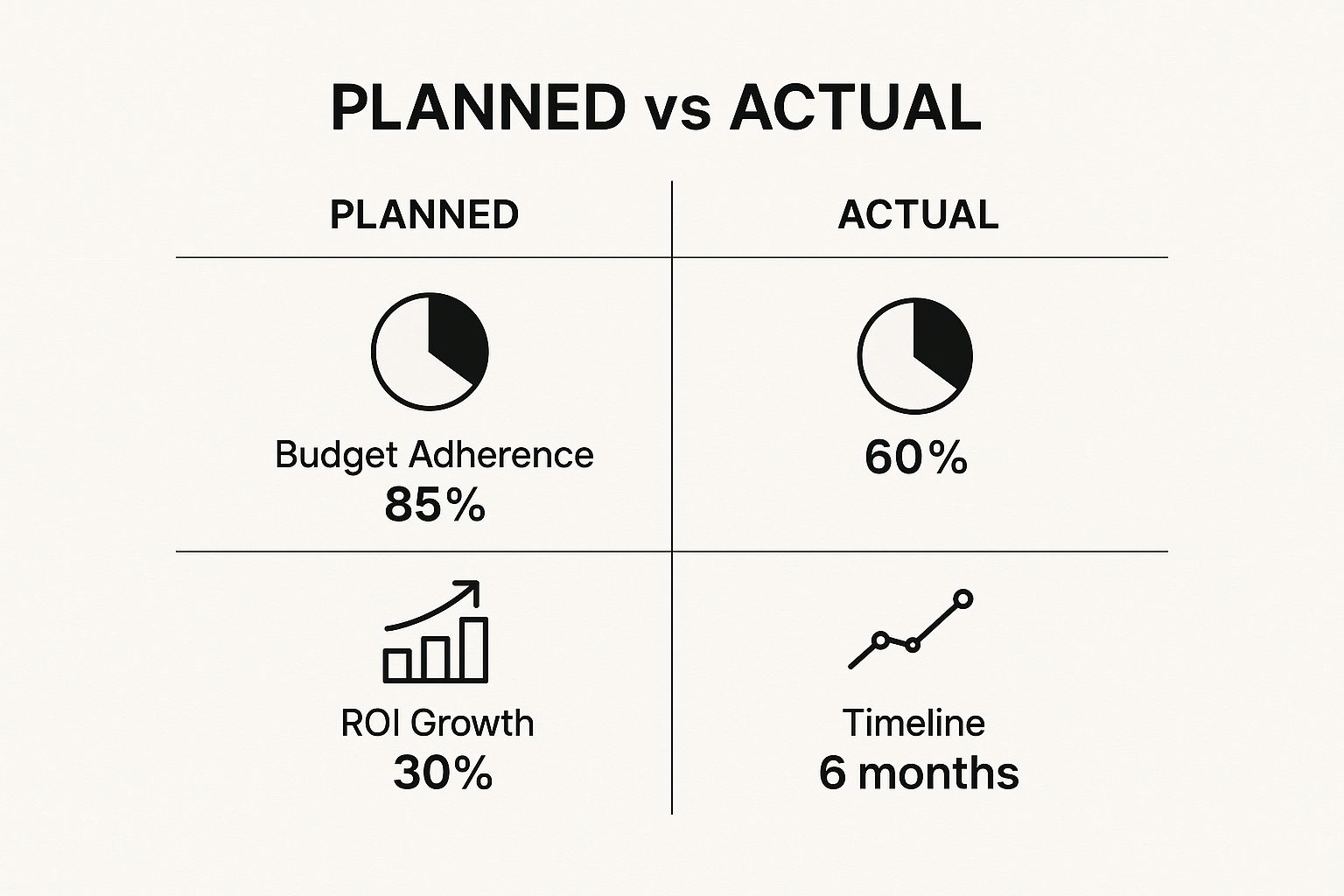
The data here makes it painfully clear how easily projects can get derailed without a rigorous plan, often leading to a much lower ROI and significant delays.
Before your team even thinks about signing a new software contract, they need to have solid answers to three non-negotiable questions:
- What specific business outcome does this accelerate? The answer can’t be fuzzy, like "improving efficiency." It has to be concrete, like "reducing customer onboarding time by 25%" or "increasing our lead-to-close conversion rate by 10%."
- How does this improve the customer experience? Every dollar you spend on tech should ultimately create more value for your customer. If you can’t draw a straight line from the software to a better, smoother customer journey, it’s probably the wrong investment.
- How does this integrate with our existing ecosystem? A new tool has to be a team player. If it can't connect seamlessly with your core systems—like your CRM or data warehouse—it’s just going to create another frustrating data silo and make your problems worse.
By making every potential investment pass this test, you shift the conversation from acquiring technology to achieving results. This disciplined approach is how you turn your technology ecosystem into a powerful engine for your strategy, not a complex anchor weighing you down.
Leading Through Uncertainty and Ambiguity
Outdated leadership models are poison to any real transformation. The classic top-down, command-and-control style might have worked in a more predictable world, but today, it actively strangles the very agility and creativity you need to survive. I’ve seen it time and again: the leader's job is no longer to be a director but an enabler of talent.
This brings us to the final, and often most critical, hurdle—the leadership itself. It’s rarely about a lack of executive buy-in. In fact, one study showed that only 13% of leaders pointed to a lack of senior support as a major problem. That tells a fascinating story: most executives want transformation, but they often don't know how to lead it effectively on the ground. You can dig into more of these digital transformation statistics from Backlinko to see how leadership's view often clashes with the tactical reality.
The heart of the issue is that leading through ambiguity requires a completely different playbook than managing for predictability. It’s a profound shift from having all the answers to knowing how to ask the right questions.
The Mandate for Modern Leadership
To guide a company through the choppy waters of change, leaders need a new set of principles. And let’s be clear, these aren't "soft skills"—they are hard-edged requirements for survival and growth. In my experience, the leaders who successfully drive real change consistently embody three essential traits.
These aren't just nice-to-haves; they form the bedrock of a resilient, adaptable organization:
- Radical Transparency: Share everything—the good, the bad, and the uncertain. When you're open about the challenges and the "why" behind your decisions, you build a foundation of trust. It gives your teams the context they need to make smart choices on their own, without you.
- Relentless Customer Obsession: Every single decision should be tied back to one question: "How does this create more value for our customers?" This focus becomes a true north, cutting through internal politics and aligning siloed teams around a purpose that actually matters.
- Courageous Data-Driven Decisions: The best leaders I’ve worked with have the guts to let data challenge their own sacred cows and deeply held beliefs. They cultivate a culture where solid evidence, not someone's opinion or tenure, wins the argument.
Actionable Principles for Steering Change
Making the switch from director to enabler is all about creating the right conditions for your teams to do their best work, especially when the path forward isn't clear. It means trading micromanagement for genuine empowerment.
A leader's job isn't to minimize risk. It's to build an organization resilient enough to take smart risks. You set the vision, clear the roadblocks, and then get out of the way and trust your people.
Here’s how you actually put that philosophy into practice:
- Set a Clear and Compelling Vision: Your team has to understand not just what they are doing, but why it’s so important. The vision needs to be simple enough to remember, ambitious enough to inspire, and laser-focused on the customer outcome you're all chasing.
- Empower Small, Autonomous Teams: Don't try to boil the ocean. Break down huge, messy problems into smaller, manageable pieces and give cross-functional teams the authority to solve them. This model naturally builds ownership, speeds up the learning cycle, and makes your entire organization far more adaptable.
- Build a Resilient, Change-Ready Culture: You have to celebrate experimentation and reframe failures as learning opportunities. When people feel safe to try new things without fearing punishment, innovation actually happens. This psychological safety is the soil in which a culture that thrives on change, rather than resists it, can grow.
Digital Transformation FAQ
Over the years, I’ve sat down with countless executives and leadership teams, and I’ve noticed something interesting. While every company’s story is different, the core questions and roadblocks they face on the path to digital transformation are surprisingly similar. Here are the straight-up answers to the questions that come up most often.
What Is the Single Biggest Challenge?
After working with companies in everything from SaaS and gaming to real estate, I can tell you it’s not the technology. The single biggest challenge is always organizational culture.
It's one thing to buy a new software platform; it’s another thing entirely to change how people think and work. Breaking down those stubborn departmental silos and overcoming a deep-rooted fear of the new? That takes a real, dedicated push from leadership. Without getting the human side right, the best tech in the world will just gather dust.
How Do You Measure Transformation ROI?
This is a big one. The key is to look beyond just cutting costs. You need a much broader view of what "return" actually means.
The real return on investment in transformation is measured by customer obsession and operational agility. Track metrics that prove you are becoming faster, smarter, and more valuable to the people you serve.
To get the full picture, we always look at metrics across four key areas:
- Customer Experience: Are you seeing a lift in your Net Promoter Score (NPS)? Is customer lifetime value (CLV) going up? Is churn going down?
- Operational Efficiency: How many processes are now automated? Are you seeing fewer manual errors? How quickly can you get a new product out the door?
- Employee Productivity: How much time are your people saving on repetitive tasks? Are they actually using the new tools? What’s their feedback?
- New Revenue Generation: Are you making money from new digital products or services? Have you captured more market share? Are you seeing more cross-sells and upsells?
Crucially, you have to get these baseline numbers before you start. It’s the only way you can prove progress with hard data and keep everyone bought into the journey.
Where Should a Company Start?
Start with the customer. Always. Don’t start with a shiny new technology you want to try or an internal process you want to fix. The best place to begin is by finding and fixing the biggest pain points in your customer’s experience.
Where are you letting them down? What parts of dealing with you are slow, clunky, or just plain frustrating?
When you rally the team around solving a real, high-impact customer problem, you create a clear target. It helps you score some quick wins, which in turn builds the confidence and momentum you need for bigger changes down the road. This approach ensures your transformation is tied to real business value from the very beginning.
At MGXGrowth, we do more than just talk strategy. We get in the trenches with ambitious brands to help them navigate these challenges and build sustainable, AI-powered growth. We partner with your team to drive real results you can see on the top and bottom line. Discover how we can help you build your growth roadmap.
