


Your social media profile is no longer a digital bulletin board. It is your restaurant's digital front door—the primary touchpoint where potential customers assess your brand, your product, and ultimately, decide whether to allocate their spend with you. It is the new first impression, and you only get one shot at it.
Why Social Media Is Your Primary Revenue Channel
Across decades of driving growth in sectors from SaaS to hospitality, one immutable law persists: you must operate where your customers exist. For restaurants, that arena is social media. This is no longer a peripheral task for a junior marketer; it is your 24/7 host, your dynamic menu, and one of the most potent levers for driving measurable EBITDA growth.
The most critical error I see is treating social media as a siloed function, detached from core business operations. This is a direct path to leaving revenue on the table. A high-performance strategy integrates social media into the operational fabric, ensuring every post, story, and ad campaign is meticulously engineered to impact the bottom line.
Connecting Social Media Actions to Business Outcomes
To operationalize this, you must pivot from chasing vanity metrics—follower counts, likes—to what truly matters: tangible business results. Every social media action must be tied to a core KPI for your restaurant, whether that's increasing reservation volume, driving higher average check value, or improving customer lifetime value (LTV).
This matrix demonstrates how specific social media activities directly influence core restaurant metrics, shifting focus from vanity numbers to P&L impact.
| Social Media Activity | Primary Business Impact | Key Metric |
|---|---|---|
| Highlighting a new menu item with a "Book Now" CTA | Reservation volume and average check size | Click-Through Rate (CTR) on booking link |
| Running a user-generated content (UGC) campaign | Community engagement and brand loyalty | UGC submissions, brand mentions |
| Sharing behind-the-scenes video of kitchen prep | Brand authenticity and customer trust | Video completion rate, sentiment analysis |
| Promoting a limited-time offer via targeted ads | Foot traffic and direct sales | Offer redemption rate, ROAS |
Viewing your content through this lens clarifies the "why" behind every action.
The objective is to build a predictable, scalable system for growth, not simply to post aesthetically pleasing food photography. When you connect social media directly to your P&L, it becomes an indispensable component of your revenue strategy.
The Data-Driven Reality of Diner Decisions
This strategic shift isn't just best practice—it's a requirement for market survival. Today's diners are digitally native, and they leverage social media as a primary tool for purchasing decisions.
The data is unequivocal. Research shows that 74% of diners utilize social media as their primary resource for deciding where to eat. More critically, 57% of diners now book reservations directly through a restaurant's social media channels. The correlation between a robust digital presence and a full dining room has never been more direct. If you require further validation, you can explore more restaurant social media statistics to understand the landscape.
Platform Strategy: Maximize ROI by Focusing Resources
I have observed this pattern repeatedly: a new restaurant attempts to establish a presence on every available social platform simultaneously. This is the most common—and costly—strategic error. Spreading your budget and creative resources across five channels guarantees mediocrity on all of them. An effective social media strategy is not about casting the widest net; it's about identifying the most profitable fishing grounds.
You must begin with a deep, data-informed understanding of your ideal customer profile (ICP). Who are they? Where do they allocate their digital attention? Answering this question is the difference between shouting into a void and initiating a high-value conversation that converts to a reservation. Before allocating a single dollar to content creation, you must pinpoint the one or two platforms where your target audience demonstrates the highest engagement.
Strategic Capital and Time Allocation
Each social channel possesses a unique culture and user demographic. Your objective is to align your restaurant's brand identity and customer profile with the platform that delivers the highest return on investment (ROI). It is about deploying resources where they will generate measurable results, not merely creating noise.
Let's analyze the primary channels from a strategic perspective:
- Instagram: For restaurants, Instagram is the premier platform for visual storytelling. With over 38% of users actively seeking food-related content, it is non-negotiable if your establishment has a strong visual brand—from meticulous plating to a distinct interior design. The goal is to leverage high-quality imagery and video (Reels) to drive an emotional, purchase-intent response.
- Facebook: Do not discount Facebook's utility. While its demographic skews older, its core strengths are in local community building and its sophisticated ad-targeting capabilities. It is a powerful tool for neighborhood establishments aiming to engage local residents, deploy targeted promotions, and manage customer relations through reviews.
- TikTok: To capture the attention of a younger demographic (Gen Z, Millennials), TikTok is the dominant channel. Its algorithm offers the potential for exponential organic reach; a short, authentic video of your culinary process can achieve virality overnight. Critically, 55% of TikTok users report visiting a restaurant after discovering it on the platform.
Your primary directive should be to achieve complete dominance on a single channel before considering expansion. A deeply engaged community on one platform is exponentially more valuable than a fragmented, low-engagement presence across five.
This focused methodology is the bedrock of any scalable growth plan. To explore this approach in greater detail, review the complete digital marketing strategy framework we implement for our partners.
Ultimately, your platform selection dictates the efficacy of all subsequent efforts—content strategy, ad spend, and overall market penetration. Choose with precision, and your message will resonate with a high-intent audience. Choose poorly, and you are simply liquidating capital. Know your customer, select your channel, and execute with focus.
Content Architecture: Engineer for Conversion, Not Just Aesthetics
Let me be direct: your social media feed is not a menu. It is a conversion funnel. I see far too many restaurants treat their profiles as static product catalogs. This is a fundamental strategic error. Consumers do not purchase food; they invest in experiences.
To transform your social media from a cost center into a profit center, you must operate less like a restaurateur and more like a media company. Every piece of content—post, story, video—must serve a purpose: to tell your brand story and systematically move a prospect closer to a transaction.
The objective is to architect a content mix that balances brand-building with direct-response marketing. This is what separates a passive follower from a customer who executes a "Reserve Now" action.
Architecting a High-Impact Content Calendar
Arbitrary posting yields arbitrary results. A strategic approach is required. I structure content plans around three core pillars. This framework ensures a balanced feed that builds community, demonstrates value, and—most importantly—drives quantifiable action.
Here is a tactical breakdown of your content allocation:
-
Experience & Ambiance (50%): This pillar captures the essence of your brand. Move beyond static food photography. Showcase the controlled intensity of the kitchen, the artistry of your mixologist, or a time-lapse of the dining room reaching peak service. Make your audience feel the experience of being in your establishment.
-
Promotional & Menu Highlights (30%): This is your direct-response pillar. Here, you spotlight high-margin dishes, announce new menu offerings, or promote limited-time offers (LTOs). Every post in this category must have a singular, clear call-to-action (CTA), such as "Link in bio to reserve your table" or "Tap to order now." Eliminate all friction from the conversion path.
-
Community & Social Proof (20%): This is your trust-building pillar. Share exceptional customer reviews, execute user-generated content (UGC) campaigns, or introduce your team members. When prospects see authentic social proof from existing customers, it de-risks their decision to visit.
This 50/30/20 framework ensures your content remains engaging without becoming a constant sales pitch. To understand how this fits into a larger strategy, see our guide on branding and content marketing.
The Non-Negotiable Power of Short-Form Video
Static imagery is no longer sufficient to capture attention in a saturated feed. Short-form video is a mandatory component of a modern content strategy. The dominance of platforms like TikTok and Instagram Reels in restaurant marketing is a direct result of their ability to convey brand personality and energy in a way static photos cannot.
The data confirms this. We have observed Instagram Reels generating up to 2x the engagement of standard image posts. Video is simply more effective at capturing and retaining user attention.
Your content has one job: stop the scroll. A 15-second video of your chef meticulously plating a signature dish is infinitely more compelling than a perfectly lit, yet lifeless, photograph of the final product.
Ultimately, your content architecture has a single objective: to convert passive followers into paying customers. It is about telling a story that elicits an emotional response, then providing a frictionless path for them to act on that emotion. That is how you transform social media from a task into a growth engine.
8. Scaling with Paid Media and Strategic Partnerships

Organic reach builds a foundation, but to accelerate growth and achieve market dominance, strategic capital allocation is required. I have witnessed countless restaurants misallocate funds by "boosting posts" without a coherent strategy. That is gambling, not marketing.
Paid social media is not about outspending competitors; it is about out-thinking them. This is the point where you transition from content creation to systematic customer acquisition. Consider it a controllable lever you can activate to fill tables during off-peak hours or drive trial for a new menu.
Precision Targeting with Paid Social Ads
The strategic advantage of platforms like Facebook and Instagram lies in their advertising toolsets. They enable a level of targeting precision that was unimaginable a decade ago. This is how you digitize and amplify word-of-mouth at scale.
Your objective is to deliver the right offer to the right person at the exact moment they are making a dining decision.
- Geofencing: This is your primary tool. Target users within a tight 3-5 mile radius of your location. This simple tactic ensures 100% of your ad spend is directed at individuals who can physically patronize your establishment.
- Behavioral Targeting: Go deeper. Target users based on demonstrated interests like "fine dining" or "brunch," or those who follow key local food influencers. You are identifying and engaging a pre-qualified audience.
- Retargeting: Never let a warm lead go cold. Serve targeted offers to users who have recently visited your website or engaged with your social content. They have already signaled intent; your job is to provide the final nudge to convert.
For one client launching a new brunch service, we implemented this playbook. We ran a hyper-local ad campaign targeting users within a five-mile radius who also followed three specific local food influencers. The creative was a high-quality video of their signature brunch dish, paired with a direct "Book Your Table" CTA. The result: a fully booked brunch service for the first month, achieved on a modest ad spend, delivering exceptional ROAS.
Vetting and Partnering with Local Influencers
Influencer marketing can be a high-ROI channel or a significant capital drain. The outcome is determined entirely by your partner selection process.
Cease the pursuit of large follower counts. Vanity metrics do not generate revenue. A local micro-influencer with 5,000 highly engaged followers who trust their recommendations is ten times more valuable than a national "foodie" with 100,000 passive followers.
The only metric that matters in an influencer collaboration is their ability to drive foot traffic. Structure partnerships around measurable outcomes, not likes and comments.
When vetting partners, analyze their engagement metrics. Do their followers ask questions? Does the influencer respond and foster dialogue? This indicates a genuine, influential community.
Define deliverables with precision from the outset. A standard agreement might include one Reel, three stories, and a reservation link in their bio for a 48-hour period. If this landscape seems complex, partnering with a specialized restaurant marketing agency can help you identify high-value influencers and structure performance-based agreements.
By combining the precision of paid ads with the authentic trust of local influencers, you create a powerful, scalable customer acquisition system. This is how you stop hoping for customers and start systematically acquiring them.
Transforming Engagement into a Defensible Community
This is a frequent and costly operational failure. A restaurant's team treats social media as a one-way communication channel. They invest resources in content creation and scheduling, then disengage. Comments and DMs go unanswered. This fundamentally misunderstands the purpose of the platform and results in lost revenue opportunities.
True brand loyalty is not created by your posts; it is forged in the replies.
Your social channels are digital extensions of your in-house hospitality. An unanswered question is the digital equivalent of ignoring a guest at the host stand. It is an operational breakdown.
This requires breaking the silo between marketing and operations. Your social media manager is not merely a content creator; they are a frontline brand ambassador. They must be empowered with the information and authority to manage customer interactions in real-time. This is not a "marketing" function—it is a customer service function that directly impacts LTV.
From Monologue to Dialogue: A Tactical Shift
Pivoting from broadcasting to conversation requires a system. You must actively initiate and manage dialogue to make followers feel valued. This is how you convert passive followers into a loyal community of brand advocates who not only patronize your restaurant but also drive word-of-mouth referrals.
Implement these non-negotiable protocols:
- Establish a Response Time SLA: Mandate a service-level agreement (SLA) to respond to all comments and DMs within a maximum of a few hours. A compelling 71% of customers report they are more likely to recommend a restaurant that provides quick responses on social media. This is a massive leverage point.
- Utilize Interactive Features: Do not just post; engage. Use polls in Instagram Stories to solicit feedback on new menu items. Deploy the Q&A sticker for "Ask the Chef" sessions. Involve your audience in the brand narrative.
- Amplify User-Generated Content (UGC): When a guest tags you in a high-quality photo, do not just "like" it. Request permission to feature it on your primary feed with full credit. This form of social proof is more credible and impactful than any branded advertisement.
This strategic approach transforms your profile from a static gallery into a dynamic hub for your most valuable customers.
Public Reputation Management
Every online review—positive or negative—is a public relations opportunity. Your response to feedback signals your commitment to the customer experience. A well-managed negative review can generate more long-term customer loyalty than a dozen positive ones.
Your response to a negative comment is rarely for the original commenter. It is for the hundreds of prospective customers observing how you handle adversity. Demonstrate accountability, empathy, and a commitment to resolution.
When faced with negative feedback, the protocol is simple: acknowledge their experience, apologize for the service failure, and immediately move the conversation to a private channel (DM or email) to resolve the issue. This projects professionalism and builds immense public trust.
Converting one-way engagement into a two-way community is a foundational element of any successful restaurant social media marketing strategy. It is the critical juncture where digital interaction builds real-world, defensible loyalty.
Tying Social Media Performance to Your P&L
I operate by a single business principle: what gets measured, gets managed. This axiom has proven true across every company I have scaled. Your social media initiatives must be held to the same rigorous standard. We must draw a direct line from marketing activity to the profit and loss statement.
It is time to abandon vanity metrics. A large follower count is irrelevant if it doesn't translate to revenue. This is where we break down the wall between marketing and finance, ensuring every dollar invested in social media generates a measurable, positive return.
This flowchart visualizes the customer journey from initial social media interaction to a confirmed, revenue-generating transaction.
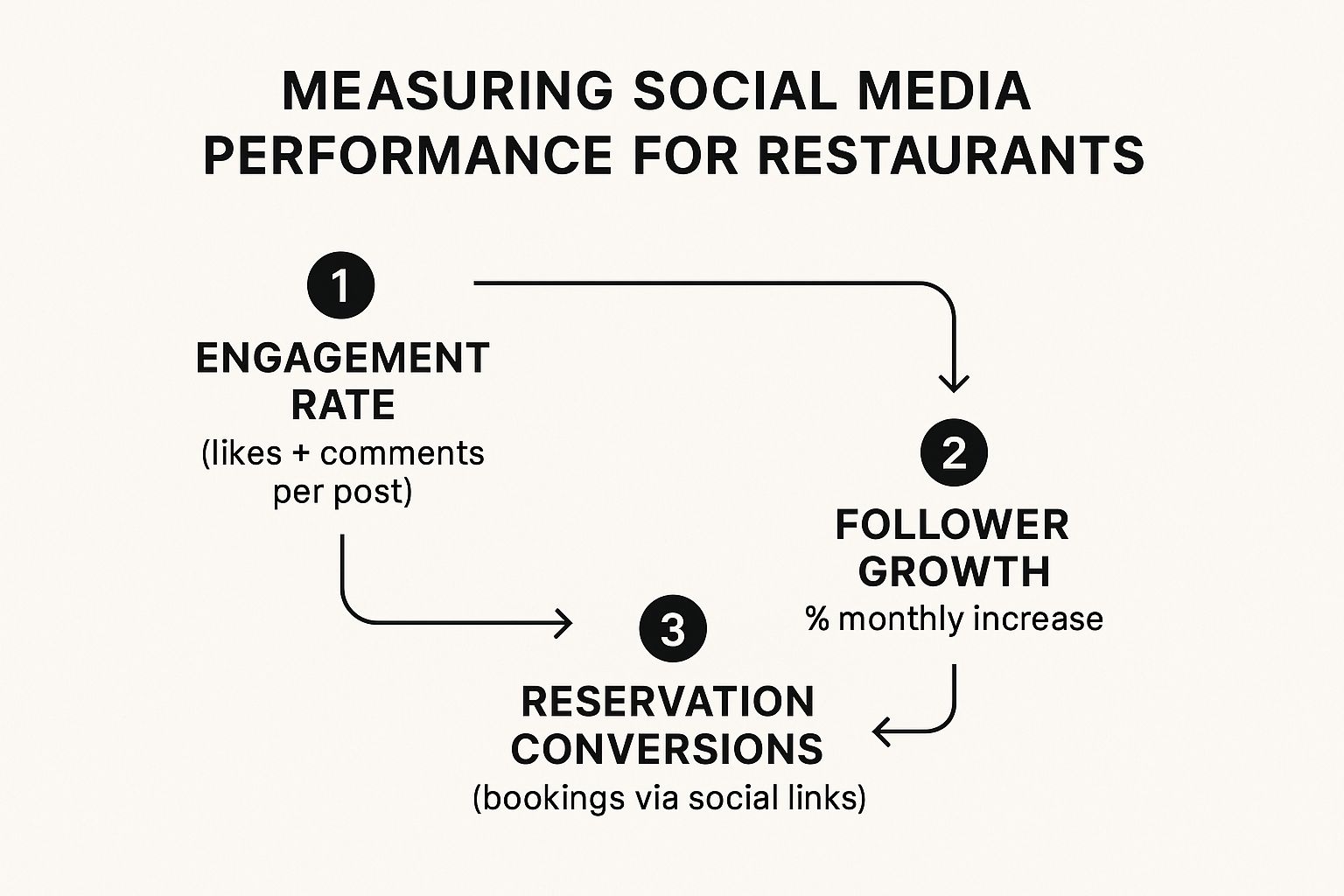
Your mandate is to track and optimize the conversion points at each stage of this funnel.
Building a Simple Growth Dashboard
You do not need complex, expensive software to begin. A simple spreadsheet is sufficient to track the handful of metrics that directly impact revenue. This dashboard will become your single source of truth, illuminating which activities are driving growth and which are wasting resources.
Focus exclusively on these key performance indicators (KPIs):
- Click-Through Rate (CTR) on "Reserve Now" Links: Of the total audience reached, what percentage clicked to initiate a booking? This metric directly measures the persuasive power of your content and CTA.
- Social Media Referral Traffic: Using your website analytics, identify the volume of traffic originating from your social channels. This establishes a clear link between your social presence and online booking/ordering funnels.
- Redemption Rate on Social-Only Promotions: When you deploy a unique offer code exclusively on social media, what is the redemption rate? This is one of the cleanest methods for attributing direct revenue to a specific campaign.
- Customer Acquisition Cost (CPA): For paid advertising, this is non-negotiable. Divide your total ad spend by the number of new customers acquired through that campaign. The objective is to continuously optimize and drive this number down.
Precision Revenue Attribution
To achieve an accurate financial picture, you must implement rigorous tracking. The most effective tool for this is the UTM parameter. This small string of code appended to your URLs allows your analytics platform to identify the exact social post, ad, or influencer that drove a specific reservation or order.
A/B testing is not exclusive to tech companies. Continuously test different ad creatives, headlines, and offers. A marginal improvement in your conversion rate can have a substantial impact on your P&L over time.
By tracking these metrics with discipline, your restaurant social media marketing evolves from a game of chance into a predictable system for driving revenue and filling tables.
Common Questions from Restaurant Operators
I am often asked about budget allocation for social media. While there is no universal figure, a sound starting point is to allocate 5-7% of gross revenue to your total marketing budget. A significant portion of this should be dedicated to digital and social media campaigns. View this as a capital investment, not an operating expense. For new initiatives, prioritize hyperlocal paid ads to drive immediate foot traffic and generate cash flow.
Another frequent query is how to manage negative public feedback. My guidance is unequivocal: never delete a negative comment. Address it publicly and professionally. A concise public response that acknowledges the feedback and offers to resolve the issue offline demonstrates accountability and builds trust with the wider audience observing the interaction.
Finally, what is the single most critical metric? It is not likes or followers. The most important KPI is the click-through rate (CTR) on your reservation or online ordering links. This metric directly connects your social media activity to revenue generation, proving its tangible impact on your P&L.
At MGXGrowth, we specialize in transforming a restaurant's social media presence into a predictable and scalable revenue engine. Learn more about our data-driven growth strategies and let's begin optimizing your customer acquisition funnel.
