


If you want to drive sustainable foot traffic to your restaurant, you must stop chasing tactical silver bullets and start architecting a unified growth system. This isn't about fleeting trends; it's about a relentless, data-driven focus on your ideal customer and executing an exceptional experience with operational precision. Every. Single. Time.
That is the core principle that separates a restaurant that sees a temporary spike in traffic from one that achieves defensible, long-term market share growth.
Your Foundation for Sustainable Restaurant Growth
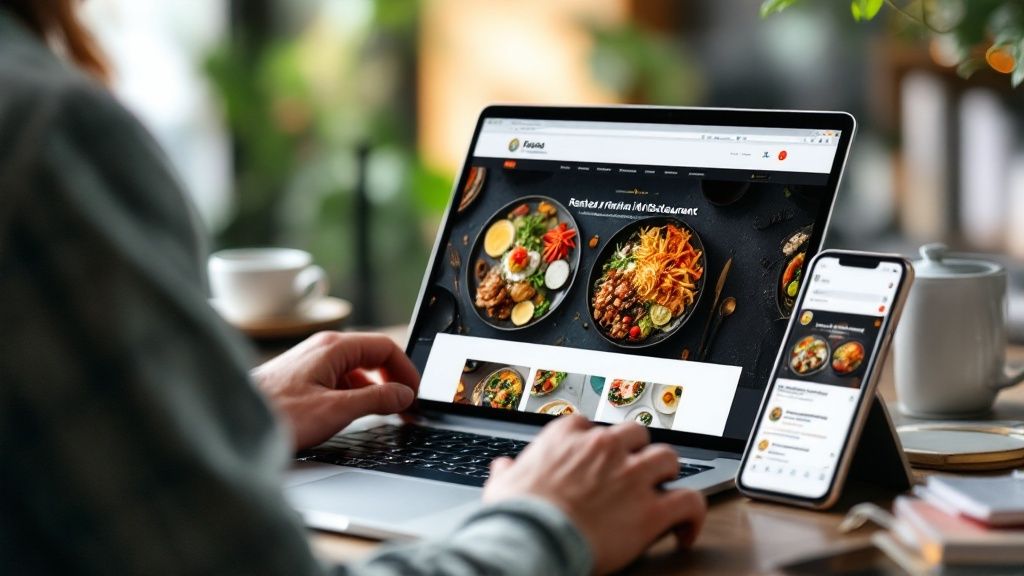
Across every industry I’ve driven growth in—from SaaS to hospitality—the most common point of failure is identical: a rush to tactics before strategy. Teams want to know which ad platform to use or what discount to offer before they've done the foundational work. But real, EBITDA-positive growth is never the result of a single marketing campaign. It’s the output of a powerful, integrated operational and experiential engine.
I’ve seen this scenario play out countless times: a restaurant allocates significant ad spend, generates a short-term buzz, and then traffic flatlines. Why? Because the operational reality couldn't deliver on the marketing promise, or the campaign attracted a cohort of low-value, one-time diners. Sustainable growth is architected from within your four walls by breaking down the silos between your teams.
Unifying the Customer Journey
Your kitchen, front-of-house, and marketing functions cannot operate as independent silos. They are sequential, interdependent components of a single customer journey. Any friction between them is felt directly by the customer.
Consider the value chain:
- Marketing generates demand by making a promise about a specific dining experience.
- Front-of-house must execute on the brand promise through service and ambiance.
- The Kitchen must deliver the product—the meal—with unwavering consistency that matches what marketing promoted.
When these three functions are aligned, you create a seamless, memorable experience that generates your most powerful marketing asset: authentic word-of-mouth. The objective must shift from merely filling seats tonight to building a brand that commands loyalty and organic advocacy.
"Your best marketing isn't an ad; it's a consistently excellent product and experience. Growth becomes inevitable when your operations become your best acquisition channel."
Defining Your Unique Value Proposition
Before allocating a single dollar to customer acquisition, you must answer one question with analytical clarity: Why should a customer choose my restaurant over all other available options, including staying home?
This is your unique value proposition (UVP). It cannot be "great food" or "good service"—those are table stakes. Your UVP must be specific and defensible.
Are you the definitive provider of the fastest, healthiest lunch for time-constrained professionals? The most authentic Neapolitan pizza within a 10-mile radius, backed by certified sourcing? The optimal environment for a quiet, romantic date night? Obsessing over this core identity is the highest-leverage strategic activity you can undertake. Your UVP dictates your menu engineering, decor, service model, and, critically, your target customer segment.
The market opportunity is substantial. The restaurant industry is projected to reach $1.5 trillion in sales, driven by strong consumer demand—81% of consumers state they would dine out more frequently if circumstances allowed. To capture this demand profitably, you need a laser focus on the specific experience and value you deliver, which begins with a crystal-clear UVP. You can explore more on the industry's growth trajectory and consumer demand to quantify the total addressable market.
Master Your Digital Front Door to Attract New Diners
Across every vertical I've operated in, from enterprise SaaS to hospitality, one truth remains constant: your digital presence is your new front door. A potential customer's first interaction with your brand now happens on a screen, long before they consider entering your physical location. We must evolve past simply "having a website" to architecting a digital ecosystem that actively drives customer acquisition.
The strategic goal is to own the customer journey from the initial search query. This means creating a frictionless path from discovery to direct booking or ordering, systematically reducing reliance on high-commission, third-party aggregators. Your website and social profiles are not digital brochures; they are high-intent acquisition channels that must be optimized for conversion.
Win the Local Search Game
Let's be tactical. When a high-intent customer searches for "tacos near me" or "best pasta in [your city]," failure to appear in the top search results renders your business functionally invisible. Mastering local search engine optimization (SEO) is therefore non-negotiable for customer acquisition.
Your Google Business Profile (GBP) is your single most critical asset in this battle. It is a free tool that, when optimized correctly, outperforms many paid media strategies. It is your digital storefront on the world's dominant search engine.
This is the output of effective optimization. A well-managed local business appears with high visibility, complete with a map, review velocity, and the key decision-making information a customer requires.
The restaurants that dominate this channel provide Google with complete, accurate, and engaging data. This signals to both the algorithm and potential customers that you are a legitimate, active, and high-quality operator.
To drive customer acquisition, you must manage your GBP with the same rigor as your physical restaurant. This requires:
- High-Quality Photos: Deploy professional, high-resolution imagery of your food, interior, and exterior. You are selling the experience before they arrive.
- Complete Information: Ensure 100% accuracy for hours, address, and phone number, particularly during holidays. Inaccurate data is a direct cause of customer churn.
- Menu Integration: Upload your full, current menu directly to your profile. Reduce friction by allowing customers to evaluate your offerings within the Google ecosystem.
- Active Q&A: Proactively populate and answer common questions regarding parking, reservations, or dietary accommodations. Control the narrative.
Turn Reviews into a Customer Magnet
Your online reputation is an active acquisition tool, not a passive metric. Today's market is defined by online reviews and digital convenience. Data shows 65% of customers are influenced by online reviews when selecting a restaurant. Concurrently, 67% of consumers prefer ordering directly from a restaurant's proprietary app or website.
This data tells a clear story: diners require social proof before converting and prefer a direct relationship with your brand. Every positive review is a trust signal that de-risks the decision for a new customer. You must implement a system to actively generate and manage this feedback.
I’ve always coached my teams to view a negative review not as a crisis, but as a public demonstration of exceptional customer service. A strategic, professional response that resolves the issue can convert more prospects than ten positive reviews.
Use Social Media to Build a Community, Not Just Followers
Your social media strategy must transcend posting aesthetically pleasing food photography. While high-quality visuals are table stakes, the objective is to build a community and communicate the unique experience your brand offers. This is a fundamental component of effective branding and content marketing that creates a defensible moat against competitors.
Focus on content pillars that articulate your brand narrative:
- Behind the Scenes: Showcase your chef sourcing ingredients from a local supplier or your team preparing for service. This builds authenticity and humanizes the brand.
- User-Generated Content: Systematically identify and repost high-quality photos from your customers. This is the most credible form of social proof available.
- Highlight the Experience: Shift focus from the plate to the people. Capture the ambiance, energy, and social connection that define a visit to your establishment.
By treating your digital presence as an integrated system—from local SEO and reputation management to community development—you build a powerful, scalable engine that consistently acquires new customers and drives repeat business.
Put a Modern Marketing Mix to Work Driving Foot Traffic
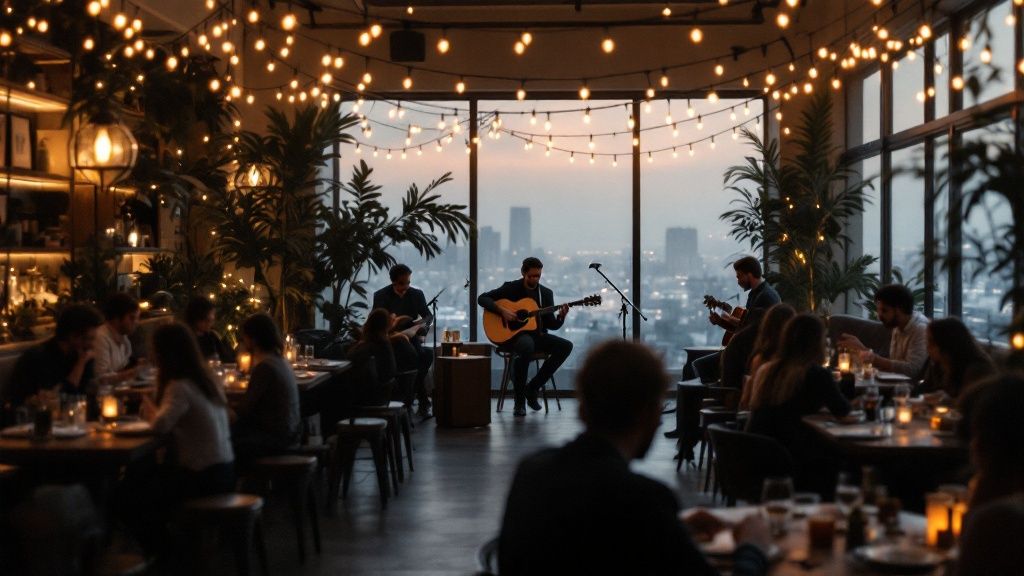
With a robust digital foundation in place, it’s time to strategically drive new customer acquisition. The operative word is strategic. I’ve seen too many restaurants incinerate their marketing budgets with a scattergun approach, hoping for a positive outcome. Growth is not a function of spend; it’s a function of intelligent investment in a modern, measurable marketing plan.
The goal is to engineer multiple, interconnected pathways that lead high-value diners to your tables. This isn’t about a single tactic, but about building a system where each component amplifies the others. We are moving beyond generic advertising into precision targeting and authentic connection.
Run Laser-Focused Social Media Ad Campaigns
Hitting "Boost Post" is not a marketing strategy; it is an abdication of one. The power of platforms like Facebook and Instagram lies in their sophisticated targeting capabilities. You can move far beyond simple demographics to reach your ideal customer based on their behaviors and interests.
Consider the data sets you can leverage:
- Behavioral Targeting: Target users who have recently engaged with high-end culinary content, follow celebrity chefs, or have demonstrated interest in "farm-to-table" dining.
- Geofencing: Serve ads to users physically located within a specific radius of your restaurant or who frequent complementary local businesses, such as theaters or hotels.
- Lookalike Audiences: This is a powerful growth lever. Upload your existing customer email list, and the platform will build a new audience of users who share characteristics with your most valuable patrons.
This level of precision ensures marketing spend is allocated only to individuals with a high propensity to convert. It transforms advertising from an expense into a direct, ROI-positive investment in growth. You can delve deeper into building this kind of plan in the digital marketing strategy framework I've implemented across multiple industries.
Forge Powerful Local Partnerships
One of the most underutilized growth channels for any local business is the network of adjacent, non-competing businesses. Your restaurant is not an island; it is part of a local economic ecosystem. Architecting a referral network is a low-cost, high-impact strategy for acquiring qualified customers.
For example, a premium steakhouse could formalize a partnership with a nearby corporate hotel, becoming the "preferred" dining option for business travelers. A simple commission structure for the hotel's concierge for each referred reservation creates a mutually beneficial arrangement.
Analyze other potential synergies:
- Event Venues: Collaborate with theaters, concert halls, or conference centers to create pre-show or post-event dining packages.
- Retail Shops: Partner with local boutiques for a "shop and dine" promotion, where a receipt from one business provides a discount at the other.
- Tour Companies: Position your restaurant as the exclusive lunch destination for a local food or city tour.
These partnerships generate a consistent flow of high-intent referrals from trusted sources, which carry a higher conversion rate than cold advertising.
Your goal isn't just to be a restaurant in a community, but to become a restaurant that is woven into the fabric of the community. Strategic partnerships are the threads that create that connection.
Create Urgency with Email and Influencers
Do not underestimate the power of email marketing. It remains one of the most effective channels for building affinity and triggering immediate action. This is your direct communication line to a high-intent audience that has already opted in. Deploy it to announce special events, limited-time menu items, or exclusive offers that create a compelling reason to visit now.
Simultaneously, integrate local influencers into your marketing mix. This is not a vanity metric exercise. It is about leveraging credible, third-party voices to generate powerful social proof. Identify local food bloggers or Instagrammers whose audience demographics align with your ideal customer profile. A single, authentic endorsement from a trusted local authority can often drive more foot traffic than a week of paid advertising.
Optimize Your Operations and Create Raving Fans
Let's be direct: Marketing acquires a customer once. Operations determine if they ever return. I have witnessed countless well-funded marketing campaigns collapse because the in-house experience failed to deliver on the brand promise. You cannot build sustainable growth on a foundation of operational inconsistency.
This is the critical handoff from marketing to operations, and it must be seamless. If your advertising promises a quick and efficient lunch, but a guest waits 10 minutes for a greeting, the brand promise has been broken. Every touchpoint—from the initial welcome to the final payment—is an integral part of your growth engine.
Engineer the Perfect Customer Journey
The moment a guest enters your establishment, you are being evaluated. You have a finite window to validate their decision. This requires a meticulous deconstruction of the entire customer journey to identify and eliminate every point of friction. This is not simply "good service"; it is the intentional design of a superior experience.
Analyze the process. Is the greeting immediate and authentic? Is the seating process efficient, even during peak hours? Minor points of friction compound rapidly. A disorganized host stand or a delayed greeting introduces immediate anxiety, forcing your team to expend extra effort to recover the guest experience.
Your single most powerful marketing tool is a flawlessly executed customer experience. It creates vocal advocates for your brand, which is something no amount of ad spend can ever buy.
Your front-of-house team are not order-takers; they are brand ambassadors and revenue drivers. I coach my teams to see themselves as guides for the entire dining experience. Empower them to make confident recommendations, articulate the story behind a signature dish, and resolve minor issues autonomously without requiring managerial intervention.
Smart Tech That Serves the Experience, Not Replaces It
Technology must be deployed as a tool to remove friction and empower your staff, not to replace the human element of hospitality. The objective is to free up your team for higher-value interactions with guests—not to automate your restaurant into sterility.
Consider the operational impact of strategic tech integrations:
- Handheld POS Devices: These are efficiency multipliers. They enable servers to take orders and process payments tableside, which significantly increases table turnover rates and reduces order entry errors.
- QR Code Menus & Payments: While not universally applicable, offering a QR code option for menu viewing or payment provides customers with control and speed. It is an efficiency play that meets a growing consumer expectation.
- Kitchen Display Systems (KDS): A KDS is the central nervous system of a consistent kitchen. It ensures clear, timed order fulfillment, which directly improves food quality and ticket times, especially under high volume.
These are not technology for technology's sake; they are strategic investments in a smoother, faster, and more profitable operation.
The Power of Unwavering Consistency
The primary driver of customer churn in hospitality is inconsistency. A guest who experiences the "best burger of their life" one month and returns to a mediocre product the next is a lost customer. This principle applies to every operational facet, from food preparation to service standards.
Consistency is not an accident; it is the output of rigorous systems and relentless training. It requires standardized recipes that are executed with precision every time. It demands clear service standards that are internalized by every team member, from the newest hire to the most senior manager.
This obsessive focus on operational excellence is the true secret to long-term customer acquisition. It shifts the model from constantly paying to acquire new patrons to earning their loyalty, transforming them into regulars who form the profitable foundation of your business.
Build a Retention Engine That Fuels Growth
Too many restaurant operators are trapped on an acquisition treadmill, relentlessly chasing new customers. Significant capital and effort are expended to get a customer in the door, only for that customer to churn after a single visit. This is a fundamentally broken growth model.
The most significant lever for profitable growth is sitting in your dining room: your existing customers.
The Leaky Bucket Problem
Acquiring a new customer is an expensive proposition. For a quick-service restaurant, the Customer Acquisition Cost (CAC) might be around $27, but for fine dining, this figure can escalate to nearly $180.
Allocating your marketing budget primarily to new customer acquisition while neglecting retention is analogous to filling a bucket with a large hole in it. The most strategic, ROI-positive investment you can make is in systems designed to convert first-time visitors into repeat customers.
Average Customer Acquisition Cost (CAC) by Restaurant Type
Understanding the fully-loaded cost to acquire one new customer provides critical context for your marketing budget. Here is a breakdown of average costs by restaurant segment.
| Restaurant Type | Average Paid CAC |
|---|---|
| Quick Service (QSR) | $27.00 |
| Fast Casual | $31.25 |
| Casual Dining | $68.00 |
| Fine Dining | $179.82 |
These costs underscore the economic imperative of building a sustainable growth loop fueled by repeat business and increased customer lifetime value (LTV).
It's Time to Move Beyond the Punch Card
Let's be clear: the analog "buy ten, get one free" punch card is an artifact of a bygone era. In a hyper-competitive market, loyalty is not earned through a generic discount. It is cultivated through recognition, personalization, and a superior customer experience.
A modern retention strategy is data-driven, and you are likely sitting on a wealth of data within your Point of Sale (POS) system.
Your POS is far more than a payment processor; it is a customer data platform. By analyzing this data, you can answer the questions that unlock profitable growth:
- Who are my highest-value customers? Identify the top 20% of patrons who likely generate 80% of your revenue.
- What are their purchasing behaviors? Understand their favorite dishes, drinks, and visit frequency.
- When do they visit? Segment them by daypart and occasion.
- What is their average spend? Differentiate your high-LTV customers from your discount-seekers.
This is not about becoming a data scientist; it is about leveraging data to understand your customer base. This is the foundational step toward making your customers feel seen, which is a prerequisite for making them feel valued.
Create Personalized Triggers to Bring People Back
Once you understand your customers' behavior, you can create targeted, automated campaigns that feel like a personal invitation, not a mass marketing blast. The objective is to connect your operational data to your marketing execution by establishing intelligent "triggers" that reactivate dormant customers.
Consider these scenarios:
- A customer who consistently orders your signature ribeye has not visited in 60 days. An automated system could send a personalized email: "We miss you, Sarah. The ribeye is waiting. Next time you join us, enjoy a complimentary glass of Malbec on the house."
- A family typically visits for brunch on the first Sunday of each month. If they miss their usual visit, a targeted communication with a small offer for the kids can serve as a powerful nudge to rebook.
The most powerful retention strategy is proactive personalization. Don't wait for a customer to forget about you; give them a compelling, relevant reason to remember you and come back.
This is how you increase customer frequency without continuously paying acquisition costs. You are reactivating an audience that already has a positive brand association. The data from these campaigns, as illustrated by the impact of local partnerships below, will show you exactly which levers are driving results.
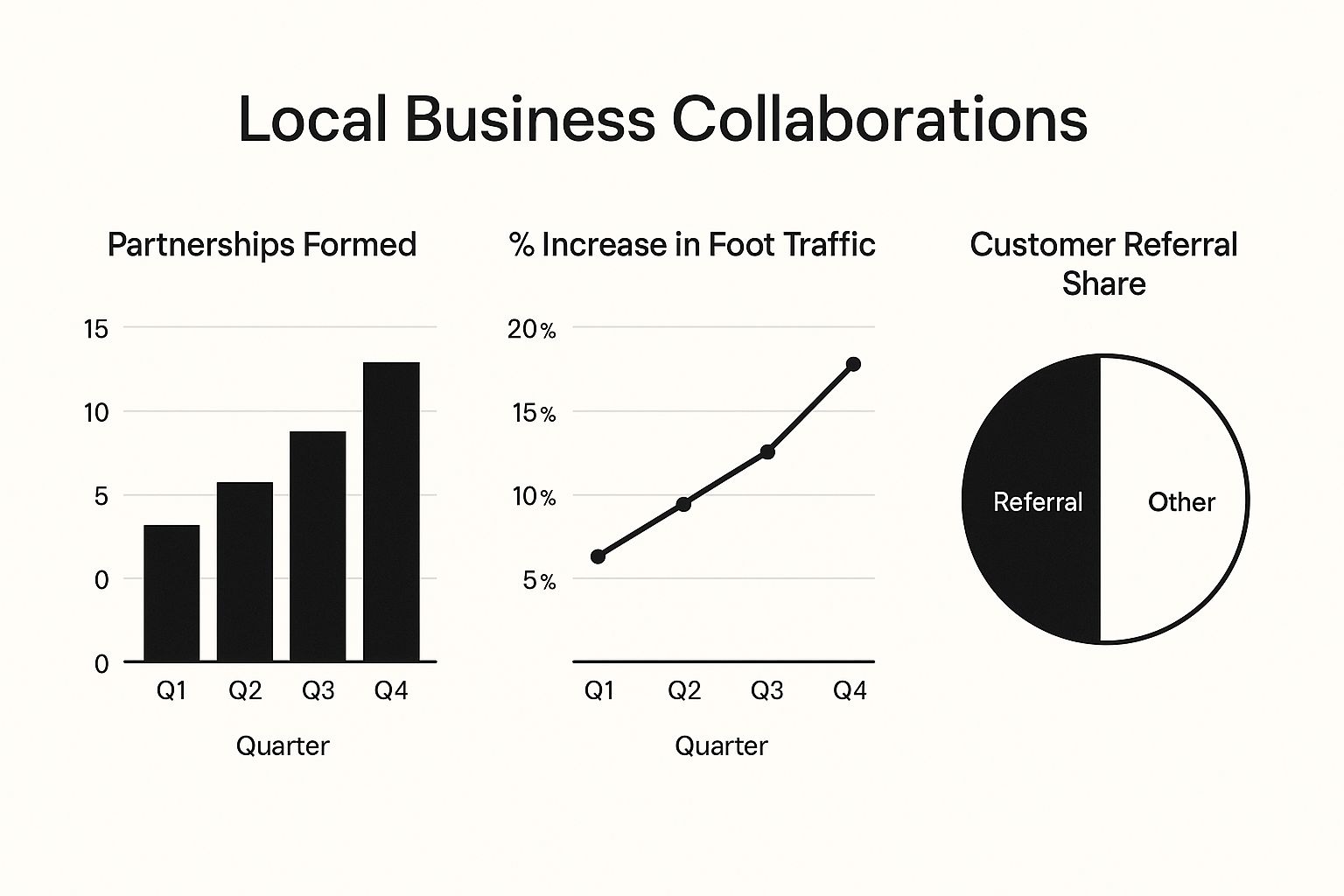
The chart provides a clear visualization of how strategic outreach directly impacts foot traffic and referrals. Applying this same data-driven methodology to your existing customer base ensures every marketing dollar is optimized for maximum ROI.
Turn Regulars into Your Biggest Fans
The final stage of this model is to convert loyal regulars into brand evangelists. These are the individuals who proactively leave five-star reviews, defend your brand online, and become an extension of your sales force by bringing in their friends and colleagues. This form of marketing is invaluable.
Achieving this requires a deep, qualitative understanding of what motivates your best customers. You can gain these insights by deploying various methods of client satisfaction measurement to gather direct, actionable feedback.
From there, empower your staff to recognize and reward these VIPs. A surprise complimentary dessert, a personal greeting from the chef, or early access to a new menu item can transform a satisfied customer into a passionate advocate. This transcends loyalty; it's about building a community around your brand that becomes a self-sustaining growth engine.
Answering Your Toughest Growth Questions

After advising leadership teams across multiple industries, I’ve seen the same fundamental growth challenges manifest repeatedly. The restaurant sector is no different. Here are my direct, data-informed answers to the most critical growth questions from operators. This is not theory; this is what my experience in hyper-competitive markets has proven to work.
What Should I Fix First with a Limited Budget?
With constrained capital, your focus must be on maximizing owned and free channels. The highest ROI activity, without question, is to claim and meticulously optimize your Google Business Profile. Treat it as your primary digital asset—and its core functionality is free.
Your immediate priority is to ensure that any potential customer searching for you, or a restaurant like yours, finds accurate, compelling information that builds trust. Perfect your menu, hours, and address data. Then, implement a systematic process to generate a steady stream of recent, positive reviews. These foundational steps require an investment of time, not capital, yet yield a disproportionately high impact on your visibility in local search results.
How Do I Know If My Marketing Is Actually Working?
You cannot manage what you do not measure. If you are not tracking marketing performance, you are not executing a strategy; you are deploying random acts of marketing. Every initiative must be tied to a clear, quantifiable metric to differentiate between activities that drive revenue and those that simply drain cash flow.
This requires integrating your marketing data with your operational data.
- Online: Utilize Google Analytics to track referral sources for your website traffic. For paid social campaigns, measure conversions on your reservation button and use unique promotional codes for different ad sets to enable A/B testing.
- In-Store: Do not neglect qualitative data. Train your staff to ask a simple question: "How did you hear about us?" The insights from this direct feedback are invaluable.
- POS Data: Your point-of-sale system is a data warehouse. Analyze it to track redemption rates for email offers and measure the engagement and ROI of your loyalty program.
Data turns ambiguity into action. It gives you the confidence to double down on what’s working and the clarity to cut what isn’t.
Should I Use Third-Party Apps or Build My Own System?
This is a strategic trade-off between reach and margin. Third-party platforms like Uber Eats or DoorDash provide immediate access to a massive, existing user base. They are powerful customer acquisition tools. However, the commission fees are significant, and you relinquish control over the customer relationship and data.
Conversely, developing a proprietary online ordering system yields higher margins and enables you to own the customer data. But this requires an upfront capital investment and a dedicated marketing effort to drive adoption.
For most restaurants, a hybrid strategy is optimal. Leverage the third-party platforms for customer discovery. Then, execute a conversion strategy: in every delivery order, include a compelling offer—such as 15% off their next order—valid only when they order directly from your website. You are effectively using the aggregator's marketing spend to acquire customers and then converting them into your own.
How Can I Get More Online Reviews Without Being Pushy?
The key is to minimize friction and ask at the moment of peak satisfaction. The ideal time to solicit a review is immediately after a guest has expressed unsolicited positive feedback to your staff.
Train your servers on a simple, non-transactional script: "I'm so glad you loved everything! As a local business, feedback is incredibly important to us. If you have a moment, a quick review on Google would mean the world to our team." It is direct, appreciative, and highly effective.
Supplement this with a low-friction technological solution. A small card with a QR code that links directly to your Google review page, presented with the check, is an efficient tactic. For online reservations, a simple, automated follow-up email thanking them for their visit and requesting feedback is a proven best practice. The easier you make it for happy customers to advocate for you, the more they will.
At MGXGrowth, we architect and implement the integrated growth systems that drive sustainable revenue and market share. We partner with brands to turn complex challenges into clear, actionable strategies. If you are ready to build the next stage of your restaurant's growth, let's connect at https://www.mgxgrowth.com.
