


Restaurant digital advertising isn't just marketing; it's a core business function designed to meet your customers where they spend their time: online. It is the strategic application of digital channels—social media, search engines, and local platforms—to drive reservations, takeout orders, and, ultimately, revenue.
The fundamental advantage of this approach lies in its data-centric nature. Unlike traditional media, digital advertising provides quantifiable results, allowing for precise targeting and continuous optimization for return on investment.
Why Digital Advertising Is Now Your Core Growth Engine
Throughout my career driving growth across multiple industries, I've observed a recurring pattern: the old playbooks become obsolete. For restaurants, relying on location and word-of-mouth is no longer a viable strategy for market leadership. The battle for customer acquisition and retention is now fought and won in the digital arena.
This is not about dabbling with a Facebook page or boosting a few posts. It's a fundamental paradigm shift. Restaurant digital advertising must be viewed as the primary engine for predictable growth, not a discretionary expense on a P&L statement. Every dollar deployed must be a strategic, trackable investment designed to yield a clear, measurable return.
The Shift from Expense to Investment
Operating as a data-driven restaurateur means systematically linking marketing expenditure directly to bottom-line results. This is a global macro-trend; worldwide ad spending is projected to reach $1 trillion in 2025, with over 75% allocated to digital channels. This is not arbitrary. It's a strategic reallocation of capital towards efficiency, accountability, and demonstrable ROI.
This data-first methodology removes ambiguity from marketing. Instead of hoping a billboard is seen by the right demographic, you can algorithmically serve an ad to an individual within a specific radius who has actively searched for "best tacos near me." This level of precision is the key to unlocking predictable, scalable growth.
The objective is to engineer a system where $1 invested in advertising consistently generates $3, $5, or even $10 in revenue. At that point, marketing ceases to be a cost center and becomes your most potent growth lever.
Achieving this requires a cohesive plan. It necessitates breaking down organizational silos between marketing, operations, and finance to align all teams toward unified growth objectives. A robust digital marketing strategy framework serves as the blueprint, ensuring every campaign is directly tethered to core business goals.
This is how you construct an online presence that doesn't just generate visibility—it drives reservations, increases online order volume, and builds a defensible market position.
Building Your Social Media Advertising Playbook
Across my experience in hospitality and tech, a common inefficiency persists: restaurant teams often treat social media as a creative outlet, disconnected from tangible business metrics. This is a strategic error. Social media is not a gallery for food photography; it is a powerful machine for customer acquisition and retention, but only when guided by a data-driven playbook.
Let's be unequivocally clear: vanity metrics like likes and followers are irrelevant. They do not impact your P&L. The only metrics that matter are those directly correlated with revenue—reservations booked, online orders placed, and repeat customer visits. Your entire social media strategy must be engineered to drive these specific outcomes.
Consider the customer journey. The modern diner's path to your establishment almost invariably begins on a mobile device. A compelling 74% of diners now leverage platforms like Instagram and Facebook for restaurant discovery. This interaction doesn't end at awareness; 57% proceed to book reservations directly through these social channels, converting passive browsing into measurable revenue. The data is conclusive: an underdeveloped digital presence isn't just a missed opportunity—it's a direct loss of market share. You can analyze more restaurant social media trends to grasp the strategic imperative.
Choosing the Right Platforms
Not all social media platforms deliver equal ROI. A diluted, multi-channel approach is a common path to budget exhaustion with minimal results. You must concentrate capital and effort where your ideal customer segment is most active.
-
Instagram & Facebook: For the vast majority of restaurant concepts, these platforms are non-negotiable. Their visual-centric format is ideal for showcasing cuisine, ambiance, and promotions. Critically, their advertising platforms offer sophisticated targeting capabilities, allowing you to segment audiences by location, psychographics (e.g., "foodies," "fine dining"), and past engagement.
-
TikTok: To penetrate the Gen Z and younger millennial demographics, a TikTok presence is mandatory. The platform's short-form video algorithm rewards authenticity, making it ideal for behind-the-scenes content, chef features, or user-generated content campaigns that foster a genuine brand connection.
-
Local Platforms (Yelp, Nextdoor): While not traditional social networks, their advertising products should not be overlooked. Users on these platforms exhibit high purchase intent; they are actively seeking immediate dining solutions. This represents a prime opportunity to capture local customers at the final stage of their decision-making process.
Crafting Ads That Actually Convert
Your ad creative serves a single function: to interrupt a user's scroll and compel a specific action. A high-quality image of your signature dish is table stakes, but insufficient on its own. Your ad must present a clear, compelling offer and a direct call-to-action (CTA).
Frame your ad as a direct invitation with a clear value proposition. Are you promoting a "Weeknight Happy Hour" or "New Special for Delivery"? Specificity is paramount. A precise offer combined with compelling visuals is what drives conversions, not passive views.
The objective is to minimize friction between ad exposure and customer conversion. Whether it's a "Book Now" button integrated with your reservation system or a "Shop Now" link to your online ordering portal, every potential obstacle must be eliminated.
Executing this correctly is what separates professional growth marketing from amateur efforts. It's why many restaurants find that partnering with a specialized restaurant advertising agency accelerates their learning curve—they provide proven frameworks for building campaigns laser-focused on conversion. This is how you transition from simply "doing" social media to integrating it as a core component of your growth engine.
Mastering Search Ads to Capture Local Diners

While social media is effective for demand generation, search advertising is designed for demand capture. Consider the critical moment in the customer journey: the user types "best Italian food near me" or "restaurants open now" into their device.
This is not passive browsing. It is a high-intent signal of an imminent transaction.
Securing top visibility at this exact moment is non-negotiable. Failure to appear at the top of Google's search and map results is a direct concession of revenue to your competitors. Unlike a social media ad, which interrupts a user's feed, a search ad is the explicit answer to a user's query.
The strategic objective is simple: convert that search query into a reservation or a walk-in. This requires mastery of platforms like Google Ads and treating your Google Business Profile as the strategic digital asset it is.
Owning Your Digital Front Door
Your Google Business Profile (GBP) is, unequivocally, your most valuable digital asset. It is the first point of contact for the majority of potential customers. Before allocating a single dollar to paid ads, you must optimize this profile to perfection.
A well-managed GBP functions as a high-conversion landing page embedded directly within search results. It provides essential data points: address, phone number, hours, menu, and—most critically—reviews. Research indicates that 90% of guests research a restaurant online before visiting, making your GBP the single most important first impression.
Treat your GBP as your digital storefront. A customer makes a split-second decision to engage or move on based on the quality of your photos, the sentiment of your reviews, and the accuracy of your information.
An incomplete or outdated profile erodes trust instantaneously. Conversely, a profile rich with professional photography and a consistent flow of positive reviews becomes your most powerful customer acquisition tool.
Building High-Intent Search Campaigns
With a solid GBP foundation, the next step is to build search campaigns that target users with immediate purchase intent. This is about surgical precision, not a wide net. Your entire strategy must be built around keywords that signal a user is in the final stages of their decision-making process.
I categorize these keywords into three primary buckets:
- Location-Based Keywords: These include searches like "restaurant downtown," "sushi in [Your Neighborhood]," or "bars near me." They capture users who are geographically positioned and actively seeking dining options.
- Cuisine-Specific Keywords: This targets the diner with a specific craving, such as "best tacos," "vegan pizza," or "seafood restaurant."
- Branded Keywords: While it may seem counterintuitive to bid on your own restaurant's name, it is a critical defensive strategy. It prevents competitors from running conquesting campaigns on your brand term and siphoning off customers who are already seeking you out.
The key to a profitable campaign is ensuring perfect message match between the user's search query, your ad copy, and your landing page. If someone searches for "family friendly restaurants," your ad must explicitly mention your kids' menu, and the destination page must reinforce that value proposition. This alignment is what drives high conversion rates and maximizes return on ad spend.
Mastering these details is complex, which is why strategic partnerships often yield superior results. You can learn more about identifying high-caliber restaurant marketing services near me that specialize in this discipline. This is the methodology for consistently converting clicks into profitable customers.
How to Set a Realistic Digital Advertising Budget

The most frequent question I receive from restaurant executives is, "How much should we allocate to digital advertising?" My answer is consistent: let the data dictate the budget. Arbitrary allocations are the fastest path to capital incineration with no measurable return. A strategic financial plan transforms advertising from a line-item expense into a predictable, scalable investment.
Abandon outdated, flawed benchmarks like allocating 3-5% of revenue. This model is inherently broken, as it ties marketing potential to past performance rather than using it to fuel future growth. An effective budget is built from the ground up, based on two core metrics: the cost to acquire a new customer and the lifetime value of that customer.
Start with Your Unit Economics
To budget effectively, marketing and finance must operate from a shared set of metrics. The entire model hinges on two key performance indicators that directly link ad spend to profitability: Customer Lifetime Value (LTV) and Customer Acquisition Cost (CAC).
-
Customer Lifetime Value (LTV): This is the total gross margin you can expect from an average customer over their entire relationship with your restaurant. It encompasses every transaction, from their first meal to their last.
-
Customer Acquisition Cost (CAC): This is your total advertising expenditure divided by the number of new customers acquired through those campaigns. It is, simply, your cost to buy a new customer.
The strategic insight comes from analyzing the relationship between these two metrics.
Your business model is profitable as long as your LTV is significantly greater than your CAC. A healthy LTV:CAC ratio for most businesses is at least 3:1—for every dollar spent to acquire a customer, you should generate at least three dollars in gross margin over their lifetime.
This simple ratio serves as your financial North Star. It provides a clear ceiling for how much you can afford to spend to acquire a new customer while maintaining profitability.
Choosing a Budgeting Model
Once you have established your target CAC, you can construct a budget designed to achieve specific growth objectives. Instead of relying on an arbitrary percentage, you employ an objective-based model.
For example, assume your objective is to acquire 200 new customers this month. Through analysis, you have determined your maximum allowable CAC is $15. Your initial budget is therefore calculated as $3,000 ($15 CAC x 200 customers). This methodology directly links every dollar of spend to a measurable business outcome.
With this budget, you would then allocate capital across your highest-performing channels—be it social media, search, or others—based on which ones can deliver new customers at or below your $15 CAC threshold.
This is not a static process. A strategic advertising budget is dynamic. You must continuously monitor performance, reallocating capital away from underperforming campaigns and increasing investment in those that prove efficient. This disciplined, data-driven approach to capital allocation is what separates restaurants that achieve market leadership from those that merely survive.
Measuring Performance and Optimizing for ROI
I've advised countless restaurant groups, and a universal truth holds: if you cannot measure your advertising, you cannot manage it, and you certainly cannot optimize it. This is where we transition from merely executing campaigns to architecting a predictable, profit-generating engine for your business.
We must establish a clear through-line from every campaign to your P&L. Vanity metrics like post "likes" are distractions. The only questions that hold strategic value are: What was the cost per reservation generated? What was the cost per online order acquired? Your success is contingent on tracking the KPIs that reflect tangible business impact.
Building a Data-Driven Feedback Loop
At its core, effective advertising is the creation of a perpetual feedback loop: deploy capital, measure results, derive insights, and iterate. It is a continuous cycle of optimization that transforms marketing from an art into a science. The entire process begins with the proper implementation of analytical tools, such as Google Analytics, to track which ads are driving traffic and, more critically, converting that traffic into revenue-generating customers.
Consider the methodology of a chef developing a new menu item. They don't combine ingredients arbitrarily and hope for a positive outcome. They taste, adjust seasoning, and re-taste with discipline. The same rigor applies here. You should be in a constant state of A/B testing—modifying headlines, swapping creative assets, or refining offers—to identify what resonates most effectively with your target audience. This relentless testing is the mechanism by which you systematically reduce acquisition costs and increase returns over time.
This chart illustrates a sample budget allocation between search and social channels, highlighting their respective return on investment and a six-month expenditure trend.
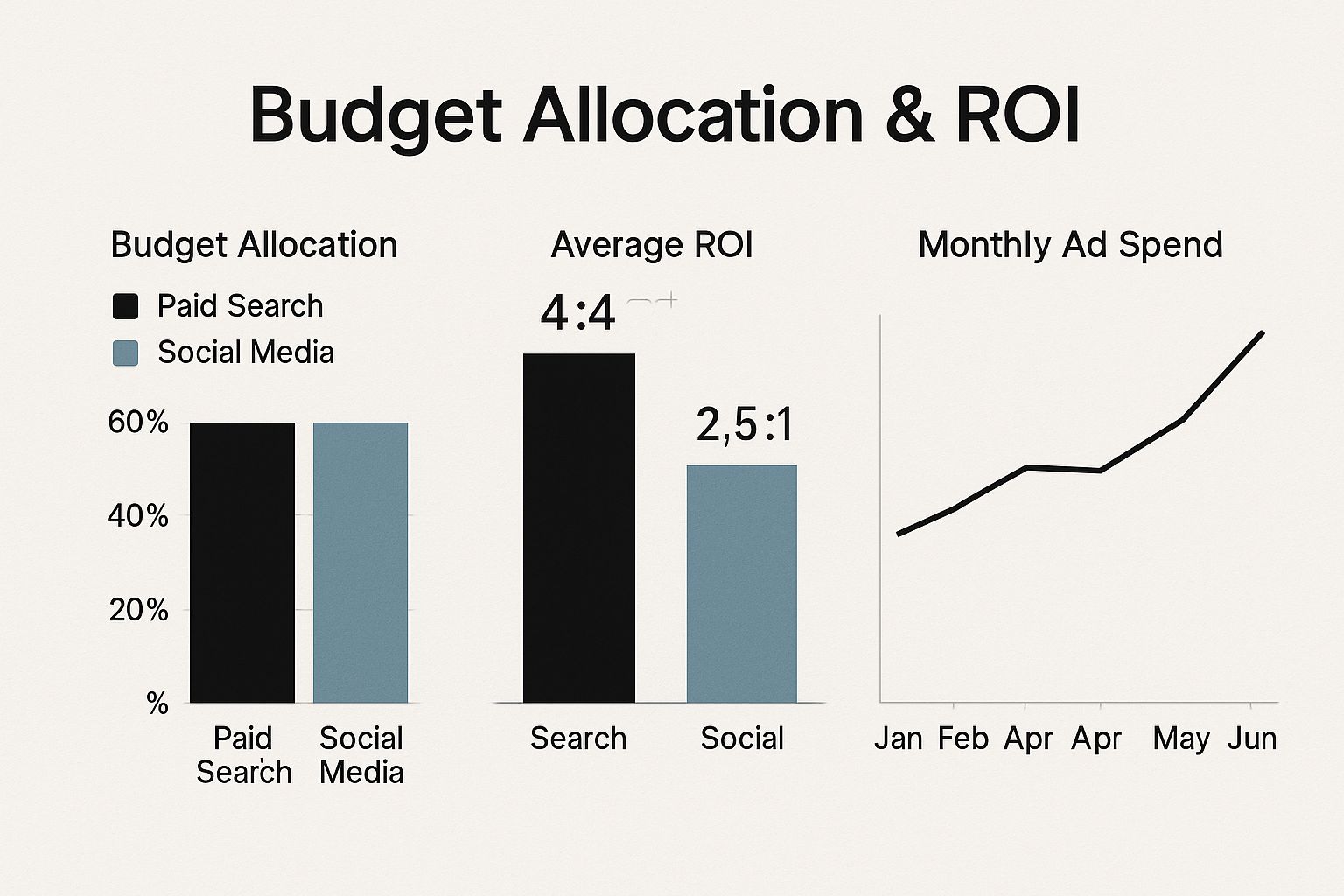
As the data indicates, while both channels contribute to the marketing mix, search advertising typically yields a higher direct ROI. It is an indispensable component for capturing high-intent diners at the precise moment of their decision.
Key Metrics That Drive Profitability
To maximize the efficiency of your budget, you must focus on the correct performance indicators. Data from 2025 shows the industry average Cost Per Click (CPC) for restaurants on platforms like Google Ads is approximately $2.69. However, with sophisticated optimization, I have seen campaigns achieve a CPC as low as $0.23. The delta is enormous.
Similarly, a standard Click-Through Rate (CTR) is a mere 1.43%, but with precise targeting and compelling creative, that figure can exceed 14%. For a restaurant operating on thin margins, mastery of these metrics is paramount to profitability. You can explore these figures in greater detail with these restaurant advertising benchmarks and their impact.
The objective isn't merely to run ads; it's to build a profitable customer acquisition engine. Every campaign must be treated as an experiment designed to answer a single question: "How can we acquire new customers for less than their lifetime value to our business?"
Answering that question iteratively is the secret to sustainable growth. It demands full alignment between your marketing and finance teams, focused on the metrics that directly impact the bottom line:
- Return on Ad Spend (ROAS): For every dollar invested in advertising, what is the gross revenue returned?
- Cost Per Reservation: What is the advertising cost required to secure one confirmed booking?
- Cost Per Online Order: What is your advertising cost for each delivery or takeout order processed?
When you track these metrics with rigor, you gain command over your growth trajectory. You know precisely which levers to pull to enhance profitability, transforming your restaurant's digital advertising from a speculative expense into a calculated, high-yield investment.
Essential Restaurant Advertising Metrics to Track
To operationalize this, the following table deconstructs the most critical metrics, their definitions, and target benchmarks. Consider this your dashboard for converting data into revenue.
| Metric | What It Measures | Good Benchmark | Action to Improve |
|---|---|---|---|
| Return on Ad Spend (ROAS) | Revenue generated for every dollar spent on ads. The ultimate measure of profitability. | 4:1 or higher | Refine ad targeting to higher-value audiences. Improve offers and promotions to increase average order value. |
| Cost Per Acquisition (CPA) | The total cost to acquire one new paying customer (e.g., a reservation or an online order). | Below customer lifetime value (CLV) | Optimize ad creative and landing pages for higher conversion rates. A/B test different calls to action. |
| Click-Through Rate (CTR) | The percentage of people who see your ad and click on it. Measures ad relevance. | 5% or higher | Write more compelling ad copy. Use high-quality, mouth-watering images or videos. Test different headlines. |
| Cost Per Click (CPC) | The average amount you pay each time someone clicks your ad. | Under $2.00 | Improve your ad's Quality Score (on Google). Use more specific, long-tail keywords. Target less competitive audiences. |
| Conversion Rate | The percentage of ad clickers who take a desired action (e.g., book a table, order online). | 5-10% | Simplify your reservation or ordering process. Ensure your website is mobile-friendly. Add social proof like reviews. |
By maintaining a disciplined focus on these KPIs, you are no longer just spending on advertising—you are strategically investing in your restaurant's future. You will make more intelligent capital allocation decisions, eliminate inefficient spend, and scale the campaigns that demonstrably drive business growth.
Straight Answers to Your Toughest Questions
After decades spent advising growth-stage companies, including numerous hospitality brands, I've identified the recurring challenges and questions that confront restaurant leadership. Let's address them directly with data-driven, actionable answers.
How Much Should a Small Restaurant Spend on Digital Ads?
Disregard the outdated guideline of allocating 3-5% of total revenue. That approach is arbitrary. A more strategic methodology is to work backward from the economic value of a new customer.
First, establish your target Customer Acquisition Cost (CAC)—the maximum amount you are willing to invest to acquire one new customer.
If your objective is 100 new customers this month, and you determine a profitable CAC is $10, your starting budget is $1,000 per month. It is that straightforward. Begin with a manageable figure, meticulously track your Return on Ad Spend (ROAS), and strategically increase investment in channels that prove efficient. Treat your advertising budget as a direct investment in growth, not a fixed operational cost.
Which Social Media Platform Is Best for Restaurants?
There is no universally "best" platform. The optimal platform is the one where your target customer demographic concentrates their attention. For most restaurant concepts, however, Instagram and Facebook are foundational. Their visually driven formats are ideally suited for food and beverage, and their user base is extensive and demographically diverse.
If you are targeting younger demographics like Gen Z or millennials, a presence on TikTok is non-negotiable. The platform's algorithm rewards authentic, short-form video content, which aligns well with modern consumer preferences. The strategy is to identify where your audience resides and achieve mastery on one or two core channels before diversifying your efforts.
Is SEO More Important Than Paid Social Media Ads?
This poses a false dichotomy. It is not an "either/or" scenario. These are distinct tools within your marketing arsenal, each serving a specific strategic purpose.
Conceptualize it this way: SEO and your Google Business Profile are your foundation. They are 'pull' marketing—they capture existing demand from users actively searching for dining options now. Paid social ads are 'push' marketing—they create new demand by proactively placing your offering in front of qualified audiences who were not necessarily in-market until they saw your ad.
An integrated strategy leverages both. You require a robust SEO foundation to capture existing high-intent demand. You then layer paid social advertising on top to generate new demand and accelerate growth. Always prioritize optimizing your local SEO first; it is a long-term, appreciating asset that pays continuous dividends.
At MGXGrowth, we specialize in architecting these data-driven advertising engines that convert marketing expenditure into predictable revenue streams. We partner with restaurants to eliminate guesswork and implement strategies that deliver quantifiable, bottom-line results.
If you are ready to engineer your next stage of growth, let's connect. Find out how we can help.
