


A consulting engagement is not a rescue mission; it's a strategic partnership. It’s about integrating an expert into your leadership team to systematically fine-tune operations, drive EBITDA, and build a resilient enterprise. My role is to transition your leadership from reactive, day-to-day firefighting to proactive, long-term value creation, leveraging objective, data-driven analysis.
Why Top-Performing Restaurant Owners Engage Growth Strategists

Across decades of driving growth in hospitality and other hyper-competitive sectors, I’ve seen a recurring pattern. Passion launches a restaurant, but a rigorous, data-centric strategy is what scales it. Many owners I partner with are culinary geniuses or masters of hospitality, yet they're so enmeshed in daily operations that strategic oversight becomes impossible. They can’t see the entire system because they are a component within it.
This is precisely where consulting for restaurant owners creates immense value. It’s not an admission of weakness; it is a decisive executive action to accelerate growth. A consultant isn't an auditor who simply identifies flaws. Think of them as a fractional COO or Chief Strategy Officer. They bring a dispassionate, analytical framework to navigate the industry's complex challenges, from razor-thin margins to evolving consumer behavior.
Gaining an Unbiased, Strategic Perspective
When you are simultaneously managing inventory, leading your team, and ensuring guest satisfaction, achieving objective distance from your business is a monumental challenge. A strategist provides that crucial external viewpoint, connecting disparate data points from your kitchen, front-of-house, marketing, and finance departments to unlock growth opportunities that are invisible from the inside.
My objective is to reframe your restaurant from a high-stress occupation into a scalable, high-value asset. This partnership is centered on architecting systems that deliver predictable, repeatable results, thereby empowering you to work on the business, not just in it. We accomplish this by focusing on quantifiable objectives:
- Optimizing Profitability: We conduct a forensic analysis of your P&L to identify and eliminate margin erosion, from COGS inefficiencies to suboptimal labor deployment.
- Enhancing Operational Efficiency: We re-engineer workflows to eliminate friction, reduce waste, accelerate service delivery, and increase team productivity and morale.
- Driving Sustainable Growth: We architect a brand and marketing engine designed not merely for customer acquisition, but for maximizing Customer Lifetime Value (CLV).
A consultant's core function is to synthesize fragmented data—from POS analytics and P&L statements to customer sentiment analysis—into a coherent, actionable growth strategy. It’s about converting raw information into decisive, profitable action.
Ultimately, engaging a consultant is an investment in building an anti-fragile business. The restaurant industry is notoriously volatile. However, the operators who consistently outperform the market are those who build their enterprises on a foundation of sound strategy, operational excellence, and an unwavering focus on the customer. That is the blueprint for a business that doesn't just survive—it dominates.
Pinpointing Your Restaurant's Growth Levers
A restaurant is not a single entity; it is a complex ecosystem of interconnected systems operating in concert. I view it as a high-performance engine. When every component is calibrated and synchronized, the output is explosive power and efficiency. But if a single system is misaligned, the entire engine sputters, consuming excess resources and losing momentum.
As a growth strategist, my role is that of a master diagnostician. I don't just observe the engine; I deconstruct it. I analyze the fuel injection (financials), the combustion cycle (operations), the emissions system (customer feedback), and the electronic control unit (data analytics). By isolating the most critical growth levers, we can execute targeted optimizations that generate maximum impact on enterprise value.
Decoding the Financial Engine
Your Profit and Loss (P&L) statement is the central nervous system of your restaurant's financial engine. Far too many operators treat it as a historical record—a lagging indicator of past performance. This is a critical error. It must be utilized as a real-time diagnostic tool, providing a constant pulse on the operational and financial health of the business.
The global foodservice market is valued at $3.09 trillion and is projected to exceed $4.1 trillion by 2033. However, this macro growth does not automatically translate to profit. While top-quartile performers can achieve net profit margins of 10%, the industry average hovers at a precarious 3% to 5%. In this low-margin environment, financial precision is not an advantage; it is a prerequisite for survival.
To achieve this, a consultant systematically disassembles the P&L to optimize for cash flow and profitability. This process involves:
- Cost of Goods Sold (COGS) Analysis: We move beyond top-line food cost percentages, drilling down to the SKU level to identify opportunities for strategic sourcing, optimized purchasing cycles, and rigorous waste reduction protocols.
- Labor Optimization: Labor is a dynamic, controllable expense, not a fixed cost. By cross-referencing sales velocity data with staffing schedules, we ensure optimal deployment of human capital—eliminating overstaffing in troughs and preventing understaffing during peaks.
- Intelligent Pricing Strategy: Arbitrary price increases are a blunt instrument. A data-driven methodology involves analyzing price elasticity, competitive positioning, and the psychological impact of menu design to maximize revenue per transaction.
Achieving Operational Excellence
With the financial framework calibrated, we pivot to the mechanics of service delivery—your operational workflows. Inefficiency in the front or back of house acts as friction in the engine, draining energy and causing systemic stress. My methodology involves breaking down the silos between the kitchen and the dining room to create a single, seamlessly integrated production system.
Operational excellence is not achieved by working harder; it is achieved by eliminating the systemic friction that forces your team to over-exert. It is about designing systems where the most efficient process is also the easiest.
This systematic optimization means streamlining every touchpoint, from order injection to payment processing. The objective is clear: reduce ticket times, increase table turns, and ensure every customer interaction is executed flawlessly.
The Science of Menu and Brand Strategy
Your menu is unequivocally your most potent marketing and sales asset. Yet, it is frequently treated as a mere price list. True Menu Engineering is a quantitative discipline that balances item popularity (sales velocity) against profitability (contribution margin).
Here, we analyze the core components of menu optimization, integrating profit margin, sales volume, and ingredient costs into a unified strategic framework.
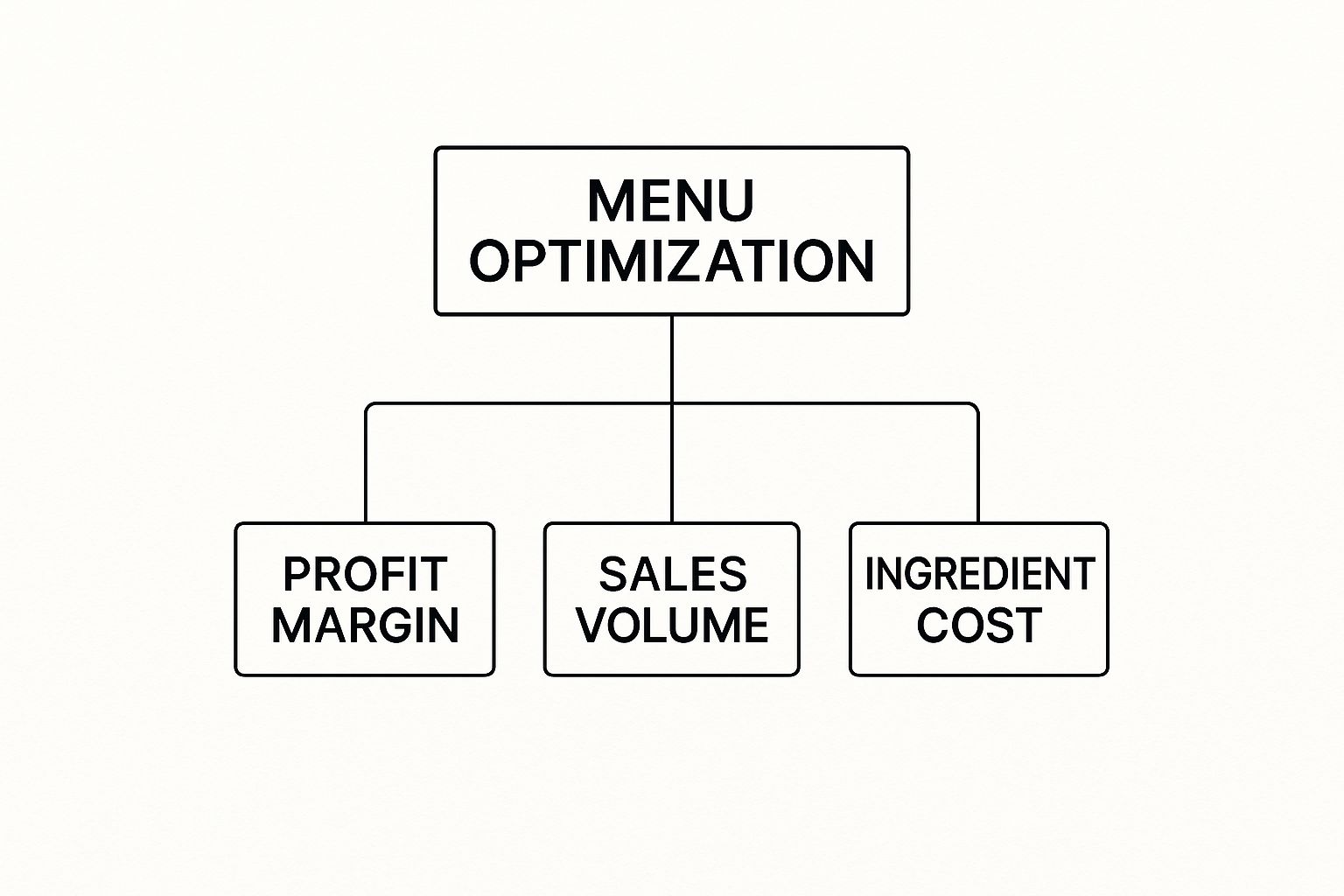
The matrix illustrates that an optimized menu is not about singular metrics. It's about the strategic equilibrium of these competing variables. By deep-diving into your POS data, we can instantly identify your "stars" (high profit, high popularity) and your "puzzles" (high profit, low popularity), which dictates precise strategic interventions. You can explore these concepts in greater detail in our guide on restaurant revenue growth strategies.
Finally, your brand strategy is the gravitational force that drives customer acquisition. It is the narrative communicated through your environment, your service protocol, and your marketing. A consultant ensures this narrative is coherent, compelling, and targeted at the right customer segments, transforming your restaurant from a commodity into a destination. Each of these levers—financial, operational, and strategic—must be manipulated in concert to generate real, sustainable enterprise growth.
Turning Economic Headwinds Into Opportunities

In my experience, adverse market conditions are the ultimate stress test for any business model. For restaurant owners, factors like inflation, labor shortages, and shifting consumer behavior represent a confluence of threats. The common reaction is defensive retrenchment. However, the businesses that emerge stronger are those that leverage the disruption as a catalyst for reinvention.
Economic pressures have a clarifying effect. They compel you to eliminate operational slack and focus intensely on what delivers value to your customers and your bottom line. This is where a sharp strategist becomes a critical asset, guiding a shift from a defensive posture to an offensive one. The objective is not merely to patch leaks, but to re-engineer the vessel to be faster, more efficient, and hyper-responsive to its environment.
Consider the current climate. Restaurant menu prices have increased by approximately 4% year-over-year, outpacing the rate of grocery inflation. This creates a difficult strategic dilemma: how do you protect margins without alienating a price-sensitive customer base, particularly as foot traffic is projected to soften?
Building a Bulletproof Operational Core
When margins are compressed, efficiency becomes your primary competitive advantage. The first step is to dismantle the functional silos separating the kitchen, front-of-house, and back office. Your chef is focused on food cost, while your service team is focused on table turns. A consultant's job is to create a unified system, demonstrating how a minor modification to a dish's composition can reduce prep time, enabling faster turns and ultimately increasing server compensation and morale.
This holistic, system-wide view invariably uncovers opportunities to optimize your two largest expense categories: food and labor.
- Strategic Menu Re-engineering: We leverage sales data to identify and promote high-margin items while re-engineering or eliminating high-effort, low-contribution dishes. This is not about compromising quality; it is about architecting a menu that functions as a powerful profit engine.
- Dynamic Staffing Models: We replace static schedules with predictive models. By analyzing historical sales data, local event calendars, and even weather patterns, we can forecast demand with high accuracy. This ensures optimal labor deployment—preventing costly overstaffing during lulls and capturing all potential revenue during peaks.
Transforming Customer Data Into Predictable Revenue
In a volatile economy, your existing customer base is your most valuable asset. The strategic challenge is converting transactional customers into a loyal cohort that generates predictable, recurring revenue. To achieve this, we must move beyond generic, broadcast-style discounts and implement intelligent, data-driven loyalty systems.
In turbulent times, the businesses that win are those that know their customers better than the competition. Data isn't just numbers on a spreadsheet; it's the voice of your customer telling you exactly what they want.
By analyzing purchasing behavior, visit frequency, and average spend, we can craft personalized, behavior-triggered offers. Instead of a generic "10% off" email, imagine deploying an automated offer for a complimentary appetizer to a guest who previously ordered it consistently but has lapsed for 60 days. This is a high-precision tool for re-engagement.
This targeted methodology not only drives repeat business but also builds significant brand equity, making your restaurant the default choice. To explore this model further, our guide on business model innovation details how to construct this level of operational resilience. This is how marketing transitions from a cost center into a direct, measurable engine for revenue growth.
Finding a Consultant Who Delivers Real Results
Selecting a consultant is a significant capital allocation decision. The right partner is more than an advisor; they become an embedded member of your executive team, a strategist as intensely focused on your P&L as you are. After decades of leading growth initiatives across various sectors, I can state unequivocally that the most successful partnerships are founded on a mutual obsession with measurable outcomes—not on delivering a beautifully designed PowerPoint deck.
Identifying that individual requires looking beyond a polished pitch. You need a rigorous framework for vetting who can actually execute. It’s about finding a professional who understands your vision, aligns with your culture, and has a verifiable track record of creating enterprise value. This isn't about hiring a vendor; it's about securing a strategic partner.
Look for a Strategist, Not Just an Advisor
First, it is critical to distinguish between an advisor and a strategist. An advisor offers recommendations based on industry best practices. A strategist, by contrast, embeds themselves in your organization, dives deep into your proprietary data, collaborates with your teams, and architects a bespoke roadmap where every initiative is directly linked to a financial KPI.
An advisor tells you what to do. A strategist shows you how to execute, measures the financial impact, and helps you iterate and optimize in real-time. They are accountable for the outcome.
Vet Their Track Record with Verifiable Proof
Any consultant can speak to a history of success. A true growth strategist can prove it with quantifiable data. When interviewing potential partners, reject ambiguous claims of "improving performance."
Demand concrete evidence. Ask for case studies that clearly define the client’s initial problem, the specific strategies implemented, and—most critically—the measurable results. Focus on the metrics that drive enterprise value:
- Revenue Growth: What was the top-line revenue increase, and over what period?
- Profitability Improvement: By how many basis points did they increase EBITDA or net profit margins?
- Cost Reduction: Where did they achieve specific, quantifiable savings in COGS, labor, or SG&A?
- Return on Investment (ROI): What was the financial return generated for every dollar invested in their fees? I operate on a principle of delivering a minimum 10x return for my partners.
The single most critical question to ask a potential consultant is, "How do you measure success?" If the answer is not immediately anchored to concrete KPIs like revenue, EBITDA, or customer lifetime value, they are not the right partner for a results-driven owner.
Key Questions to Uncover a True Partner
Your vetting process should function less like an interview and more like a working session. You want to evaluate how they think. These are the essential questions I advise every owner to pose:
-
What is your process for integrating with our existing team? An effective consultant breaks down silos. They work directly with your key personnel—from the GM to the line cooks—to achieve buy-in and facilitate change. Their methodology must be collaborative, not dictatorial.
-
How will you customize your framework to our specific brand, market, and operational challenges? A one-size-fits-all playbook is a significant red flag. They should be asking you more questions than you ask them initially. This demonstrates a focus on your unique context.
-
Describe a time a strategic initiative failed to meet projections and detail your course-correction process. This question reveals their integrity and adaptability. Not every strategy executes perfectly. You need a partner who can analyze the data, recognize failure quickly, and pivot without ego.
-
What specific data and systems will you require access to? A data-driven strategist will immediately inquire about your POS system, accounting software, and customer feedback channels. This signals they are prepared to base their strategy on empirical evidence, not intuition.
Ultimately, you are looking for a partner who is as financially and emotionally invested in your success as you are. Consider customer loyalty. An advisor might suggest a generic punch card. A strategist will analyze your customer data to design a tiered, personalized program. To understand what this deeper level of strategic thinking looks like, you can learn more about selecting a restaurant loyalty program consultant who architects systems that generate predictable revenue. This focus on measurable impact is the key differentiator.
What to Expect from a Consulting Engagement

Engaging a consultant should not be an opaque process. A high-impact partnership is built on a transparent, structured methodology where objectives and deliverables are clearly defined at every stage. This is not about receiving a static report and being left to implement it. It is an immersive, collaborative engagement designed to generate tangible, quantifiable results.
I analogize the process to bringing a vehicle to a high-performance automotive engineering firm. You don't begin by randomly swapping parts. You start with a comprehensive diagnostic analysis. Only then do you architect a customized performance upgrade plan and execute it with precision. This is the exact framework a professional consulting for restaurant owners engagement should follow.
The Initial Discovery Phase
First, we execute a deep diagnostic. This is not a superficial conversation; it is a forensic audit of the entire business entity. We break down the functional silos between front-of-house, back-of-house, and administration to build a single, unified view of the operation.
This phase typically includes:
- A Financial Deep Dive: We analyze your P&L statements, cash flow, COGS, and labor data to map the flow of every dollar through the business.
- An Operational Analysis: We map your core operational workflows, from order procurement to service delivery, identifying bottlenecks and points of friction through direct observation and team interviews.
- A Market Positioning Review: We conduct a rigorous assessment of your brand, menu, pricing architecture, and competitive landscape to define your precise position within the market.
Acquiring this baseline data is non-negotiable. Without it, any subsequent "strategy" is merely conjecture.
The Strategy and Planning Phase
With a complete data set, we transition from analysis to synthesis. This is where we convert raw data and insights into a concrete, time-bound growth plan. This is a strategic roadmap with clear milestones, accountability assignments, and—most critically—Key Performance Indicators (KPIs) to measure progress against objectives.
A plan without quantifiable metrics is a wish. Every single recommendation, from a menu price adjustment to a new staffing model, must be directly tied to a specific, measurable outcome, such as "increase contribution margin by 2%" or "reduce average ticket times by 15 seconds."
This stage of the process is intensely collaborative. We work directly with your leadership team to prioritize initiatives based on impact and feasibility, ensuring the final plan aligns with your capital constraints and brand identity. The output is a clear, actionable playbook that your entire organization can execute against.
The Implementation and Refinement Phase
This is the execution phase, where strategy becomes reality. It is also where a true strategic partner differentiates themselves, as a plan is worthless without disciplined implementation. In this phase, a consultant functions as an embedded project manager, coach, and accountability partner, working alongside you and your team.
This hands-on support is critical for navigating the inevitable execution challenges. We monitor KPIs relentlessly, analyze real-world performance, and iterate the strategy as needed. The U.S. restaurant industry, projected to reach $1.5 trillion in sales, is a dynamic environment; strategies must be agile. To gain a deeper understanding of these market dynamics, you can explore the full restaurant industry statistics for 2025.
The ultimate objective is to build sustainable, self-sufficient systems and empower your team to manage them long after the engagement concludes. This structured process—Discovery, Strategy, and Implementation—ensures the partnership delivers not just short-term wins, but durable, long-term enterprise value.
So, What's the Next Step for Your Restaurant?
We have covered significant ground in this guide, from operational diagnostics to strategic growth planning. The central thesis has been to demonstrate how expert guidance can transform your restaurant from a high-stress, all-consuming job into a scalable, valuable asset. The imperative now is to transition from analysis to action.
Consider the objectives we have discussed: enhanced profitability, operational excellence, and sustainable growth. These are not abstract concepts. They are tangible, achievable outcomes that are well within your reach.
Here is the most critical insight I've gained from years of partnering with business owners: the most effective leaders possess a keen awareness of their own limitations. They do not hesitate to bring in specialized expertise when they reach the boundary of their own knowledge. This is not a sign of weakness; it is a strategic imperative.
Stop Firefighting and Start Building
Engaging an external strategist is your opportunity to break the cycle of reactive management. It allows you to elevate your perspective from the daily chaos of operations to the strategic oversight of the entire enterprise. You can finally focus on architecting the systems and strategies that will secure the long-term health of your business.
The pivotal moment for any restaurant owner occurs when they transition from being the primary operator to being the chief strategist. Partnering with a consultant is simply an accelerant for that transition.
This is how you break through the performance plateaus that have proven insurmountable. You begin making decisions grounded in empirical data and deep customer insight, building a business engineered to withstand economic volatility.
A true consultant does not simply deliver a report and exit. They embed themselves in your team to help you build a brand that is resilient, profitable, and positioned for long-term dominance. The enterprise you envisioned is attainable, and it begins with the strategic decision to seek expert partnership.
Your Questions, Answered
If you are considering engaging a consultant, you should have critical questions. It signifies a serious commitment to driving change. Having fielded these questions from hundreds of owners, let's address them directly.
What's the Real Cost of Restaurant Consulting?
Let's be direct: consulting fees are not standardized. The investment is contingent upon the scope of the engagement. A discrete project, such as a menu re-engineering or a comprehensive financial audit, is typically priced on a fixed-fee basis. For ongoing, embedded strategic guidance, a monthly retainer is the standard model.
However, this is the proper framework for evaluation: it is not a cost; it is an investment in ROI. A competent consultant is not a service provider; they are a profit center. My standard for any engagement is to generate a minimum 10x return on my fees. When vetting potential partners, ask them to specify how they will measure and report on the financial impact of their work.
Can Bringing Someone in Actually Lower My Overhead?
Absolutely. The opportunities are often in non-obvious areas. One immediate value-add is identifying opportunities for strategic outsourcing. For example, outsourcing accounting functions can reduce associated overhead costs by up to 60% compared to an in-house hire. A consultant's objective analysis is designed to identify these efficiencies across the entire organization.
The goal is not indiscriminate cost-cutting. It is surgical optimization—eliminating the financial leaks that silently erode profitability. This includes data-driven labor scheduling to eradicate unnecessary overtime, rigorous inventory controls to minimize waste, and strategic vendor negotiations.
How Fast Will I Actually See a Difference?
Results manifest in distinct phases. First, we target "quick wins"—high-impact, low-effort initiatives that can generate tangible results within the first 30 to 60 days. These might include tactical pricing adjustments, scheduling optimizations, or a targeted marketing campaign to drive immediate traffic.
The more significant, systemic improvements require a longer implementation runway. Initiatives like deploying a new kitchen operating system or executing a full brand repositioning are designed for long-term impact. The full financial and operational benefits of these strategic shifts typically materialize over a six to twelve-month period. The approach combines immediate tactical relief with long-term strategic fortification.
My Restaurant Is Struggling. Is It Too Late for a Consultant?
On the contrary, this is precisely the scenario where an external expert delivers maximum value. When you are in a crisis, emotional and cognitive biases make objective problem-solving exceptionally difficult. A consultant specializing in turnarounds brings a dispassionate, analytical framework to a high-stakes situation.
Consider them a financial first responder. The immediate priority is to stabilize the business—primarily by arresting negative cash flow—and then to implement a clear, sequential plan to restore financial health. From that point of stability, we can begin the work of rebuilding for a profitable future.
At MGXGrowth, we are not advisors; we are embedded growth partners who implement data-backed strategies to deliver measurable financial results. If you are ready to transition from firefighting to building a resilient enterprise that can dominate in any market, I invite you to connect with me. You can review our methodology at https://www.mgxgrowth.com.
