


To take your small restaurant from a local favorite to a thriving, scalable enterprise, you must shift your mindset. It’s no longer just about the quality of the food coming out of the kitchen. It's about engineering a robust business that operates on intelligent data and a deep, customer-centric understanding of your market. This requires a fundamental transition from being the head chef to becoming the CEO—an executive obsessed with profitability metrics and building systems that deliver a flawless experience, every single time.
Building Your Foundation for Scalable Growth

I've driven growth across countless industries, from SaaS to hospitality, and the principle is always the same: real, sustainable growth isn't about chasing fads. It's about building a machine that runs with precision and efficiency. For a restaurant, this begins with a change in perspective. You are not just creating fantastic food; you are architecting a business that can scale without breaking.
This demands looking beyond daily sales figures to understand the financial pulse of your operation and the core drivers of customer loyalty.
Unifying Your Operations for Growth
One of the most significant hurdles I see crippling restaurants is what I call "the silo effect." The kitchen operates in its own world, the front-of-house in another, and marketing is isolated on a separate island. This fragmentation is a poison pill for efficiency and, more critically, it creates a disjointed customer experience. To scale, you must tear down these walls.
The goal is to forge a single, unified team. Everyone, from the dishwasher to the host, must understand how their role impacts the broader business objectives. When your line cooks internalize that faster ticket times directly correlate with better online reviews and higher revenue, or when your servers can confidently upsell high-margin dishes, you begin to cultivate a powerful culture of shared success. That is the bedrock upon which you build.
Focusing on the Metrics That Matter
It's tempting to fixate on top-line revenue, but the true narrative is in the underlying unit economics. To build a profitable business, you must become fluent in the numbers that reveal operational health.
Track these key performance indicators (KPIs) with an obsessive focus:
- Customer Acquisition Cost (CAC): What is your fully-loaded cost—marketing, promotions, labor—to acquire one new customer?
- Customer Lifetime Value (CLV): What is the total net profit an average customer will generate for your business over the entire duration of their relationship with you?
- Table Turnover Rate: During peak hours, what is the efficiency of your seating, serving, and table-turning process?
Here is the core equation: your CLV must be a multiple of your CAC. Once you solve that, you have unlocked the formula for profitable, predictable growth.
The market opportunity is immense. With the restaurant industry projected to hit $1.5 trillion in sales this year, the pie is substantial. Consumer demand is robust across all segments, from fine dining to quick-service and delivery. By building this solid foundation, you position yourself to capture a disproportionate share. You can explore the detailed restaurant industry outlook to see precisely where the capital is flowing.
Engineer Your Menu for Maximum Profitability
Throughout my career, one truth remains constant across all industries: the most overlooked asset is almost always hiding in plain sight. For a restaurant, that asset is your menu. It is not merely a list of inventory; it is your most powerful sales and marketing instrument. Unfortunately, most operators treat it as a static document, leaving a staggering amount of profit on the table.
This is where we move beyond basic food costing and into the discipline of menu engineering. This is a data-driven methodology that transforms your menu into a finely tuned profit engine. The first step is to break the silo between your kitchen's cost data and your front-of-house sales data. Merging these two datasets provides a crystal-clear P&L view at the individual item level.
Uncovering Your Menu's True Performers
The core of menu engineering is the classification of every single item into one of four categories, based strictly on its profitability and popularity. This is an exercise in objectivity; it is not about personal favorites or chef's pride. It is about what the cold, hard data reveals. You will require sales data from your POS system and your item-level cost breakdowns to begin.
With that data, you can plot each dish into these quadrants:
- Stars: These are your high-flyers—highly profitable and highly popular. Customers love them, and they generate excellent margins. Your sole objective is to protect and promote these assets.
- Plowhorses: These are popular items with low profit margins. They are traffic drivers that satisfy a core customer need but do little for your bottom line. The goal is not elimination but margin enhancement.
- Puzzles: The inverse of Plowhorses—high profitability but low sales volume. These are undervalued assets. Your mission is to diagnose the sales friction and increase their visibility.
- Dogs: These items have both low profitability and low popularity. They consume valuable menu real estate and kitchen resources while contributing little value. In nearly all cases, these should be deprecated.
This analysis is your strategic roadmap. It dictates exactly where to focus your resources to achieve the greatest financial leverage.
Guiding Customer Choices with Psychology
Once you have identified your Stars and Puzzles, you can begin to architect customer choice. This is not about manipulation; it is about applying proven psychological principles to highlight your most valuable offerings.
For instance, eye-tracking studies consistently show that a diner's gaze gravitates to the top-right corner of a menu first. That is your prime real estate. Are your Stars featured there, or are they buried in a list?
Another incredibly potent technique is the use of a decoy item. Placing a strategically overpriced item at the top of a category makes everything else appear more reasonable by comparison. I consulted for a steakhouse that introduced a "$120 seafood tower for two," not with the expectation of high sales volume, but to make their $75 ribeye—a true Star—seem like an exceptional value. The result? Sales of the ribeye increased by over 18%.
Your menu's design must be a deliberate, strategic guide for the customer, not a passive catalog of options. Every element, from item placement to descriptive language, must serve the primary objective of increasing average check size and overall profitability.
Finally, reconsider your pricing architecture. Removing dollar signs and using clean numerals like "14" instead of "$13.99" has been shown to reduce the cognitive friction of spending. These are not minor tweaks; applied systematically, they create a powerful cumulative effect on your bottom line and are a critical lever in how you grow a small restaurant business.
Own Your Digital Real Estate to Drive Repeat Business
Relying entirely on third-party delivery platforms is one of the most critical strategic errors a small restaurant owner can make. In essence, you have built a fantastic business, but on rented land. The landlord can increase the rent arbitrarily, obscure your entrance, and—most critically—they own the guest list. This is an untenable foundation for any business seeking long-term, sustainable growth.
Reclaiming control of your customer relationships is not just a strategic advantage; it is a matter of survival. You must own your digital storefront with the same rigor and control you exert over your physical space.
The High Cost of Rented Land
On the surface, third-party platforms offer a turnkey solution for online ordering. However, that convenience comes at a steep price. These services act as an intermediary, severing the direct link between you and your most valuable asset: your customers. They own the data, control the communication channel, and have no compunction about marketing your direct competitors to your loyal patrons.
This fosters a dangerous dependency. You become reliant on a partner whose business model is predicated on commoditizing your unique brand into one option among many. While these apps can be a channel for new customer acquisition, they erode your margins, often capturing up to 30% in commission fees on every transaction. With the global online food delivery market projected to reach approximately $430 billion, you cannot afford to cede that much of your revenue.
The true cost is not merely the commission. It is the opportunity cost. Every order facilitated by a third-party app represents a customer relationship you cannot cultivate and invaluable data you will never own.
Building Your Commission-Free Channel
The solution is to internalize your online ordering. This is no longer the complex, capital-intensive undertaking it once was, reserved for large chains. Modern software-as-a-service platforms make it remarkably easy and cost-effective for any small restaurant to deploy its own branded, commission-free ordering system.
Here is the playbook for taking back control:
- Select the Right Technology Partner: Choose an online ordering system that integrates seamlessly with your website and POS. Critical features include intuitive menu management, secure payment processing, and—non-negotiably—unfettered access to all customer data.
- Aggressively Promote Your Direct Channel: Your existing customers are the low-hanging fruit. Incentivize direct ordering by offering a modest discount or an exclusive item unavailable on the apps.
- Execute a Multi-Channel Awareness Campaign: Utilize every customer touchpoint to promote your proprietary system. Insert flyers into every takeout bag, place a prominent banner on your website, and train staff to highlight the benefits of ordering direct during phone calls. Communicate clearly that ordering direct is the optimal way to support the business and receive the best value.
The image below quantifies this point, illustrating the immense value gap between a star menu item and a low-performer. When you own the platform, you architect the customer journey towards your most profitable items.
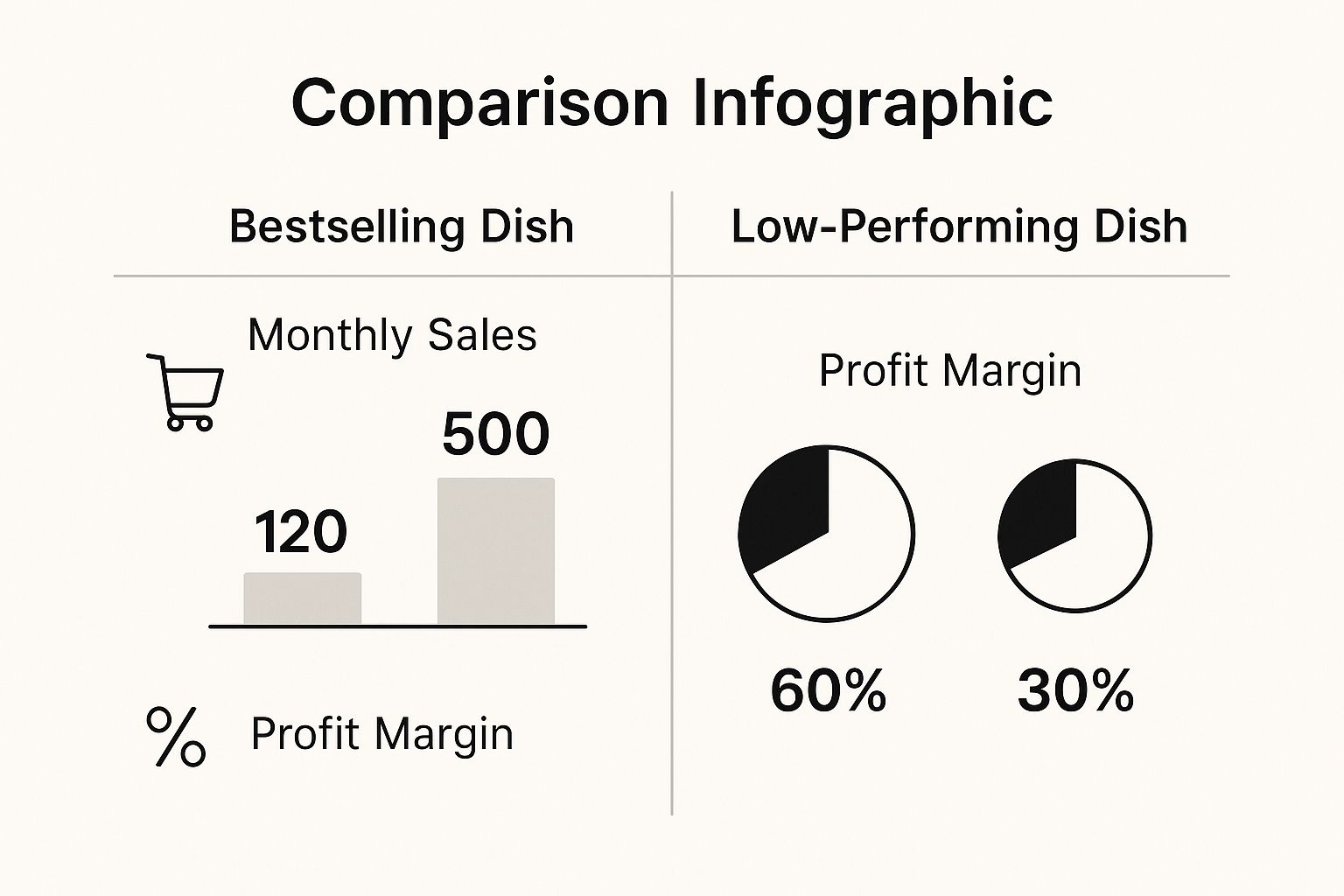
As is evident, driving volume to your high-margin bestsellers—a capability you fully control on your own platform—generates vastly superior returns compared to leaving sales to chance.
Turning Data into Repeat Business
Once you own the system, you own the data. This is where you unlock exponential growth. You now have a direct communication channel to your customers. You possess their contact information, order history, and preferences. This is the fuel for a powerful marketing engine that third-party platforms intentionally withhold.
With this proprietary data, you can execute targeted campaigns that drive repeat business and increase CLV.
- Has a customer lapsed for 60 days? Deploy an automated "we miss you" SMS with a personalized offer.
- Launching a new dessert? Email a promotion to every customer who has previously ordered a specific entrée.
This level of personalized marketing is impossible when you are merely renting customers from an aggregator. It is the foundation for building true loyalty and maximizing the lifetime value of every guest. A well-designed loyalty program is often the logical next step, and if you are interested, you can learn more about how a restaurant loyalty program consultant can help you architect a best-in-class program.
Dominate Your Neighborhood with Local Marketing
I have observed countless entrepreneurs become distracted by the allure of national brand recognition when their most profitable customer segments reside just outside their door. For a small restaurant, the battle is not won on a national stage—it is won block by block. Your immediate geographic area contains your highest-ROI customers.
Therefore, hyperlocal marketing is not merely a tactic; it is the core strategy. The objective is to become the undisputed, top-of-mind choice for everyone within a five-mile radius. Forget expensive billboards and broad-reach advertising. Your mission is to achieve absolute dominance in your digital and physical backyard.
Your Google Business Profile Is Your New Front Door
Consider the evolution of customer discovery. A decade ago, your physical storefront was paramount. Today, it is your Google Business Profile (GBP). When a potential customer in your vicinity searches "tacos near me" or "best brunch spot," your GBP listing is the first—and often the only—brand interaction they will have.
Treating it as a secondary priority is the strategic equivalent of locking your doors during the lunch rush. It is nonsensical. Achieving a top rank in local search results requires a relentless, almost obsessive approach to profile management. This is not a "set it and forget it" task; it is a daily operational imperative.
- Optimize for Keywords: Engineer your business description for both humans and search algorithms. Integrate terms your customers actively use, such as "family-friendly Italian restaurant," "local craft beer selection," or "vegan pizza options."
- Maintain High Activity Levels: Google's algorithm rewards activity. You must consistently upload high-quality photos of daily specials, publish weekly updates, and answer every single question posted to your profile. An active profile signals to Google that your business is relevant and operational.
- Systematize Review Management: Reviews are the social proof that drives local search rankings. Implement a simple, repeatable process for encouraging satisfied customers to leave a review. Critically, you must respond to every single review—positive and negative—ideally within 24 hours. A thoughtful response to a negative comment can convert more future customers than a dozen five-star ratings.
Your Google Business Profile is not a static listing. It is a dynamic, living digital asset. The more you feed it with fresh content and engagement, the more visibility Google will grant you in those mission-critical "near me" searches.
This dedicated effort is what separates the restaurants appearing in the top-three "map pack" from the rest. Those top positions capture the vast majority of clicks, and you must be there.
Build a Moat with Community Partnerships
While dominating the digital domain is critical, you can construct an even more formidable competitive barrier by embedding your restaurant into the fabric of the local community. These local partnerships are low-cost, high-impact initiatives that build an authentic loyalty that competitors cannot simply purchase with a larger ad budget.
Your objective is to become a true neighborhood institution, not merely a transactional food provider.
- Forge Alliances with Non-Competitors: Cultivate relationships with the owner of the local boutique, the real estate office, or the gym down the street. Offer their employees a standing corporate discount. In return, request they include your menu in welcome packages for new clients. This is a simple, symbiotic relationship.
- Sponsor Hyperlocal Events: Avoid sponsoring a large city-wide festival. Instead, cater the local little league awards ceremony or the annual neighborhood block party. The investment is significantly lower, but the visibility and goodwill generated among your core customer base are exponentially higher.
These initiatives are about building genuine relationships and network effects. When the owner of the local hardware store recommends your establishment for lunch, that endorsement carries more authority than any paid advertisement. This is how you create a powerful competitive moat around your business.
If you seek more structured methodologies, partnering with a specialized restaurant advertising agency can provide a framework for these types of campaigns. This hyperlocal focus is how you transition from a local favorite into an undeniable neighborhood cornerstone.
Adapt Your Restaurant Concept to Market Realities
Across my career scaling companies, I've seen one thing kill growth more than any other: rigidity. An owner becomes so emotionally invested in their original vision that they willfully ignore clear market signals.
The restaurant industry is in a constant state of flux. If you are unwilling to adjust your strategy in response to changing consumer behavior and economic conditions, you will be left behind. Your ability to evolve from a small operation into a durable enterprise depends entirely on your agility.
This is not about abandoning your passion. It's about channeling that passion into a concept that meets current market demand. You must be a ruthless analyst of your own business, prepared to pivot based on data, not just intuition. I have seen too many brilliant concepts fail because they were a perfect solution for a market that no longer existed.
Follow the Money to Growing Segments
Currently, the data is telling an unambiguous story. Diners are feeling the pressure of economic uncertainty, and it is directly impacting their spending habits. We are witnessing a significant shift away from high-end, fine dining toward concepts that deliver a superior blend of quality, atmosphere, and perceived value.
Recent industry analysis shows that Casual Dining and Fast Casual are experiencing robust same-store sales growth of 1.4%. Conversely, Fine Dining is contracting. This data point is a powerful directive for a small operator: the sweet spot for sustainable traffic lies in creating moderately priced, high-value experiences. To perform your own analysis, you can review detailed restaurant industry trends and see precisely how different segments are performing.
This market intelligence should be the bedrock of your strategy. It might necessitate tweaking your service model for greater efficiency, adjusting price points, or cultivating a more relaxed, approachable ambiance.
The operative question is not "What do I want to sell?" It is "What is the market willing to pay for right now?" The answer to that question is your roadmap to growth.
Protect Your Margins with Smart Value Propositions
Adapting to a price-sensitive market does not mean initiating a price war. That is a race to the bottom that erodes brand equity. The strategic objective is to introduce targeted, value-driven offers that protect your core profit margins. This is far more sophisticated than a simple happy hour discount.
Consider implementing tactical shifts like these:
- Introduce Bundled Meals: Package a popular, high-margin entrée with a lower-cost side and beverage for a fixed price. This increases the average check size while providing the customer with a clear value proposition.
- Launch a Loyalty Program: Reward your most frequent customers. A simple "buy nine, get the tenth free" program incentivizes repeat visits from your most price-sensitive guests without discounting every transaction.
- Create Off-Peak Specials: If you have a slow period between 2 and 5 p.m., drive traffic with a "lunch power hour" or a late-night menu. This generates incremental revenue without cannibalizing your prime-time sales.
These are surgical adjustments designed to meet market demand without eviscerating your bottom line. This process is a core component of business model innovation, and you can learn more about how to rethink your approach with our guide on business model innovation.
The Financial Case for Investing in Your People
Ultimately, any service business relies on operational consistency to scale. In a restaurant, that consistency is a direct function of your team—particularly your management. High employee turnover is not an HR issue; it is a massive, direct drain on profitability.
The hard costs to replace a single manager can easily exceed $10,000 when you factor in recruitment, hiring, and training. This figure does not even account for the "soft" costs of lost productivity, inconsistent service quality, and declining team morale.
Investing in your key personnel with competitive compensation, clear career progression paths, and a positive culture is one of the highest-ROI decisions you can make. A stable, empowered management team ensures your operational standards are executed flawlessly on every single shift—and that is a non-negotiable prerequisite for growth.
Your Top Restaurant Growth Questions, Answered
Over the years, I've advised hundreds of business owners. Regardless of the industry or concept, the same strategic questions and challenges consistently arise, particularly within the demanding environment of the restaurant world.
I will cut through the noise and provide direct, actionable answers based on decades of experience.
What Are the First Three Things I Should Do to Grow My Restaurant?
This is the fundamental question. Every operator wants to know where to allocate their limited capital and time for maximum impact. Forget a sprawling checklist. If you do nothing else, execute these three initiatives.
- Master Your Menu Engineering. This is the lowest-hanging fruit available to you. Analyze your sales data and food costs to identify your "Stars"—the high-popularity, high-profitability items. Simply promoting these dishes through better placement and suggestive selling is the fastest path to margin expansion without acquiring a single new customer.
- Get Obsessed with Your Google Business Profile. Treat your GBP listing as your digital front door. Optimizing it is the single most effective "free" marketing activity you can undertake. Complete every section, saturate it with relevant keywords, upload new photos constantly, and respond to every single review. This is the primary channel through which new local customers will discover you.
- Start Your Customer List. Today. Implement a simple process at your point-of-sale to capture an email or phone number. Offer a digital receipt or an exclusive "insider club." Owning this direct line of communication is the foundational step to breaking your dependency on high-commission third-party apps.
These three actions address the trifecta of sustainable growth: profitability, new customer acquisition, and customer retention. Master these first.
How Can I Market My Restaurant With Almost No Money?
A constrained budget is not a barrier; it is a catalyst for creativity. The strategy is to substitute marketing expenditure with hustle and authentic community engagement.
Your entire strategy should be hyperlocal. First, master your local SEO via the Google Business Profile I just detailed. Next, select one or two social media platforms where your ideal customer demographic is most active and commit to them fully. Post daily specials, share behind-the-scenes content, and introduce your team. Humanize your brand.
Defer expensive advertising for now. Your most potent marketing assets are your existing customers and your local community. Trade creativity and real-world engagement for a large ad spend.
Do not confine your efforts to the digital realm. Get out into the community. Deliver a complimentary lunch to the manager of a new office building and ask them to inform their staff. Partner with a local boutique on a cross-promotional giveaway. This type of consistent, grassroots marketing builds a loyal following that a competitor cannot simply purchase.
When Is It Actually the Right Time to Open a Second Location?
I will be direct: do not even contemplate a second location until your first unit operates like a well-oiled machine without your daily presence. Many owners mistake their personal ability to firefight for a scalable business model. They are not synonymous.
The true litmus test is whether your systems are successful, not your personal intervention. Before you even consider another lease, your flagship restaurant must have:
- Rock-Solid Profitability: It must be consistently profitable on a month-over-month basis, with healthy cash flow. This is non-negotiable.
- Documented Systems for Everything: Every operational task, from the opening checklist to plating a signature dish, must be documented in a simple, repeatable process that a new employee can follow.
- A Strong, Autonomous Manager: You need a leader in place who can run the entire operation—hiring, training, inventory, and customer service—without escalating every minor issue to you.
If you are still the hero saving the day at restaurant one, a second location will simply multiply your problems and jeopardize both ventures.
What's the One Piece of Tech With the Best ROI for a Small Restaurant?
It is easy to become distracted by novel technologies. But for a small, independent restaurant, the single best investment you can make is an integrated online ordering and Point of Sale (POS) system that you own.
This is not about sophisticated reservation software; it is about plugging the largest financial leak in your business. Third-party delivery apps are draining your profitability with commissions that can reach as high as 30%. Bringing ordering in-house repatriates that margin directly to your bottom line.
More importantly, it provides you with customer data. That information is the most valuable asset you can possess. It allows you to build your own marketing database to drive repeat business through email and SMS campaigns—a capability that is impossible when a third party owns the customer relationship. This single piece of foundational technology delivers a return on investment many times over.
Growing a restaurant is about more than great food. It requires a strategic, data-driven approach. If you're ready to build a more profitable, scalable business using these kinds of proven frameworks, the team at MGXGrowth can help architect your next move. Learn more at https://www.mgxgrowth.com.
