


Across every industry I’ve operated in—from SaaS and bustling marketplaces to high-touch hospitality—I’ve seen leadership teams make the same critical mistake. They pour millions into acquiring new customers while their revenue foundation is quietly cracking. The truth is, the smartest growth engine isn't acquisition; it's retention. Slashing customer churn is the single most powerful, and most overlooked, growth lever you have.
Why Churn Is Your Ultimate Growth Lever
I’ve seen firsthand how a small, single-digit improvement in churn can do more for EBITDA and company valuation than a splashy, multi-million dollar marketing campaign ever could. The constant chase for new logos often becomes a vanity metric, hiding a fundamental weakness in the business model. But when you stop seeing churn as just a "leaky bucket" and start treating it like a critical diagnostic tool, everything changes.
This isn't just about the immediate hit to your annual recurring revenue (ARR). The real cost of churn is a nasty trifecta that smothers growth from all sides:
- Skyrocketing Re-Acquisition Costs: Replacing a lost customer is brutally expensive. Research from Forrester has shown it can cost five times more to land a new customer than to keep an existing one. Every time someone leaves, your marketing and sales teams are forced back to square one, burning cash just to get back to where you were.
- The Silent Poison of Bad Reviews: Unhappy customers don't just vanish. They often become your loudest detractors. For every one person who actually complains to you, countless others leave quietly, telling their friends and colleagues about their bad experience. This negative word-of-mouth can taint your reputation and make every future sale that much harder.
- Lost Expansion and Upsell Revenue: Your best, most profitable revenue comes from the customers you already have. A loyal, engaged client is your prime audience for new features, premium tiers, and add-on services. When a customer churns, you lose their current subscription and their entire future lifetime value.
The Staggering Financial Drain
The scale of this problem is hard to overstate. The financial fallout from customer churn is massive, with US businesses alone losing $136.8 billion a year due to departures that could have been prevented. That number is even more jarring when you realize 67% of consumers will jump to a competitor after just one bad experience.
"Churn is a direct tax on your growth. For every dollar you lose to a departing customer, you have to spend exponentially more to replace it. The most successful companies I've worked with aren't the best at acquiring customers; they are the best at keeping them."
A Mindset Shift from Vanity to Value
To really get a handle on this, leadership has to stop chasing vanity metrics and start building a resilient, profitable company. It all begins with understanding why customers are leaving in the first place.
The first move isn't to build some complex AI model. It's to put a simple diagnostic framework in place. You have to categorize the "why" behind every single departure.
Immediate Churn Diagnostic Framework
To get started, you need a quick way to triage why customers are leaving. This simple framework helps you categorize the core drivers so you can take immediate, targeted action instead of guessing.
| Churn Driver Category | Key Indicators | First Actionable Step |
|---|---|---|
| Product Gaps | Low feature adoption; specific feature requests in exit surveys; customers switching to competitors with better functionality. | Tag and quantify all feature-related churn reasons. Feed this data directly to the product team for roadmap prioritization. |
| Poor Onboarding | High churn rate within the first 30-60 days; low initial product usage; support tickets related to basic setup. | Review the first 7-day user experience. Implement an automated check-in email or in-app message for new users who show low engagement. |
| Perceived Value/ROI | Complaints about pricing; low usage of core value-driving features; feedback that the tool is "too expensive for what it does." | Create and send case studies or guides that highlight the ROI of your most valuable features to at-risk accounts. |
| Inadequate Support | Long ticket resolution times; negative CSAT/NPS scores; churn reasons mentioning "poor customer service" or "slow responses." | Conduct a 24-hour audit of your support ticket queue. Identify and immediately address the oldest, most frustrated customer issues. |
From my experience, churn drivers almost always fall into one of these buckets. The challenge is that without a systematic way to track them, these crucial signals get lost in the noise. To truly fix the problem, you need to measure it. Our guide on client satisfaction measurement gives you the foundational tactics for gathering the data that will fuel your entire retention strategy.
The journey to crushing customer churn starts with a simple acknowledgment: your existing customers are your most valuable asset. Protecting that asset isn’t a defensive move—it's the most powerful offensive strategy you've got.
Building Your Predictive Churn Analytics Engine
If you're only reacting to churn, you've already lost the battle. By the time a customer complains or their logins drop off, you're playing defense, trying to patch up a relationship that's likely been bleeding out for months. In every growth role I’ve held, the biggest wins in cutting customer churn came from one simple shift: moving from hindsight to foresight.
The goal is to build a predictive engine that works like an early-warning system for your customer base. This isn't about hiring a massive data science team on day one. It's about getting smart and deliberate about tracking the real signals of customer health long before a cancellation request ever hits your inbox.
Identifying Your Core Churn Predictors
Let's set aside the complex data science for a minute and think like an operator. Your first move is to pinpoint the leading indicators of churn that are unique to your product and customers. These aren't just vanity metrics; they are the specific behaviors that tell you if a customer is getting massive value or quietly drifting away.
When I start this process, I always zero in on these data categories first:
- Product Usage Velocity: This goes way beyond just tracking daily active users. I look for how often customers are using your "stickiest" features—the ones you know correlate directly with long-term retention. A sudden drop in the use of a critical workflow feature is a much bigger red flag than a single low NPS score.
- Support Ticket Sentiment: Don't just count the number of tickets or how fast you close them. Use simple sentiment analysis tools to read the transcripts. A customer who repeatedly sounds frustrated, even if their issues are resolved quickly, is a high-risk account waiting to happen.
- Invoice and Payment Patterns: This is an often-overlooked goldmine of data. Are they consistently paying late? Have they had multiple credit cards fail? This "involuntary churn" is often the easiest to fix, but you can only do it if you're proactively monitoring these patterns.
This fundamental process—diagnosing risks, categorizing them, and then taking decisive action—is the absolute backbone of any retention strategy that actually works.
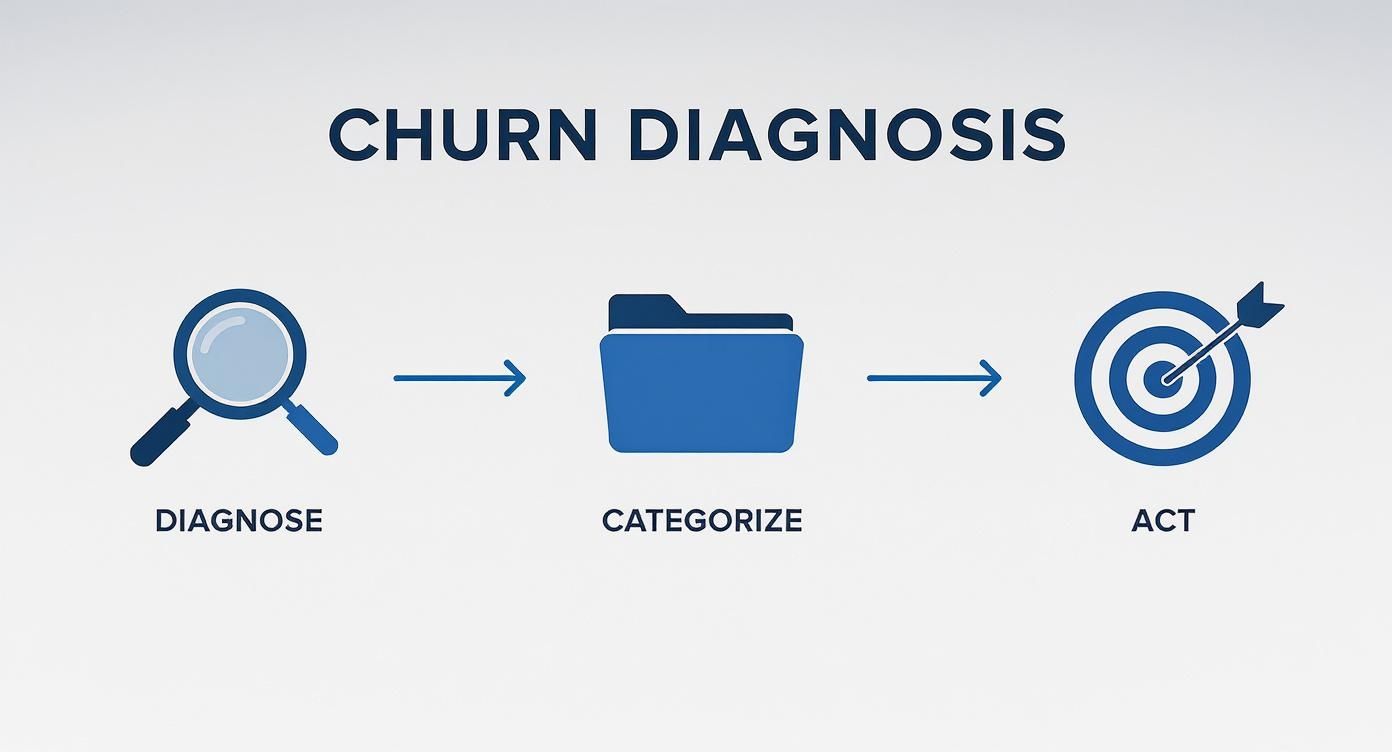
As the visual above shows, a systematic approach is what separates successful churn reduction from constantly fighting fires. You need to diagnose the signals, categorize the risk level, and act with confidence.
From Data Points To A Customer Health Score
Once you start pulling in these signals, the next logical step is to combine them into a simple, actionable customer health score. This doesn't need to be some mystifying algorithm right out of the gate. You can start with a basic weighted model in a simple spreadsheet or your CRM.
For instance, you could assign points based on key actions:
- High Engagement (Logs in daily, uses 3+ core features): +20 points
- Recent Upsell/Expansion: +15 points
- Positive Support Interactions: +10 points
- Declining Feature Usage (over 30 days): -15 points
- Overdue Invoice: -20 points
- Negative Support Ticket Sentiment: -25 points
A score like this gives every team—from Sales to Success to Product—a shared, at-a-glance snapshot of an account's health. It breaks down departmental silos by creating a common language for customer risk.
This proactive approach has never been more critical. Customer expectations are constantly rising, making retention tougher than ever. In fact, a Forrester report noted that 21% of brands saw their customer experience scores decline year-over-year, which just goes to show how hard it is to keep up. Discover more insights from Forrester on evolving customer expectations.
The goal of a predictive engine isn't to be 100% accurate. Its purpose is to direct your team's limited attention to the accounts that need it most, long before they raise their hand to say they're leaving.
This is where even basic AI can be a game-changer. Many modern CRMs and analytics platforms have built-in features to automatically flag at-risk segments. You don't need a dedicated engineering team to get started. Exploring these AI tools for business can give you a significant leg up.
Ultimately, you want to move from manual tracking to an automated system that flags risk in real time. This empowers your teams to intervene with precision and save accounts you would have otherwise lost.
Putting Proactive Customer Interventions into Action
Having a predictive engine that flags at-risk customers is a fantastic start. But let's be blunt: data without action is just an expensive hobby. I’ve seen countless companies invest heavily in analytics only to have the insights die in a dashboard. The real work—and where you’ll see the biggest drop in churn—is in bridging that gap between knowing and doing.
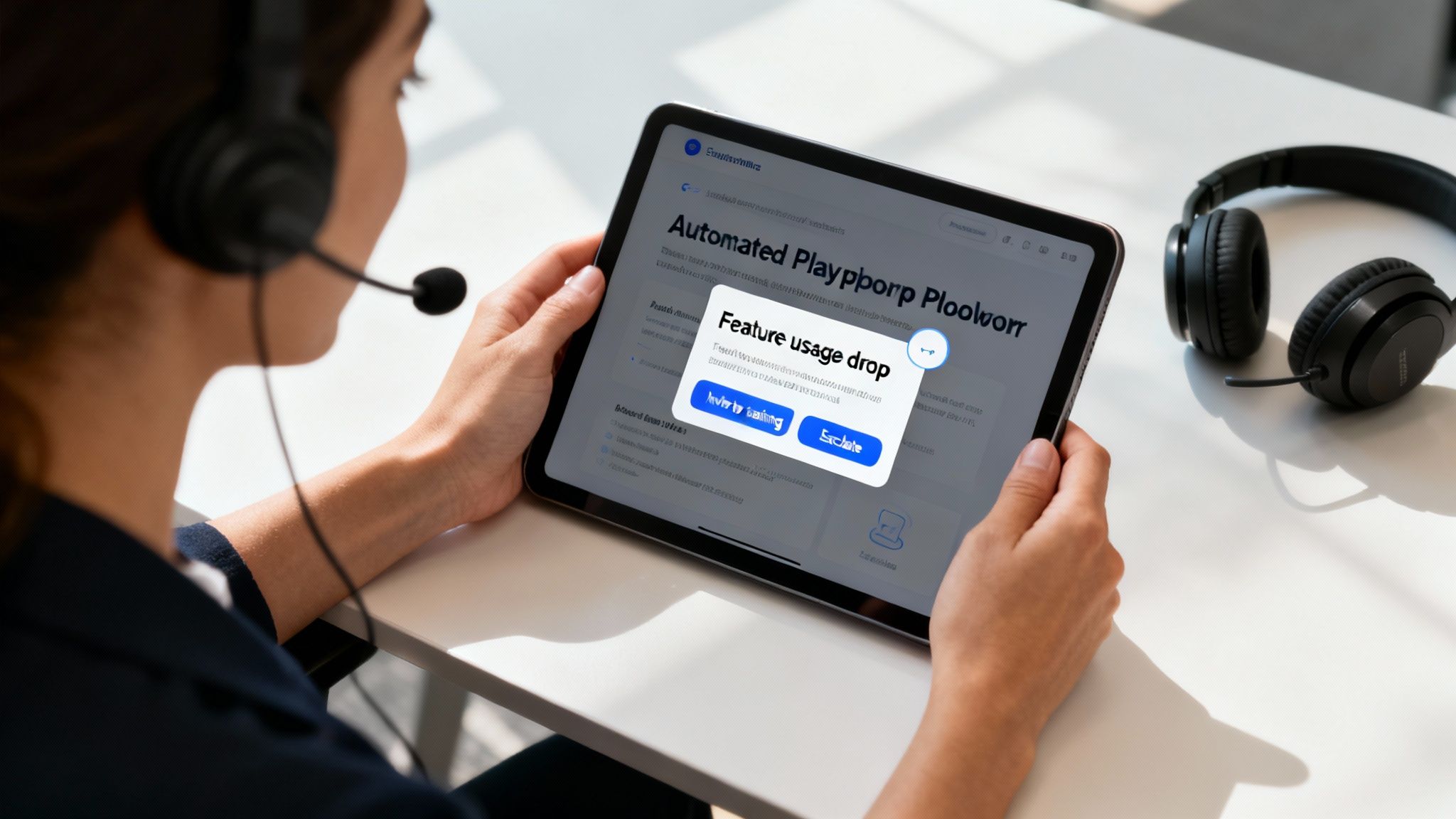
So, your system flags an account as a churn risk. What happens next? The answer can't be a frantic, manual scramble. You need a pre-defined, automated playbook that triggers specific, high-value interventions based on the exact churn signal you've detected.
This isn't about sending a generic "We miss you!" email. That's lazy, and frankly, it doesn't work. It’s about precision. For example, if a customer's usage of a critical, value-driving feature drops by 30% over two weeks, the playbook should kick off a multi-step sequence, not just an email.
Building Your Intervention Playbook
A successful playbook requires breaking down the walls that typically separate Product, Sales, and Customer Success. Each team holds a piece of the puzzle, and a unified response is the only way to effectively reinforce your product's value.
Here’s how I think about structuring these systems:
- The Signal: This is the specific, measurable change in customer behavior. Think decreased login frequency or a sudden drop in creating new projects.
- The Trigger: This is the automated rule that listens for the signal and kicks off the intervention.
- The Action: This is the series of orchestrated steps that your teams and systems take.
Let's walk through a real-world scenario. A mid-sized SaaS client of mine was struggling with high churn among accounts that started strong but then fizzled out after 90 days. Our predictive engine pinpointed a key signal: a sharp decline in their use of the "Reporting Suite" feature.
In my experience, a drop in usage of a core value-driving feature is one of the most reliable predictors of voluntary churn. It means the customer is no longer seeing the ROI they signed up for, and you have a very short window to act.
Instead of just pinging the account manager, we built a cross-functional playbook:
- Immediate Automated Action: The system automatically sends a highly targeted email. It invites the user to a specialized, on-demand webinar focused exclusively on "Advanced Reporting Strategies to Maximize ROI."
- Customer Success Nudge: If there's no engagement with the webinar after 48 hours, a task is automatically created in the CSM's workflow. The goal? A personal call, not to sell, but to offer a complimentary "health check" on their reporting setup.
- Product Feedback Loop: That signal is also logged and tagged in a shared dashboard for the Product team. If this becomes a recurring pattern across multiple accounts, it flags a potential usability or feature-gap issue that needs to get on the product roadmap.
This approach completely transformed their retention efforts. They moved from reactive damage control to proactive value delivery, all orchestrated by the data.
Empowering Your Front-Line Teams
A playbook is useless if your front-line teams—your CSMs, support agents, and even salespeople—aren't empowered to act. You have to give them both the data and the autonomy to make real-time retention decisions.
This means giving them the full context of a customer's health score directly within the tools they already use.
When a support agent sees an incoming ticket, they shouldn't just see the problem. They should also see that this customer's engagement has been trending downward for a month. This context changes their response from a simple transactional fix to a relationship-building opportunity. They can solve the immediate issue and then proactively ask, "I also noticed you haven't used our new integration feature. Would a quick 5-minute walkthrough be helpful?"
Of course, this entire system of triggers and actions relies on a solid technical foundation. To explore the nuts and bolts of setting up these kinds of workflows, I recommend reading our in-depth guide on marketing automation implementation, which covers the core principles of building scalable, trigger-based communication systems.
Ultimately, putting your data to work is about creating a unified, customer-centric front. It ensures every single touchpoint, whether from an automated email or a personal phone call, is timely, relevant, and reinforces the value your product delivers.
Hyper-Personalization Throughout The Customer Lifecycle
Let's be blunt. Customers don't just wake up one day and decide they dislike your product. They drift away. They churn because the product stops feeling like it’s built for them and solving their specific problems. The most powerful way to fight this slow fade is with hyper-personalization.
And I'm not talking about just dropping a {{first_name}} tag into an email. This is about using real data to make every customer feel like they’re your only one. I’ve seen it time and time again: generic, one-size-fits-all communication is the fastest way to get ignored. The second your messages feel like they could have been sent to your entire database, you’ve lost the battle for their attention, and their loyalty is next on the chopping block.
Real personalization means showing you understand their journey, their goals, and how they actually use your platform.
Customizing The First Impression
The first 30 days are critical. This is where you either win a customer for life or lose them to confusion and overwhelm. A generic onboarding tour that dumps every single feature on a new user is a surefire path to churn.
The real goal is to guide each user to their specific "aha!" moment—that spark of understanding where they see the true value—as fast as possible. And that moment is completely different for a marketing analyst than it is for a CFO.
By using the data you collect during sign-up (think role, company size, or stated goals), you can create truly custom onboarding tracks.
- A user who says they're a sales leader? Don't show them API settings. Guide them straight to the pipeline and forecasting features that will immediately impact their work.
- Someone signing up as a support manager? The first thing they should see are the ticket management and team performance dashboards.
This isn't about hiding parts of your product. It’s about sequencing the value in a way that makes sense for the user's world. This approach proves you don't just offer a tool; you offer a solution designed for them.
Transforming Communication From Generic To Essential
Once a customer is onboarded, personalization is what keeps the relationship strong. Let’s face it, the standard company newsletter is dead. Blasting the same product update to your most active power users and the ones who haven't logged in for a month is a waste of everyone's time.
Your communication needs to become an essential, personalized resource—a playbook tailored to their actual behavior.
The best marketing you can do for existing customers isn't really marketing at all. It's highly relevant, data-driven education that helps them get more out of the investment they've already made.
For example, imagine you see a group of users who live in your reporting features but have completely ignored your new AI forecasting tool. Don't just send them a generic "New Feature!" announcement. Instead, hit them with a targeted case study: "How Teams Like Yours Are Slashing Reporting Time with AI Forecasting."
See the difference? You’ve reframed the message from a bland announcement to a compelling, personalized solution. That’s how you drive engagement and deeper product adoption.
Case Study: Personalized QBRs at Scale
At a B2B SaaS company I worked with, we were battling a nagging churn rate of around 2.5% per month. It wasn't huge, but it was slowly eating away at our growth. The core problem was that our customers were using the product, but they weren't connecting that daily usage to real business value. Our quarterly business reviews (QBRs) were generic and falling flat.
So, we decided to automate the creation of hyper-personalized value reports. Here’s how we did it:
- First, we pulled API data on how each client was using our top three value-driving features.
- Next, we translated that raw usage data into hard ROI metrics. For instance, "You automated 4,200 tasks this quarter, which saved an estimated 150 hours of manual work."
- We then used automation to generate a slick, one-page PDF report for thousands of clients, each one filled with their own data and insights.
- Finally, account managers delivered these reports during check-ins, instantly turning a routine call into a high-impact conversation about value.
The result? We saw a 15% reduction in churn within six months. We didn't fundamentally change the product. We just changed how we communicated its value, making it personal, tangible, and undeniable for every single client. That’s the real power of putting personalization into practice.
Churn Is Not a Monolith: Industry-Specific Retention Strategies
I've seen so many leaders fall into the same trap: they treat customer churn as this one-size-fits-all problem. But here's the reality I've learned firsthand: a 5% monthly churn that would signal a five-alarm fire for a B2B SaaS company might be perfectly normal for a B2C gaming app. If you really want to get a grip on churn, you first have to accept that the warning signs, the benchmarks, and the levers you pull to keep customers are wildly different depending on your industry.
What’s considered a "good" churn rate is completely relative. A professional services firm, for example, might see an average annual churn of 27%, whereas a B2B SaaS business is fighting to keep its monthly rate under 3.5%. Then you have the wholesale sector, staring down a massive 56% churn rate, largely because of brutal price wars and how easy it is for customers to jump ship. Getting familiar with these benchmarks is your starting point for setting goals that actually make sense for your market. This in-depth analysis of churn rates by industry is a great resource for seeing where you stand.
Finding the Right Levers to Pull
Once you have a realistic benchmark in mind, the real work starts. You've got to figure out what actually keeps your customers around. Generic advice you read in a blog post just won't cut it. Your strategy has to be deeply connected to why customers chose you in the first place.
Take online marketplaces. In that world, I’ve found that the biggest things keeping customers loyal are seamless logistics and signals of trust, like verified sellers or solid buyer protection. A customer can love your product selection, but if an order shows up late or a return is a nightmare, they’re gone for good. The entire experience hinges on being operationally flawless.
Now, let's look at the gaming industry—a completely different beast. The key drivers there are all about content cadence and community engagement. Players stick around for the next big update, the next competitive season, or a special in-game event. A healthy, positive community acts like a powerful magnet, making the idea of leaving feel like walking away from a group of friends.
“Don’t just tell your team to 'lower churn.' Instead, ask them to find and strengthen the single biggest reason a customer in your specific industry decides to stay. The first is a wish; the second is a real strategy.”
Tuning In to Industry-Specific Churn Signals
Just as the reasons for staying are different, so are the warning signs that a customer is about to leave. You need to train your predictive models to listen for the right kind of signals, not just generic ones.
-
For SaaS Businesses: A dip in the usage of a core, "sticky" feature is a massive red flag—it's often more telling than a dozen negative surveys. Another classic sign is when the number of active users on a team account starts to drop off.
-
For B2C Marketplaces: A decrease in how often someone buys or how much they spend is an obvious one. A more subtle clue? When a user stops exploring new categories, it suggests they no longer see your platform as a place for discovery.
-
For Real Estate Tech: This is a high-stakes, high-speed world where responsiveness is king. A lead that isn't followed up on within minutes is as good as gone. Here, the churn signals are less about product engagement and more about critical communication gaps.
A deeper understanding of industry-specific churn rates and what drives retention is crucial. It’s the difference between a generic, often ineffective strategy and a targeted, successful one.
Comparative Churn Rates and Key Retention Levers by Industry
| Industry Sector | Average Annual Churn Rate | Primary Retention Driver |
|---|---|---|
| B2B SaaS | ~3-5% (Monthly) | Product Stickiness & Feature Adoption: Ensuring users are deeply integrated with high-value features that make their workflow easier. |
| B2C Gaming | Varies Widely (~10-20% Monthly) | Content Cadence & Community: Regular updates, new content, and a strong, engaging player community keep people logged in. |
| E-commerce & Marketplaces | ~25-35% (Annual) | Logistics & Trust: Fast, reliable shipping, easy returns, and a trustworthy platform are paramount. |
| Professional Services | ~27% (Annual) | Relationship & Perceived Value: Strong client relationships and consistently delivering clear, tangible results are key. |
| Wholesale Distribution | ~56% (Annual) | Price & Convenience: Competitive pricing and a frictionless ordering process are the biggest factors. |
This table is just a starting point, but it highlights a critical truth: the battle against churn isn't one war, but many different ones fought on different fronts.
By decoding these industry-specific nuances, you can finally move away from a scattergun approach to fighting churn. You'll stop wasting time and money on tactics that work for someone else's business and start investing in the things that build real, lasting loyalty in your own backyard.
Creating a Culture of Retention
The predictive models and AI-powered playbooks we've talked about are incredibly powerful. But at the end of the day, they're just tools. Your churn reduction strategy is only as strong as the culture that supports it, and real, lasting success only comes when keeping customers is part of your company’s DNA.

I've seen this play out time and again. The biggest point of failure isn't a lack of data or a bad algorithm; it's the organizational silos that let at-risk customers slip right through the cracks. Sales closes a deal, tosses it over the fence, and moves on. Support resolves a ticket, and the conversation ends there. Product ships a new feature and just hopes people use it.
This assembly-line approach is the natural enemy of retention.
Aligning Incentives Across Departments
To break down these silos, you have to make everyone accountable for customer success—not just their isolated piece of the puzzle. This begins with incentives. If only the sales team gets a bonus for landing a new account, they have zero motivation to care if that customer churns three months later.
Think about restructuring commissions. What if a portion of a salesperson's payout was tied to that customer's first-year renewal? All of a sudden, the quality and fit of a new customer become just as critical as getting a signature on the dotted line.
By the same token, a product manager's performance review should include metrics on feature adoption and how those features actually impact churn rates.
A true retention culture is born when the celebration for a saved account is just as loud as the celebration for a new sale. It's a seismic shift from cheering for transactions to cheering for long-term partnerships.
This all depends on creating shared metrics that every department can see and influence. A "Customer Health Score" shouldn't just be a KPI for the Customer Success team; it needs to be on dashboards in Marketing, Sales, and Product, too.
Building the Customer Feedback Loop
With everyone aligned, the next move is to build rock-solid communication channels between teams. Your front-line support and success teams are sitting on a goldmine of customer feedback. Every single day, they hear the raw, unfiltered truth about product gaps, confusing UI, and what competitors are doing better.
This crucial intelligence can't be left to die in a support ticket. You need to create a formal, direct pipeline for these insights to flow straight to the people building the product.
Here are a few ways I’ve seen work really well:
- Weekly Churn Huddles: Get leads from Support, Success, Product, and Sales in a room (or a Zoom) for a quick, mandatory meeting. The only agenda item? Discuss the top reasons for churn that week and spot emerging patterns.
- Shared Slack Channels: Create dedicated channels like
#customer-feedbackor#product-ideas. This gives front-line staff a place to post real-time insights where product managers can see and engage with them directly. - Voice of the Customer Reports: Have your Customer Success team compile a monthly "Voice of the Customer" report. This isn't just a collection of quotes; it should quantify the top pain points and feature requests and be presented to the entire company.
When a developer hears directly from a support agent about a frustrating bug that just cost you three customers, the urgency to fix it becomes personal and immediate. This feedback loop is what makes your product stickier over time, because it's constantly evolving based on the real-world needs of the people paying the bills.
Ultimately, tools and tech will change. A deeply ingrained culture of shared ownership over the customer experience is what builds a truly resilient, high-growth business.
Common Questions On Reducing Customer Churn
Over the years, I've been in more meetings about growth than I can count. No matter the company, the conversation always, always circles back to churn. And it's usually the same handful of questions that pop up when a team decides it's time to get serious.
Here are the answers I give when leadership is ready to stop admiring the problem and start building a real retention culture.
What Is The First Metric I Should Track?
Forget your overall churn rate for a second. That number is a vanity metric; it tells you that you have a problem, not what the problem is.
Your first move—before you do anything else—is to segment your churn. This is the single most important step you can take. It’s the difference between a vague, company-wide issue and a specific, solvable problem.
Start by splitting it into two basic categories: voluntary vs. involuntary churn. This simple division immediately tells you if you have a product/value issue or if you have a payments issue. That’s a huge first clue.
From there, start slicing the data by customer cohorts. Look at it by:
- Acquisition month
- Subscription plan
- Company size
Once you do this, patterns jump out. You might discover that 80% of your churn is coming from small businesses on your lowest-tier plan who signed up in Q2. Suddenly, you have a very specific problem you can actually solve.
How Do I Get Buy-In From Other Departments?
"We need a customer-first mindset" is a nice, fluffy sentiment that accomplishes nothing. To get real buy-in, you have to speak the language of each department and show them what's in it for them. Connect retention directly to their KPIs.
-
For the Sales team: Don't just talk about happy customers. Show them the math. A mere 5% increase in retention can skyrocket profits by as much as 95%. Better retention means more opportunities for expansion revenue and more powerful case studies they can use to close bigger deals. It makes their job easier and their commission checks bigger.
-
For the Product team: Bring them the data. Show them the exit survey results and support ticket trends that prove which missing features are actively costing you the most money. When you frame retention as the ultimate proof that their roadmap is working, you'll get their attention.
-
For the Finance team: This one’s the easiest sell. Show them the direct impact of a 1% reduction in monthly churn on your Annual Recurring Revenue (ARR). Then, show them what that does to the company's valuation. It’s a number they can’t ignore.
The key is to make it personal. Data-driven arguments tied to the specific goals of each department will always win over vague pleas for a cultural shift. Show them how retention helps their team win.
When Should A Startup Seriously Invest In This?
Day one. I'm not saying you need a complex, AI-driven program from the jump, but the mindset has to be there from your very first customer.
In the early days, you won't be building predictive models. But you absolutely must be obsessive about the fundamentals. This looks like:
- Manually tracking how often your first users log in.
- Getting on the phone and personally asking for feedback.
- Having tough conversations to understand exactly why someone decided to leave.
Those scrappy, manual habits you build when you have 10 customers are the foundation for a powerful, scalable retention strategy when you have 10,000. Don't wait.
At MGXGrowth, we do more than just strategize. We roll up our sleeves and work with your teams to build the systems and culture you need for long-term, sustainable growth. We help you turn your customer data into a proactive retention engine that delivers real results.
Discover how we can help you architect the next stage of your growth.
