


I've seen countless brilliant products fail. Not because they weren't innovative or well-engineered, but because the company lacked a rigorous, data-driven plan to connect that product to a paying customer. In my decades driving revenue and market share growth across SaaS, gaming, and real estate, I've learned one brutal truth: a great product isn't enough. A go-to-market strategy framework is the battle-tested blueprint that turns a high-stakes product launch from a gamble into a calculated success by aligning your entire organization around a single, unified mission.
Why a GTM Framework Is Your Growth Blueprint

Hope is not a strategy. Too many companies treat a product launch like an opening night, hoping for applause. They pour millions into R&D and engineering, only to stumble at the final hurdle because they lack a solid plan to connect that product with the right customer. This isn't just inefficient; it's a direct path to failure.
A go-to-market strategy framework isn't some theoretical business school exercise. It’s a rigorous, disciplined process for answering the toughest questions before you spend a single dollar on a launch campaign. It forces a level of organizational alignment that’s otherwise impossible, breaking down the silos between product, marketing, and sales that cripple growth.
The True Cost of Neglecting Your GTM
The stakes couldn't be higher. The market is littered with the ghosts of "great" products that nobody bought. Research shared by Harvard Business School paints a stark picture: of the 30,000 new products launched annually, a staggering 95% fail. A huge driver of this failure rate is the lack of a structured GTM strategy. You can discover more insights about go-to-market strategy challenges and why so many launches miss the mark.
A GTM framework is your insurance policy against becoming another statistic. It’s the disciplined process of converting your product’s potential into measurable market share, revenue, and EBITDA growth.
Think of this framework as your roadmap for execution. It's how you ensure your product, marketing, sales, and customer support teams are not just working hard, but are working in perfect sync toward a shared, quantifiable goal. It defines:
- Who to Target: Pinpointing the Ideal Customer Profile (ICP) with precision, moving beyond vague demographics to focus on specific pain points and buying triggers.
- What to Say: Crafting a value proposition and messaging that resonates so deeply with your target market that they feel you built the solution just for them.
- Where to Engage: Selecting the most effective channels to reach your customers, whether through direct sales, channel partners, or a product-led growth motion.
- How to Win: Defining the specific plays, metrics, and operational cadence required to capture the market efficiently and build a repeatable engine for growth, not just a one-time win.
The Four Pillars of Every Winning GTM Strategy
After launching dozens of go-to-market plans for everyone from SaaS startups to established hospitality brands, I can tell you one thing for sure: success is never an accident. It’s engineered. Every GTM framework that actually drives revenue stands on four unshakable pillars, each one reinforcing the others. Get these right, and you build a solid foundation for growth. Get one wrong, and the entire structure becomes unstable.
Think of it like building a high-performance engine. You can’t just toss a bunch of parts together and hope for the best. Each component has to be precisely tuned and perfectly integrated. Let’s break down these pillars not as abstract theories, but as the critical, moving parts of your growth machine.
Pillar 1: Market Definition
First up, and most importantly, is your Market Definition. This is about so much more than sketching out a demographic profile of a 35-year-old marketing manager. Frankly, that’s where most companies stumble—they get a clear picture of who the customer is, but they completely miss what job that customer is trying to get done.
I’m a huge believer in the "Jobs-To-Be-Done" (JTBD) framework. Instead of asking, "Who is our buyer?" we need to be asking, "What progress is this person trying to make?" No one buys a drill because they want a drill; they buy it because they need a quarter-inch hole in the wall. The hole is the job.
The real market isn’t a group of people; it’s a specific struggle or aspiration. Your product is just the tool they "hire" to solve that problem and make progress. This mindset shift is the key to building something people don’t just buy, but actually rely on.
This approach forces you to get crystal clear on the context, the real-world frustrations, and the outcomes your customers are chasing. It's the difference between selling software features and selling a guaranteed end to revenue leakage.
Pillar 2: Value Proposition
Once you truly understand the job your customer needs done, you can build your second pillar: the Value Proposition. This is your promise. It's the clear, simple answer to the question every customer is silently asking: "Why should I pick you over all the other options, including just doing nothing?"
A strong value proposition isn't a laundry list of features; it's a bold statement about outcomes. It has to directly connect your solution back to the customer's struggle you identified in the first pillar.
To make sure your message hits home, dial in on these elements:
- Relevancy: How, specifically, does your product solve their problem or make their situation better?
- Quantifiable Value: What tangible results can you deliver? Can you promise a 20% reduction in customer acquisition costs or a 15% boost in team productivity? Be specific and data-driven.
- Unique Differentiation: What makes you the only one who can deliver this value in this particular way?
This message becomes the DNA of your marketing and sales. It needs to be woven into every ad, every landing page, and every sales call.
Pillar 3: Distribution Model
Your Distribution Model is the third pillar, and it answers a simple but incredibly tough question: how are you actually going to get your product into your customers' hands? Your channel isn't an afterthought—it’s a strategic choice that defines your business model and customer experience.
I typically see companies succeeding with one of three primary models:
- Direct Sales: This is the go-to for complex, high-ticket B2B products. When you need a consultative sales process to close big enterprise deals, you need a skilled sales team on the ground.
- Channel Partners: This involves using third parties—like resellers, affiliates, or agencies—to sell your product for you. It’s a powerful way to scale reach quickly, but it demands serious partner management and a willingness to share margins.
- Product-Led Growth (PLG): Here, the product itself is the main engine for acquiring, converting, and expanding customer accounts. Think of any SaaS tool with a freemium plan or a free trial that lets you see the value before you ever pull out a credit card.
The right model for you depends entirely on your product’s complexity, your target market's buying habits, and your price point. The key is to choose deliberately, not by default.
Pillar 4: Pricing and Positioning
Finally, we land on the fourth pillar: Pricing and Positioning. This is where you capture all the value you've created. Pricing is one of the most powerful levers for growth, yet so many companies treat it like a math problem, defaulting to cost-plus calculations or just copying their competitors.
Your price is a signal. It communicates your product's value and carves out its spot in the market. A low price might scream "bargain," but it can also whisper "low quality." A premium price has to be backed up by a premium value proposition and an exceptional brand experience. This is where your deep understanding of your customer’s pain and the results you deliver really pays off. A smart pricing strategy, powered by a data-driven marketing strategy, lets you align what you charge with the value customers feel they’re getting, maximizing revenue without scaring anyone away.
These four pillars—Market, Value, Distribution, and Pricing—are all tied together. Tweak one, and you have to re-evaluate the others. When you build each one with intention and precision, you create more than just a plan; you build a powerful, repeatable engine for sustainable growth.
Choosing the Right GTM Framework for Your Business
Once you have your four core pillars locked in—Market, Value, Distribution, and Pricing—it’s time to decide on the lens you’ll use to bring your product to market. This isn't about finding one "perfect" go-to-market strategy framework; it’s about picking the right tool for the job.
There’s simply no one-size-fits-all answer here. What sends a high-growth SaaS startup into orbit could absolutely cripple a mature consumer goods brand. I always tell leaders to think of these frameworks less as rigid rulebooks and more as different diagnostic tools. Each one shines a light on different parts of your business and forces you to ask different questions. The trick is to pick the model that actually lines up with your product's maturity, your market's complexity, and your company's core strengths.
This decision tree infographic is a great starting point. It’s a high-level diagnostic for testing the strength of your GTM's foundational components.
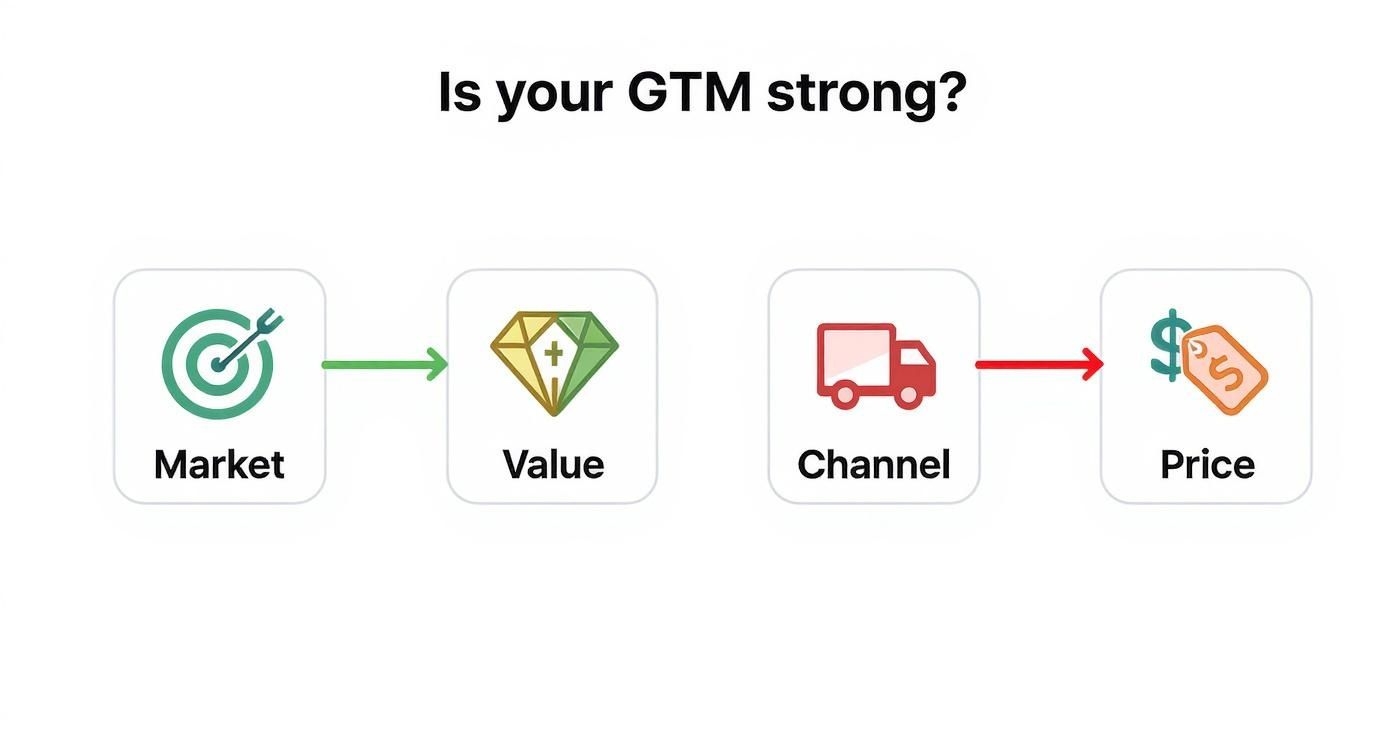
This kind of visual guide helps you quickly spot weaknesses by forcing a simple "yes" or "no" to fundamental questions, immediately showing you where your plan might be shaky.
The Classic 4 Ps: A Product-Centric Model
Let's start with the one everyone knows: the 4 Ps. For decades, this was the absolute bedrock of marketing. It's a product-centric model, meaning everything starts with what you’ve built and works its way outward.
- Product: The features, quality, and design of your offering.
- Price: Your list price, discounts, and overall pricing structure.
- Place: Where and how customers actually buy your product (your distribution channels).
- Promotion: All your advertising, PR, and sales activities.
This framework is beautifully straightforward and works as a solid checklist, especially for physical goods going into established markets. But its biggest strength is also its greatest weakness. In a world that is now overwhelmingly customer-driven, a "product-first" approach can lead you to build something brilliant that nobody actually needs.
The 4 Ps work best when you're launching a new product into a market you already understand well, where the main goal is simply to capture market share. It’s far less effective for truly disruptive products where you have to educate the market from scratch.
The Modern SAVE: A Customer-Centric Model
The shortcomings of the 4 Ps, especially in the service and SaaS-heavy economy we live in, paved the way for a more customer-centric alternative: the SAVE framework. This model completely flips the script, forcing you to see things from the customer's point of view.
- Solution (instead of Product): This isn't about your product's features; it’s about the customer’s problem it solves.
- Access (instead of Place): This looks at the entire customer journey and how they access your solution, not just the final transaction.
- Value (instead of Price): This shifts the focus from your price tag to the tangible value the customer gets.
- Education (instead of Promotion): Forget one-way promotional blasts. This is about providing useful information and building trust over time.
This shift is crucial. It forces every team—product, marketing, and sales—to anchor their decisions in what customers actually need. It’s a fantastic framework for breaking down internal silos because you can't deliver a "Solution" or "Education" if your teams aren't perfectly aligned on who the customer is and what they care about. I find the SAVE model is exceptionally powerful for B2B SaaS and service businesses where long-term relationships are everything.
The Audience-Centric GTM Funnel
A third, more tactical approach is the Audience-Centric GTM Funnel. This framework is less of a static checklist and more of a dynamic map that charts the customer's journey from a complete stranger to a vocal advocate. It’s all about execution and getting marketing and sales to work together seamlessly.
This model visualizes the path a customer takes, helping you identify key touchpoints and figure out what content or interaction is needed at each stage. You’re forced to think about how you will attract, engage, convert, and ultimately delight your audience. You start with broad awareness campaigns at the top of the funnel and move toward specific, value-driven conversations at the bottom. To make it work, you have to define the triggers and metrics that move a prospect from one stage to the next.
This approach is indispensable for businesses with longer, more complex sales cycles. By understanding each stage, you can put your resources where they’ll have the most impact, ensuring you’re not trying to close a deal with someone who is just starting their research. It’s also foundational for building a successful market penetration strategy, as it gives you a clear roadmap for converting potential customers within a defined market segment.
Comparing GTM Strategy Frameworks
Choosing a framework isn't just a theoretical exercise—it shapes how your teams operate daily. The table below breaks down these three popular models to help you see which one might be the best fit for your specific situation.
| Framework Model | Core Focus | Best For | Key Considerations |
|---|---|---|---|
| The 4 Ps | Product Features & Distribution | Businesses with physical products in mature, well-defined markets. | Can lead to a lack of customer focus if not balanced. Less effective for services or disruptive tech. |
| The SAVE Model | Customer Problems & Value | B2B SaaS, service-based businesses, and companies focused on long-term customer relationships. | Requires deep customer understanding and strong alignment between product, marketing, and sales. |
| GTM Funnel | Customer Journey & Conversion | Companies with long or complex sales cycles and a heavy reliance on inbound marketing and sales. | Demands tight integration between marketing and sales teams, with clear handoffs and metrics. |
Ultimately, your choice of framework sets the tone for your entire operational approach. So, take the time to select the one that best reflects the reality of your product, your market, and most importantly, your customer.
Building Your Custom GTM Strategy Step-By-Step

Theory and frameworks are great, but they're useless until you roll up your sleeves and put them to work. This is where the real work begins—turning abstract ideas into a concrete plan you can actually execute. After years in the trenches driving growth, I can tell you that building a custom go to market strategy framework isn't about filling in a template. It's about making a series of smart, data-backed decisions that stack the odds in your favor.
Think of this process as building an engine for growth, not just a launch checklist. It's the discipline that separates companies that win consistently from those that just get lucky once. The effort you put in here will directly translate to the results you see in the market.
The data backs this up. Companies with a structured GTM framework see a 10% higher success rate on product launches and can achieve up to 3 times greater revenue growth. Yet, somehow, less than a third of businesses actually have a documented playbook. Let’s walk through my five-step process to build a plan that truly works.
Step 1: Define Your Ideal Customer Profile with Precision
Everything starts and ends with the customer. But just "knowing your customer" is a vague, unhelpful platitude. You have to define your Ideal Customer Profile (ICP) and buyer personas with relentless, data-driven precision.
An ICP isn’t a rough sketch; it's a detailed blueprint of the perfect company for your solution. Personas, on the other hand, are the specific people inside that company who will make or influence the buying decision.
To nail this, you need to dig deeper than just demographics and company size. Break down the silos in your own organization and pull data from every corner—sales call notes, customer support tickets, product usage logs, and marketing engagement metrics.
- Quantitative Data: Look at your best current customers. What industries are they in? How big are they? What tech do they already use? Find the common threads that signal a great fit.
- Qualitative Data: Talk to your happiest customers. Even more importantly, talk to the ones who churned. Ask them about the "job" they hired your product to do. What specific pain point drove them to look for a solution in the first place?
Getting this right is the foundation for everything that follows. It ensures you’re aiming at the slice of the market where you have the best chance of winning. For a more detailed roadmap, check out our guide on customer segmentation strategies.
Step 2: Conduct a Ruthless Competitive Analysis
Once you know exactly who you're selling to, you need to understand the world they live in. A competitive analysis isn't just a boring list of your competitors' features. It’s about reverse-engineering their GTM strategy so you can carve out your own unique, defensible spot in the market.
Your entire goal here is to answer one simple question: Why should a customer choose you over every other option available, including doing nothing?
To find the answer, put your top three to five competitors under a microscope, always looking at them through the eyes of your ICP. Dig into their:
- Messaging and Positioning: How do they talk about themselves? What problems do they claim to solve?
- Pricing and Packaging: How do they charge? What's included at each price point? Is it confusing or straightforward?
- Primary Channels: Where do they find their customers? Are they all-in on content, paid ads, or a traditional sales force?
- Customer Reviews: What do their actual customers love and hate about them? Sites like G2 and Capterra are gold mines for this kind of brutally honest feedback.
This exercise will shine a light on gaps in the market—opportunities for you to differentiate not just your product, but your entire go-to-market approach.
Step 3: Craft a Targeted Messaging Matrix
With a crystal-clear picture of your customer and the competition, you're ready to build your message. A messaging matrix is a surprisingly powerful tool that maps specific value propositions to each of your buyer personas. It’s your secret weapon for making sure every email, ad, and website headline is sharp, relevant, and persuasive.
Your message isn't what you want to say; it's what your ideal customer needs to hear. It must connect their specific pain point directly to the unique value your solution provides, in language that resonates with them.
For each persona you identified back in Step 1, create a row in your matrix. Then, fill in these columns:
- Their Primary Pain Point: The single biggest problem that keeps them up at night.
- Your Solution's Value: How your product directly makes that specific pain go away.
- Proof Points: A killer statistic, customer quote, or case study that proves you can deliver on your promise.
- Core Marketing Message: A short, powerful statement that ties it all together.
This matrix becomes the bible for your marketing and sales teams, ensuring everyone is singing from the same hymn sheet.
Step 4: Select and Validate Your Channels
You could have the best product and the most compelling message in the world, but they're worthless if you can't get them in front of your ICP. The next step is picking your primary sales and marketing channels. The keyword here is focus. Trying to be everywhere at once is a surefire way to burn through your budget with nothing to show for it.
Pick one or two primary channels to master first, based on where your ICP actually spends their time. Whether that's LinkedIn for B2B SaaS, a direct sales team for big enterprise deals, or content marketing for a product-led growth motion, choose your battlefield.
Once you’ve chosen, you have to validate the channel with small, fast experiments. Don't go all-in just yet. Run a small ad campaign. Test a cold outreach sequence. Write a few in-depth blog posts. Measure the results obsessively before you even think about committing serious resources.
Step 5: Set KPIs That Truly Matter
Finally, you need to define what victory looks like in concrete terms. This means setting clear, measurable Key Performance Indicators (KPIs) that go beyond fuzzy vanity metrics. Your KPIs should be the vital signs of your GTM engine.
Focus on a handful of metrics that actually matter:
- Customer Acquisition Cost (CAC): Exactly how much does it cost to win a new customer?
- Lifetime Value (LTV): How much revenue does an average customer bring in over their entire relationship with you?
- LTV to CAC Ratio: This is a critical health metric. A solid SaaS business often aims for a ratio of 3:1 or higher.
- Sales Cycle Length: How long does it take to get from "hello" to a signed contract?
- Adoption Rate: How quickly are new customers actually using your product and getting value from it?
These numbers give you the feedback loop you need to constantly tweak and improve your go-to-market strategy over time. They turn your plan from a static document into a living, breathing system for driving sustainable growth.
Avoiding Common GTM Execution Pitfalls

I’ve seen more go-to-market strategies fail in the real world than on the drawing board. A brilliant plan is worthless if it can't survive first contact with the market. In my experience, the difference between a market leader and a cautionary tale often comes down to sidestepping a few common, yet critical, execution traps.
These aren’t complex strategic blunders. They’re fundamental errors in alignment, focus, and investment that can derail even the most promising launch. Overlooking them is like building a powerful engine but forgetting to add oil—it’s going to seize up, and the results are never pretty.
The Silo Trap
The most common and destructive pitfall I see is the silo trap. This is what happens when product, marketing, and sales operate like independent kingdoms instead of a unified force. Marketing runs a campaign based on features the product team already deprioritized, while sales reps use messaging that’s completely disconnected from the latest marketing push.
The result? A disjointed customer experience and massive internal friction. Breaking down these silos isn't about adding more meetings to the calendar; it's about creating shared goals and shared accountability.
A go-to-market strategy framework is not a document to be handed off from one team to the next. It is a shared covenant that aligns every department to a single set of customer-centric objectives and metrics.
A great way to do this is by creating a "GTM council" with leaders from each function. Have them meet weekly to review progress against shared KPIs. This forces collaboration and ensures everyone is rowing in the same direction, guided by the same data.
Chasing Vanity Metrics
Another all-too-common mistake is getting obsessed with vanity metrics. I’m talking about impressions, website traffic, or social media likes. These numbers feel good and look great on a dashboard, but they often have zero correlation with revenue or market share.
A truly effective go-to-market strategy framework is anchored in metrics that measure actual business impact. You need a relentless focus on numbers like Customer Acquisition Cost (CAC), Lifetime Value (LTV), and pipeline velocity. These are the metrics that tell you if your strategy is actually working.
- Actionable Metric: Instead of total traffic, track the conversion rate from that traffic into qualified leads.
- Actionable Metric: Instead of lead volume, measure the percentage of marketing-qualified leads (MQLs) that convert into sales-qualified leads (SQLs).
This kind of data-driven focus keeps the entire organization honest about what’s truly driving growth, not just activity.
The Peril of Underinvestment
Perhaps the most frustrating pitfall is the failure to properly fund the launch. Companies will spend millions developing a product only to starve the GTM budget, crippling its chances from the very start. It’s a surprisingly common shortfall.
In fact, 59% of executives feel their organizations underinvest in product launches. It's a critical error, especially when nearly 15.4% of companies don’t even have a defined GTM strategy to guide their spending. If you're interested in the numbers, you can read the full research about GTM investment statistics to see just how widespread this is.
Your GTM budget isn't an expense; it's an investment in realizing the ROI of all that product development. Be realistic about what it takes to capture mindshare and market share, then allocate the resources to make it happen.
Failure to Adapt Post-Launch
Finally, many leaders treat the launch date as the finish line. It’s not. It’s the starting pistol. A GTM strategy is not a static document you frame on the wall. The moment your product hits the market, you’ll be flooded with real-world feedback—from customers, competitors, and your own performance data.
The biggest mistake is to ignore this feedback and rigidly stick to the original plan. You have to build a culture of learning and adaptation. Establish a post-launch feedback loop where insights from sales calls, customer support tickets, and product analytics are reviewed weekly. Be ready to pivot your messaging, adjust your pricing, or even refine your ICP based on what the market is telling you.
In execution, resilience and agility are what separate the winners from everyone else.
Your Go-to-Market Framework Questions, Answered
Once we've covered the theories and models, the real-world questions always start to pop up. These are the kinds of practical, in-the-weeds concerns I hear from leadership teams when they’re ready to stop planning and start doing. Let's tackle some of the most common hurdles right now.
Think of this as your final pre-flight check. Getting these points straight will give your team the clarity and confidence they need to actually execute your go-to-market strategy framework and get results.
How Often Should We Update Our GTM Strategy Framework?
Your GTM framework should be a living document, not something you carve in stone. I've seen too many companies treat their initial plan as gospel, completely ignoring what the market is telling them. But on the flip side, changing direction every week just creates chaos. The sweet spot is a steady rhythm of review and adjustment.
Here’s a cadence that works wonders:
- Annual Strategic Review: Once a year, you need to do a deep dive. This is the time to seriously re-examine your Ideal Customer Profile (ICP), your core market positioning, and what your competitors are up to.
- Quarterly Tactical Review: Your action plan—the specific campaigns, channel budgets, and sales plays—needs a look every quarter. This is where you tweak your tactics based on performance data without throwing the whole strategy out the window.
- Weekly/Monthly Performance Check-in: Your most important metrics, like CAC, LTV, and conversion rates, should be on a dashboard you glance at weekly. This constant pulse check lets you make small, quick course corrections before they become big problems.
What’s the Difference Between a GTM Strategy and a Marketing Plan?
This is probably the most important distinction to get right. Mixing these two up is a surefire way to end up with teams working in silos and pulling in different directions. A marketing plan is a piece of a GTM strategy, not the whole thing.
Think of it this way: The GTM strategy is the entire battle plan. It aligns product, sales, and marketing on who you're targeting, what you're selling, and how you'll win them over. A marketing plan is just one part of that, detailing the specific tactics marketing will use to build awareness and bring in leads.
Basically, the GTM strategy connects everything. Without it, your marketing plan is operating in a vacuum, totally disconnected from what the product team is building or how the sales team is selling.
Can a Small Startup Really Use a GTM Strategy Framework?
Not only can they, but they absolutely must. It's a survival tool. A huge corporation might be able to absorb the financial hit of a botched launch, but a startup can't. When every dollar, every hour, and every person counts, a GTM framework provides the laser focus you need to avoid spinning your wheels.
For a young company, the framework forces you to answer the hard questions:
- Which one customer segment are we going to win over first?
- What single, critical problem does our MVP solve better than anyone else?
- Which one or two channels can we realistically master right now?
Your framework doesn't have to be some 100-page monster document. It can be a simple, shared plan that keeps everyone aligned and ensures every bit of effort pushes you closer to finding product-market fit. The discipline it creates is where the real value lies.
Building a powerful go-to-market engine requires both strategic foresight and flawless execution. At MGXGrowth, we partner with ambitious brands to bridge that gap, turning strategic plans into measurable revenue growth. If you’re ready to architect your next stage of growth, let's connect at MGXGrowth.
