


In my decades as a growth strategist across SaaS, real estate, and hospitality, I've seen one truth hold firm: digital marketing consulting isn't about campaigns. It's about architecting a direct, quantifiable link between your marketing spend and the outcomes that matter to the C-suite: revenue growth, EBITDA, and market share. It’s a fundamental shift from running siloed tactics to building a data-driven, customer-centric growth engine where every dollar is an investment, not an expense.
Why Elite Digital Marketing Consulting Is a Strategic Imperative
I've watched countless companies make the same costly mistake. They pour capital into marketing channels—SEO, PPC, social media—but these efforts operate in a vacuum, completely disconnected from the P&L and the bottom-line results leadership scrutinizes. This is a failure of strategy, not tactics.
This is precisely where top-tier digital marketing consulting services become a non-negotiable strategic asset. It isn't another line item; it’s a catalyst for re-architecting your entire go-to-market motion. The objective is to elevate the conversation from vanity metrics like clicks and impressions to the metrics that define business value: customer lifetime value (CLV), market share, and profitability.
Think of it this way: you can hire a contractor to build walls, or you can engage an architect to design the skyscraper. A true consultant is the architect of your growth, ensuring every marketing initiative is a calculated move toward a defined business objective.
Moving Beyond Tactics to a Growth Engine
A classic failure I see is marketing teams operating in functional silos, hyper-focused on channel-specific KPIs without a view of the larger business impact. The paid search team might celebrate a lower CPC, while the sales team laments the abysmal quality of the leads. This is the hallmark of a tactical, disconnected approach that burns cash and creates internal friction.
A strategic consulting partnership exists to demolish those silos. Its purpose is to align marketing, sales, product, and finance around shared, data-backed objectives. The mission is to build a predictable, scalable growth engine where investment reliably generates revenue, breaking the cycle of disjointed efforts.
A world-class consultant doesn't just manage your campaigns; they re-architect your entire go-to-market motion. They build the systems, processes, and data feedback loops that connect every marketing dollar to a P&L result.
Before we go further, it's helpful to visualize how this strategic approach differs from a typical in-house setup.
In-House Team vs Consulting Services: A Strategic Overview
This table breaks down the fundamental differences in focus and impact between relying solely on an internal team versus engaging a strategic consultant.
| Area of Focus | Typical In-House Marketing Team | Strategic Digital Marketing Consultant |
|---|---|---|
| Primary Goal | Execute campaigns & manage channels. | Build a predictable revenue engine. |
| Key Metrics | Clicks, impressions, leads, CPC. | Customer Acquisition Cost (CAC), Lifetime Value (LTV), Market Share, ROI. |
| Scope of Work | Day-to-day tactical execution. | Go-to-market strategy, system design, cross-functional alignment. |
| Perspective | Internal, often siloed by channel. | External, objective, and holistic view of the business. |
| Business Impact | Supports marketing department goals. | Drives C-suite level objectives like profitability and enterprise value. |
As you can see, the consultant's role is to elevate the marketing function from a cost center to a core driver of business valuation and growth.
The Widening Gap Between Spending and Effectiveness
The market data itself screams for this strategic shift. Global digital ad spending is projected to hit a staggering $715 billion in 2025. Yet, despite this colossal investment, only 3 out of 5 marketers feel their strategy is effective. That represents an enormous chasm between capital deployed and value created.
It gets worse. While 83% of marketing leaders state that proving ROI is their top priority, a mere 36% report being able to measure it with confidence. This is the precise problem a strategic consultant is engaged to solve—to instill clarity, accountability, and measurable performance into the marketing function. For a deeper look at these issues, you can review some of the latest digital marketing statistics.
The right partner brings more than expertise; they provide the objective, data-driven perspective required to challenge legacy assumptions and unlock growth opportunities hidden within organizational silos. They ensure your company joins the minority of businesses that can prove a clear, substantial return on every marketing dollar invested.
The Core Pillars of a High-Impact Growth Strategy
Across my career leading growth for companies in diverse sectors—from SaaS to real estate—a core principle has emerged: premier digital marketing consulting services don't deliver a list of tactics. They architect an integrated growth system. This engine is built on interconnected pillars that create a flywheel effect, ensuring every action and every dollar contributes to compounding business momentum.
Disconnected marketing efforts lead to wasted capital and missed opportunities. True, sustainable growth is the product of a unified framework where each component strengthens the others. These are the four pillars I leverage to construct a durable growth strategy.
1. Data and Analytics Architecture
Everything begins with data. It's the bedrock of intelligent decision-making, yet it's where most companies falter. Without a clean, unified view of the customer journey, you're not making strategic bets; you're gambling based on gut feel and incomplete information.
A robust data architecture is about creating a single source of truth that tracks every customer touchpoint, from the initial ad impression to post-purchase behavior, and ties it directly to revenue. This goes far beyond installing Google Analytics. It's about building a system that connects marketing spend to revenue outcomes with certainty.
I once worked with a SaaS client whose lead generation metrics looked stellar, but their sales were dominated by low-value contracts. By re-architecting their data infrastructure to track signals of high purchase intent, we shifted their acquisition focus. The result was a 35% increase in average deal size without increasing their marketing budget.
2. Full-Funnel Customer Acquisition
Next, you must engineer the entire customer lifecycle, not just the initial acquisition. Too many teams are obsessed with acquiring users at the lowest possible cost, neglecting the post-conversion journey of activation, retention, and expansion. This is a critical strategic error.
A full-funnel approach recognizes that the most profitable growth is often unlocked from your existing customer base.
This means designing intelligent user onboarding flows, creating systematic retention loops, and personalizing the customer experience to drive deeper engagement. When you map and optimize the entire journey, you don't just reduce churn; you increase customer lifetime value, which fundamentally alters the unit economics of your entire business. For a deeper look at this, check out our guide on building a data-driven marketing strategy.
The infographic below shows what happens when these pillars aren't working together—it’s a recipe for poor results.
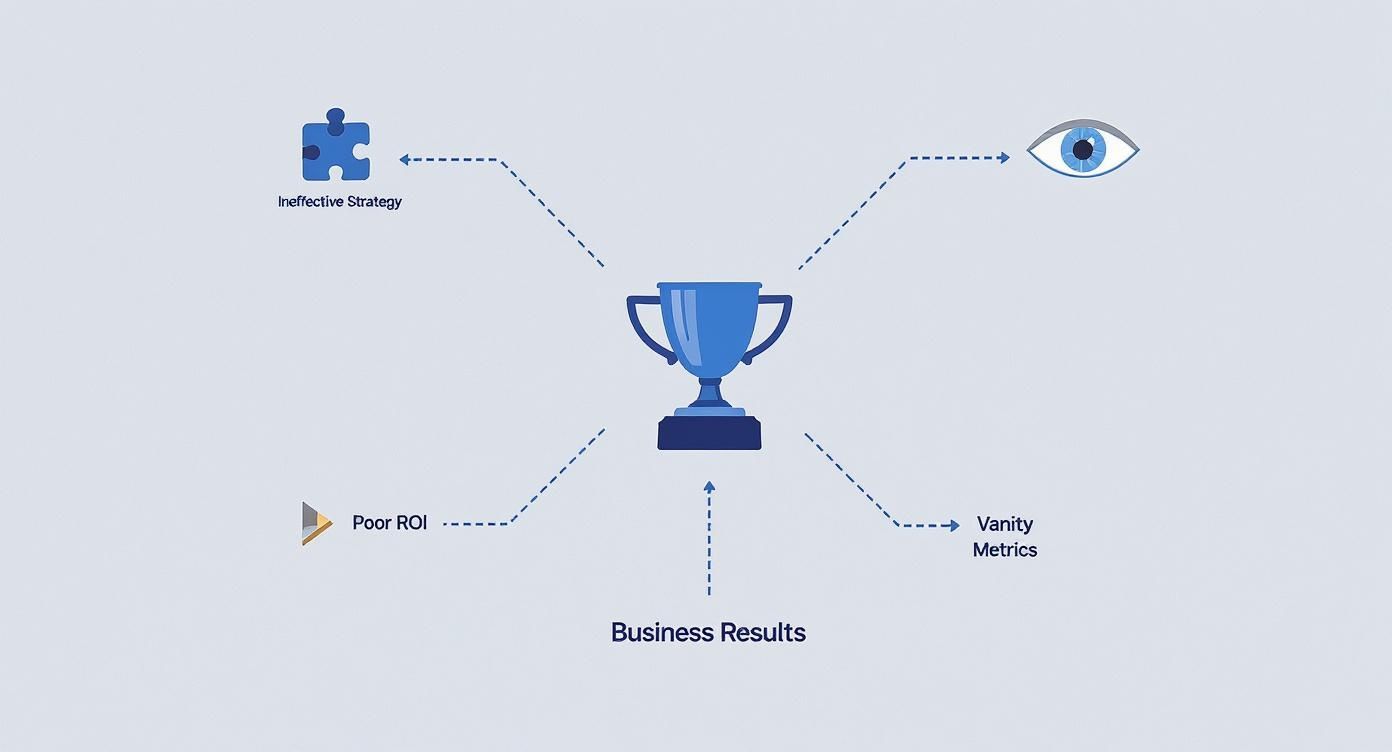
As you can see, things like a weak strategy, poor ROI, and a focus on vanity metrics are all symptoms of a disconnected approach.
3. Brand and Performance Synergy
For decades, organizations have treated brand marketing (long-term, narrative-driven) and performance marketing (short-term, conversion-focused) as separate disciplines. This is an outdated model that creates a false dichotomy and limits growth. In reality, they are two sides of the same coin, and their synergy is a powerful growth multiplier.
A strong brand makes every performance marketing dollar more efficient. Period. When customers know and trust your brand, your click-through rates are higher, conversion rates increase, and customer acquisition costs decrease.
Conversely, every performance campaign is an opportunity to reinforce your brand narrative. The objective is to create a seamless customer experience where your brand story and your conversion-focused calls-to-action work in concert, telling one cohesive and compelling story.
The most successful companies I've worked with treat every ad, email, and social post as both a brand-building moment and a performance driver. This synergy demolishes the false choice between long-term value and short-term results.
4. The Technology and Automation Stack
Finally, technology is the enabler that allows you to execute this strategy at scale and with precision. The key is to select tools that solve specific business problems, not to chase the latest marketing trend. A well-designed tech stack automates repetitive tasks, enables personalization at scale, and provides the data feedback loops necessary for continuous improvement.
From a Customer Data Platform (CDP) that unifies customer data (Pillar 1) to an automation platform that powers personalized journeys (Pillar 2) while delivering a consistent brand message (Pillar 3), technology is the operational backbone. It's what transforms a strategic framework from a document into a living, breathing growth engine.
Measuring the Real ROI of Your Consulting Partner

In the boardroom, there is only one metric that truly matters: Return on Investment. When you engage digital marketing consulting services, you are not purchasing a list of deliverables. You are making a strategic investment in a business outcome, and that outcome must be reflected in the P&L.
Too many leaders are seduced by vanity metrics. Return on Ad Spend (ROAS) is a prime example. While useful for optimizing a specific campaign, it reveals nothing about overall profitability, the lifetime value of the customers acquired, or whether you are gaining market share. It is a siloed metric in a world that demands integrated business intelligence.
A true consulting partner re-frames the conversation away from ROAS. They architect a measurement framework that connects marketing activities directly to the core financial drivers of the business.
Beyond ROAS: A Holistic ROI Model
To accurately measure a consultant's impact, you must adopt a more sophisticated, multi-faceted view of performance. This isn't about channel-specific reporting; it's about understanding how your marketing investment is building long-term enterprise value.
Your reporting framework must be built on three core pillars:
- Customer Lifetime Value (CLV): Are your marketing efforts attracting and retaining high-value customers who drive long-term profitability? A high ROAS on a campaign that acquires low-value, one-time buyers is a strategic failure.
- Customer Acquisition Cost (CAC): Is the fully-loaded cost to acquire a new customer—including all marketing, sales, and consulting fees—decreasing over time? Improving efficiency is the hallmark of a scalable growth model.
- Market Share Gains: Is marketing merely generating leads, or is it actively capturing territory from competitors? This requires tracking metrics like share of voice, branded search volume, and competitive displacement rates.
The ultimate test of a consulting partnership isn't a temporary spike in website traffic or a fleeting drop in cost-per-click. It's a sustained, positive impact on the core unit economics of your business—higher CLV and lower CAC—that leads directly to profitable growth.
A Case Study in Shifting Focus
I once partnered with a B2B SaaS company that was fixated on lead volume. Their previous agency was celebrated for driving thousands of cheap Marketing Qualified Leads (MQLs). The problem? The sales team was drowning in unqualified leads from small businesses, while their ideal enterprise targets were being ignored.
We immediately discarded their old metrics. Instead of MQL volume, we began measuring the sales pipeline value generated exclusively from target enterprise accounts.
Initially, the raw lead count dropped, causing considerable anxiety. But within six months, the data spoke for itself. We drove a 40% increase in high-value sales pipeline and improved average CLV by 25%. That is the difference between being busy and driving strategic, profitable growth.
Establishing Data-Backed KPIs Before Day One
Before any consulting engagement begins, a clear set of data-backed Key Performance Indicators (KPIs) must be mutually established. This is a non-negotiable prerequisite for accountability and ensures alignment from the outset.
This process links every proposed initiative to a specific, measurable business outcome. An SEO project is not defined by "ranking for keywords," but by a target percentage increase in the organic sales pipeline. This requires sophisticated attribution, and you can get a better sense of how to properly attribute value across channels by understanding what marketing mix modeling is.
This level of rigor is what separates high-impact consultants from the rest. The digital marketing consulting industry is characterized by rapid growth and strategic differentiation. High-growth firms, achieving a compound annual growth rate (CAGR) of at least 20% over three years, are far outpacing the industry average of 4.7%. This disparity proves that firms delivering clear, measurable business value are capturing the market. You can read the full research on the state of marketing consulting services to see how strategic focus is driving this success.
How to Choose the Right Digital Marketing Consultant
Selecting a partner for your digital marketing consulting services is one of the most critical growth decisions an executive team will make. A successful partnership can unlock exponential growth and create a defensible competitive advantage. A poor choice results in millions in wasted capital, a demoralized team, and irretrievable market opportunity.
This decision demands more than a cursory review of a website and a few polished case studies.
Over my career, I've developed a rigorous framework for vetting potential partners. It’s not about finding someone who confirms your existing biases. It’s about identifying a partner who will challenge your assumptions with data, drive your team toward higher performance, and tie every action back to the P&L. This framework centers on three non-negotiable criteria.
1. Digging into Their Strategic Brain
First, you must rigorously test their strategic acumen. Does the consultant truly understand your business model, your market dynamics, and the specific unit economics that drive your profitability? A consultant who immediately discusses SEO or PPC without first inquiring about your Customer Lifetime Value (CLV) and Customer Acquisition Cost (CAC) is a technician, not a strategist.
To assess this, ask questions that force them to think beyond marketing channels.
- Drill-Down Question: "Walk me through how you’d diagnose our current growth engine in the first 30 days. What specific data would you need from finance, sales, and product—not just from the marketing team?"
- What You Want to Hear: A strong answer will focus on business fundamentals before marketing tactics. They should request P&L statements, sales cycle data, and customer retention cohorts. This demonstrates they view marketing as an integrated component of the business system, not an isolated function.
2. Validating Their Technical Chops
Once you confirm their strategic mindset, you must validate their technical and executional capabilities. Many leaders either accept a consultant's expertise at face value or become lost in technical jargon. The goal is to determine if they possess practical, hands-on experience and can translate complex initiatives into clear business outcomes.
The best consultants don’t just know the theory; they have the scars to prove they've been in the trenches. They understand the messy reality of execution and can see roadblocks coming a mile away.
A consultant's past failures are often more instructive than their successes. A seasoned professional has seen strategies fail and knows how to pivot based on data, not ego.
- Drill-Down Question: "Tell me about a time when a major strategic recommendation you made didn't deliver the expected results. How did you figure out what went wrong, and what was the pivot?"
- What You Want to Hear: Avoid anyone who claims a flawless record. Look for humility, a clear, data-driven diagnostic process, and a structured methodology for learning from missteps. This reveals resilience and a commitment to results over appearances.
3. Gauging Cultural Fit and Influence
Finally, and perhaps most critically, you must evaluate cultural fit and their ability to influence your organization. This is not about finding a friend for your team. It is about engaging a partner who can constructively challenge the status quo, break down internal silos, and build the cross-functional alignment necessary for sustainable growth.
A consultant's true value lies in their ability to drive change. This requires a unique combination of data-driven authority and the emotional intelligence to get marketing, sales, product, and finance all aligned and moving in the same direction.
- Drill-Down Question: "Our sales and marketing teams don’t always see eye-to-eye. How would you start breaking down those silos to build a single, accountable revenue team?"
- What You Want to Hear: An excellent answer will focus on establishing shared metrics (like pipeline value), instituting joint planning processes, and creating data transparency across both teams. They should speak the language of both a CMO and a CRO, demonstrating their ability to mediate and align disparate departments toward a common business objective. This capacity to unify teams is the hallmark of world-class digital marketing consulting services.
To help you structure this evaluation, I've put together a checklist of questions. Think of this as your guide to separating the talkers from the true strategic partners who will actually move the needle for your business.
Critical Vetting Questions for Potential Consultants
| Evaluation Category | Key Question to Ask | What to Look for in the Answer |
|---|---|---|
| Business Acumen | How do you define success for an engagement like this? What are the top 3-4 metrics you would anchor to? | They should tie success directly to high-level business outcomes (e.g., pipeline value, revenue growth, market share) not just vanity metrics (e.g., traffic, impressions). |
| Strategic Depth | Based on what you know about our company, what do you see as our biggest untapped growth opportunity and our most significant threat? | Look for a nuanced answer that shows they’ve done their homework. They should connect market trends to your specific business model and competitive position. |
| Technical Proficiency | Walk me through the tech stack you are most proficient with. How do you ensure data integrity across different platforms? | They should not only list tools but explain how and why they use them. A focus on data governance and clean integration is a sign of a true expert. |
| Execution & Process | Describe your process for turning a high-level strategy into a detailed, week-by-week execution plan. | Look for a structured methodology. They should talk about prioritization, resource allocation, feedback loops, and how they manage dependencies. |
| Problem Solving | Tell me about the most complex marketing problem you've had to solve. What was your process for diagnosing and addressing it? | A strong answer will reveal a systematic, data-driven approach to problem-solving, not just a lucky guess. Look for evidence of critical thinking and resilience. |
| Cultural Influence | How do you handle situations where a key stakeholder on the client-side is resistant to your recommendations? | They should describe a diplomatic but firm approach rooted in data and shared goals. The focus should be on building consensus, not forcing an agenda. |
Using a structured set of questions like this prevents you from being swayed by a slick presentation. It forces a deeper conversation that reveals a consultant's true capabilities and whether they have what it takes to be the growth partner you need.
The Future of Consulting: Where AI Meets Human Expertise

The consulting landscape is being fundamentally reshaped by artificial intelligence. Many executives I speak with view AI as an eventual replacement for human strategists. This perspective, in my view, is fundamentally flawed. AI is not a replacement for human expertise; it is a powerful force multiplier.
The most effective digital marketing consulting services are already integrating AI into their core workflows to deliver outcomes that were previously unattainable. AI is an analytical engine capable of processing data and executing at a scale no human team can match. It is the ultimate accelerator for identifying opportunities and optimizing performance.
This is not a future-state prediction; it is the current reality. A striking 71% of marketers plan to invest at least $10 million in AI tools over the next three years, up from 57% in 2024. This significant capital allocation, detailed in Marketing Dive's AI investment trends, underscores how central AI is becoming to everything from campaign automation to predictive customer modeling.
AI as the Ultimate Co-Pilot
I view AI as a strategic co-pilot. It excels at the computational heavy lifting—the tasks that require immense processing power and speed. This liberates human consultants to focus on their highest-value contributions: sophisticated strategy, creative problem-solving, and organizational leadership.
Here is how elite consultants are leveraging AI today:
- Predictive Analytics: AI models analyze vast datasets to identify high-value customer segments and predict future behavior, enabling hyper-targeted campaigns that maximize ROI.
- Massive-Scale Optimization: AI can A/B test thousands of ad creatives simultaneously or adjust media buying in real-time based on competitive shifts, ensuring maximum capital efficiency.
- Hypothesis Generation: By synthesizing market trends and customer data, AI can generate novel hypotheses for creative angles and marketing strategies, serving as a data-driven source of innovation.
AI handles the what and the how—what patterns are in the data, and how can we act on them? But it takes a human consultant to answer the most important question: why?
The Irreplaceable Human Element
For all its analytical power, AI cannot replicate uniquely human capabilities. It cannot enter a boardroom, build trust with a skeptical executive team, and align sales and marketing around a new strategic direction. Technology can surface a game-changing insight, but it takes human leadership to drive the organizational change required to act on it.
This is where the value of a modern consultant becomes indispensable. Skills like leadership, empathy, and the ability to translate complex data into a clear, compelling narrative are uniquely human. If you're looking to get your teams on the same page, our guide on how to implement AI in business is a great place to start.
The consultant of the future is a hybrid leader—equally adept at commanding an AI platform and a boardroom. They leverage technology to find the signal in the noise and then apply their seasoned judgment to architect a winning strategy. This synergy between machine intelligence and human wisdom will define the next era of business growth.
Answering the Tough Questions About Digital Marketing Consulting
Having spent years in boardrooms and executive committees, I've come to anticipate the critical, often skeptical, questions that arise when the topic of external consulting is raised. Let's address the most common inquiries I encounter regarding digital marketing consulting services with direct, experience-backed answers.
What’s the Real Difference Between a Consultant and an Agency?
This is the most critical distinction to understand. It's the difference between hiring a pair of hands and engaging a strategic mind.
An agency is typically retained to execute predetermined tactics. You instruct them to manage SEO, run social media, or launch a PPC campaign, and they implement those tasks. Their focus is tactical, measured by channel-specific metrics and the completion of deliverables.
A true consultant, by contrast, is engaged to architect your overarching growth strategy. They begin by interrogating the "why" long before considering the "what." Their work starts with your P&L statement, not your Google Ads account. Their role is to design the entire growth system, break down organizational silos, and build the data infrastructure that connects every marketing dollar to a business outcome like revenue or market share.
Think of it like this: An agency rents you their hands to do a job. A consultant partners with you to solve a fundamental business problem.
How Long Until We See Tangible Results?
This is the question every executive asks, and for good reason. The candid answer: it depends entirely on the current state of your foundation.
Quick wins are almost always achievable. Optimizing a high-traffic landing page or reallocating a misdirected ad budget can generate a positive impact within the first 30 to 60 days. These early results are crucial for building momentum and establishing credibility.
However, the transformative, game-changing results stem from foundational work, which requires a longer time horizon. Architecting a proper data and analytics infrastructure or engineering a full-funnel customer journey are not quick fixes; these initiatives may take three to six months to mature fully. But it is this foundational work that delivers sustainable, compounding returns—the difference between a short-term sugar rush and building a durable, high-performance growth engine.
How Much Should We Budget for Consulting?
This question often frames consulting as a cost center, which is a strategic miscalculation. A consulting engagement should be viewed as a strategic investment tied directly to specific growth targets and a quantifiable ROI.
Therefore, the question should not be, "How much does it cost?" but rather, "What is the business outcome we are investing in?"
A high-caliber engagement should be priced based on the value it is designed to create. If the objective is to increase customer lifetime value by 20% or reduce customer acquisition cost by 15%, the consulting fee should represent a calculated fraction of that projected financial upside. This model aligns incentives and shifts the conversation from cost to the only metric that truly matters: measurable business growth.
Ready to stop guessing and start building a predictable revenue engine? At MGXGrowth, we partner with executive teams to architect and execute data-driven growth strategies that deliver measurable ROI. Let's discuss how we can build your growth roadmap.
