


Leading Change Isn't Art—It's Architecture: Building Your Blueprint for Transformation
In my decades driving growth across SaaS, hospitality, and real estate, I've learned that the market never stands still. The ability to not just manage change, but to architect it, is what separates high-growth organizations from those left behind. Too often, leaders treat transformation as a reactive measure, a fire to be extinguished. But the most effective transformations are proactive, data-driven, and deeply human. They require a blueprint, not just a gut feeling.
This isn't about vague theories; it's about deploying proven frameworks that align strategy with execution and break down the silos that stifle progress. In this deep dive, we move beyond the buzzwords to dissect ten of the most powerful organizational change management strategies. I'll share insights from the trenches on how to apply these models to drive real results, whether you're implementing new AI-driven marketing technology, merging corporate cultures, or pivoting your entire go-to-market plan. This is your toolkit for building a resilient, adaptable organization ready for what's next. We will explore specific models that offer clear steps to guide your teams from uncertainty to adoption, ensuring your strategic initiatives translate into tangible growth and competitive advantage.
1. Kotter's 8-Step Change Model
Developed by Harvard Business School professor John Kotter, this model provides a clear, sequential roadmap for navigating complex transformations. From my experience driving growth initiatives, its power lies in its structured, people-centric approach. It’s one of the most effective organizational change management strategies because it addresses both the logistical and emotional sides of change, ensuring you build momentum from the ground up rather than imposing directives from the top down.
This framework is particularly effective for large-scale, deep-rooted changes like a digital transformation or a post-merger integration. It forces leaders to establish a compelling "why" before diving into the "how," which is critical for getting genuine buy-in. When I guided a major SaaS firm through a product-led growth transition, we leaned heavily on Kotter's early steps to create a sense of urgency around shifting market demands, which was foundational to our success.
Implementation and Key Steps
The 8-step process is linear and builds upon itself. Rushing or skipping a step often leads to failure, as each one lays the groundwork for the next. The process begins by establishing the need for change, builds a powerful coalition to lead it, and culminates in embedding the new ways of working into the very fabric of your company’s culture.
The infographic below highlights three pivotal stages in this journey: creating the initial urgency, generating tangible short-term wins to maintain momentum, and finally, anchoring the change within the corporate culture to ensure it sticks.
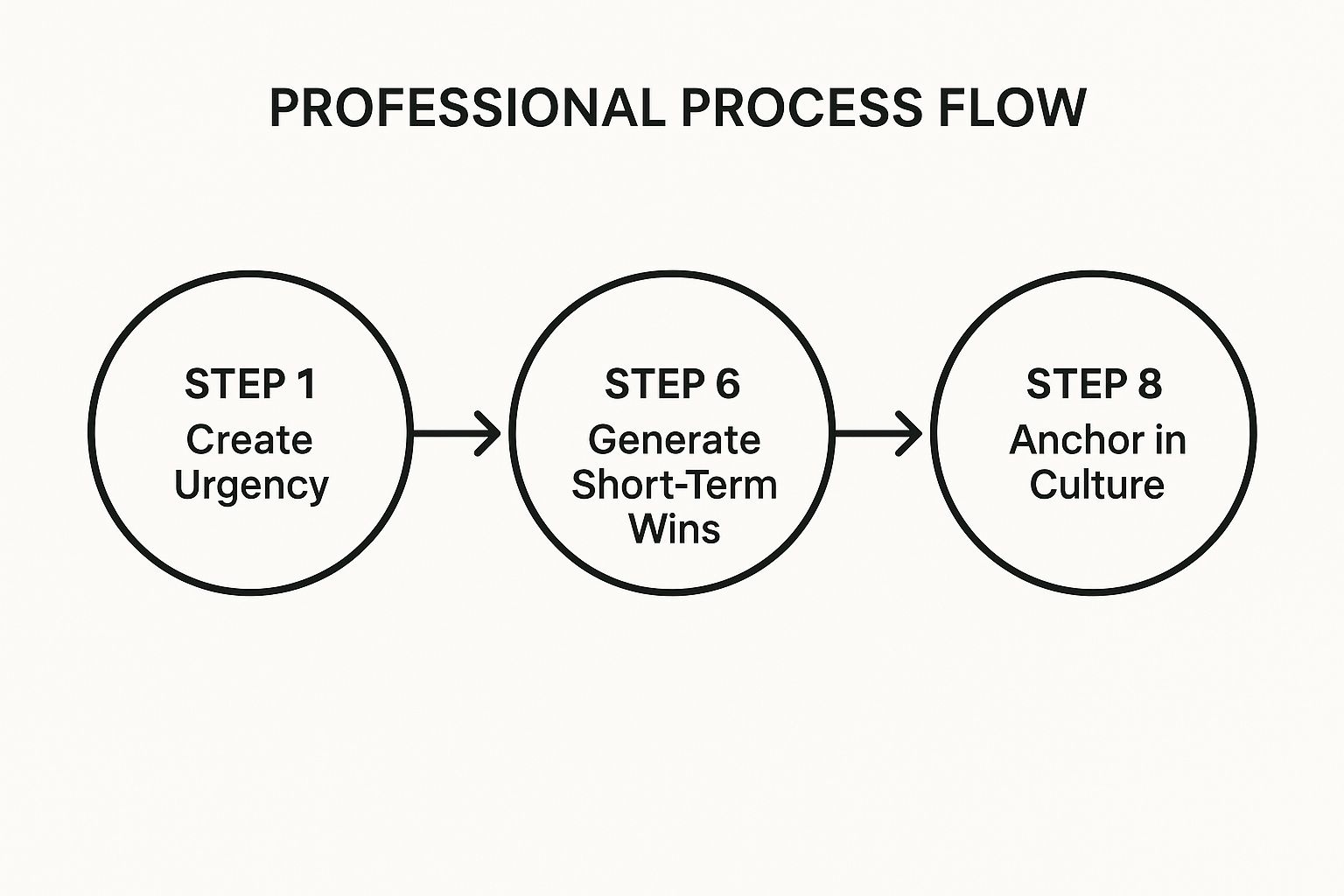
This flow underscores that successful change is a marathon, not a sprint, requiring a strong start, sustained motivation, and a definitive finish that solidifies new behaviors.
Actionable Tips for Leaders:
- Don't Underestimate Step 1: Spend significant time building a data-backed case for why the change is not just beneficial but essential for survival or growth.
- Empower Your Coalition: Your "guiding coalition" must include influential leaders from various departments with real authority, not just figureheads.
- Over-Communicate the Vision: Communicate your vision at least ten times more than you think you need to, using different channels and formats.
- Celebrate Early Wins: Publicly recognize and reward teams who achieve short-term wins. This provides crucial proof that the change is working and silences skeptics.
2. ADKAR Model
Developed by Prosci founder Jeff Hiatt, the ADKAR model is a goal-oriented framework that focuses on the individual's journey through change. I've found it to be one of the most practical organizational change management strategies because it reminds us that large-scale change only happens one person at a time. It shifts the focus from the "what" of the change to the "who," ensuring each team member successfully navigates the transition.
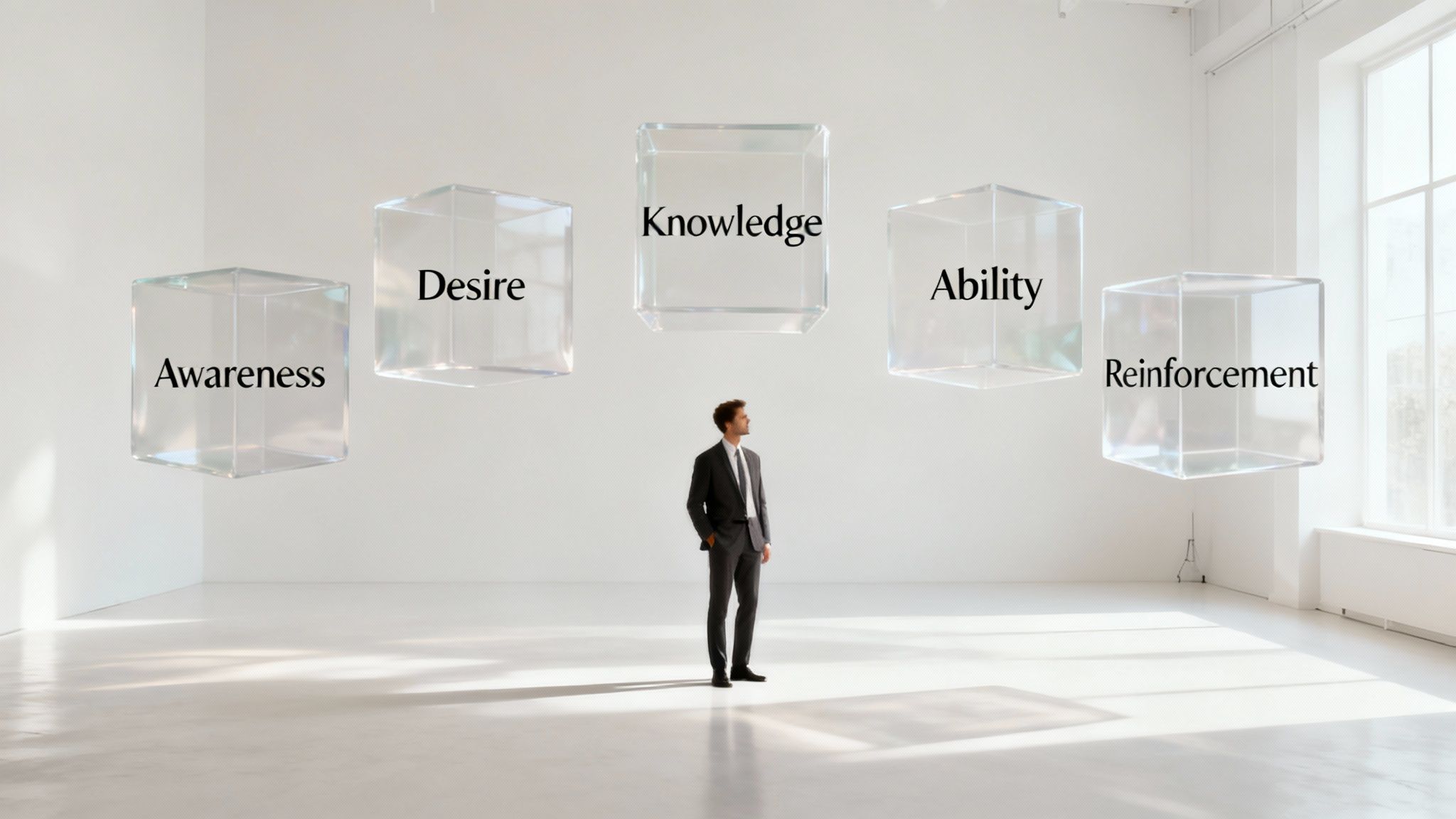
This bottom-up approach is incredibly effective for changes that heavily impact daily workflows, like the adoption of new software or a shift in safety protocols. When I consulted for a healthcare system implementing new clinical protocols, we used ADKAR as a diagnostic tool. It quickly revealed that while Awareness was high, the Desire to change was low due to perceived workflow disruptions. This insight allowed us to pivot our strategy to address the "what's in it for me" question directly.
Implementation and Key Steps
ADKAR is an acronym for the five sequential outcomes an individual must achieve for change to be successful: Awareness, Desire, Knowledge, Ability, and Reinforcement. This model acts as both a roadmap for planning change activities and a tool for diagnosing points of failure. If a change stalls, you can pinpoint which of the five building blocks is missing for an individual or group and take targeted corrective action.
The process is sequential; you can't build Knowledge on how to change if you haven't first cultivated the Desire to participate. The final step, Reinforcement, is crucial for making the change stick by celebrating successes and recognizing new behaviors.
Actionable Tips for Leaders:
- Diagnose the Gaps: Use the ADKAR framework to survey employees and identify the primary barrier to change. Is it a lack of awareness, desire, or ability?
- Empower Frontline Managers: Train managers to be change coaches who can identify where their team members are in the ADKAR journey and provide tailored support.
- Target Your Interventions: Develop specific tactics for each stage. For example, build Awareness with clear communications, foster Desire by highlighting personal benefits, and provide Knowledge through hands-on training.
- Don't Rush the Stages: Ensure each stage is solid before moving to the next. An individual without the prerequisite Ability cannot sustain the change, even with strong reinforcement.
3. Lewin's Change Management Model
Developed by psychologist Kurt Lewin, this model is one of the most foundational organizational change management strategies, conceptualizing transformation in three simple stages: Unfreeze, Change, and Refreeze. From my work transforming cultures in both startups and enterprises, its enduring power comes from its grasp of human psychology. It acknowledges that before you can introduce a new way of working, you must first deliberately dismantle the old one.
This framework is highly effective for cultural transformations or process overhauls where old habits are deeply ingrained. It forces leadership to address the inertia holding the organization back before pushing forward. When I guided a manufacturing firm through a massive safety culture transformation, we spent a significant portion of our effort on the "Unfreeze" stage, using data to show the undeniable risks of the existing "that's how we've always done it" mindset. This made the subsequent changes feel necessary rather than forced.
Implementation and Key Steps
The three stages provide a powerful, high-level guide. First, you Unfreeze the current state by challenging existing beliefs and practices. Next, you implement the Change itself, introducing new processes and behaviors. Finally, you Refreeze the new state, anchoring the changes into your company's culture, policies, and reward systems to ensure they stick.
This model is less of a tactical checklist and more of a strategic lens. It reminds us that change isn't just about adding something new; it's about removing what’s old and solidifying the replacement. The "Refreeze" step is crucial for preventing a regression to old habits once the pressure is off.
Actionable Tips for Leaders:
- Analyze the Forces: Before unfreezing, use Lewin’s Force Field Analysis to map out the driving forces (pushing for change) and restraining forces (resisting it). Focus on weakening the restraining forces, not just strengthening the drivers.
- Invest in Unfreezing: Don't rush this stage. Use data, compelling stories, and clear communication to explain why the status quo is unsustainable. Address both the rational and emotional resistance to change.
- Make Refreezing Intentional: The change isn't complete until it's refrozen. Update job descriptions, performance metrics, and reward systems to align with the new way of operating.
- Communicate Continuously: Provide consistent updates and support through all three stages, especially during the uncertainty of the "Change" phase, to maintain trust and momentum.
4. McKinsey 7-S Framework
Developed by McKinsey consultants in the 1980s and popularized in the book "In Search of Excellence," this model provides a holistic view of an organization as seven interconnected elements. My experience in scaling tech companies has shown me that its strength lies in preventing siloed thinking. It’s one of the most vital organizational change management strategies because it forces leaders to see that you can't just change one part of the business, like your strategy, without considering its ripple effect on your structure, systems, and people.
This framework is exceptionally useful for diagnosing misalignments that are holding back growth or for planning complex changes like a merger, where two different corporate DNAs must be integrated. When I advise companies on aligning their go-to-market functions, we use the 7-S model to map how a new sales strategy (Strategy) will require new CRM workflows (Systems), different team incentives (Style), and updated training programs (Skills). It ensures no critical component is overlooked.
Implementation and Key Elements
The 7-S model is divided into "hard" elements (Strategy, Structure, Systems) and "soft" elements (Shared Values, Style, Staff, Skills). The hard elements are more tangible and easier to define, while the soft elements are often more cultural and harder to change. The central idea is that Shared Values sit at the core, influencing and connecting all other elements. Successful change requires harmony across all seven.
A change initiative that focuses only on hard elements like restructuring a department is destined to fail if it ignores the soft elements like the leadership style and the team's existing skills. You must treat the organization as a complex, interconnected ecosystem, not a set of independent parts. To learn more about how these elements influence business growth, check out this guide on innovation and branding.
Actionable Tips for Leaders:
- Start with a Diagnostic: Before planning any change, map the current state of all seven elements to identify existing strengths and, more importantly, misalignments.
- Prioritize Shared Values: Treat your "Shared Values" as the gravitational center. Any proposed change must align with or reinforce your core mission and culture.
- Don't Neglect the Soft 'S's: The soft elements (Style, Staff, Skills) are often the most difficult to address but create the most resistance. Dedicate significant resources to them.
- Visualize the Connections: Create a visual map showing how a change in one element (e.g., a new system) will impact all others. This helps communicate the comprehensive nature of the change to stakeholders.
5. Bridges' Transition Model
Developed by consultant William Bridges, this model brilliantly distinguishes between the external "change" event and the internal psychological "transition" people undergo. From my experience managing post-merger integrations, this distinction is crucial. You can change a system overnight, but you can't force people's mindsets to change with it. Bridges' model is one of the most powerful organizational change management strategies because it focuses entirely on the human experience, guiding people through letting go of the past and embracing the future.
This framework is exceptionally effective during culturally sensitive shifts, such as leadership changes or deep reorganizations where identity and routine are disrupted. It acknowledges that productivity will dip as people navigate the "Neutral Zone," a messy but necessary period of reorientation. When I worked with a healthcare system integrating new EMR software, we used Bridges' model to prepare managers for this exact dip, helping them support their teams through the confusion rather than punishing them for it, which was critical for long-term adoption.
Implementation and Key Steps
Unlike process-driven models, Bridges' framework focuses on three psychological phases people move through. The journey begins with acknowledging what is being lost, moves through a period of uncertainty and creative exploration, and concludes with a new sense of purpose and identity. Understanding this path is key to preventing employee disengagement.
The success of this model hinges on a leader’s ability to guide teams through these emotional stages with empathy and clear communication, recognizing that the transition, not the change itself, is what ultimately determines success or failure.
Actionable Tips for Leaders:
- Acknowledge the Loss: Before promoting the benefits of the new way, openly and honestly address what people are losing, whether it's a team, a process, or a sense of familiarity.
- Normalize the Neutral Zone: Repeatedly communicate that feeling confused, anxious, or unmotivated during the transition is normal. Don't rush this phase; it's where innovation often begins.
- Mark the Endings: Formally say goodbye to the old way of doing things. This could be a team event or a final "report" on an old system to provide closure.
- Define the New Beginning: Clearly articulate what the new beginning looks like, what the new rules are, and what each person's role will be. Create opportunities for quick wins to build confidence.
6. Kübler-Ross Change Curve
Originally developed by psychiatrist Elisabeth Kübler-Ross to describe the stages of grief, this model has been powerfully adapted for organizational change. It’s one of the most insightful organizational change management strategies because it acknowledges a fundamental truth: change is a form of loss. People lose comfort, familiarity, and routine, and their emotional journey mirrors the stages of grief. I’ve found it invaluable for managing the human side of restructuring or major technology shifts.
This framework maps the emotional states employees experience, from initial shock and denial to eventual acceptance and integration. It helps leaders anticipate and understand productivity dips and resistance not as defiance, but as a natural part of the process. During a painful but necessary round of layoffs at a previous company, using this curve helped us train managers to support their teams with empathy, recognizing their journey through anger and depression before they could move toward testing new realities.
Implementation and Key Steps
The Change Curve isn't a rigid, linear path; it's a guide to the emotional landscape of your team. The goal is to help individuals move through the stages constructively by providing tailored support. Leaders must first understand the stages-denial, anger, bargaining, depression, testing, and acceptance-to recognize them in their teams.
By acknowledging where people are on the curve, you can deploy the right interventions. For instance, clear communication is crucial during denial, while active listening and empathy are vital during the anger stage. The model’s power lies in humanizing the change process and equipping leaders to manage emotional responses instead of just operational ones.
Actionable Tips for Leaders:
- Train Your Managers: Equip your frontline leaders to identify each stage and provide the appropriate support. They are your first responders during a change initiative.
- Anticipate Productivity Dips: The "valley of despair" (depression stage) is real. Plan for a temporary drop in performance and don't penalize teams for it.
- Communicate, Communicate, Communicate: During the early stages (denial, anger), information and clarity are your best tools to combat rumors and fear.
- Show the Path Forward: As people move into the "testing" phase, provide clear opportunities for them to experiment and learn in the new environment, building their confidence.
7. Nudge Theory
Popularized by Nobel laureate Richard Thaler and Cass Sunstein, Nudge Theory is a fascinating strategy rooted in behavioral economics. Instead of enforcing change through mandates, it uses subtle, indirect suggestions to influence behavior. From my experience optimizing user funnels and internal workflows, its brilliance lies in guiding people toward better choices without restricting their freedom. This is one of the more sophisticated organizational change management strategies because it works with human psychology, not against it.

This approach is perfect for driving adoption of new tools, encouraging healthier habits, or promoting collaborative behaviors. For instance, when I needed a product team to adopt a new daily analytics dashboard, we didn't mandate it. We simply set it as the default homepage on their browsers. Adoption skyrocketed because we made the desired behavior the path of least resistance. It's about engineering the environment so the "right" choice is also the "easy" choice.
Implementation and Key Steps
Implementing Nudge Theory involves designing "choice architecture" to make desired actions intuitive and attractive. The goal is to gently steer decisions rather than command them. This requires a deep understanding of your team's current behaviors, friction points, and motivations. You’re not tricking people; you’re making it easier for them to do what's ultimately in their own and the company's best interest. The process is iterative, involving testing and refining nudges based on observable data.
Actionable Tips for Leaders:
- Set Smart Defaults: Make the desired behavior the default option, such as auto-enrolling employees in a new training portal or 401(k) plan.
- Leverage Social Proof: Highlight that "80% of top-performing teams use the new CRM daily." People are naturally inclined to follow the herd.
- Reduce Friction: If you want teams to collaborate more, redesign the office space with more common areas. If you want a new software adopted, ensure it has single sign-on.
- Provide Immediate Feedback: Use visual cues or instant notifications to reinforce positive actions, like a progress bar for completing compliance training.
8. Agile Change Management
Adapted from software development, Agile Change Management applies iterative and collaborative principles to organizational transformation. From my experience in high-growth tech environments, its strength is its flexibility. Instead of a rigid, top-down plan, it breaks change into small, manageable sprints, allowing for continuous feedback and adaptation. It is one of the most effective organizational change management strategies for dynamic industries where market conditions shift rapidly.
This framework is ideal for digital transformations or cultural shifts where the final outcome isn't perfectly defined from the start. It allows teams to learn and pivot as they go. When I advised a rapidly scaling tech company, we used an agile approach to overhaul their customer onboarding process. This let us test new workflows with small user groups, gather real-time feedback, and refine our approach iteratively, avoiding a disruptive, large-scale failure.
Implementation and Key Steps
Agile change management revolves around iterative cycles, often called "sprints," where cross-functional teams work on specific change increments. The core idea is to deliver value quickly, learn from both successes and failures, and adjust the plan accordingly. This contrasts with traditional "waterfall" methods that attempt to plan the entire change initiative from start to finish before any action is taken.
This approach is less about a linear path and more about a continuous loop of planning, executing, and learning. It fosters transparency through tools like visual Kanban boards and regular "retrospective" meetings, ensuring everyone is aligned and can contribute to improving the process. As you might imagine, this methodology can dramatically improve operational efficiency by reducing wasted effort on flawed plans.
Actionable Tips for Leaders:
- Start with a Pilot: Test the agile approach on a smaller, lower-risk project to build competency and demonstrate its value before a full-scale rollout.
- Empower Cross-Functional Teams: Create dedicated change teams with members from different departments and give them the autonomy to make decisions.
- Embrace Transparency: Use visual management tools like Trello or Jira to track progress and make the status of initiatives visible to everyone in the organization.
- Prioritize Regular Feedback: Hold daily stand-ups and weekly or bi-weekly retrospectives to discuss what’s working, what isn't, and how to adapt.
9. Appreciative Inquiry (AI)
Developed by David Cooperrider, Appreciative Inquiry (AI) flips the traditional problem-solving script on its head. Instead of focusing on what's broken, AI is a strengths-based model that identifies and amplifies what’s working well within an organization. In my work breaking down silos, I’ve found its power lies in generating positive energy and collective ownership, making it one of the most uniquely effective organizational change management strategies. It rallies people around a shared vision of what's possible, built on existing successes.
This framework is exceptionally powerful for revitalizing culture, improving team morale, or reimagining a customer experience. It avoids the defensiveness that often accompanies "problem-focused" change. When advising a hospitality group on improving their guest services, we used AI to explore peak moments of customer delight. This positive-core discovery process was far more inspiring and productive than a conventional gap analysis, leading to innovative ideas that were enthusiastically adopted by staff.
Implementation and Key Steps
AI typically follows the "4-D Cycle": Discovery (appreciating what is), Dream (imagining what could be), Design (determining what should be), and Destiny (creating what will be). The process is highly collaborative, engaging stakeholders at all levels to co-create the future. The core idea is that organizations move in the direction of what they study; by studying successes, you create more of them.
This journey starts by uncovering the organization's positive core and builds toward embedding those strengths into future processes and goals. It’s a fundamentally optimistic and energizing approach to transformation that fosters psychological safety and creative thinking.
Actionable Tips for Leaders:
- Ask Genuinely Appreciative Questions: Frame your "Discovery" questions to uncover stories of success and vitality, not to subtly diagnose problems.
- Ensure Diverse Participation: The magic of AI comes from including a wide range of voices, from frontline staff to senior leadership, to get a holistic view of the organization's strengths.
- Share Positive Stories Widely: Collect and circulate the powerful stories uncovered during the Discovery phase to build momentum and reinforce the positive core.
- Create Provocative Propositions: In the "Dream" phase, craft bold, affirmative statements about the future that inspire and stretch your team's aspirations.
10. Stakeholder-Centric Change Management
This strategic approach places stakeholder analysis and engagement at the very core of change planning. In all my years driving growth, I’ve learned that a transformation is dead on arrival if it ignores the people it impacts. This is one of the most vital organizational change management strategies because it recognizes that change isn't a monolithic event; it's a unique experience for every group, from your engineers and frontline sales reps to your customers and investors.
This framework is exceptionally powerful for complex initiatives with diverse interest groups, like a major IT transformation affecting various user departments or a healthcare system merger needing to align different physician groups. When I orchestrated a company-wide shift to a data-driven culture, we started by mapping stakeholders. Understanding the specific fears of the sales team versus the needs of the product team allowed us to tailor our approach, turning potential resistors into our most vocal champions.
Implementation and Key Steps
Success with this approach hinges on a systematic process of identification, analysis, and engagement. It’s not just about communication; it's about building a coalition by understanding and addressing specific interests. You must move from a broadcast mentality to a dialogue-driven one, where each group feels heard and valued. The goal is to build buy-in by demonstrating how the change aligns with what each stakeholder group cares about.
The process involves mapping stakeholders based on their influence and interest, developing tailored engagement plans for each segment, and creating feedback loops. This ensures that concerns are addressed proactively rather than reactively, which is essential for maintaining momentum and minimizing friction throughout the transition.
Actionable Tips for Leaders:
- Map Your Stakeholders Early: Create a comprehensive map identifying all stakeholders, their level of influence, and their potential interest or opposition to the change. Revisit this map regularly.
- Identify Internal Champions: Find influential individuals within key stakeholder groups who can advocate for the change and provide authentic feedback from the ground up.
- Develop Group-Specific Value Propositions: Don't use a one-size-fits-all message. Explain the "what's in it for me" for each distinct group, from the C-suite to the front lines. Leaders looking to improve these skills can explore setting new goals for leadership development.
- Address High-Influence Resistors Directly: Don't avoid the tough conversations. Engage directly with influential skeptics to understand their concerns and, where possible, involve them in finding solutions.
Organizational Change Strategies Comparison
| Model | Implementation Complexity 🔄 | Resource Requirements ⚡ | Expected Outcomes 📊 | Ideal Use Cases 💡 | Key Advantages ⭐ |
|---|---|---|---|---|---|
| Kotter's 8-Step Change Model | Moderate to High – sequential 8 steps, top-down structure | Moderate – leadership involvement and communication effort | Sustainable cultural change, strong leadership buy-in | Large-scale transformations in hierarchical organizations | Clear framework, leadership focus, builds momentum |
| ADKAR Model | Moderate – individual sequential stages | High – time-intensive per individual | Individual adoption of change, measurable progress | Ensuring individual adoption in technology/process changes | Simple, diagnostic, measurable at individual level |
| Lewin's Change Management Model | Low – 3 stages, straightforward | Low to Moderate – focus on transition phases | Stabilized change, reduced resistance to change | Discrete changes with clear start/end in stable environments | Easy to understand, emphasizes preparation and stabilization |
| McKinsey 7-S Framework | High – complex interdependencies | High – thorough assessment across 7 elements | Organizational alignment, comprehensive diagnosis | Large transformations, mergers, strategic shifts | Holistic view, considers soft/hard elements, diagnostic tool |
| Bridges' Transition Model | Low to Moderate – psychological focus | Moderate – emotional support needed | Improved psychological transition, reduced resistance | People-focused change, cultural shifts, leadership transitions | Addresses emotional journey, empathetic, reduces resistance |
| Kübler-Ross Change Curve | Low – conceptual emotional path | Low – training on emotional awareness | Understanding and managing emotional reactions | Supporting leaders during difficult organizational changes | Anticipates emotional responses, normalizes negative feelings |
| Nudge Theory | Moderate – subtle behavioral design | Low to Moderate – low-cost nudges | Behavior change through choice architecture | Behavior change initiatives, wellness, safety improvements | Low resistance, preserves choice, evidence-based |
| Agile Change Management | High – iterative, requires culture shift | High – ongoing commitment and skilled teams | Rapid value delivery, adaptive change | Fast-moving, dynamic environments, digital transformations | Flexible, collaborative, reduces risk, continuous feedback |
| Appreciative Inquiry (AI) | Moderate – stakeholder engagement and facilitation | Moderate to High – time and facilitation skills needed | Positive momentum, shared vision, strengths-based culture boost | Culture change, vision creation, mergers needing unity | Builds engagement, focuses on strengths, inclusive |
| Stakeholder-Centric Change Management | High – continuous stakeholder mapping and engagement | High – resource-intensive ongoing management | Greater buy-in, reduced resistance, tailored communications | Complex, politically sensitive changes, public sector, large projects | Targeted engagement, early blocker identification, coalition building |
From Framework to Flywheel: Activating Your Change Strategy
Navigating the landscape of organizational change management strategies can feel like learning a new language. We've dissected ten powerful models, from the structured urgency of Kotter's 8 steps to the human-centric empathy of the Kübler-Ross Change Curve. We've examined the holistic alignment of the McKinsey 7-S Framework and the iterative, adaptive nature of Agile Change Management. Each provides a distinct lens through which to view, plan, and execute transformation.
But here is the critical insight I've gained from decades of driving growth: these frameworks are not isolated playbooks. They are complementary tools in a leader’s toolkit. The true mastery of change isn't in picking one model and following it blindly; it's in the strategic integration of several. You might use Lewin's "Unfreeze, Change, Refreeze" model to frame the big picture, while deploying the ADKAR model to diagnose and address resistance at the individual level. You could leverage Appreciative Inquiry to build positive momentum while using Stakeholder-Centric approaches to ensure your key players are not just informed, but fully invested.
Turning Theory into Traction
The ultimate goal is to move beyond the "change project" mindset. A project has a start and an end date, but in today's market, adaptation is constant. Your objective is to build a self-sustaining flywheel of change, where each successful initiative builds momentum for the next, making your organization more resilient, innovative, and responsive.
This requires shifting from a top-down mandate to a deeply embedded cultural capability. It means transforming your approach by:
- Integrating Data: Moving from gut-feel decisions to data-driven insights to measure the impact of change on performance, engagement, and customer satisfaction.
- Fostering Psychological Safety: Creating an environment where teams can navigate the uncertainty and emotional journey of transition, as outlined by Bridges' model, without fear of failure.
- Aligning Incentives: Ensuring that performance metrics and rewards are aligned with the new behaviors and outcomes you want to encourage, a key aspect often overlooked in purely theoretical applications.
The most effective organizational change management strategies are those that become ingrained in your operational DNA. They are not a one-time fix but a continuous discipline. By mastering this discipline, you transform change from a disruptive threat into your most potent competitive advantage. This is how you stop simply managing change and start leading through it, unlocking sustainable growth and cementing your position as a market leader.
Ready to translate these powerful frameworks into a concrete, data-driven growth strategy for your organization? At MGXGrowth, we specialize in helping leadership teams implement these organizational change management strategies to break down silos, align teams, and drive measurable revenue and EBITDA growth. Visit MGXGrowth to learn how we can help you build your change flywheel.
