


In my decades driving growth across SaaS, hospitality, and real estate, I've learned one non-negotiable truth: the most durable competitive advantage is anticipating what your highest-value customers need before they do. Predictive personalization for VIP travelers isn't about loyalty points or a free drink; it's a strategic imperative. It's about leveraging data to orchestrate seamless, hyper-relevant experiences that directly translate to increased Customer Lifetime Value (CLV) and market share.
This isn't just about remembering a guest's name. It's about knowing a C-level executive is arriving on a red-eye from a grueling international trip and having their preferred room—quiet, high-floor, away from the elevator—ready for an early check-in, with their specific brand of mineral water waiting. It’s about anticipating, not reacting. That’s how you build unbreakable loyalty.
The Future of Luxury Hospitality Is Proactive
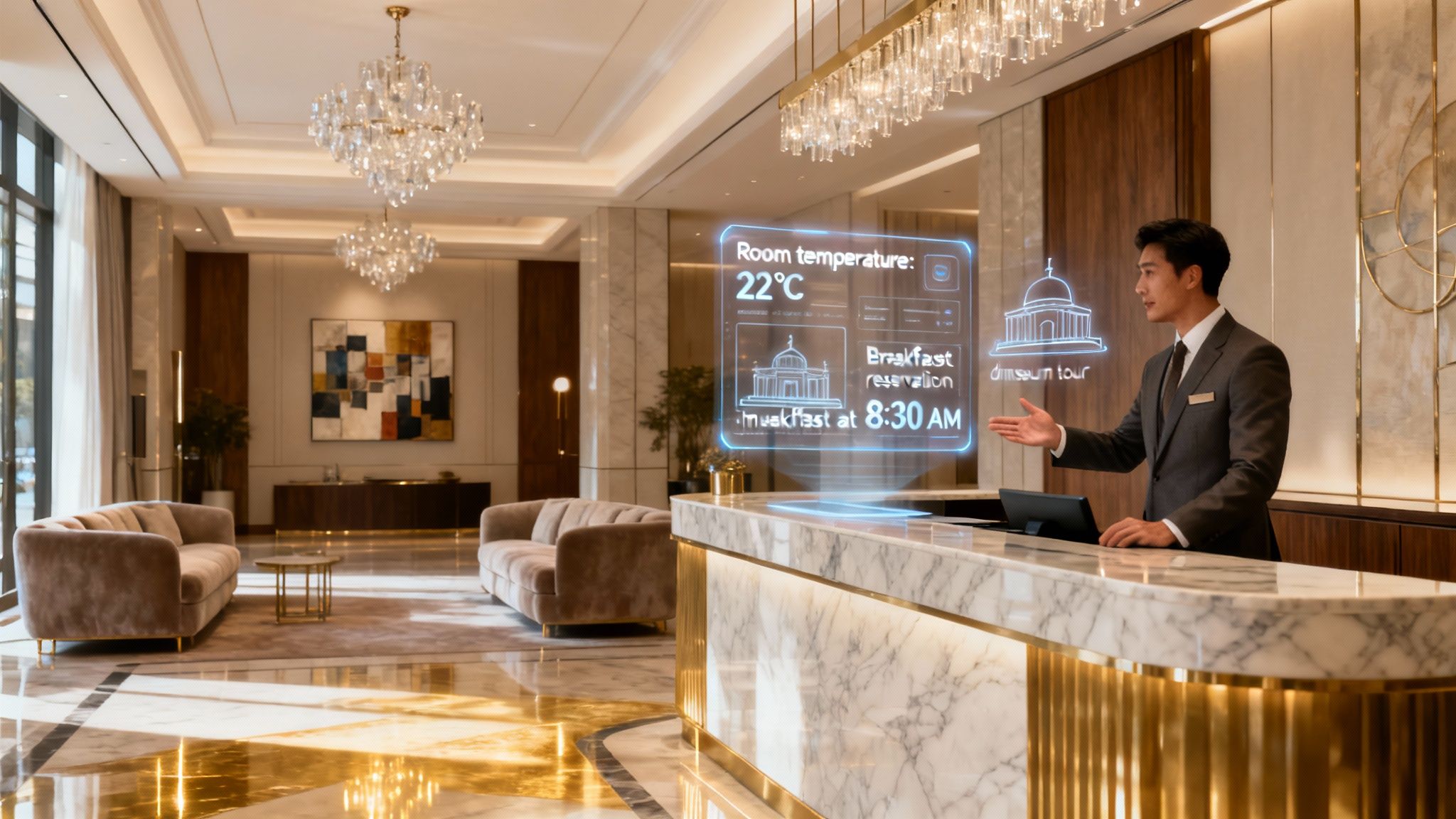
I've seen countless trends cycle through the C-suite, from SaaS to gaming. Most are noise. Predictive personalization, however, is a fundamental operational shift. It’s not another marketing buzzword; it’s a P&L-level strategy for how we acquire, retain, and grow our most profitable customer segments.
Reactive service—acknowledging a repeat guest or recalling their favorite wine—is now table stakes. It's the cost of entry, not a differentiator. The growth opportunity lies in proactive, data-driven anticipation. It’s about creating moments that feel both effortless and prescient, which is the very definition of modern luxury.
Why This Shift Is Happening Now
This evolution is the direct result of two powerful forces converging: the democratization of AI-driven analytics and an unequivocal demand from sophisticated, high-value travelers. These individuals don't just expect amenities; they expect their value to be recognized through effortless, intelligent service.
The market data validates this thesis. The luxury travel sector is projected to hit $620.71 million by 2032, driven not by more gold-plated fixtures, but by deeply personalized experiences. It's no surprise that 85% of hoteliers now identify personalization as a primary driver of commercial growth. You can review the data behind this luxury travel market shift for yourself.
I’ve spent my career breaking down the silos between marketing, operations, sales, and product teams. Predictive personalization is the ultimate silo-buster. It forces the entire organization to rally around a single, data-informed view of the VIP guest, which has a direct and powerful impact on EBITDA.
This proactive model transforms the guest relationship from transactional to deeply relational. It's how we engineer the moments that forge lasting loyalty and drive superior financial performance.
The Tangible Business Impact
Shifting from a reactive to a proactive service model isn't about platitudes; it’s about driving measurable business outcomes. This is a competitive moat built on data and operational excellence.
A properly executed predictive personalization strategy delivers concrete results:
- Increased Customer Lifetime Value (CLV): Anticipating needs creates a bond far stronger than any points-based rewards program can achieve.
- Higher Ancillary Revenue: Predicting that a guest will want a specific spa treatment after a long flight allows for a timely, relevant offer that converts at a higher rate.
- Improved Operational Efficiency: Empowering your teams with predictive insights allows them to prepare for guest needs in advance, reducing friction and freeing them to focus on high-touch service delivery.
In this guide, I'll lay out the operational framework for building and deploying these workflows, turning your data from a static asset into a dynamic engine for revenue and loyalty.
Building Your Data Foundation for Personalization
Let's be direct: every growth strategy I've ever implemented has been built on a foundation of clean, unified data. In my experience, most predictive personalization for VIP travelers initiatives fail right here. Without a pristine data foundation, you aren't predicting; you're just making expensive, ill-informed guesses.
The primary objective is to break down the data silos that plague most organizations. Your Property Management System (PMS) holds one piece of the puzzle, your CRM holds another, and your loyalty program a third. Attempting to deliver a seamless VIP experience from that fragmented view is operationally impossible. The first and most critical mandate is data unification.
Creating the Single Source of Truth
The end goal is a unified guest profile—a single source of truth that is accessible and actionable for every team member, from the C-suite to the front line. This profile is not a static report; it's a living asset that becomes more valuable with every guest interaction. It is the playbook that empowers every employee to deliver a consistently exceptional experience.
To build this asset, we must be disciplined about the data we integrate. This extends far beyond contact information.
- Past Booking Behavior: What room types are preferred? What is the typical length of stay? Are they traveling for business or leisure?
- On-Property Spending Patterns: Do they frequent the spa? What is their average F&B spend? Which ancillary services do they utilize?
- Explicit Preferences (Zero-Party Data): This is the goldmine. It's the data guests willingly provide—dietary restrictions, pillow preferences, preferred newspaper. It's incredibly powerful because it's built on trust.
This flow illustrates how disparate data streams must be integrated to build the foundational unified profile.
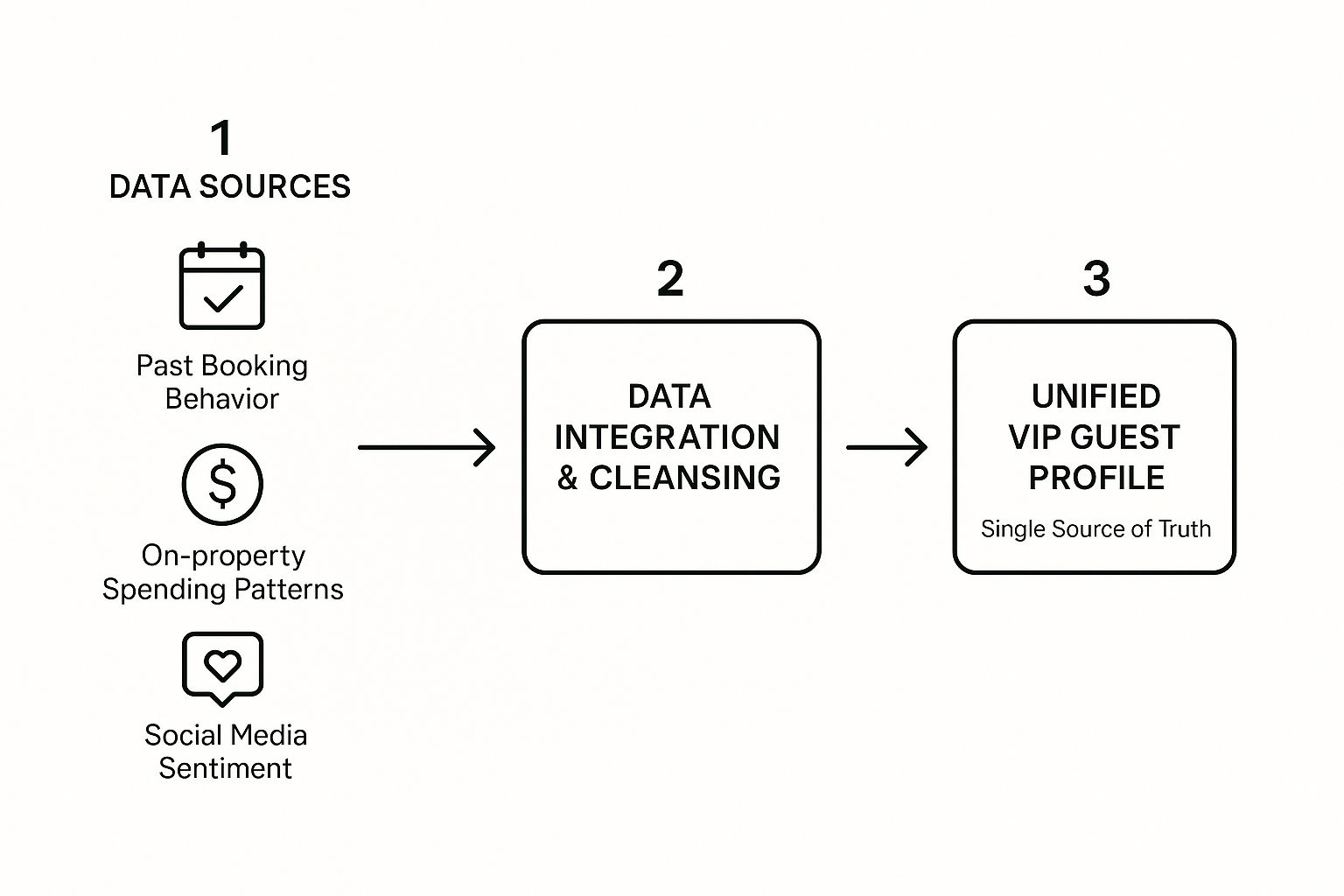
The real value isn't in data collection; it's in the integration, cleansing, and enrichment that transforms raw data into a single, actionable profile.
The Power of First-Party Data
While data comes from multiple sources, the strategic focus must be on first-party and zero-party data. This is the information you collect directly from your customers with their consent. It is the most accurate, relevant, and privacy-compliant data available, and it is the key to building a relationship that transcends the transactional. A guest informing you they are celebrating an anniversary is a direct invitation to create a memorable, loyalty-building experience.
The greatest challenge isn't data collection; it's operationalizing the insights. A unified profile is worthless if it remains confined to a database. The objective is to deliver the right insight to the right team member at the right moment to drive action.
This data-first discipline is the bedrock of any modern growth engine. For a deeper dive into the frameworks behind this, my guide on a successful business intelligence implementation outlines how to transform raw data into a strategic asset. By architecting this data foundation correctly, you set the stage for a personalization program that can anticipate guest needs and drive real growth.
Choosing the Right Tech to Anticipate Guest Needs
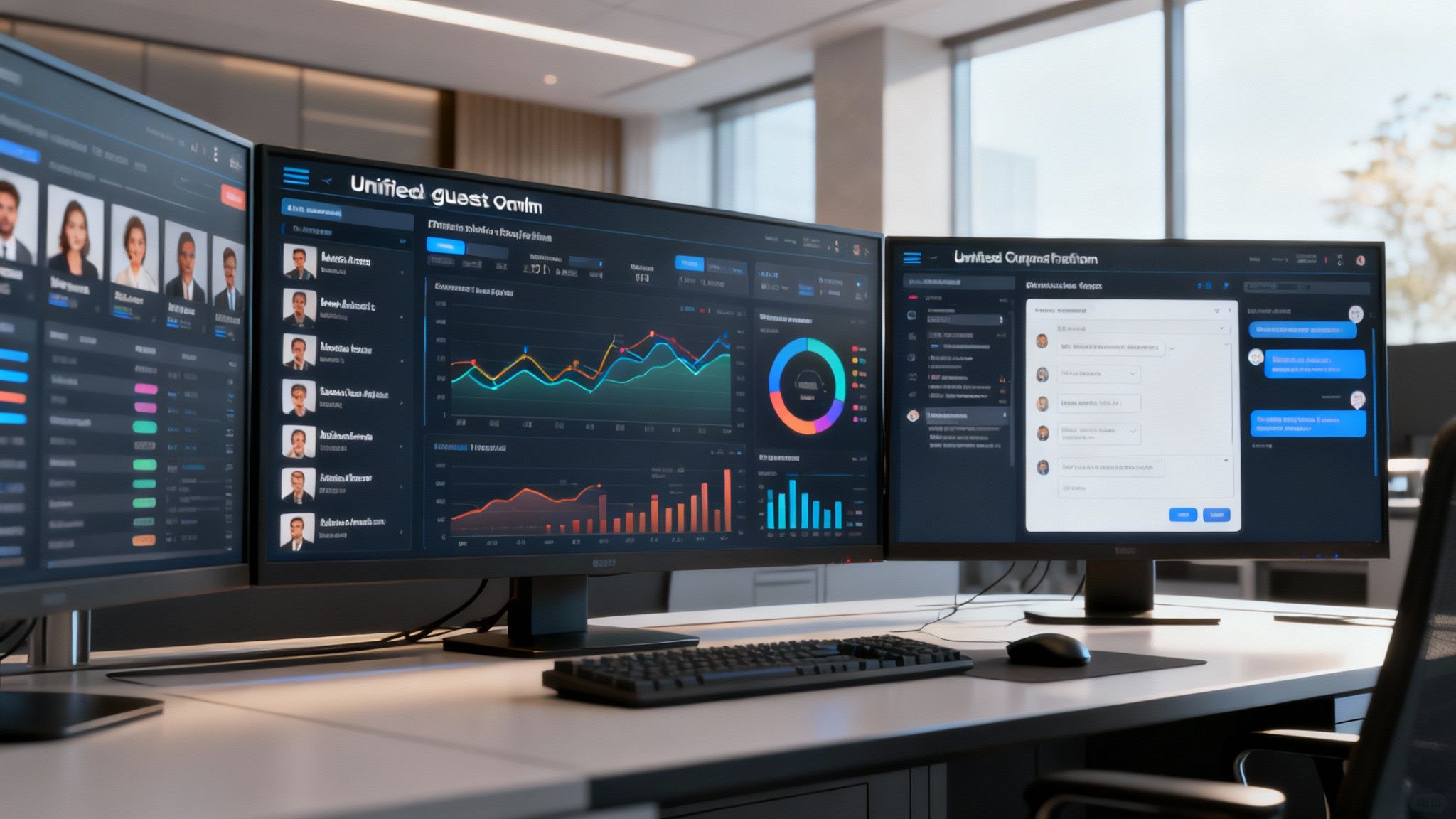
Investing in technology without a clear integration strategy is one of the fastest ways to destroy capital. I've seen it repeatedly: companies procure the latest "best-in-class" software, only to find it operates as yet another data silo, creating more complexity instead of a unified customer view.
The goal is not to acquire software; it's to architect a cohesive tech stack where every component interoperates to deliver a single outcome: a proactive, predictive guest experience.
When I evaluate vendors, my first question is never "What are your features?" It's "How does your platform integrate with my existing systems to create a unified view of my guest and empower my teams?" The right technology should be a force multiplier for your staff, not an additional burden.
The Foundational Tech Pillars
A robust predictive personalization engine requires three core pillars. Think of them as the brain, the central nervous system, and the execution arm of your operation.
- Customer Data Platform (CDP): This is your central data brain. A CDP ingests and unifies data from all sources—PMS, CRM, POS—to create that single, persistent guest profile. It is the engine that powers a holistic customer view.
- Machine Learning (ML) Models: This is the predictive nervous system. These models analyze the unified data to identify patterns, forecast behavior, and calculate propensity scores. They answer critical business questions like, "Which guests are most likely to churn?" or "What is the next best offer for this specific traveler?"
- Automation & Delivery Tools: These are the hands that execute the strategy. This ecosystem includes your marketing automation platform, mobile app, and front-line operational software. These tools take the intelligence from the ML models and deliver the personalized message or experience at the right time, on the right channel.
Architecting this stack requires a rigorous evaluation of how each component contributes to the overall system.
Core Components of a Predictive Personalization Tech Stack
| Technology Component | Primary Function | Key Evaluation Criteria |
|---|---|---|
| Customer Data Platform (CDP) | Aggregates and unifies customer data from all touchpoints (e.g., website, CRM, POS) to create a single, persistent guest profile. | – Integration Capabilities: How seamlessly does it connect with your existing PMS, CRM, and marketing tools? – Identity Resolution: How accurately can it stitch together anonymous and known user data? – Real-Time Data Processing: Can it ingest and process data fast enough for in-the-moment personalization? |
| Machine Learning (ML) Engine | Analyzes unified data to predict guest behavior, calculate lifetime value, and identify churn risk. Powers propensity models and recommendation engines. | – Model Flexibility: Can you build custom models, or are you limited to pre-built ones? – Explainability (XAI): Does it provide clear reasons for its predictions, helping your team trust the output? – Scalability: Can it handle growing data volumes and an increasing number of predictive models? |
| Marketing Automation & Delivery | Executes personalized campaigns based on ML insights across various channels like email, SMS, mobile apps, and on-property systems. | – Omnichannel Support: Can it deliver consistent messages across every channel your guests use? – Trigger-Based Logic: Does it allow for complex, real-time triggers based on guest actions or model scores? – Personalization Tokens: Can it pull in dynamic content and predictive scores from your CDP/ML engine? |
Ultimately, a world-class tech stack is not a collection of standalone tools; it's an interconnected ecosystem where the whole is far greater than the sum of its parts.
Making Machine Learning Work for You
The true power of predictive personalization for VIP travelers is unleashed by the intelligent application of machine learning. ML is what transforms massive datasets into the actionable, forward-looking insights that enable dynamic anticipation of guest needs.
Modern systems can analyze historical behavior, booking patterns, and even external data like flight delays to recommend hyper-personalized actions, such as proactively offering a late checkout to a guest whose flight has been pushed back. For more on this, you can explore more about the future of personalized hospitality and its industry-wide impact.
The most common strategic error I see is investing in a powerful CDP but failing to connect it to an equally powerful decisioning engine. You can have the best data in the world, but if you can't use it to predict what a guest wants next, you've just built a very expensive data warehouse.
Building this stack is a strategic journey, not a one-time purchase. It begins with a deep understanding of your guest journey and the key moments of impact. For those mapping this out, our guide on choosing the right customer journey mapping software provides a solid operational framework.
By focusing on an integrated, scalable ecosystem, you avoid the common pitfall of disjointed tools and build a tech foundation that drives sustainable growth.
Turning Data Into Memorable Guest Experiences
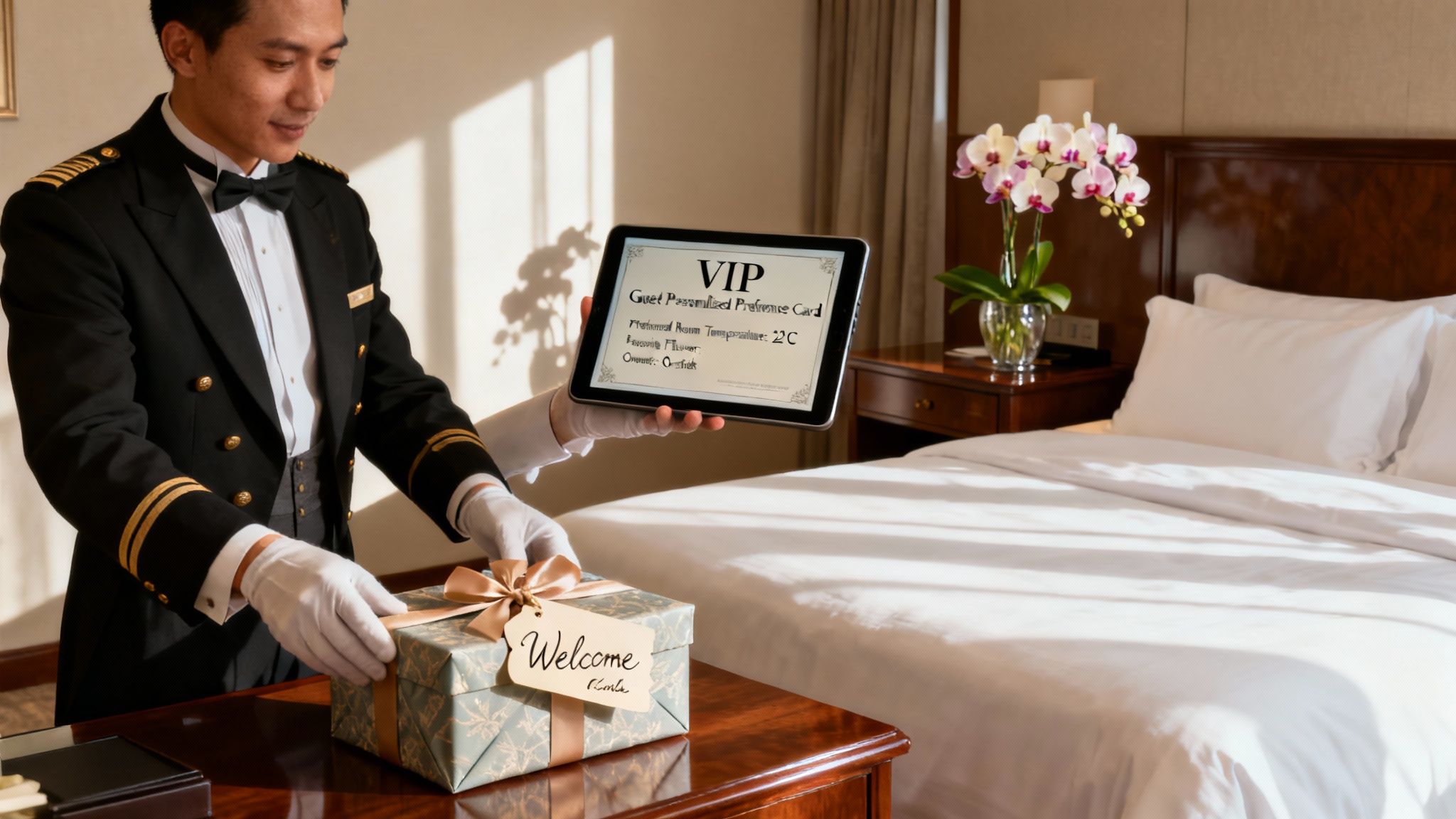
Possessing a unified data foundation and an integrated tech stack is merely the price of admission. I have seen too many organizations build brilliant data systems that fail to deliver ROI because the insights never leave the analytics team's dashboards. The true value is realized only when data is translated into tangible, real-world actions that make your VIP guests feel uniquely understood and valued.
This is where strategy meets execution. It's about embedding data intelligence into your daily operations so that every team member, from the front desk to the executive lounge, is empowered to deliver service that feels proactive and intuitive. The objective is to shift from knowing your guest to actively anticipating their needs.
Mapping Proactive Personalization Across the Guest Journey
Effective predictive personalization for VIP travelers requires a holistic, journey-based approach that transcends departmental silos. It’s not about isolated touchpoints; it's about orchestrating a seamless end-to-end experience. I focus on four critical phases where predictive intelligence can deliver the greatest impact.
- Pre-Booking & Pre-Arrival: Your systems should identify a high-value guest the moment they begin their search. Dynamically present them with the rooms, suites, and packages that align with their past behavior and predicted preferences, creating a frictionless booking path.
- Arrival & Check-In: The arrival is the first and best opportunity to demonstrate your proactive service model. A VIP arriving on a red-eye? Your system should have already flagged this, prompting an offer for an immediate check-in and ensuring their preferred amenities are in the room.
- In-Stay Experience: This is where you can engineer unforgettable moments. A predictive model identifies a guest who has ordered a specific steak via room service on their last three stays. This triggers an alert for the concierge to suggest a reservation at your signature steakhouse, complete with their preferred table.
- Post-Departure & Re-Engagement: The relationship doesn't end at checkout. Leverage data from the recent stay to send a highly personalized follow-up. Replace the generic survey with a message referencing a highlight from their trip, paired with a tailored offer for their next visit based on their demonstrated preferences.
A perfect dataset and a brilliant machine learning model are useless if the insights they generate are not operationalized. The most critical step is building the workflows that put that intelligence into the hands of your front-line staff at the precise moment of impact.
From Theory to Reality
Consider this real-world scenario: your predictive model flags a VIP guest whose flight has just been delayed by three hours. Instead of waiting for a fatigued and frustrated traveler to arrive, the system triggers two automated actions. First, it alerts the front desk to hold the room. Second, it notifies the concierge, who sends a personalized SMS: "We saw your flight was delayed. Please don't worry about your arrival time. We've arranged a complimentary car service for you upon landing."
In one stroke, you've transformed a negative travel event into a positive, loyalty-building brand experience.
A key enabler of this is attribute-based selling (ABS), a model rapidly transforming hospitality. Instead of booking a generic "king room," guests select specific attributes they value—a corner unit, a city view, a high floor away from the elevator.
With 62% of hotel operators now investing in ABS, the industry trajectory is clear. It provides guests with greater control while leveraging data to predict and surface the attributes they are most likely to value, streamlining their decision-making process. This is a core component of how the digital transformation is reshaping hospitality and creating new avenues for data-driven personalization.
Of course, this all hinges on a deep understanding of your most valuable customer segments. To sharpen this focus, our guide to developing effective customer segmentation strategies is an essential starting point. It all comes back to a simple business principle: turning information into action.
Measuring Success and Optimizing for Growth
As a data-driven executive, I operate on a simple principle: what gets measured gets managed. A predictive personalization strategy, for all its technological sophistication, is merely a cost center if it doesn't demonstrably improve the bottom line. It's imperative to move beyond vanity metrics and focus on the key performance indicators (KPIs) that signal real growth in revenue and profitability.
Your personalization initiatives are a direct investment in the lifetime value of your most crucial customer segment. The entire purpose is to see a quantifiable lift in the metrics that matter to your EBITDA and market share.
Key Metrics for VIP Personalization
To accurately measure the ROI of your strategy, your executive dashboard must be ruthlessly focused on a few core business metrics. These are the numbers that tell the true story of whether your predictions are translating into loyalty and revenue.
- Customer Lifetime Value (CLV): Is the total predicted revenue from your VIP segment increasing month-over-month? This is your ultimate north star.
- Repeat Booking Rate: Are your most valuable guests returning more frequently since the implementation of your personalization program?
- Ancillary Revenue Per Guest: Are your predictive offers for spa treatments, dining, and upgrades driving a measurable lift in on-property spend?
- Net Promoter Score (NPS): Within your VIP cohort, are you seeing a higher willingness to recommend your brand? This is a powerful leading indicator of sustainable growth.
The goal is to establish a clear, data-driven feedback loop: data informs the strategy, the strategy drives actions, and those actions produce measurable results. If you cannot draw a direct line from a personalized offer to an increase in CLV or ancillary spend, the model must be re-evaluated.
Creating an Optimization Engine
Measurement is only half the equation. Continuous optimization is what separates market leaders from the laggards. This requires building a rigorous culture of testing and iteration. You should be constantly A/B testing different personalized communications, offers, and experiences to determine what resonates most deeply with your high-value guests.
For example, test a proactive room upgrade against a complimentary spa credit for a specific VIP segment. Then, analyze the data. Which offer generated a higher total in-stay spend? Which resulted in a higher post-stay NPS score?
Use these insights to continuously refine your predictive models, making them more intelligent and accurate with every guest interaction. This iterative process transforms your personalization program from a static set of rules into a dynamic, self-improving growth engine.
Answering the Tough Questions About Personalization
In any executive planning session where I've tabled a predictive personalization strategy, the same critical questions arise. This is healthy. Deploying a program of this nature is a significant strategic undertaking, and it’s prudent to address the operational realities and potential hurdles head-on.
Let’s tackle the most common ones.
What If Our Data Is a Complete Mess?
This is the number one obstacle I encounter. The answer is not to boil the ocean. Start small, targeted, and prove value quickly.
Do not attempt a massive, enterprise-wide data cleanup project from day one. Instead, identify your top 5% of guests using a single, reliable data source, like your Property Management System (PMS). Focus exclusively on unifying the data for this high-value cohort first.
Then, launch a small pilot program. It could be as simple as a personalized welcome amenity based on their last stay's room service order. The goal is not perfection; it's demonstrating a tangible ROI. This early win will secure the executive buy-in and resources required for the broader data integration project. Treat it as an iterative process, not a monolithic one-time fix.
What's the Single Biggest Mistake to Avoid?
Without question: confusing personalization with customization. The two concepts are strategically and operationally distinct.
- Customization is reactive. It gives the guest more work to do, like selecting their pillow type from a list of ten options in your app.
- Personalization is proactive. It removes work. It means their preferred pillow is already in the room upon arrival because your data predicted they would want it.
Too many companies invest in technology that simply bombards guests with more choices, leading to decision fatigue. True predictive personalization is about removing friction and demonstrating a deep understanding of the individual. The focus must be on anticipating needs, not merely offering more options.
How Do We Balance High-Tech with the Human Touch?
This is where operational excellence meets brand differentiation. Technology should never replace your team; it should empower them to deliver an even higher level of service. The role of AI and predictive analytics is to handle the complex data processing—to surface the right insight at the right moment.
For instance, the system might flag a VIP's upcoming anniversary and suggest sending up a bottle of their preferred champagne. But it is the general manager who writes the personal, handwritten note that accompanies it. Technology provides the what (the insight), but your people deliver the how (the warm, human execution).
This synthesis of high-tech intelligence and high-touch delivery is what creates the truly memorable, loyalty-defining experiences that technology alone can never replicate.
At MGXGrowth, my team and I specialize in helping brands translate complex data into revenue and loyalty. We build the growth engines that are fueled by proactive, AI-driven personalization. If you're ready to move from theory to execution, let's connect. Learn more about our approach at https://www.mgxgrowth.com.
