


If you want to successfully bring AI into your business, the first—and most critical—step is to pinpoint a specific, high-value business problem you need to solve. From there, you build a roadmap laser-focused on the P&L. This keeps your AI initiatives grounded in tangible results, like boosting revenue or slashing costs, instead of just chasing the latest tech fad.
Your AI Implementation Playbook for Real Business Impact
I've seen it happen in every industry I’ve worked in, from SaaS to hospitality. Leaders get starry-eyed over new technology and completely forget about the fundamental business case. Let's be clear: implementing AI isn't an IT project. It's a strategic business evolution that has to be driven from the top. Success always comes down to starting with the problem, not the platform.
This playbook is designed to cut through the noise. It’s the same core framework I’ve used to guide countless companies through major changes, distilled into its most essential parts. The goal is to anchor every effort in what actually moves the needle: driving measurable growth in revenue, EBITDA, and market share.
Forget the hype. Focus on these fundamentals:
- Start with the Business Need: What's the biggest pain point or a can't-miss opportunity? Identify it first.
- Define Financial Goals: Every single initiative needs to be tied to a specific P&L outcome. No exceptions.
- Build a Cross-Functional Team: Get marketing, sales, operations, and tech in the same room from day one. Silos will kill your momentum.
The Path to P&L-Focused AI
The rush to adopt AI isn't some far-off trend; it's happening right now. By 2025, AI adoption has skyrocketed, with a staggering 78% of global companies reporting they use AI in at least one business function. That's a huge jump from just 20% back in 2017. What's more, 71% of these firms are now using generative AI tools. These numbers tell a clear story: sitting on the sidelines is no longer a viable strategy. You can find out more about the rapid corporate adoption of AI in recent studies.
This simple flow chart really captures the core philosophy behind any successful AI implementation.
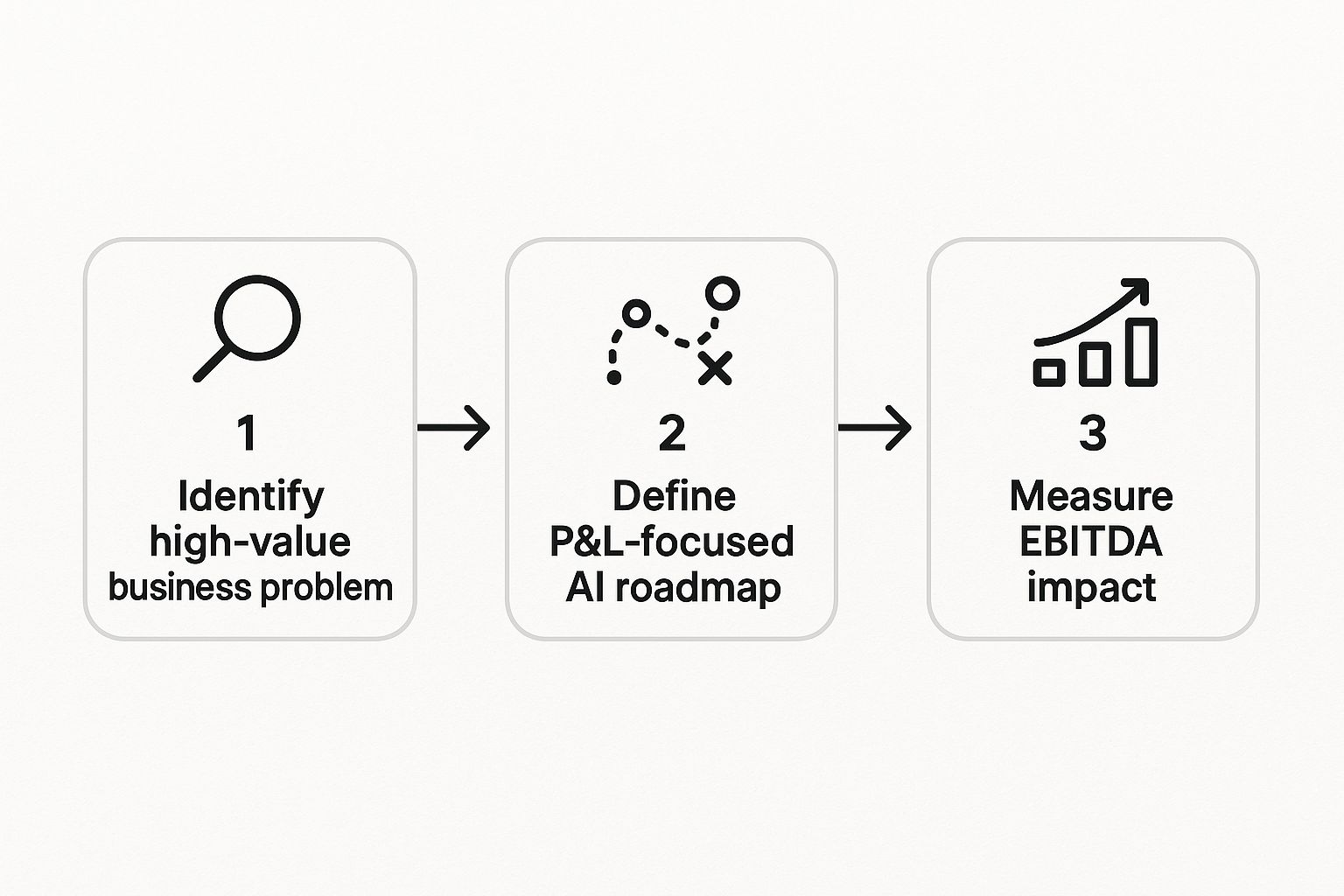
As you can see, the sequence is non-negotiable. Your strategy has to start with a real business challenge and end with a clear measurement of its financial impact.
In my experience, the single biggest mistake is funding an "AI project" instead of funding a "business growth project" that happens to use AI. The language you use internally sets the expectation for what success looks like.
This table below breaks down the journey into distinct phases, giving you a high-level overview of the path from initial idea to full-scale deployment.
Core Phases of AI Business Implementation
| Implementation Phase | Key Objective | Critical Success Factor |
|---|---|---|
| 1. Strategic Alignment | Identify high-impact business problems and define clear P&L goals for AI initiatives. | C-suite sponsorship and a cross-functional steering committee. |
| 2. Tech & Data Readiness | Assess current infrastructure, select the right AI tools, and ensure data is clean and accessible. | A unified data strategy and scalable technology stack. |
| 3. Pilot Program Design | Launch a small-scale, controlled pilot to test hypotheses and measure initial ROI. | A clearly defined scope with specific, measurable success metrics. |
| 4. Full-Scale Deployment | Roll out the proven AI solution across the relevant department or business unit. | A robust project management plan and dedicated technical support. |
| 5. Change Management & Scaling | Train employees, refine processes, and identify new opportunities to expand AI use. | Consistent communication, employee training programs, and a feedback loop. |
Think of this guide as your immediate, actionable framework. Following it ensures you start with a solid understanding of the milestones required to turn AI's potential into real-world business results. We'll now walk through each of these phases, from spotting those high-value problems to scaling your wins across the entire organization.
Aligning AI Initiatives with Core Business Objectives
Before you even think about software or write a single line of code, every potential AI project needs to pass one simple test. You must be able to answer this question with total clarity: which specific business problem are we trying to solve? I’ve seen countless promising projects die on the vine, not because the tech was bad, but because they weren't tied to a real strategic goal.
Chasing technology for its own sake is a recipe for wasted resources. But an AI project designed to cut customer churn by 15% or boost qualified leads by 30%? That’s not a tech project; that's a business imperative. The failure to make that distinction is usually the first misstep toward a project with zero ROI.
When you frame AI as the solution to a core business challenge, the entire conversation shifts. It’s no longer just an IT budget line item. It becomes a strategic investment in the company's bottom line. This is the bedrock of implementing AI successfully.

Conduct an AI Opportunity Audit
To find the right problems to solve, you have to get people out of their departmental silos. The most valuable AI opportunities are almost always found where marketing, sales, and operations intersect, yet these teams rarely collaborate on technology initiatives in a structured way.
This is why I always push for a formal "AI Opportunity Audit." This isn't just a brainstorming session with donuts. It's a focused workshop where you get leaders from across the business in one room to map their biggest pains and bottlenecks to potential AI solutions.
For instance, your audit might uncover that:
- Marketing: Is struggling to personalize campaigns at scale, which is killing engagement rates.
- Sales: Is wasting too much time on admin work instead of talking to high-value prospects.
- Operations: Is bleeding money from supply chain hiccups and inaccurate demand forecasting.
- Customer Service: Is swamped with support tickets, leading to long waits and unhappy customers.
Each of these represents a concrete business problem with a measurable price tag. Once you've cataloged them, you can start prioritizing which projects will deliver the biggest and fastest wins.
Don't ask your teams, "How can we use AI?" Instead, ask them, "What are the three biggest obstacles preventing you from hitting your quarterly targets?" The second question will always lead you to the most valuable use cases.
Assemble a Cross-Functional Steering Committee
With a prioritized list of potential projects in hand, it’s time to establish clear governance. An AI project can't live within a single department—it needs a cross-functional steering committee with the authority to actually get things done.
Think of this committee as the engine that drives the whole initiative forward. It needs to include stakeholders who can provide the necessary resources, unlock access to data, and offer strategic oversight.
So, who gets a seat at the table?
- The Executive Sponsor: A C-level leader—ideally the CEO, COO, or CMO—who will champion the project and keep it aligned with top-level company goals.
- The Business Unit Leaders: The heads of the departments most impacted, like the VP of Sales or Head of Operations. They own the problem you're trying to solve.
- The Technology Lead: Your CIO, CTO, or a senior data scientist who can speak to technical feasibility and what resources you'll need.
- The Finance Representative: Someone who can help build the business case, track the budget, and validate the ROI you're promising.
This group’s first job is to turn that identified business problem into a rock-solid project charter with SMART goals (specific, measurable, achievable, relevant, and time-bound). This step is non-negotiable and echoes many digital transformation best practices. Their work ensures your AI roadmap is a direct contributor to the company’s financial health, not just a list of cool tech features.
Building a Rock-Solid Data and Technology Foundation
An AI model is a lot like a high-performance engine. It can do incredible things, but it’s completely useless without the right fuel. For us, that fuel is data. The number one reason I see AI initiatives fail isn't some flaw in the algorithm; it's a fundamental weakness in the data foundation it’s built on.
I’ve watched it happen time and again in SaaS and marketplace businesses. A team gets excited about a brilliant idea for an AI-powered feature, only to find out their customer data is fragmented across a dozen different systems—sales, marketing, support. It's impossible to get the unified view they need. Before you can even think about advanced modeling, you have to get your data house in order.

This isn’t just some academic exercise. The economic impact of getting this right is enormous. In the global retail sector alone, 80% of executives expect to adopt AI automation by 2025. This explosion is driven by clear financial incentives, with AI software service revenues projected to hit nearly $100 billion in 2025. You can discover more insights about AI's economic impact to see just how big this opportunity is.
Assess and Cleanse Your Critical Data Assets
Your first move should be a ruthless audit of your existing data. This means figuring out where your most valuable information lives, how it's stored, and, most importantly, how clean it is. You need to map out your core data assets—think customer transaction histories, product usage logs, or supply chain records.
Once you have that map, the real work begins. Data cleansing is completely non-negotiable. You have to tackle:
- Inconsistencies: Are customer names or addresses formatted differently across systems?
- Missing Values: What's the plan for records with incomplete information?
- Inaccuracies: Is outdated or just plain wrong data skewing your view of reality?
This process can feel tedious, but skipping it is a fatal mistake. Feeding a sophisticated AI model dirty data is like putting contaminated fuel in a race car; you'll get sputtering, unreliable performance every single time. It's a critical piece of any successful business intelligence implementation and forms the bedrock for everything that follows.
I tell every leadership team the same thing: your AI is only as good as your worst data source. Investing in data governance isn't an IT expense; it's a direct investment in the accuracy and reliability of your future business decisions.
Navigating the Build Versus Buy Dilemma
With your data strategy taking shape, the next huge decision is whether to build a custom AI solution from scratch or buy an off-the-shelf platform. There’s no single right answer here. The correct choice depends entirely on your specific business, your resources, and how unique the problem you're trying to solve really is.
This table breaks down the core trade-offs I walk through with companies:
| Factor | Buy (Off-the-Shelf SaaS) | Build (Custom Solution) |
|---|---|---|
| Speed to Market | Fast. You can often be up and running in weeks. | Slow. Development can take many months, sometimes years. |
| Initial Cost | Lower. Typically a predictable monthly or annual fee. | Higher. Requires a big upfront investment in talent and infrastructure. |
| Customization | Limited. You’re stuck with the vendor's feature set and roadmap. | Total Control. The solution is tailored precisely to your unique processes. |
| Competitive Edge | Minimal. Your competitors can buy the exact same tool. | Significant. A proprietary model can become a powerful, defensible moat. |
My rule of thumb is pretty simple: start with "buy" whenever you possibly can. For common problems like CRM optimization or marketing automation, countless excellent SaaS tools already have powerful AI features built right in. Use them to score an early win and build momentum.
Only consider a custom "build" when the problem is core to your company's unique value proposition and no existing tool comes close to solving it. Think of a gaming company developing a proprietary matchmaking algorithm or a marketplace creating a one-of-a-kind fraud detection system. In those cases, the strategic advantage is absolutely worth the heavy investment.
Executing a High-Impact Pilot Project to Build Momentum
After all the planning and data wrangling, this is where the rubber really meets the road. Your first AI project is your single best shot at building momentum and proving that this whole initiative is worth the effort. The goal isn't to change the company overnight. It’s to score a quick, decisive, and measurable win that quiets the skeptics and gets everyone else excited.
From my experience, a well-run pilot is the most powerful tool you have for unlocking future investment. It shifts the conversation from a theoretical debate about potential to a data-backed discussion about what you’ve already achieved. The key is to think small, fast, and focused. Forget the moonshot for now; aim for a target you know you can hit.

This isn’t just for the tech giants anymore. Today, even mid-market companies are seeing huge returns. By 2025, an estimated 67% of the Inc 5000 fast-growing companies will have implemented AI, with project cycles now as short as 90 days. This speed means businesses see real benefits quickly, with some reporting up to 40% improvements in operational efficiency.
Selecting the Right Pilot Project
Choosing the right pilot is more art than science, but it’s guided by a few hard-and-fast rules. You’re looking for that perfect sweet spot where high business value meets a high probability of success. A project with a massive potential payoff but a 50% chance of failure is absolutely the wrong choice for your first time out.
Here are the criteria I always use to vet potential pilot projects:
- A Tightly Defined Scope: The project needs a clear beginning and end. "Improve marketing" is a vague wish, not a scope. "Use AI to score inbound leads and increase our MQL-to-SQL conversion rate by 15%"—now that's a scope.
- Measurable Success Metrics: You have to be able to prove the impact with cold, hard numbers. Think reducing customer service response times, cutting operational costs, or improving sales forecast accuracy.
- Data Availability: The project must rely on data you already have, and that data needs to be clean, accessible, and ready to go. Your first pilot is not the time to start a massive data engineering overhaul.
- Visible Impact: The results should be easy for key stakeholders outside of the tech team to understand and appreciate.
I’ve always found that the best first pilot is one that solves a persistent, annoying problem for a critical department like sales or customer support. When you make their lives tangibly easier and more effective, you create powerful internal champions who will advocate for the AI program for you.
Structuring a Lean and Agile Pilot Team
Your pilot team needs to be small, cross-functional, and empowered to move fast. This is no time for bureaucracy or endless committee meetings. You need a commando unit, not an army.
A typical high-impact pilot team should include:
- A Project Lead: Someone with enough clout to clear roadblocks and keep things on track.
- A Business Stakeholder: This is your project’s "customer"—the person whose problem you're actually solving.
- A Data Expert: A data scientist or analyst who can handle the data and build the model.
- An Engineer/IT Specialist: The person who can manage the technical implementation and integrate it into existing systems.
Set a realistic but aggressive timeline—think weeks, not months. A 90-day window is often perfect. It forces the team to stay focused on the core objective and ruthlessly cut out any scope creep. Many of the same principles behind a successful marketing automation implementation apply here: start with a clear goal and iterate quickly.
Finally, you need a tight feedback loop. Hold weekly check-ins to review progress against your key metrics. This lets you make adjustments on the fly and ensures you’re constantly communicating progress to stakeholders, managing their expectations, and showing them real, tangible value every step of the way.
Scaling AI From a Pilot to an Enterprise Capability
A successful pilot project feels great, but it’s a false summit. The real climb—and the real payoff—is turning that small win into something that works across the entire company. I’ve seen so many teams nail a pilot only to watch the initiative wither on the vine. They lose all that hard-won momentum because they think scaling is just a copy-paste job.
It's a completely different beast. Scaling means shifting your mindset from managing a project to leading an organizational transformation. You're no longer trying to prove value in a sandbox; you're weaving that value into the very fabric of how your company operates. This is the chasm where most AI initiatives fall, failing to make the leap from a cool experiment to a core business driver.
Establish an AI Center of Excellence
Once you have a taste of success, the last thing you want is for every department to go off and reinvent the wheel. That's how you end up with a dozen siloed, inconsistent, and probably insecure AI tools. To avoid this chaos, you need an AI Center of Excellence (CoE).
This isn’t about creating a bureaucratic roadblock. It’s about building guardrails that actually enable people to innovate faster and more safely. Think of it as a central hub that offers up the right tools, playbooks, and expertise.
A solid CoE is usually responsible for a few key things:
- Standardizing Tools and Platforms: They pick a core set of vetted AI technologies so you don't end up with a chaotic mess of redundant and incompatible software.
- Developing Best Practices: They create the go-to guides for everything from data governance and model validation to ethical AI and security protocols.
- Providing Expertise: They act like internal consultants, helping different business units spot high-value opportunities and design AI solutions that will actually work.
- Facilitating Knowledge Sharing: They build a community where teams can share wins, losses, and lessons learned, which dramatically speeds up the learning curve for everyone else.
The goal is to find that sweet spot: enough structure to maintain quality and consistency, but not so much that you crush the creativity of individual teams.
Technology adoption is always about people, not just platforms. If you don't bring your team along on the journey, even the most brilliant AI model will sit on a server collecting dust. The human element is the single most critical factor in successful scaling.
Master the Art of Change Management
This leads me to what is, without a doubt, the most critical part of scaling: change management. I really can't overstate this. Your biggest challenges won't be technical; they'll be human. People might be resistant, worried about their jobs, or just plain overwhelmed by new ways of working. If you don't handle this transition with empathy and clear communication, your AI investment will go down the drain.
The trick is to relentlessly communicate the "why." Don't just tell people what is changing; explain why it's happening and, crucially, what's in it for them. Frame AI as a tool that gets rid of the tedious, repetitive junk so they can focus on more strategic, interesting work. It’s an assistant, not a replacement.
Next, you have to put your money where your mouth is and invest in upskilling your people. This is non-negotiable. Good training builds confidence and shows your team you're invested in their future. It could be anything from formal courses on data literacy to hands-on workshops with the new tools. A team that feels capable is a team that will actually embrace change.
Finally, don't just bolt a new tool onto an old process. That never works. Sit down with your front-line employees and map out their day-to-day work. Then, redesign those workflows with them to seamlessly integrate the AI. When people see for themselves that the tech makes their job easier or more impactful, adoption happens organically. This is how you build a culture that truly runs on data and ensures your AI investment pays off for years to come.
Answering the Tough Questions on AI Implementation
From the boardroom to the front lines, any big AI initiative is going to stir up a lot of questions. As a leader, it's my job to have clear, direct answers ready. I’ve been in these meetings for years, and I’ve heard the same critical questions from executives across every industry imaginable. This isn't about some far-off theoretical future; it's about the practical, dollars-and-cents reality of making AI work for your business.
Let's get right to it and tackle the most common questions I hear. These are the conversations that make or break a project before it ever gets off the ground.
How Much Is This Actually Going to Cost?
This is always the first question, and the only honest answer is: it depends. There’s no single price tag. The real cost comes down to the path you choose, and that choice has to be driven by your immediate business goals, not the tech itself.
You can really think about it in two main buckets:
- Using Off-the-Shelf Tools: This is the fastest and most accessible way in. Many of the SaaS platforms you already use—from your CRM to your marketing software—have powerful AI features baked right in. This could run you anywhere from a few hundred to several thousand dollars a month. It's a fantastic starting point because it's quick, the costs are predictable, and you tie your investment to a specific business function from day one.
- Building a Custom Solution: This is a whole different ballgame—a major capital expenditure. You're funding a team of data scientists, engineers, and the cloud infrastructure to make it all run. This path can easily get into the hundreds of thousands, if not millions, of dollars. It only makes sense when you're solving a unique, mission-critical problem that will give you a serious competitive edge.
My advice is almost always to start with the tools you already have or can easily subscribe to. Use them to run a pilot project and prove a clear ROI. This approach ties your initial budget directly to solving a high-impact business problem before you ever consider committing to a massive custom build.
What Are the Biggest Risks We Should Worry About?
In my experience, the biggest risks have almost nothing to do with the technology. The algorithms are pretty solid these days. Where projects truly fall apart is in the human and strategic side of the equation.
From where I sit, I see three main things that can kill an AI project before it even has a chance:
- No Clear Business Goal: This is the number one project killer, hands down. If you're implementing AI without a direct line to solving a real problem—like cutting down customer churn or fixing a broken supply chain—you’re just lighting money on fire.
- Bad Data: I can't say this enough. AI models are strictly garbage-in, garbage-out. If your data is trapped in silos, inconsistent, or just plain wrong, your AI will be useless at best and dangerously misleading at worst.
- Resistance to Change: Your team is going to have questions and fears. They'll worry AI is coming for their jobs. Without a strong, proactive change management plan that shows how AI is a tool to help them, not replace them, you'll face internal resistance that will quietly grind everything to a halt.
How Do We Measure the ROI on This?
You can't manage what you don't measure, and you certainly can't justify spending more money without proving a return. Measuring the ROI of an AI project means tying it directly to the business metrics you defined before you spent a single dollar.
It all starts with getting a baseline. You have to know where you are today to prove you’ve gotten somewhere better tomorrow.
- For Efficiency Gains: Look at the direct impact on operational costs or how much time you're saving. For example, "We cut the average time to process an insurance claim from 20 minutes down to 3 minutes."
- For Revenue Growth: Track the lift in key sales and marketing numbers, like lead conversion rates or customer lifetime value. For instance, "Our new AI recommendation engine boosted the average order value by 12%."
- For Customer Experience: Keep an eye on metrics like Net Promoter Score (NPS), customer satisfaction (CSAT), or a drop in churn.
The math itself is simple: (Net Gain from AI – Cost of AI Investment) / Cost of AI Investment. A successful pilot has to show a clear, positive ROI within a reasonable timeframe, which I typically define as six to twelve months. That proof point is the currency you need to get the budget and the buy-in to scale up.
Answering these questions head-on is the first step toward a successful AI strategy. At MGXGrowth, we partner with executive teams to build AI roadmaps grounded in business reality, ensuring every initiative is designed to deliver measurable results. Discover how we can help you architect your growth roadmap.
