


After decades driving revenue, EBITDA, and market share growth across industries from SaaS to hospitality, I've learned one immutable truth: market leadership isn't built on a superior product or a slicker marketing campaign alone. It's forged by architecting an unbreakable link between innovation and branding. This guide is designed to dismantle the dangerous myth that these are separate functions.
The Unbreakable Link Between Innovation and Branding
I've sat in countless boardrooms and strategy sessions, watching the same fundamental mistake cripple otherwise promising companies. Product and engineering teams operate in one silo, chasing technical perfection. In another, marketing and brand teams spin compelling narratives. That gap is precisely where market share goes to die.
From my experience, the companies that create defensible, long-term value treat innovation and branding as a single, unified discipline, not a two-step process.
Innovation is the tangible proof of your brand's promise. It's the "show, don't tell." Your brand, in turn, provides the strategic "why" that must guide every single product decision. When these two are in lockstep, they create a powerful, self-perpetuating growth engine.
Think of it as a feedback loop: your brand sets a clear expectation in your customer's mind. Your innovations must then meet or exceed that expectation. Every time they do, you build trust and cement your brand's authority, directly impacting customer lifetime value.
Why This Synergy Matters More Than Ever
Let's be blunt: in today's hyper-competitive markets, a feature advantage is fleeting. Competitors can replicate functionality faster than ever. A powerful brand, however, creates an emotional and psychological moat that is far more difficult to breach.
Time and again, the data shows that brands with significant positive equity—think Apple's association with intuitive design or Nike's with peak performance—can command premium pricing and earn far greater loyalty.
I've personally driven and measured the results of integrating these functions, and the impact on the P&L is undeniable:
- Lower Customer Acquisition Costs: A strong, innovative brand acts as a gravitational force, reducing reliance on expensive paid acquisition channels.
- Higher Customer Lifetime Value: When your innovation pipeline consistently delivers on the brand promise, customers don't just transact; they become advocates.
- Faster Market Penetration: When a new product or feature perfectly embodies your brand's story, market adoption accelerates organically.
Here’s the core operational principle for any company serious about building a legacy: Your 'what' (the value created through innovation) must be inseparable from your 'why' (the reason your brand matters to your customers).
Moving from Theory to Execution
Throughout my career, whether scaling SaaS platforms or optimizing hospitality experiences, the mission has been constant: dismantle the walls between what we build and what we say. This means ensuring engineers deeply understand the brand's soul and marketers genuinely grasp the product's unique value proposition.
This guide isn't about abstract theory. I'm sharing the operational frameworks I've used to create a powerful feedback loop where the brand promise guides innovation, and each innovation reinforces the brand's market strength. This isn't just another business tactic; it's the foundational architecture for building a resilient, high-growth enterprise.
Your Brand as the North Star for Innovation
Before my teams allocate a single dollar of R&D budget, I mandate they answer one question: How does this serve the brand?
Too often, companies treat their brand as a cosmetic layer—a logo, a color palette, a tagline applied after the "real" work of product development is done. From my experience, that's a direct path to wasted resources and customer confusion. The most successful organizations don't just build products; they build tangible proof of their brand's core promise.
Your brand must function as the strategic filter for every decision, the unwavering North Star that guides your innovation roadmap. It's the central organizing principle that aligns product, engineering, and marketing into a single, cohesive growth engine. Once that brand promise is crystal clear, teams stop debating random features and start architecting solutions that truly resonate. This clarity breaks down the silos that kill momentum and drain budgets.
From Vague Ideas to Focused Execution
A well-defined brand shifts your innovation process from reactive to proactive. Instead of chasing competitor features or jumping on every new trend, your teams are equipped with a reliable framework for evaluating opportunities.
The critical question evolves from "Can we build this?" to "Should we build this?" and, most importantly, "Does this reinforce who we are to our customers?"
This focus has a direct and measurable impact on the bottom line. When innovation and branding are deeply integrated, you create a powerful flywheel effect. The visual below highlights the significant uplift we've seen in key growth metrics when businesses adopt this brand-led approach.
This data illustrates a clear correlation: a 35% increase in brand awareness, a 40% jump in customer engagement, and a 25% rise in revenue growth when branding dictates innovation strategy.
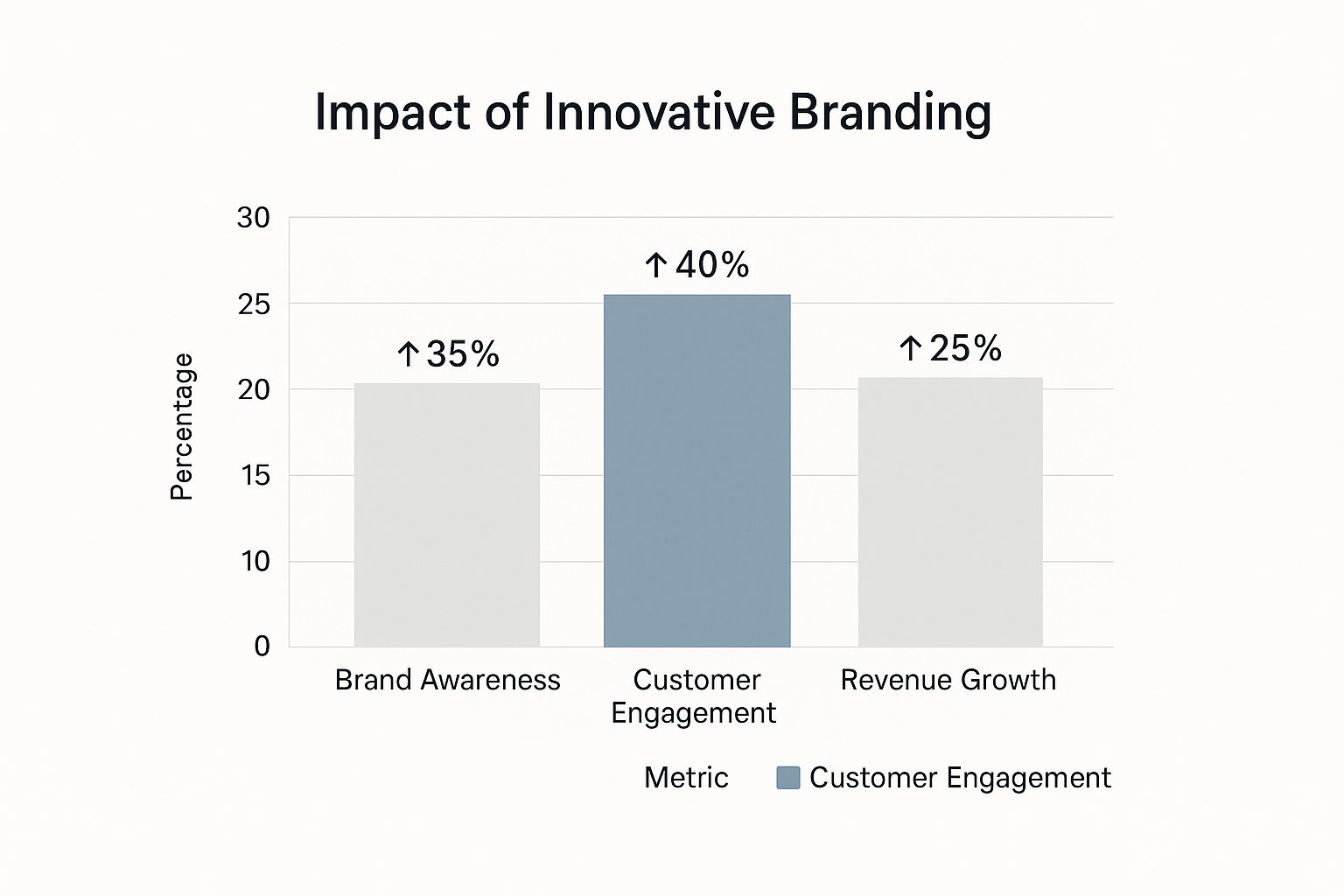
The numbers are unequivocal. A brand-centric innovation strategy isn't a "nice-to-have"; it's a direct driver of business performance.
Siloed vs Integrated Approaches to Innovation and Branding
The operational difference between a company that separates these functions and one that integrates them is stark. It's visible in everything from team meetings to product launches and, ultimately, the P&L statement. One path leads to disjointed customer experiences and internal friction; the other creates a unified force that captures market share.
To make this distinction crystal clear, the table below contrasts the disconnected, siloed approach with the integrated, brand-led model that drives real growth.
| Attribute | Siloed Approach (Separate Functions) | Integrated Approach (Brand-Led Innovation) |
|---|---|---|
| Product Roadmap | Driven by technical capabilities, competitor features, or isolated requests. | Guided by the core brand promise and its ability to solve specific customer problems. |
| Team Communication | Marketing and product teams operate in separate worlds, often with conflicting goals and KPIs. | Cross-functional teams are aligned around a shared understanding of the brand and customer. |
| Success Metrics | Success is measured in disconnected metrics like feature adoption or campaign clicks. | Success is measured by integrated KPIs like Customer Lifetime Value and brand equity lift. |
| Customer Experience | Inconsistent and fragmented, as the product experience may not match the marketing message. | Cohesive and powerful, where every product touchpoint reinforces the brand's core values. |
| Market Outcome | Creates "me-too" products that compete primarily on price and features, leading to commoditization. | Builds a strong, defensible market position with loyal customers who connect with the brand's purpose. |
This integrated model isn't just a superior operational methodology—it's the only way to build a brand that can withstand market pressures and create lasting enterprise value. It ensures you're not just making noise, but making a measurable impact.
Weaving AI into Your Brand's Fabric
In my work with SaaS companies, marketplaces, and even in hospitality, it's clear the next frontier in branding isn't just a new product. It’s the strategic application of artificial intelligence to forge personalized customer connections at scale—something previously unattainable. We're not talking about deploying AI as a cost-cutting measure; we're talking about using it as a precision instrument to amplify brand resonance.
For too long, "personalization" was a buzzword for rudimentary segmentation based on demographics. AI allows us to jettison that simplistic model. Now, we can architect true one-to-one engagement, making every customer feel that the brand understands them intimately. The strategic advantage emerges when your brand feels both hyper-intelligent and deeply human.
This paradigm shift is enabled by AI's capacity to analyze vast datasets and anticipate customer needs. When executed correctly, AI becomes the engine that not only predicts the future but builds experiences that deliver on your brand's promise with every single interaction.
From a Megaphone to a Million Conversations
The real power of AI in branding lies in its ability to internalize your unique brand voice and deploy it consistently across millions of customer touchpoints. This is where generative AI becomes a game-changer. Forget generic, one-size-fits-all copy. AI can now craft messaging that resonates with an individual's specific history, preferences, and immediate context.
This represents a fundamental transition from a broadcast model to a conversational one. Here’s how high-performing organizations are already implementing it:
- Adaptive Content Deployment: AI can generate email subject lines, ad copy, and website banners that change in real-time based on user behavior, maximizing relevance at every interaction.
- Proactive Customer Service: By analyzing past support interactions, AI can identify customers at risk of churn and proactively offer solutions, turning a potential negative into a brand-affirming moment.
- Intelligent Product Recommendations: Moving beyond basic "people also bought" algorithms, AI can identify complex patterns and suggest products that solve latent, unarticulated customer needs.
This is the cutting edge of brand innovation today. With generative AI poised to become a standard feature in most business software, the opportunity for growth is immense. It’s about creating hyper-personalized experiences, especially when you consider that 75% of consumers are more likely to buy from a brand that personalizes its content. It's no wonder that 56% of marketing leaders are already investing in these tools. To see more on this trend, check out how branding innovations are shaping the industry.

Making Your Team More Human, Not Replacing Them
One of the biggest strategic errors I see is viewing AI as a tool for headcount reduction. This fundamentally misunderstands its power. The highest-value application of AI is to augment your team's creativity and empathy, not eliminate it. Let AI handle the heavy lifting of data analysis and pattern recognition. This frees up your human capital to focus on high-level strategy, creative breakthroughs, and building genuine customer relationships.
The objective of AI in branding is not to create a flawless, impersonal machine. It’s to leverage technology to make your brand feel more personal, responsive, and human to every individual it touches.
Consider this workflow: an AI tool flags a cohort of customers exhibiting behavior correlated with friction on a specific software feature. That data-driven insight is passed to a human product manager. She can then conduct targeted outreach, have real conversations to understand the frustration, and work with her team to architect a superior solution. The AI identifies the what; the human team uncovers the why and responds with empathy.
Ultimately, customers crave authenticity. A recent study found that 87% of people consider it critical for a brand's imagery to feel authentic. This underscores the point that AI must be a tool in the hands of creative professionals, ensuring that all brand output feels true to your core identity. The future belongs to organizations that master the synthesis of intelligent automation and irreplaceable human touch.
Building Emotional Connections Through Product Innovation
Across every industry I’ve operated in, from SaaS to hospitality, one principle holds true: customers don't just buy products; they buy better versions of themselves. They seek solutions that make them feel more intelligent, more capable, or more secure. This is where the real synergy of innovation and branding materializes—by architecting your product to forge a genuine emotional connection.
This extends far beyond a superficial marketing slogan. It's about embedding your brand’s promise so deeply into the user experience that the product itself becomes your most potent branding asset. Forget asking focus groups how they feel. True emotional resonance is engineered, not applied. It is the sum of a thousand deliberate micro-decisions that make a product feel intuitive, dependable, and indispensable.
When your product makes a customer feel truly understood, their status elevates from a mere user to a loyal advocate. That is the strategic objective: creating an experience so powerful that your customers become your most effective sales force.
The Psychology of 'Newstalgia' in Modern Products
An effective strategy for building these connections is to tap into fundamental human psychology. One of the most compelling approaches I've seen is ‘newstalgia’—the art of blending familiar, comforting elements with fresh, modern functionality. It’s a powerful emotional shortcut, making a novel innovation feel instantly trustworthy.
This isn't just for consumer goods. In the B2B and SaaS space, 'newstalgia' is not about retro logos. It's about delivering powerful AI-driven features within an interface that feels as straightforward as a trusted legacy tool. The innovation provides the competitive edge, while the familiar usability provides the comfort that accelerates adoption and retention.
This approach is gaining traction because it directly addresses the human need for emotional connection. Brand innovation is increasingly powered by strategies like 'newstalgia,' which mix childhood comforts with modern features to create an instant bond. This is evident in the food industry, where brands add functional ingredients like protein to classic snacks, pairing the comfort of nostalgia with a health-conscious benefit. This fusion of product innovation and emotional intelligence is a significant differentiator in a crowded market. You can explore more about how brand innovation trends are driving growth on smashbrand.com.
Engineering Emotion into the User Experience
So, how do you operationalize this? It begins by dismantling the silos between your product, engineering, and marketing teams. They must function as a single, integrated unit, obsessed with one question: "How will this feature make our customer feel?"
Here are the guiding principles for engineering that emotional connection directly into your product:
- Deliver on Reliability First: You cannot delight a customer you have just disappointed. Your product’s core promise must be flawlessly executed. Trust is the foundation of any emotional bond, and no amount of branding can repair a product that fails to perform.
- Solve Unspoken Needs: The most powerful innovations address a problem a customer couldn't even articulate. This requires deep, empathetic research—not just asking people what they want, but observing their workflows, identifying their frustrations, and architecting a superior way.
- Create Moments of 'Micro-Delight': These are the small, unexpected details that signal a deep understanding of the user. A clever animation, a helpful shortcut, a witty error message. These incremental moments accumulate, building a powerful and positive brand perception over time.
Your product isn't just a set of features; it's the most consistent and impactful conversation you have with your customers. Make every interaction count.
Ultimately, your innovation roadmap must be a direct reflection of your brand's emotional promise. If your brand stands for simplicity, every new feature must combat complexity. If it stands for empowerment, every update must enhance user capability. When your product consistently delivers on that emotional promise, your brand transcends its name—it becomes a trusted partner.
Creating Brand Communities Beyond Transactions

I've seen it time and again, in high-stakes SaaS and high-touch hospitality alike: the brands that endure don't just sell products. They convene people. That is the strategic pivot that separates market leaders from the pack—they shift from broadcasting to a mass audience to cultivating genuine communities around shared values and interests.
This is not about accumulating likes on a corporate social media page. It's about meeting customers where they already are, both digitally and physically. The strategy lies in providing tangible value within those spaces, fostering an authentic connection that a top-down marketing campaign can never replicate.
Execute this correctly, and you create an ecosystem of genuine brand advocates. This is the inflection point where your brand ceases to be something you push at people and becomes something they actively pull into their own lives.
From Audience to Community
The traditional marketing playbook treated customers as a passive audience awaiting a message. A community-first strategy inverts this paradigm, viewing them as active participants in the brand's narrative. This necessitates a complete mindset shift from broadcasting to them to facilitating conversations with and among them.
Your brand's role is to be the host of a compelling gathering, not the guest of honor. You provide the platform, the resources, or the unifying cause that stimulates interaction. You are building a clubhouse, not merely a storefront.
To execute this, you must understand what your customers value beyond your product. What are their professional aspirations? What are their personal passions? Who do they trust for advice? The answers to these questions are your roadmap to identifying the ideal community-building opportunity.
Personalization at Scale Fuels Belonging
Attempting to build a community without personalization is like hosting a party but failing to learn anyone’s name. It feels inauthentic. True community is founded on mutual recognition, and personalization is your most powerful tool for creating it at scale.
When you leverage data to understand individual motivations, you can craft experiences that make every member feel seen and valued. This is what converts a casual follower into a loyal advocate. It's no surprise that 75% of consumers are more likely to buy from brands that offer personalized content. We're seeing a massive shift toward interest-based platforms where brands can build these tight-knit groups by championing shared passions. You can find more insights on how top brands use this strategy at thebrandingjournal.com.
The ultimate competitive moat isn't built on features or price; it's built on a community so strong that leaving feels like a genuine social loss. Your goal is to make your brand the context for your customers' connections.
This means delivering value that is not directly tied to a transaction. This could manifest as:
- Educational Content: Hosting expert workshops or tutorials that help members achieve their own goals.
- Exclusive Access: Offering sneak peeks at new products or providing a direct line of communication to your development teams.
- Networking Opportunities: Creating forums or events where members can connect, exchange ideas, and build their own professional relationships.
This community-first model, powered by intelligent personalization, builds a defense that competitors cannot simply outspend. It insulates you from price wars and feature shootouts because it is founded on something far more durable: a true sense of belonging. When your brand facilitates meaningful connections, you are no longer just a vendor—you are an indispensable part of your customers' world.
Putting the Brand-Led Growth Framework into Action
A brilliant strategy is merely a well-designed slide deck without a rigorous execution framework. Across every industry I've worked in, the companies that win are those that translate high-level vision into daily operational reality. This is where we move from theory to practice and build the engine that drives brand-led growth, integrating innovation and branding into the organization's DNA.
The first, non-negotiable step is to dismantle departmental silos. Silos are where great ideas and customer value go to die. The solution is to create dedicated, cross-functional "growth pods." These are not temporary task forces; they are permanent teams comprising members from product, marketing, engineering, and data. Their singular mission is to solve a specific customer problem in a way that tangibly delivers on the brand promise.
Getting Everyone on the Same Scoreboard
Once you have the right people in the room, they must be aligned around a unified set of metrics. Traditional teams often fail because they are incentivized by conflicting KPIs—marketing chases leads while product focuses on feature adoption. A true brand-led growth team, however, is measured by a blended set of metrics that reflects the entire customer journey.
These are the KPIs that integrated teams must live and breathe:
- Brand-Attribute Lift: Following a new product or feature launch, do customers more strongly associate your brand with a key attribute like "simplicity" or "security"? This directly measures whether your innovation is strengthening your brand equity.
- On-Brand Adoption Rate: How quickly do your most valuable customer segments adopt new functionality specifically designed to deliver on your brand promise? A high adoption rate here is a leading indicator of success.
- Customer Lifetime Value (CLV) Cohorts: Analyze the CLV of customers who engage with your brand-centric innovations versus those who do not. This is the ultimate proof point—demonstrating that on-brand product development directly drives long-term economic value.
When the entire team is accountable for the same metrics, a powerful cultural shift occurs. The team wins or loses together. This forces every dollar of R&D and every marketing campaign to serve the same strategic end: building a single, powerful, cohesive brand.
The ultimate goal is to reach a state where every employee, from an engineer to a customer support agent, can articulate exactly how their role brings the brand's promise to life. That is the bedrock of sustainable growth.
Running the Brand-Centric Innovation Sprint
To make this operational, I implement a structured, repeatable cycle I call the brand-centric innovation sprint. It's a five-step process designed to rapidly test and deploy brand-aligned ideas.
- Audit: The growth pod begins by mapping the entire product experience against the core brand promise. This exercise quickly identifies gaps and surfaces opportunities to reinforce the brand.
- Ideate: Using insights from the audit and direct customer feedback, the team brainstorms solutions. The focus is not on features, but on complete experiences that solve a real problem while amplifying the brand's core message.
- Prototype: A minimal, low-fidelity version of the most promising idea is built. The objective is not technical perfection but to get a core concept in front of real customers as quickly as possible.
- Test & Learn: The prototype is tested with a small, targeted customer segment. The team collects both qualitative and quantitative feedback, obsessively focused on answering one question: "Does this make our brand promise more tangible and valuable to them?"
- Scale or Scrap: Armed with real-world data, the team makes a decisive, data-driven call. If the test demonstrates a positive impact on both brand perception and business metrics, the initiative is scaled. If not, it is scrapped, and the learnings are immediately applied to the next sprint.
This framework transforms innovation from a high-risk gamble into a disciplined process for building market-leading brands.
Your Questions on Innovation and Branding Answered
Over the years, I've seen the same critical questions arise whenever leadership teams get serious about integrating innovation and branding. These are the pivotal conversations that bridge the gap between strategic intent and operational reality. Here are my direct, experience-based answers to the most common challenges.
How Can We Measure the ROI of Integrating Innovation and Branding?
First, you must discard the siloed scorecards of the past. Measuring the ROI of this integration is not about analyzing product metrics and marketing metrics in isolation. The true picture emerges when you connect them—linking what you build to how customers perceive your brand, and ultimately, how that perception drives economic behavior.
True success isn't just a spike in feature adoption or a temporary lift in brand sentiment. It’s when your most valuable customers adopt new innovations that deliver on your brand promise, and their loyalty deepens as a result.
Instead of chasing vanity metrics, I focus on a core set of KPIs that provide a holistic view of performance:
- Customer Lifetime Value (CLV): An increasing CLV is the ultimate indicator that your brand-led innovation is fostering loyalty that generates long-term revenue.
- Brand Equity Lift: We conduct perception surveys before and after major innovation initiatives to measure shifts in key brand attributes among our target audience.
- On-Brand Innovation Adoption Rate: How quickly do your ideal customers engage with new features that are a direct expression of your brand’s promise? This confirms you are innovating for the right people.
- Net Promoter Score (NPS): Monitor NPS closely post-launch. If your innovations are truly on-brand, they should be creating more advocates for your business.
When these metrics move in concert, you have undeniable proof of a positive ROI.
What Is the First Step to Align Branding and Innovation Teams?
The single most critical first step is to establish a shared objective, mandated from the executive level. You must break down organizational silos before a project is even conceived.
I always begin with a workshop that brings leaders from marketing, product, and engineering into the same room. Their sole objective for the day is to co-author a "Brand Innovation Charter." This is not a lengthy document; it's a concise one-pager that clearly articulates:
- Our core brand promise in one sentence.
- The top three customer problems we are uniquely positioned to solve.
- The non-negotiable principles that will guide every product decision moving forward.
This charter becomes the North Star for all teams, eliminating ambiguity and fostering alignment from the outset.
Can a Small Business Effectively Implement These Strategies?
Absolutely. In many respects, small businesses and startups possess a significant advantage: agility. You are not encumbered by layers of corporate bureaucracy.
The key is not to innovate on all fronts simultaneously. The strategy is ruthless focus. Use your brand promise as a stringent filter. What is the one feature or service enhancement that can deliver on that promise more effectively than anyone else for a specific, well-defined niche?
For a smaller company, brand-led innovation is about depth, not breadth. It's about creating an unparalleled experience in one core area that your larger, slower-moving competitors cannot easily replicate.
At MGXGrowth, we specialize in implementing these practical, brand-led frameworks to drive measurable growth. We partner directly with leadership teams to break down silos, connect strategy to execution, and build the operational engine for sustained market leadership. Discover how we can architect your growth roadmap at mgxgrowth.com.
