


After decades spent leading growth in boardrooms from SaaS to real estate, I've seen one roadblock derail more companies than any other: a fundamental disconnect between branding and content marketing. Your brand team builds the why, while your content team creates the what and how. In my experience, this silo is a silent killer of ROI.
Why Your Growth Engine Is Hiding In Plain Sight

From what I’ve seen, executives often treat brand and content as separate line items on a budget. The brand team gets tasked with logos, messaging, and market positioning. Meanwhile, the content team is under the gun to churn out blog posts, videos, and social updates to hit lead gen targets. They end up operating in parallel universes, governed by different KPIs and rarely sharing strategic insights.
This separation creates a massive, costly inefficiency. Content without a strong brand foundation just becomes generic noise that fails to build lasting equity or command pricing power. A brand without effective content to bring it to life remains an abstract concept, unable to connect with customers where they actually spend their time. The result? Wasted marketing spend, inconsistent customer experiences, and stalled growth.
The Real Cost of Siloed Operations
The damage goes deeper than just a few misaligned campaigns. When your brand and content strategies aren't fused, you create friction across the entire customer journey. Prospects get conflicting messages, which leads to confusion and a lack of trust. This operational drag directly torpedoes key business metrics.
Think about the consequences:
- Increased Customer Acquisition Cost (CAC): Marketing teams spend more to acquire each new customer because their messaging isn't resonating consistently.
- Reduced Customer Lifetime Value (LTV): A weak or inconsistent brand experience fails to build the loyalty required for repeat business and upselling.
- Stagnant Market Share: Competitors with a unified voice and story will capture the attention and loyalty of your target audience much more effectively.
In every organization I’ve transformed, the highest-leverage growth opportunity was found at the intersection of brand strategy and content execution. It’s not about doing more; it’s about aligning what you’re already doing.
Unifying for Measurable Growth
In this guide, I'm going to share the exact framework I use to shatter these internal silos. Forget abstract theory. We're diving into the practical, data-driven steps to make sure every single piece of content reinforces your brand, converting casual consumers into loyal advocates.
Our goal is to transform two separate cost centers into a single, unified growth engine. By aligning branding and content marketing, you don’t just create better content; you build a more resilient, profitable business. This approach is designed to deliver measurable top-line revenue and bottom-line EBITDA growth. Let's get started.
Your Brand Is More Than a Logo: Here's How to Prove It

It’s a classic mistake I see all the time: executives think their brand is just a logo, a slick color palette, or a clever tagline. Those are just the window dressing. Your brand is really that gut feeling a customer gets when they think of you. It's the sum of every email, every ad, every interaction they've ever had with your company.
Before you write a single blog post or launch a single campaign, you have to get that "gut feeling" down on paper. You need to reverse-engineer it into something tangible your team can actually use.
Skip this, and your content marketing becomes a messy collection of random tactics instead of a cohesive strategy. This is precisely where marketing ROI goes to die. I call this essential document the 'Brand DNA'. It's not some fluffy style guide; it’s a strategic blueprint that dictates how your brand thinks, speaks, and acts.
Start With Your Mission and Vision
First things first, you have to clarify why your company exists beyond just making a profit. This isn't about crafting corporate jargon to hang on a wall. This is your North Star, the guide for every single decision your branding and content marketing teams make.
Get brutally honest and answer these questions:
- Mission: What are we really doing right now? Who do we serve, and what specific problem do we solve for them better than anyone else?
- Vision: What kind of future are we trying to build? If we succeed beyond our wildest dreams, how will the world look different because of us?
Nailing these down sets the strategic guardrails. It stops your team from chasing shiny objects or creating content that might get a few likes but does absolutely nothing to move your business forward.
Find Your Authentic Voice and Tone
Once you know why you exist, you need to define how your brand communicates. Think of your brand's voice as its core personality—it should stay consistent. The tone is the emotional inflection you use in different situations, like talking to an angry customer versus celebrating a win.
A consistent voice builds the kind of trust that keeps customers coming back. In fact, consistent brand presentation can boost revenue by up to 23%.
Your goal is for your voice to be so distinct that if you stripped the logo off your content, your ideal customer would still know it was you. That’s the real test.
I use a simple but powerful framework to make this crystal clear. Define your voice with a handful of adjectives, then spell out the do's and don'ts for each one.
| Voice Attribute | We Are | We Are Not |
|---|---|---|
| Confident | Direct, knowledgeable, clear | Arrogant, dismissive, overly academic |
| Empathetic | Understanding, supportive, customer-first | Patronizing, sentimental, apologetic |
| Action-Oriented | Practical, concise, results-focused | Hype-driven, vague, overly promotional |
This little matrix gets rid of the guesswork. It empowers everyone, from the newest hire to the CEO, to communicate with one, unified voice.
Lock In Your Core Messaging Pillars
Finally, your Brand DNA needs its messaging pillars. These are the 2-4 foundational themes you want to own in your customers' minds. From this point on, every single piece of content you create must tie back to at least one of these pillars.
I once worked with a B2B SaaS company that was having a full-blown identity crisis. Their content was all over the place because they were trying to be everything to everyone. We dug into their real value and landed on three powerful pillars:
- Effortless Integration: Every piece of content here focused on how easily the platform connected with customers' existing tools.
- Actionable Data: This pillar was all about turning analytics into clear, immediate business insights.
- Proactive Support: We shifted the narrative from being just another software vendor to a true strategic partner.
By mapping every webinar, sales deck, and blog post back to these pillars, we created an echo chamber of consistency. This wasn't just a branding facelift; it hit the bottom line hard. Within nine months, we saw a 15% increase in customer lifetime value (LTV) because our message finally started attracting and keeping the right kind of high-value clients. That’s what happens when you turn an abstract brand into a ruthlessly effective operational tool.
Building a Content Framework on Your Brand Pillars

Alright, you’ve done the hard work of defining your Brand DNA. Now comes the critical part: translating that strategy into a content machine that actually works. This is where so many companies stumble. A brilliant brand strategy is worthless if it just sits in a slide deck. It has to be the living, breathing foundation for every single piece of content you create.
I’ve seen it time and time again: teams get caught up in a chaotic scramble for ideas, chasing whatever topic is trending or what a competitor just published. That’s not a strategy; it’s a recipe for a disjointed mess that yields zero ROI.
My system is straightforward but non-negotiable: every content idea must tie directly back to one of your core brand pillars. This simple rule enforces discipline, ensuring every blog post, video, and social update is intentionally reinforcing who you are and building real brand equity.
A Brand-First Twist on the Hub, Hero, Help Model
You’re probably familiar with the 'Hub, Hero, Help' content model. It’s a decent framework, but I've always felt it focuses too much on the format of the content instead of its strategic purpose. I’ve adapted it to put the brand front and center, filtering every decision through the lens of our Brand DNA.
Here’s how I think about it:
- Hero Content: These are your big, splashy, flagship pieces. Think of them as your brand’s blockbuster movie—a bold statement designed to grab attention and perfectly embody your core mission or a key pillar.
- Hub Content: This is your regularly scheduled programming, the content that nurtures your community. It’s all about consistently delivering value that aligns with your brand voice and keeps your audience coming back for more.
- Help Content: This is the quiet workhorse of your strategy. It’s the practical, problem-solving content that answers your audience's most specific questions, building trust and proving your expertise one search query at a time.
The goal isn't just to create content; it's to build a cohesive ecosystem. Every piece, from a tentpole Hero campaign down to a simple Help article, should echo and reinforce the same core brand message.
The demand for this kind of strategic content is exploding. The global content marketing market is projected to hit an incredible $2 trillion by 2032, up from $413.2 billion in 2022. This surge is driven by a hunger for authentic, valuable content, making a disciplined framework for branding and content marketing absolutely essential. You can dig into more of the data behind these trends at Blogging Wizard.
Bringing the Framework to Life
Let’s go back to that SaaS company I mentioned, the one with the three brand pillars: Effortless Integration, Actionable Data, and Proactive Support. Here’s a snapshot of how we mapped their content directly to this framework.
Pillar 1: Effortless Integration
- Hero: We invested in a high-production video series featuring CEOs from three of their biggest clients. They didn't just give a thumbs-up; they walked viewers through their exact integration process, showcasing how shockingly simple it was. It became a powerful, brand-defining asset.
- Hub: They launched a monthly webinar called "The Integration Insider," where product managers demoed new API connections and platform partnerships, keeping their power users engaged.
- Help: We built out a library of short, no-fluff screen-recorded tutorials and articles answering hyper-specific questions like "How to connect with Salesforce" or "Troubleshooting your Zapier connection."
Pillar 2: Actionable Data
- Hero: Their big play was an annual "State of the Industry" report, packed with original research and data. It was a massive undertaking, but it quickly became their most-downloaded asset, positioning them as the undisputed authority in their space.
- Hub: A weekly blog post that took one interesting data trend and broke it down, always connecting the dots back to how their software helps customers find similar insights.
- Help: An exhaustive knowledge base and FAQ section explaining every single metric and chart on their dashboard. No more guessing.
This systematic approach completely eliminates "random acts of content." Suddenly, every piece has a clear purpose tied to both a business goal and a brand pillar. It gets the team to stop chasing vanity metrics and start focusing on activities that build lasting value, drive conversions, and cement the brand’s authority. This is how you transform your content budget from a cost center into a predictable engine for growth.
Activating Your Brand Across Content Channels
You can build the most brilliant content framework in the world, but if you don't stick the landing on distribution, it won't matter. I've seen too many sharp strategies fall flat because activation was treated as the last, hurried step. The real secret I've learned from high-growth companies is this: they don't just blast the same message everywhere. They treat each channel as a distinct conversation, a unique place to tell their brand story.
The goal isn't just chasing audience numbers; it's finding true brand alignment. Where does your brand's personality naturally belong? Think about a luxury hotel brand. Its presence on LinkedIn should feel worlds apart from its Instagram strategy. On LinkedIn, it needs to project executive authority and investment potential. On Instagram, it’s all about evoking aspiration and sensory delight. Same brand, completely different conversations.
Tailoring Your Voice for Maximum Impact
Your core brand voice shouldn’t change, but your tone absolutely must. I always tell my teams to think of it like dressing for an occasion—you're the same person, but you wouldn’t wear a tuxedo to a backyard barbecue. Nailing this nuance is what separates authentic engagement from just another corporate post.
You have to learn the native language of each platform and meet the user's expectations head-on.
- LinkedIn: This is the boardroom. The tone here is authoritative, insightful, and backed by data. It's the perfect stage for long-form articles, deep industry analysis, and showcasing your executive team's thought leadership.
- Instagram: Think of this as the art gallery. Your tone should be aspirational, highly visual, and emotionally resonant. Success here is built on stunning imagery, compelling behind-the-scenes Stories, and short, value-packed videos.
- Your Blog: This is your personal university lecture hall. It's where you have the space to go deep, publishing comprehensive guides and proving you're a true expert. This is how you build long-term SEO equity and become the definitive authority in your niche.
The biggest mistake I see is companies treating channels like simple pipelines for content. They're not. They are stages for a performance. Each stage has a different audience with different expectations, and your brand needs to perform accordingly.
When you get this right, a unified brand and content strategy delivers results you can actually measure, from brand awareness and engagement all the way to ROI.
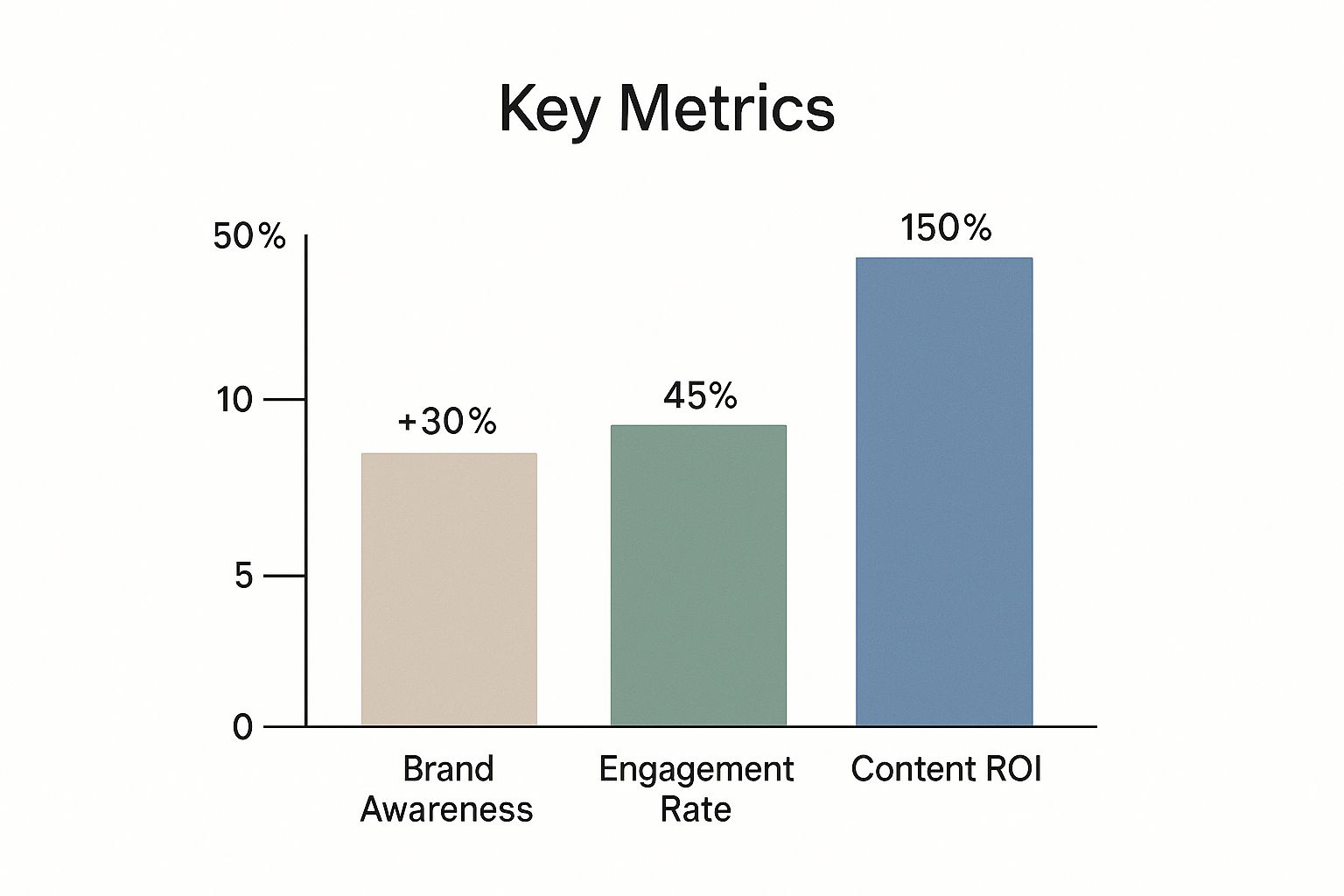
This kind of strategic channel activation directly fuels your most important KPIs. As the data shows, it can lead to a massive 150% uplift in Content ROI.
To make this practical, it's helpful to map out how your brand will show up on each platform. I use a simple framework with my teams to ensure we're always aligned.
Brand-Channel Alignment Matrix
This matrix is a simple but powerful tool for adapting your content strategy to different channels while keeping your brand's core message intact. It helps you decide what type of content and tone will be most effective for each platform based on your overarching brand goals.
| Channel | Primary Audience Mindset | Brand Voice Application | Primary Content Format | Key Performance Indicator |
|---|---|---|---|---|
| Professional Development, Industry News, Networking | Authoritative, Insightful, Professional | Articles, Whitepapers, Case Studies, Text-heavy Posts | Lead Generation, Website Clicks, Engagement Rate | |
| Discovery, Inspiration, Entertainment | Aspirational, Creative, Authentic | High-quality Images, Reels, Stories, Carousels | Follower Growth, Engagement Rate, Brand Mentions | |
| Blog / Website | Problem Solving, In-depth Research, Education | Expert, Helpful, Comprehensive | Long-form Guides, How-to Articles, Research Reports | Organic Traffic, Time on Page, Keyword Rankings |
| Twitter / X | Real-time News, Quick Updates, Community Banter | Witty, Timely, Conversational | Short-form Text, Threads, Polls, Memes | Retweets, Replies, Website Clicks, Brand Mentions |
| TikTok | Entertainment, Trend Discovery, Authenticity | Playful, Human, Relatable | Short-form Vertical Video, Behind-the-Scenes | Views, Shares, Follower Growth, User-Generated Content |
Using a matrix like this turns abstract strategy into a clear, actionable plan, ensuring every piece of content serves a purpose and reinforces your brand identity, no matter where it appears.
The Untapped Power of Employee Advocacy
One of the most authentic—and most overlooked—channels you have is your own team. Your employees can extend your brand's reach in a way no corporate account ever could. When one of your engineers shares a technical blog post on their personal LinkedIn, it comes with a built-in layer of credibility that you just can't buy.
But a successful employee advocacy program isn't about mandating shares. It's about empowerment. We make it happen by creating a simple content hub where employees can find pre-approved snippets, compelling images, and suggested talking points. This makes it incredibly easy for them to share content that is both on-brand and genuinely interesting to their personal networks.
This is more important than ever. Your customers are spending a huge amount of time on social media—globally, the average is 2 hours and 20 minutes daily. These platforms are the modern battleground for attention. With over 90% of brands actively using social media and 76% of users admitting to buying something they saw on these platforms, the path to revenue is clear. You can find more data on the impact of social media marketing at Socal News Group.
By carefully activating your brand across the right channels and empowering your internal teams to join the conversation, you turn content distribution from a final checklist item into a strategic force multiplier that builds brand equity and drives real revenue.
Measuring the ROI of Brand-Led Content
"How do you measure the ROI of a gut feeling?" It’s the question that always hangs in the air in the boardroom, the one that can stop an ambitious brand initiative dead in its tracks. For too long, leaders have been taught to view brand-building as a soft, unmeasurable expense. I'm here to tell you that this mindset is not only outdated but flat-out dangerous for growth.
From what I've seen, the inability to tie brand investment back to revenue is the single biggest reason why so many branding and content marketing efforts fizzle out. They never get the sustained funding they need to actually work. The C-suite speaks in the language of numbers—EBITDA, LTV, CAC. If you can't translate your work into that language, you’ve already lost the battle. We have to look past vanity metrics like likes and shares.
A Blended Model for True Performance
The secret is to use a blended measurement model. This approach tracks both the immediate, hard numbers and the leading indicators of brand health. One set of metrics tells you what happened yesterday; the other gives you a very good idea of where your business is headed next year. You absolutely need both to tell the full story.
This isn't about choosing between brand and demand. It’s about finally understanding how they feed each other.
-
Direct Response Metrics: These are the numbers your CFO already knows and loves. They’re the immediate, tangible results of your content.
- Marketing Qualified Leads (MQLs): Think prospects generated from content downloads or webinar sign-ups.
- Sales Qualified Leads (SQLs): This is the crucial next step—how many of those MQLs the sales team actually accepts as real opportunities.
- Content-Attributed Revenue: Use multi-touch attribution to directly connect specific content pieces to closed deals.
-
Brand Equity Indicators: These are the long-game metrics. They signal growing influence, trust, and customer loyalty, and they are powerful predictors of future revenue.
- Branded Search Volume: When more people are searching for your company by name, it’s a massive sign of growing awareness and trust.
- Share of Voice (SOV): How often is your brand mentioned online compared to your top competitors? This is a direct measure of your presence in the market.
- Sentiment Analysis: Are the conversations about your brand online positive, negative, or neutral? This tells you how the market feels about you.
Forget trying to isolate the ROI of a single blog post. The real goal is to show the correlation: as your brand equity indicators trend upward, your revenue grows and your customer acquisition cost goes down. That’s the story that gets executive buy-in.
Building Your Growth Dashboard
To make this data work for you, you need a unified dashboard. Stop creating separate reports for "brand" and "content." Put these metrics side-by-side. This is how you shatter silos and force everyone to see the relationship between their work.
For example, when we launched a major "Hero" content campaign for a SaaS client, we tracked everything. We got a small, immediate bump in MQLs, which was nice. But the real story unfolded over the next six months. We watched our Share of Voice climb by 18% and saw our branded search volume shoot up by 30%.
And here’s the kicker: this rising brand tide lifted all the other boats. Our non-branded organic traffic also grew, and our customer acquisition cost dropped by a full 12%. Why? Because new prospects were already familiar with our brand and trusted our expertise before they even clicked. By showing this correlated data in one place, we proved that the brand content wasn't just an expense; it was one of the smartest growth investments the company could make.
This data-driven reality is why a recent survey of 685 senior content marketers found that 81.02% are optimistic or very optimistic about content marketing's future as a growth engine. You can find more details in this content marketing statistics survey. They see the connection. It's our job as leaders to make that connection impossible for the rest of the organization to ignore.
When you can prove that brand and content synergy directly impacts financial performance, you’re no longer asking for a budget—you’re presenting a clear investment case for future growth.
Answering the Tough Questions on Brand and Content Alignment
I’ve been in countless rooms with leadership teams, and the same fundamental questions always come up when we talk about merging brand and content marketing. The specifics might change, but the core challenges are universal. Here are the straight-up answers I give, pulled from years of knocking down these walls in the real world.
How Do We Start If Our Teams Are Already Siloed?
This is where almost everyone begins. The good news is you don't need a massive, disruptive re-org to get started. The key is to start small with a single, cross-functional project.
Instead of trying to rewrite every process overnight, pick one high-impact content campaign. Maybe it's a quarterly webinar, a big industry report, or a major product launch. Then, create a temporary "squad" to own it from start to finish.
This team needs to include:
- A key decision-maker from the brand team.
- The content strategist or lead writer.
- A product marketing manager.
- Someone from the sales team who's on the front lines.
Your mandate for this group is simple: they must co-create everything together. That means the initial messaging (brand's world) and the actual content and distribution plan (content's world) are developed in lockstep. This small-scale project forces everyone to speak the same language and rally around a shared goal. When it succeeds, you'll have the perfect internal case study to make the argument for a more integrated approach company-wide.
What Comes First: Brand or Content Strategy?
This isn't a chicken-or-egg debate. The answer is clear and non-negotiable: brand always comes first.
A content strategy without a solid brand strategy is just a collection of random ideas. It has no point of view, no consistent voice, and no real direction. You’re essentially trying to build a house without a blueprint.
Your brand strategy defines the why—your mission, who you serve, your core messaging. Your content strategy is the how—the way you'll deliver on that brand promise through articles, videos, and social media. Jumping straight to content is a surefire way to waste money on assets that might get some clicks but will do absolutely nothing to build long-term brand equity or give you pricing power.
Think of it this way: Your brand is the operating system; your content is the application. You have to install the OS before you can run any programs. If you don't, you're guaranteed to crash.
How Do We Convince Leadership to Invest in Brand-Building Content?
Let's face it, executives care about measurable results, as they should. The trick is to stop talking about "brand awareness" and start talking about "brand-led demand generation." You have to connect the dots between brand strength and financial outcomes, using the kind of blended metrics we discussed earlier.
Build a dashboard that puts brand health indicators like branded search volume and share of voice right next to hard business metrics like Customer Acquisition Cost (CAC) and Customer Lifetime Value (LTV).
When you make your pitch, don't just show them a slick piece of Hero content. Show them the data story: "After we launched our annual industry report six months ago, our branded search traffic jumped by 40%, and our CAC for that product line dropped by 15%. Leads who read the report converted at a higher rate because they already saw us as an authority." You have to speak the language of the C-suite and prove that brand isn't just a cost center—it's what makes every other marketing dollar you spend work harder.
Should Our Content Always Be Promotional?
Absolutely not. In fact, some of the most powerful brand-building content never even mentions the product.
Your content’s main job is to solve your audience’s problems and establish your company as the undisputed expert in your space. This is the heart of brand-led content marketing. Your brand is your promise of value, and your content is how you deliver on that promise, long before anyone is ready to buy. By consistently sharing your expertise with no strings attached, you build an incredible amount of trust.
A good rule I've always followed is the 80/20 principle:
- 80% of your content should be purely educational, insightful, and focused on your customer’s world.
- 20% of your content can be more product-centric—think case studies, demos, or comparison guides—aimed at people who are deeper in the buying process.
This balance ensures you cultivate a loyal audience that views you as a trusted partner, not just another vendor. When they finally are ready to buy, you won't just be on the list; you'll be the only one they want to talk to.
At MGXGrowth, we live and breathe this stuff. We specialize in breaking down these exact silos, partnering with executive teams to build unified brand and content engines that drive real, measurable growth. If you're ready to end the internal friction and build a true growth machine, let's connect at https://www.mgxgrowth.com.
