


In my decades driving growth across SaaS, hospitality, and real estate, I've seen one truth hold constant: leadership is not a title; it's a strategic asset. Too often, leadership development is treated as a theoretical exercise—a checklist of soft skills disconnected from hard metrics like EBITDA and market share. That approach fails because it misses the point. Effective leadership is the engine that breaks down silos, aligns cross-functional teams, and translates vision directly into revenue.
The most impactful leaders I've worked with, and coached through my firm MGXGrowth, are those who set intentional, data-driven goals for leadership development. They understand that enhancing their ability to inspire, strategize, and execute is directly tied to the P&L. This isn't about becoming a 'better' person; it's about becoming a more effective driver of customer-centric, organizational success.
This guide cuts through the abstract theories to provide seven practical, business-focused goals that will equip you to not just manage, but to multiply your impact. Each goal is designed to be actionable and directly linked to tangible business outcomes, giving you a clear roadmap to elevate your leadership from a management function to a core growth driver.
1. Emotional Intelligence (EI) Development
In my experience driving revenue growth across diverse industries, from SaaS to hospitality, I’ve found that technical skills and market knowledge alone don't build winning teams. The most critical differentiator is Emotional Intelligence (EI), a cornerstone among effective goals for leadership development. EI is the ability to perceive, evaluate, and influence your own emotions and the emotions of others. It’s not about being "nice"; it’s about being smart with feelings to foster collaboration, resilience, and superior data-driven decision-making.

This framework, popularized by Daniel Goleman, breaks down into four core competencies: self-awareness, self-regulation, social awareness, and relationship management. Leaders who master these skills can navigate complex team dynamics, inspire loyalty, and align entire organizations toward a common objective, directly impacting everything from employee retention to customer satisfaction and, ultimately, EBITDA.
Strategic Application: Microsoft's Cultural Renaissance
Consider the transformation at Microsoft under Satya Nadella. He inherited a culture known for its internal competitiveness and siloed divisions, which was strangling innovation. Nadella made empathy, a key component of EI, a core leadership tenet.
Key Insight: Nadella shifted the company mindset from "know-it-all" to "learn-it-all." This wasn't just a catchy phrase; it was a strategic pivot that required leaders to develop high EI. They had to listen actively to customers, empathize with colleagues across different departments, and regulate their own ego-driven responses to foster psychological safety. This customer-centric shift was instrumental in breaking down internal silos.
The business impact was monumental. This EI-driven cultural shift unlocked collaboration, revitalized product innovation, and propelled Microsoft’s market capitalization into the trillions. It proves that developing EI is not a "soft skill" goal; it is a hard-nosed business strategy.
Actionable Plan for Implementation
To integrate EI as a leadership development goal, focus on tangible, data-driven actions:
- Start with Self-Assessment: Use validated tools like the EQ-i 2.0 or 360-degree feedback surveys specifically designed to measure emotional competencies. This provides a data-driven baseline.
- Practice Active Listening: In your next one-on-one, commit to listening without interrupting. Summarize what you heard and ask, "Did I understand that correctly?" to validate your comprehension and show respect.
- Implement Mindfulness: Encourage leaders to adopt a 5-minute daily mindfulness practice. This simple habit improves self-regulation, reducing reactive decision-making under pressure.
- Use an "Emotions Journal": Have leaders log high-stress situations and their emotional responses. This builds self-awareness by connecting triggers to reactions, enabling more controlled future behavior.
2. Strategic Thinking and Vision Development
Across every venture I’ve led, from scaling SaaS platforms to optimizing multi-location hospitality brands, the leaders who deliver exponential growth are those who operate on a different timeline. They aren't just managing the present; they are architecting the future. This foresight is the essence of Strategic Thinking, a crucial element among goals for leadership development. It's the capacity to rise above daily operational fires to analyze the entire competitive landscape, anticipate customer needs, and craft a compelling, long-term vision that galvanizes the entire organization.

This discipline, championed by thinkers like Michael Porter and Jim Collins, involves moving beyond simple problem-solving to embrace systems thinking. A strategic leader connects disparate trends, from macroeconomic shifts to emerging technologies, and synthesizes them into a coherent, forward-looking plan. This isn't about having a crystal ball; it's about building a robust framework for decision-making that ensures long-term relevance and market share growth.
Strategic Application: Netflix's Pivot to Streaming
Recall Netflix in the mid-2000s. Reed Hastings was running a successful DVD-by-mail business, but he saw the inevitable disruption posed by increasing internet bandwidth. While competitors were focused on optimizing DVD logistics, Hastings was strategically planning for a future that would make his core business obsolete. This required an immense, data-informed, and often unpopular long-term vision.
Key Insight: Hastings’s strategy was not just about adopting a new technology; it was a fundamental reimagining of the business model. He made the painful decision to invest heavily in streaming infrastructure and content licensing, even when it cannibalized the profitable DVD segment. This vision-driven pivot required leaders to think in decades, not quarters, and to communicate a compelling "why" that unified the company through a difficult transition.
The business impact was legendary. This strategic foresight transformed Netflix from a niche service into a global media juggernaut, demonstrating that developing strategic vision is a non-negotiable for market leadership. It's about making bold bets on the future and having the operational discipline to execute them.
Actionable Plan for Implementation
To build strategic thinking as a core leadership competency, focus on structured, data-driven practices:
- Conduct Quarterly Environmental Scans: Dedicate time for your leadership team to analyze PEST (Political, Economic, Social, Technological) trends. Document key shifts and discuss their potential impact on your 3-to-5-year plan.
- Practice Scenario Planning: Develop best-case, worst-case, and most-likely scenarios for a major market development (e.g., a new competitor, a regulatory change). This builds mental agility and prepares leaders to adapt quickly.
- Create a "Future-Back" Vision: Ask your team to envision the company in 10 years. What does success look like from a customer and market share perspective? Work backward from that vision to identify the critical milestones and capabilities needed today.
- Rotate Leaders Through Functions: Temporarily assign leaders to different departments. This breaks down silos and gives them a systems-level view of the business, which is essential for holistic strategic thinking.
3. Communication and Influence Skills Enhancement
Across every venture I’ve led, from scaling SaaS platforms to optimizing hospitality operations, one truth remains constant: a brilliant strategy is worthless if it cannot be communicated effectively. Enhancing communication and influence skills is therefore one of the most high-leverage goals for leadership development. This isn't just about public speaking; it’s the ability to articulate a vision, persuade stakeholders, and build consensus, whether in the boardroom, a one-on-one, or an all-hands meeting.
Mastery in this area means influencing without relying on authority, turning data into compelling narratives, and aligning disparate teams toward a single, unified objective. Leaders who can do this don't just manage; they inspire action, drive organizational change, and directly impact revenue by ensuring strategic initiatives are understood, adopted, and executed flawlessly across all levels.
Strategic Application: Steve Jobs's Storytelling Mastery
Consider the legendary product launches by Steve Jobs at Apple. He didn't just list features; he wove customer-centric narratives that created desire and defined entire product categories. The 2007 iPhone launch is a masterclass in influence. He didn't introduce three separate products; he built suspense and then revealed a single revolutionary device, framing it as a historic leap forward.
Key Insight: Jobs's technique was rooted in a deep understanding of his audience and the power of simplicity. He used the "rule of three" to make his message sticky and paired technical specifications with emotional benefits, answering the unspoken question in every customer's mind: "How will this change my life?"
This communication strategy transformed product announcements into cultural events, creating immense brand loyalty and market demand before the product even hit shelves. It proves that strategic communication is a powerful tool for market creation and a critical driver of business valuation.
Actionable Plan for Implementation
To elevate communication and influence as a core leadership competency, implement these targeted actions:
- Practice Audience-Centric Messaging: Before any key communication, have leaders write down three things their audience cares about most. They must then frame their core message to directly address those points, connecting the strategy to the customer.
- Master the Data-Story Sandwich: Teach leaders to start with a relatable story, present the supporting data, and conclude by reinforcing the story's emotional hook. This makes complex information digestible and memorable.
- Implement "Message Rehearsals": For critical announcements, conduct rehearsal sessions where leaders present to a "murder board" of trusted peers who provide blunt, constructive feedback on clarity, persuasiveness, and impact.
- Develop Active Listening Skills: In meetings, encourage leaders to use the "what I'm hearing is…" technique to paraphrase and confirm understanding before stating their own opinion. This builds trust and ensures alignment.
4. Team Building and Collaboration Mastery
Throughout my career scaling businesses, I’ve learned a fundamental truth: individual brilliance doesn't scale, but high-performing teams do. That's why Team Building and Collaboration Mastery is one of the most crucial goals for leadership development. This isn't about forced fun or trust falls; it's the strategic practice of breaking down silos to engineer an environment where diverse talents merge to create something greater than the sum of its parts. It involves a deep understanding of team dynamics, conflict resolution, and fostering psychological safety.

Pioneered by thinkers like Patrick Lencioni and Amy Edmondson, this discipline focuses on building trust and enabling healthy conflict to drive commitment and accountability. When leaders master this, they unlock discretionary effort, accelerate innovation, and build resilient teams that can execute complex strategies with precision. The direct line from cohesive collaboration to operational excellence and bottom-line results is undeniable.
Strategic Application: Google's Project Aristotle
Google, a company built on data, embarked on a multi-year study called Project Aristotle to codify the secrets of its most effective teams. They analyzed hundreds of variables, from individual skills to team structure, expecting to find a perfect mix of personality types or expertise. Instead, the data pointed to something far more human.
Key Insight: The single most important factor for team success at Google was psychological safety, a concept championed by Amy Edmondson. This is the shared belief that team members can take interpersonal risks, like admitting a mistake or proposing a radical idea, without fear of humiliation. Teams with high psychological safety had higher ratings for effectiveness, brought in more revenue, and had lower turnover.
This discovery transformed how Google approached leadership development. It wasn't about finding the "best" people; it was about training leaders to create an environment where the best people could thrive together. This insight proves that breaking down silos and building collaborative teams is not an HR initiative; it's a core growth strategy.
Actionable Plan for Implementation
To build this mastery into your leadership development goals, focus on structured, repeatable actions:
- Establish Clear Team Norms: In the first week of any new project, facilitate a session where the team defines its rules of engagement: communication protocols, decision-making processes, and how to handle disagreements.
- Model Vulnerability: As a leader, be the first to admit a mistake or say, "I don't know the answer." This single act gives others permission to be vulnerable, which is the bedrock of psychological safety.
- Run a "Team Health" Check: Use a simple survey (like Google’s gTeams assessment) quarterly to measure psychological safety and other key dynamics. Discuss the data openly and create an action plan together.
- Invest in Shared Experiences: Dedicate time for non-work activities that build personal connections. This isn't about lavish offsites; it can be as simple as a team lunch where work talk is off-limits.
5. Change Management and Adaptability Leadership
Across every sector I’ve helped scale, from high-growth SaaS to legacy hospitality brands, the one constant is change. The ability to lead through disruption isn't just a skill; it’s a survival mechanism. This makes developing Change Management and Adaptability a critical, non-negotiable item among goals for leadership development. It’s the capacity to steer organizations through transitions, mergers, or market pivots while keeping teams focused, motivated, and productive.
Effective change leadership, as pioneered by thinkers like John Kotter, is about architecting a transition, not just announcing it. It requires a leader to build a compelling vision, manage stakeholder psychology, and proactively mitigate the inevitable resistance that stalls progress. Leaders who master this are the ones who turn market threats into competitive advantages, directly safeguarding revenue streams and fostering a resilient organizational culture.
The infographic below outlines a simplified yet powerful process flow for initiating any change management plan.
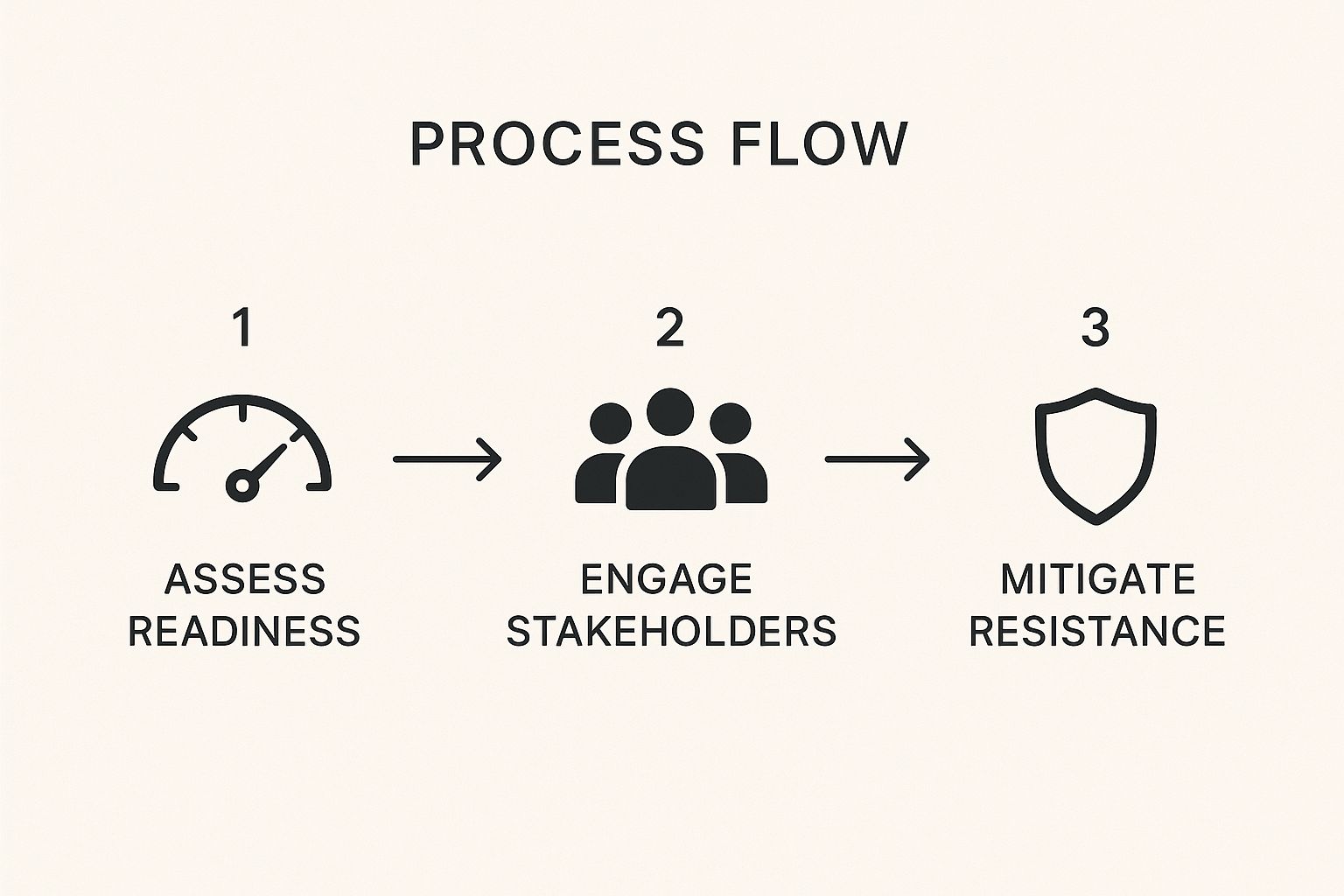
Following this sequence ensures that change initiatives are built on a solid foundation of organizational awareness and buy-in, rather than top-down force.
Strategic Application: General Motors' EV Pivot
Look at Mary Barra's leadership at General Motors. She inherited a century-old manufacturing titan and had to pivot it toward an electric, autonomous future, a monumental change in both technology and culture. This wasn't just about retooling factories; it was about rewiring the mindset of an entire organization deeply rooted in the internal combustion engine.
Key Insight: Barra didn't just announce a new strategy; she methodically managed the transition. She secured massive investment, communicated a clear and ambitious customer-centric vision of "zero crashes, zero emissions, and zero congestion," and engaged unions and employees directly. This created a sense of shared purpose, transforming potential resistance into a source of competitive energy.
The result was a dramatic acceleration of GM's EV roadmap, allowing it to compete with digital-native disruptors like Tesla. This proves that deliberate change management is a strategic lever for market repositioning and long-term value creation.
Actionable Plan for Implementation
To build adaptability into your leadership corps, implement these targeted actions:
- Create a Change Communication Cadence: For any new initiative, schedule weekly or bi-weekly "Change Check-in" meetings. Dedicate the first 10 minutes solely to addressing questions and concerns transparently.
- Identify and Empower Change Champions: In every department, identify early adopters who are enthusiastic about the change. Equip them with information and empower them to be peer advocates, creating a grassroots support network.
- Conduct "Pre-Mortem" Workshops: Before launching a change, gather the team and ask, "Imagine this initiative has failed six months from now. What went wrong?" This surfaces potential points of resistance and logistical hurdles before they happen.
- Celebrate Micro-Milestones: Break the change process into small, achievable steps. Publicly recognize and celebrate the team when each milestone is hit. This builds momentum and makes the larger goal feel less daunting.
6. Decision-Making and Problem-Solving Excellence
Across every venture I’ve led, from scaling SaaS platforms to optimizing hospitality operations, the quality of leadership is directly proportional to the quality of its decisions. Superior decision-making isn’t about having a crystal ball; it's a disciplined process. This makes developing goals for leadership development around this competency non-negotiable for anyone serious about driving sustainable growth. It involves a systematic, data-driven approach to analyzing complex problems, weighing alternatives under pressure, and committing to a course of action with conviction.
This skill set blends critical thinking, data literacy, risk assessment, and the courage to act decisively. Leaders who excel here don't just solve problems; they anticipate them. They can dissect a challenge, separate signal from noise, and align resources effectively, turning potential crises into strategic advantages that directly impact profitability and market share.
Strategic Application: Andy Grove at Intel
Consider Andy Grove's legendary leadership at Intel during the 1980s when Japanese competitors were overwhelming the memory chip market, Intel's core business. The company was bleeding money, and morale was at an all-time low. Grove and co-founder Gordon Moore faced a paralyzing decision.
Key Insight: Grove famously asked Moore, "If we got kicked out and the board brought in a new CEO, what do you think he would do?" Moore's immediate answer was, "He would get us out of memories." Grove's response was, "Why shouldn't we walk out the door, come back in, and do it ourselves?"
This mental exercise, a powerful problem-solving framework, allowed them to detach emotionally from their legacy business. They made the brutal but data-informed and correct decision to pivot entirely to microprocessors. This single, courageous decision wasn't just a pivot; it was the strategic move that saved Intel and created the foundation for its decades-long dominance of the computing industry.
Actionable Plan for Implementation
To build this critical leadership muscle, leaders must adopt structured, repeatable practices:
- Define Problems with Precision: Before exploring solutions, use the "5 Whys" technique to drill down to the root cause of an issue. A clear problem statement prevents wasted effort on superficial symptoms.
- Use Structured Frameworks: Introduce models like the WRAP framework (Widen Your Options, Reality-Test Your Assumptions, Attain Distance Before Deciding, Prepare to Be Wrong) from Chip and Dan Heath to guide the decision-making process and mitigate cognitive biases.
- Create a "Decision Journal": Encourage leaders to document key decisions: the rationale, the supporting data, the expected outcome, and the actual result. This creates a powerful feedback loop for learning and refining judgment.
- Conduct "Pre-Mortems": For any major initiative, hold a meeting where the team imagines the project has failed spectacularly one year in the future. This process uncovers potential risks and weaknesses before they become reality.
7. Coaching and Mentoring Development
In my work scaling businesses from early-stage startups to enterprise giants, I’ve seen firsthand that leaders who only manage tasks will always be outpaced by those who develop people. The most impactful leaders are multipliers, and this is achieved by mastering coaching and mentoring. This crucial skill set is one of the most effective goals for leadership development, transforming managers from simple directors into true talent developers. It's about shifting from providing answers to asking powerful questions, fostering a culture of ownership and continuous improvement.
This discipline, championed by thinkers like Marshall Goldsmith and John Whitmore, moves beyond simple instruction. It involves active listening, delivering constructive feedback that fuels growth, and empowering team members to solve their own problems. Leaders who excel at coaching don't just hit their targets; they build a sustainable pipeline of future leaders, directly boosting organizational resilience, innovation, and long-term EBITDA growth.
Strategic Application: Salesforce's Leadership Pipeline
Consider Marc Benioff's approach at Salesforce, where leadership development is deeply embedded in the company's "Ohana" culture. Benioff understood that rapid, sustainable growth required a scalable way to develop leaders at every level, not just at the top. Coaching and mentoring became systemic.
Key Insight: At Salesforce, leadership development isn’t an occasional training event; it's a daily practice. Managers are trained and expected to hold regular coaching conversations, focusing on career aspirations and skill gaps, not just project status updates. This creates a powerful feedback loop that aligns individual growth with the company's strategic objectives and customer-centric mission.
The business impact is a highly engaged workforce and an internal talent pipeline that fuels its relentless growth. By making every leader a coach, Salesforce created a self-perpetuating system for excellence, reducing turnover costs and accelerating innovation by empowering employees to take on bigger challenges.
Actionable Plan for Implementation
To build coaching and mentoring into your leadership development goals, implement these practical steps:
- Train on a Simple Framework: Introduce a model like GROW (Goal, Reality, Options, Will). It provides a simple, memorable structure for coaching conversations, preventing them from becoming unstructured chats.
- Practice "Question-Based" Leadership: In your next team meeting, when a problem is raised, challenge yourself to ask at least three clarifying questions before offering a solution. For example, "What have you already tried?" or "What does success look like here?"
- Create Formal Mentoring Pairs: Intentionally pair high-potential junior employees with senior leaders outside their direct reporting line. This cross-pollinates knowledge, breaks down silos, and provides a safe space for developmental feedback.
- Focus on Developmental Feedback: Teach leaders to frame feedback around growth. Instead of saying, "Your presentation was disorganized," try, "For your next presentation, let's focus on building a clearer narrative structure to increase your impact."
7 Leadership Development Goals Comparison
| Leadership Development Goal | Implementation Complexity 🔄 | Resource Requirements ⚡ | Expected Outcomes 📊 | Ideal Use Cases 💡 | Key Advantages ⭐ |
|---|---|---|---|---|---|
| Emotional Intelligence (EI) Development | Moderate to High: requires sustained self-reflection | Moderate: assessment tools and coaching needed | Improved interpersonal relationships and decision-making | Leaders aiming to enhance emotional self-awareness and team engagement | Builds trust, reduces conflict, boosts communication |
| Strategic Thinking and Vision Development | High: involves complex analysis and scenario planning | High: training and continuous research required | Long-term organizational alignment and competitive edge | Leadership roles focused on future planning and innovation | Enables proactive leadership, improves resource allocation |
| Communication and Influence Skills Enhancement | Moderate: continual practice and feedback required | Moderate: training and coaching in communication | Stronger influence, better team alignment and trust | Leaders needing to enhance persuasion and narrative skills | Increases credibility, drives change, reduces misunderstandings |
| Team Building and Collaboration Mastery | Moderate to High: ongoing relationship management | Moderate to High: team-building activities and facilitation | Higher productivity, engagement, and innovation | Managing diverse or virtual teams requiring collaboration | Enhances team resilience, improves retention, fosters inclusion |
| Change Management and Adaptability Leadership | High: involves managing complex processes and emotions | High: resources for training and stakeholder engagement | Increased organizational agility and successful transformations | Leaders navigating organizational change or crisis | Reduces failure rate, builds resilience, improves buy-in |
| Decision-Making and Problem-Solving Excellence | Moderate to High: requires data analysis and frameworks | Moderate: data collection and analytical tools | Improved quality and consistency of decisions | Roles demanding critical thinking under pressure | Reduces costly mistakes, builds trust, enhances strategic thinking |
| Coaching and Mentoring Development | Moderate: requires ongoing commitment and skill growth | Moderate: training and time investment | Stronger bench strength and continuous learning culture | Leaders focused on talent development and succession planning | Develops future leaders, increases engagement, improves performance |
From Goals to Growth: Your Leadership Development Roadmap
We've explored seven critical goals for leadership development, moving from the internal mastery of emotional intelligence to the external impact of strategic communication and change management. These aren't just items to check off a list. They are interconnected capabilities that form the bedrock of high-performing, resilient organizations.
The journey from a manager to a true leader isn't linear. It's a continuous cycle of learning, applying, measuring, and refining. The most common mistake I see executives make is treating leadership development as a passive activity, like attending a seminar or reading a book. The real growth, the kind that translates into market share and EBITDA improvement, happens when you actively and intentionally apply these principles in your daily operations.
Synthesizing Your Leadership Strategy
The power of this framework lies not in mastering each goal in isolation, but in understanding how they work together.
- Emotional Intelligence is the foundation. Without it, your attempts at coaching, communication, and breaking down silos will feel inauthentic and ineffective.
- Strategic Thinking provides the "why" behind your actions, giving your team a clear, customer-centric vision to rally behind.
- Effective Communication is the vehicle that translates that vision into coordinated action across the organization.
Think of these goals as a force multiplier. Improving your ability to coach and mentor, for instance, directly enhances team collaboration and accelerates problem-solving. A leader who masters change management can steer their team through market disruptions, a critical skill in today's volatile tech and SaaS landscapes.
Activating Your Development Plan
To turn these insights into tangible results, you must commit to a structured, data-driven approach. Don't try to tackle all seven goals at once. Instead, identify the one or two that will have the most immediate and significant impact on your current business challenges.
Ask yourself:
- Where is the biggest bottleneck in my team or organization? Is it a lack of clear direction (Strategic Thinking), poor cross-functional alignment (Team Collaboration), or resistance to new initiatives (Change Management)?
- What is the business outcome I need to achieve? Are you trying to increase customer retention, accelerate product development, or improve employee engagement scores?
- How will I measure success? Define clear, data-driven KPIs. Success isn't completing a course; it's seeing a measurable lift in team productivity, a reduction in employee turnover, or a faster time-to-market.
Your commitment to setting and achieving these goals for leadership development is a direct investment in your organization's most valuable asset: its people. It signals a shift from a reactive management style to a proactive, strategic leadership approach. This is how you build a culture that not only weathers storms but actively seeks them out as opportunities for growth. It’s how you build a legacy.
Ready to translate these goals into measurable revenue growth and a high-performance culture? At MGXGrowth, we specialize in implementing data-driven leadership frameworks that break down silos and align your entire organization around strategic objectives. Visit MGXGrowth to learn how we can help you build the leadership capabilities required to scale your business.
