


I’ve spent decades in the trenches, driving growth across SaaS, marketplaces, and real estate, and one truth has become undeniable: the old command-and-control leadership model is a liability. Sustainable growth isn't achieved by squeezing more out of your teams. It's unlocked by investing in them. From my experience, human-centred leadership is the most powerful lever for tearing down internal silos and driving tangible, measurable business results.
Why Human Centred Leadership Is a Growth Strategy

I've been in countless boardrooms, from SaaS startups hitting an inflection point to established hospitality giants, and the conversation always gravitates to growth. We fixate on revenue, EBITDA, and market share. But here’s the variable so many leaders overlook: their people.
For far too long, leadership was a one-way street. The playbook was to command, control, and extract maximum value. In today's market, that approach doesn't just feel outdated; it's a direct threat to your P&L. It breeds a culture of silos, stifles innovation, and drives your top talent to competitors. These are the silent killers of your bottom line.
Shifting from Overhead to Asset
This is where human-centred leadership fundamentally alters the equation. It’s not a "soft skill" or a feel-good initiative to be delegated to HR. It is a core strategic decision to treat your employees as the primary engine of value creation, not merely an expense on a spreadsheet.
"A leader's primary role is to make their employees more successful. It's about removing barriers to foster a culture of productivity and resilience, enabling individuals to create, innovate, and charge full speed ahead."
This isn't a niche philosophy; it's a global business imperative. A major study by the leadership advisory firm Boyden found that 43.1% of leaders worldwide now identify human-centred leadership as their primary focus. It earned a priority score of 8 out of 10, significantly outpacing other models. You can review the global leadership trends to see the data for yourself.
The Foundation of Performance
When you place your people at the core of your strategy, you’re not just being benevolent—you’re engineering the foundation for sustainable high performance. This approach directly fuels the outcomes every executive is measured on. It's about creating an environment where teams feel valued, psychologically safe, and empowered to deliver their best work.
Throughout this guide, I'll provide a practical, data-driven framework for this model. We'll explore exactly why leading with humanity is the most direct path to boosting the financial metrics that define success.
Traditional vs Human Centred Leadership A Growth Strategist's View
The difference between these two models isn't just philosophical—it's quantifiable and shows up directly in your P&L statement. Let's break down how this plays out across the metrics that define success.
| Metric | Traditional Leadership Model | Human Centred Leadership Model |
|---|---|---|
| Innovation | Stifled by fear of failure and rigid hierarchies. | Encouraged through psychological safety and autonomy. |
| Employee Retention | High turnover as people feel like cogs in a machine. | Low turnover; people feel valued and invested in. |
| Productivity | Capped by micromanagement and burnout. | Boosted by empowerment, trust, and well-being. |
| Customer Loyalty | Inconsistent service from disengaged employees. | Stronger relationships built by motivated, happy teams. |
| Profitability | Eroded by turnover costs and lack of innovation. | Enhanced by higher productivity and a stronger brand. |
The contrast is stark. The old model creates friction and value leakage, while the human-centred approach acts as a force multiplier for every metric you're trying to move.
The Three Pillars of Actionable Leadership
High-level ideas don't grow a business; actionable frameworks do. In my decades of experience scaling companies, I've seen that for human-centred leadership to drive results, it must be a practical system that leaders can execute, measure, and refine. This comes down to three interconnected pillars: Empathy, Empowerment, and Purpose.
These aren't abstract concepts. They are the structural supports of a high-performance culture. This diagram illustrates how these principles are linked, forming the foundation of the leadership model.
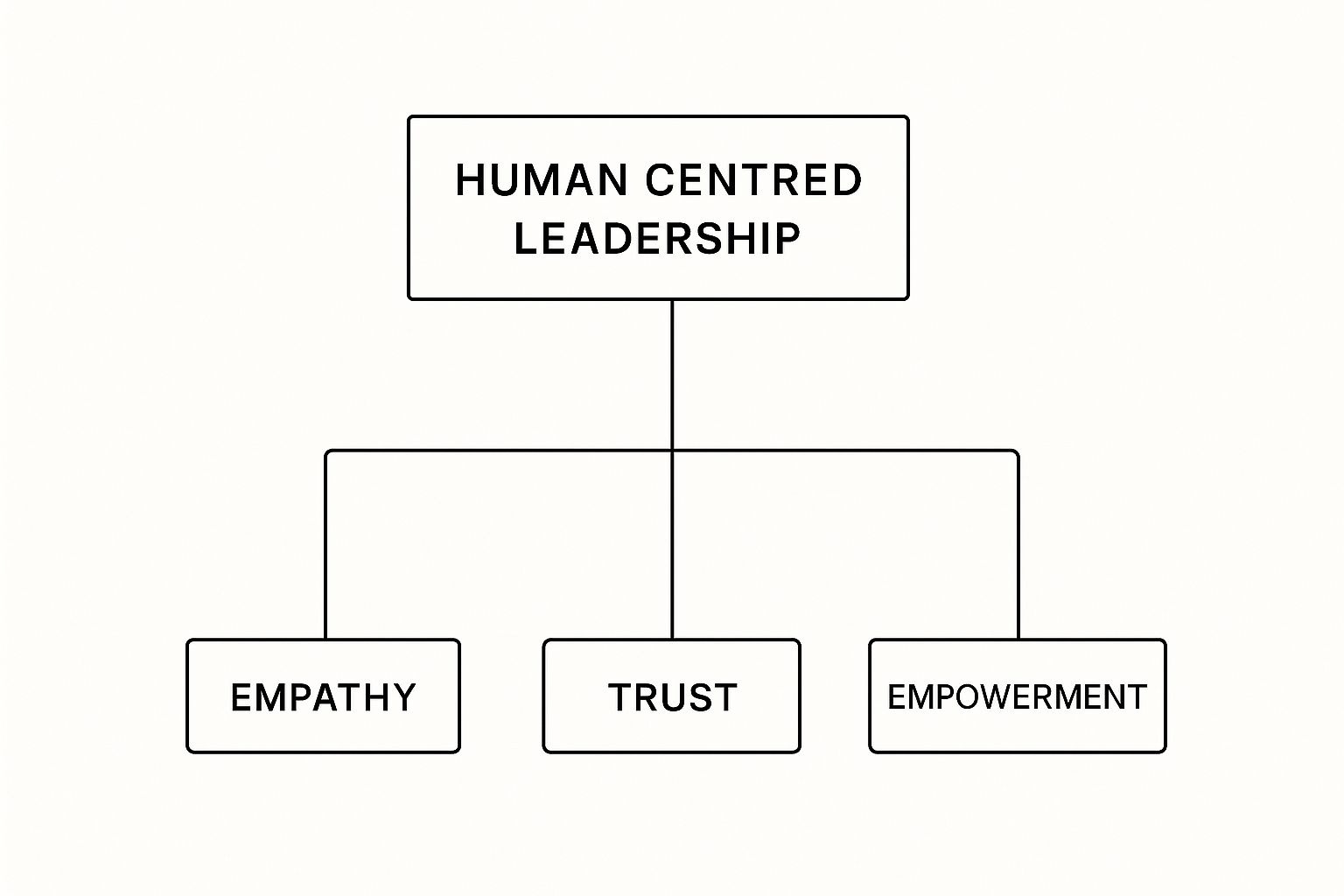
As you can see, Empathy, Empowerment, and Purpose are not separate initiatives to be checked off a list. They are deeply interconnected components of a powerful, self-reinforcing system.
Empathy as a Data Source
The first pillar, empathy, is often the most misunderstood. In a business context, empathy is not about sentimentality or avoiding difficult decisions. It is a powerful intelligence-gathering tool. It's about rigorously understanding the motivations, blockers, and frustrations your teams face.
I once advised a SaaS company where engineering output had flatlined. A traditional manager would demand longer hours. Instead, we started by listening. We discovered the primary roadblock wasn't a lack of talent but deep frustration with a clunky, outdated deployment tool.
That single insight was a goldmine. By investing in a superior system, we didn't just improve morale; we cut deployment errors by 40% and shipped 25% more features the following quarter. That’s empathy translating directly into a hard business result.
Empowerment Beyond Delegation
The second pillar is empowerment. Many leaders believe they empower people by delegating tasks, but that is simply offloading work. True empowerment is about delegating ownership of outcomes. It means giving your team the autonomy, resources, and trust to solve problems as if they were owners of the business themselves.
This is only possible within an environment of psychological safety—a culture where calculated risks are encouraged, not merely tolerated. Failure isn't punished; it's analyzed for insights that strengthen the entire organization.
When you empower a team with true ownership, you cease to be the bottleneck for every decision. You transform your team from task-doers into an engine of proactive problem-solvers, dramatically accelerating your entire operation.
This shift is a competitive advantage. In the gaming industry, for example, market trends pivot in weeks. Empowered studio teams can react to player feedback almost instantly, while top-down organizations are still scheduling the initial meeting. That agility is a direct result of empowerment.
Purpose as a North Star
Finally, we have purpose. This is the connective tissue linking an individual's work to the company's ultimate objective—its north-star metric. When an engineer understands how their code directly improves customer retention, or a support agent sees how their service impacts lifetime value, their work gains significant meaning.
A clear, shared purpose achieves two critical objectives:
- It clarifies priorities: When faced with competing demands, any team member can ask, "Which option moves us closer to our primary goal?"
- It builds resilience: Driving toward a meaningful, shared objective helps teams navigate the inevitable setbacks that come with pursuing ambitious targets.
In every marketplace I’ve worked with, from real estate to professional services, the key to breaking down silos between sales, product, and marketing has been aligning every team around a single purpose—such as creating more successful outcomes for our users.
These three pillars—Empathy, Empowerment, and Purpose—are not just "nice-to-haves." They are the fundamental mechanics of a high-growth, human-centred organization.
Connecting People to Profit: A Data-Driven Case

In every leadership role I've held, my decisions are guided by a core principle: if you can't measure it, you can't manage it. I don't invest in strategies based on buzzwords; I invest in what produces a measurable return. Human-centred leadership is no exception. This is where we move past theory and examine the hard numbers that prove its impact on the balance sheet.
For too long, executives have viewed employee well-being and corporate profit as separate, often conflicting, priorities. This is a fundamentally flawed perspective. The reality is that one directly fuels the other. The most powerful leading indicator of future financial success is not your sales pipeline; it's the level of engagement and psychological safety within your teams.
The Direct Line from Engagement to Earnings
High employee engagement—a direct outcome of this leadership style—is not just an HR metric. It is a critical driver of revenue. When people feel valued, understood, and connected to a larger purpose, their performance improves dramatically. This isn't conjecture; the data is conclusive.
Research consistently shows that companies with highly engaged teams realize a 23% increase in profitability and an 18% boost in productivity compared to their peers. This occurs because purpose-driven employees are more motivated and committed. Leaders who successfully connect company goals to their team's values unlock a powerful competitive advantage. You can explore the leadership trends for 2025 that substantiate this.
This link between purpose and performance creates a positive feedback loop that impacts every key financial metric.
Analyzing the Compounding Financial Benefits
The financial case for human-centred leadership becomes even more compelling when analyzed component by component. This isn't about a single, one-time benefit; it's about creating a series of compounding advantages that fortify your business from the inside out.
Let's examine the three areas where I've observed the most significant financial impact:
-
Reduced Employee Turnover: The cost to replace a skilled employee can range from one-half to two times their annual salary. Engaged employees who feel supported are far less likely to seek other opportunities. This approach directly reduces recruitment and training expenses, which flows straight to the bottom line.
-
Lower Customer Acquisition Cost (CAC): Happy, empowered employees deliver superior customer service. They are more proactive, creative, and invested in the customer's success. This leads to higher satisfaction and, more importantly, powerful word-of-mouth referrals—the most cost-effective marketing channel available.
-
Higher Customer Lifetime Value (LTV): An engaged team doesn't just acquire new customers; it retains them. Consistent, high-quality service builds loyalty and reduces churn. This increases LTV, providing more capital to reinvest in strategic, sustainable growth.
The ultimate ROI of human-centred leadership is the creation of a resilient, innovative culture. When people feel psychologically safe, they are more willing to experiment, share bold ideas, and identify inefficiencies. This is how you outmaneuver competitors and build a durable business.
Putting your people first is not an expense; it is the highest-return investment a leader can make. It is the most direct path from empathy to EBITDA.
Leading Your Team Through High Stakes Change
I’ve spent my career in dynamic industries like SaaS, gaming, and real estate, where the only constant is change. Whether you are navigating a digital transformation, a market pivot, or a supply chain overhaul, the outcome is always determined by one factor: how effectively you lead your people through it.
Top-down mandates are dead on arrival. They fail because they ignore the human emotions that accompany significant shifts—fear, uncertainty, and resistance to the unknown.
In my experience, this is where human-centred leadership becomes your most critical asset. It is the difference between a transformation that succeeds and one that fails six months later.
Turning Resistance into an Engine for Change
Most traditional change management models are flawed. They treat employees as obstacles to be managed or overcome. The default assumption is that resistance is a problem to be solved with more emails, town halls, and executive decrees.
This approach fails because it misunderstands a fundamental aspect of human psychology. Resistance is not a sign of defiance; it is a symptom of people feeling unheard and excluded from the process.
A human-centred approach inverts this script. Instead of pushing change onto your team, you pull them into the process. They are no longer passive recipients of a new plan; they become active co-creators of the solution.
When you involve your team in diagnosing the problem and designing the future state, two powerful things happen:
- You create genuine ownership. People do not fight ideas they helped create. When they have a real stake in the outcome, they become its most effective champions.
- You get far better solutions. The people performing the work possess insights no executive in a boardroom can see. Tapping into that collective intelligence is a massive strategic advantage.
A Framework for Co-Created Transformation
Leading through change isn't about having all the answers. It's about creating a structure where the best answers can emerge directly from the team. This requires a framework built on transparency, collaboration, and empowerment.
1. Communicate the 'Why,' Not Just the 'What'
Before taking any action, be transparent about the business realities driving the change. Frame it as a shared challenge. For example, instead of declaring, "We're switching to a new software system," explain, "Our customer complaints are up 30% because our current system can't keep up. We need to solve this together."
2. Facilitate Collaborative Problem-Solving
Assemble small, cross-functional "squads" or task forces to own specific components of the transformation. Provide clear goals but also grant them the autonomy to explore their own solutions. Your role as a leader shifts from director to facilitator, responsible for clearing roadblocks and securing resources.
3. Empower and Trust Your Experts
Allow these teams to test their ideas on a small scale. This creates a low-risk feedback loop that de-risks the entire project. When a team pilots a new process and demonstrates its effectiveness, they become the most credible advocates for a company-wide rollout.
True leadership during a transformation isn't about command and control; it’s about creating psychological safety. It’s about building an environment where people feel secure enough to challenge the status quo, try new things, and even fail without fearing punishment.
This is not a theoretical benefit; it yields measurable results. A joint study by the University of Oxford's Saïd Business School and EY, surveying over 1,600 leaders and employees, found that organizations adopting human-centred leadership models were 2.6 times more likely to succeed in their transformations. You can review the complete findings in this human-centric transformation study.
By taking this approach, you don't just mitigate resistance—you harness the collective intelligence and energy of your entire organization. You turn your team into a powerful, self-sustaining engine for change, dramatically increasing the probability of a successful transformation that is on time, on budget, and built to last.
How to Implement This Leadership Model

A philosophy remains an abstraction until it is operationalized. I've observed this repeatedly across every industry I've worked in—the gap between concept and result is closed by methodical implementation. Shifting to a human-centred leadership model is not about a single announcement. It's about systematically rewiring your company's daily operating rhythm.
This is not an initiative to be delegated to HR. It requires a sustained, leader-driven effort to build a system where a people-first mindset is the default. The objective is to embed these principles so deeply into your organization’s DNA that they become your greatest competitive advantage.
Redesign Your Performance Systems
To change behavior, you must change how you measure and reward it. If your performance reviews exclusively track individual outputs like sales quotas or lines of code, you will get exactly that: silos and internal competition. You will not foster a collaborative culture.
To break this cycle, your systems must evolve to celebrate the behaviors that define a human-centred environment.
- Introduce Collaboration Metrics: Measure how teams contribute to each other's success. Did the product team's insights help marketing reduce customer acquisition costs? That is a win worth recognizing.
- Reward Empathy and Mentorship: Formalize it. Officially acknowledge individuals who actively mentor junior colleagues or provide constructive, supportive feedback.
- Incorporate 360-Degree Feedback: Make peer feedback a core component of performance reviews. This signals that how results are achieved is as important as the results themselves.
Realigning incentives broadcasts a powerful message about what the organization truly values.
Build Continuous Feedback Loops
In a traditional top-down company, information flows in one direction. A human-centred organization thrives on a continuous, multi-directional conversation. Your ability to monitor the pulse of your teams in real time is non-negotiable. This requires intentional systems for listening.
Do not wait for an annual engagement survey to diagnose last year's problems. Utilize lightweight, frequent pulse surveys to get a real-time read on morale and identify roadblocks as they emerge. More importantly, leaders must get out from behind their desks.
The most valuable insights I’ve ever gathered didn't come from a dashboard. They came from informal chats, skip-level meetings, and asking a simple question: "What's the most frustrating part of your job right now, and how can I help fix it?"
These are not casual conversations; they are critical data collection points. When you act on the feedback you receive, you create a powerful, self-reinforcing cycle of trust and engagement.
Invest in Essential Leadership Competencies
Let's be direct: human-centred leadership is not always intuitive, especially for managers promoted for their technical expertise rather than their people skills. You cannot simply expect it to manifest; you must actively cultivate the necessary skills.
This requires investing in practical training and coaching, not abstract theory. Your leadership development programs must be laser-focused on three crucial competencies:
- Active Listening: Train leaders to listen to understand, not just to reply. This is a learnable skill, involving better open-ended questions and comfort with silence to allow others to think.
- Fostering Psychological Safety: Equip your managers with the tools to create an environment where people feel safe to speak up, challenge the status quo, and admit mistakes without fear of retribution.
- Coaching Over Managing: Help managers shift from being directors to being coaches. This means guiding people to find their own answers instead of simply providing them.
These are not "soft skills." They are the core mechanics of modern, high-performance leadership. Making this model a reality is a deliberate, strategic process that begins with redesigning your systems, opening feedback channels, and systematically building these capabilities in your leaders.
Real-World Examples: Human-Centred Leadership in Action
Theory is valuable, but the ultimate test of any leadership philosophy is its performance in the real world. I have seen these principles deliver results everywhere, from nimble software startups to established hotel chains. It's not about abstract ideals; it’s about making specific, people-focused decisions that directly fuel business growth.
To provide a clearer picture, let’s analyze two real-world scenarios from my own experience. These are not sanitized case studies; they are complex situations where placing people at the center of the equation led to a significant business win.
Case Study 1: The SaaS Scale-Up and the Bottleneck Breakthrough
A few years ago, I was advising a rapidly growing SaaS company that had hit a growth plateau. The engineering team was talented, but product releases were slow, and burnout was palpable. The root cause was a classic bottleneck: a top-down management style where every decision was routed through one overworked product leader.
Instead of demanding more hours, we changed the system itself. We restructured the large engineering department into small, self-governing teams called "pods," each focused on a specific customer problem.
The critical element was granting them true ownership, not just a task list. Each pod received control over its own roadmap, budget, and success metrics. The transformation was immediate and remarkable.
By pushing decision-making down to the engineers closest to the code, we unleashed a wave of creativity and velocity. The teams began shipping smaller, frequent updates directly informed by customer feedback.
This wasn't just about employee satisfaction—it had a massive P&L impact. Within six months, we measured a 30% reduction in time-to-market for new features. This newfound agility allowed us to outmaneuver a major competitor and capture an additional 5% market share that year.
Case Study 2: The Hospitality Giant and the Front-Line Fix
This example comes from a different sector. I was brought in to assist a legacy hospitality company with a high-stakes project: deploying a new property management system across all its hotels. The executive team had selected the software, and the plan was to simply train thousands of front-line employees on the new tool.
This top-down mandate was a significant red flag, almost guaranteed to fail. Front desk staff, concierges, and housekeeping managers possess ground-level insights that no executive can see from a boardroom.
We paused the full-scale rollout. It was critical to involve the people who would use the system daily.
We implemented a simple but effective feedback system:
- Small-Scale Pilots: We first deployed the software at just three properties. We then created a dedicated, easy-to-use channel for those employees to report every bug, frustration, and idea.
- Weekly Huddles: I personally met with these teams weekly to listen. We did not defend the software or explain away its flaws. We asked two simple questions: "What's not working?" and "How can we make it better for you?"
This approach transformed potential critics into co-creators. Their feedback led to critical software customizations that the vendor implemented before the enterprise-wide launch, averting what would have been an operational disaster.
The results were clear: we avoided significant employee turnover and saw guest satisfaction scores climb by 15% in the six months following the full launch.
Impact Analysis: SaaS vs. Hospitality Implementation
These two cases, from vastly different industries, highlight the flexibility of human-centred leadership. The core principle remains constant, even when the specific tactics differ.
This table breaks down how the principles were applied in each unique environment.
| Metric | SaaS Scale-Up | Legacy Hospitality Company |
|---|---|---|
| Primary Challenge | Slow innovation and engineer burnout. | High risk of employee resistance to new tech. |
| Intervention | Empowered autonomous pods with ownership. | Created feedback loops with front-line staff. |
| Business Outcome | 30% faster time-to-market, 5% market share gain. | Prevented churn, improved guest satisfaction by 15%. |
In both scenarios, success was not the result of a brilliant strategy deck or a top-down mandate. It came from trusting, listening to, and empowering the people responsible for executing the work.
Answering Your Questions on Human-Centred Leadership

As a growth strategist, I find that while leaders are intrigued by the concept of human-centred leadership, they quickly focus on its practicality. They want to know if a people-first approach can withstand the intense pressures of running a business.
These are valid questions. Let's address the most common ones I encounter.
How Do You Actually Measure the ROI?
The return on investment for putting people first is not a vague, qualitative metric; it is directly reflected in core business KPIs. We begin by tracking leading indicators like employee engagement and retention rates. These are not just HR statistics—they have a direct, measurable impact on operational costs.
We then track the lagging indicators that result from these improvements. Higher engagement and lower turnover consistently translate into tangible productivity gains, faster project completion, and improved customer satisfaction scores. Ultimately, the impact is visible where it matters most: in revenue and profitability.
Does This Approach Work When the Pressure Is On?
Absolutely. In fact, it is most effective in high-stakes environments. This isn't a choice between people and performance; it's about creating the conditions necessary for a team to perform at its peak, sustainably.
When you build psychological safety and connect people to a shared purpose, you unlock their ability to innovate, solve complex problems, and adapt quickly. That’s how you drive high performance without burning out your team.
So, What's the Very First Step?
The most powerful initial action is also the simplest: start listening. I mean actively listening.
Block time to speak with your team members one-on-one, with no agenda other than to understand their perspective. Ask directly: “What is the biggest obstacle to you doing your best work right now?” and “What could I do to better support you?”
This single act builds a foundation of trust and provides the real-time data you need to lead effectively. Everything else builds from there.
At MGXGrowth, we work with executive teams to put these principles into practice, turning people-first strategies into measurable financial results. If you're ready to architect your company's next phase of growth, let's connect at https://www.mgxgrowth.com.
