


Forget the "growth at all costs" mantra you hear in Silicon Valley. In my decades of driving revenue, EBITDA, and market share growth across SaaS, marketplaces, and even real estate, I've learned that scaling isn't a mad dash for bigger numbers. It's a discipline. True, sustainable growth is won by mastering three things: nailing your product-market fit with data, engineering a repeatable go-to-market engine, and cultivating a culture that can execute under pressure.
The Unvarnished Truth About Scaling Your Startup
I'm Mikhail Gaushkin. After spending my career in the trenches driving growth for companies in SaaS, marketplaces, and gaming, I've watched more scaling efforts crash and burn than succeed. The ones that fail almost always make the same mistake: they try to sprint before they can even walk. They pour investor cash into a leaky bucket, confusing frantic activity with genuine progress.
This guide is the playbook I've built from firsthand experience—the wins, the losses, and the hard-won lessons from breaking down the silos between product, marketing, and sales. We’ll start with validating your core assumptions with data and then methodically move into building your team, securing the right kind of capital, and operationalizing for the long haul.
The Reality of Early-Stage Growth
One of the toughest lessons for founders to internalize is just how fast the growth curve changes. It's easy to get hooked on those explosive early numbers, but that initial surge is often misleading and almost never lasts. You have to shift your mindset. That first burst of growth is validation; what comes next is the real work of building a durable business with predictable systems.
The data backs this up. Startups typically project incredible growth in their first year—an average of 522%. But that number naturally cools to 236% in year two and settles around 136% by year three. This isn't a red flag; it's the sign of a maturing company. Understanding this pattern helps you plan your resources, manage investor expectations, and focus on building systems that support steady, predictable expansion. Digging into these startup growth benchmarks can help ground your strategy in reality, not hype.
The most dangerous myth in the startup world is that scaling is just a bigger version of starting. It's an entirely different discipline that requires a shift from founder-led hustle to system-driven execution.
My Approach to Sustainable Scaling
Throughout this guide, my focus is on breaking down the silos that cripple momentum. Growth isn't just a marketing problem or a sales quota; it's an all-hands-on-deck mission. I'll walk you through how to weave product, marketing, sales, and operations into a single, cohesive, data-driven machine.
Here's what we'll cover:
- Validating Product-Market Fit: How to find undeniable proof that you're solving a real problem for a market that will pay for it.
- Building a Go-to-Market Engine: The blueprint for creating a predictable, repeatable process to win customers profitably.
- Securing Smart Capital: Choosing investors who bring more than a check and steering clear of the "growth at all costs" trap.
- Operationalizing for the Long Haul: Structuring your teams, processes, and tech stack to handle massive scale without falling apart.
This isn't academic theory. This is the real playbook for how to scale a startup and actually last.
Find Your Repeatable Growth Engine
Before you even think about pouring fuel on the fire, you have to be dead certain you’ve built the right engine. I’ve seen more companies implode from scaling too early than from any other single cause. It's a classic trap: they chase vanity metrics like sign-ups or social media buzz, mistake noise for genuine demand, and burn through cash trying to grow a product nobody truly needs.
The real starting point for scaling is proving two things with cold, hard data—not hope. You need undeniable product-market fit (PMF) and a repeatable go-to-market (GTM) motion. This isn't just about finding customers; it's about finding the right customers, again and again, in a way that’s profitable and predictable. Nailing this is what separates the startups ready for explosive growth from those just delaying an inevitable collapse.
This visual flow shows the essential progression: you build a solid foundation, engineer a growth engine, and only then can you sustain the marathon of scaling.
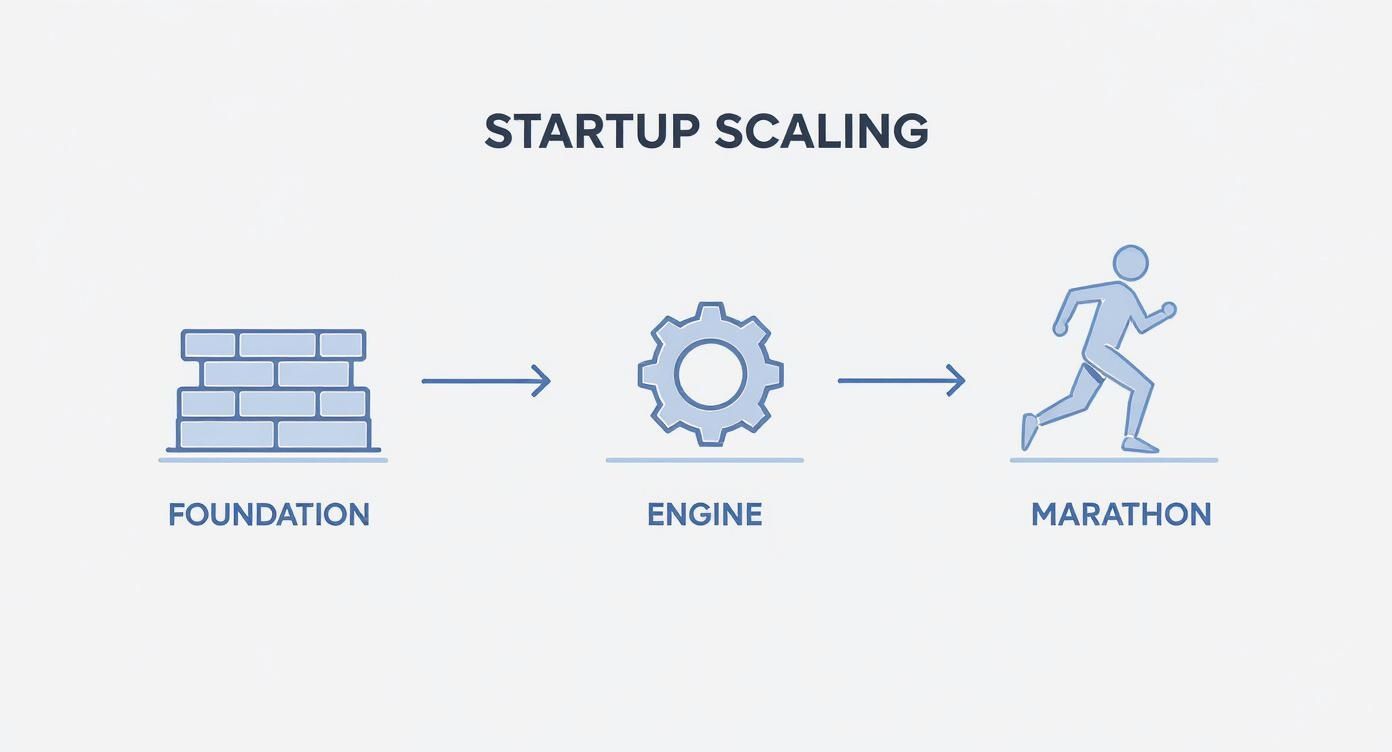
Think of these stages as sequential. Trying to build a growth engine without a solid foundation is like trying to build a skyscraper on sand—it’s guaranteed to fail.
Moving Beyond Vanity Metrics to True PMF
Product-market fit is the most overused and misunderstood term in the startup world. It’s not a feeling you get or a milestone you cross off a list. It's a state of being, proven by relentless customer retention and organic demand.
So, forget about total downloads or website traffic for a minute. Instead, get obsessive about these metrics:
- Cohort Retention: Are users who signed up three, six, or twelve months ago still actively using your product? If your retention curve flattens out instead of dropping to zero, you've built something sticky.
- Net Promoter Score (NPS) and Qualitative Feedback: Don't just glance at the score. Dig into why your promoters love you and what specific problems your detractors are facing. A high NPS is nice, but the real gold is in understanding the "why."
- The "How Would You Feel" Test: Ask your core users how they would feel if they could no longer use your product. If fewer than 40% say "very disappointed," you probably haven't reached PMF. You’re still a 'nice-to-have,' not a 'must-have.'
This intense focus on user behavior is how you confirm your product isn't just a novelty. It's how you prove it's a vital part of your customers' workflow or life. That's the difference between a leaky bucket and a strong foundation.
To help you get an honest look in the mirror, here’s a quick checklist to see if you’re actually ready.
Key Indicators of Product-Market Fit Readiness
| Metric/Area | Signal You Are NOT Ready | Signal You ARE Ready to Scale |
|---|---|---|
| Customer Retention | High churn; retention curve drops toward zero. Users leave after a month or two. | Low churn; retention curve flattens. Users stick around for 6+ months. |
| Customer Feedback | Mixed reviews, feature requests all over the map, low NPS (<20). | Strong positive feedback, clear value prop in testimonials, high NPS (>50). |
| Organic Growth | All new users come from paid ads. Word-of-mouth is non-existent. | You see strong organic growth and word-of-mouth referrals. Customers are advocates. |
| Sales Cycle | Long, unpredictable sales cycles. High effort to close even small deals. | Sales cycles are becoming predictable. You know the steps to close a deal. |
| Usage Metrics | Users log in infrequently and only use one or two features. | High engagement; users are adopting core features and exploring the product deeply. |
If you find yourself mostly on the left side of this table, hit the brakes. Your job isn't to scale—it's to get back to talking with customers and iterating on the product until the signals on the right start to appear.
Engineering a Predictable Go-to-Market Motion
Once you have clear signals of PMF, the next job is to build a machine that acquires customers profitably. A powerful go-to-market strategy isn't a 50-page document; it’s a clear, repeatable process that everyone on your team understands.
It all boils down to answering three critical questions with hard numbers.
1. Who Is Your Ideal Customer Profile (ICP)?
You need to move beyond broad personas. Your ICP should be so specific that your sales and marketing teams know exactly which companies to target and which to ignore. Define it by firmographics (industry, size, revenue) and, more importantly, by behavioral signals (the tech stack they use, recent hiring patterns, funding announcements).
2. What Is Your Customer Acquisition Cost (CAC)?
Calculate an honest, fully loaded CAC. This has to include everything: ad spend, salaries, software costs, commissions. If you can’t measure it, you can’t manage it. A vague CAC is a massive red flag that you don’t truly understand your own business model.
3. What Is Your Lifetime Value (LTV)?
For a healthy SaaS business, your LTV must be significantly higher than your CAC—the gold standard is a ratio of at least 3:1. This ratio proves your unit economics are sound and that every dollar you invest in acquisition will generate a profitable return over time.
A common failure point is conflating a GTM plan with a GTM engine. A plan is a document full of assumptions. An engine is a proven, data-backed system where a specific input predictably generates a desired output.
Building this engine requires breaking down silos. Marketing can’t just generate leads; they must generate leads that fit the ICP. Sales can’t just close deals; they must feed insights on lead quality back to marketing and on customer needs back to the product team. It’s a closed loop, constantly getting smarter with data.
For a deeper dive, you can explore our comprehensive go-to-market strategy framework to build out your own repeatable motion. This methodical approach is how you build a pipeline you can invest in with confidence, turning your startup into a true growth machine.
Secure Capital the Smart Money Way
Let's get one thing straight: capital is fuel, not the destination. I’ve seen countless founders celebrate a funding round as if they’ve won the championship, only to run their company into the ground six months later. Raising money isn't proof you have a viable business; it’s a strategic tool you use to accelerate a model you've already proven works.
From my seat on both sides of the table—as an operator scaling companies and as an advisor to investors—I can tell you the most irresistible pitch isn’t the one with the flashiest deck. It's the one that tells a powerful story backed by undeniable traction. It’s a compelling narrative built on a foundation of hard data, a massive market, and a leadership team that just radiates quiet, relentless execution. Anything less is just a gamble.
The fundraising landscape is littered with success stories that hide a darker truth. In 2025, there are roughly 1,245 'unicorn' startups valued at over $1 billion. Yet, despite those massive funding achievements, about one in five startups still fails within its first year, often because they simply run out of cash. This reality check is a crucial part of learning how to scale a startup—financial discipline is non-negotiable. You can discover more startup failure insights on Exploding Topics.
Understanding the Investor Mindset by Stage
Investors aren't just writing checks. They're buying into a specific chapter of your growth story, and their expectations change dramatically at each step. Misunderstanding this is a fatal error. You can't walk into a Series A meeting with a Seed-stage story.
-
Seed Stage: At this early point, the bet is almost entirely on you and your team. Investors are looking for a massive market opportunity and a founder who has a unique, almost obsessive, insight into a painful problem. Your job is to show the first glimmers of product-market fit, even if it's just with a small but passionate user base.
-
Series A: Now, the game changes completely. The conversation pivots from "vision" to "traction." Investors need to see a repeatable go-to-market engine. You have to have your unit economics—like Customer Acquisition Cost (CAC) and Lifetime Value (LTV)—nailed down. More importantly, you need to show a clear, data-backed plan for how their capital will pour gas on that proven fire.
The most common reason I see founders get a 'no' after a Series A pitch is that they are still selling the dream. By this stage, investors aren't buying dreams; they're buying evidence.
The Hidden Dangers of Too Much Capital
Raising more money than you need can be just as dangerous as raising too little. It creates a false sense of security and encourages sloppy, undisciplined spending. I call this the "growth at all costs" trap, and it’s a silent killer.
When you're flush with cash, you start throwing money at problems instead of solving them with ingenuity. You hire too quickly, bloating your payroll before your internal processes can handle the team. You burn cash on unproven marketing channels, chasing vanity metrics instead of profitable growth. This undisciplined approach erodes your culture and torches your runway with terrifying speed, often forcing you back to the fundraising table from a position of weakness.
The goal is not to raise the most money. It's to raise the right amount of money to hit your next set of key milestones, which will put you in a position of strength for future rounds.
Choosing Partners, Not Just Piggy Banks
Finally, remember that not all money is created equal. The right investor is a strategic partner who brings much more than a check to the table. They bring a network, deep industry expertise, and the operational scars to help you navigate the inevitable chaos of scaling.
When you're evaluating potential investors, ask yourself these questions:
- Do they actually understand my industry? An investor with deep domain expertise can make game-changing introductions and help you sidestep common pitfalls.
- What's their track record with companies at my stage? Look for partners who have a history of helping companies navigate the specific challenges you're about to face.
- How will they act when things get tough? Talk to other founders in their portfolio—the ones whose companies didn't become unicorns. You want a partner who will be a calm, supportive voice during the storms, not one who will panic at the first sign of trouble.
Securing capital is a critical step, but you have to approach it with discipline and strategic foresight. It’s about finding the right fuel, from the right partners, for what will be a very long journey.
Build a Machine of People, Process, and Technology
Rapid, explosive growth is a force of nature. I’ve seen it firsthand—it will find every single crack in your company’s foundation. Every manual workaround, every fuzzy role, every piece of outdated software… and it will shatter them. So many companies with a brilliant product and incredible market demand grind to a halt, not because of the market, but because their internal systems just can't keep up.
The chaos of scaling isn't an external problem; it's an internal operational failure.
To get through this phase and come out stronger, you have to deliberately build an operational machine. This machine is built on three core pillars: people, process, and technology. Get these right, and you create a stable platform for growth. Ignore them, and you're building on quicksand.

Hire for Where You’re Going
Here’s a hard truth many founders struggle with: the team that got you to your first million in revenue is rarely the team that will get you to ten million. It’s tough, because loyalty runs deep. But the skills needed for scrappy, early-stage hustling are worlds apart from what’s required to build and manage systems in a fifty-person organization.
Your hiring philosophy has to change. Start hiring for the roles you’ll need 12 to 18 months from now, not just the ones you need today. This means bringing in leaders who have already seen the next stage of growth. They can spot the challenges before they arrive because they’ve been there. They know how to build teams, implement processes, and—critically—delegate.
At the same time, your own role as a founder has to evolve. You can no longer be the best salesperson or the most creative marketer. Your new job is to be the chief architect of the machine. It means letting go of the day-to-day grind and trusting the experts you hired. It’s a huge transition, but absolutely essential for sustainable growth.
Implement Just Enough Process
The word "process" can make fast-moving teams cringe. They picture bureaucratic red tape and meetings that kill innovation. But the right kind of process doesn't restrict; it liberates. It creates clarity and removes friction so your team can focus on high-value work instead of constantly reinventing the wheel.
Start with the areas causing the most pain.
- Sales Playbooks: Don't let every sales rep figure things out on their own. Document what works—the key stages, qualification criteria, and core messaging. A simple, one-page playbook helps new reps ramp up faster and deliver a consistent experience.
- Communication Channels: As your team grows, Slack-only communication breaks. Define where conversations happen. Use a tool like Slack for quick updates, email for formal communication, and a project management tool for tasks. This simple step prevents information silos before they even form.
- Onboarding Checklists: A standardized onboarding process is a game-changer. A well-structured program can improve employee retention by 82%. It makes new hires feel supported and gets them productive, faster.
The art of process at a scaling startup is to introduce just enough structure to ensure quality and predictability, without suffocating the speed and agility that got you here in the first place.
Building a well-defined team structure is also crucial. Your marketing team, for example, will need to evolve from a few generalists into specialized roles. To see how to design a team for scale, check out our guide on the ideal organizational structure for a marketing department.
Build a Tech Stack That Enables Growth
Your technology stack is the central nervous system of your scaling machine. The wrong tools create data silos, frustrate your teams, and actively block growth. The right stack, however, acts as a force multiplier, automating grunt work and serving up the data you need to make smart decisions.
Don't chase shiny objects. Focus on a core set of tools that actually work together.
Your Foundational Tech Stack
- CRM (Customer Relationship Management): This is non-negotiable. It has to be your single source of truth for every customer interaction. Think Salesforce or HubSpot.
- Marketing Automation: Tools like Marketo or Pardot let you nurture leads at scale and hand over genuinely qualified opportunities to sales.
- Data Analytics Platform: You can't manage what you don't measure. A tool like Looker or Tableau is essential for pulling data from different systems and finding real, actionable insights.
I once worked with a B2B SaaS company that was buckling under a 10x surge in sign-ups. Their homegrown systems were on fire, support tickets were piling up, and the team was burning out. We paused everything, re-architected their internal stack around a scalable CRM, automated their customer onboarding, and plugged in a BI tool.
Within three months, they were handling the increased volume with ease, and customer satisfaction scores actually went up. That’s the power of a purpose-built tech stack. It turns chaos into controlled, predictable execution.
Think Bigger: Going Global and Building a Model That Endures
You've built a well-oiled machine in your home market. The engine is humming, and the temptation is to just keep your foot on the gas. But if you’re aiming for true, defensible scale, you have to start looking beyond your own borders.
Taking a startup global is one of the toughest challenges a founder can face, but it's where market leaders are truly made. This isn't about just translating your website into a few new languages. It’s a serious exercise in strategic planning, cultural empathy, and operational grit.
At the same time, you have to be brutally honest about your business model. Is it genuinely built for profitable, long-term growth? Or is it a leaky bucket that needs ever-increasing funding just to stay afloat? These two threads—global expansion and a resilient business model—are tied together. Get one wrong, and you'll either run out of room to grow or collapse under your own weight.

Taking the Gamble Out of International Expansion
Going global feels like a high-stakes bet because it often is. I’ve watched companies burn through millions on failed international launches simply because they assumed what worked in Silicon Valley would work in Singapore. That’s a catastrophic, and surprisingly common, mistake. A disciplined, data-first approach is the only way to de-risk this move.
Your first step isn’t booking flights or renting an office; it’s exhaustive research from your desk. You're looking for clear signals of product-market fit before you commit a single dollar.
- Look for Organic Pull: Are you already getting web traffic, sign-ups, or sales inquiries from a specific country without any marketing spend there? This is the strongest signal you can get. It means they're actively looking for you.
- Find the Competitive Void: Size up the local players. Is there a genuine gap in the market that your solution plugs better than anyone else? Don't just look at direct competitors; consider local workarounds and legacy systems.
- Do Your Regulatory Homework: Never, ever underestimate this. Get familiar with data privacy laws (like GDPR in Europe), local employment regulations, and tax structures. A single legal snag can kill an entire launch before it even starts.
Once you’ve pinpointed a promising market, the real work begins: localization. And this is so much more than translation. It's about adapting your pricing, your marketing messages, and maybe even core product features to fit what local customers expect and value.
The goal of localization isn't just for a customer in a new market to understand your product. It's for them to feel like your product was built for them.
Is Your Business Model Built to Last?
As you're planning to conquer the world, you also need to put your core business model under the microscope. Some models are just inherently more scalable and durable than others. For example, service-based startups are twice as likely to survive globally as product-based ones, which tells you something about the power of recurring revenue and high-touch relationships. And with up to 80% of entrepreneurs relying on digital tools, as detailed in this rundown of entrepreneurship statistics, your model has to be tech-forward.
The most bulletproof business models I’ve seen all share a few key characteristics.
- Fat Gross Margins: Models with low marginal costs for each new customer (think SaaS) can plow more cash back into growth instead of just servicing existing accounts.
- Recurring Revenue Streams: Predictable income from subscriptions or retainers gives you stability and makes forecasting infinitely more reliable. It smooths out the bumps.
- Strong Network Effects: Does your product get more valuable for everyone as more people join? That creates a powerful competitive moat that becomes incredibly difficult for a new player to cross.
- Low Customer Churn: At the end of the day, the best model is one that keeps the customers you worked so hard to win. High churn is a silent killer, putting you on a hamster wheel of acquisition just to stand still.
When you're thinking about how to scale a startup, you're not just building for the next quarter; you're building for the next decade. It demands a relentless focus on creating a company that is both durable and global—one that can ride out market shifts, fend off competitors, and create real, lasting value.
Common Questions on How to Scale a Startup
Over the years, I've had the same conversations with hundreds of founders. Once they get past the initial adrenaline rush of starting up, they hit the scaling stage and are faced with a set of brutally tough, practical questions. Here are the most common ones I hear, along with my straight-to-the-point answers based on what I’ve seen work—and fail—in the real world.
When Is the Right Time to Start Scaling a Startup?
This is the big one, and the answer has nothing to do with a magic revenue number or how long you’ve been in business. The only signal that matters is when you have achieved undeniable Product-Market Fit and engineered a repeatable, profitable customer acquisition model.
You’ll know you’re there when you see these signs:
- Low Churn: Your customers stick around because they can't imagine working without your product.
- High User Retention: Your cohort analysis shows a retention curve that flattens out over time, not one that dives to zero.
- Organic Referrals: Customers are actively telling their friends and colleagues about you, unprompted.
- Positive Unit Economics: Your Lifetime Value (LTV) is demonstrably higher than your Customer Acquisition Cost (CAC), ideally by at least a 3:1 ratio.
Trying to scale before locking these in is like pouring gasoline on damp wood. You'll burn through an incredible amount of resources—time, money, and morale—without ever generating real heat. Perfect the engine first, then hit the accelerator with confidence.
What Are the Biggest Mistakes Founders Make When Scaling?
By far, the single biggest and most destructive mistake is premature scaling. It’s an easy trap to fall into. You get a little traction, raise some capital, and immediately start hiring and spending aggressively before the core business model is truly proven. This almost always ends in a painful reset or outright failure.
Another common pitfall is neglecting culture. What works organically with a tight-knit team of ten will shatter when you hit fifty if you haven't been intentional about defining and reinforcing your values and communication norms. The chaos of rapid growth exposes every cultural weakness you have.
A final, and often personal, failure is the founder's inability to evolve. Your job has to shift from being the primary 'doer' of everything to being the leader who builds the systems and hires the team to do the work. You have to learn to work on the business, not just in it.
How Do You Maintain Company Culture During Rapid Growth?
Here’s the thing: you don't just "maintain" culture. It's not a static thing you can preserve in a jar. You have to actively and relentlessly cultivate it, especially when new faces are showing up every single week. This requires a deliberate, operational approach.
First, codify your core values into specific, observable behaviors. These can't be fluffy words on a poster. They have to be the clear criteria you use to hire, promote, and, when necessary, let people go.
Second, you have to over-communicate the vision and strategy. As the distance between you and every employee grows, clarity becomes your most important tool. Everyone needs to understand where the company is going and exactly how their specific role contributes to getting there.
And third, empower your mid-level leaders. They are your culture carriers on the front lines. Invest in their training, give them autonomy, and hold them accountable for championing the values you’ve established. Culture at scale doesn't happen by accident; it’s the result of constant, focused effort.
Should I Focus on Profitability or Growth When Scaling?
This isn't a simple either/or question; it’s a matter of strategic sequencing. In the early stages of scaling—especially if you've taken on venture capital—the primary focus is almost always on aggressive, thoughtful growth to capture market share and build a defensible position.
However, this pursuit of growth cannot be blind. It must be done with a clear and data-backed line of sight to eventual profitability. You must know your unit economics inside and out and have a realistic plan for when and how the business will flip from burning cash to generating it.
The ultimate goal is building a machine for sustainable growth, where every dollar invested in sales and marketing has a predictable and, ultimately, profitable return. It’s a balancing act: grow as fast as you can, but only as fast as your proven economics will allow.
Navigating the complexities of scaling requires more than just a playbook; it needs experienced guidance to align your strategy with execution. At MGXGrowth, we partner with leadership teams to build the data-driven systems and resilient culture necessary for sustainable, long-term success. Discover how we can help you architect your next stage of growth at https://www.mgxgrowth.com.
