


Increasing revenue isn't about chasing fleeting sales spikes with disjointed tactics. Over my career scaling companies across SaaS, real estate, and hospitality, I've seen that mistake cripple countless businesses. Sustainable growth comes from building a unified, data-driven system—a well-oiled machine that aligns your entire organization around a single mission: creating and capturing immense customer value.
My Blueprint for Sustainable Revenue Growth
Too many companies get trapped in a dangerous cycle. They scramble for temporary revenue bumps—a sudden price drop, a random marketing blitz—without a foundational strategy. This approach is a direct path to a growth plateau.
Lasting growth isn't about finding one silver bullet; it's about building an interconnected engine.
Real revenue acceleration begins the moment you tear down the walls between your product, marketing, sales, and customer success teams. When these groups operate in silos, they're chasing disparate KPIs, often at the expense of the customer journey and, ultimately, your EBITDA. An aligned organization, however, rallies around one powerful goal: delivering and capturing more value.
The Three Pillars of Revenue Generation
My growth framework is built on three core pillars. These are not independent strategies; they are a tightly integrated system. Neglecting any one of them means you're leaving significant capital on the table.
- Deepen Customer Value: This is far more than retention. It's about knowing your customers so intimately that you can anticipate their needs and solve their next problem before they even articulate it. This deep understanding is what justifies premium pricing and drives higher lifetime value.
- Expand Your Market Reach: Relying on a single acquisition channel is a critical vulnerability. You must systematically identify, test, and scale new channels and customer segments to ensure your growth is resilient and not subject to the whims of a single platform's algorithm.
- Optimize Your Operational Engine: Growth without profit is a vanity metric. This pillar is about leveraging technology, automation, and intelligent processes to ensure every dollar of new revenue directly enhances your margins and contributes to EBITDA.
This is how I visualize the priority of these efforts when diagnosing a business's growth potential.
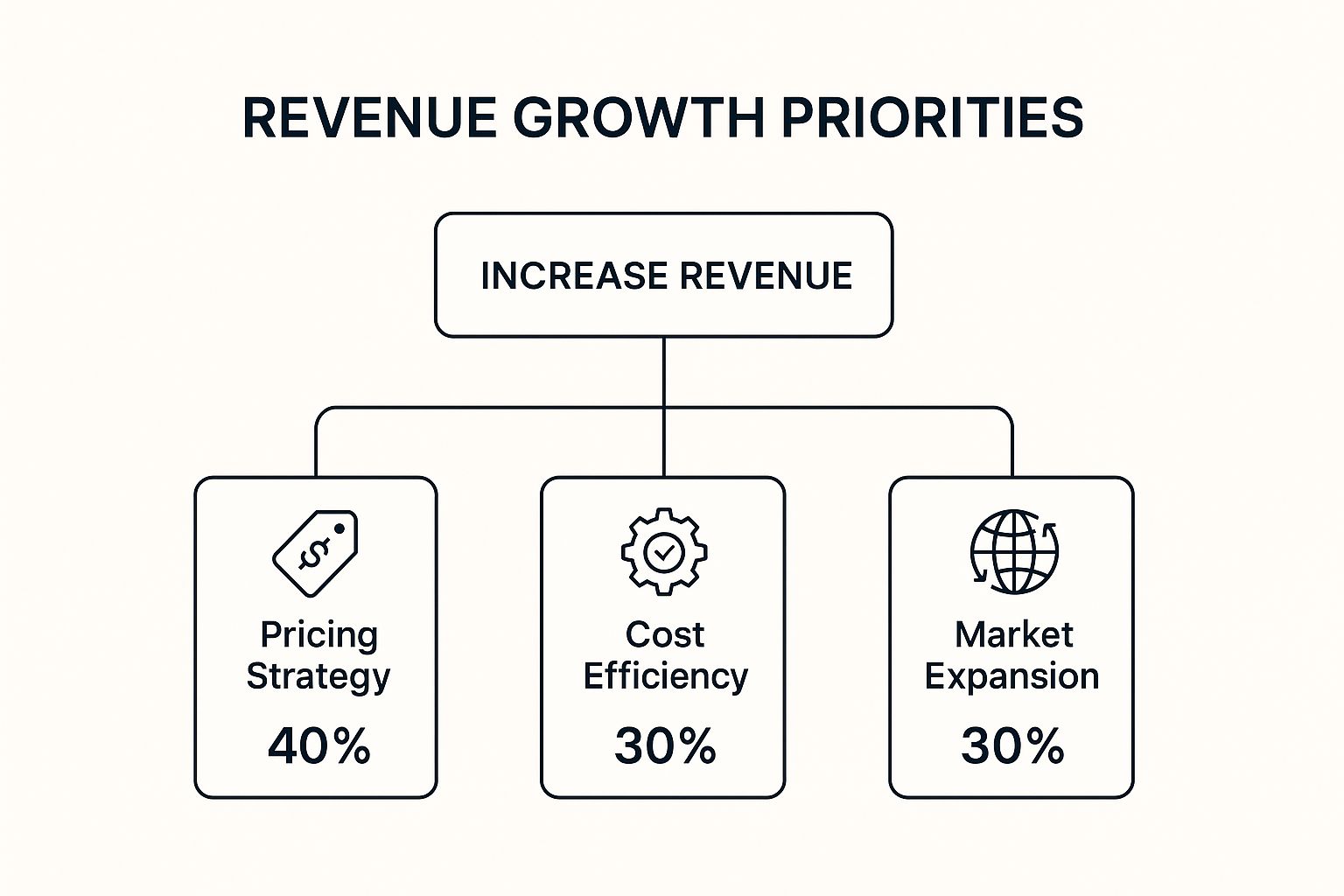
As you can see, optimizing your pricing strategy is often the fastest way to impact the top line, but it must be supported by operational efficiency and market expansion to create a durable, long-term growth model.
To put it all together, here’s a quick summary of how these foundational pillars function in concert.
Core Pillars of Revenue Growth
| Pillar | Core Focus | Key Activities |
|---|---|---|
| Deepen Customer Value | Increasing lifetime value (LTV) from existing customers. | Pricing optimization, upselling/cross-selling, improving retention. |
| Expand Market Reach | Acquiring new customers from untapped segments and channels. | Channel expansion, geographic diversification, new market entry. |
| Optimize Operations | Improving profitability and efficiency as you scale. | Automation, process improvement, reducing customer acquisition cost. |
This table highlights the interconnected nature of a robust revenue strategy. Each pillar reinforces the others, creating a powerful, compounding growth loop.
In my experience across SaaS, real estate, and hospitality, the companies that win are those that treat revenue growth as an integrated system. It's a cultural mindset, not just a series of campaigns.
This guide is your roadmap to integrating these pillars into your business. It’s the same data-driven, customer-centric approach I’ve used to scale companies and capture market share. We'll delve into why a customer-first perspective is non-negotiable and how it connects everything from pricing to technology. To explore foundational strategy further, see our guide to business model innovation.
Mastering Pricing and Product Monetization

Let's discuss the single most potent lever you have for increasing revenue: your pricing. It's astonishing how many companies treat it as an afterthought. They'll glance at a competitor, add a margin to their costs, and settle on a number that feels safe. This "cost-plus" or "competitor-based" thinking is a surefire way to leave a fortune on the table.
The only variable that truly matters in pricing is the one most often ignored: the value your product delivers. Your price is a direct signal of that value. When you get it right, you don't just see a healthier top line; you fortify your product's position in the market.
I witnessed this firsthand at a SaaS company. We had a strong hypothesis we were underpriced. Instead of a blind price hike, we spent a month conducting deep interviews with our best customers. We didn't ask, "What would you pay?" We asked, "What tangible, quantifiable results are you achieving with our software?" Armed with that data, we rebuilt our pricing model around the outcomes they valued most. The result? A 22% increase in average revenue per user (ARPU) in one quarter.
Shift to a Value-Based Pricing Model
To escape the pricing guessing game, you must get inside your customers' operations and quantify their willingness to pay. This isn't about a generic survey. It requires rigorous, qualitative research to draw a direct line from your product’s features to the cold, hard cash it saves or generates for your clients.
Start by zeroing in on your Ideal Customer Profile (ICP). Then, conduct structured interviews to understand precisely how they use your product and which operational headaches it eliminates.
You must get quantitative answers to these questions:
- What specific outcome does our product help you achieve? (Is it saving labor hours, reducing operational costs, or increasing lead conversion?)
- What is the measurable financial impact of that outcome? (You need answers like, "We save 10 hours of manual data entry per week, which is worth $X in loaded cost.")
- Which of our features are absolutely mission-critical to your daily workflow?
- And which ones are merely nice-to-have?
These answers are strategic gold. They provide the empirical data needed to construct pricing tiers that perfectly mirror customer value, making the decision to purchase a logical, ROI-driven conclusion for them.
Pricing is not just a math problem; it's a customer empathy problem. If you can’t articulate the value your customer receives in terms they understand and agree with, your pricing will always be a shot in the dark.
This research isn't an academic exercise. It provides the conviction to adjust prices because your decisions are backed by direct customer data, not internal guesswork.
Designing Tiers and Bundles That Drive Upsells
Once you've mapped the value drivers for different customer segments, you can architect strategic pricing tiers. The goal isn't just to create "cheap" and "expensive" options. You are building a clear, logical upgrade path that incentivizes customers to grow with you.
A classic and highly effective framework is the three-tiered model: Basic, Pro, and Enterprise.
| Tier Name | Target Audience | Core Strategy | Example Feature |
| :— | :— | :— |
| Basic | Startups or small teams | Solves the core problem and gets users hooked on the platform. | Limited core functionality for 1-3 users. |
| Pro | Growing businesses | Offers advanced features that drive efficiency and ROI. | Automation, integrations, advanced analytics. |
| Enterprise | Large organizations | Provides security, support, and customization for scale. | SSO, dedicated account manager, API access. |
The tiers are constructed around the customer's needs and maturity, not a random collection of features. The "Pro" tier is typically your profit engine, engineered for your ICP. The Basic tier serves as your on-ramp, and the Enterprise tier captures the high-value end of the market.
Don't underestimate the psychology of bundling. Grouping complementary features creates a package with a perceived value far greater than the sum of its parts. For instance, at a marketplace platform I helped scale, we bundled premium listing placement with a seller analytics dashboard. That simple move increased adoption of our premium seller package by over 35%, significantly lifting our average transaction fees.
Finally, particularly in SaaS, do not overlook usage-based models. Tying price to a key metric—like API calls, data storage, or active users—directly links the value a customer derives to what they pay. This model aligns your success with theirs, creating a powerful flywheel where your revenue grows as their business scales. It's one of the most effective ways to organically increase revenue from your existing customer base.
Expand Your Reach Through Strategic Channels
Relying on a single source for new customers is one of the most common—and dangerous—strategic errors a business can make. I’ve seen it repeatedly: a company masters paid search or social media, and revenue skyrockets. Then, an algorithm changes, ad costs spike, and growth evaporates overnight. That’s not a strategy; it’s a time bomb.
True, sustainable growth is built on a diversified portfolio of acquisition channels. You aren't just building one road to your business; you're constructing a multi-lane highway. This creates a strategic moat around your company, making your revenue streams far more predictable and resilient.
Move Beyond the Obvious Channels
When most leaders think about expansion, their minds jump to the usual suspects: Google Ads and Facebook. While these platforms can be effective, they are also saturated, expensive, and often a game of diminishing returns. A true competitive advantage is found in the channels your competitors are ignoring.
Focus on channels that align with your unique strengths.
- Strategic Partnerships: Who else serves your ideal customer? Identify non-competing businesses and build mutually beneficial partnerships. A well-structured partnership provides a direct line to a warm, relevant audience at a fraction of the cost of traditional advertising.
- Affiliate Programs: This is performance marketing in its purest form. You only pay for results, transforming your biggest advocates and industry influencers into a scalable, commission-based sales force.
- Content Ecosystems: Don't just write a blog. Build a true resource hub with podcasts, webinars, proprietary data reports, and deep-dive guides. This establishes you as an authority and creates a powerful organic customer-acquisition engine that compounds over time.
For example, when I was in the hospitality sector, the cost to acquire a single leisure traveler via online ads was prohibitively high. We pivoted to focus on B2B partnerships with local corporations, event planners, and universities. This created a scalable, high-volume stream of business with a customer acquisition cost (CAC) that was nearly 70% lower than our direct-to-consumer campaigns.
A Framework for Channel Evaluation
Not every channel is a fit. Chasing every new trend is an efficient way to incinerate your budget with zero return. You need a disciplined, data-driven framework to evaluate potential channels based on your specific unit economics and customer profile.
Before investing a single dollar, ask these three questions about any new channel:
- ICP Alignment: Is my ideal customer actively engaged here? Don't attempt to sell enterprise SaaS on TikTok unless you have hard data indicating your buyers are present and receptive.
- Scalability: Can this channel realistically grow to meet our revenue targets? A guest appearance on a niche podcast might yield a few high-quality leads, but it likely won't deliver the volume required for significant growth.
- Unit Economic Viability: Can we acquire customers here at a cost that is sustainable relative to their lifetime value (LTV)? A channel is only successful if it brings in profitable customers.
The goal isn't to be everywhere. It's to be everywhere your best customers are, and to do it profitably. Any channel that doesn't clear that bar is just a distraction.
Test and Scale with Discipline
Once you've identified a promising channel, the next step is to test it with a small, controlled budget. The goal of a test isn't an immediate massive return; it's to gather data to validate or invalidate your initial hypothesis.
First, define what success looks like. For a partnership, it might be the number of qualified leads generated. For a content strategy, it could be organic traffic and newsletter sign-ups. Set a clear timeline—perhaps 90 days—and a budget you are fully prepared to write off as a learning expense.
At the end of the test period, be ruthless in your analysis. If the channel is hitting your KPIs, it's time to double down and scale your investment. But if it's underperforming with no clear path to viability, you must have the discipline to cut your losses and reallocate those resources. This disciplined cycle of test, measure, and scale (or cut) is the true engine of sustainable growth.
Weaving Technology and AI Into Your Growth Strategy

It is time to stop viewing technology as an IT budget line item. Today, it is the core of your revenue engine. If you aren't actively integrating automation and artificial intelligence into your growth strategy, you are ceding market share to your competitors.
Too many leaders still see technology through a defensive lens—a tool for cost-cutting or incremental efficiency gains. This is a profound missed opportunity. The real strategic advantage comes from using these tools offensively to create superior customer experiences and unlock entirely new monetization models.
Use AI to Get Hyper-Personal
Generic, one-size-fits-all marketing is obsolete. Your customers expect you to understand them—their needs, their preferences, their history with your brand. AI makes it possible to deliver this level of relevance at scale, without a commensurate increase in headcount.
This goes far beyond inserting a first name into an email. I'm talking about AI-powered recommendation engines that analyze browsing history, past purchases, and in-app behavior to surface the perfect product or content at precisely the right moment. This doesn't just increase average order value; it makes customers feel understood, which is invaluable for building long-term loyalty.
Imagine a SaaS company using AI to identify users whose behavior indicates they're ready for an upgrade. Instead of a generic mass email, the system can trigger a personalized offer highlighting the specific premium features that user has shown interest in. That is how you convert an existing customer into a larger, more valuable one.
Technology should be a force multiplier for your team, not a replacement. The goal is to let the machines handle the repetitive, data-crunching tasks so your people can focus on what they do best: building relationships and thinking strategically.
Get Ahead of Churn with Predictive Analytics
We all know that acquiring a new customer is expensive, but losing an existing one is a direct hit to your bottom line. Predictive analytics allows you to shift from a reactive to a proactive stance on retention. You can identify the warning signs of churn long before a customer decides to cancel.
These AI models analyze a multitude of data points—login frequency, support ticket history, feature engagement—to generate a "health score" for each account. When that score drops below a certain threshold, it’s an immediate, actionable red flag.
This creates an incredibly powerful workflow for your customer success team:
- An Early Warning: The team receives an alert about an at-risk customer, along with the specific data points driving the low score.
- Proactive Help: They can intervene with targeted support or training to address the underlying issue before it escalates.
- Smarter Product Decisions: Over time, this data reveals the root causes of churn, providing invaluable, data-driven feedback for your product roadmap.
Put Your Sales and Marketing Funnel on Autopilot
Finally, automation is the key to building an efficient operation that can support your revenue goals. By automating routine tasks, you liberate your team to focus on high-value activities that directly drive growth.
The impact is not theoretical. Research indicates that 68% of companies increased revenue from existing streams after implementing digital tools and AI. You can explore more statistics like this over at Bizplanr.
Here are a few practical applications to implement immediately:
- Automated Lead Scoring: Stop guessing which leads are qualified. Implement a system that scores them based on their actions, ensuring your sales team always prioritizes the most promising opportunities.
- Email Nurture Sequences: Build automated workflows that guide prospects with valuable content, building trust and keeping your brand top-of-mind.
- Real-Time Reporting: Eliminate manual spreadsheets. Set up automated dashboards that provide a live, accurate view of your most important metrics.
When you implement these systems, the traditional wall between marketing and sales begins to dissolve. Both teams can work from a single source of truth, optimizing the entire customer journey from initial lead to loyal advocate. If you're looking for where to start, our guide on essential AI tools for business has several powerful recommendations.
Deepening Customer Relationships to Unlock LTV
Let's be direct: the most expensive dollar you will ever earn is from a new customer. The most profitable dollar comes from someone who already knows, trusts, and derives value from your business. It is astounding how many companies obsess over top-of-funnel acquisition while neglecting the gold mine of their existing customer base.
This is a massive, unforced error. If you are serious about predictable revenue growth, you must master the art of retaining and expanding customer relationships. This requires a fundamental mindset shift from transactional deal-closing to building genuine, long-term partnerships.
Build a Customer Success Program That Drives Outcomes
First, let's be clear: customer success is not customer support. Support is reactive; it fixes problems. Success is proactive; it ensures customers achieve their desired outcomes with your product.
A world-class customer success program is not measured by ticket resolution times. It is measured by its direct impact on net revenue retention, expansion revenue, and customer health scores.
- Nail the Onboarding: The first 90 days are critical. A confusing onboarding experience is a primary driver of churn. Your singular goal should be to guide new customers to their first "aha!" moment as rapidly as possible, demonstrating immediate value.
- Create Customer Health Scores: Use your data to build a simple, predictive health score. Track metrics like product usage, key feature adoption, and support history. This is not a vanity metric; it is an early warning system that allows your team to identify at-risk accounts before they disengage.
- Hold Regular Business Reviews: For your high-value accounts, institutionalize Quarterly Business Reviews (QBRs). This is not a sales pitch. The conversation must be focused entirely on the value they've realized to date and their strategic goals for the next quarter.
This proactive approach fundamentally changes the relationship dynamic. You cease being just another vendor and become an indispensable partner in their growth.
Use Feedback to Create a Loyalty Loop
Your most loyal customers are those who feel heard. Too often, product roadmaps are built in an internal vacuum, based on what executives or engineers think customers want. You need a systematic process for gathering, analyzing, and—most importantly—acting on customer feedback.
When executed correctly, this creates a powerful loyalty loop. Customers provide feedback, they see their suggestions implemented, and their loyalty deepens because they feel a sense of co-ownership in your product's evolution. This is how you build a base of advocates who will defend your brand and remain with you for years.
A customer's voice is the most valuable, unfiltered data you have. Ignoring it isn't just bad service; it's a catastrophic business intelligence failure.
The secret is to "close the loop." It is not enough to collect suggestions. When you release a feature a specific customer requested, their account manager must personally reach out to inform them. That small gesture has a massive impact on loyalty.
Identify the Right Moments for Upselling and Cross-Selling
Once you have built a foundation of trust and are consistently delivering value, you have earned the right to sell more. Upselling and cross-selling are not about extracting more money; they are about solving the customer's next problem.
Timing and context are everything. Pushing an upgrade at the wrong moment feels aggressive. Presenting it as the perfect solution at the right moment feels like a valuable consultation. For a deeper dive into the metrics behind this, our guide offers more on how to increase customer lifetime value.
Look for trigger events in the customer journey that signal a readiness for expansion.
| Trigger Event | Opportunity | The Pitch |
|---|---|---|
| Hitting a Usage Limit | Upsell to a higher tier | "We noticed your team is nearing its user limit. Let's get you on a plan that can support your growth." |
| Frequent Support Queries | Cross-sell a premium support or services package | "I see you're asking about advanced integrations. Our premium support package includes a dedicated expert to help with that." |
| New Feature Release | Upsell to a plan that includes the new functionality | "Remember when you asked for better reporting? We just launched our advanced analytics dashboard, and it's included in our Pro tier." |
When you tie expansion efforts directly to the customer's stated needs and goals, the conversation shifts from negotiation to strategic partnership. This loyalty loop—deliver value, listen, improve, and solve the next problem—is the key to building a predictable, scalable, and highly profitable recurring revenue stream.
Foster a Culture of Continuous Growth

The strategies we've covered—pricing, channel expansion, technology integration—are powerful tools. But they are merely components. True, enduring revenue growth is not the result of a one-off project or a silver-bullet tactic. It is the natural outcome of an entire organization obsessed with creating value for the customer.
This means demolishing the silos between departments. Revenue is a direct reflection of the value customers perceive. When every individual in your company, from backend engineers to customer support specialists, internalizes this principle, growth ceases to be something you chase and becomes an inevitable consequence of your daily operations.
Give Your Teams Permission to Experiment
A true growth culture is fueled by disciplined curiosity. It requires creating an environment where teams feel psychologically safe to test new ideas, even if those ideas fail. You must build a system where a failed experiment is not a career liability but a valuable data point.
In practice, this means empowering small, cross-functional teams with ownership over specific metrics. Imagine a "pod" comprising a product manager, a marketer, and an engineer, tasked with improving new user activation. They must have the autonomy to run A/B tests on the onboarding flow without navigating a bureaucratic approval process.
In every company I’ve scaled, the biggest breakthroughs came from the teams closest to the customer, not from the boardroom. Your job as a leader is to give them the data, the tools, and the permission to act on their insights.
Make Data Everyone's Language
For any of this to be effective, data cannot be a secret language spoken only by analysts. Your key performance indicators must be transparent and accessible to everyone. This is how you align the entire company toward a common objective.
A few ways to operationalize this:
- Broadcast Your Dashboards: Display real-time dashboards on screens throughout the office (or on a shared virtual hub) showing metrics like Monthly Recurring Revenue (MRR), churn rate, and Customer Lifetime Value (LTV).
- Shout-Out the Wins: When a team's experiment moves a key metric, celebrate it publicly. This reinforces that data-driven decisions are valued and builds organizational momentum.
Ultimately, investing in robust analytics tools and training your people to use them is non-negotiable. It is the foundation upon which a company that is constantly learning and growing is built.
Frequently Asked Questions
After years in boardrooms and strategy sessions, I've found the same questions about revenue growth arise repeatedly. Here are the direct, no-nonsense answers I provide to the leaders I advise.
What Is the Fastest Way to Increase Revenue for a Small Business?
For most small businesses, the most immediate path to increased revenue is pricing optimization. It is the most frequently overlooked lever. You don't need a massive overhaul; a modest 5-10% price increase for new customers can immediately lift your top line with virtually zero added cost, provided your value proposition supports it.
Another fast-acting strategy is to present a targeted offer to your existing customer base. It is always easier and more cost-effective to sell to those who already know and trust your brand. Consider a loyalty discount or a bundled package that provides clear, incremental value.
How Can I Increase Revenue Without Spending More on Marketing?
You must shift your focus from pure acquisition to expansion. Concentrate on increasing your Average Order Value (AOV) and Customer Lifetime Value (LTV). The most effective tactics are often the simplest.
- Upselling: At the point of purchase, offer a more premium version of the product that solves the customer's problem more completely.
- Cross-selling: Suggest a complementary product or service that addresses a related need. "Customers who bought X also benefited from Y" is a classic for a reason.
- Referral Program: Systematize word-of-mouth by turning your best customers into your most effective marketing channel. Reward them for bringing you new, qualified business.
These strategies generate growth from your most valuable asset—your existing customers.
It's easy to get fixated on pouring money into the top of the funnel. But the most profitable growth often comes from nurturing the customers you've already earned. Don't neglect your existing base.
Which Metrics Are Most Important for Tracking Revenue Growth?
Monitoring only top-line revenue is a critical error. That number provides no insight into the health or sustainability of your business. You must look deeper.
Beyond the basics, you should be obsessively tracking Monthly Recurring Revenue (MRR), Customer Lifetime Value (LTV), and Customer Acquisition Cost (CAC). The relationship between these metrics tells the true story of your business's viability.
Your LTV to CAC ratio is your true North Star. A healthy, scalable business typically maintains a ratio of 3:1 or higher, meaning for every dollar spent to acquire a customer, you generate at least three dollars in lifetime value. You must also track revenue by channel to understand where your most profitable customers originate.
At MGXGrowth, we don't just provide advice. We partner with you to implement the systems that create measurable, sustainable growth. If you’re ready to move beyond theory and build a data-driven revenue roadmap, let's connect and learn more about our approach.
