


In my decades of driving growth across SaaS, gaming, and hospitality, I’ve seen countless beautiful customer journey maps. They’re usually the product of intense workshops, plastered with sticky notes, and celebrated as a major win. Then, they’re laminated, hung on a wall, and promptly ignored. These static artifacts are snapshots in time, relics of a customer who no longer exists. The real engine for growth isn’t a map; it’s a living, breathing intelligence system. This is where modern customer journey mapping software becomes non-negotiable for any serious executive.
Why Static Journey Maps Are a Dead End for Growth
Let's be direct—a journey map saved as a PDF is a history report, not a strategic asset. It’s built on outdated data and assumptions, showing you where your customers were, not where they are now or where they’re going. Today's customer path is a chaotic, multi-channel whirlwind that changes by the minute.
Relying on a static map is like navigating a hostile market with last quarter’s financial reports. You’re blind to the real-time threats and opportunities directly in front of you.

This antiquated approach is a massive drain on resources. Teams burn weeks in workshops to produce a visual that loses its value almost instantly. The real cost isn’t the man-hours; it’s the lost revenue from invisible friction points and the missed conversion opportunities you can't seize fast enough.
From a Static Picture to a Live Intelligence System
The sole purpose of mapping the journey is to identify opportunities to improve business outcomes—to increase retention, drive down customer acquisition costs, and maximize lifetime value. This is where dedicated customer journey mapping software fundamentally changes the game. It transforms your map from a passive diagram into an active, intelligent system that ingests real-time data from every single customer touchpoint.
With a dynamic, data-driven approach, you can finally:
- Isolate friction as it happens: Pinpoint exactly where users are abandoning carts or getting stuck now, not in a report you review next quarter.
- Uncover predictive behavioral trends: Identify patterns that signal churn risk or an upsell opportunity long before the customer acts.
- Synthesize disparate data: Integrate intelligence from your CRM, analytics platform, and help desk to forge a single, coherent view of the customer experience.
This strategic shift is precisely why the global customer journey mapping software market is projected to explode from USD 16.8 billion in 2025 to USD 76.2 billion by 2035. Leaders are recognizing that this technology is essential for true customer-centricity. You can explore the data behind this market growth from Future Market Insights.
A dynamic journey map isn't a marketing deliverable; it’s the central nervous system for your entire go-to-market organization. It provides the shared intelligence required to align product, marketing, sales, and success around a singular objective: delivering quantifiable customer value.
To truly grasp the strategic delta, it helps to see the two approaches side-by-side.
Static vs Dynamic Journey Mapping: A C-Suite Comparison
| Attribute | Traditional Static Mapping (Cost Center) | Software-Driven Dynamic Mapping (Growth Engine) |
|---|---|---|
| Data Source | Manual interviews, surveys, lagging analytics | Live data feeds from CRM, analytics, support, etc. |
| Timeliness | Historical snapshot; immediately outdated | Real-time, continuous, and predictive |
| Perspective | Historical; based on past behavior and assumptions | Predictive; identifies current friction and future trends |
| Actionability | Requires manual analysis; insights are subjective | Automatically surfaces opportunities and triggers alerts |
| Collaboration | Often owned by a single department (e.g., Marketing) | Provides a shared, cross-functional source of truth |
| ROI | Difficult to measure direct impact on P&L | Directly links experience improvements to revenue and retention |
This comparison exposes the core flaw: static maps are passive observations, while dynamic maps are active, data-driven systems architected for decisive action.
Breaking Down Silos for Measurable ROI
In my experience, the single most destructive force preventing sustainable growth is internal silos. When marketing, sales, and product operate from different data sets and chase conflicting KPIs, the customer suffers a disjointed, frustrating experience that directly impacts the bottom line. Static maps often exacerbate this by being created and "owned" by a single team.
A software platform, by contrast, becomes the common operational picture. Suddenly, the product team sees how a marketing campaign impacts feature adoption. The sales team understands the pre-purchase journey of its highest-value leads. This is how you shift the conversation from departmental outputs to shared business outcomes. It is the first, essential step toward building a truly customer-centric organization where every decision is backed by data, not institutional habit.
A Framework for Selecting the Right Platform
Committing to new enterprise software is a significant investment of capital and focus. With customer journey mapping software, the stakes are even higher. I’ve seen it too many times: a company is seduced by a flashy demo, signs the contract, and ends up with expensive shelf-ware. The tool fails its first real-world test, becoming a source of frustration, not a solution.
To avoid this common pitfall, I use a four-pillar framework I’ve refined over years of P&L responsibility. This isn't a feature checklist. It's about a rigorous evaluation of the core capabilities that determine whether a tool will be a growth engine or another data silo. These pillars are Data Integration, Actionability, Collaboration, and Scalability. Get these four right, and you aren't just buying software; you're making a strategic investment in your company's growth trajectory.
This visual captures how a robust platform transforms a static diagram into a dynamic engine for both customer success and business growth.
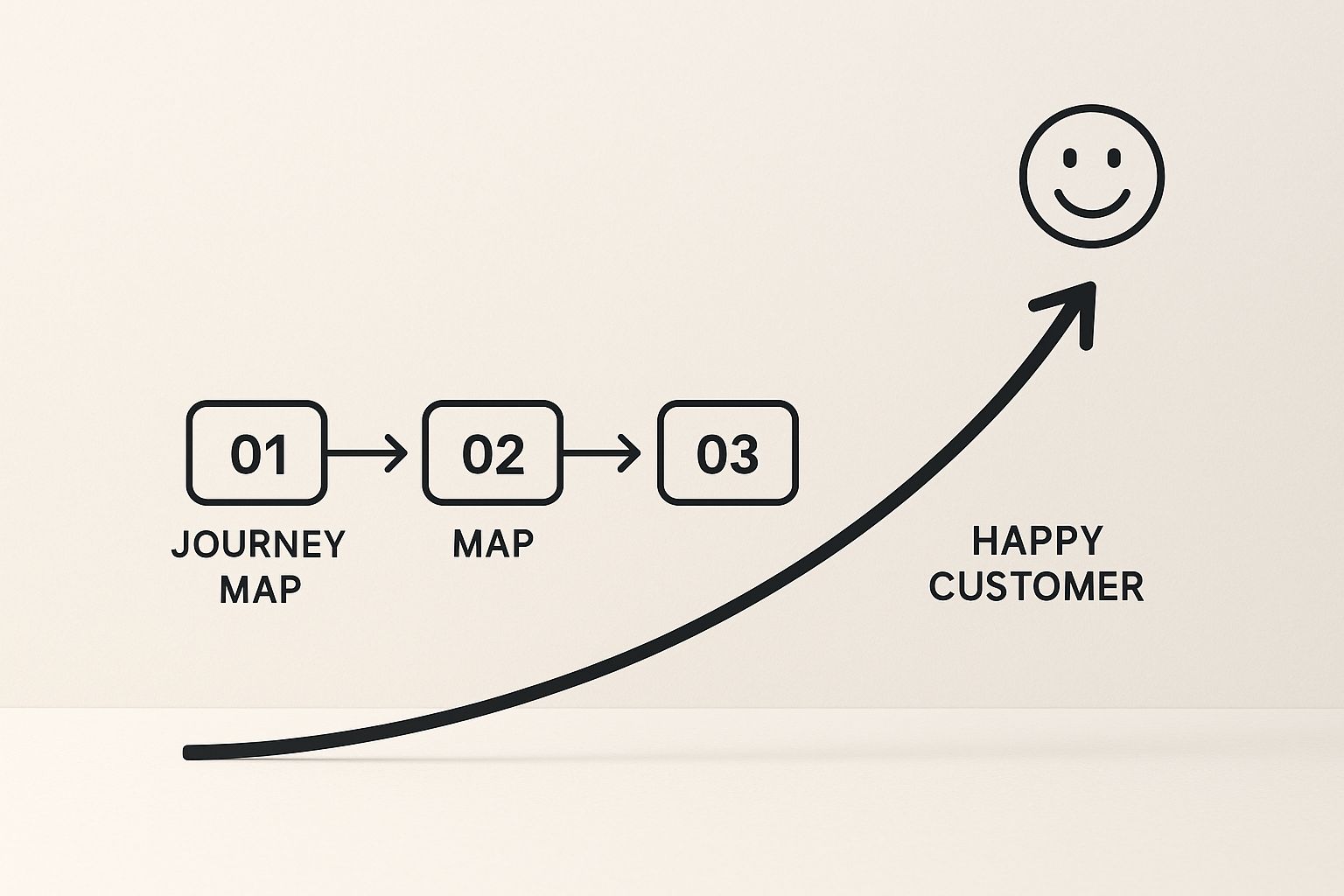
The real power here is seeing the journey map evolve from a simple flowchart into a clear, upward trend that links customer experience improvements directly to tangible business results.
Pillar 1: Data Integration
Let me be blunt: your journey mapping tool is useless if it’s an island. Its entire strategic value rests on its ability to aggregate scattered customer signals into a single, coherent narrative. Without deep, reliable integrations, you’re back to manual data dumps, which completely negates the purpose of the platform. A tool's capacity to seamlessly connect to your existing tech stack is absolutely non-negotiable.
Before you even agree to a demo, demand clear answers to these questions:
- Does it have native, bidirectional integrations with our mission-critical systems like Salesforce (CRM), Google Analytics (web data), and Zendesk (support)?
- Can it ingest real-time behavioral data from product analytics tools like Mixpanel or Amplitude to show us what users are actually doing?
- Is there a robust, flexible API that allows our engineers to connect proprietary data sources unique to our business model?
Do not accept a simple "yes." You need to understand the depth and reliability of these connections. True integration means automated data flow, creating a single source of truth for the entire customer lifecycle.
Pillar 2: Actionability
Visualizing the journey is table stakes. The real value is realized when you can convert those insights into concrete actions that improve the customer experience and drive your metrics. An actionable platform is the critical bridge between identifying a problem and deploying a solution.
An insight that doesn't lead to an action is just expensive trivia. Your software must be a catalyst for change, not a passive reporting dashboard.
To determine if a tool is truly actionable, assess if it enables you to:
- Assign Ownership: When a friction point is identified—such as a high drop-off rate on a checkout page—can you assign that issue directly to a product manager or UX lead within the platform itself?
- Create and Track Initiatives: Does the tool integrate with your project management systems, like Jira or Asana, to generate tickets linked to specific journey stages and business outcomes?
- Measure Impact: Can you establish goals to track the performance of your interventions? For instance, after redesigning a confusing onboarding step, can you measure the direct impact on user activation rates and, ultimately, retention?
If a tool only highlights problems without facilitating the operational response, it will quickly become more of a liability than an asset.
Pillar 3: Collaboration
Frankly, one of the most powerful functions of journey mapping software is its ability to dismantle organizational silos. It must serve as the common ground where marketing, product, sales, and customer success can align around a single version of the truth. The right platform builds a shared understanding of the customer's reality, forcing everyone to align on the same strategic objectives.
This is less about a specific feature and more about the tool's core design. Does it foster cross-functional teamwork through shared dashboards, role-based access, and collaborative workflows? A tool that remains confined to the marketing department is a failed investment. It must be accessible and deliver value to every function that impacts the customer lifecycle.
Pillar 4: Scalability
Finally, you must select for the future. The platform you choose today must be able to support your growth tomorrow. This extends beyond technical performance to strategic scope. A tool that works for a single product line might collapse when you expand into new markets or launch new services.
Scalability means the software can handle exponential increases in data volume, users, and journey complexity without degradation. It also means the platform itself is evolving. Scrutinize the vendor's product roadmap. Are they investing in AI-powered predictive analytics? Are they planning integrations with emerging channels? Partnering with a forward-thinking vendor ensures your investment continues to deliver returns for years to come.
From Data Visualization to Actionable Insights
Let’s be clear: the power of modern customer journey mapping software is not in creating aesthetically pleasing charts. Any competent tool can visualize data. The true value—the kind that moves the needle on revenue and EBITDA—comes from its ability to reveal critical blind spots in your operation. It’s about shifting from passive observation to active, decisive intervention.
Too many teams fall into the trap of treating journey data as just another report. They see a high cart abandonment rate and conclude, "We need to fix the checkout page." That’s treating a symptom without diagnosing the disease. A sophisticated platform allows you to trace that cart abandonment back to interactions that occurred days, or even weeks, prior.

Visualizations like this one from a tool like UXPressia are the starting point. They provide a comprehensive landscape of customer interactions, emotions, and pain points in a single view. This is how you begin to weave disparate data points into a coherent narrative that dictates exactly where to allocate resources for maximum impact.
Pinpointing Your Moments of Truth
Every customer journey contains a few critical "moments of truth"—touchpoints that either secure a customer's loyalty or lose them forever. These are rarely the obvious milestones like the final purchase. More often, they are subtle interactions that quietly shape a customer’s perception of your brand.
A premier journey analytics platform helps you identify these moments by linking behavior to business outcomes. For example, you might discover that customers who engage with live chat support exhibit a 30% higher conversion rate. Or you might find that users who skip a key setup step during onboarding are 50% more likely to churn within 30 days.
These aren't just interesting statistics; they are strategic directives. They tell you precisely where a small investment can deliver an outsized return. This is how you stop guessing what customers want and start knowing what they need to drive growth.
This focus on actionable data is fueling massive market expansion. The customer journey mapping software sector, valued at around USD 10.8 billion in 2024, is projected to reach USD 53.6 billion by 2032. This isn’t speculative hype; it reflects a fundamental shift in how businesses approach customer experience as a primary growth lever. You can find more analysis on these market dynamics to understand the underlying trends.
A Real-World Example From My Playbook
Here's a concrete example from a SaaS portfolio company. We were battling significant first-year customer churn. The executive team’s hypothesis was that our pricing was too high or the product lacked key features. We were chasing symptoms, debating roadmaps and pricing models without any hard evidence.
Instead of guessing, we leveraged our journey analytics software to correlate pre-churn behaviors with onboarding actions. The platform surfaced a startling insight: customers who watched a specific series of advanced "how-to" videos within their first week had a 40% higher retention rate after 12 months. This wasn't a minor correlation; it was a powerful signal we had been completely missing.
That single data point changed everything. The problem wasn't the product or the price—it was our failure to guide new users to that "aha!" moment quickly enough. Armed with this data, we completely re-architected our onboarding process to drive every new user toward that critical video content. The results were immediate and material, delivering a direct boost to both annual recurring revenue and EBITDA.
This is what it means to translate data into action. It's about connecting disparate dots to uncover the narrative that points directly to growth, a cornerstone of any effective business intelligence implementation strategy.
Key Takeaways for Finding Your Own Insights
To achieve these kinds of results requires a shift in mindset. Stop viewing journey maps as static artifacts. Start treating them as living, dynamic databases of customer behavior that you can constantly interrogate. Here’s where to begin:
- Connect Behavior to Outcomes: Don't just track clicks and page views. Correlate user actions (e.g., watching a video, using a feature) to business goals (e.g., conversion, retention, expansion).
- Segment Your Journeys: Your power users behave differently from new trial users. Dissect your analysis by persona, pricing tier, or acquisition channel to extract more specific, actionable insights.
- Identify Leading Indicators: What are the early behaviors that predict long-term success or failure? These are your early-warning systems, giving you the opportunity to intervene before a customer has already decided to leave.
Ultimately, your customer journey mapping software should function as the source of truth for your entire organization, providing the clarity needed to make smarter, faster decisions that directly drive profitable growth.
Weaving Journey Insights into Your Company's DNA
A powerful customer journey mapping platform is a wasted investment if its insights are confined to the marketing department. I’ve seen this scenario play out more than once. The transformative value is only unlocked when its intelligence becomes the connective tissue that binds your entire organization together. It ceases to be a marketing tool and becomes the operational blueprint for growth.
This isn't a theoretical exercise. It's about fundamentally re-engineering how your teams operate. You're shifting them away from siloed KPIs and toward a shared accountability for the customer's end-to-end experience. The objective is simple: create a unified front focused on identifying and eliminating every obstacle to customer value delivery.
Creating a Common Language
When departments operate in isolation, they speak different languages. Marketing talks MQLs and CAC, Product obsesses over feature velocity, and Sales lives by quota. A living, data-driven customer journey map acts as the Rosetta Stone, translating these disparate priorities into a single, shared language: the customer's reality.
To operationalize this, a lightweight governance model is essential. This isn't about bureaucracy; it's about intentional collaboration.
I’ve achieved outstanding results by establishing a cross-functional 'Journey Council.' This is not another passive, hour-long meeting. It's a focused, bi-weekly working session where leaders from Product, Marketing, Sales, and Customer Success analyze the same dashboards and assume ownership of their respective stages of the customer experience.
The council’s mandate is clear: identify the single greatest point of friction in the journey that week and assign a clear owner with a deadline to resolve it. This approach embeds accountability directly into the process and ensures insights translate into action, not just more reports.
Putting Insights to Work, Team by Team
Once everyone is aligned on the same data, the real work begins. Each department can leverage journey insights to optimize its daily operations and, more importantly, contribute directly to the company's bottom line.
Here’s what this looks like in practice:
-
For Product Teams: Journey analytics become a direct feed into the development backlog. When the software reveals a 25% drop-off at a specific onboarding step, that’s not a data point—it's an urgent user story with a quantifiable business case. It empowers product managers to shift from building features based on opinion to solving problems based on measurable customer pain.
-
For Sales Teams: Imagine a salesperson knowing that a lead has watched three specific product webinars and engaged with an ROI case study before making the initial call. This context, sourced directly from the journey platform, transforms a generic cold call into a highly relevant, strategic conversation about the prospect’s demonstrated priorities.
-
For Customer Success Teams: The software functions as a proactive early-warning system. By identifying behavioral patterns that are leading indicators of churn—such as a decline in feature usage—the platform can automatically trigger an alert for a customer success manager. This enables them to intervene before the account is at risk.
From Siloed KPIs to Shared Journey Metrics
The final, critical step is to align incentives. Your Journey Council must own a central dashboard tracking journey-wide metrics, not just departmental KPIs. Instead of only looking at conversion rates, you start tracking metrics like "time to first value" for new customers or the "customer effort score" for support resolution.
These shared metrics are paramount. They rally the entire organization around the end-to-end customer experience. If you're exploring how to connect the underlying systems, our guide on marketing automation implementation details how to bring these data points together. This is how you get every team rowing in the same direction, with the customer journey as their North Star.
The Future of Journey Mapping with AI
For years, our focus has been on using data to understand what happened on a customer journey. It’s been a necessary, reactive process. But the next frontier, where market leaders will be forged, lies in predictive intelligence—using AI to determine what is about to happen and intervening proactively.
This is not a distant, theoretical concept. The most advanced customer journey mapping software platforms are already making this leap, evolving from historical record-keepers into predictive growth engines. They are designed to analyze vast datasets of customer behavior, identifying the subtle, almost invisible signals that precede major customer decisions.
From Reactive Analysis to Predictive Intelligence
Consider customer churn. The traditional approach? You discover a customer has left when you receive the cancellation notice—far too late to do anything about it. An AI-driven system completely inverts this model.
It can identify the subtle behavioral tells that historically precede churn. For example, it might flag an account where a feature once used daily is now accessed only weekly. That’s not just a data point; it’s a critical warning flare.
From there, the software can trigger a proactive response—such as automatically creating a high-priority task for a customer success manager to investigate. Suddenly, customer experience management shifts from reactive damage control to a data-driven strategy for revenue protection.
We are moving from analyzing the past to architecting the future. The goal is no longer just to map the journey but to actively shape it in real-time to drive superior business outcomes.
Uncovering Hidden Revenue Opportunities
This predictive capability is not just a defensive tool. It is incredibly powerful for pinpointing revenue expansion opportunities. AI algorithms excel at identifying patterns of feature usage that signal a customer is outgrowing their current plan and is ready for an upgrade.
Imagine your software alerts you that an account has increased its use of advanced reporting features by 300% in the last 30 days and is nearing its API call limits. That is a clear, data-backed upgrade signal. Instead of waiting for the customer to experience friction, your sales team receives a proactive notification to initiate a conversation about a higher-tier plan that better suits their needs.
This is a world apart from generic, mass-market upsell campaigns. It’s targeted, timely, and rooted in the customer’s actual behavior, which makes the conversation feel helpful rather than opportunistic. To explore this further, our guide on AI tools for business examines how this technology is fundamentally reshaping go-to-market strategies.
The Economic Impact of Predictive Journey Analytics
The market is voting with its wallet. The customer journey analytics market, a close sibling of mapping software, was valued at USD 20.87 billion in 2025. It is projected to surge to USD 48.40 billion by 2030. What’s driving this growth? An overwhelming demand for cloud platforms with the computational power required for real-time AI. You can discover more about the trends in this market growth to understand the forces at play.
This massive capital allocation underscores a simple truth: the companies that can anticipate their customers' needs will win. AI-powered journey mapping enables you to deploy resources with surgical precision. You can solve problems before they occur, capture revenue opportunities you would otherwise miss, and build a customer experience so responsive it feels predictive. That is the future we are building today.
Frequently Asked Questions
Over my career, I've guided countless executives through the transition from static journey mapping to a dynamic, software-driven model. It’s a significant strategic shift, and the same questions invariably arise. Leaders want to understand the real-world business impact, not just the technical features. Here are my direct answers to the most common questions I hear from the C-suite.
How Do You Actually Measure ROI on This Software?
This is always the first, and most critical, question. The ROI isn't measured by the number of maps created; it’s measured by the tangible business outcomes those maps enable. We don't track vanity metrics. We tie the software investment directly to core P&L results.
Here’s my practical framework for it:
- Reduced Churn: The software flags behavioral leading indicators, like a decline in feature adoption, that predict churn. By intervening to save these at-risk accounts, even a 5% reduction in churn delivers a direct, measurable impact on annual recurring revenue and EBITDA.
- Increased Conversion Rates: When you identify a friction point in your sales funnel that's causing a 15% drop-off, fixing that issue based on platform insights allows you to directly attribute the recaptured revenue back to the investment.
- Higher Customer Lifetime Value (LTV): This is about executing intelligent expansion plays. When the software identifies a user segment that is heavily utilizing a specific feature set, it signals a prime opportunity for a targeted upgrade offer. The resulting expansion revenue is directly attributable to the tool's intelligence.
It’s about connecting specific customer experience improvements to hard dollars. The software provides the empirical "why" behind your financial performance, making the business case irrefutable.
What Is the Biggest Challenge in Implementation?
The technology is the straightforward part. The most significant obstacle, almost invariably, is organizational inertia. It's a leadership and culture challenge, not a software one. Getting siloed departments—each with its own budget, KPIs, and turf—to align around a single, shared view of the customer is a formidable change management exercise.
Consider the reality: Sales is focused on quota attainment, Product is driven by its roadmap, and Marketing is measured on lead generation. This software often surfaces uncomfortable truths about how these disconnected efforts create a fragmented and frustrating customer experience.
The platform itself won’t break down your silos. What it will do is provide the objective, undeniable data that forces the tough, necessary conversations to happen. The real work is in creating the cross-functional governance—like the 'Journey Council' I mentioned—to act decisively on that shared intelligence.
How Long Until We See Tangible Results?
You can, and should, secure quick wins within the first 90 days. These typically come from identifying "low-hanging fruit"—obvious, high-friction points in your digital experience that are simple to remedy. This could be a broken link in a critical onboarding email or a confusing step in your mobile signup flow. These are immediate fixes that yield immediate results.
However, the deeper, strategic value—such as fundamentally improving customer retention or building predictive upsell models—is a longer-term initiative. You're looking at a 6-12 month timeline for that level of impact, as you accumulate data, refine your journey models, and embed these new data-driven workflows into your teams' daily operations. The key is to balance these immediate tactical wins with the long-term strategic vision.
At MGXGrowth, we don't just advise on strategy; we architect and implement the systems and processes required to execute it. If you're ready to move beyond static maps and build a true engine for growth, let's have a conversation. Learn how we can architect your growth roadmap.
