


Launching a new restaurant is more than a grand opening party. It's the strategic execution of a pre-launch buzz campaign, the establishment of a robust digital footprint, and an unwavering focus on the guest experience from day one. True growth isn't a singular event; it's the output of a system designed to convert first-time visitors into high-LTV regulars who become your most effective marketing channel.
Laying the Foundation for a Profitable Launch
I'm Mikhail Gaushkin. Across my career driving growth in hyper-competitive sectors from SaaS to hospitality, I’ve seen that success hinges on the rigor of the opening playbook. The restaurant industry is brutally competitive. Your culinary vision is your entry ticket, but a data-driven, customer-centric marketing framework is what ensures long-term profitability.
Let's dispense with the platitudes. We will construct a practical, actionable framework that moves beyond generic advice. The objective is to engineer a brand that resonates so deeply with your target customer segment that they become evangelists. This guide is built on proven tactics that directly impact top-line revenue and build a defensible moat of loyal customers.
A Customer-Centric Approach Is Non-Negotiable
In a saturated market, you cannot afford to operate on assumptions. Every decision—from menu engineering to Instagram creative—must be informed by a deep, quantitative and qualitative understanding of your ideal customer profile. My methodology has always centered on breaking down silos between the kitchen, marketing, and front-of-house to architect a seamless, memorable customer journey.
The most powerful marketing occurs when every touchpoint—from the host's welcome to the post-visit email—is a consistent, reinforcing signal of your brand's core value proposition. It’s about operationalizing your story.
Today, restaurant marketing is inseparable from the digital customer journey. The global restaurant industry is projected to hit $4.03 trillion, with U.S. sales forecasted to reach $1.6 trillion by 2025. A significant driver of this growth is the acceleration of online ordering and mobile engagement.
This guide will walk you through the mission-critical steps, based on frameworks I’ve implemented to scale businesses. We will cover the critical phases of your launch, from generating demand before you serve a single dish to sustaining momentum post-launch. For a deeper analysis of brand identity, consult our complete guide on restaurant branding and marketing.
Let's begin architecting your growth engine.
Building Buzz Before You Open Your Doors
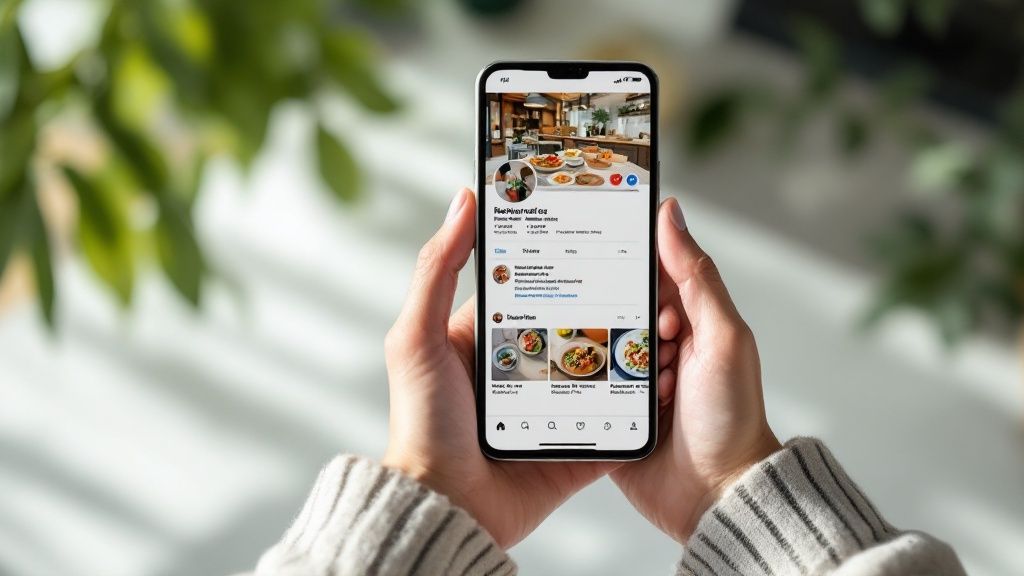
The single most costly error new restaurateurs make is delaying marketing until opening day. This is a fundamental strategic failure, akin to launching a product without a go-to-market plan.
Sustainable success is built on the demand you generate before you unlock the doors. The objective is to orchestrate such a significant groundswell of local anticipation that your primary operational challenge on opening night is managing capacity, not acquiring customers. This requires a disciplined, multi-channel pre-launch strategy, not a last-minute tactical scramble.
First, Codify Your Narrative
Before executing a single marketing tactic, you must codify your core narrative. What is your unique value proposition? A proprietary family recipe? A commitment to a hyper-local, sustainable supply chain? A disruptive fusion concept that addresses a clear gap in the market?
This narrative is your strategic anchor. It dictates the brand identity of a farm-to-table bistro (freshness, community, authenticity) versus a high-energy taco bar (fun, bold flavors, social). It is the foundation of your visual identity, your menu design, and the voice of your social media channels. You are not merely selling food; you are selling a differentiated experience.
Your brand story isn't a marketing asset; it is the decision-making filter for the entire organization. It is the core reason a customer will choose your establishment over a dozen proximate competitors.
When you engage local media or food influencers, it is this compelling narrative—not a mere list of menu items—that will secure high-value, earned media placements.
Establish Your Digital Infrastructure
Long before your kitchen is operational, your digital presence must be active. This doesn’t require a complex, multi-page website. The focus is on establishing the essential infrastructure to build an audience and capture high-intent leads.
-
A "Coming Soon" Landing Page: This is your primary digital asset in the pre-launch phase. A single-page site featuring your restaurant's name, concept, and location. Its most critical function is an email acquisition form. Offer a tangible incentive for sign-ups, such as an exclusive invitation to a soft-opening event or a compelling launch-week offer. This list is your first owned-marketing channel.
-
Claim Your Social Handles: Immediately secure your brand name on primary platforms like Instagram and Facebook. Begin executing a content strategy that documents the journey. Share behind-the-scenes visuals of the build-out, menu R&D, and introductions to your key personnel. This content creates a sense of insider access and builds an early emotional connection with your future customers.
Activate Your Google Business Profile Immediately
I cannot overstate this: claim and meticulously optimize your Google Business Profile the moment you have a signed lease. It is unequivocally your most powerful, highest-ROI organic marketing tool.
Complete every data field. Input your address, phone number, and a link to your "Coming Soon" landing page. As you approach launch, begin populating it with professional photography of the interior (even work-in-progress shots) and, critically, your food.
A fully optimized profile is a prerequisite for ranking in high-intent, local search queries like "new restaurants near me." This is the primary discovery channel for your target audience. Securing this from the outset provides a significant and durable competitive advantage.
Mastering Your Digital Storefront And Local SEO
In the current market, your digital presence is as critical as your physical one. Your website, Google Business Profile, and social channels function as your digital storefronts. To be blunt: if a potential customer cannot find you and get the information they need in seconds, you are functionally invisible.
This is not about simply having a web presence. It's about achieving dominance in local search results. The objective is clear: when a user in your geographic target area searches for "new restaurants near me," your establishment must not only appear—it must present as the most compelling and credible option.
Your Google Business Profile Is Your Most Powerful Free Tool
Let me be clear: your Google Business Profile (GBP) is the single most valuable free marketing asset you possess. Data shows that 90% of guests research a restaurant online before visiting. For the vast majority, that journey begins and ends on Google. An incomplete or neglected profile is a critical failure of marketing execution.
Your GBP is not a static asset to be set up and forgotten. It is an active, dynamic tool that drives measurable foot traffic.
- High-Quality Photos Are Non-Negotiable: Grainy smartphone images are unacceptable. Upload a minimum of 10 high-resolution photographs that tell a cohesive visual story. Showcase your hero dishes, the ambiance, your team, and the exterior. Enable potential customers to visualize their experience.
- Menu Integration is Key: Do not simply link to a PDF. Natively upload your full menu to your profile. This is a strategic imperative, as it allows individual dishes to surface in specific, high-intent searches like "best carbonara near me."
- Enable Messaging and Q&A: Activate the messaging feature. A rapid, professional response to an inquiry about parking or dietary accommodations can be the final conversion point. Proactively populate the Q&A section with answers to frequently anticipated questions.
Before proceeding, it's critical to ensure your digital foundation is solid. This checklist prioritizes the actions required for a successful online launch, mirroring the operational rigor of your physical opening.
Digital Foundation Checklist For New Restaurants
| Digital Asset | Key Objective | Priority Level |
|---|---|---|
| Google Business Profile (GBP) | Dominate local search and maps; provide essential info. | CRITICAL |
| Mobile-First Website | Convert visitors into diners (reservations, orders). | CRITICAL |
| Social Media Profiles (Primary) | Build community and showcase your brand's personality. | HIGH |
| Online Review Platforms (Yelp) | Manage reputation and build social proof. | HIGH |
| Email List Signup | Capture leads for direct marketing and promotions. | MEDIUM |
This checklist is not a simple to-do list; it is a strategic roadmap. Executing the critical and high-priority items first will generate the necessary momentum to build a sustainable customer acquisition engine from day one.
Your Website Must Be A Conversion Engine
Your website has a singular primary function: to convert digital traffic into revenue. This dictates that it must be engineered with a mobile-first methodology. The overwhelming majority of restaurant searches occur on mobile devices, often from users with immediate transactional intent.
A slow, poorly designed website is the digital equivalent of a poorly run front-of-house—it creates friction and drives away customers. Prioritize speed and simplicity. Essential information—address, phone, hours, menu—must be immediately accessible. Your primary call-to-action, whether "Make a Reservation" or "Order Online," must be the most prominent element on the page.
Your digital storefront must be as clean, inviting, and efficient as your physical one. Every click is a customer interaction, and every slow-loading page is a potential lost sale.
The infographic below illustrates the powerful synergy between your unique local narrative and your digital marketing execution.
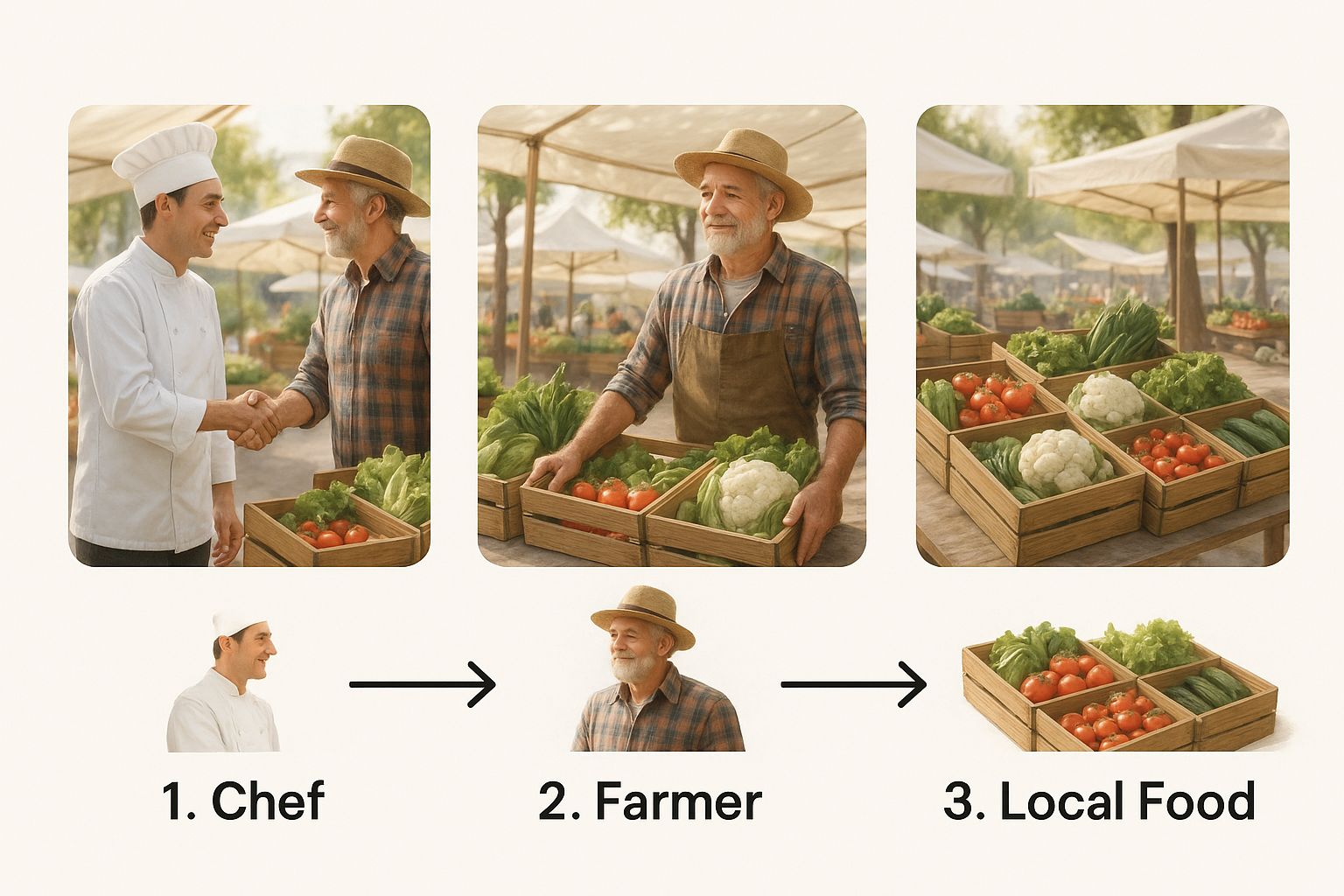
This is the essence of modern restaurant marketing—translating your core differentiators, like sourcing from local purveyors, into compelling content distributed directly to your target audience through owned and paid digital channels.
Manage Your Reputation Across All Platforms
Your online reputation extends far beyond your owned properties. You must proactively manage your presence on critical third-party platforms like Yelp, TripAdvisor, and relevant delivery aggregators. Inconsistency in your Name, Address, and Phone number (NAP) data erodes trust and negatively impacts local search rankings.
Systematize the process of requesting reviews from your initial satisfied customers. A simple, well-designed card presented with the check or a follow-up email can dramatically increase review velocity. Critically, you must respond to every single review—positive and negative. A thoughtful, professional response to negative feedback demonstrates a commitment to operational excellence and can mitigate the impact for future potential customers. This consistent engagement builds the social proof necessary to de-risk the trial for new diners.
For a more detailed tactical breakdown, learn more about local SEO for restaurants in our comprehensive guide.
Your Launch and First 90 Days: Making It Count
Your opening day is not a finish line; it is the starting gun for a critical 90-day operational and marketing sprint. This period is about converting pre-launch hype into measurable revenue and establishing a durable market reputation. Simply displaying a "Grand Opening" banner and hoping for foot traffic is a strategy for failure.
You need a structured, multi-stage launch campaign designed not just for one-time trial, but to build a system that converts first-time visitors into repeat customers with a high lifetime value.
A Staged Rollout Builds Momentum
The impulse to open to the public immediately is a common but costly mistake. A staged, controlled launch is strategically superior. It allows you to stress-test your operations, gather invaluable qualitative feedback, and generate an aura of exclusivity that fuels powerful word-of-mouth marketing.
I advise clients to execute a three-phase rollout:
-
Friends & Family Night: This is your final, full-scale operational stress test. Invite your team's personal network for a complimentary or heavily discounted service. This low-stakes environment allows your kitchen and front-of-house teams to synchronize in a live scenario. The feedback from this trusted group is operationally priceless.
-
VIP & Influencer Preview: Next, host an exclusive event for a curated list of local food media, journalists, and social media influencers with proven local audience engagement. This is not a transactional "free meal." It is a strategic communications event. Have your chef articulate their vision. Ensure every brand touchpoint, from the menu narrative to the ambient music, reinforces your core story.
-
The Public Grand Opening: Now you are operationally ready for the public. Launch with a compelling, time-bound introductory offer. For example, "20% off all entrees during our first week" or "Complimentary signature appetizer with any main course." This creates urgency and reduces the perceived risk for new customers.
Keep the Buzz Going with Smart Ads and Customer Content
Once you are open, it's time to amplify your reach. This requires disciplined execution of paid social media advertising. Concentrate your budget on platforms like Facebook and Instagram, leveraging their powerful geo-targeting capabilities. Target users by zip code, demographic profiles, and interests like "foodie," "local dining," or specific culinary keywords.
Paid media is most effective when amplified by authentic social proof. You must actively encourage user-generated content (UGC). A peer recommendation, accompanied by compelling photography, is exponentially more credible and influential than any branded advertisement.
Your job is to create an experience people can't help but share. Engineer "Instagrammable" moments within your establishment, from the plating of a signature dish to a unique interior design element.
These details are not trivial; they are strategic marketing assets. A visually striking mural, custom glassware, or a well-placed neon sign can transform your restaurant into a social media destination. Establish a branded hashtag and consistently feature the best customer-generated content on your own channels—this rewards and incentivizes further sharing.
The restaurant industry operates on notoriously thin margins. While top-tier establishments might achieve 10% profit margins, the industry average hovers at a challenging 3% to 5%. In this environment, leveraging your customers as a marketing channel via UGC isn't a "nice to have"—it is a critical, high-ROI growth lever. You can explore these metrics further in these restaurant industry statistics. The strategic rigor you apply to these first 90 days will define your restaurant's growth trajectory.
Building Loyalty to Drive Repeat Business
Customer Acquisition Cost (CAC) is consistently five times higher than Customer Retention Cost. Let that data point guide your strategy. While launch-phase acquisition is critical, long-term, profitable growth is driven by converting those new customers into a loyal base with a high visit frequency.
This phase is about building a defensible moat through community and connection. It requires a shift from broad promotional tactics to personalized communication that makes customers feel like valued insiders. The goal is to cultivate brand evangelists who not only return but actively recruit new customers on your behalf.
Implement a Simple Yet Effective Loyalty Program
You do not need a complex, technology-heavy platform to begin. The most effective loyalty programs are frictionless for both staff to execute and customers to understand.
Start with a tangible, low-tech solution. The classic "Buy nine, get the tenth free" punch card remains effective for a reason—it's simple and the reward is clear. For a full-service concept, this could be a complimentary dessert after four visits or access to an "off-menu" special. The key is to make the reward both achievable and valuable, providing a rational incentive to choose your restaurant over competitors.
Customer retention is the engine of profitability. A mere 5% increase in customer retention can boost profits by 25% to 95%. Focus on making your regulars feel like insiders.
As you scale, you can integrate digital loyalty solutions with your POS system. But the foundational principle remains: reward loyalty and make your best customers feel recognized.
Master the Art of Staying Top-of-Mind
In the restaurant business, being "out of sight" is synonymous with being "out of mind." This is why building a proprietary email list is a strategic imperative. It provides a direct, owned communication channel to your most engaged customers, bypassing the unpredictable algorithms of social media platforms.
Your email strategy must be content-driven, not solely promotional.
- Tell the story of the local farm that supplies your produce.
- Share the R&D process behind a new seasonal menu item.
- Offer subscribers exclusive pre-sale access to a special ticketed dinner.
This transforms your email from a marketing blast into valuable, engaging content. For a deeper dive into this channel, our guide on email marketing for restaurants provides a comprehensive tactical playbook.
Actively Manage Your Online Reputation
Your response to online reviews is public-facing customer service. Every review—positive, negative, or neutral—is an opportunity to demonstrate your brand's commitment to excellence.
Establish alerts for your profiles on Google, Yelp, and TripAdvisor. Respond to all positive reviews with a personalized message of thanks.
More critically, address negative feedback with speed and professionalism. Never become defensive. Thank the customer for their feedback, acknowledge the service failure, and propose a concrete resolution. Offering to host them for a return visit to demonstrate your true standard can convert a detractor into a powerful advocate. This public commitment to service recovery shows all prospective customers that you take their experience seriously.
Your Blueprint for Sustained Restaurant Growth
We have architected a complete go-to-market framework, from generating pre-launch demand to cultivating a high-LTV customer base. This guide is your strategic roadmap for marketing a new restaurant—but the execution begins now.
Marketing is not a discrete project with a defined endpoint. It is a continuous, iterative process of deploying tactics, measuring results, gathering customer feedback, and optimizing. The most successful operators I have worked with are relentlessly customer-obsessed and data-informed. They don't just serve food; they actively solicit feedback and constantly refine every aspect of the guest experience.
If I could leave you with just one piece of advice, it would be this: Tear down the walls between your kitchen, your front-of-house staff, and your marketing. Every single interaction a customer has with your restaurant is a marketing opportunity.
The host's greeting, the server's product knowledge, the consistent execution of your signature dish—these operational details communicate your brand narrative far more powerfully than any paid advertisement. When these elements are aligned and executed with excellence, you create an experience so differentiated that new customers inevitably become your most effective marketing channel.
Your culinary passion is the initial spark. But a rigorous, customer-centric, and data-driven marketing discipline is what will enable you to not just compete, but win in this challenging industry. Use this framework as your foundation, but never stop iterating, learning, and optimizing.
Common Questions I Hear from New Restaurant Owners
After advising numerous restaurant launches, I consistently encounter the same critical questions. Addressing these with strategic clarity is essential for focusing resources effectively. Let's get straight to the data-driven answers.
How Much Should We Really Spend on Marketing for the Launch?
The standard benchmark suggests allocating 3-6% of gross sales to marketing. However, a launch is not a standard operating period. It is a high-stakes customer acquisition sprint.
For the first 3 to 6 months, you must operate with greater investment intensity. I advise my clients to budget 6-10% of projected revenue for this critical launch window. This is not an expense; it is a capital investment in generating initial momentum and market penetration. Once a stable baseline of repeat business is established, you can normalize the budget back to the 3-6% range for sustained growth.
What's the One Thing We Absolutely Must Do Before Opening?
If you have resources for only one pre-launch marketing activity, it must be the complete optimization of your Google Business Profile. There is no higher-leverage, zero-cost initiative.
Your GBP is your primary tool for discovery on Google Maps and local search. It is how a customer searching for "tacos near me" will find you. A fully populated, optimized profile is non-negotiable. This includes high-resolution photography of your food and space, a natively uploaded menu, and meticulous verification of all business information.
Should Our Focus Be on Paid Social Ads or Just Posting Organic Content?
This is a false dichotomy. You require an integrated strategy that leverages both. They serve distinct, complementary functions.
Think of it this way: organic content is for building a community and showing off your brand's personality. Paid ads are for reaching the thousands of potential customers in your area who have no idea you exist yet.
Organic content nurtures your existing followers and builds brand affinity. Paid advertising, precisely targeted by geography and user interests, is the engine for new customer acquisition. For a launch, a dedicated paid media budget is not optional; it is essential for driving initial trial and foot traffic.
At MGXGrowth, we partner with ambitious hospitality brands to build sustainable, data-driven growth engines that deliver measurable results. Schedule a consultation to build your restaurant's growth roadmap.
