


I've seen the same story play out in dozens of industries, from SaaS to hospitality. Leadership teams celebrate impressive revenue growth, completely blind to the fact that they're losing money on a huge chunk of their customers. The problem isn't a lack of sales; it's the hidden costs and operational complexities quietly eating away at the bottom line.
Real, sustainable profitability isn't about the top-line number. It’s about understanding the actual cost to serve each unique customer instead of just relying on broad, blended averages.
The Hidden Costs Eroding Your Profit Margins
The most dangerous assumption a business can make is that all revenue is created equal. It's just not true. Traditional accounting practices often mask the reality by lumping costs into big, generic buckets, making it impossible to see which customers are profit-drivers and which ones are secretly draining your resources.
This is where the Cost to Serve (CTS) framework becomes your strategic lens. It's not just another accounting task; it's a new way of seeing your business. CTS pushes you past the simple averages and forces you to look at every single activity that goes into supporting a customer.
Think about it this way: two customers might each pay you $100,000 a year. On the surface, they look identical. But what if one is completely self-sufficient, while the other demands custom logistics, constant support calls, and has special invoicing needs? In your financial report, they're the same. In reality, one is a gold mine, and the other is an anchor weighing you down.
From Blended Averages to Granular Truths
The core issue with traditional costing is that it smooths everything out into a neat, tidy—and completely misleading—average. This approach hides the crucial details in the margins, preventing you from seeing the full picture of your profitability. When you can't see the true cost drivers, you can't make smart decisions.

The table below shows just how different the world looks when you shift from a blended view to a granular, activity-based perspective.
| Business Activity | Traditional Costing View (The Illusion) | Cost to Serve View (The Reality) |
|---|---|---|
| Sales Process | All sales efforts are lumped into one "Sales & Marketing" bucket. | High-touch clients require 5x more pre-sales support and demos than self-service ones. |
| Order Fulfillment | A single "shipping cost" is applied across the board. | Custom packaging for one client adds 15% to their fulfillment costs, while another uses standard boxes. |
| Customer Support | Support costs are averaged out over the entire customer base. | One segment of customers accounts for 70% of all support tickets due to complex needs. |
| Invoicing & Payments | Finance overhead is treated as a general administrative expense. | A key account's unique billing requirements add 8 hours of manual work for accounting each month. |
This shift from illusion to reality is what separates businesses that just grow from those that grow profitably.
Time and again, I've seen companies run their first CTS analysis and get a shock: they discover that 20% of their customers are responsible for eroding up to 50% of their profits. This isn't a fluke; it's the predictable result of not measuring what truly matters.
Uncovering these hidden costs is the first step to bridging the gap between Sales, Operations, and Finance. When your sales team is only chasing revenue, they might land high-cost, low-profit clients. When operations tries to standardize everything, they might alienate a profitable but high-maintenance account.
CTS analysis gives everyone a common language and a shared set of data to work from. It changes the central question from "How much revenue did we make?" to "How much profit did we actually keep?" For a deeper look at building this kind of alignment, our guide on how to improve operational efficiency is a great resource. This change in mindset is absolutely essential for building a resilient and truly scalable business.
Understanding the Cost to Serve Framework
Let's cut right to the chase. Cost to Serve (CTS) is the total price tag for everything you do for a customer. I’m not just talking about the cost of the product itself. I’m talking about every single expense, from the first sales call to warehousing, custom packaging, last-minute shipping, and even processing their returns. Every touchpoint costs something.
In today's market, treating every customer the same is a surefire way to kill your margins. If you apply a one-size-fits-all service model, you're almost certainly over-serving your least profitable clients and, even worse, under-serving the ones who actually drive your growth. This is the exact blind spot where profitability gets lost.
The Cost to Serve framework forces you to look past simple revenue numbers. It gives you the power to organize your customer base by actual profitability, not just how much they spend. That single distinction is the key to finally seeing which accounts are your growth engines and which are quietly bleeding you dry.
Moving Beyond Revenue to See True Profitability
I've been in more than a few meetings where a team is celebrating a huge new client, only for everyone to realize a year later that the account is a financial black hole. The revenue looks fantastic on paper, but the operational gymnastics required to keep that client happy are completely unsustainable.
CTS analytics makes you connect the dots between sales, logistics, and support. It's about putting a real dollar amount on activities like:
- Sales Efforts: How many demos and custom proposals did it take to get them to sign?
- Logistics & Fulfillment: Do they constantly place small, frequent orders or require special handling that messes up your workflow?
- Customer Support: Are they constantly on the phone with your support team, needing a ton of hand-holding?
- Administrative Overhead: Does their unique invoicing process require hours of manual work from your finance team?
Once you start assigning costs to these activities, you can build a detailed P&L statement for every single customer. This isn't just another KPI to track; it's a core part of any modern growth strategy. The shift is already happening—a whopping 82% of supply chain organizations have increased their IT spending to embrace this kind of deep-dive analytics. You can dig into more of these supply chain statistics and trends to see for yourself.
Why This Framework Is No Longer Optional
The pressure is on from all sides. Customers expect more than ever before, and supply chains are only getting more complicated. If you don't have a clear picture of your cost to serve, you're essentially flying blind and making critical business decisions with faulty data.
The real goal of a Cost to Serve analysis is to make the invisible visible. It shines a light on all the hidden costs buried in your customer relationships, giving you the clarity to make smart, profit-driven decisions.
Getting this right isn't about firing your "difficult" customers. It’s about understanding them. Once you see the true cost profile for each customer segment, you can start making strategic moves. Maybe that means adjusting your pricing, tweaking service levels, or even collaborating with a client to find a more efficient way of working together. At the end of the day, CTS is the roadmap you need to build a more resilient and genuinely profitable business.
How to Calculate Your True Cost to Serve
Theory is one thing; execution is another. Now that we've covered why cost to serve is so important, let's get our hands dirty and actually calculate it. This is where a lot of executives I work with get stuck. They imagine a massive, year-long project that demands perfect data from day one. That’s the wrong way to think about it.
The real goal is to get actionable insights fast, not to build a flawless accounting model right out of the gate. I always push for a structured, step-by-step approach that makes the whole process manageable. We’re not trying to boil the ocean here. We’re going to focus on the core steps that deliver the biggest wins first.
This infographic gives a great visual of the customer journey and all the little places where costs creep in, from the first hello to ongoing support.
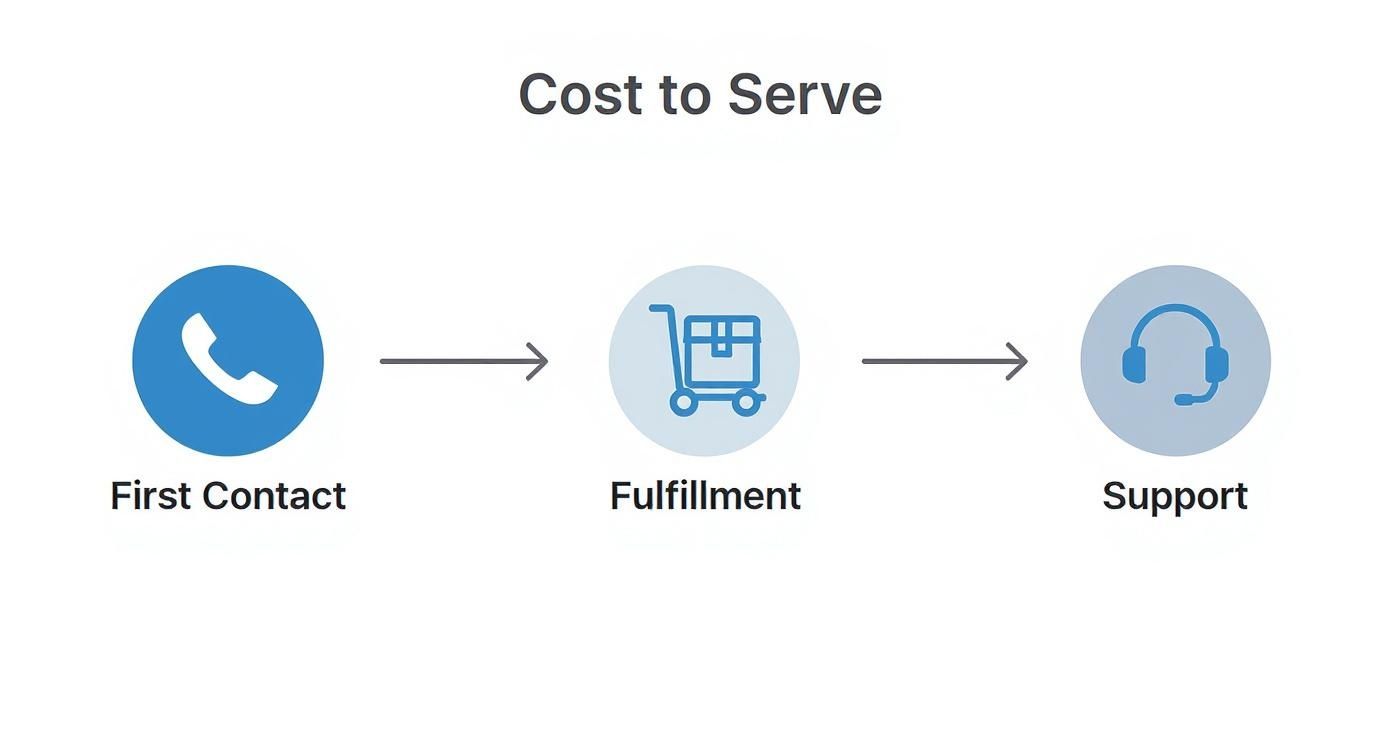
As you can see, costs add up at every single touchpoint. It’s a perfect illustration of why just looking at the Cost of Goods Sold (COGS) doesn't give you the full picture of a customer's real profitability.
Step 1: Identify Cost-Driving Activities
First things first, you need to map out every single thing your company does to land, serve, and keep a customer. This means breaking down those departmental walls. Get your leaders from Sales, Marketing, Logistics, Customer Service, and Finance into a room together.
The objective is to create a master list of all the work that happens behind the curtain. And you need to get granular.
- Sales & Marketing: How much time do people spend prospecting or running demos for different client types? What are the actual campaign costs to acquire specific segments?
- Order Processing: Is an order handled through manual entry, an automated EDI system, or a self-serve portal? Each one has a very different price tag.
- Fulfillment & Logistics: What does it cost to pick, pack, and ship? Do some customers demand custom packaging or expensive expedited freight?
- Customer Support: How many calls, tickets, or emails does a particular customer generate? What’s the average time it takes to solve their issues?
- Finance & Admin: Do certain clients need special invoicing, have complex payment terms, or require frequent credit checks?
Just doing this exercise often uncovers some shocking inefficiencies and points where teams are working against each other. For anyone looking to add more structure to this discovery phase, exploring various business process improvement methods can give you a great framework for mapping these activities.
Step 2: Gather and Pool Your Data
Don’t get hung up on waiting for perfect data. It doesn't exist. Start with what you have right now. Your ERP, CRM, and accounting software are sitting on a goldmine of information, even if it’s a bit messy. Pull reports on labor costs, warehouse expenses, shipping fees, software licenses—whatever you can get your hands on.
The biggest mistake I see is analysis paralysis. An 80% accurate model that you can use today is infinitely more valuable than a 100% perfect model you deliver next year. Your initial findings will build the business case for investing in better data down the road.
Once you have the data, group the costs into logical pools. For instance, you can lump all expenses related to your warehouse—like rent, utilities, and staff salaries—into a single "Warehousing Cost Pool." This makes the next step much, much easier.
Step 3: Allocate Costs to Customers
This is where the magic really happens. We're going to borrow a concept from Activity-Based Costing (ABC) and assign the costs from our pools to specific customers based on how much they actually use those resources.
To do this, you need to find a "cost driver" for each activity pool. Think of a cost driver as the unit of measure that connects the cost to the activity itself.
| Cost Pool | Potential Cost Driver | Example Allocation |
|---|---|---|
| Warehouse Operations | Number of orders processed | A customer placing 100 small orders will get tagged with more of this cost than a customer placing 2 large ones. |
| Customer Support | Number of support tickets | A high-maintenance client with 50 tickets a month absorbs way more support cost than a self-sufficient one with just 2. |
| Sales Commissions | Revenue per sale | Higher-revenue deals will naturally carry a larger share of the sales commission costs. |
By multiplying the rate of each cost driver by a customer's actual usage, you can build a detailed, customer-level P&L. Suddenly, you'll see exactly who your most—and least—profitable customers really are.
Step 4: Analyze and Visualize the Results
Finally, you have to turn the raw numbers into a story that people can understand. The most powerful way to do this is with a "Whale Curve." This chart plots your cumulative profitability against your customer base, which you've ranked from most to least profitable.
Almost every time, you'll find something startling: the top 20% of your customers are likely generating more than 150% of your profits. The big chunk in the middle is probably just breaking even, and the bottom 20-30% are actively draining the value created by your best clients.
Seeing this curve for the first time is a lightbulb moment for any leadership team. It shifts the conversation from vague feelings about "good" customers to a data-backed discussion about true profitability. This is the launchpad for making the smart, strategic moves that will reshape your business for the better.
Turning Cost to Serve Insights into Strategic Actions
Once you've done the analysis and mapped out your customer profitability—maybe with a classic whale curve—the real work begins. Data sitting in a spreadsheet doesn't do a thing for your bottom line. The whole point of a cost to serve analysis is to give your leadership team the hard evidence they need to make bold, strategic decisions that actually drive EBITDA growth.
From my own experience working in SaaS, marketplaces, and even hospitality, this is the phase that separates the companies that just find problems from the ones that actually solve them. It's where you have to break down the walls between Sales, Operations, and Finance to push through changes that help the business grow smarter, not just bigger.
And let's be clear: the goal isn't just to fire your unprofitable customers. That’s a blunt instrument and, frankly, a lazy solution. The real art is turning those insights into a sophisticated, multi-pronged strategy that fine-tunes your entire commercial engine.
Tier Service Levels Based on True Profitability
One of the most powerful moves you can make is to kill the one-size-fits-all service model. Your most profitable customers—your champions—deserve a premium, white-glove experience. Your least profitable customers, on the other hand, should be gently guided toward more cost-effective service channels.
This means creating clearly defined service tiers.
- High-Profit Customers: These are the folks who get a dedicated account manager, proactive support, and premium service-level agreements (SLAs). You invest your best resources here.
- Mid-Tier Customers: Guide them toward high-quality, scalable support channels. Think comprehensive knowledge bases, active community forums, or efficient chat support.
- Low-Profit Customers: Steer this group toward fully self-service options. This slashes your direct cost to serve while still giving them the tools they need to get by.
This approach isn't about neglecting anyone; it's about allocating your most valuable resources to the customers who generate the most value. It’s how you maximize both satisfaction and margin at the same time.
Renegotiate or Restructure Unprofitable Relationships
When you find a customer who is deep in the red, the conversation has to change. Armed with specific data on exactly why they are so expensive to serve, your sales and account management teams can approach them—not with an ultimatum, but with a collaborative proposal.
Lay the data on the table. Show them how their unique demands for logistics, support, or payment terms are driving up the cost structure. From there, you have a few ways to go:
- Adjust Pricing: Renegotiate the contract to reflect the true cost of their service demands.
- Modify Behavior: Work with them to change the behaviors that inflate costs. Can they consolidate orders? Use standard packaging?
- Offer an Alternative: Maybe they’d be better off on a different service plan or with a different product that better fits both their needs and your cost structure.
This isn't about confrontation; it's about re-aligning the relationship so it works for both of you. The best outcomes I’ve ever seen happened when it was treated as a partnership discussion, focused on finding a sustainable way forward.
A company in the CPG sector provides a great real-world example. After a deep cost-to-serve analysis, they broke down their costs into material, conversion, warehouse management, freight, and service fees, which pinpointed their most unprofitable accounts. This clarity gave them the leverage to renegotiate contracts and optimize logistics, leading to a 12% increase in EBITDA. You can read more about how they used CTS to drive profitability on plantemoran.com.
Redesign Processes and Automate for Efficiency
A lot of the time, a high cost to serve isn't the customer's fault—it's a flashing red light signaling an inefficient internal process. Your CTS analysis acts as a diagnostic tool, exposing operational bottlenecks and areas that are screaming for an upgrade.
If you find that manual order entry or ridiculously complex invoicing is a major cost driver for a whole segment of customers, that's your cue to invest in automation. By implementing better systems, you can dramatically lower the cost of serving entire groups of customers without them even noticing a change. It's the classic win-win. We cover this topic in more detail in our guide to the essentials of business process automation.
Ultimately, turning cost to serve insights into action is all about intelligent intervention. It’s about making deliberate choices—from tiered service and contract renegotiations to process redesign—that systematically shift your business toward more profitable, sustainable growth.
Embedding CTS Analysis into Your Business DNA
A one-time cost-to-serve project is like a snapshot; it gives you a clear picture of a single moment in time. But to really build a lasting advantage, you need a motion picture—a continuous, real-time understanding of your profitability. This is where we shift from a reactive, project-based mindset to a proactive system where CTS data is woven into the very fabric of your organization.
The goal is to stop treating this as a special assignment and start seeing it as your core operating rhythm. It requires a bit of a shift in both culture and technology, but the payoff is huge: a business where every single team is aligned around profitable growth.

Cultivating a Culture of Profitability
Before you even think about new software, you need to lock down your most critical asset: executive sponsorship. Without a champion in the C-suite, any CTS initiative is doomed to fizzle out and get dismissed as "just another finance project." The CEO or COO has to clearly and repeatedly communicate that understanding true profitability is a top priority for the entire business.
This top-down support is what gives you the green light to create a cross-functional CTS team. This isn't a temporary task force. It's a permanent group with people from Sales, Operations, Finance, and Marketing. Their collective mission is to own the data, interpret the insights, and—most importantly—drive the necessary actions within their departments. This is how you break down the silos that so often hide the real cost to serve.
This cultural shift completely changes the central question people ask across the company. Instead of Sales asking, "How much revenue can this deal bring in?" they start asking, "How profitable will this new relationship be for us?" That subtle change in perspective is the foundation of smart, sustainable growth.
Building the Right Technology Stack
Culture provides the "why," but technology gives you the "how." Let's be honest, you can't run a continuous CTS analysis on manual spreadsheets. It’s just not going to happen. You need a tech stack that can automate data collection and analysis, turning all those raw numbers into something you can actually use.
The good news is most companies already have the foundational pieces:
- ERP Systems: This is your source of truth for financial and operational costs, from warehouse expenses to labor hours.
- CRM Platforms: Your CRM holds the keys to customer behavior—every interaction, order history, and support ticket is in there.
- Business Intelligence (BI) Tools: Platforms like Tableau or Power BI are perfect for visualizing the data and making that whale curve truly come to life.
The real magic happens when you connect these systems and, in many cases, add a specialized analytics layer on top. The market for these tools is growing fast because the need is so clear. Cost-to-serve analytics is now a critical tool, with the global market for this tech valued at $5 billion and projected to grow at a 15% CAGR. You can dig into more details about this booming supply chain analytics market.
Making CTS Data Actionable Every Day
The final piece of the puzzle is to embed CTS insights directly into the daily workflows of your key teams. It’s not enough for a central team to review a report once a quarter. True integration means the data shows up right where decisions are being made.
Here’s what that looks like in practice:
- For the Sales Team: Imagine integrating a "profitability score" directly into your CRM. Before a rep even picks up the phone, they see a simple red, yellow, or green indicator telling them about a prospect's likely cost to serve based on their segment.
- For the Operations Team: This means building dashboards that track fulfillment costs per customer segment in near-real-time. They can spot and fix inefficiencies before they spiral out of control.
- For the Marketing Team: It's all about using CTS data to refine customer personas and acquisition channels. They can then focus their budget on attracting more of your most profitable customer types.
When CTS analysis becomes part of your company’s DNA, it stops being a project and becomes a reflex. It empowers every employee to see their direct impact on the bottom line and gives them the data they need to improve it. That’s how you build an organization that doesn’t just chase growth—it achieves truly profitable scale.
Your Top Cost to Serve Questions, Answered
After decades of helping companies put growth strategies into action, I've noticed the same crucial questions pop up whenever executives start digging into a cost-to-serve model. Let's tackle the big ones I hear most often in the boardroom.
How Often Should We Perform a Cost to Serve Analysis?
For your first go-around, a thorough, deep-dive analysis is absolutely essential. Think of it as establishing your baseline. After that, you’ll want to refresh the data quarterly to see how your strategic adjustments are playing out.
But here’s the real goal: get this out of the realm of one-off projects. The ultimate win is baking CTS metrics right into your daily business intelligence dashboards. When you do that, it stops being a backward-glancing report and becomes a powerful tool for making smart, forward-looking decisions in near-real-time.
How Do We Get the Sales Team on Board Without Crushing Morale?
I've been in this exact situation more times than I can count. This is a classic change management challenge. The trick is to frame CTS not as a weapon for punishing reps or firing customers, but as a secret weapon for smarter, more profitable selling.
Present the data as a competitive edge. You need to show your sales team how knowing the true profitability of an account helps them zero in on the clients who will deliver the biggest commission checks and build the most stable, long-term partnerships.
The secret lies in realigning incentives. The moment you start rewarding profitable growth—not just revenue for revenue's sake—your sales team will become the biggest champions of your cost to serve program. They'll quickly realize it helps them land better, more sustainable business.
What If Our Company Data Is a Mess?
Welcome to the club. Don't let the quest for perfect data stop you before you even start. I’ll let you in on a secret: every company has messy data. Waiting for it to be perfect is a guaranteed way to do absolutely nothing. You have to start with what you’ve got.
An 80% accurate CTS model will give you worlds more insight than the blended averages you’re likely using now. Your very first analysis will shine a bright light on your biggest data gaps, which actually helps you build a rock-solid business case for investing in better systems and data governance. The most important step is the first one—just start, see what you learn, and make it better from there.
At MGXGrowth, our expertise lies in embedding data-driven frameworks like Cost to Serve to unlock sustainable, profitable growth. We work directly with executive teams to break down departmental silos and transform complex data into clear, actionable strategies that have a real impact on EBITDA. Find out how we can help you design the next stage of your company's growth at https://www.mgxgrowth.com.
