


The basic formula for calculating customer acquisition cost is simple: divide total sales and marketing spend by the number of new customers acquired. But in my decades of driving growth, I've learned that knowing the formula is the easy part. The real work—and where true growth leaders separate themselves from the crowd—is in the rigorous, unflinching application.
Getting this right isn't just a best practice; it's the difference between scaling intelligently and burning through capital. If you're serious about building a durable, profitable business, CAC isn't just another KPI. It is the very pulse of your go-to-market engine, dictating everything from budget allocation to your entire pricing strategy.
Why Mastering Your CAC Calculation Is Non-Negotiable

Across every industry I've operated in—SaaS, gaming, real estate—I’ve seen the same pattern. Companies become fixated on top-line revenue, celebrating every new logo while willfully ignoring the cost of that win. They're operating blind, mistaking expensive activity for genuine progress.
Mastering your cost of customer acquisition calculation pulls you out of that dangerous guesswork and into a world of strategic, data-driven decision-making. Think of it as the ultimate diagnostic for your entire growth engine.
The Rising Stakes of Acquisition
The margin for error is shrinking. Acquiring customers today is more expensive than ever, thanks to saturated digital channels and skyrocketing ad costs. The game has changed.
Look at the ecommerce sector. Over the last decade, customer acquisition costs have exploded. Back in 2013, the average ecommerce brand lost $9 on each new customer. Today, that loss is projected to hit $29 by 2025—a staggering 222% increase. This isn't a temporary spike; it is the new reality. You can see more data on rising ecommerce acquisition costs to understand the full scope.
This trend underscores a critical point: if your CAC calculation is flawed, you're not making a minor rounding error. You're building your entire growth strategy on a foundation of sand.
I’ve personally watched companies burn through millions in venture funding because they meticulously tracked ad spend but conveniently forgot to include the fully-loaded salaries of the team running those campaigns. A "good" CAC on paper was a catastrophic loss in reality. True CAC must be the total, all-in cost—no exceptions.
Turning a Metric into a Competitive Advantage
Understanding your CAC goes far beyond having a number for your board deck. It’s about forging a genuine strategic edge that your competitors are almost certainly overlooking.
When you truly master this metric, you can execute powerful, decisive moves:
- Allocate Capital with Precision: You will know exactly where to double down and where to pull back, shifting investment from underperforming channels to those that deliver profitable customers.
- Validate Your Business Model: CAC is the ultimate stress test for your pricing and unit economics. It tells you if your model actually works in the market.
- Align Your Organization: When everyone from marketing to sales to finance speaks the language of CAC, silos crumble. You start operating as one cohesive unit driving toward a single goal: efficient, profitable growth.
In this guide, I will walk you through my operational playbook, cutting through academic theory to show you how getting this number right transforms your marketing function from a cost center into a predictable profit engine.
Gathering the Right Inputs for an Honest CAC
The single greatest failure I see in calculating customer acquisition cost is using incomplete data. Teams will track ad spend to the penny but ignore the massive, hidden costs of the people and tools required to deploy that spend. This isn't a minor oversight; it's a fundamental error that leads to disastrous capital allocation.
The old adage "garbage in, garbage out" is the brutal truth of growth metrics. An honest CAC requires honest inputs. To get them, you must break down the silos between marketing, sales, and finance. Each team holds a piece of the puzzle; your job as a leader is to assemble it.
Beyond the Obvious Ad Spend
Your total advertising expenditure is merely the tip of the iceberg. To calculate a true, fully-loaded CAC, you must conduct a comprehensive audit of every expense tied to acquiring new customers.
Over my career, I've developed a checklist to ensure nothing is missed. It’s not just about what you spend, but who is spending their time and what technology they leverage to do so.
Your audit must include:
- Team Salaries and Benefits: This is the most commonly omitted—and most critical—input. You must account for the fractional, fully-loaded salaries of everyone in your growth, marketing, and sales organizations. If a content strategist spends 50% of their time creating top-of-funnel assets, then 50% of their salary, benefits, and payroll taxes go into your CAC calculation.
- Software and Tool Licensing: Every platform has a cost. Sum the expenses for your CRM (like Salesforce), marketing automation (like HubSpot), analytics suites, and any other software supporting the acquisition funnel.
- Creative and Production Costs: Did you hire a freelance designer for ad creative? Pay for a video shoot? Those project-based costs are part of the equation.
- Agency and Contractor Retainers: Any external partners, from SEO agencies to PPC consultants, must be fully accounted for in the period their work was performed.
A Framework for Cross-Functional Data Collection
Obtaining this data requires a systematic, operational approach, not a one-off email request. You need a structured process to pull information from disparate departments, which is why a robust central data repository is non-negotiable. A well-executed business intelligence implementation creates a single source of truth that makes this process repeatable, reliable, and scalable.
I once worked with a SaaS company whose marketing team proudly reported a $250 CAC. After my team and I pulled payroll data from HR and software invoices from finance, we discovered their actual, fully-loaded CAC was closer to $900. This single insight forced a complete re-evaluation of their pricing, channel mix, and ideal customer profile.
To avoid this pitfall, implement a recurring, cross-functional meeting with heads of finance, sales, and marketing. The objective is to create a shared understanding and a transparent process for tracking all relevant expenses on a monthly or quarterly basis. This isn't just a financial exercise; it's a cultural shift toward data-driven accountability.
Only then can your CAC calculation become the powerful strategic tool it is meant to be.
Putting the CAC Formula into Practice
You’ve gathered your data. Now it is time to execute. The formula for calculating customer acquisition cost is refreshingly simple: divide your Total Sales & Marketing Costs by the New Customers Acquired in a given period.
But do not let that simplicity fool you. I have seen countless teams stumble here—not in the mathematics, but in the application. They produce numbers that are either misleading or, worse, useless for making sound business decisions.
Let's walk through a practical example using a B2B SaaS company to demonstrate precisely how to apply the formula and derive a clear, actionable result.
This infographic breaks down the calculation's flow, from aggregating your costs to arriving at the final per-customer figure.
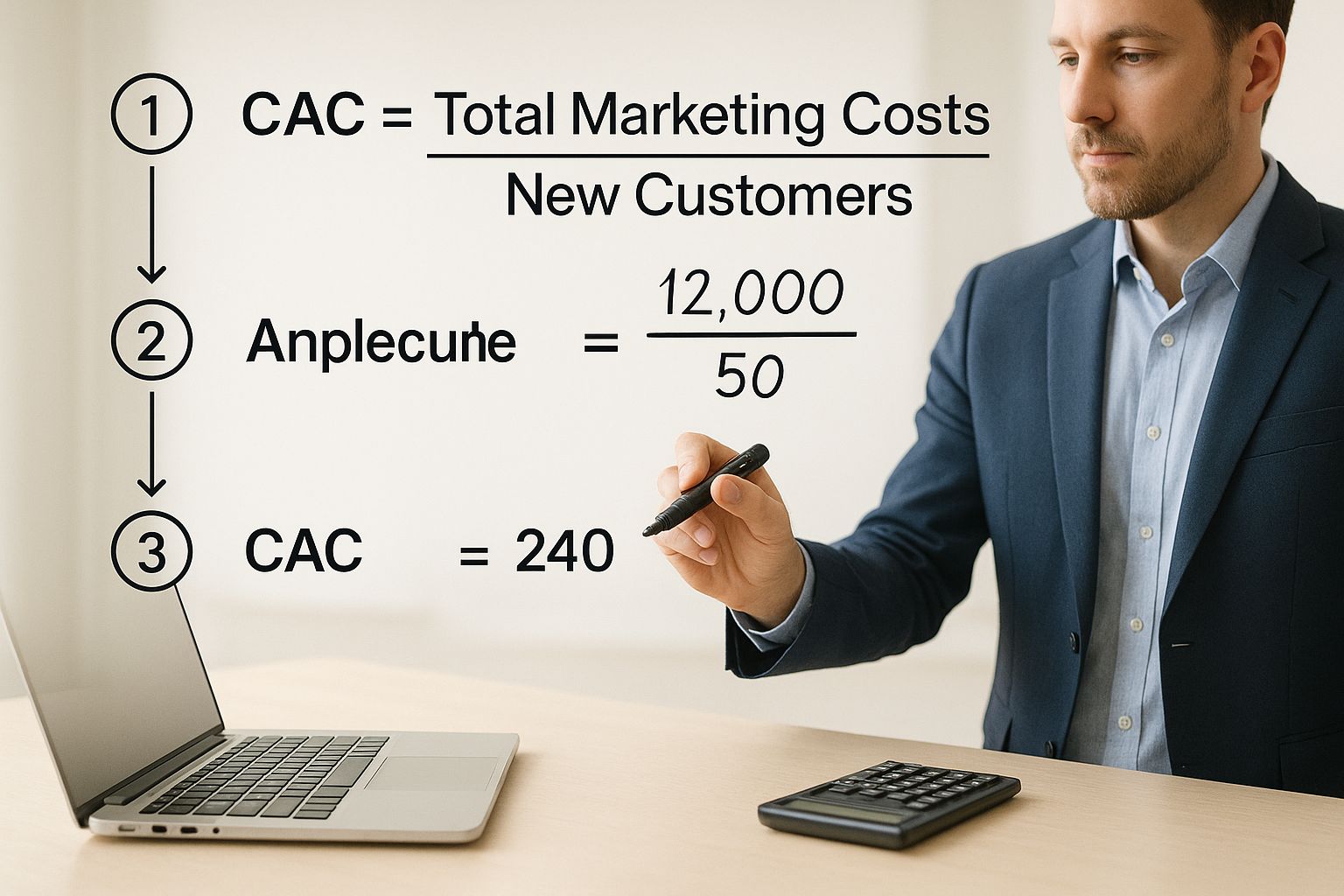
As you can see, a precise CAC comes from a disciplined, comprehensive tally of all related expenses—not just the obvious ones like ad spend.
A B2B SaaS Worked Example
Imagine our SaaS company is analyzing its performance for the first quarter (Q1). The first task is to consolidate every single cost associated with sales and marketing during that three-month period.
Here is what that audit reveals:
- Ad Spend: $45,000 (This covers all paid media, from Google Ads and LinkedIn campaigns to listings on software marketplaces.)
- Team Salaries & Benefits: $120,000 (This is the fully loaded cost for marketing and sales staff—never forget benefits, taxes, and commissions.)
- Software & Tools: $15,000 (CRM, marketing automation platforms, and analytics subscriptions.)
- Agency Retainers: $20,000 (For a specialized SEO agency supporting organic growth.)
Summing these gives you your total investment.
Total Costs = $45,000 + $120,000 + $15,000 + $20,000 = $200,000
Next, you need the other half of the equation: the number of net new paying customers acquired in Q1. After pulling reports from the CRM and billing system, the team confirms they acquired 250 new customers.
With both inputs, the math is straightforward:
CAC = $200,000 / 250 = $800
The fully-loaded CAC for Q1 is $800. This single figure is the bedrock of your growth strategy. It tells you exactly what it costs to win a new logo.
A common pitfall here is an imprecise definition of "new customer." This must be a net new paying account. Including trial users or reactivated churned accounts will artificially deflate your CAC and provide a dangerously false sense of security. Rigorous data hygiene is non-negotiable.
Breaking Down the Costs: A Sample Calculation
To ensure clarity and organizational alignment, let's structure the Q1 data into a simple table. This is an excellent format for internal reporting, as it provides transparency into how the final number was derived.
| Sample CAC Calculation for a B2B SaaS Company (Q1) | ||
|---|---|---|
| Cost Category | Expense for Q1 | Notes |
| Ad Spend | $45,000 | Includes Google Ads, LinkedIn, and Capterra. |
| Team Salaries & Benefits | $120,000 | Fully loaded costs for sales and marketing teams. |
| Software & Tools | $15,000 | CRM, marketing automation, analytics platforms, etc. |
| Agency Retainers | $20,000 | SEO agency fees. |
| Total Sales & Marketing Costs | $200,000 | Sum of all above costs. |
| New Customers Acquired | 250 | Pulled from billing system and CRM. |
| Customer Acquisition Cost (CAC) | $800 | Total Costs / New Customers. |
This line-item breakdown leaves no room for ambiguity. It is a transparent methodology for tracking investment and the return it generates.
Considering Industry Benchmarks and Time Frames
An $800 CAC is meaningless in a vacuum. Its value is entirely relative to your industry, business model, and, most importantly, your Customer Lifetime Value (LTV).
For instance, average customer acquisition costs vary by industry dramatically. For D2C and B2C companies, 2025 benchmarks project costs as low as $53 in food & beverage but as high as $91 for jewelry. Context is everything.
The time frame you choose for calculation also matters. I prefer a quarterly calculation for high-level strategic planning, as it smooths out monthly volatility. However, running the numbers monthly is critical for tactical campaign optimization and agile budget adjustments.
Knowing your number is the first step. The real work begins when you use this data to build a more efficient acquisition engine. To that end, read our guide on how to reduce customer acquisition cost without sacrificing momentum. That is how you turn a simple calculation into a powerful lever for profitability.
Unlocking Insights with CAC Segmentation
A single, company-wide CAC is a starting point, not the destination. I have seen countless marketing budgets derailed by reliance on this one blended number. The problem is that it masks both incredible performance and catastrophic failure within your acquisition portfolio. The real strategic power is unlocked when you segment your cost of customer acquisition calculation.
This granular analysis is what separates amateur growth hackers from professional strategists. It is about moving beyond "what" (our CAC is $800) and into the crucial "why." Why are some channels delivering high-value customers for a fraction of the cost, while others are incinerating cash? Answering that question is how you build a truly efficient growth model.
Pinpointing Your Winners and Losers
Segmentation involves calculating CAC for specific dimensions of your business. This is not an academic exercise; it is a practical diagnostic of your go-to-market strategy's health. The key to executing this is meticulous attribution—you must be able to assign costs and new customers to the correct segment with high confidence.
Your analysis should break down CAC by several key areas:
- Marketing Channel: What does it cost to acquire a customer from Google Ads versus organic search? From your affiliate program versus content marketing?
- Customer Persona: Does an enterprise customer cost more or less to acquire than an SMB client? This is critical for validating your targeting and pricing tiers.
- Geographic Region: Are you spending more to acquire customers in North America compared to Europe? This can dictate the viability of international expansion.
- Specific Campaigns: How did a major Q3 product launch campaign truly perform against your evergreen nurture campaigns?
This level of detail provides the evidence needed to reallocate budget with conviction. You can decisively cut what isn't working and double down on the channels and campaigns that are proven winners.
I once advised a marketplace that discovered its paid social CAC was 3x higher than its organic search CAC, yet both channels received nearly equal budget. Segmenting the data provided the hard evidence needed to shift $2 million in annual spend, effectively tripling the ROI from that capital.
Structuring Your Segmented Calculation
To do this effectively, you simply adapt the basic CAC formula. For a specific channel, the calculation becomes:
Channel CAC = Total Marketing & Sales Costs for a Specific Channel ÷ New Customers Acquired from that Channel
This requires you to isolate all relevant expenses. For a Google Ads channel CAC, you must include the ad spend, the fractional salary of the PPC manager, and the cost of any channel-specific tools. This requires discipline and often means breaking down silos between finance and marketing to get it right.
This segmented approach transforms your cost of customer acquisition calculation from a simple report card into a detailed strategic roadmap. It tells you precisely where to invest your next dollar for maximum impact, driving not just growth, but profitable, sustainable scale.
The LTV to CAC Ratio: Your Ultimate Growth Metric

Let me be direct: your cost of customer acquisition calculation is meaningless in a vacuum. A $500 CAC could be a phenomenal bargain or a catastrophic failure. The number itself tells you nothing without its essential counterpart: Customer Lifetime Value (LTV).
The LTV to CAC ratio is the key metric that reveals the long-term health and scalability of your business. It elevates the conversation from "How much did we spend?" to the far more critical question, "Was that investment profitable?"
The 3-to-1 Gold Standard
In my experience across sectors, from SaaS to e-commerce, a 3:1 LTV to CAC ratio is the gold standard for sustainable, profitable growth. Simply put, for every dollar you invest to acquire a customer, you should generate at least three dollars in profit over their lifetime with your business.
This ratio is the ultimate indicator of your business model's viability. It confirms that your upfront investment will be recouped and will ultimately generate real profit. For example, with a CAC of $75, your average customer must generate a minimum of $225 in profit to achieve this healthy benchmark. Anything less indicates you are likely overspending on acquisition, jeopardizing long-term profitability.
This 3:1 cushion is what covers your overhead and other operating expenses, leaving sufficient profit to reinvest in growth. For more context, you can explore industry benchmarks for the LTV to CAC ratio.
A 1:1 ratio is a fast track to insolvency. A 2:1 ratio means you are merely treading water. Conversely, a 5:1 ratio or higher, while superficially positive, might indicate you are underinvesting in growth and leaving market share on the table for competitors.
Improving Your LTV to CAC Ratio
Improving this critical ratio is not just about slashing your marketing budget—that is a rookie mistake. Smart growth is a two-sided equation, giving you two levers to pull:
- Decrease Your CAC: This is the efficiency play. It involves optimizing marketing channels, improving conversion rates, and refining audience targeting to acquire customers for less capital.
- Increase Your LTV: This is often the more powerful lever. Here, the focus shifts to improving customer retention, increasing average order value, and creating effective upselling and cross-selling motions.
I always push my teams to focus disproportionately on the LTV side of the equation. Why? Because a business built on retention and customer loyalty is far more durable and defensible than one built purely on aggressive acquisition. It creates a powerful flywheel where your best customers become your most valuable, long-term asset.
For a deeper operational playbook, read these practical strategies on how to increase customer lifetime value and build a more resilient business.
Ultimately, mastering the LTV:CAC ratio is how you stop defending marketing as a cost center and start proving its direct contribution to long-term, sustainable profitability.
Common Questions on Calculating Customer Acquisition Cost
Over the years, I've observed that the same questions about calculating customer acquisition cost arise in every boardroom and marketing meeting. Getting the answers right is non-negotiable for building a growth strategy that is both aggressive and financially sound.
Let’s address the questions I hear most frequently.
How Often Should I Calculate My CAC?
The optimal cadence depends entirely on the decision you are trying to inform.
For tactical, operational decisions within your marketing team, you must look at this monthly. This rhythm allows for agile adjustments to campaigns and ad spend. A monthly check-in can prevent a failing campaign from burning through your budget.
For strategic planning, such as annual budgeting or board-level reporting, you must use a quarterly calculation. This smooths out monthly volatility—like a large ad spend in January that yields customers in February—giving you a more stable and accurate view of your acquisition engine's true performance. Any more frequently, and you risk making strategic decisions based on statistical noise.
What Are the Biggest Mistakes You See in a CAC Calculation?
I consistently see two fundamental errors, both of which paint a dangerously optimistic picture.
First is incomplete cost accounting. It is tempting to only look at ad spend. But what about the fully-loaded salaries of your marketing and sales teams? The software they use? Ignoring these inputs results in a vanity metric, not a true CAC, and leads to flawed capital allocation.
The second, and equally damaging, is relying on a single, blended CAC for all decisions. A blended number hides the truth. It averages out your most efficient channels with those that are draining your budget. You must segment your CAC by channel to understand what is actually driving performance.
A "good" CAC is completely relative to your Customer Lifetime Value (LTV). A healthy business model typically has an LTV:CAC ratio of 3:1 or better. A $1,000 CAC is fantastic if your LTV is $5,000, but it's a catastrophe if your LTV is only $800. Always, always focus on the ratio, not the absolute number.
How Can We Lower CAC Without Slashing Our Budget?
This is the essential question for any growth leader. Cutting the budget is the easy answer, but it is rarely the smart one. The key is a relentless focus on conversion rate optimization (CRO). This is not about spending less; it is about making every dollar you invest work harder.
- A/B Test Everything: Remove guesswork. Test your landing page headlines, calls to action, ad copy—everything.
- Simplify Your Funnel: Every field you remove from a signup form can increase your conversion rate. Be ruthless in eliminating friction.
- Refine Ad Targeting: Move beyond surface-level demographics. Get hyper-specific with your audience segments to stop wasting money on impressions that will never convert.
Making your funnel more efficient—from first click to final conversion—is the single most powerful lever for lowering your CAC without sacrificing momentum.
At MGXGrowth, we specialize in moving beyond theoretical concepts to drive real business results. We partner with leadership teams to implement the data-driven strategies that turn marketing into a predictable profit engine. Architect the next stage of your growth with us.
