


What exactly is channel partner management?
Throughout my career driving growth in SaaS, marketplaces, and even gaming, I've seen it defined in many ways. But at its core, it's the disciplined craft of architecting, nurturing, and scaling a network of third-party companies—your 'partners'—to sell your products or services. The critical distinction is this: you're not just hiring outsourced salespeople; you're building a powerful, performance-based extension of your own go-to-market engine. It’s about creating leverage for exponential growth, not just incremental addition.
Unlocking Growth Beyond Your Four Walls

In every business I've scaled—from SaaS platforms to real estate marketplaces—a consistent pattern emerges: the most explosive, capital-efficient growth is almost always unlocked through indirect channels. Companies that master the discipline of building and managing external sales ecosystems consistently outmaneuver and outperform their direct-sales-only competitors. This is the strategic power of effective channel partner management.
It’s easy to fall into the tactical trap of viewing this as simply managing resellers. That’s a transactional mindset that caps your potential and leads to mediocre, unpredictable results. The real value is unlocked when you build a symbiotic ecosystem. You aren't just handing off a product for someone else to sell; you're equipping independent businesses with the brand, tools, and strategic support they need to accelerate their own growth.
When you get this right, your P&L and your partners’ P&L become inextricably linked. When they win, you win. This powerful alignment is the bedrock of any resilient, high-growth channel program.
This strategic approach transforms partners from mere vendors into genuine business allies. They bring their existing customer relationships, deep market credibility, and specialized resources to the table, becoming a true force multiplier for your organization. A 2023 study from Canalys found that 44% of customers already depend on four or more partners to meet their business needs, proving how vital these collaborative networks have become in modern B2B sales.
Core Components of a Channel Partner Management Program
A world-class partner program isn't built on handshakes and hope. It demands a deliberate, data-driven architecture that manages the entire partner lifecycle, from initial recruitment to celebrating significant joint wins.
Here are the essential pillars that support any high-performance partner program.
| Pillar | Objective | Key Activities |
|---|---|---|
| Recruitment & Onboarding | Systematically identify and attract the right-fit partners, then accelerate their time-to-first-revenue. | Ideal partner profiling, targeted outreach, frictionless application and contracting, and structured initial training. |
| Enablement & Training | Arm partners with the knowledge, tools, and confidence to represent your solution effectively in the market. | Product certifications, sales playbooks, demo environments, co-brandable marketing assets, and continuous product updates. |
| Engagement & Co-Marketing | Keep partners strategically aligned, motivated, and actively generating pipeline. | Joint business planning, co-marketing campaigns (MDF), regular performance reviews, partner events, and shared success stories. |
| Performance Management | Drive predictable outcomes through transparent data, clear KPIs, and mutual accountability. | Performance dashboards, quarterly business reviews (QBRs), tiered incentive programs, and data-driven optimization. |
Each of these pillars is non-negotiable. A weakness in one creates instability across the entire structure, jeopardizing your investment and results.
Ultimately, channel partner management is a strategic discipline, not a tactical sales function. It's about architecting a system where independent companies are incentivized to collaborate toward a shared financial goal, creating a powerful engine for scalable, defensible, and profitable growth.
The Shift from Handshakes to Ecosystems
In my early days in business development, many partnerships were sealed with little more than a firm handshake and a shared sense of optimism. While that foundation of trust is still vital, the world of channel partner management has fundamentally changed. Today, relying on informal agreements is not just outdated; it's a direct threat to scalable, predictable growth.
The companies I’ve seen achieve breakout success are the ones that have moved beyond a simple, transactional view of their partners. They don't just see a reseller or a distributor; they see an essential node in a much larger, interconnected business ecosystem. This isn't just a semantic difference—it's a strategic imperative.
From Vague Promises to Concrete Agreements
The first and most critical step in this evolution is formalizing the relationship. A handshake doesn't define liability, outline data ownership, or establish clear rules of engagement for lead registration. Without a legally sound agreement, you’re operating on assumptions, which inevitably leads to conflict and lost revenue down the line.
A formal contract isn't about a lack of trust; it's about creating clarity. It ensures both parties are protected and aligned on the mechanics of the partnership, covering critical areas such as:
- Performance Expectations: What are the specific sales targets or lead generation goals?
- Brand Guidelines: How can the partner represent your brand in the market?
- Data and Privacy: Who owns the customer data, and how will it be managed?
- Termination Clauses: What are the clear, fair terms for ending the relationship if necessary?
This visual below illustrates the necessary progression from informal beginnings to a structured, measurable partnership model.
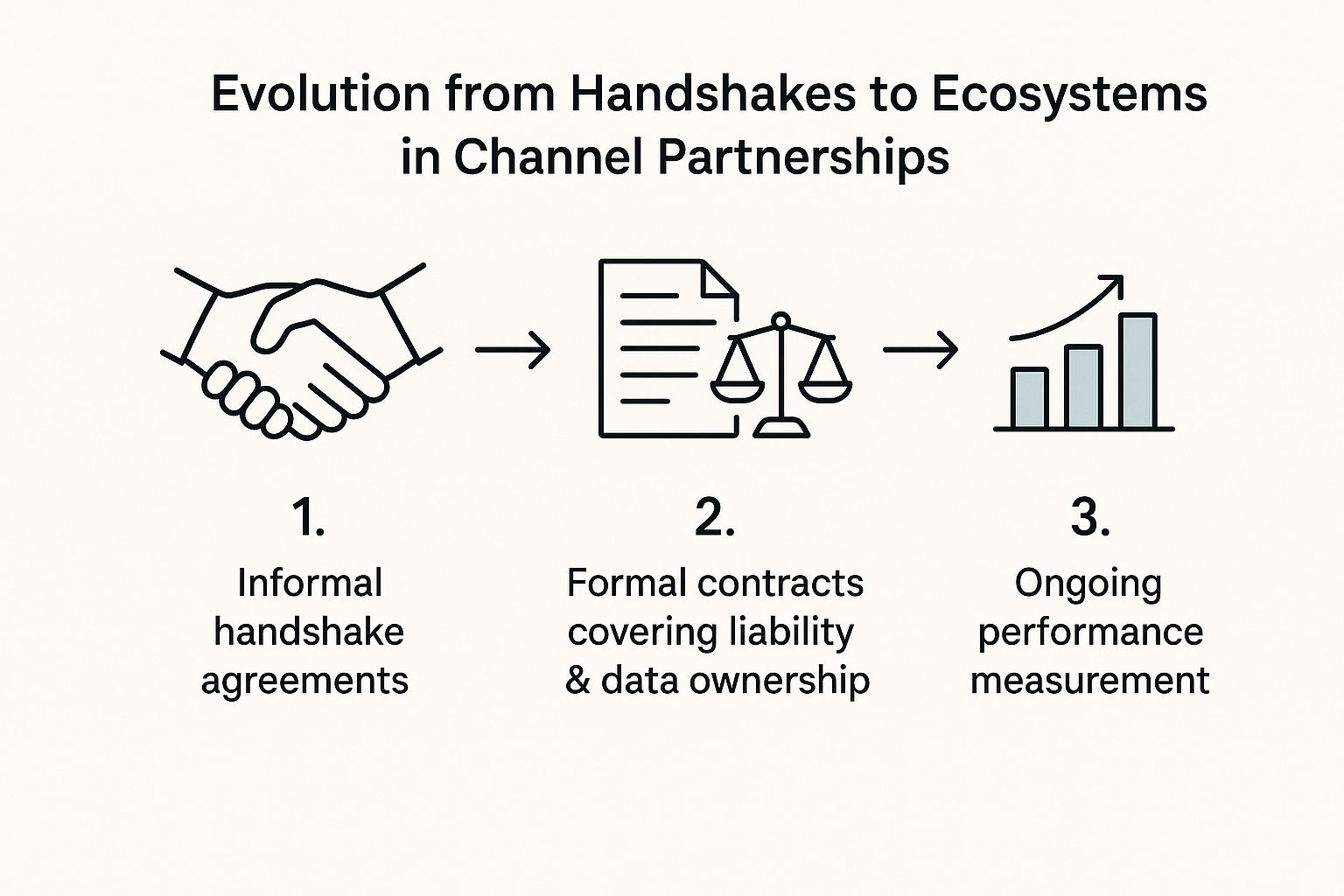
The infographic clearly shows that a modern partnership requires both formalization and a commitment to ongoing measurement to succeed.
This shift is more than a trend; it's a reflection of market reality. Research shows that by 2025, 75% of global companies will view ecosystem partnerships as vital for their growth and innovation strategies. Yet, the same data reveals a dangerous gap: only about a third of these companies consistently measure their ecosystem's performance, while nearly a quarter make no effort to measure it at all. You can dive deeper into these key partnership trends on ChannelVisionMag.com.
The Challenge of Sustaining Strategic Alignment
Once agreements are in place, the real work begins. Maintaining strategic alignment across a diverse network of partners, each with its own goals and priorities, is one of the toughest challenges in channel partner management. It's like conducting an orchestra where every musician is an independent contractor.
I’ve seen programs falter because the vendor's goals—like pushing a new, high-margin product—were completely disconnected from the partners’ reality, where they needed to sell a bundled solution to solve a customer's core problem.
True alignment isn't achieved through a single kickoff call. It's the result of continuous communication, shared planning, and a deep, mutual understanding of each other's business models. It's about building resilient, long-term relationships that can adapt to market changes, not just executing transactional, short-term arrangements.
To achieve this, performance measurement becomes your guiding star. Consistent, transparent data on what’s working—and what isn’t—is the only way to have productive conversations and make intelligent adjustments. Without it, you're just guessing. Effective channel partner management is about replacing ambiguity with data, turning potential into predictable revenue, and building an ecosystem that is truly greater than the sum of its parts.
Your Framework for Building a Partner Program

Where do you begin? Building a channel partner program from scratch can feel daunting. Having launched and scaled multiple programs, I can tell you it’s less about a magic formula and more about a disciplined, repeatable process.
Think of it like building a high-performance engine. You wouldn't just toss a bunch of parts in a box and hope it runs. You'd start with a blueprint, carefully select every component, and follow a precise assembly sequence. This five-stage framework is your blueprint for building that powerful partner engine.
Let's walk through the key stages for developing a successful partner program from the ground up. The following table outlines the journey from initial strategy to ongoing optimization.
Partner Program Development Framework
| Stage | Primary Goal | Critical Actions |
|---|---|---|
| 1. Define | Establish a clear profile of the ideal partner. | Create a detailed Ideal Partner Profile (IPP) focusing on market access, technical skills, and cultural fit. |
| 2. Recruit | Attract and sign the right partners. | Develop a compelling partner value proposition and a frictionless, high-touch onboarding experience. |
| 3. Enable | Equip partners with the knowledge to sell confidently. | Provide comprehensive sales playbooks, technical training, and co-brandable marketing assets. |
| 4. Engage | Keep partners motivated and actively selling. | Implement joint marketing initiatives (like MDF programs) and create a strong incentive structure. |
| 5. Manage | Drive continuous growth through data-driven insights. | Establish clear KPIs, use dashboards for transparency, and conduct regular Quarterly Business Reviews (QBRs). |
This framework provides a structured path, ensuring you cover all the critical bases for a program built to last.
Stage 1: Define Your Ideal Partner Profile
The single biggest mistake I see companies make is taking a "spray and pray" approach to recruitment. The goal isn't to sign up the most partners; it's to sign up the right partners. This starts with a laser-focused Ideal Partner Profile (IPP).
An IPP isn't just about company size or industry. It's about pinpointing the specific DNA of a partner who is poised to succeed with you. Ask yourself these questions:
- Who already owns the relationship with my target customer? You're looking for partners who are already trusted advisors to the very people you want to reach.
- What capabilities do they have that complement our own? A partner who can implement or service your product is exponentially more valuable than one who just makes an introduction.
- Do our business models and cultures align? If you have a complex, consultative sale, a partner built for high-volume, low-touch transactions will inevitably fail.
Getting this right saves you from wasting an incredible amount of time and money on partners who were never going to work out anyway.
Stage 2: Recruit and Onboard for Momentum
Once you know exactly who you're looking for, your recruitment becomes surgical. You're no longer just asking for a partnership; you're presenting a meticulously crafted business case that speaks directly to their needs. Your value proposition has to answer their one crucial question: "What's in it for me?"
The moment a partner says yes, the clock starts ticking. A clunky, slow onboarding process is a momentum killer. It sends the message that your program is an afterthought. Your goal should be a frictionless, "white glove" experience that helps them get their first win—and their first commission check—as fast as humanly possible.
A partner’s early experience is a powerful predictor of their long-term engagement. A seamless, well-supported onboarding process that quickly leads to revenue is the single best retention tool you have.
Stage 3: Enable and Train for Confidence
It's simple: a partner who doesn't truly understand your product cannot sell it. Effective channel partner management is built on a foundation of enablement. This isn't a one-and-done webinar. It’s a continuous flow of knowledge and resources that builds deep confidence and competence.
Your enablement program has to equip partners to own the entire sales cycle. This means providing:
- Sales Playbooks: Crystal-clear guides on who to target, what pain points to solve, and how to position your solution against the competition.
- Technical Training: Deep dives and certifications that turn their team members into genuine product experts.
- Marketing Collateral: A library of co-brandable assets that makes it dead simple for them to generate their own demand.
Stage 4: Engage with Co-Marketing and Incentives
Getting partners trained is just the start. The real work is keeping them actively engaged and motivated, month after month. This is where you bring co-marketing and smart incentives into the picture.
I've seen Marketing Development Funds (MDF) work wonders when managed correctly. Instead of just cutting a check, work with your partners to build joint campaigns that deliver a measurable return for both of you. Celebrate every shared win publicly with case studies and testimonials. Success breeds more success. To make these activities truly effective, your internal teams need to be on the same page, a topic we explore in our guide on designing a modern marketing department organizational structure.
Stage 5: Manage and Optimize with Data
You can't manage what you don't measure. A data-driven approach to performance management isn't optional; it's essential. You need to establish clear Key Performance Indicators (KPIs) from day one and build transparent dashboards so both you and your partners always know where things stand.
This isn’t about micromanaging. It's about creating a tight feedback loop for constant improvement. Use Quarterly Business Reviews (QBRs) as collaborative, strategic sessions to figure out what's working, tackle challenges head-on, and set shared goals for the next 90 days. This mindset turns your partner program from a static agreement into a dynamic ecosystem that consistently drives real growth.
Navigating the High Cost of Partner Churn
I’ve spent years building channel programs, and I can tell you one of the biggest threats isn't a competitor—it's the slow, quiet drain of partner churn. When a partner you’ve invested in walks away, it’s not just about losing future revenue. It’s a total write-off of all the time, money, and effort you poured into recruiting, onboarding, and training them.
This isn't a small problem. It's a massive financial and operational drag that many leaders don't see until the damage is done. When a productive partner leaves, you're not just back at square one; you're deep in the red.
Partners rarely leave for no reason. Their departure is usually a symptom of a deeper issue in the program itself. Maybe your goals don't align with their business model, or perhaps they just don't feel supported. A partner who feels ignored, undervalued, or set up to fail will always look for a better opportunity. It's only natural.
The Rise of Partner Quiet Quitting
Even more dangerous than a partner officially ending the relationship is one who "quietly quits." They’re still listed in your portal, technically part of your network, but they've completely stopped selling your products. This creates a false sense of security, making your partner numbers look good while your revenue engine is actually stalling out.
This disengagement is a silent killer. Your dashboard might show a healthy number of partners, but the sales pipeline is bone dry. The numbers on this are pretty alarming. A recent study found that while 29% of partners formally terminated their relationship with a vendor last year, another 41% simply stopped selling without saying a word. That means a staggering 70% of technology partners either left or quietly quit in just 12 months. You can dig into these findings on partner intent data from The Channel Company.
Proactive Strategies to Combat Churn
Fighting churn isn't about making desperate calls to save a relationship at the last minute. It's about building a program that keeps partners engaged from day one. The best channel partner management strategies are designed to prevent disengagement before it even has a chance to start.
Here’s how you build a solid anti-churn strategy:
- Recruit for Alignment, Not Just Numbers: The fight against churn begins with recruitment. Use a solid Ideal Partner Profile (IPP) to find partners whose business model and customer base genuinely fit with yours. The right partner is far more likely to stick around.
- Make Partner Profitability a Priority: Your partners are in business to make money. Period. If selling your product is too complicated, offers thin margins, or requires a ton of unpaid work, they'll focus on vendors who make it worth their while.
- Invest in Continuous Enablement: Onboarding isn't a one-and-done event. You need to provide ongoing training, fresh sales playbooks, and easy-to-access marketing materials. An enabled partner is a confident partner, and confidence leads to sales.
- Establish a Proactive Communication Cadence: Don't just wait for the quarterly business review to connect. Regular, meaningful check-ins show you're invested in their success and give you an early warning if things are going off track.
The most overlooked element in partner retention is empathy. You have to understand a partner's business as well as they do. When they see you as a strategic ally genuinely committed to their growth, they become fiercely loyal.
Ultimately, cutting down on partner churn boils down to operational excellence and a real commitment to making the relationship mutually successful. When your program is easy to work with and profitable for partners, you create a powerful advantage. This means streamlining your own house first; you can read more about how to improve operational efficiency in our detailed guide to make sure your team is ready to support partners effectively. Retention isn't just defense—it’s one of the smartest growth strategies you can have.
Your Partner Management Technology Toolkit

I’ve seen it time and time again: you can’t scale what you can’t automate. Trying to run a modern channel program with a patchwork of spreadsheets, endless email chains, and disconnected files is a recipe for disaster. It leads to frustrated partners, a burnt-out team, and a ton of missed revenue.
It’s like trying to run a global logistics company with a paper map and a rotary phone. It just doesn't work.
Technology is the essential infrastructure that turns a partner program from a manual, high-effort chore into a scalable, data-driven growth engine. The right tech stack doesn’t just make your team more efficient; it fundamentally improves the partner experience, which is the ultimate key to channel success.
The Central Role of Partner Relationship Management
At the heart of any modern channel partner toolkit is Partner Relationship Management (PRM) software. Think of a PRM platform as the central nervous system for your entire partner ecosystem. It acts as the single source of truth, connecting every single aspect of the partner journey from day one.
A solid PRM system demolishes the silos that so often plague partner programs. Instead of having deal registration in one place, training materials in another, and performance data hiding somewhere else entirely, everything is unified and accessible.
The real win with a PRM isn't just about organizing information. It’s about freeing up your channel managers from tedious admin work so they can focus on what actually moves the needle: building strategic relationships and co-selling with your most valuable partners.
The market for these platforms is booming for a reason. The global PRM software market is projected to grow at a compound annual rate of 16.2% between 2021 and 2028. This growth reflects the critical need for automation and smarter, data-driven insights in the channel space. You can dig deeper into these key channel predictions and market growth.
Key Functions of a Modern PRM Platform
A top-tier PRM platform is much more than a glorified contact database. It's an active system designed to automate and optimize the entire partner lifecycle. If you're shopping for one, these are the non-negotiable features you should be looking for:
- Partner Portal: A secure, co-branded online hub where partners can instantly access everything they need—from marketing collateral and playbooks to deal registration forms.
- Deal Registration and Lead Management: A clean, automated system for managing leads, which is crucial for preventing channel conflict and giving everyone clear visibility into the sales pipeline.
- Training and Certification (LMS): An integrated Learning Management System to deliver seamless onboarding and ongoing training, track progress, and certify partners on your latest offerings.
- Marketing Automation and MDF Management: Tools that let partners easily run co-branded marketing campaigns, plus a transparent process for managing and tracking Marketing Development Funds (MDF).
- Performance Dashboards and Analytics: Real-time visibility into key performance indicators (KPIs), allowing both you and your partners to see exactly how you're tracking against goals.
The Next Frontier: AI and Predictive Analytics
But the evolution of channel partner management tech doesn’t stop with a great PRM. The next wave is all about AI and predictive analytics. The smartest platforms are now using machine learning to analyze partner data and predict which partners are most likely to succeed, identify those at risk of churning, and even recommend the "next best action" for a channel manager to take.
This data-first approach shifts your strategy from being reactive to proactive. It’s about using technology not just to manage the day-to-day, but to truly architect a more profitable and predictable future for your entire partner ecosystem.
In every business I’ve scaled, one principle has proven itself time and time again: what gets measured, gets managed. A channel partner program without clear, meaningful metrics isn't a strategy—it's just guesswork. You're essentially flying blind and hoping for a safe landing you can't even see.
To really nail channel partner management, you have to look past the vanity metrics and zero in on the Key Performance Indicators (KPIs) that actually reflect the health and ROI of your partner ecosystem.
So many leaders get this wrong. They’ll proudly track the total number of partners, but they’re missing the bigger picture—that 80% of their channel revenue often flows from just 20% of their partners. This is exactly why we need to break down measurement into distinct, actionable categories. A data-driven approach lets you see what’s truly happening under the hood.
The goal of measurement isn't just to report on the past. It’s to gain the foresight needed to make strategic decisions about the future—where to invest your resources, which partners to double down on, and which to help improve or move on from.
To get this kind of clarity, I always break channel KPIs into three critical areas. This framework helps connect the dots between finance, sales, and marketing by giving everyone a shared language for success.
Program Growth Metrics
Think of these as your top-of-funnel indicators. They tell you if your program is attracting the right players and building momentum. They’re all about the overall health of your partner recruitment engine.
- Partner Recruitment Rate: How many new, qualified partners are you actually adding each quarter? This is a direct reflection of how compelling your value proposition is.
- Time to First Sale: From the moment a partner signs on, how long does it take them to close their first deal? A short timeline here is a great sign that your onboarding and enablement are hitting the mark.
- Partner Origination: Are partners finding you (inbound) or are you having to find them (outbound)? A high number of inbound leads suggests you’ve built strong brand equity in the channel.
Partner Performance Metrics
This is where the rubber meets the road. These KPIs measure the direct revenue impact your partners are having. They're the ultimate proof of your program's financial contribution to the business.
- Channel-Sourced Revenue: This is your North Star metric. It’s the total revenue generated through your partners, plain and simple.
- Average Deal Size (Partner vs. Direct): Are your partners bringing in bigger, more strategic deals than your in-house sales team? If so, it could mean they're unlocking new market segments for you.
- Deal Registration Volume and Approval Rate: This shows you the pipeline your partners are building and how efficiently you’re managing it to avoid channel conflict.
Partner Engagement Metrics
Finally, these are your leading indicators of future success. Why? Because an engaged partner is a productive partner. These metrics help you spot signs of disengagement long before it turns into a revenue problem.
- Portal Logins and Resource Downloads: Are your partners actually using the tools you give them? Low login rates can be a huge red flag for "quiet quitting."
- Training and Certification Completions: This shows you how invested partners are in becoming experts on your solutions. More certifications usually mean more capable, committed sellers.
- MDF Utilization Rate: What percentage of the Marketing Development Funds you offer are actually being put to use? High utilization means your partners are actively co-marketing and driving demand with you.
By tracking these distinct categories, you can build a dashboard that tells the full story. This data is the bedrock of a solid business intelligence strategy, a topic we cover in more detail in our guide on implementing business intelligence. With this kind of insight, you can stop guessing and start managing your channel with real precision.
Frequently Asked Questions
As a growth strategist, I've seen countless channel programs up close. Over the years, I've fielded hundreds of questions from executives trying to get their partner strategies right. Let's dig into some of the most common ones.
What Is the Difference Between Direct and Channel Sales?
Think of it this way: direct sales is your own team, on your payroll, selling your product straight to the customer. It’s a completely in-house operation.
Channel sales, on the other hand, is an indirect approach. You’re teaming up with third-party companies—like resellers, distributors, or affiliates—who sell on your behalf. It’s how you tap into new markets and grow faster than you ever could on your own.
How Do I Choose the Right Partners for My Business?
It’s tempting to chase partners with the biggest customer lists, but that's a shortsighted view. The best partnerships are built on a much stronger foundation.
Look for companies that already have a deep, trusted relationship with the exact audience you want to reach. Their product or service should complement yours, not compete with it. And critically, their company culture needs to align with your own values.
I always recommend creating an 'Ideal Partner Profile' that outlines not just their business size but their capabilities, technical expertise, and market reputation. This strategic filter is the foundation of a successful recruitment process.
What Is the Most Common Mistake in Channel Management?
The single biggest mistake I see is companies treating their partners like a separate, less important sales channel. They see them as a transaction, not an extension of their own team.
This mindset starves the program of what it needs most: proper onboarding, consistent training, and real, ongoing support. If you don't equip your partners to win and make them feel genuinely valued, they’ll drift away. A partner program is a relationship, first and foremost.
When Should I Invest in PRM Software?
The tipping point is usually when your spreadsheets and email threads start to buckle under the weight of your program. If managing your partners feels chaotic and is holding you back, it's time for a change.
Specifically, if you're struggling to track leads, communicate updates, or measure performance across more than a handful of partners, you should seriously consider a Partner Relationship Management (PRM) platform. The right technology provides the infrastructure you need to scale your channel program without the chaos.
At MGXGrowth, we specialize in architecting high-performance channel programs that drive predictable, scalable revenue. We partner with executive teams to build the strategies, processes, and data-driven frameworks needed to turn your partner ecosystem into a powerful competitive advantage. Learn more about how we can help you accelerate your growth.
