


Let me be direct. In my decades driving growth across gaming, hospitality, and tech, I’ve learned one immutable truth: the operators who win are those who relentlessly optimize the guest experience to drive revenue. Today, that optimization engine is an AI concierge for gaming resorts. This isn't a futuristic concept; it's the new operational standard for any property serious about market leadership.
This is not about a fancy chatbot. A true AI concierge is a strategic asset that integrates into your operational fabric. It's an intelligent system designed to manage the guest journey, systematically unlock new revenue streams, and deliver a consistently superior experience at a scale that was previously impossible.
The New High Roller Redefining Resort Operations
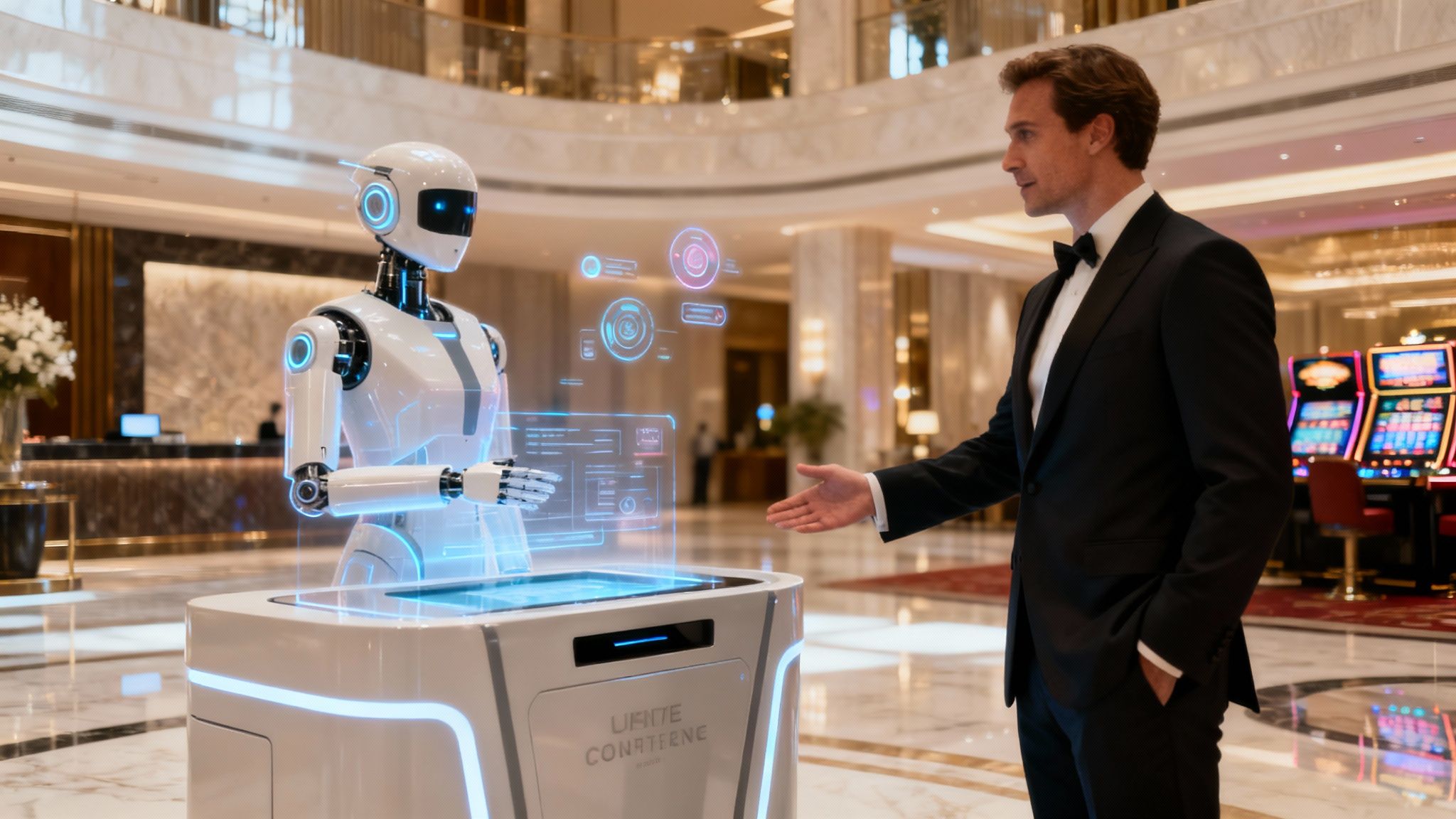
After spending my career in the trenches of hospitality and gaming growth, I can tell you that market leaders are built on superior guest experience. Today, that experience is engineered with artificial intelligence. Let's be clear: this isn't about replacing the critical human touch that defines exceptional hospitality. It’s about arming your teams with a tool that executes with precision and scale, turning service into a measurable growth driver.
You must stop thinking of this as a bot that answers simple questions. A genuine AI concierge for gaming resorts is a core engine for growth. It is your most diligent team member, embedded at every guest touchpoint, continuously anticipating needs, personalizing interactions, and identifying revenue opportunities your teams are too busy to see. For any executive focused on EBITDA and market share, this is no longer optional.
From Cost Center to Revenue Engine
Historically, guest services have been classified as a cost center—a necessary operational expense. The AI concierge fundamentally inverts this model, transforming service interactions into profitable transactions. By ingesting and analyzing guest behavior, preferences, and real-time activity, the AI can strategically present the right upsell at the optimal moment.
This isn't theoretical; the data proves its impact. Industry analysis indicates that by 2025, AI could manage up to 80% of hotel guest interactions. We are already witnessing major properties slash customer service costs by 20–40% while simultaneously driving a 10–15% uplift in upsell conversions. You can discover more insights about these hospitality trends to understand the direct P&L implications.
The Core Mandate of an AI Concierge
The objective here extends beyond efficiency. It's about architecting a more intelligent, agile, and profitable business. A properly implemented AI concierge is engineered to achieve three critical business goals that break down the silos between marketing, sales, and operations:
- Hyper-Personalization at Scale: It delivers VIP-level recognition to every guest, not just the whales. The system logs preferences from past visits to anticipate future needs, whether that’s a specific dinner reservation or a preferred slot machine.
- Proactive Revenue Generation: Instead of passively waiting for guest requests, the concierge intelligently pushes relevant, high-margin offers. This could be a last-minute spa opening, premium seats for a sold-out show, or a dining special aligned with their known culinary tastes.
- Operational Excellence: It automates the high volume of routine inquiries and simple tasks. This liberates your human capital to focus on what they do best: resolving complex issues and creating the memorable, high-value interactions that forge genuine loyalty.
In my experience, the primary barrier to scalable growth has always been the inability to deliver personalized service to the entire customer base. An AI concierge eradicates that barrier. It converts every guest interaction into an opportunity to build loyalty and increase lifetime value. It is the definitive tool for creating sustainable, data-driven growth.
Deconstructing the AI Concierge Technology
To grasp the strategic value of an AI concierge for gaming resorts, you must look under the hood. In my work helping both tech and hospitality companies scale, the most successful systems are not just a slick interface. They are a deeply integrated ecosystem architected to achieve a specific, profitable outcome. Don't think of it as an application; think of it as your resort's central nervous system—constantly sensing, learning, and acting to guide the guest journey toward maximum value.
An effective system is built on a foundation of key technologies that must function in concert. When integrated correctly, they tear down the operational walls that typically separate marketing, operations, and sales, creating a unified growth engine. Each component has a distinct function, but their synergy is what delivers a measurable return on investment.
This infographic provides a high-level overview of the three primary ways this technology drives value.
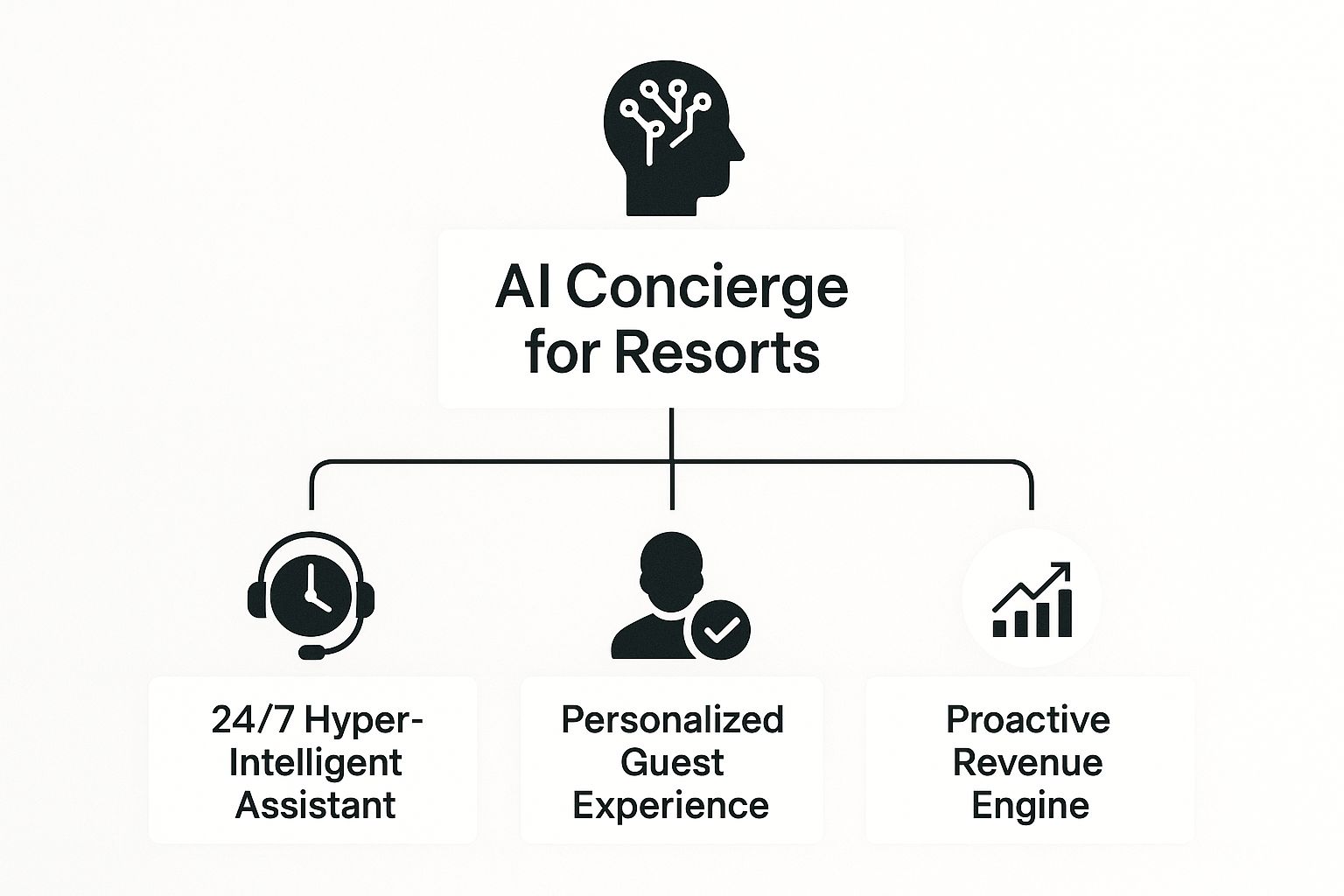
As illustrated, the technology functions simultaneously as a 24/7 assistant, a personalization engine, and a revenue generator.
Let's dissect the core components and their direct impact on your P&L.
Core AI Concierge Components and Their Business Impact
| Technology Component | Functionality | Direct Business Impact |
|---|---|---|
| Natural Language Processing (NLP) | Understands and responds to guest requests in a conversational, human-like manner across various channels (text, app, in-room devices). | Reduces front desk workload, improves guest satisfaction with instant, accurate responses, and captures service requests that might otherwise be missed. |
| Systems Integration | Connects the AI to core resort systems like the Property Management System (PMS) and Customer Relationship Management (CRM) for real-time data access. | Enables automated service fulfillment (e.g., late check-out) and hyper-personalized offers, leading to increased on-property spending and guest loyalty. |
| Machine Learning (ML) | Analyzes guest data to predict behavior, anticipate needs, and identify high-potential revenue opportunities in real-time. | Proactively drives upsells, cross-sells, and personalized promotions with a high probability of conversion, directly increasing Total Guest Value. |
These three technologies are the pillars of a modern AI concierge. They are interdependent, creating a system far greater than the sum of its parts.
The Brain: Natural Language Processing
The first and most visible component is Natural Language Processing (NLP). This is the technology that enables the AI to comprehend guest requests—and respond with human-like acuity—whether via SMS, an in-room tablet, or your proprietary mobile app. This capability extends far beyond simple keyword recognition; it discerns intent, context, and even guest sentiment.
For example, a guest might type, "I want a great steak, but nothing too stuffy." A rudimentary chatbot would fail. An NLP-powered concierge understands the nuances: the food preference ("steak"), the desired ambiance ("not too formal"), and can instantly cross-reference table availability to recommend the resort's casual grill over the fine-dining steakhouse, then offer to secure the booking. This is the critical difference between a frustrating bot and a genuinely value-added service.
The Connective Tissue: Systems Integration
The true power of an AI concierge is unlocked through deep integration with your resort's core operational software. This is non-negotiable. Without it, your AI is operating with incomplete data, incapable of delivering the personalized experiences that drive incremental revenue.
Two integrations are paramount:
- Property Management System (PMS): Integration with the PMS provides the AI with real-time access to room status, guest folios, and stay history. This is what enables it to autonomously handle requests like a late check-out or a room service order.
- Customer Relationship Management (CRM): Connecting to the CRM unlocks a rich dataset of guest preferences, historical spend, gaming activity, and loyalty status. This is the data that fuels true 1:1 personalization.
By unifying these systems, the AI concierge gains a 360-degree view of every guest. It knows if an individual is a high-value player, if they've booked a spa treatment on every previous visit, or if they provided negative feedback on their last stay. This context transforms every interaction into a relevant, data-informed opportunity.
I’ve seen firsthand that technology without integrated data is just a cost center. An AI concierge that can’t access your PMS or CRM is a missed opportunity. The goal is to create a seamless flow of information that makes every guest feel like your only guest.
The Predictive Engine: Machine Learning
The final layer is Machine Learning (ML). This is the engine that converts vast amounts of guest data into predictive, actionable intelligence. ML algorithms analyze behavioral patterns across thousands of guest profiles to forecast needs and identify revenue opportunities. This is where the AI transitions from a reactive tool to a proactive growth driver.
Instead of waiting for a guest to inquire about an upgrade, an ML model can identify a guest who perfectly matches the profile of someone likely to accept a suite upgrade—if offered at the right price point upon check-in. It can predict which guests are prime candidates for last-minute show tickets or which high-roller is receptive to an exclusive offer at the baccarat table. To go deeper on this, our guide on how to apply predictive analytics for sales is an excellent resource.
This predictive capability is what elevates the AI concierge from a customer service tool to an automated revenue-generation platform. It stops merely answering questions and starts actively shaping the guest experience to maximize both satisfaction and spend.
Unlocking New Revenue Streams with Intelligent Automation
In my years driving growth initiatives, I've learned that technology is only valuable if it directly contributes to the bottom line. An AI concierge for gaming resorts is not another IT expense; it is a revenue-generation machine. When deployed correctly, it transforms guest service from a reactive cost center into a proactive, 24/7 sales engine.
The strategic imperative is to identify and capture value that was previously lost. This goes far beyond operational efficiency. We are talking about converting millions of data points into precisely timed, personalized offers that increase guest spend and expand profit margins.
Dynamic Pricing and Direct Booking Conversion
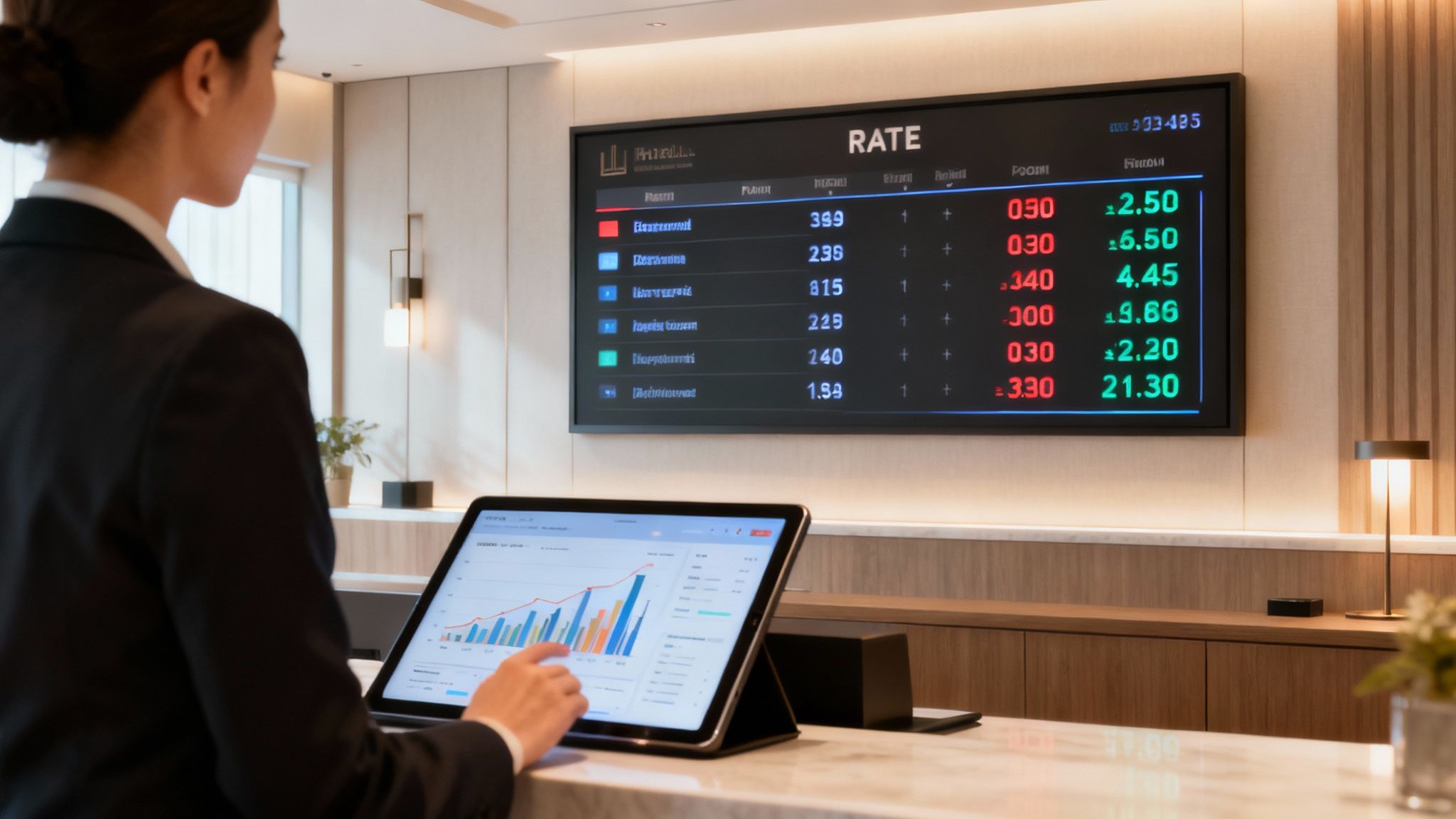
One of the most immediate financial impacts is seen in AI-driven dynamic pricing for accommodations. The system continuously analyzes real-time demand, competitor rates, local events, and even a guest's gaming profile to optimize rates dynamically. This ensures maximum yield for every room without alienating loyal patrons through perceived price gouging.
This strategy also directly combats a primary source of margin erosion: over-reliance on third-party Online Travel Agencies (OTAs). An AI-powered revenue management function can significantly shift the booking mix, delivering double-digit growth in both direct bookings and real-time upsells. By 2025, it's projected that resorts leveraging these intelligent pricing and recommendation engines will see an 18–22% increase in direct booking revenue, allowing them to retain healthier margins. You can see more on how AI improves hospitality efficiency for a comprehensive view of this trend.
Proactive Upselling of Ancillary Services
This is where the platform's true revenue potential is realized: ancillary services. The AI concierge connects a guest's real-time behavior to your full portfolio of amenities, creating frictionless upsell opportunities that feel like exceptional service, not a sales pitch. This is all predicated on predictive triggers that are impossible for a human team to manage at scale.
Consider these real-world applications:
- Spa & Wellness: A guest concludes a lengthy session at the poker tables. The AI registers their activity and the time, then instantly sends a notification offering a discount on a deep-tissue massage available within the next hour, filling an otherwise empty slot.
- Show Tickets: The system identifies a couple who dined at your high-end Italian restaurant on their last two visits. Two hours before their reservation, it offers them premium, last-minute seats to a nearby show that aligns with their profile.
- Dining Reservations: A guest's flight is delayed. The AI receives the updated arrival time via an airline data feed and proactively suggests a reservation at one of the few restaurants that can accommodate a late seating, salvaging a dining opportunity that would have been lost.
These are not random offers. Each one is a calculated, personalized recommendation delivered at the precise moment of highest probable conversion.
The most significant growth is unlocked when you finally break down the silos between departments. The AI concierge is the ultimate data unifier, pulling information from the casino floor, hotel operations, and F&B to create a single, comprehensive guest profile. That is how you stop leaving money on the table.
Intelligent Comping for High-Value Players
Finally, the AI concierge revolutionizes player rewards. Traditional comping is largely reactive and based on historical data. An intelligent system, however, can intervene at the critical moment to preserve the loyalty of a high-value player.
Imagine a VIP on a losing streak. The AI can detect this in real time from gaming system data and immediately dispatch a personalized offer to their mobile device—perhaps a complimentary dinner at their preferred steakhouse or tickets to a sold-out sporting event. This small, timely gesture can convert a negative experience into a memorable one, securing that player's loyalty and future spend before they even consider leaving the property. This is not customer service; it is intelligent asset protection.
Crafting the Hyper-Personalized VIP Experience at Scale
In the high-stakes gaming resort industry, the VIP experience has always been the primary currency of loyalty. Historically, this depended on skilled hosts with exceptional memories—a personalized touch reserved for a select few high-rollers. It was effective but manually intensive and fundamentally unscalable.
This is precisely the operational bottleneck an AI concierge for gaming resorts is engineered to eliminate. It institutionalizes the essence of that 1:1, high-touch service and deploys it across your entire guest population, from their first stay to their fiftieth.
Consider this the democratization of five-star treatment. It represents a strategic pivot that transforms every guest interaction into an opportunity to build measurable, long-term loyalty.
From Manual Service to Predictive Personalization
True personalization is not about using a guest's first name in an email. It's about anticipating their needs before they have to articulate them. An AI concierge achieves this by becoming a master of guest behavior, learning from every data point and interaction across your entire property.
It demolishes the data silos that typically separate the casino, hotel, and F&B, creating a unified guest profile.
- Gaming Habits: The AI understands whether a guest prefers slots or high-stakes poker, enabling it to push relevant comps and offers with a high degree of acceptance.
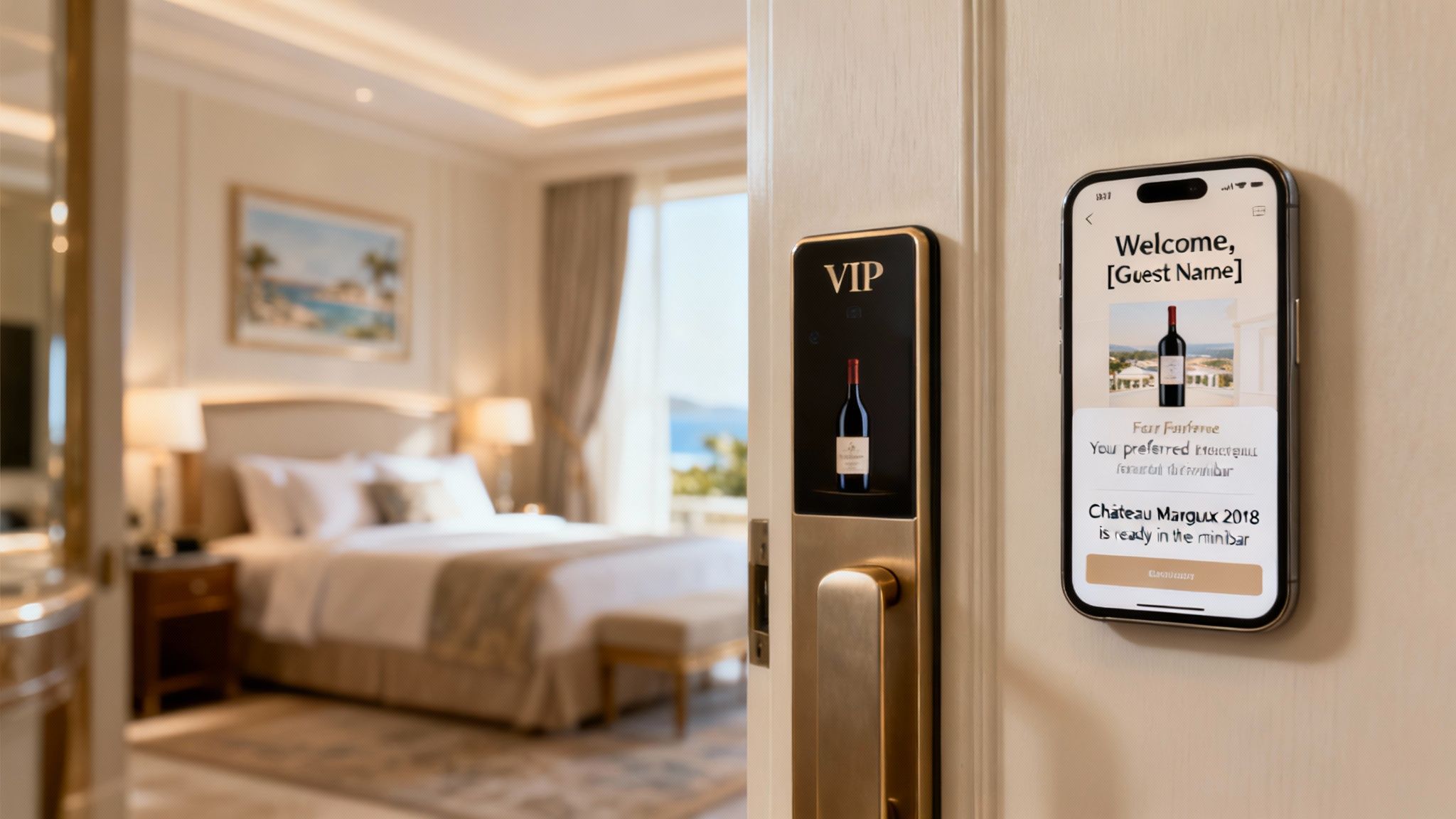
- Dining Preferences: It remembers they ordered a specific cabernet on their last two stays and can alert a sommelier or even arrange for a bottle to be in their room upon arrival.
- Past Stays: It learns they consistently request extra pillows or a late check-out and proactively confirms these arrangements before they ask.
This continuous learning cycle elevates the AI from a reactive query tool to a proactive experience curator. It is the difference between waiting for a guest to complain about a check-in line and automatically offering mobile check-in because the system knows their flight just landed.
Real-World Execution of Scaled VIP Treatment
This is not a future-state concept; it is happening now. Generative AI is transforming how resorts deliver this white-glove service. Industry leaders like Resorts World Las Vegas are already deploying sophisticated AI platforms to manage complex guest requests across multiple languages.
Data from initial deployments shows these systems can resolve up to 85% of routine inquiries without human intervention. For VIPs, the AI analyzes past behavior to recommend new experiences, driving both satisfaction and incremental spend. To understand how central this technology is becoming, review the latest gaming and leisure trends shaping the casino industry.
By automating the mundane, the AI liberates your human talent to focus on what they do best: creating the high-value, emotionally resonant moments that define a truly luxury experience.
The ultimate objective is to make every guest feel like the most important person on the property. AI makes that achievable not just for your top 1% of players, but for 100% of your guests. That is how you build an unassailable foundation of loyalty and maximize guest lifetime value.
The data generated from these AI interactions is a goldmine for your entire organization. By understanding the nuanced preferences of different guest segments, you can architect far more effective marketing campaigns. We frequently direct our clients to our guide on powerful customer segmentation strategies to fully leverage these insights. This level of data-driven decision-making was simply not feasible at this scale before now.
Ultimately, by delivering a consistently exceptional and personalized experience, the AI concierge becomes one of your most powerful retention tools. It builds a competitive moat around your business that cannot be breached by generic discounts. It's about cultivating a genuine, data-powered relationship with every guest, executed with flawless precision.
A Strategic Blueprint for AI Concierge Implementation
Deploying an AI concierge within a gaming resort is not an IT project; it is a fundamental business transformation. Having spent my career breaking down silos between operations, marketing, and finance, I can tell you that success hinges on a disciplined, strategic implementation plan. Simply "plugging in" new technology is a recipe for failure. A haphazard rollout guarantees a poor ROI and creates more operational friction than it resolves.
Consider this my C-suite blueprint for execution. It's a phased methodology I've seen succeed repeatedly, designed to ensure your AI platform delivers measurable value from day one and empowers your staff rather than burdening them.
Phase 1: Define Your Business Objectives
Before you engage a single vendor, you must define what "success" looks like in quantifiable terms. The objective is not to "implement AI"; it's to solve specific business problems and achieve clearly defined targets. Convene your leadership team—heads of hotel operations, casino marketing, F&B, and finance—and do not proceed until you have alignment.
These objectives must be tied directly to your KPIs. What are you trying to achieve?
- Increase direct booking conversions by 15%?
- Boost ancillary revenue per guest by $50?
- Reduce front desk call volume by 30% during peak hours?
Without these hard metrics, you are operating on assumptions. Setting concrete goals will govern every subsequent decision, from vendor selection to the features you prioritize in your initial rollout.
Phase 2: Assess Your Data and Integration Readiness
An AI concierge is only as effective as the data it can access. A common and critical error is underestimating the complexity of integration. Your AI requires real-time, two-way communication with your core systems, primarily your Property Management System (PMS) and Customer Relationship Management (CRM).
Conduct a rigorous and honest assessment of your data infrastructure:
- Is Our Data Centralized? Is guest information fragmented across dozens of databases, or do you have a single source of truth?
- Are Our APIs Modern? Can your PMS and CRM easily interface with third-party software, or will this require a costly, custom development project?
- Is Our Data Clean? Is your guest data accurate and up-to-date, or is it riddled with duplicates and obsolete information?
The answers to these questions will define the true scope of the project. This is often the most challenging phase, but it is absolutely non-negotiable.
A siloed data environment is the number one killer of AI initiatives. If your AI can't see the full picture of a guest's history and real-time behavior, it can't deliver the hyper-personalized experiences that drive revenue. Breaking down these data walls is the first, most critical battle to win.
Phase 3: Select the Right Technology Partner
With clear objectives and a realistic understanding of your data landscape, you can begin vetting technology partners. Do not be swayed by flashy demonstrations. You need a partner with proven expertise in the gaming and hospitality sectors who can demonstrate tangible results with properties comparable to yours.
Focus on their integration capabilities, their long-term support model, and their product roadmap. A key differentiator is the AI's training methodology. Ensure any solution you consider can be deeply trained on your property’s specific operational details—from restaurant menus and spa services to casino promotions and local events. Generic, out-of-the-box models are destined to underperform. For more on structuring a complex rollout, our guide on strategic marketing automation implementation provides an adaptable framework.
Phase 4: Launch a Controlled Pilot Program
Under no circumstances should you attempt a full, property-wide rollout from the outset. The risk is too great. The intelligent approach is to design a controlled pilot program to validate the concept and resolve any unforeseen issues.
Execute your pilot with scientific rigor:
- Define a Scope: Start with a limited, high-impact use case. For example, have the AI manage all incoming spa reservation inquiries or handle room service for a single hotel tower.
- Establish a Control Group: You need a baseline for comparison. Measure the performance of your pilot group against a control group that continues with the existing process.
- Measure Everything: Relentlessly track the KPIs defined in Phase 1. Is the AI measurably reducing call times? Is it successfully upselling spa packages? The data will provide the definitive answer.
- Involve Your Team: Your staff are not obstacles to automation; they are critical to its success. Engage them in the pilot to provide feedback and manage the "human-in-the-loop" escalations when the AI encounters a query it cannot resolve.
This phased approach de-risks the investment and builds internal momentum. When your pilot program demonstrates a clear, positive ROI, you will have the business case required for a full-scale deployment.
Securing Your Competitive Edge in the AI Era
Looking at the strategic horizon, the AI concierge for gaming resorts is not merely an ancillary feature; it is rapidly becoming the operational core of the business. Having navigated numerous industry transformations, I recognize this as a fundamental paradigm shift, not an incremental upgrade. We are moving beyond basic automation into what I term hyper-automation, where AI seamlessly orchestrates the entire end-to-end guest journey.
This process begins long before a guest arrives, leveraging predictive analytics to craft personalized offers that drive direct bookings. On-property, the AI anticipates needs, delivering proactive service that feels prescient. Post-stay, it utilizes intelligent feedback loops for continuous learning and improvement. The technology is evolving to a state where the AI will function as a true, autonomous agent for both the guest and the resort.
The Rise of Hyper-Automation
Do not view hyper-automation as a mechanism for staff replacement. Instead, conceive of it as the central nervous system for your entire operation. This system will connect every functional department—marketing, casino operations, housekeeping, finance—enabling real-time, autonomous decisions that optimize for both guest satisfaction and profitability.
From what I've seen, the companies that come out on top are the ones that build the strongest competitive moats. Over the next decade, that moat won't be made of brick and mortar; it'll be built with data and the intelligence to use it effectively. The AI concierge is the first and most important stone in that wall.
Resorts that delay adoption will not just fall behind; they risk obsolescence. The guest of tomorrow will consider this level of fluid, personalized service to be table stakes. Attempting to compete without a sophisticated AI backbone will be akin to a Wall Street firm operating with paper ledgers. It is an unwinnable proposition.
A Final Word for Resort Executives
The opportunity is immense. An AI concierge is far more than an efficiency tool. It is a strategic weapon to secure market leadership for the next decade. It enables the delivery of bespoke experiences at mass scale, unlocks novel revenue streams, and provides the operational agility required to not just compete, but dominate.
The time for deliberation is over. The technology is mature, the business case is compelling, and first-movers are already establishing a formidable lead. The question executives must ask is not if they should implement an AI concierge, but how quickly they can make it the centerpiece of their growth strategy. Your resort's future market position depends on it.
Frequently Asked Questions
After advising countless leadership teams through major technology adoptions, I find the same questions arise regarding the implementation of an AI concierge in a gaming resort. The conversation invariably centers on three core concerns: ROI, staffing impact, and implementation risk. Let's address these directly, with the candor that executives require.
How Do We Justify the ROI on an AI Concierge?
Shift your focus from cost savings to measurable revenue growth. While operational efficiencies are significant—reducing front desk call volume by up to 50% is a material gain—the true ROI is realized through increased guest spend.
Your AI concierge becomes your most effective salesperson. It leverages real-time guest data to deliver highly targeted upsell and cross-sell offers. We've seen personalized offers increase ancillary revenue by 10-15%. Furthermore, it helps shift your booking mix toward more direct channels, which carry substantially higher margins than OTA bookings. The financial model must be built not just on operational cost reduction, but on the incremental revenue generated per guest.
Will an AI Concierge Replace Our Staff?
This is the most pervasive misconception. The objective is not staff replacement; it is staff empowerment. Your AI is designed to manage the high volume of routine, low-complexity inquiries. Up to 85% of simple guest requests can be resolved autonomously, without human intervention.
This liberates your talented team members to focus on high-value activities: solving complex problems and delivering the memorable, high-touch service that builds lasting loyalty. The AI acts as a force multiplier. It provides your team with the capacity to manage escalations, cultivate VIP relationships, and create experiences that a machine cannot. The result is a more intelligent operation and a more effective, fulfilled team.
What Is the Biggest Mistake Resorts Make During Implementation?
The single greatest pitfall is treating this as a siloed IT project. It is not. This is a business transformation that demands a cross-functional approach from inception. You must have buy-in and active participation from Marketing, Hotel Operations, Casino Management, and IT, all aligned around a common set of business objectives.
From my experience, a siloed data strategy is the primary reason AI initiatives fail to deliver value. The AI is only as powerful as the data it can access. If it can't see the full picture of guest behavior across the entire property, its ability to personalize and generate revenue is severely handicapped.
Your AI's ability to seamlessly integrate with your Property Management System (PMS) and Customer Relationship Management (CRM) is non-negotiable. Without this deep, unified data flow, you are leaving the majority of the potential return on the table.
Ready to build a data-driven growth engine for your resort? MGXGrowth specializes in implementing AI-powered strategies that deliver measurable results. Let's architect your competitive edge together. Start the conversation with us today.
