


For decades, I've driven growth across industries by focusing on a single, unifying principle: sustainable revenue is not a happy accident. It's the engineered outcome of a system. The restaurant industry, with its razor-thin margins and fierce competition, is the ultimate proving ground for this philosophy. Too often, I see passionate operators trapped in the daily grind, focusing solely on the quality of the food while overlooking the powerful levers that control profitability. They believe great service and a good product are enough. They are not.
In my experience breaking down silos between marketing, operations, and finance, the most profound growth comes from treating your restaurant not just as a culinary art project, but as a dynamic economic engine. This requires a shift in mindset from chef to CEO, from manager to growth architect. We must move beyond gut feelings and embrace a data-driven, customer-centric approach to every facet of the business. This applies to everything from the pixels on a digital menu to the workflow in the kitchen.
In this definitive guide, we will dissect the best ways to grow restaurant revenue, not as a list of generic tips, but as an integrated strategic framework. These are the battle-tested, high-impact strategies I've implemented to drive measurable EBITDA and market share growth, adapted specifically for the unique challenges of the hospitality landscape. Prepare to look at your business through a new lens and unlock the revenue potential that has been hiding in plain sight.
1. Menu Engineering and Optimization
Your menu isn't just a list of what you sell; it's the single most powerful internal marketing and sales tool you possess. In my experience across various industries, the core principle remains the same: optimizing your product mix is fundamental to revenue growth. For restaurants, this practice is called menu engineering, a data-driven discipline that transforms your menu from a simple catalog into a strategic profit-generating asset.
This methodology, developed by pioneers like Donald Smith and Gregg Rapp, involves categorizing every dish based on its profitability (margin per item) and popularity (sales volume). This analysis provides a clear roadmap for what to promote, what to reprice, what to reinvent, and what to remove. It’s one of the most direct and impactful ways to grow restaurant revenue because it focuses on maximizing the value of every single guest transaction.
The Four Quadrants of Your Menu
The core of menu engineering lies in a simple but powerful matrix that classifies each item into one of four categories:
- Stars: High Profitability, High Popularity. These are your signature dishes. Promote them heavily and ensure their quality is consistently excellent.
- Plowhorses: Low Profitability, High Popularity. These are crowd-pleasers that drive volume. Look for ways to slightly increase their price or reduce their food cost without sacrificing quality.
- Puzzles: High Profitability, Low Popularity. These are hidden gems. They need better marketing, a more prominent menu position, or a more enticing description to boost sales.
- Dogs: Low Profitability, Low Popularity. These items are typically candidates for removal unless they serve a strategic purpose, like being a loss leader or essential for a specific dietary need.
This infographic visualizes the hierarchical decision tree used to classify each menu item based on its profit and popularity metrics.
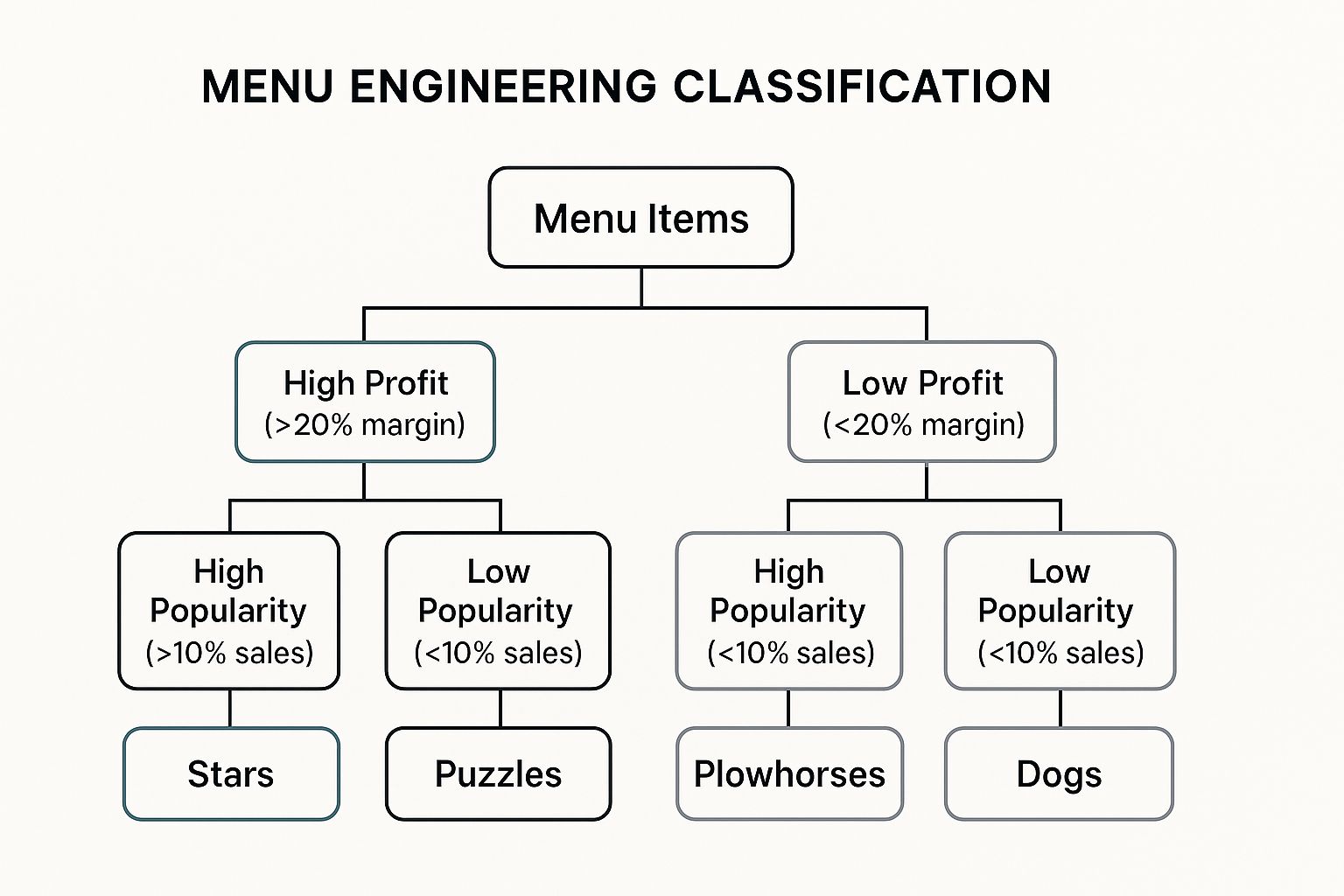
This classification immediately clarifies where your strategic effort should be focused: protecting Stars, fixing Plowhorses, solving Puzzles, and eliminating Dogs.
Putting Engineering into Practice
Once you've classified your items, the next step is implementation. Start by redesigning your menu layout to draw a customer’s eye toward your "Stars" and "Puzzles." Research shows diners often scan menus in a "golden triangle" pattern, looking first at the top right, then the top left, and finally the center. Placing your high-margin items in these prime spots is a simple yet effective tactic.
Further, enhance the perceived value with descriptive language. A "Tuscan-inspired, sun-ripened tomato bruschetta" sounds far more appealing than "Tomato on toast." Studies have shown that vivid descriptions can increase sales by up to 27%. Finally, test small price adjustments on your "Plowhorses" and "Puzzles," and always remove dollar signs from prices to reduce customer price sensitivity. This iterative, data-backed approach turns menu design from an art into a science.
2. Dynamic Pricing Strategies
The static, one-price-fits-all model is a relic of a less connected era. In my work advising high-growth companies, I've seen firsthand how adopting fluid pricing models, common in tech and travel, can unlock significant revenue streams. For restaurants, dynamic pricing means strategically adjusting menu prices based on real-time data like demand, time of day, day of the week, or even inventory levels.
This strategy, popularized by ride-sharing platforms like Uber and now integrated into POS systems from Toast and Square, allows you to capitalize on peak demand while incentivizing traffic during slower periods. It's not about arbitrary price hikes; it's a calculated approach to maximizing your revenue potential for every seat, at every hour. The Melt, a fast-casual chain, famously leveraged this to boost revenue by 40% during testing, proving its power. This is one of the best ways to grow restaurant revenue because it aligns price with perceived value in real-time.
Demand-Based Pricing in Action
The core principle is to align price with demand. Just as an airline seat costs more during holidays, a table during Friday’s dinner rush holds more value than one on a Tuesday afternoon. Implementing this can take several forms:
- Time-Based Pricing: Offering "early bird" specials or late-night discounts to fill tables during off-peak hours. Many sushi restaurants successfully use this model, offering 30-40% discounts for the 5-6 PM slot.
- Demand-Based Surcharges: Slightly increasing prices on high-demand items or during peak service times, often facilitated through delivery apps like DoorDash or Uber Eats during a "dinner rush."
- Event-Driven Pricing: Adjusting prices for special events, holidays, or days when a large local event (like a concert or sports game) drives significant traffic to your area.
- Inventory-Based Discounts: Offering specials on dishes with ingredients that are nearing their expiration to reduce waste and recoup costs, turning potential loss into profit.
This data-driven approach allows you to optimize yield management, ensuring you're not leaving money on the table during your busiest moments or sitting with empty seats during your slowest.
Implementing a Dynamic Strategy
A successful rollout requires careful planning and clear communication. Start small to gauge customer response. Begin with established concepts like happy hours or prix-fixe lunch menus before moving to more fluid, digitally-managed pricing. Use QR code menus or digital menu boards, which allow for seamless and instant price updates without the cost of reprinting.
Critically, you must set clear price floors and ceilings to maintain your brand's value perception. Use your POS data to identify your true peak and off-peak hours, and test small, incremental price changes of 5-10%. Transparency is key; if customers understand the "why" behind the pricing, such as getting a deal for dining early, they are far more likely to embrace it. This methodical approach ensures you enhance profitability without alienating your loyal customer base.
3. Strategic Upselling and Cross-Selling Programs
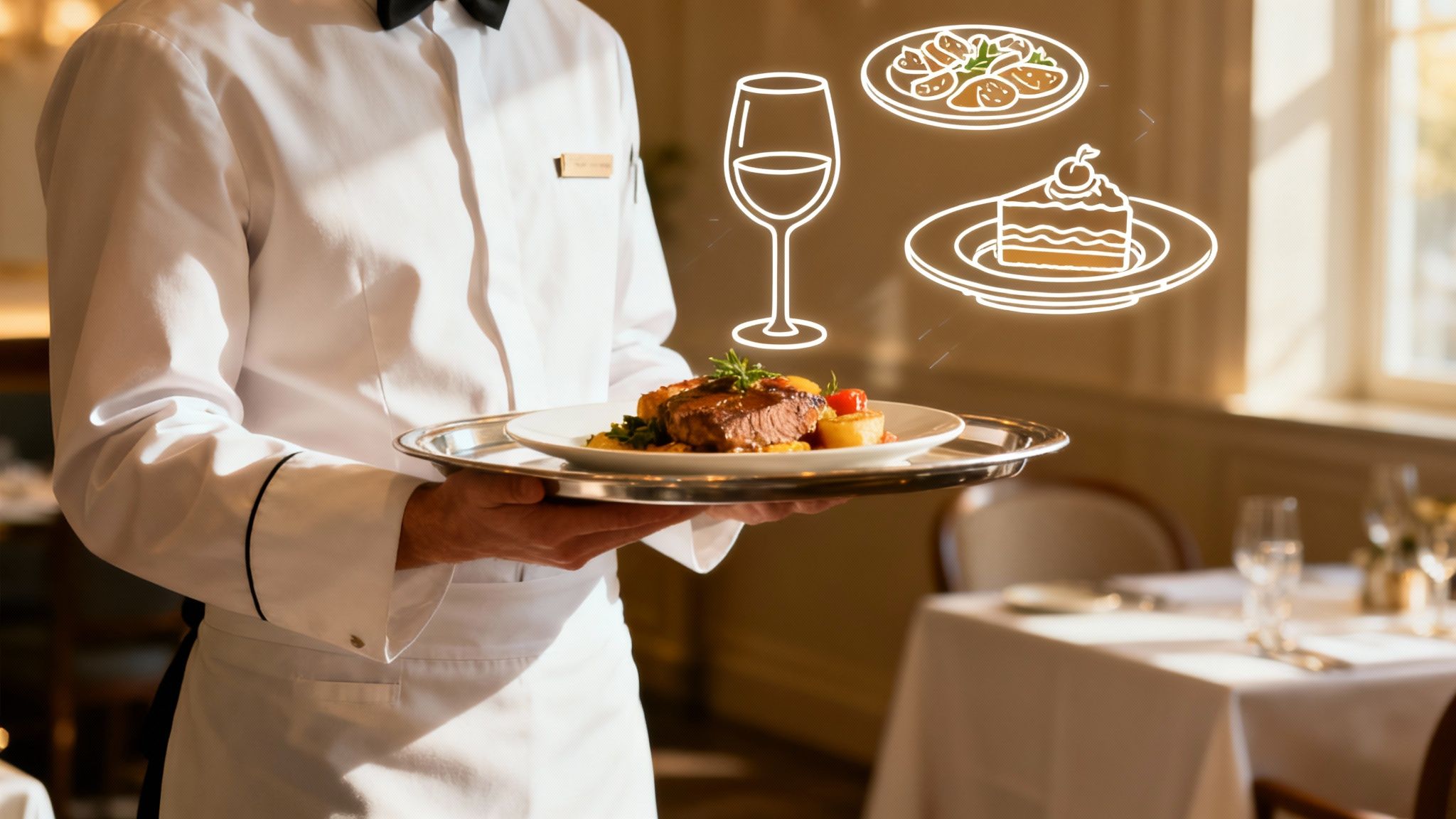
Upselling isn't just about asking "Do you want fries with that?" It's a nuanced, systematic approach to increasing average check size by enhancing the guest experience. Throughout my career, I've seen that the most successful growth strategies are those that align company goals with customer value. In the restaurant world, a well-executed upselling and cross-selling program does exactly that, transforming transactional service into a consultative experience that benefits both the diner and your bottom line.
This isn't about pushy sales tactics; it's about thoughtful suggestion. A strategic program trains your staff to identify opportunities to offer upgrades, add-ons, and complementary items that genuinely improve the meal. When done correctly, this practice builds trust and guest satisfaction, making it one of the most consistent and scalable ways to grow restaurant revenue directly from your floor staff.
The Two Pillars of Suggestive Selling
Effective programs are built on a clear understanding of upselling and cross-selling, using each technique at the right moment to maximize impact.
- Upselling: This involves encouraging customers to purchase a more premium or larger version of an item they are already considering. For example, suggesting a top-shelf spirit for their cocktail or offering the larger size of a draft beer. It's about upgrading the existing choice.
- Cross-Selling: This technique focuses on selling related or complementary products. This is where you suggest a side of garlic bread with a pasta dish, a specific wine pairing for a steak, or an espresso after dessert. The goal is to complete the meal, not just enlarge a single part of it.
This dual approach ensures that every transaction has multiple points where value can be added, directly increasing the average check size without needing to attract new customers.
Putting Suggestive Selling into Practice
Systematic training is the key to turning these concepts into consistent revenue. Start with role-playing during pre-shift meetings to build staff confidence. Servers should learn to use specific, assumptive language, like "Which of our craft IPAs can I get started for you?" instead of a passive "Would you like a drink?"
Next, empower your team with knowledge. They must know which wine pairs best with the fish special or which dessert is the perfect, light finish to a heavy meal. Implement POS prompts to remind them of key pairings or limited-time offers. Finally, create server incentive programs, such as contests for the highest check average or appetizer attachment rate. These initiatives foster friendly competition and directly tie your team's performance to revenue growth, creating a culture where everyone is focused on delivering an exceptional and complete dining experience.
4. Online Ordering and Delivery Optimization
The digital storefront is no longer a secondary channel; it's a primary revenue engine. Across my work in diverse sectors, a universal truth has emerged: meeting customers where they are is non-negotiable. For restaurants today, that means mastering the off-premise experience through robust online ordering and delivery systems. This isn't just about listing your menu on an app; it's a strategic discipline focused on capturing the massive and growing off-premise dining market while carefully managing the economics to protect your margins.
This approach involves optimizing every digital touchpoint, from your own proprietary ordering platform to third-party delivery apps. It extends into operational excellence, including creating delivery-friendly menu items, investing in quality packaging, and even leveraging concepts like ghost kitchens. For brands like Chipotle, whose digital sales now exceed $3.5 billion annually, this is one of the most critical ways to grow restaurant revenue by expanding reach and increasing order frequency.
Core Components of Digital Optimization
A successful off-premise strategy requires a multi-faceted approach. It's about building an ecosystem that is both convenient for the customer and profitable for the business. Here are the key pillars:
- Proprietary vs. Third-Party: Building your own ordering platform is a long-term play to avoid high commission fees and own the customer data. Third-party apps like DoorDash and Uber Eats offer immediate reach but require careful menu pricing and operational integration to remain profitable.
- Menu Engineering for Delivery: Not all dishes travel well. A dedicated delivery menu with items designed to maintain quality, temperature, and texture after a 20-minute journey is essential.
- Packaging as Marketing: Your packaging is the final touchpoint and a crucial part of the brand experience. High-quality, branded containers that prevent spills and maintain food integrity can justify a premium and encourage repeat business.
- Operational Efficiency: Managing an influx of digital orders without disrupting in-house service is key. This often means creating dedicated prep stations or "make lines" specifically for takeout and delivery orders during peak hours.
Implementing Your Off-Premise Strategy
Transitioning to a digitally-optimized model requires a clear, actionable plan. First, analyze the trade-offs between third-party marketplaces and a direct ordering system. While starting with apps is quick, your goal should be to migrate customers to your own platform, where you control the relationship and the profits.
Next, critically evaluate your menu from the perspective of a delivery customer. Can your famous crispy fries survive a trip across town? If not, either remove them from the delivery menu or innovate on the recipe and packaging. Introduce online-only bundles or specials to create exclusivity and drive traffic to your digital channels. Finally, actively manage your online presence by monitoring reviews on delivery platforms and responding swiftly to feedback. This data-driven approach turns digital ordering from a necessary evil into a powerful and sustainable revenue stream.
5. Loyalty Programs and Customer Retention
Focusing solely on acquiring new customers is a costly mistake I've seen countless businesses make. The real, sustainable path to growth lies in retention. For restaurants, a well-designed loyalty program is your single most effective tool for increasing customer lifetime value and visit frequency, making it one of the best ways to grow restaurant revenue.
These programs do more than just offer discounts; they build a direct relationship with your guests. By rewarding repeat business, you create a powerful incentive for customers to choose you over a competitor. More importantly, modern loyalty platforms collect invaluable data on purchase history and preferences, allowing for the kind of personalized marketing that transforms one-time visitors into brand advocates. The data shows this works: Starbucks attributes over half of its US sales to its 31 million rewards members.
The Pillars of an Effective Loyalty Program
A successful loyalty program isn't just about giving away free items. It's a strategic system built on key principles that encourage repeat behavior and deepen customer engagement.
- Frictionless Enrollment: Make it incredibly simple to join. A one-click sign-up via a POS system or QR code is far more effective than a long form.
- Immediate Gratification: Offer a small, instant reward upon signing up. This provides immediate value and encourages active participation from day one.
- Personalized Rewards: Use purchase data to send targeted offers. A customer who only buys lattes should get a coffee-related offer, not a generic discount on a food item they've never tried.
- Tiered Incentives: Create VIP levels that unlock better rewards for higher spending. This gamifies the experience and motivates customers to increase their visit frequency and average check size.
The goal is to move beyond simple transactions and build a community around your brand. Chick-fil-A has mastered this, with its "One" members visiting three times more often than non-members.
Putting Your Program into Practice
Implementation is where strategy meets execution. Start by integrating your loyalty program directly with your POS and mobile payment systems for a seamless experience. When a customer pays, their points should automatically be added, and their balance should be clearly communicated on the receipt or via a push notification.
Use the data you collect to identify your most valuable customers and also to spot those at risk of churning. A personalized "we miss you" offer sent to a customer who hasn't visited in 60 days is far more effective than a generic marketing blast. Finally, keep the program exciting by offering exclusive access to new menu items or special events for members. This reinforces their insider status and makes them feel truly valued. For a deeper dive into structuring these programs, you can learn more about restaurant loyalty program consulting on mgxgrowth.com.
6. Table Turnover Optimization
Time is a resource as valuable as any ingredient in your kitchen. In my work optimizing operations, I've seen that one of the most direct levers for revenue growth is maximizing the utility of your most finite asset: your dining space. Table turnover optimization is the strategic discipline of increasing the number of parties served per table during a shift without ever making a guest feel rushed.
This isn't about hurrying customers out the door; it's about eliminating inefficiencies in your service cycle. From the moment guests are seated to the moment they pay, every step presents an opportunity to streamline. By focusing on kitchen efficiency, service flow, and payment processing, you can serve more guests and significantly increase your revenue per available seat hour (RevPASH), a critical metric for any restaurant looking to scale.
The Anatomy of an Efficient Service Cycle
Optimizing turnover means dissecting your entire guest experience to find and remove friction. The goal is to create a seamless, well-paced service flow that feels effortless to the guest but is highly calculated behind the scenes. Think of it as a well-choreographed performance.
- The Greeting and Seating: A smooth start sets the pace. Staggered reservations prevent a bottleneck at the host stand and an overwhelmed kitchen.
- Order to Delivery: This is where kitchen efficiency is paramount. A well-designed menu with varied prep times and a strong expeditor role can prevent long waits between courses.
- The Check and Payment: The final minutes are often the most prolonged. Offering tableside or QR code payment can shave 5-10 minutes off this crucial step.
- Bussing and Resetting: A swift and clean reset prepares the table for the next guest, minimizing downtime between seatings.
The cumulative effect of shaving a few minutes off each stage can result in one or more additional turns per table during a peak service, directly impacting your bottom line.
Putting Turnover Optimization into Practice
Begin by setting realistic timing goals for different party sizes and dining types (e.g., 75 minutes for a casual two-top, 120 for a fine-dining group of four). Use a reservation system like OpenTable to strategically stagger arrivals, preventing your kitchen from being "slammed" at 7:30 PM. Implement "two-minute drills" in your pre-shift meetings to align the team on the night's efficiency goals.
Empower your staff with technology. Handheld POS systems allow servers to take orders and process payments tableside, drastically cutting down on time spent walking to and from a central terminal. Train servers to "pre-bus," clearing plates and glassware throughout the meal rather than waiting until the very end. This not only keeps the table tidy but also signals to the bussing team that the table will soon be ready to turn, making it one of the simplest yet most effective ways to grow restaurant revenue.
7. Beverage Program Enhancement
In my work guiding growth across hospitality and other sectors, I've seen leaders obsess over food costs while neglecting one of their most powerful profit centers: beverages. Your drink menu is far more than an afterthought; it’s a high-margin engine capable of dramatically increasing profitability. Strategically enhancing your beverage program is one of the quickest ways to grow restaurant revenue because drinks often carry profit margins of 70-85%, significantly higher than most food items.
This strategy involves treating your beverage offerings with the same culinary respect and business acumen as your food menu. It's a holistic approach that encompasses everything from craft cocktail development and bartender training to strategic pricing and non-alcoholic innovation. When executed correctly, a strong beverage program not only boosts the average check size but also defines your brand identity and creates a destination experience, as exemplified by pioneers like Death & Co and José Andrés’ Barmini.
Building a High-Margin Beverage Menu
The foundation of a successful program is a menu designed for both customer appeal and profitability. This means curating a balanced selection of high-margin offerings, including signature cocktails, a thoughtful wine list, and premium non-alcoholic options that cater to all guests.
- Signature & Craft Cocktails: These are your "Stars." Develop unique, high-quality cocktails that reflect your brand. Price house cocktails strategically to anchor customer perception of value, making premium options seem more reasonable.
- Wine & Beer Programs: Partner with local breweries or distilleries for exclusive offerings that create a unique selling proposition. Offer wine by the glass at a price point that typically covers the wholesale cost of the entire bottle.
- Premium Non-Alcoholic Drinks: This is a rapidly growing and highly profitable category. Create craft mocktails, house-made sodas, and specialty coffees with the same care as your alcoholic drinks, and price them accordingly.
- Cost Control: Implement strict portioning with jiggers and other tools. Utilize batching for popular cocktails to ensure consistency and speed during peak hours, protecting your margins from waste and over-pouring.
Driving Sales Through Service and Presentation
A great menu is only effective if your team can sell it and the presentation lives up to the price. This is where training and operational excellence become critical revenue drivers. A well-trained server can increase beverage sales significantly on every single table they serve.
Start by training all front-of-house staff, not just bartenders, to confidently describe and recommend beverage pairings. Empower them with tasting notes and stories behind the drinks. Next, focus on presentation. Use unique, high-quality glassware and eye-catching garnishes to create "Instagrammable" moments that serve as free marketing. Finally, use tactical promotions like tasting flights to encourage experimentation and higher spending. Offering a flight of local beers, wines, or even mocktails can increase the average beverage spend per person while providing a memorable experience.
8. Private Events and Catering Services
Expanding beyond your standard table service is one of the most reliable ways to insulate your business from nightly fluctuations and add a predictable, high-margin revenue stream. In my work scaling operations, I've seen that leveraging existing assets for new use cases is a powerful growth lever. For restaurants, this means transforming your space and kitchen into a private event and catering engine.
This strategy involves dedicating resources to capture group dining business, from corporate events and holiday parties to weddings and off-site functions. Concepts like Lettuce Entertain You's RPM Restaurants, which reportedly generate over 30% of their revenue from private dining, have proven this model's immense potential. It’s an essential strategy to grow restaurant revenue because it leverages fixed costs like rent and kitchen capacity to serve high-spending, guaranteed-minimum groups.
Building Your Events Business
The core of a successful events program lies in creating a separate, focused business unit that operates alongside your regular service. This allows you to market, sell, and execute large-format dining without disrupting the daily guest experience.
- Corporate and Social Events: Develop tiered packages for corporate meetings, private parties, and receptions. These often occur during off-peak times (e.g., weekday lunches), maximizing your kitchen's productivity.
- Off-Site Catering: Use your existing culinary expertise and brand reputation to cater events outside your four walls. This creates a new sales channel without requiring additional real estate.
- Semi-Private Dining: Offer sections of your main dining room for smaller groups. This lowers the barrier to entry and captures business that doesn't require a fully private space.
- Venue Buyouts: For significant events, offer the option to book the entire restaurant. This provides a massive, predictable revenue injection for a single service period.
This diversification transforms your restaurant from a place that serves individual tables into a versatile hospitality venue capable of hosting a wide range of profitable occasions.
Putting Events into Practice
The key to implementation is structure and salesmanship. Start by creating standardized event packages with clear pricing and minimum spend requirements to simplify the sales process. You must require a non-refundable deposit of 25-50% to secure bookings and protect your revenue.
Next, invest in professional photography of your space set up for events and feature it prominently on your website. Build strategic relationships with local corporate event planners, hotel concierges, and destination management companies to create a referral pipeline. Finally, use event management software to track inquiries, automate follow-ups, and manage bookings efficiently. This structured approach moves you from passively accepting large parties to proactively selling high-value experiences.
9. Limited-Time Offers (LTOs) and Seasonal Menus
Your core menu drives consistent business, but novelty is what creates urgency and generates buzz. In my work across diverse consumer-facing industries, I've seen that a well-executed scarcity strategy is a powerful lever for growth. For restaurants, this translates to Limited-Time Offers (LTOs) and seasonal menus, a tactic that combats menu fatigue and gives your regulars a compelling reason to visit now.
This approach is about more than just adding a special; it’s a strategic marketing tool that injects excitement and perceived exclusivity into your brand. By introducing items available only for a short period, you tap into the customer's fear of missing out (FOMO). This is one of the best ways to grow restaurant revenue because it drives immediate traffic, allows for low-risk testing of new concepts, and leverages the premium appeal of seasonal ingredients.
The Power of Urgency and Seasonality
The core principle behind LTOs is simple but profoundly effective: create demand through scarcity. When something is not available forever, its perceived value increases. This can be seen in legendary examples like Starbucks' Pumpkin Spice Latte or McDonald's McRib, which create annual sales spikes and massive social media engagement.
- Urgency Drivers: These are your classic LTOs, like a unique burger available for one month only. They create a "get it before it's gone" mentality.
- Seasonal Specials: These items are tied to a specific time of year, utilizing ingredients at their peak freshness and lowest cost. Think of a summer berry tart or an autumn squash soup.
- Test-Kitchen Concepts: LTOs are the perfect low-risk laboratory to test daring new dishes. Taco Bell's Doritos Locos Tacos started as an LTO and became a billion-dollar permanent item.
- Collaborations: Partnering with other brands for a co-branded LTO can introduce your restaurant to a new audience and generate significant cross-promotional buzz.
Putting LTOs into Practice
A successful LTO strategy is built on a foundation of careful planning and execution. It should not be an afterthought but an integrated part of your marketing calendar. Start by identifying slower periods in your sales cycle and plan LTO launches to create a traffic boost when you need it most.
Build anticipation with a teaser campaign on social media a week or two before launch. Use high-quality, "Instagram-worthy" photos to make the item visually irresistible. When pricing, don't be afraid to test a higher price point than your regular menu; the novelty and perceived specialty often justify a premium. Finally, train your front-of-house staff thoroughly so they can describe the LTO enthusiastically and effectively upsell it. This integrated approach turns a temporary special into a repeatable engine for revenue growth and is central to many successful restaurant marketing ideas. Learn more about innovative marketing for restaurants on mgxgrowth.com.
10. Operational Efficiency and Cost Control
While top-line growth gets the spotlight, I’ve found that some of the most substantial revenue gains are found by optimizing what happens behind the scenes. Controlling costs isn't about being cheap; it's about being smart. A systematic approach to operational efficiency is one of the most powerful ways to grow restaurant revenue because it directly widens your profit margins on every single sale.
This strategy involves a rigorous examination of your three biggest expenses: food, labor, and overhead. For a typical restaurant with a 5-8% profit margin, every 1% reduction in these prime costs can translate to a 10-15% increase in bottom-line profit. As pioneered by efficiency-focused giants like McDonald's and Chipotle, the goal is to create streamlined, repeatable systems that minimize waste and maximize output without compromising the guest experience.
The Pillars of an Efficient Operation
Controlling costs isn't a one-time fix but a continuous discipline built on three core pillars. Each area offers significant opportunities for improvement and directly impacts your profitability.
- Inventory Management: This is about more than just counting stock. It's about precision: minimizing waste through accurate ordering, strict portion control, and tracking every ingredient from delivery to plate.
- Labor Optimization: Matching your staffing levels precisely to demand is crucial. This involves using data to forecast customer traffic and cross-training your team to create a more flexible and productive workforce.
- Process Streamlining: This involves analyzing every step of your operation, from food prep to service, to eliminate bottlenecks and wasted motion. Think of Chick-fil-A’s legendary drive-thru system, which serves more cars per hour than any competitor.
This disciplined approach transforms your restaurant from a chaotic environment into a well-oiled machine where every dollar and every minute is used effectively.
Putting Efficiency into Practice
Begin by tackling your prime costs. Conduct weekly inventory counts to identify waste sources and implement strict portioning tools like scales and standardized ladles. For labor, use scheduling software like 7shifts or HotSchedules that leverages historical sales data to create demand-based schedules, preventing overstaffing during slow periods.
Next, focus on workflows. Create and enforce prep sheets based on par levels to eliminate overproduction, a major source of food waste. Cross-train your kitchen and front-of-house staff so they can flex between roles during unexpected rushes or lulls. Finally, create a culture of cost-consciousness by introducing staff incentive programs tied to hitting specific cost-reduction targets, like reducing food waste by a certain percentage. This is not just about cutting expenses; it's about building a more resilient and profitable business. You can learn more about how to improve operational efficiency on mgxgrowth.com.
Top 10 Revenue Growth Strategies Comparison
| Strategy | Implementation Complexity 🔄 | Resource Requirements ⚡ | Expected Outcomes 📊 | Ideal Use Cases 💡 | Key Advantages ⭐ |
|---|---|---|---|---|---|
| Menu Engineering and Optimization | Medium 🔄 (requires data & analysis) | Low to Medium ⚡ ($500-5,000) | 10-15% revenue increase 📊 | Menus needing profitability balance | Data-driven pricing & design ⭐ |
| Dynamic Pricing Strategies | High 🔄 (technology & monitoring) | Medium to High ⚡ ($2,000-20,000) | 8-20% revenue increase 📊 | High variability demand environments | Revenue maximization during peaks ⭐ |
| Strategic Upselling and Cross-Selling Programs | Low 🔄 (training needed) | Low ⚡ ($500-2,000) | 15-30% revenue increase 📊 | High-touch/service-driven venues | High ROI, customer satisfaction ⭐ |
| Online Ordering and Delivery Optimization | Medium to High 🔄 (tech & ops) | Medium to High ⚡ ($3,000-50,000) | 20-50% revenue increase 📊 | Off-premise market growth | Expands reach & data capture ⭐ |
| Loyalty Programs and Customer Retention | Medium 🔄 (tech & management) | Medium ⚡ ($2,000-15,000 + ongoing) | 10-25% revenue increase 📊 | Repeat customer focus | Drives frequency & spend growth ⭐ |
| Table Turnover Optimization | Medium 🔄 (coordination required) | Low to Medium ⚡ ($1,000-10,000) | 15-30% revenue increase 📊 | High-volume, casual dining | Increases capacity without expansion ⭐ |
| Beverage Program Enhancement | Medium 🔄 (training & compliance) | Medium to High ⚡ ($5,000-50,000) | 20-35% revenue increase 📊 | Bars, restaurants prioritizing margins | High margin, repeat visits ⭐ |
| Private Events and Catering Services | Medium to High 🔄 (planning complex) | Medium to High ⚡ ($10,000-100,000+) | 15-40% revenue increase 📊 | Group dining, corporate events | Predictable high-value revenue ⭐ |
| Limited-Time Offers (LTOs) and Seasonal Menus | Low to Medium 🔄 (creative resources) | Low to Medium ⚡ ($500-5,000 per launch) | 5-15% revenue increase (short term) 📊 | Customer engagement & testing new items | Creates urgency & buzz ⭐ |
| Operational Efficiency and Cost Control | Medium 🔄 (systems & process change) | Medium ⚡ ($5,000-25,000) | 3-8% margin improvement 📊 (30-80% revenue equivalent) | Profit margin improvement focus | Sustainable cost reduction ⭐ |
Integrating Your Growth Engine: From Strategy to Execution
Throughout this article, we have dissected ten powerful, distinct strategies for growing restaurant revenue. From the mathematical precision of menu engineering to the customer-centric design of loyalty programs, each pillar represents a significant opportunity. But in my decades of driving growth across industries, the most profound and sustainable success stories are never about mastering just one of these tactics in isolation.
The true leap from incremental gains to exponential growth happens at the point of integration. This is where you transform a collection of disparate functions into a single, cohesive, and intelligent revenue-generating system. It's about breaking down the traditional silos that exist between your front of house, your kitchen, and your marketing efforts.
The Power of a Connected System
Think of these strategies not as a checklist, but as interconnected gears in a powerful engine. Your menu engineering data, for instance, shouldn't just live in a spreadsheet; it must directly inform your LTO strategy, ensuring you feature high-profit, high-popularity items. The behavioral data from your loyalty program becomes the fuel for your dynamic pricing algorithms, allowing you to optimize revenue based on real-world demand patterns, not just guesswork.
Similarly, the operational efficiencies you gain through rigorous cost control are what make your private events and catering services truly profitable, rather than just a source of high revenue with low margins. When these systems talk to each other, a powerful flywheel effect begins.
Key Insight: True growth isn't about doing one thing perfectly. It's about creating a system where every strategic action informs and enhances the others, creating a cycle of continuous improvement and revenue acceleration.
From Functions to a Growth-Focused Organism
This integrated approach fundamentally changes the roles within your organization. Your front-of-house staff, armed with strategic upselling training and insights from your beverage program analysis, evolves from order-takers into a sophisticated, on-the-ground sales team. Your kitchen, guided by meticulous cost control and table turnover data, transforms from a cost center into a profit center.
Your marketing team, leveraging rich data from your online ordering platform and loyalty program, ceases to be a simple promotions department. Instead, it becomes a powerful personalization engine, capable of delivering the right offer to the right customer at precisely the right moment. This is how you build one of the best ways to grow restaurant revenue: by creating an organization where every team member is aligned and empowered to contribute directly to the bottom line.
Your Roadmap to Execution
The journey from a siloed operation to an integrated growth engine is a challenging one. It requires strong leadership, a strategic investment in the right technology, and an unwavering, organization-wide commitment to making data-driven decisions. The strategies we've outlined are your roadmap.
Your next steps are clear:
- Audit Your Current State: Where are your biggest revenue leaks and opportunities? Start with one or two strategies that will have the most immediate impact.
- Assign Ownership: Who will lead the charge for menu engineering? Who is responsible for analyzing loyalty data? Clear ownership is critical for execution.
- Test, Measure, and Iterate: Implement a change, measure its impact on key metrics like average check size, customer lifetime value, and profitability. Learn from the results and refine your approach.
This is not a "set it and forget it" process. It is a continuous cycle of optimization. But the reward is immense: a resilient, highly profitable, and scalable business that doesn't just survive market fluctuations but consistently thrives. You now have the blueprint. The work of building your growth engine begins today.
Executing a holistic growth strategy requires not just the right plan, but the right tools and expertise to connect the dots between data, operations, and customer experience. At MGXGrowth, we specialize in implementing these integrated systems to unlock sustainable revenue streams for businesses like yours. If you're ready to move from strategy to execution, learn how our fractional leadership and advisory services can build your restaurant's growth engine at MGXGrowth.
